Introduction
•
In addition to GMOs in our diet, DNA technologies
affect our lives in many other ways.
• Gene cloning is used to produce medical and
industrial products.
• DNA profiling has changed the field of forensic
science.
• New technologies produce valuable data for
biological research.
• DNA can be used to investigate historical
questions.
• Personalized medicine, genomic sequencing, and
Figure 12.0-2
Chapter 12: Big Ideas
12.1 Genes can be cloned in recombinant
plasmids
•
Biotechnology
is the manipulation of organisms
or their components to make useful products.
•
For thousands of years, humans have
• used microbes to make wine and cheese and
• selectively bred stock, dogs, and other animals.
•
DNA technology
is the set of modern laboratory
techniques used to study and manipulate genetic
material.
•
Genetic engineering
involves manipulating genes
12.1 Genes can be cloned in recombinant
plasmids
•
Gene cloning
leads to the production of multiple,
identical copies of a gene-carrying piece of DNA
in
12.1 Genes can be cloned in recombinant
plasmids
•
Recombinant DNA
is formed by joining nucleotide
sequences from two different sources and often
different species.
• One source contains the gene that will be cloned.
• Another source is a gene carrier, called a vector.
• Plasmids are small, circular DNA molecules that
12.1 Genes can be cloned in recombinant
plasmids
•
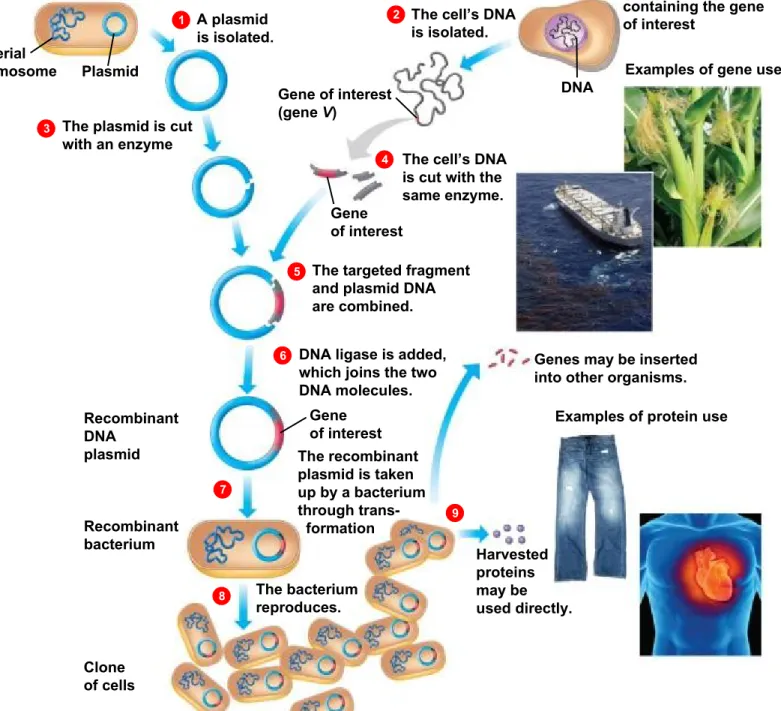
The following are the steps in cloning a gene:
1. Plasmid DNA is isolated.
2. DNA containing the gene of interest is isolated.
3. Plasmid DNA is treated with a restriction enzyme
that cuts in one place, opening the circle.
4. DNA with the target gene is treated with the same
enzyme, and many fragments are produced.
5. Plasmid and target DNA are mixed and associate
12.1 Genes can be cloned in recombinant
plasmids
6. Recombinant DNA molecules are produced when
the enzyme DNA ligase joins plasmid and target
segments together.
7. The recombinant plasmid containing the target
gene is taken up by a bacterial cell.
8. The bacterial cell reproduces to form a clone, a
group of genetically identical cells descended from a single ancestral cell.
•
Gene cloning can be used to produce a variety of
Figure 12.1b-0 Plasmid 1 2 3 4 5 6 7 9 8 Bacterial chromosome
E. coli bacterium
A plasmid is isolated.
The plasmid is cut with an enzyme
The cell’s DNA is isolated.
DNA
A cell with DNA containing the gene of interest
Examples of gene use Gene of interest
(gene V)
The cell’s DNA is cut with the same enzyme. Gene
of interest
The targeted fragment and plasmid DNA are combined.
DNA ligase is added, which joins the two DNA molecules.
Gene of interest
Genes may be inserted into other organisms.
Examples of protein use
Harvested proteins may be used directly. The recombinant
Figure 12.1b-4
Figure 12.1b-5
Figure 12.1b-6
A protein is used to dissolve blood clots in heart
12.2 VISUALIZING THE CONCEPT: Enzymes
are used to “cut and paste” DNA
•
Restriction enzymes
• recognize a particular short DNA sequence, called
a restriction site, and
• cut both strands of the DNA at precise points in the
sequence, yielding pieces of DNA called
restriction fragments.
•
Once cut, fragments of DNA can be pasted
Figure 12.2-5 Restriction enzyme Restriction site DNA Sticky
end Gene of interest
Sticky end
DNA ligase
Recombinant DNA Every restriction enzyme recognizes one
specific nucleotide sequence (its restriction site).
A restriction enzyme always cuts DNA sequences at its restriction site in an identical manner.
A piece of DNA from another
source (the gene of interest) is cut by the same restriction enzyme.
The DNA fragments from the two sources stick together by hydrogen bonding of base pairs.
The enzyme DNA ligase creates new covalent bonds that join the backbones of the DNA strands. The result is a piece of recombinant DNA.
12.3 Cloned genes can be stored in genomic
libraries
•
A
genomic library
is a collection of all of the
cloned DNA fragments from a target genome.
•
Genomic libraries can be constructed with different
types of vectors.
• In a plasmid library, genomic DNA is carried by
plasmids.
• In a bacteriophage (phage) library, genomic DNA is
12.4 Reverse transcriptase can help make
genes for cloning
• A researcher can focus on the genes expressed in a
particular kind of cell by using its mRNA as the starting material for cloning.
• In this process,
• mRNA from a specific cell type is the template,
• reverse transcriptase produces a DNA strand from mRNA,
• DNA polymerase produces the second DNA strand, and
• the DNA that results from such a procedure, called
complementary DNA (cDNA), represents only the
12.4 Reverse transcriptase can help make
genes for cloning
•
Advantages of cloning with cDNA include the
ability to
• study genes responsible for specialized functions of
a particular cell type and
• obtain gene sequences that are smaller in size,
Figure 12.4-0
ExonIntron Exon IntronExon DNA of a
eukaryotic gene RNA transcript mRNA CELL NUCLEUS TEST TUBE Reverse transcriptase cDNA strand being synthesized Direction of synthesis
cDNA of gene (no introns) Transcription
RNA splicing (removes introns and joins exons)
Isolation of mRNA from the cell
Addition of reverse transcriptase; synthesis
of new DNA strand
Breakdown of RNA
12.5 Nucleic acid probes identify clones
carrying specific genes
•
Nucleic acid probes
bind very selectively to
cloned DNA.
• Probes can be DNA or RNA sequences
complementary to a portion of the gene of interest.
• A probe binds to a gene of interest by base pairing.
• Probes are labeled with a radioactive isotope or
12.5 Nucleic acid probes identify clones
carrying specific genes
•
One way to screen a gene library is as follows:
1. Bacterial colonies (clones) are transferred to filter
paper.
2. A chemical treatment is used to break open the
cells and separate the DNA strands.
3. A probe solution is added, and any bacterial
colonies carrying the gene of interest will be tagged on the filter paper.
4. The clone carrying the gene of interest is grown
Figure 12.5
Radioactive nucleic acid probe (single-stranded DNA)
Single-stranded DNA
The probe is mixed with single-stranded DNA from a genomic library.
12.6 Recombinant cells and organisms can
mass-produce gene products
• Recombinant cells and organisms constructed by DNA
technologies are used to manufacture many useful products, chiefly proteins.
• Bacteria are often the best organisms for
manufacturing a protein product because bacteria
• have plasmids and phages available for use as
gene-cloning vectors,
• can be grown rapidly and cheaply,
• can be engineered to produce large amounts of a
particular protein, and
12.6 Recombinant cells and organisms can
mass-produce gene products
•
Yeast cells
• are eukaryotes,
• are easy to grow,
• have long been used to make bread and beer,
• can take up foreign DNA and integrate it into their
genomes, and
• are often better than bacteria at synthesizing and
12.6 Recombinant cells and organisms can
mass-produce gene products
•
Mammalian cells must be used to produce
glycoproteins, proteins with chains of sugars
attached. Examples include
• human erythropoietin (EPO), which stimulates the
production of red blood cells,
• factor VIII to treat hemophilia, and
• tissue plasminogen activator (TPA), used to treat
12.7 CONNECTION: DNA technology has
changed the pharmaceutical industry and
medicine
•
DNA technology, including gene cloning, is widely
used to produce medicines and to diagnose
diseases.
•
Therapeutic hormones produced by DNA
technology include
• insulin to treat diabetes,
• human growth hormone to treat dwarfism, and
• tissue plasminogen activator (TPA), a protein that
12.7 CONNECTION: DNA technology has
changed the pharmaceutical industry and
medicine
•
DNA technology is used to
• test for inherited diseases,
• detect infectious agents such as HIV, and
• produce vaccines, harmless variants (mutants) or
derivatives of a pathogen that stimulate the immune system to mount a lasting defense against that
12.8 CONNECTION: Genetically modified
organisms are transforming agriculture
•
Since ancient times, people have selectively bred
agricultural crops to make them more useful.
•
DNA technology is quickly replacing traditional
breeding programs to improve the productivity of
agriculturally important plants and animals.
•
Genetically modified
organisms
(
GMOs
) contain
one or more genes introduced by artificial means.
12.8 CONNECTION: Genetically modified
organisms are transforming agriculture
•
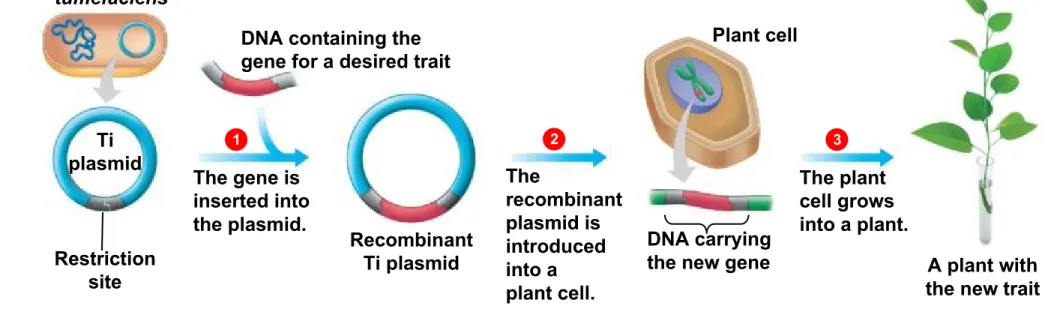
The most common vector used to introduce new
genes into plant cells is a plasmid from the soil
bacterium
Agrobacterium tumefaciens
called the
Ti
Figure 12.8a-3 Plant cell 2 1 3 Agrobacterium tumefaciens
DNA containing the gene for a desired trait
Ti plasmid
Restriction site
The gene is inserted into the plasmid. Recombinant Ti plasmid The recombinant plasmid is introduced into a plant cell. DNA carrying the new gene
The plant cell grows into a plant.
12.8 CONNECTION: Genetically modified
organisms are transforming agriculture
•
GMO crops may be able to help a great many
hungry people by improving
• food production,
• shelf life,
• pest resistance, and
• the nutritional value of crops.
•
Golden Rice, a transgenic variety created in 2000
12.8 CONNECTION: Genetically modified
organisms are transforming agriculture
•
Genetic engineers are now creating plants that
make human proteins for medical use.
•
Pharmaceutical trials currently under way involve
using modified
• rice to treat infant diarrhea,
• corn to treat cystic fibrosis,
• safflower to treat diabetes, and
12.8 CONNECTION: Genetically modified
organisms are transforming agriculture
•
Agricultural researchers are producing transgenic
animals by injecting cloned genes directly into the
nuclei of fertilized eggs.
• Genetically modified pigs convert less healthy fatty
acids to omega-3 fatty acids, producing meat with four to five times as much healthy omega-3 fat as regular pork.
• Atlantic salmon have been genetically modified to
12.9 SCIENTIFIC THINKING: Genetically
modified organisms raise health concerns
• Scientists use safety measures to guard against
production and release of new pathogens.
• To guard against rogue microbes, scientists developed
a set of guidelines, includin
g
• strict laboratory safety and containment procedures,
• the genetic crippling of transgenic organisms to ensure
that they cannot survive outside the laboratory, and
• a prohibition on certain obviously dangerous
12.9 SCIENTIFIC THINKING: Genetically
modified organisms raise health concerns
•
Genetically modified organisms are used in crop
production because they are
• more nutritious or
• cheaper to produce.
•
But do these advantages come at a cost to the
12.9 SCIENTIFIC THINKING: Genetically
modified organisms raise health concerns
•
To date, no study has documented health risks in
humans from GMO foods and there is general
agreement among scientists that the GMO foods
on the market are safe.
•
On the other hand, because they are new, it is not
12.9 SCIENTIFIC THINKING: Genetically
modified organisms raise health concerns
•
In the case of GMO crops, zero risk is probably
unattainable.
•
Scientists and the public need to weigh the
possible benefits versus risks on a case-by-case
basis.
•
The best scenario would be to proceed with
12.10 CONNECTION: Gene therapy may
someday help treat a variety of diseases
• Gene therapy is the alteration of a diseased
individual’s genes for therapeutic purposes.
• One possible procedure is the following:
1. A gene from a healthy person is cloned, converted to
an RNA version, and then inserted into the RNA genome of a harmless virus.
2. Bone marrow cells are taken from the patient and
infected with the recombinant virus.
Figure 12.10-0 Healthy person 1 2 3 4 Cloned gene
(normal allele) An RNA version of a healthy human gene is inserted into a retrovirus. RNA genome of virus Retrovirus
Bone marrow cells are infected with the virus.
Viral DNA carrying the human gene inserts into the cell’s chromosome. Bone marrow
cell from the patient
Bone marrow The engineered
12.11 The analysis of genetic markers can
produce a DNA profile
• DNA profiling is the analysis of DNA samples to
determine whether they came from the same individual.
• In a typical investigation involving a DNA profile:
1. DNA samples are isolated from the crime scene,
suspects, victims, or other evidence,
2. selected markers from each DNA sample are
Figure 12.11
Crime scene
2
3 1
Suspect 1 Suspect 2 DNA is
isolated.
The DNA of selected markers is amplified.
The amplified DNA is
12.12 The PCR method is used to amplify
DNA sequences
•
Polymerase chain reaction
(
PCR
) is a technique
by which a specific segment of a DNA molecule
can be targeted and quickly amplified in the
12.12 The PCR method is used to amplify
DNA sequences
•
PCR relies upon a pair of short
primers
, which are
chemically synthesized, single-stranded DNA
molecules with sequences that are complementary
to sequences at each end of the target sequence.
• One primer is complementary to one strand at one
end of the target sequence.
• The second primer is complementary to the other
strand at the other end of the sequence.
• The primers thus bind to sequences that flank the
12.12 The PCR method is used to amplify
DNA sequences
• The basic steps of PCR are as follows:
1. The reaction mixture is heated to separate the strands
of the DNA double helices.
2. The strands are cooled. As they cool, primer
molecules hydrogen-bond to their target sequences on the DNA.
3. A heat-stable DNA polymerase builds new DNA
strands by extending the primers in the 5→3 direction.
Figure 12.12-0
3′ 5′ 3′ 5′ 3′ 5′
3′
5′ 5′
3′ 5′
3′ 5′
5′
3′
5′
3′
5′ 5′ 3′ 5′ 3′
Cycle 1 yields two molecules
Cycle 2 yields four molecules
Cycle 3
yields eight molecules
Additional Cycles… Sample DNA Target sequence
Primer New DNA Heat separates DNA strands. Primers bond with ends of target sequences. DNA polymerase adds nucleotides.
12.12 The PCR method is used to amplify
DNA sequences
•
The advantages of PCR include
• the ability to amplify DNA from a small sample,
• rapid results, and
• a reaction that is highly sensitive, copying only the
12.12 The PCR method is used to amplify
DNA sequences
•
Devised in 1985, PCR has had a major impact on
biological research and biotechnology. PCR has
been used to amplify DNA from
• fragments of ancient DNA from a mummified
human,
• a 40,000-year-old frozen woolly mammoth,
• a 30-million-year-old plant fossil, and
• DNA from fingerprints or from tiny amounts of
12.13 Gel electrophoresis sorts DNA
molecules by size
•
Many DNA technology applications rely on
gel
electrophoresis
, a method that separates
macromolecules, usually proteins or nucleic acids,
on the basis of size, electrical charge, or other
12.13 Gel electrophoresis sorts DNA
molecules by size
• Gel electrophoresis can be used to separate DNA
molecules based on size as follows:
1. A DNA sample is placed at one end of a porous gel.
2. Current is applied, and DNA molecules move from the
negative electrode toward the positive electrode.
3. Shorter DNA fragments move through the gel matrix
more quickly and travel farther through the gel.
4. DNA fragments appear as bands, visualized through
staining or detecting radioactivity or fluorescence.
5. Each band is a collection of DNA molecules of the
Figure 12.13-0
Gel Power
source
A mixture of DNA fragments of different sizes
Completed gel
Longer (slower) molecules
12.14 Short tandem repeat analysis is
commonly used for DNA profiling
•
Repetitive DNA
consists of nucleotide sequences
that are present in multiple copies in the genome.
•
Short tandem repeats
(
STRs
) are short
nucleotide sequences that are repeated in tandem,
composed of different numbers of repeating units
in individuals, that are used in DNA profiling.
•
STR analysis
• compares the lengths of STR sequences at specific
sites in the genome and
Figure 12.14a
STR site 1 STR site 2
Crime scene DNA
AGAT GATA
The number of short tandem repeats match
The number of short tandem repeats do not match
GATA AGAT
Figure 12.14b
Amplified crime
scene DNA
Amplified suspect’s DNA
Longer STR fragments
12.15 CONNECTION: DNA profiling has
provided evidence in many forensic
investigations
•
DNA profiling is used to
• determine guilt or innocence in a crime,
• settle questions of paternity, and
12.16 RFLPs can be used to detect
differences in DNA sequences
•
Geneticists have cataloged many single-base-pair
variations in the genome.
•
Such a variation found in at least 1% of the
population is called a
single nucleotide
polymorphism
(
SNP
, pronounced “snip”).
•
SNPs occur on average about once in 100 to 300
base pairs in the human genome,
• in the coding sequences of genes and
12.16 RFLPs can be used to detect
differences in DNA sequences
•
SNPs may alter a restriction site—the sequence
recognized by a restriction enzyme.
• Such alterations change the lengths of the
restriction fragments formed by that enzyme when it cuts the DNA.
• A sequence variation of this type is called a
restriction fragment length polymorphism
(RFLP, pronounced “rif-lip”).
12.17 Genomics is the scientific study of
whole genomes
•
Genomics
is the study of an organism’s complete
set of genes and their interactions.
• Initial studies focused on prokaryotic genomes.
• Many eukaryotic genomes have since been
investigated.
• As of 2013, the genomes of nearly 7,000 species
12.17 Genomics is the scientific study of
whole genomes
•
Genomics allows another way to examine
evolutionary relationships.
• Genomic studies showed a 96% similarity in DNA
sequences between chimpanzees and humans.
• Functions of human disease-causing genes have
12.18 CONNECTION: The Human Genome
Project revealed that most of the human
genome does not consist of genes
•
The goals of the
Human Genome Project
(
HGP
)
included
• determining the nucleotide sequence of all DNA in
the human genome and
• identifying the location and sequence of every
12.18 CONNECTION: The Human Genome
Project revealed that most of the human
genome does not consist of genes
•
Results of the Human Genome Project indicate
that
• humans have about 21,000 genes in 3 billion
nucleotide pairs,
• only 1.5% of the DNA codes for proteins, tRNAs, or
rRNAs, and
Figure 12.18
Exons (regions of genes coding for protein or giving rise to rRNA or tRNA) (1.5%)
12.18 CONNECTION: The Human Genome
Project revealed that most of the human
genome does not consist of genes
•
Much of the DNA between genes consists of
repetitive DNA, nucleotide sequences present in
many copies in the genome.
•
Stretches of DNA with thousands of short
repetitions are also prominent at
• the centromeres and
12.18 CONNECTION: The Human Genome
Project revealed that most of the human
genome does not consist of genes
•
In a second main type of repetitive DNA, each
repeated unit is hundreds of nucleotides long, and
the copies are scattered around the genome.
•
Most of these sequences seem to be associated
with
transposable elements
(“jumping genes”),
12.19 The whole-genome shotgun method of
sequencing a genome can provide a wealth
of data quickly
•
The Human Genome Project proceeded through
three stages that provided progressively more
detailed views of the human genome.
1. A low-resolution linkage map was developed
using mostly RFLP analysis of 5,000 genetic markers.
2. A physical map was constructed from nucleotide distances between the linkage map markers.
3. DNA sequences for the mapped fragments were
12.19 The whole-genome shotgun method of
sequencing a genome can provide a wealth
of data quickly
•
The
whole-genome shotgun method
was
proposed in 1992 by molecular biologist J. Craig
Venter.
•
He used restriction enzymes to produce fragments
12.19 The whole-genome shotgun method of
sequencing a genome can provide a wealth
of data quickly
•
Today, this whole-genome shotgun approach is
the method of choice for genomic researchers
because it is
• relatively fast and
• inexpensive.
•
However, limitations of the whole-genome shotgun
method suggest that a hybrid approach using
Figure 12.19
Chromosome
Chop up each chromosome with restriction enzymes
DNA fragments
Sequence the fragments
Align the fragments
A A T C G A C G A T T A
12.20 Proteomics is the scientific study of the
full set of proteins encoded by a genome
•
Proteomics
• is the study of the full protein sets encoded by
genomes and
• investigates protein functions and interactions.
•
The human proteome includes about 100,000
proteins.
•
Genomics and proteomics are helping biologists
12.21 EVOLUTION CONNECTION: Genomes
hold clues to human evolution
•
Human and chimp genomes differ by
• 1.2% in single-base substitutions and
• 2.7% in insertions and deletions of larger DNA
sequences.
•
Genes showing rapid evolution in humans include
• genes for defense against malaria and tuberculosis,
• a gene regulating brain size, and
12.21 EVOLUTION CONNECTION: Genomes
hold clues to human evolution
•
Neanderthals
• first appeared at least 300,000 years ago,
• were humans’ closest relatives,
• were a separate species,
• also had the FOXP2 gene,
• may have had pale skin and red hair, and
Figure 12.UN03
DNA amplified
via plasmidsBacterial
DNA sample
treated with
DNA fragments sorted by size via