Look For The Following Key
Ideas In Chapter 8
✓ The interaction of ocean and atmosphere moderates surface temperatures, shapes Earth's weather and climate, and creates most of the sea's waves and currents.
✓ Different amounts of solar energy are absorbed at different latitudes. The tropics are warmer than the polar regions because of this difference.
✓ Uneven solar heating causes convection currents to form in the atmosphere. The direction of air flow in these currents is influenced by the rotation of Earth.
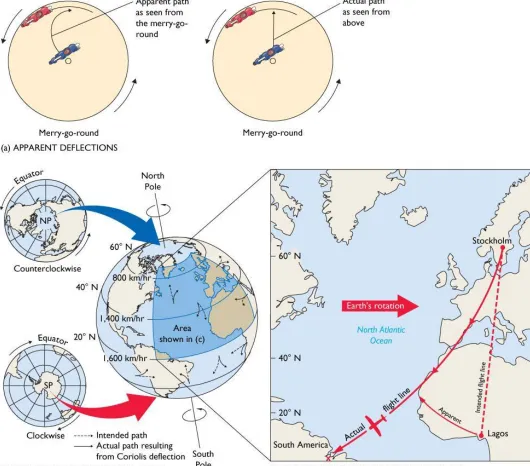
✓ To observers on the surface, Earth's rotation causes moving air (or any moving mass) in the Northern Hemisphere to curve to the right of its initial path, and in the Southern Hemisphere to the left. The apparent curvature of path is known as the Coriolis effect.
Key Ideas Continued…
✓ The atmosphere responds to uneven solar heating by flowing in three great circulating cells over each hemisphere. The flow of air within these cells is influenced by Earth’s rotation (Coriolis effect).
✓ Large storms are spinning areas of unstable air that develop between or within air masses. Extratropical cyclones originate at the boundary between air
masses.
Earth’s Atmosphere
• Consists of the nearly homogenous mix of gases that surround the Earth and extend to approximately 90 km above the Earth
• Components:
Nitrogen 78.084% Oxygen 20.946%
Carbon Dioxide 0.033%
Layers of the Atmosphere
Atmospheric Circulation
Is powered by sunlight
Earth intercepts 1/2,200,000,000 of Sun’s radiant energy
Earth is in NEAR thermal equilibrium: Incoming heat = outgoing heat (we have disturbed balance - and shifted it to
absorbing more than is being re-radiated...temp. is shifting to a new equilibrium)
Heating at different latitudes is uneven rotation and striking angle
Reasons for Uneven Heating
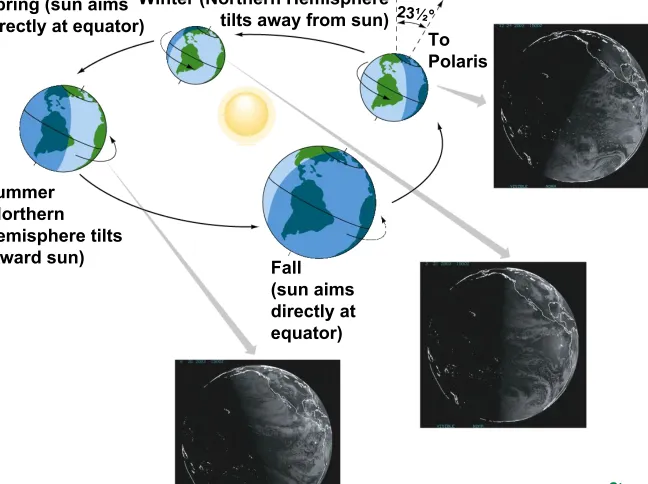
The heat absorbed at latitudes is also influenced by the season…since the Earth is tilted 23.5 degrees on axis, facing of
hemispheres
Fig. 8-6, p. 207
Winter (Northern Hemisphere tilts away from sun) Spring (sun aims
directly at equator)
Earth’s Uneven Solar Heating Results in
Large-Scale Atmospheric Circulation
A convection current forms in a room when air flows from a hot radiator to a cold window and back.
Crude Circulation Model From Heating
• Density of air is controlled by:
– Temperature (decreases with increased temp)
– Pressure (increases with pressure)
– Moisture content (decreases with moisture)
• Warm air is less dense than cold air and moist air is
less dense than dry air.
• Air pressure is the
weight
of the air from Earth’s
surface to the top of the atmosphere.
– It equals 1.04kg/cm2 (standard air pressure, one
• Low pressure zone is where
air density is
lower
than in surrounding areas because the
air:
– is warmer
or
– has a higher moisture content
– associated with
rising air
• High pressure zone is where
air pressure is
higher
than in surrounding area because the
air:
– is cooler
or
– has lower moisture content
•
Fluids (air and water) flow from areas
of high pressure to areas of low
pressure.
• Change in pressure across a horizontal
distance is a pressure gradient.
• Greater the difference in pressure and the
shorter the distance between them → the
Rotation of the Earth strongly
influences winds.
Coriolis deflection
is the apparent deviation of
objects moving across Earth’s surface.
– Objects are deflected to the
right
of direction of
travel in the
northern hemisphere
,
Three major convection cells are present
in each hemisphere
• The
Hadley cell
extends from the Equator to about 30
olatitude.
• The
Ferrel Cell
extends from 30
oto about 50
olatitude.
• The
Polar Cell
extends from 90
oto about 50
olatitude.
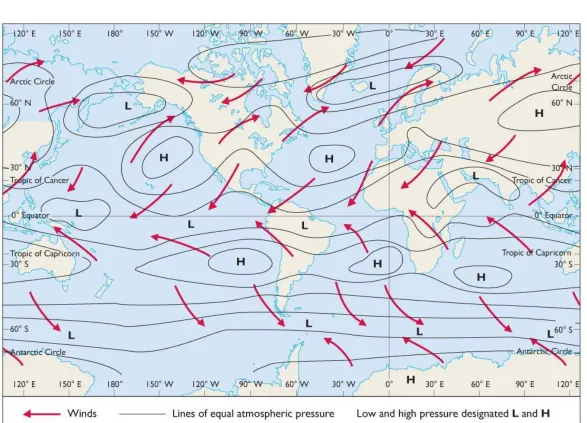
Global Wind Circulation
Wind Circulation
Monsoons Are Wind
Patterns That Change with
the Seasons
Monsoons are patterns of wind circulation that change with the
season. Areas with monsoons generally have dry winters and wet summers.
Sea breeze is cool air from over the water moving toward land.
Sea breezes occur after sunrise.
Land breezes occur after sunset when air warmed by the land
Monsoons Are Wind Patterns That
Change with the Seasons
A monsoon is a pattern of wind circulation that changes with the
season. (The word monsoon is derived from mausim, the Arabic word for
season). Locations where monsoons occur typically have wet summers and dry winters.
(left) Monsoon patterns.
During the monsoon circulations of January (a) and July (b), surface
Storms Are Variations in
Large-Scale Atmospheric
Circulation
Storms are regional atmospheric disturbances. Storms have high
winds and most have precipitation.
Tropical cyclones occur in tropical regions. These storms can
cause millions of dollars worth of damage and endanger life.
Extratropical cyclones occur in Ferrel cells, and are winter
weather disturbances. These storms can also cause extensive damage.
Storms
Are regional atmospheric disturbances characterized by strong winds and often accompanied by
precipitation
Cyclones - rotating masses of low-pressure air in which winds converge and ascend.
Extratropical Cyclone - form at the boundary between Polar Cell and Ferrel Cells (called the Polar Front)
Extratropical Cyclone Development
Formation process…
Winds in the Polar (from east) and Ferrel Cells (from west) moving in different directions. Flow is
disrupted by zones of alternating high/low pressure - this bends the flow into waves - since different flows have
different densities, the cold Polar Cell air slides under the warm air.
As the warm air is lifted - it cools, and precipitation develops…
Cold Front: Cold air doing the lifting
Warm Front: Warm air blowing on top of
Extratropical Storm
Hurricane Allen
(1980)
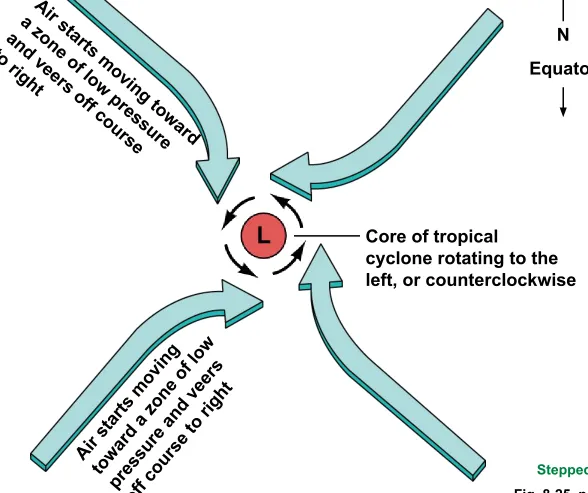
Tropical Cyclones Form in One Air
Mass
Air starts moving toward a zone of low pressure and veers off course to right
Core of tropical
cyclone rotating to the left, or counterclockwise
Air starts moving
toward a zone of low pressure and veers
off course to right
N
Equator
Fig. 8-25, p. 221
Hurricane Formation
Origin not well understood…but, source of power is!
Storm development occurs as
moisture is pulled up by air. When a tropical depression (low) occurs over water at about 26 degrees, higher circular winds begin to blow, some warm humid air is forced upward. This moisture condenses - releasing energy - which increases the
• Movement of air across a pressure gradient
parallel to Earth’s surface is called a
wind
.
• Winds are designated according to the
direction from which they come.
• In contrast, ocean currents are designated
according to the direction towards which they
travel.
• Global winds blow in response to variation in
pressure related to uneven solar heating
(insolation) of Earth’s surface.
Wind-driven currents are produced by the
interaction between the wind and the water
• As wind moves across the water, air
molecules collide with water molecules.
• When they collide, energy is transferred from
the air to the water.
• This energy transfer is inefficient:
•
Zonal wind flow
is wind moving nearly
parallel to latitude.
– This is a result of Coriolis deflection.
• A
gyre
is a circular current caused by:
– Westerly-driven ocean currents in the trade
winds
– easterly-driven ocean currents in the
Westerlies