Mandy Tu, Callie Hurd & John M. Randall
The Nature Conservancy
Wildland Invasive Species Team
version April 2001
Weed Control Methods Handbook:
Tools & Techniques for
Use in Natural Areas
Mandy Tu, Callie Hurd & John M. Randall
The Nature Conservancy
Wildland Invasive Species Team
version April 2001
Weed Control Methods Handbook:
Tools & Techniques for
Weed Control Methods Handbook:
Tools and Techniques for Use in Natural Areas
Mandy Tu, Callie Hurd, and John M. RandallTable of Contents File Name
Title Page & Table of Contents 01.TitleContents.doc
Introduction 02.Introduction.doc
Chapter 1 – Manual & Mechanical Techniques 03.ManualMechanical.doc
Chapter 2 – Grazing 04.Grazing.doc
Chapter 3 – Prescribed Fire 05.PrescribedFire.doc
Chapter 4 – Biological Control 06.BiologicalControl.doc Chapter 5 – Guidelines for Herbicide Use 07.HerbicideGuidelines.doc Chapter 6 – Herbicide Properties 08.HerbicideProperties.doc Chapter 7 – The Herbicides:
Herbicide Table 09.HerbicideTable.xls
a) 2,4-D 10.24-D.doc
b) Clopyralid 11.Clopyralid.doc
c) Fluazifop-p-butyl 12.Fluazifop.doc
d) Fosamine Ammonium 13.Fosamine.doc
e) Glyphosate 14.Glyphosate.doc
f) Hexazinone 15.Hexazinone.doc
g) Imazapic 16.Imazapic.doc
h) Imazapyr 17.Imazapyr.doc
i) Picloram 18.Picloram.doc
j) Sethoxydim 19.Sethoxydim.doc
k) Triclopyr 20.Triclopyr.doc
Chapter 8 – Adjuvants 21.Adjuvants.doc
Appendix 1 – PVC Applicator 22.PVCapplicator.doc
Appendix 2 – Spot-burning 23.Spotburn.doc
Appendix 3 – How to read a pesticide label 24.PesticideLabel.doc Appendix 4 – How pesticides are regulated in the U.S. 25.PestRegulation.doc Appendix 5 – List of Personal Contacts 26.Contacts.doc Appendix 6 – List of State Regulatory Agencies 27.StateAgencies.doc
Note: This manual is periodically revised, expanded, and improved. If you have any comments or questions please contact TNC’s Wildland Invasive Species Team:
Barry Rice [email protected] or 530-754-8891 Mandy Tu [email protected] or 503-230-1221
Introduction Intro.1
Invasive non-native plants are a serious threat to native species, communities, and ecosystems in many areas around the world. They can compete with and displace native plants, animals, and other organisms that depend on them, alter ecosystem functions and cycles significantly, hybridize with native species, and promote other invaders. The good news is that many plant invasions can be reversed, halted or slowed, and in certain
situations, even badly infested areas can be restored to healthy systems dominated by native species. In most instances this requires taking action to control and manage those invasive plants. This handbook provides you with detailed information about the tools and techniques available for controlling invasive plants, or weeds, in natural areas. Whenever possible, language familiar to natural area managers is used, and unfamiliar terms and jargon borrowed from other fields are defined.
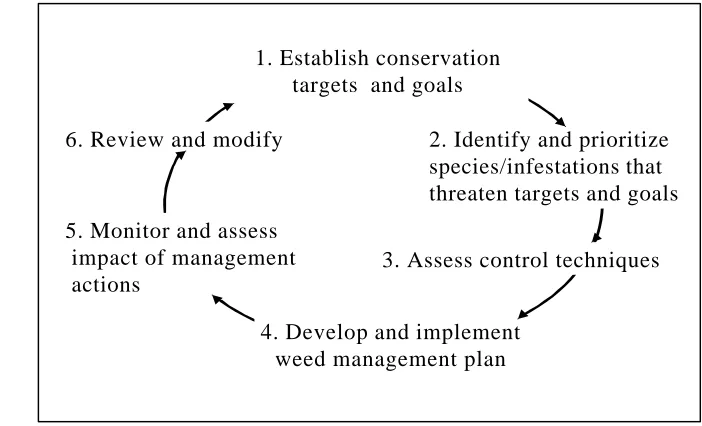
Before embarking on a weed management program, it is important to develop a straightforward rationale for the actions you plan to take. We believe this is best accomplished using an adaptive management approach as follows (see Figure 1): (1) establish management goals and objectives for the site; (2) determine which plant species or populations, if any, block or have potential to block attainment of the
management goals and objectives; (3) determine which methods are available to control the weed(s); (4) develop and implement a management plan designed to move conditions toward management goals and objectives; (5)monitor and assess the impacts of
management actions in terms of their effectiveness in moving conditions toward these goals and objectives; and (6) reevaluate, modify, and start the cycle again. Note that control activities are not begun until the first three steps have been taken. A weed control program is best viewed as part of an overall restoration program, so focus on what you want in place of the weed, rather than simply eliminating the weed. When selecting control methods, keep in mind that the ultimate purpose of the work is to preserve native species, communities, and/or functioning ecosystems.
INTRODUCTION
Figure 1. Adaptive Weed Management Approach
1. Establish conservation targets and goals
2. Identify and prioritize species/infestations that threaten targets and goals
3. Assess control techniques
4. Develop and implement weed management plan 5. Monitor and assess
impact of management actions
Introduction Intro.2
Weed Control Methods Handbook, The Nature Conservancy, Tu et al.
This Handbook is divided into eight chapters, covering a range of different control methods. More often than not, however, successful weed control requires the
combination or sequential use of several methods (called integrated weed management). For example, cutting followed by herbicide applications has been used successfully in many programs, and prescribed fires followed by spot-applications of herbicides have been used well in others. Consider all available control options: manual, mechanical, promoting competition from native plants, grazing, biocontrol, herbicides, prescribed fire, solarization, flooding, and other, more novel, techniques. Each has advantages and disadvantages in terms of its effects against the target weed(s), impacts to untargeted plants and animals, risks to human health and safety, and costs. The chapters that follow discuss the advantages and disadvantages for each method and provide examples of their successful (and in some cases unsuccessful) use in natural areas.
Chapter 1 describes a variety of manual and mechanical techniques. Chapter 2 covers the use of grazing for weed control in natural areas including the types of animals that can be used and how to time grazing for best effect. Chapter 3 briefly discusses the use of prescribed fire to control invasive plants. TNC has specific guidelines and regulations for using prescribed fire that must be adhered to. See TNC’s Fire Management Manual and contact TNC’s Fire Initiative (http://www.tncfire.org) for details on the steps required to develop and implement a Site Fire Management Plan.
Chapter 4 covers biological control of invasive plants. Biocontrol agents typically have the capacity to persist, to spread to areas far from release sites, and may undergo genetic or behavioral changes that allow them to feed on new hosts. In spite of these risks, the use of biocontrol has the potential to be one of the most powerful tools available for invasive species control. TNC’s policy is to not allow intentional releases of biocontrol agents on land it owns and manages, unless permission to do so has been granted by the Executive Director of TNC’s Invasive Species Initiative. TNC’s biocontrol release policy and standard operating procedures for requesting permission for releases are contained in this chapter.
Introduction Intro.3
Information on the biology and control of specific invasive plants are available from http://tncweeds.ucdavis.edu and other sites on the web. TNC staff that would like additional assistance are encouraged to contact TNC’s Wildland Invasive Species Team. John Randall (530-754-8890 or [email protected]), Barry Rice (530-754-8891 or [email protected]) or Mandy Tu (503-230-1221 or [email protected]) are available to answer questions and provide advice, information and referrals regarding specific weed problems.
ACKNOWLEDGEMENTS
The authors would like to thank Ramona Robison, Dr. Joe DiTomaso and Dr. Tom Lanini for valuable contributions and substantial comments on this book. Dr. Barry Rice was instrumental in making this handbook web-accessible.
Date Authored: April 2001
Manual & Mechanical Techniques 1.1
Weed Control Methods Handbook, The Nature Conservancy, Tu et al.
Manual and mechanical techniques such as pulling, cutting, and otherwise damaging plants, may be used to control some invasive plants, particularly if the population is relatively small. These techniques can be extremely specific, minimizing damage to desirable plants and animals, but they are generally labor and time intensive. Treatments must typically be administered several times to prevent the weed from re-establishing, and in the process, laborers and machines may severely trample vegetation and disturb soil, providing prime conditions for re-invasion by the same or other invasive species.
Manual and mechanical techniques are generally favored against small infestations and/or where a large pool of volunteer labor is available. They are often used in combination with other techniques, for example, when shrubs are pulled and cut, and re-sprouts and seedlings are treated with herbicides or fire several weeks or months later.
When using manual and mechanical methods, it is especially important to thoroughly clean and inspect all equipment and clothing before moving it off-site. This will lessen the probability of spreading the weed(s) to the next worksite.
In addition to the tools described here, the Wildland Invasive Species Team web page reviews other innovative tools. See http://tncweeds.ucdavis.edu/tools.html.
A. WEED PULLING
Pulling or uprooting plants can be effective against some shrubs, tree saplings, and herbaceous and floating weeds. Annuals and tap-rooted plants are particularly
susceptible to control by hand-pulling. Weed wrenches and other tools are surprisingly powerful and can enable you to control large saplings and shrubs that are too big to be pulled by hand. It is not as effective against many perennial weeds with deep
underground stems and roots that are often left behind to re-sprout.
How To: Minimize soil disturbance by pulling out weeds slowly and carefully, and replace soil to disturbed areas where possible. Trampled and disturbed areas can provide optimal germination sites for many weeds. Minimize trampling by limiting the number of people in the site and the amount of time spent there. Whenever a manual technique is used, it is wise to wear gloves, a long-sleeved shirt, and long pants. Some plants can cause moderate to severe skin irritation, especially when their stems and leaves are crushed and broken. Even the flimsiest weeds can leave hands raw and bleeding after several hours of pulling.
The advantages of pulling include its small ecological impact, minimal damage to neighboring plants, and low (or no) cost for equipment or supplies. Pulling is extremely labor intensive, however, and is effective only for relatively small areas, even when abundant volunteer labor is available.
Manual & Mechanical Techniques 1.2
1. Hand Pulling
Hand pulling is easy to plan and implement, and is often the best way to control small infestations, such as when a weed is first detected in an area. Hand pulling may be a good alternative in sites where herbicides or other methods cannot be used. The key to effective hand pulling is to remove as much of the root as possible while minimizing soil disturbance. For many species, any root fragments left behind have the potential to re-sprout, and pulling is not effective on plants with deep and/or easily broken roots.
Hand pulling has been effective against a variety of invaders in natural areas scattered across the U.S. For example, hand pulling by volunteers has successfully controlled
Centaurea diffusa (diffuse knapweed) in the Tom McCall Preserve in northeast Oregon. Yellow bush lupine (Lupinus arboreus) was also controlled in coastal dunes in California by pulling small shrubs by hand. Larger shrubs were cut down with an ax, and
re-sprouting was uncommon (Pickart and Sawyer 1998). Hand pulling has also been fairly successful in the control of small infestations of Centaurea spp. (thistles), Melilotus officinalis (white and yellow clover), and Lythrum salicaria (purple loosestrife) at TNC preserves scattered across the country.
2. Pulling Using Tools
Most weed-pulling tools are designed to grip the weed stem and provide the leverage necessary to pull its roots out. Tools vary in their size, weight, and the size of the weed they can extract. The Root Talon is inexpensive and lightweight, but may not be as durable or effective as the all-steel Weed Wrench, which is available in a variety of sizes. Both tools can be cumbersome and difficult to carry to remote sites. Both work best on firm ground as opposed to soft, sandy, or muddy substrates.
Root Talon
The Root Talon is an inexpensive and lightweight tool shaped something like a pick-ax with a plastic handle and metal head. It has a specialized claw and gripping device that allow the user to grab the plant stem and provide leverage to pull-up and remove the plants. It is best used for pulling shallow rooted plants such as sapling trees and herbs with sturdy stems. Plants that have been pulled using the Root Talon include young tree-of-heaven (Ailanthus), Scarlet wisteria (Sesbania punicea), and buckthorn (Rhamnus
spp.). The Root Talon is not effective against deep-rooted plants, because it does not provide enough leverage. In addition, it is difficult to use the Root Talon to pull spiny plants because the plant stems (and spines) must be put into the gripping flange by hand. Advantages of the Root Talon are that it is lighter and less expensive than the Weed Wrench (see below), and provides easier and more effective control than hand pulling.
At the time of printing, the Root Talon retailed for $47 plus $5.25 shipping through Lampe Design, LLC, 262 South Griggs Street, St. Paul, MN 55105, (612) 699-4963, [email protected] or on the web at www.buckthorn.com.
Weed Wrench
Manual & Mechanical Techniques 1.3
Weed Control Methods Handbook, The Nature Conservancy, Tu et al.
in four sizes, from the “mini”, which weighs 2.4 kg (5.25 lbs) and is capable of pulling weeds with stems up to 2.5 cm (1.0 in) in diameter, to the “heavy”, which weighs 10.5 kg (24 lbs) and can handle weeds up to a diameter of 6.25 cm (2.5 in). Larger Weed
Wrenches provide more leverage and pulling power. It is best to choose the smallest size needed, however, because larger Weed Wrenches are heavy and can be difficult to carry and use in remote sites.
Manufacturers of the Weed Wrench claim it is capable of handling any plant that can fit within the “jaws” of the wrench, as long as the plant stem is stronger than the anchoring strength of the roots. The Weed Wrench can be used on herbaceous plants that have a stem or bundle of stems strong enough to withstand the crush of the jaws. It has been used successfully to pull acacia (Acacia melanoxylon), buckthorn (Rhamnus cathartica), Russian olive (Elaeagnus angustifolia), multiflora rose (Rosa multiflora), willow (Salix
spp.), tamarisk (Tamarix spp.), bush honeysuckles (Lonicera spp.), Scotch broom (Cytisus scoparius), French broom (Genista monspessulanus), and Brazilian pepper (Schinus terebinthifolius) at preserves across the mainland U.S. In Hawaii, the Weed Wrench has been used to pull Strawberry guava (Psidium cattleianum) and small saplings of Karaka nut (Corynocarpus laevigatus) from the Kamakou preserve on Molokai
(Hawaii).
For more information, contact The Weed Wrench Company, at 2852 Willamette Street #403, Eugene, OR 97405, 1-877-484-4177, [email protected]. You can also view their website at http://www.weedwrench.com.
B. MOWING, BRUSH-CUTTING, WEED EATING
Mowing and cutting can reduce seed production and restrict weed growth, especially in annuals cut before they flower and set seed (Hanson 1996). Some species however, re-sprout vigorously when cut, replacing one or a few stems with many that can quickly flower and set seed. For example, yellow starthistle (Centaurea solstitialis) can be controlled by mowing at the onset of flowering (when approximately 2 to 5% of the seed heads are flowering), but if mowed earlier, native species are negatively impacted and yellow starthistle is able to re-sprout (Benefield et al. 1999). Be sure to consider the biology of the weed before cutting.
How To: Mowing and cutting are often used as primary treatments to remove
aboveground biomass, in combination with prescribed burning or herbicide treatments. It is important to collect the cut fragments of species capable of re-sprouting from stem or root segments to prevent them from washing or blowing into uninfested areas.
C.STABBING
Manual & Mechanical Techniques 1.4
of the stem and under the soil. Cutting off access to these storage structures can help “starve” or greatly weaken some species.
How To: To sever a taproot, place a flat-nosed spade, pruning saw, or knife at the base of the plant and push it as far below ground as possible. To prevent re-sprouting, the taproot should be severed below the caudex or root crown (where the stem becomes the root).
The stabbing technique has been used to control baby’s breath (Gypsophila paniculata) in Michigan (J. McGowan-Stinski, pers. comm.). The stabbing of root corms has also been an effective control technique for large (two yr old) plants of burdock (Arctium lappa) and wild parsnip (Pastinaca sativa) in Illinois and Wyoming (W. Kleiman, pers. comm.).
D. GIRDLING
Girdling is often used to control trees or shrubs that have a single trunk. It involves cutting away a strip of bark several centimeters wide all the way around the trunk. The removed strip must be cut deep enough into the trunk to remove the vascular cambium, or inner bark, the thin layer of living tissue that moves sugars and other carbohydrates between areas of production (leaves), storage (roots), and growing points. This inner cambium layer also produces all new wood and bark.
How To: To girdle a tree, cut parallel lines approximately three inches or more apart around the circumference of the tree. The cuts can be made using a knife, ax, or saw, and should be slightly deeper than the cambium. Strike the trunk sharply between the cuts using the back of an ax or other blunt object. The bark should come off in large pieces and prevent the tree from any further growth. It is important not to cut too deeply into the trunk because this could cause the tree to snap and fall in high winds. To determine the depth of the cambium, make two short test cuts and strike the bark between the cuts. After several strikes the bark should come off intact, exposing the cambium and wood (xylem) below.
Girdling is effective against pines, some oaks, and some maples. It typically requires less labor than cutting and removal, is inexpensive, and kills only the targeted plant. It also leaves no residue except the standing trunks. In addition, a dead standing tree (snag) can provide valuable wildlife habitat, and if left to decay, allows the nutrients of the tree to be returned to the system, rather than being removed and deposited elsewhere. A few
species, notably black locust (Robinia pseudoacacia) and tree of heaven (Ailanthus altissima) should not be girdled because they respond by producing many fast growing root and stem sprouts. Therefore, before girdling, find out if the target species responds by re-sprouting. If so, use another control technique, such as hack and squirt herbicide applications or if you do girdle return at 1 to 4 month intervals to cut, burn, or herbicide all re-sprouts for at least 2 years.
Manual & Mechanical Techniques 1.5
Weed Control Methods Handbook, The Nature Conservancy, Tu et al. quaking aspen (P. tremuloides) in New York and Wisconsin, respectively, were controlled successfully using girdling with herbicide. This method, however, was not successful, in controlling tropical ash (Fraxinus uhdei) on the Kamakou preserve on Molokai, Hawaii.
E. MULCHING
Mulching can be used on relatively small areas, but will often stunt or stop growth of desirable native species. Mulching cannot control some perennial weeds because their extensive food reserves allow them to continue to grow up through the mulch.
How To: Cover the ground and/or seedlings with mulch (hay, grass clippings, wood chips, etc.) or other type of ground cover (newspaper clippings). This prevents weed seeds and seedlings from receiving sunlight necessary to survive and grow.
Hay mulch was used in Idaho with some success to control the spread of Canada thistle (Cirsium arvense). This hay mulch was applied several feet deep to established plants, and even though these plants were not completely eliminated, flowering rates were much suppressed by the end of the growing season.
F. TILLING
Tilling, or the turning-over of soil, is often used for weed control in agricultural crops. Its use in wildland management is largely limited, however, to restoration sites where soils are already badly disturbed. Tilling is effective against annuals and shallow-rooted perennials, but small fragments of some species, particularly those perennials with rhizomes, can often resprout following tillage. Tilling should be completed before seeds develop and are shed onto the soil. The best control is achieved when the soil remains dry, so that remaining plant fragments dry out. Moist soils help the fragments survive and re-grow.
How To: “Primary” tillage equipment is initially used to turn over soil and cuts roots at depths of six inches to two feet to prepare the soil for planting. “Secondary” tillage equipment, or equipment designed to work only the top six inches of soil, is used mainly to control weeds.
Many types of secondary tillage equipment are available. Equipment ranges from small hand-pushed models, to tractor mounted power-driven tillers. The appropriate model depends on the size and type of the habitat.
G. SOIL SOLARIZATION
Manual & Mechanical Techniques 1.6
et al. 1987). Soil solarization however, can cause significant biological, physical, and chemical changes in the soil that can last up to two years, and deter the growth of desirable native species.
Soil solarization is used in horticulture and for a few high value agriculture crops like strawberries. This method has not been used extensively for weed control in natural settings. The effectiveness of soil solarization depends, in part, on how susceptible weed seeds are to temperature increases. It is most effective against winter annual weeds that germinate under cool conditions (Elmore 1990). Summer annuals and other species adapted to higher temperatures, which germinate during warmer parts of the year, are less susceptible.
Soil solarization is most effective during the summer months, and may be less effective in cooler climates (DeVay 1990). The higher the temperature, the more quickly a kill is achieved. Solarization is effective only if done in wet soil. Where soils are typically dry, they must first be irrigated until soil from the surface to 50 to 60 cm deep is at field capacity (Grinstein & Hetzroni 1991).
How To: Polyethylene plastic film is the most useful for soil solarization (DeVay 1990). Less expensive thin films (1-1.5 mil) are more effective than thick films (2, 4, and 6 mil). Clear and black films both trap infrared radiation that is re-radiated from the soil surface, therefore keeping the soil hot. Transparent film allows more radiation to reach the soil than black films, as it lets visible light in, causing even greater temperature increases. Because black films exclude visible light however, they stop photosynthesis, which can be enough to kill some young annuals and perennials given sufficient time (Elmore 1990). Double layers of film have been found to increase soil temperatures by three to ten degrees over single layers (DeVay 1990).
Soil solarization is beneficial in that it releases nutrients that are tied up in the organic component of the soil, and that it can kill unwanted plants without the use of chemicals (Stapleton 1990). However, solarization leaves an open substrate that can be readily invaded by new organisms, both native and non-native once the plastic is removed (Stapleton 1990). The influx of nutrients that results from solarization can be advantageous to restoration efforts, but can promote aggressive, ruderal plants that typically thrive in nutrient-rich soils.
H. FLOODING
In situations where the water level of a wetland or riverine system can be manipulated, flooding can be used to control some plant species. Some species, however, have vegetative buds or underground storage organs that can survive several months or more under flooded conditions.
Manual & Mechanical Techniques 1.7
Weed Control Methods Handbook, The Nature Conservancy, Tu et al.
canarygrass (Phalaris arundinacea) in Ohio. At Wertheim NWR on Long Island, NY,
Phragmites australis was controlled by burning and then flooding with several feet of water in impounded areas.
REFERENCES
Benefield, C.B., DiTomaso, J.M., Kyser, G.B., Orloff, S.B., Churches, K.R., Marcum, D.B., and G.A. Nader. 1999. Success of mowing to control yellow starthistle depends on timing and plants branching form. California Agriculture 53(2): 17-21. DeVay, J.E. 1990. Historical review and principles of soil solarization. In: DeVay, J.E.,
Stapleton, J.J., and C.L. Elmore (eds.), Soil Solarization. United Nations, Rome. Elmore, C.L. 1990. Use of solarization for weed control. In: DeVay, J.E., Stapleton,
J.J., and C.L. Elmore (eds.), Soil Solarization. United Nations, Rome.
Grinstein, A. and A. Hetzroni. 1991. The technology of soil solarization. In J. Katan and J.E. DeVay (eds.) Soil Solarization. CRC Publications, Boca Raton: 159-170.
Hanson, E. 1996. Tools and techniques. Chapter 3 in Invasive plants. J. M. Randall and M. Marinelli, eds. Handbook #149. Brooklyn Botanical Garden, Inc., Brooklyn, New York. 111 pgs.
Katan, J., Grinstein, A., Greenberger, A., Yarden, O. and J.E. DeVay. 1987. First decade (1976-1986) of soil solarization (solar heating)-A chronological bibliography.
Phytoparasitica 15:229-255.
Pickart, A.J. and J.O. Sawyer. 1998. Ecology and restoration of Northern California coastal dunes. California Native Plant Society. Sacramento, CA. 152 pgs. Stapleton, J.J. 1990. Thermal inactivation of crop pests and pathogens and other soil
changes caused by solarization. In: DeVay, J.E., Stapleton, J.J., and C.L. Elmore (eds.), Soil Solarization. United Nations, Rome.
Grazing 2.1
Grazing can either promote or reduce weed abundance at a particular site. By itself, grazing will rarely, if ever, completely eradicate invasive plants. However, when grazing treatments are combined with other control techniques, such as herbicides or biocontrol, severe infestations can be reduced and small infestations may be eliminated. Grazing animals may be particularly useful in areas where herbicides cannot be applied (e.g., near water) or are prohibitively expensive (e.g., large infestations). Animals can also be used as part of a restoration program by breaking up the soil and incorporating in seeds of desirable native plants.
When not properly controlled, however, grazing or other actions of grazing animals (wallowing, pawing up soil) can cause significant damage to a system, and promote the spread and survival of invasive weeds. Overgrazing can reduce native plant cover, disturb soils, weaken native communities, and allow exotic weeds to invade. In addition, animals that are moved from pasture to pasture can spread invasive plant seeds.
In general, the specific weed and desirable native plants will determine the number and species of animal grazers and the duration and frequency of grazing. A grazing plan should be developed in situations where prescribed grazing is desirable, and this plan must be tailored to fit the specifics of the site.
ANIMAL CHOICE
Cattle, goats, sheep, and even geese may be used to control weeds. Cattle will graze invasive grasses, can trample inedible weed species, and can incorporate native seeds into soil. Horses can also be used to control invasive grasses, but horses tend to be more selective than cattle. Geese are also useful for the control of invasive grasses, but are more subject to predation than other animals. Predation problems in many areas may dictate the type of grazing animals that can be used.
Sheep and goats prefer broadleaf herbs and have been used to control leafy spurge (Euphorbia esula), Russian knapweed (Acroptilon repens), and toadflax (Linaria spp.). These animals appear to be able to neutralize the phytochemicals toxic to other animals that are present in these and other forbs (Walker 1994). Goats can control woody species because they can climb and stand on their hind legs, and will browse on vegetation other animals cannot reach (Walker 1994). Goats additionally, tend to eat a greater variety of plants than sheep.
Sheep can be useful in the control of spotted knapweed (Centaurea maculosa), kudzu (Pueraria lobata), and oxeye daisy (Chrysanthemum leucanthemum) (Olson and Lacey 1994). Sheep are not recommended for the control of St. John’s wort (Hypericum perforatum) or senecio (Senecio spp.) as these plants can be toxic.
Grazing 2.2
Weed Control Methods Handbook, The Nature Conservancy, Tu et al.
Sheep do not graze an area uniformly. Consequently, a method (i.e: herding, fencing, or the placement of salt licks) should be employed to concentrate activities in an area (Olson and Lacey 1994). Sheep often need a period of adaptation before they will start to
consume a new forage type. This process can be expedited by using herds as opposed to individual animals because sheep will follow the lead of their peers. Finally, leafy spurge seeds can remain viable after passing through the digestive tracts of sheep. Animals should therefore be kept out of uninfested areas until nine days after the last leafy spurge is consumed (Olson and Lacey 1994). Both sheep and goats are well adapted for grazing in steep or rocky terrain.
Plant availability, hunger, and previous experience can determine a grazer’s selection of food plants (Walker 1994). Differences in vegetation quality may cause an animal to eat one species in one situation and to ignore the same species in another. A period of adjustment is generally required to get a grazing animal to eat a new type of forage (Walker 1994). It is therefore helpful to find animals previously experienced with the target weed.
Finding grazing animals to use for weed control is frequently a problem in the U.S., particularly when sheep or goats are needed. Land managers are sometimes forced to make use of the animals available in the immediate area, especially since transportation costs can be excessive. The following groups* lease-out goats specifically for weed control:
Southern Oregon Goat Producers HC 64 Box 77
Lakeview, Oregon 541-947-2691 [email protected]
Ewe4ic Ecological Services Land Whisperer, LLC P.O. Box 3253
Alpine, Wyoming 83128 307-654-7866
TIMING & DURATION OF GRAZING
Animals should be brought into an infested area at a time when they will be most likely to damage the invasive species without significantly impacting the desirable native species. Grazing during seed or flower production can be especially useful. On the other hand, some weeds are palatable only during part of the growing season. For example, cheatgrass (Bromus tectorum) is preferred in spring before seed heads develop, but avoided by cattle once it has begun to set seed because the seed heads have stiff awns that can puncture the mouth and throat tissue of livestock (Carpenter & Murray 1999).
Grazing 2.3
Grazing will often result initially in an increase in stem density and root buds, but repeated grazing should lead to reduced stem densities in the longer term (Olson 1999).
Grazing should be closely monitored and the animals promptly removed when the proper amount of control has been achieved and/or before desirable native species are impacted. Consequently, land managers must be flexible and have control over herd movements. Lack of control can result in overgrazing of desirable species, which can enhance weed infestations or allow new weed species to become established. The necessary flexibility is not always possible with commercial herds.
In most cases, several years of intensive grazing followed by annual brief periods of grazing by the same grazing species is required to gain and maintain control of an infestation. However, gains achieved by grazing goats and sheep one year will not be maintained by cattle-only grazing in subsequent years because cattle tend to graze different types of plants.
ANIMAL FENCING & MOVEMENT
The containment and movement of grazers within and between infested areas is necessary for the successful implementation of an appropriate grazing plan. Temporary fencing erected to contain animals in a particular area may be suitable for goats and sheep, but is often inadequate for cows and horses. More stable and expensive barbed wire fencing may be required to contain these larger animals. Salt licks have been used successfully to concentrate animal impact in a particular area.
A herder is usually required to move goats and sheep between pastures or infestations and to ensure that the animals concentrate grazing on the appropriate species. Cattle must be moved periodically, but generally do not require a herder. Goats have been tied to stakes within infested areas to concentrate their activity and eliminate the need for full-time herders. “Open” herding is usually more beneficial than “close” herding, where animals are kept close together causing much of the forage to be trampled (Olson and Lacy 1994).
CONTROLLING SEED DISPERSAL
Grazing 2.4
Weed Control Methods Handbook, The Nature Conservancy, Tu et al.
GRAZING CASE STUDIES
Patagonia/Sonoita Creek Preserve, Arizona – Cattle Grazing
Jeffrey Cooper and Ed Wilk have been using cattle and horses in Arizona to reduce the density of Johnson grass (Sorghum halepense) enough to allow native grasses to become re-established. They chose to use cattle and horses because they could be found locally and were not likely to suffer from predation.
Because they needed fenced pastures only while the grazers were using the land, they initially set up electric fences, which are cheaper and easier to install and remove than barbed wire fences. The electric fences, however, were inadequate for corralling these large animals and barbed wire fences are now being considered.
The animals were put on the land during the summer growing months. Ideally, Jeffrey and Ed would have liked the grass to be grazed repeatedly during a summer, moving animals on and off throughout the growing season. However, they did not have the personnel required to move the animals repeatedly. The animals were instead moved onto the pasture once, when the grass had achieved some significant growth, and were allowed to graze until the grass forage was essentially gone. The Johnson grass, however, did recover somewhat with the arrival of the rainy season.
After four years, stem density counts on established transects showed that stem densities decreased by 75%. Once the infestation was significantly reduced, the herbicide
glyphosate (RoundUp®) was applied to control the remaining Johnson grass. Herbicide was applied in late spring to small plots from which cattle was excluded. One to two months following herbicide application, large native bunch grasses were planted on the herbicide-treated plots.
The results of this grazing-herbicide combination have been mixed. Although the combined grazing and herbicide treatments had reduced Johnson grass infestations significantly, this allowed other invasive broadleaf weeds to become established. In an effort to control these new weeds, Jeffrey and Ed cut down the invaders during flowering to reduce seed production and dispersal. Approximately five acres have been replanted with native grasses following the grazing and herbicide treatments. Some of the
transplants, especially the more mature plants, are doing well. In other areas, the replanted natives were destroyed by gophers, and Johnson grass reinvaded. Jeffrey and Ed believe that if the exotic weeds can be kept down, the native grasses will eventually outcompete the exotics.
Marsh Creek, Idaho – Goat Grazing
Grazing 2.5
from being grazed. Because goats prefer to graze only two or three times in a particular area, herders were forced to continuously move the goats to new areas. Base camps were established and temporary fencing set up to corral the animals at night. These camps were moved on a regular basis according to the movements of the herd. By the end of the project, goats were traveling approximately four miles a day.
In addition to the cost of herders and temporary fencing, medical examination costs were also incurred. A few goats became ill due to the diet of almost exclusive leafy spurge. Supplemental feeding was required to maintain a balanced diet for the goats. An
unexpected problem was that goats would not cross water, and makeshift bridges had to be erected for water crossings.
The land managers’ long-term plan is to continue intensive goat grazing for five years until the abundance of leafy spurge is sufficiently reduced. Goats will be brought in for short periods once or twice a year thereafter, or small numbers of goats will be used along with grazing cattle to maintain leafy spurge control.
Sheep Grazing in Montana
Sheep have been used to control leafy spurge (Eurphorbia esula) in pastures and along rivers in Montana (Olson & Lacey 1994; Olson 1999). In some cases, continuous grazing by sheep resulted in significant reductions of leafy spurge stem density and viable seed bank (Olson & Lacey 1994; Olson & Wallander 1998). Leafy spurge is nutritious forage for sheep and can comprise up to 50% of their diet without ill effects. An added bonus is that sometimes the use of sheep for weed control does not cost anything to the landowner, because they provide free forage for the sheep (Olson 1999).
Red Canyon Ranch, Wyoming – Animal Impact
Bob Budd has used cattle to “beat down” infestations of Russian knapweed (Acroptilon repens) and leafy spurge (Euphorbia esula), and to prepare soil for native seeds on the Red Canyon Ranch in Wyoming. Although goats and sheep traditionally have been used to control these broadleaf species, these animals also eat some of the desirable native woody species on the Ranch. Consequently, Bob developed a plan to spray the
infestations first with a 2,4-D herbicide, followed by a heavy dose of “animal impact”, or animal trampling, which breaks down any remaining weeds and turns up the soil in preparation for re-planting.
Bob uses approximately 800 head of cattle on three acres for one-half to one full day. Salt licks are placed within the infestations to help concentrate cattle in a specific area. After the animals are removed, native seeds are spread throughout the area.
Bob also uses animal impact without herbicides against infestations of dock (Rumex spp.) and kochia (Kochia scoparia) and believes that “animal impact” is the best use of
Grazing 2.6
Weed Control Methods Handbook, The Nature Conservancy, Tu et al.
CONTACTS
Jeffrey Cooper or Ed Wilk The Nature Conservancy
Patagonia/Sonoita Creek Preserve P.O. Box 815
Patagonia, AZ 85624 Phone: (520) 394-2400
Bob Budd
The Nature Conservancy Red Canyon Ranch 350 Red Canyon Rd. Lander, WY 82520 Phone: (307) 332-3388
REFERENCES
Carpenter, A.T. and T.A. Murray. 1999. Element Stewardship Abstract: Bromus tectorum. The Nature Conservancy’s Wildland Invasive Species Program. Olson, B. E. 1999. Grazing and weeds. Chapter 8 in Biology and management of
noxious rangeland weeds. R. L. Sheley and J. K. Petroff, eds. Oregon State Univ. Press. Corvallis, Oregon. 438 pgs.
Olson, B. E., and J. R. Lacey. 1994. Sheep: a method for controlling rangeland weeds. Sheep Res. J. Special Issue 1994: 105-112.
Olson, B.E. and R.T. Wallander. 1998. Effect of sheep grazing on a leafy spurge-infested Idaho fescue community. Journal of Range Management 51(2): 247-252.
Walker, J. W. 1994. Multispecies grazing: The ecological advantage. Sheep Res. J. Special Issue: 1994: 52-64.
Prescribed Fire 3.1
Weed Control Methods Handbook, The Nature Conservancy, Tu et al.
TNC and other agencies and organizations that manage land for biodiversity often use prescribed burns to promote desired vegetation and species. Fire is sometimes necessary to prompt the germination of some plants, including a number of rare and endangered species. On the other hand, fire can also sharply reduce the abundance of some species. The weather, topography, and available fuel will determine the temperature and intensity of the prescribed burn, and this along with the timing of the treatment, largely determine how the burn impacts the vegetation and the abundance of particular species.
The most effective fires for controlling invasive plant species are typically those administered just before flower or seed set, or at the young seedling/sapling stage. Sometimes prescribed burns that were not originally designed to suppress an invasive species have that happy side effect. But in some cases, prescribed burns can
unexpectedly promote an invasive, such as when their seeds are specially adapted to fire, or when they resprout vigorously. These prescriptions must be modified or other
management actions taken to undo or reverse the promotion of the invader.
Most successful weed control efforts that result from burning are due to the restoration of historical (natural) fire regimes, which had been disrupted by land use changes, urban development, fire breaks, or fire suppression practices. Many prescribed burn programs are, in fact, designed to reduce the abundance of certain native woody species that spread into unburned pinelands, savannas, bogs, prairies, and other grasslands. Repeated burns are sometimes necessary to effectively control weedy plants, and herbicide treatments may be required to kill the flush of seedlings that germinate following a burn.
When planning to implement a prescribed burn, be sure to that it fits within the context of an entire Site Conservation Plan. TNC’s Fire Initiative can help you create a Site Fire Management Plan, and get necessary training and certification to conduct burns safely. Burns on TNC property can be conducted ONLY under the supervision of a TNC-designated Fire Leader (“burn boss”). The Fire Initiative has created a Fire Management Manual, which details TNC’s Standard Operating Procedures for prescribed fires,
information on how to start a burn program, writing a fire management plan, TNC
requirements and guidelines for conducting burns, various administrative procedures, and fire management resources. The Manual can be downloaded from
http://www.tncfire.org. The Fire Initiative can also be reached by phone at (850) 668-0827 and by e-mail at [email protected].
Spot-burning invasive weeds with a propane torch can be cheaper and easier than
implementing a prescribed fire (permits are still required), but is only effective when the infestation is small. Spot-burning can be used to burn individual plants, groups of plants in a small area, or to ignite brush piles. Propane torches can be used in areas where there is little or no fine fuel to carry a prescribed burn, and can also be used to kill plants when
Prescribed Fire 3.2
Weed Control Methods Handbook, The Nature Conservancy, Tu et al.
conditions are wet. See Appendix 2 for additional information on using a propane torch for spot-burning.
IMPLEMENTING A FIRE MANAGEMENT PROGRAM
Before implementing a fire management program to control the spread of invasive weeds, several steps must be taken. First and foremost, contact the TNC Fire Initiative. Any prescribed burn on any TNC property must be reviewed and approved by a Fire Manager trained and certified by TNC’s Fire Initiative. Once site management goals and
objectives have been compiled, and problem invasive plants and the methods that could be used against them have been identified, the following 4 steps should be completed:
1. Determine if fire management is needed.
It is important to determine, if the need to use prescribed fire to control weed invasions and meet other management goals, justifies the risks inherent in burning. Consider all available options for control of the weed; i.e., manual, mechanical, encouraging competition from native plants (restoration), herbicides, and biocontrol. Also consider the setting: is the weed in an old field, along roadsides, or in a pristine natural area with highly valued species and communities? Benefits from the chosen control option should always outweigh the overall risks and costs. In some cases the best option will be doing nothing to control the weed.
2. Develop a Site Fire Management Plan1
The Site Fire Management Plan should be incorporated into the Site Conservation Plan, and designed to move conditions towards established conservation goals and objectives. TNC’s Fire Initiative can assist in developing management plans for TNC preserves. A Site Fire Management Plan should include the following components:
A. Site Background Information B. Fire Management Justification C. Fire Management Goals D. Fire Regime Proposal
E. Site Specific Fire Operations F. Smoke Management Plan
G. Neighbor and Community Factors H. Maps
3. Develop and implement a Prescribed Burn Plan1
A Prescribed Burn Plan is a field document that includes specifics for conducting a particular burn treatment at a particular burn unit. It is also a legal document that details
1
Prescribed Fire 3.3
Weed Control Methods Handbook, The Nature Conservancy, Tu et al.
the professional standards and guidelines to be used when conducting the burn. A Prescribed Burn Plan includes the objectives to be accomplished by a particular burn, an acceptable range of environmental factors under which the burn can be carried out (such as wind speed and relative humidity), lists of equipment needed, sources of emergency assistance, maps, and a checklist for burn preparation and crew briefing. Before
conducting any burn, be sure to get approvals for all parts of the management plan. Only qualified personnel2 are allowed to conduct or work during a burn, and all burns must be supervised by a TNC-designated Fire Leader (“burn boss”).
4. Monitor and assess the impacts of management actions
Plan and implement a program to monitor the impacts of burning. The design and intensity of monitoring required will depend on the situation. John Randall at the
Wildland Invasive Species Team is available to TNC staff for assistance with developing effective monitoring programs. Help is also available from TNC’s Fire Initiative as well as from Bob Unnasch, monitoring specialist and Senior Ecologist of TNC’s Aridlands Grazing Network. Analyzing monitoring data regularly will help determine whether management objectives are being met and if modifications are needed.
EXAMPLES OF PRESCRIBED FIRE TO CONTROL INVASIVE WEEDS
Spot-Burning
Spot-burning using a propane torch has been used successfully by Jack McGowan-Stinski in several Michigan preserves. Jack reported killing >90% of baby’s breath (Gypsophila panicula) seedlings with spot-burning. This method also kills most seedlings/saplings of buckthorn (Rhamnus spp.), where the adult plants have already been removed. In
contrast, hand-pulling the seedlings requires more time and labor. Jack recommends burning buckthorn seedlings early in the first growing season after adult removal. Repeat burn treatments are necessary since seeds in the soil may germinate later and plants may resprout. These repeat treatments, however, are generally not labor intensive and is usually required only on a small patch basis.
Prescribed Burns
Prescribed burns are used to control a variety of weeds at sites scattered across North America. They are effective, especially in the short-term, for controlling the spread of Japanese honeysuckle (Lonicera japonica) in Alabama. Further north in southern New Jersey, where Japanese honeysuckle is semi-evergreen, winter burns were used to sharply reduce its abundance without any detectable impact on native species.
Carlen Emanuel of the Alabama Natural Heritage Program reports that prescribed burns are useful for controlling small seedlings and saplings of native loblolly pine (Pinus taeda), and that control rates are especially high when burning is combined with cutting.
2
Prescribed Fire 3.4
Weed Control Methods Handbook, The Nature Conservancy, Tu et al.
She also finds fire invaluable for preventing native sweetgum (Liquidambar spp.) from invading wetlands.
In California’s Dye Creek and Vina Plains Preserves, prescribed burns help control the spread of invasive medusahead grass (Taeniatherum caput-medusae). California’s Lassen Foothills Project also reported good success with >95% mortality of medusahead and yellow starthistle (Centaurea solstitialis) following prescribed burns.
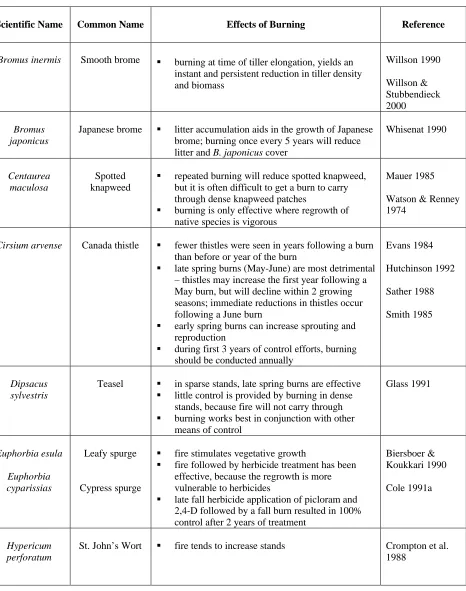
Fire was used to kill small native Eastern redcedars (Juniperus virginiana) in Ohio, and to control alien tree-of-heaven (Ailanthus altissima) in Indiana’s Blue River Project. Repeated burns were required, however, for full effectiveness. See Table 3.1 at the end of this chapter for more examples of the effects of burning on specific species.
Prescribed Burning and Herbicides
Some invasive species have underground storage organs that resprout vigorously after fire, and/or seeds whose germination is stimulated by fire. Some of these species may not be possible to control with fire, but some can be controlled with repeated burns and others may be especially vulnerable to herbicides after a burn. Resprouts or seedlings that are 1 to 3 months old are often especially sensitive to herbicides. Be sure to read the Guidelines for Herbicide Use and Developing a Rationale for Herbicide Use in this handbook, if you are considering the use of an herbicide.
In Illinois, reed canarygrass (Phalaris arundinacea) was controlled by a burning-herbicide combination treatment. Burning removed the surrounding thatch, and then glyphosate herbicide was applied. The spread of leafy spurge (Euphorbia esula) was halted, at least temporarily, with burning-herbicide treatments on preserve in Minnesota and Michigan. Burning initially reduces the litter layer, and also stimulates the seeds of leafy spurge to germinate, therefore reducing the seed bank.
Purple loosestrife (Lythrum salicaria) was successfully controlled in Michigan by burning, then applying glyphosate (Rodeo®).
Fire alone failed to control cogongrass (Imperata cylindrica) in Florida’s Apalachicola Bluffs and Ravine Preserve, but good control was achieved when herbicide was applied following burns.
Prescribed Fire 3.5
Weed Control Methods Handbook, The Nature Conservancy, Tu et al.
OTHER CONSIDERATIONS
Timing of Burn
The timing of a burn can strongly affect the fire’s impact on native and exotic plant populations. For example, in California’s Carrizo Plain Natural Area, Meyer &
Schiffman (1999) determined that warm-season prescribed burning (late-spring and fall) was most effective for reducing abundance of Mediterranean annual grasses. Native plant cover and diversity also increased significantly following warm-season prescribed burns. Winter burns, however, did not affect the abundance of native plants, and exotic plant cover was only moderately reduced.
Timing was also key in controlling smooth brome (Bromus inermis) and encouraging the growth of native grasses in Nebraska and Minnesota (Willson & Stubbendieck 2000). Timing prescribed burns so that they occurred at the time of tiller (aboveground lateral stem) elongation, yielded an immediate and persistent reduction in both tiller density and biomass of smooth brome.
Burning in Extensively Disturbed Areas
Not all burn treatments in wildlands are beneficial. When fires become too intense, crown-fires and death of native plants that typically survive fires can result. If
temperatures are too hot, soil organisms and seeds, even those of species that require fire stratification for germination, may perish, and valuable soil nutrients may be volatilized or otherwise lost. In extensively disturbed areas of southwest Australia, fire actually enhanced the invasion of weeds along roadsides, and resulted in an overall decrease in the abundance of native species (Milberg & Lamont 1995). Schwartz & Heim (1996) reported that fire was at best moderately successful for garlic mustard (Alliaria petiolata) control in Illinois forests, and Luken & Shea (2000) determined that repeated prescribed burning had no significant effect on garlic mustard in Kentucky. In both cases, however, the burns were detrimental to native herbaceous species, reducing both density and
richness. Even three years after the initial burns, native plant composition did not recover to pre-burn values.
Preventing Spread of Weeds
Prescribed Fire 3.6
Weed Control Methods Handbook, The Nature Conservancy, Tu et al.
Table 3.1. Examples of weeds that have been controlled by prescribed fire, and the effects of burning on these weeds.
Scientific Name Common Name Effects of Burning Reference
Bromus inermis Smooth brome § burning at time of tiller elongation, yields an instant and persistent reduction in tiller density and biomass Willson 1990 Willson & Stubbendieck 2000 Bromus japonicus
Japanese brome § litter accumulation aids in the growth of Japanese brome; burning once every 5 years will reduce litter and B. japonicus cover
Whisenat 1990
Centaurea maculosa
Spotted knapweed
§ repeated burning will reduce spotted knapweed, but it is often difficult to get a burn to carry through dense knapweed patches
§ burning is only effective where regrowth of native species is vigorous
Mauer 1985
Watson & Renney 1974
Cirsium arvense Canada thistle § fewer thistles were seen in years following a burn than before or year of the burn
§ late spring burns (May-June) are most detrimental – thistles may increase the first year following a May burn, but will decline within 2 growing seasons; immediate reductions in thistles occur following a June burn
§ early spring burns can increase sprouting and reproduction
§ during first 3 years of control efforts, burning should be conducted annually
Evans 1984 Hutchinson 1992 Sather 1988 Smith 1985 Dipsacus sylvestris
Teasel § in sparse stands, late spring burns are effective
§ little control is provided by burning in dense stands, because fire will not carry through
§ burning works best in conjunction with other means of control
Glass 1991 Euphorbia esula Euphorbia cyparissias Leafy spurge Cypress spurge
§ fire stimulates vegetative growth
§ fire followed by herbicide treatment has been effective, because the regrowth is more vulnerable to herbicides
§ late fall herbicide application of picloram and 2,4-D followed by a fall burn resulted in 100% control after 2 years of treatment
Biersboer & Koukkari 1990
Cole 1991a
Hypericum perforatum
Prescribed Fire 3.7
Weed Control Methods Handbook, The Nature Conservancy, Tu et al.
Scientific Name
Common Name
Effects of Burning Reference
Lysimachia nummularia
Moneywort § best to burn in spring when moneywort is green and native vegetation is dormant
§ regular burning regime for several years will be needed for control
Kenney & Fell 1992a Melilotus alba & Melilotus officinalis White sweet clover & Yellow sweet clover
§ at least two burns are necessary for control
§ increase in abundance in first year after burn
§ burning in late spring of the second-year as the shoots elongate, results in a kill of second year plants prior to flowering and seed set
§ mulching was found to be more effective than late spring burning
§ dormant season burns stimulate germination and increase the chance that plants will survive to produce seeds
§ dormant season burns can be used in conjunction with mowing or clipping in summer of the following year as plants flower
Cole 1991b Eidson & Steigmann 1990 Kline 1983 Schwarzmeier 1984
Turkington et al. 1978
Pastinaca sativa
Wild parsnip § fire removes ground litter and standing litter, providing favorable conditions for the development of parsnip rosettes
§ periodic burning may help maintain the vigor of native plants to allow them to better compete with parsnip
Eckardt 1987
Kenney & Fell 1992b
Phalaris arundinacea
Reed canarygrass
§ growing season fires may reduce vigor and help control the spread
§ growing season burns may give native species a competitive advantage
Apfelbaum & Sams 1987
Henderson 1990
Phragmites australis
Phragmites § burning will not reduce growth unless the roots burn
§ burning removes phragmites leaf litter, allowing seeds of other species to germinate
§ burning in conjunction with chemical control has been found effective
§ burn with caution, since spot fires can occur up to 100 feet from burning phragmites
Beall 1984
Marks 1986
Typha spp. Cattail § fire provides little or no control unless the roots are burned
§ drawdown followed by burning and then flooding to a depth of 8 – 18” will provide control
Apfelbaum 1985
Prescribed Fire 3.8
Weed Control Methods Handbook, The Nature Conservancy, Tu et al.
REFERENCES
Apfelbaum, S. 1985. Cattail (Typha spp.) management. Natural Areas Journal 5(3): 9-17.
Apfelbaum, S.I. and C.E. Sams. 1987. Ecology and control of reed canary grass (Phalaris arundinacea L.). Natural Areas Journal 7: 69-74.
Beall, D.L. 1984. Brigantine Division – marsh vegetation rehabilitation. Chemical control of Phragmites. US Fish and Wildlife Service. 8pp.
Biersboer, D.D. and W.L. Koukkari. 1990. Control of leafy spurge along rights-of-ways with burning and herbicides. Proceedings and Progress Reports of the Leafy Spurge Symposium, University of Wyoming, Laramie, WY.
Cole, M.A.R. 1991a. Vegetation management guideline: leafy spurge (Euphorbia esula
L.). Natural Areas Journal 11(3): 171-172.
Cole, M.A.R. 1991b. Vegetation management guideline: white and yellow sweet clover (Melilotus alba Desr. and Melilotus officinalis (L) Lam.). Natural Areas Journal 11: 214-215.
Crompton, C.W., Hall, I.V., Jensen, K.I.N. and P.D. Hildebrand. 1988. The biology of Canadian weeds. 83. Hypericum perforatum L. Canadian Journal of Plant Science 68: 149-162.
Eckardt, N. 1987. Element Stewardship Abstract: Pastinaca sativa, wild parsnip. The Nature Conservancy, Arlington, VA. 4pp.
Eidson, J. and K.L. Steigmann. 1990. Preliminary report on the response of yellow sweet clover (Melilotus officinalis) to late spring burning and mulch treatments. Proceedings of the 12th North American Prairie Conference. University of Northern Iowa, Cedar Falls, IA.
Evans, J.E. 1984. Canada thistle (Cirsium arvense): a literature review of management practices. Natural Areas Journal 4: 11-21.
Glass, W.D. 1991. Vegetation management guideline: cut-leaved teasel (Dipsacus laciniatus L.) and common teasel (Dipsacus sylvestris Huds.). Natural Areas Journal 11(4): 213-214.
Henderson, R.A. 1990. Controlling reed canary grass in a degraded oak savanna (Wisconsin). Restoration and Management Notes 8(2): 123-124.
Hutchinson, M. 1992. Vegetation management guideline: Canada thistle (Cirsium arvense (L) Scop.). Natural Areas Journal 12(3): 160-161.
Kenney, J. and G. Fell. 1992a. Vegetation management guideline: moneywort (Lysimachia nummularia L.). Natural Areas Journal 12: 40.
Kenney, J. and G. Fell. 1992b. Vegetation management guideline: wild parsnip (Pastinaca sativa L.). Natural Areas Journal 12: 42-43.
Kline, V.M. 1983. Control of sweet clover in a restored prairie (Wisconsin). Restoration and Management Notes 1(4): 30-31.
Luken, J.O. and M. Shea. 2000. Repeated prescribed burning at Dinsmore Woods State Nature Preserve (Kentucky, USA): Responses of the understory community. Natural Areas Journal 20(2): 150-158.
Prescribed Fire 3.9
Weed Control Methods Handbook, The Nature Conservancy, Tu et al. Mauer, T. 1985. Element Stewardship Abstract: spotted knapweed (Centaurea
maculosa). The Nature Conservancy. 10pp.
Meyer, M.D. and P.M. Schiffman. 1999. Fire season and mulch reduction in a
California grassland: a comparison of restoration strategies. Madrono 46(1): 25-37. Milberg, P. and B.B. Lamont. 1995. Fire enhances weed invasion of roadside vegetation
in southwestern Australia. Biological Conservation 73: 45-49.
Nelson, J.F. and R.H. Dietz. 1966. Cattail control methods in Utah. Utah Department of Fish and Game Publication 66-2. 33pp.
Sather, N. 1988. Element Stewardship Abstract: Canada thistle (Cirsium arvense). The Nature Conservancy. 15pp.
Schwartz, M.W. and J.R. Helm. 1996. Effects of a prescribed fire on degraded forest vegetation. Natural Areas Journal 16(3): 184-190.
Schwarzmeier, J.A. 1984. Sweet clover control in planted prairies: refined mow/burn prescription tested (Wisconsin). Restoration and Management Notes 2(1): 30-31. Smith, K.A. 1985. Canada thistle response to prescribed burning (North Dakota).
Restoration and Management Notes 3: 87.
Turkington, R.A., Cavers, P.B. and E. Rempel. 1978. The biology of Canadian weeds. 29. Melilotus alba Desr. and M. officinalis (L.) Lam. Canadian Journal of Plant Science 58: 523-537.
Watson, A.K. and A.J. Renney. 1974. The biology of Canadian weeds. Centaurea diffusa and C. maculosa. Canadian Journal of Plant Science 54: 687-701.
Whisenat, S.G. 1990. Post-fire population dynamics of Bromus japonicus. American Midland Naturalist 123: 301-308.
Willson, G.D. 1990. Fire effects on three growth stages of smooth brome. Proceedings 12th North American Prairie Conference, University of Northern Iowa, Cedar Falls, IA.
Willson, G.D. and J. Stubbendieck. 2000. A provisional model for smooth brome management in degraded tallgrass prairie. Ecological Restoration 18(1): 34-38.
Date Authored: April 2001
Biological Control 4.1
Weed Control Methods Handbook, The Nature Conservancy, Tu et al. John M. Randall and Mandy Tu
Biological control (biocontrol for short) is the use of animals, fungi, or other microbes to feed upon, parasitize or otherwise interfere with a targeted pest species. Successful biocontrol programs usually significantly reduce the abundance of the pest, but in some cases, they simply prevent the damage caused by the pest (e.g. by preventing it from feeding on valued crops) without reducing pest abundance (Lockwood 2000). Biocontrol is often viewed as a progressive and environmentally friendly way to control pest
organisms because it leaves behind no chemical residues that might have harmful impacts on humans or other organisms, and when successful, it can provide essentially
permanent, widespread control with a very favorable cost-benefit ratio. However, some biocontrol programs have resulted in significant, irreversible harm to untargeted (non-pest) organisms and to ecological processes. Of course, all pest control methods have the potential to harm non-target native species, and the pests themselves can cause harm to non-target species if they are left uncontrolled. Therefore, before releasing a biocontrol agent (or using other methods), it is important to balance its potential to benefit
conservation targets and management goals against its potential to cause harm.
Organisms used to feed on, parasitize, or otherwise interfere with targeted pests are called biocontrol agents. There are several general approaches to using biocontrol agents: 1. ‘Classical’ biocontrol targets a non-native pest with one or more species of biocontrol agents from the pest’s native range; 2. the ‘New Association’ or ‘Neoclassical’ approach targets native pests with non-native biological control agents; 3.
‘Conservation’, ‘Augmentation’ and ‘Inundation’ approaches maintain or increase the abundance and impact of biocontrol agents that are already present, and in many cases native to the area. Classical biocontrol is by far the most common approach for plant pests. Conservation and augmentation approaches show great promise on their own and especially for enhancing the impacts of classical biocontrol and other weed control measures as researchers and managers focus on managing to maximize native biological diversity in invaded ecosystems (Newman et al. 1998).
CLASSICAL BIOLOGICAL CONTROL OF WEEDS
It is hypothesized that some non-native plants become invasive, superabundant and damaging, at least in part because they have escaped the control of their ‘natural enemies’, the herbivores and pathogens that checked their abundance in their native ranges. Classical biocontrol addresses this by locating one or more herbivore and/or pathogen species from the weed’s native range and introducing them so they can control the pest in its new range. These herbivores and pathogens are carefully selected and screened to determine if they will attack crops or other non-target plant species.
Successful classical biocontrol programs result in permanent establishment of the control agent(s) and consequent permanent reduction in the abundance or at least the damaging impacts of the weed over all or in part of its introduced range. Classical biocontrol is not expected to eliminate the pest species completely and it often takes years or even decades after the initial release of control agents before their effects are obvious. Classical
Biological Control 4.2
biocontrol programs may fail for a variety of reasons. Some biocontrol agents never establish, or it may take repeated releases to establish viable populations. Some
biocontrol agents may become established, but then have little or no detectable impact on the targeted pest (Greathead 1995).
Some of ‘classical’ biocontrol’s greatest strengths are that once an agent is established, it will persist ‘forever’ and it may spread on its own to cover most or all of the area where the pest is present, generally with little or no additional cost. On the other hand, these strengths can become great liabilities if the agent also begins to attack desirable species (Pemberton1985; Lockwood 1993, 2000; McEvoy and Coombs 2000). Because of this, weed biocontrol researchers take pains to locate and use agents that are specific to the targeted weed and will not attack other “important” plant species. This screening process contributes to the high cost and long time required for the discovery, testing, and
approval of new biological control agents.
The selection and screening of candidate classical biocontrol agents
The first systematic biological control projects for weed species began over 100 years ago, and even at that time, potential control agents were tested to make sure that they did not harm agricultural crops. Scientific and public concern for native plant species with no known economic value has increased since then, particularly in the past few decades, and weed biocontrol programs administered by Agriculture Canada and the USDA expanded their host-specificity testing protocols to address these concerns. These programs now require checks for potential impacts on native plants, particularly rare species (DeLoach 1991; Harris 1988). This is in contrast to biocontrol programs that target insects and other arthropod pests, where even today, no host-specificity testing is legally required and few projects voluntarily screen potential control agents (Strong and Pemberton 2000). It has been suggested that this situation prevails because there is little public or professional outcry for the protection of insects, with the exception of non-native honeybees, other biocontrol agents, and possibly some non-native butterflies.
A key part of the screening process is host-testing, wherein potential control agents are given the opportunity to feed on a variety of crop species and native plants, including those most closely related to the targeted pest. No-choice tests isolate the potential control agent with one or more native species for feeding and/or egg-laying, so that if they do not use the native(s) they will die or fail to reproduce. Other tests give the proposed biocontrol agent a choice between feeding or reproducing on the targeted pest and non-target native species. Today, proposed biocontrol agents are screened for their ability to feed and reproduce on several to many native species, but it is still impossible to test all native species. For programs targeting species such as leafy spurge (Euphorbia esula) with many native congeners (over 100 native Euphorbia spp. in the U.S.), it is not even possible to test all the native species in the same genus. In addition, the tests cannot determine whether the control agents will adapt or evolve over time so that they will become more able or willing to feed on native species. For a more detailed description of the selection and host-testing processes, and suggestions for improving them, see