RESEARCH
The efficacy of
QingfengGanke
granule
in treating postinfectious cough in pathogenic
wind
invading
lungs
syndrome: a multicenter,
randomized, double-blind, placebo-controlled
trial
Hongli Jiang
1, Bing Mao
1*, Lei Wang
1*, Ruiming Zhang
1, Bin She
1, Faguang Jin
2, Yanling Xu
3, Jian Ma
4and Qiuping Liu
5Abstract
Background: Postinfectious cough (PIC) significantly affects cough-related quality of life but still lacks effective treatments. This study aims to investigate the efficacy of QingfengGanke granule (QFGKG) in treating PIC induced by pathogenic wind invading lungs syndrome.
Methods: A multicenter, randomized, double-blind, placebo-controlled clinical trial was conducted. A total of 180 eligible participants were randomly (1:1:1) assigned to group A (QFGKG 6 g plus QFGKG-matched placebo 6 g), group B (QFGKG 12 g), and group C (QFGKG-matched placebo 12 g). All herbal medications were orally administered twice daily for 10 consecutive days. The primary outcome was time to cough resolution, and secondary outcomes included time to cough alleviation, mean changes in cough symptom score (CSS), visual analogue scale (VAS) score, cough-specific quality of life questionnaire (CQLQ) score, and traditional Chinese medicine (TCM) syndrome score from baseline to Day 10, as well as adverse events.
Results: A total of 173 participants were included in the efficacy and safety analyses (group A, n = 57; group B, n = 57; group C, n = 59). The median time to cough resolution in groups A, B, and C was more than 10 days, 8 days, and more than 10 days, respectively (P < 0.0001), and the median time to cough alleviation was 4, 4, and 6 days, respectively (P < 0.0001). Compared with the placebo condition, groups A and B showed significantly greater improvements in CSS (P= 0.0005, P < 0.0001, respectively), VAS (P= 0.0002, P < 0.0001, respectively), CQLQ (P= 0.0258, P= 0.0003, respectively), and TCM syndrome (P= 0.0031, P < 0.0001, respectively). The time to cough resolution was faster in group B compared with group A (P= 0.0091). The adverse event profiles were comparable among the three groups.
Conclusion: QingfengGanke granule is efficacious in the treatment of PIC induced by pathogenic wind invading lungs syndrome.
© 2015 Jiang et al. This article is distributed under the terms of the Creative Commons Attribution 4.0 International License (http://creativecommons.org/licenses/by/4.0/), which permits unrestricted use, distribution, and reproduction in any medium, provided you give appropriate credit to the original author(s) and the source, provide a link to the Creative Commons license, and indicate if changes were made. The Creative Commons Public Domain Dedication waiver (http://creativecommons.org/ publicdomain/zero/1.0/) applies to the data made available in this article, unless otherwise stated.
Open Access
*Correspondence: [email protected]; [email protected]
1 Pneumology Group, Department of Integrated Traditional Chinese
and Western Medicine, West China Hospital, Sichuan University, No. 37 Guoxue Street, Chengdu 610041, Sichuan Province, People’s Republic of China
Background
Postinfectious cough (PIC), a cough lasting for at least 3 weeks but not more than 8 weeks, is the most common cause of subacute cough, accounting for almost 50% of cases [1]. Respiratory viruses including influenza, Myco-plasma pneumoniae, Chlamydia pneumoniae, Morax-ella catarrhalis, and Bordetella pertussis have been implicated as causes of PIC [2–6]. PIC occurs in approx-imately 10–40% of patients with upper respiratory tract infection (URTI) [2, 3]. During outbreaks of influenza or atypical infections, PIC may affect 25–50% of cases [2,
4–6].
According to traditional Chinese medicine (TCM) theory, qi is managed mainly by the lungs, which control inspiration and expiration, and is particularly susceptible to pathogenic wind, leading to failure of the lungs to perse and descend. This results in dysregulation of dis-persing and descending lung qi, manifested as coughing symptoms. PIC may be classified into the TCM disease category of “exogenous cough”; clinical practice and TCM syndrome research indicates that the “pathogenic wind (feng) invading lungs (fei)” syndrome is the most common type, which is mainly manifested as cough, throat itchi-ness, throat dryitchi-ness, chest tightitchi-ness, and expectoration, along with pale red tongue, white or yellow tongue coat-ing, and floating pulse [7].
Several pharmaceutical drugs have been used to relieve PIC, including inhaled ipratropium bromide, central act-ing antitussive agents such as codeine and dextromethor-phan, and inhaled or oral corticosteroids; however, drugs with optimal clinical efficacy and safety profiles are not yet available in Western medicine [8]. Evidence from randomized controlled trials (RCTs) of Chinese herbal medicine (CHM) treatments of PIC is not yet convincing because of small sample sizes and poor reporting quality [9].
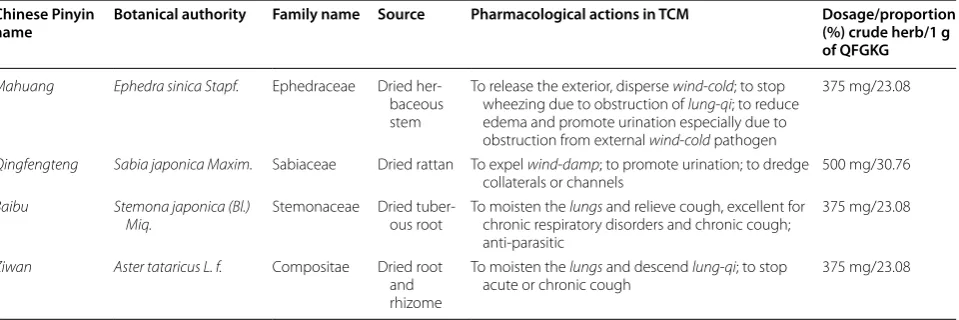
QingfengGanke granule (QFGKG) consists of Mahuang (Ephedra sinica Stapf.), Qingfengteng (Sabia japonica Maxim.), Baibu (Stemona japonica (Bl.) Miq.), and Ziwan (Aster tataricus L. f.), with starch and sucrose excipi-ents. The sources, pharmacological actions, and dosage of each ingredient are listed in Table 1. One preclinical pharmacodynamic experiment indicated the anti-inflam-matory and immune modulatory properties of GFGKG (unpublished observation by Jia Jinliang), and prelimi-nary clinical observational studies have shown its poten-tial to relieve cough [10]. In addition, acute and chronic toxicological studies have revealed that GFGKG has no apparent toxic side effects (unpublished observation by Jia Jinliang).
This study aims to investigate the efficacy of QFGKG in treating PIC induced by pathogenic wind invading lungs syndrome.
Methods Study design
Written informed consent was obtained from each sub-ject prior to participation (Additional file 1). The study protocol was reviewed and approved by the Medical Eth-ics Committee of West China Hospital at Sichuan Univer-sity (Chengdu, China) (Additional files 2, 3, respectively). This study was conducted in accordance with the Dec-laration of Helsinki and Good Clinical Practice ethi-cal guidelines [11]. In addition, the trial was authorized by the China State Food and Drug Administration (No. 2010L00279) and registered in the Chinese Clinical Trial Registry (ChiCTRTRC12002297). All herbs used in this trial are generally regarded as safe for use according to the China State Food and Drug Administration. The trial was reported in accordance with the Consolidated Stand-ards of Reporting Trials (CONSORT) statement (Addi-tional file 4) [12].
Table 1 QFGKG formula
QFGKGQingfengGanke granule, TCM traditional Chinese medicine. Chinese Pinyin
name Botanical authority Family name Source Pharmacological actions in TCM Dosage/proportion (%) crude herb/1 g of QFGKG
Mahuang Ephedra sinica Stapf. Ephedraceae Dried her-baceous stem
To release the exterior, disperse wind-cold; to stop wheezing due to obstruction of lung-qi; to reduce edema and promote urination especially due to obstruction from external wind-cold pathogen
375 mg/23.08
Qingfengteng Sabia japonica Maxim. Sabiaceae Dried rattan To expel wind-damp; to promote urination; to dredge
collaterals or channels 500 mg/30.76 Baibu Stemona japonica (Bl.)
Miq. Stemonaceae Dried tuber-ous root To moisten the chronic respiratory disorders and chronic cough; lungs and relieve cough, excellent for anti-parasitic
375 mg/23.08
Ziwan Aster tataricus L. f. Compositae Dried root and rhizome
To moisten the lungs and descend lung-qi; to stop
The randomization sequence was computer gener-ated in blocks of five in a 1:1:1 ratio by an independ-ent statistician using SAS statistical software (SAS 9.3, SAS Institute, USA). Allocation details were stored in two sealed envelopes. One set of envelopes was kept by QiHuang Drug Clinical Research Center (Beijing, China) and the other set was kept by the institutions at which the study was conducted to be opened in case of emergency. All researchers, participants, and statisti-cians were masked to treatment allocation throughout the study.
Setting and participants
Potential participants diagnosed with PIC induced by pathogenic wind invading lungs syndrome, aged 18–65 years old, were recruited by respiratory special-ists with more than 5 years’ working experience from the outpatient departments of five participating cent-ers across China: West China Hospital of Sichuan Uni-versity, Tangdu Hospital of the Fourth Military Medical University, the Affiliated Hospital to Liaoning University of TCM, Nanjing First Hospital, and Baotou Central Hos-pital. PIC was defined as a persistent cough triggered by URTI and lasting for 3–8 weeks [8, 13]. Using the Chi-nese national criteria for clinical diagnosis and treatment evaluation of cough [14], pathogenic wind invading lungs syndrome was diagnosed in the presence of cough, throat itchiness, cough aggravated by pathogenic wind, and at least one of the other minor symptoms, along with pale red tongue, white or yellow tongue coating, and floating pulse. All participant inclusion and exclusion criteria are listed in Table 2.
Intervention
All participants were randomly allocated in a double-blind manner to one of three parallel treatment groups: group A received QFGKG 6 g plus QFGKG-matched placebo 6 g, twice daily; group B took orally QFGKG 12 g, twice daily; and group C took orally QFGKG-matched placebo 12 g, twice daily. The scheduled treat-ment duration was 10 days and the participants were followed up by scheduling visits to the clinic at baseline (Day 0), Day 5, and Day 10. All participants were treated in an equivalent fashion and instructed to avoid taking any other medication for the relief of cough. Compli-ance was checked by examining a daily diary card and returned medication at the end of the study. Active and placebo granules that were indistinguishable in taste, color, appearance, and smell were issued in a sealed box and supplied by Baotou Chinese Traditional Medicine Co., Ltd. (China). All medications were dispensed by a specified drug administrator in a separate reception room.
Outcome measures Cough symptom score (CSS)
The CSS is a validated tool to evaluate the frequency and severity of cough. Participants provided self-rated CSSs ranging from 0 to 3. Each evaluation day was divided into two intervals: daytime (from 8:00 am to 8:00 pm) and nighttime (from 8:00 pm to 8:00 am) [13]. CSS was evalu-ated every day during the study.
Visual analogue scale (VAS)
The VAS is a 10 cm continuous horizontal line that meas-ures the severity of cough. Participants were instructed to rate their cough severity from “no cough” to “extremely strong cough.” Scores ranged from 0 to 10. VAS score was assessed at baseline (Day 0), Day 5, and Day 10.
Cough‑specific quality of life questionnaire (CQLQ)
The CQLQ was designed specifically to evaluate decre-ments in disease-targeted quality of life caused by cough and consists of 28 items in three domains (physical, Table 2 Inclusion and exclusion criteria
CSS cough symptom score, PIC postinfectious cough, QFGKGQingfengGanke
granule, TCM traditional Chinese medicine. Inclusion criteria
Clinical diagnosis of PIC
Pathogenic-wind invading lungs syndrome in TCM Baseline CSS of 2 or greater in the daytime and/or nighttime Cough lasting for at least 3 weeks but not more than 8 weeks Aged 18–65 years old
Participant must voluntarily give written informed consent and report adverse events
Exclusion criteria
Wheezing or rales on physical examination Bronchial provocation test positive Abnormal findings on plain chest radiograph
Use of an angiotensin-converting-enzyme inhibitor within the past 2 months
Presenting with heartburn or regurgitation Symptoms or signs of upper airway cough syndrome
Current smoker or recent ex-smoker (giving up smoking for less than 3 months)
Participant has severe primary disease of pulmonary, hepatic, renal, or hematological system, or other serious diseases affected the survival, such as cancer or AIDS
ALT or AST >1.5 times of normal upper limit, abnormal serum creatine, abnormal serum Ig E, eosinophilia in the blood, white blood cell count <3× 10⁹/L or >10 × 109/L/L, and/or neutrophil granulocyte
>80%
Pregnancy or lactating women, or women who have birth plan Allergic constitution or known to be allergic to any component in
QFGKG
social, and psychological) [15]. A recent systematic review [16] showed that the CQLQ can provide valid and reliable outcomes for cough research. The minimum and maximum CQLQ scores were 28 and 112, respec-tively, with lower scores indicating a better quality of life. CQLQ score was assessed at baseline and Day 10.
TCM syndrome score
Using the Chinese national criteria for clinical diagno-sis and treatment evaluation of cough [14], the main and minor symptoms of the TCM syndrome were graded (cough: not at all = 0, mild = 2, moderate = 4, severe = 6; throat itchiness, throat dryness, and chest tightness: not at all = 0, mild = 1, moderate = 2, severe = 3; cough aggra-vated by pathogenic wind and expectoration: yes = 0 and no = 2). The TCM syndrome score was the accumulated score of the main symptom score and all minor symptom scores. Additionally, tongue proper, tongue coating, and pulse were also assessed but not scored. TCM syndrome score was assessed at baseline and Day 10.
Safety evaluation
Safety evaluations included monitoring of adverse events (AEs), as well as clinical and laboratory findings. Partici-pants were required to record any unexpected symptoms, signs, or feelings during the treatment period. In addi-tion, routine tests of blood, urine and stool, hepatic and renal functions, and electrocardiogram were also per-formed at baseline and again after the 10-day treatment to assess safety for each group.
The primary outcome was mean or median time to cough resolution, which was assessed as the length of time from the start of treatment until the first point at which cough resolved. Cough resolution was defined as both daytime and nighttime CSS decreasing to 0. The secondary outcomes included time to cough allevia-tion, mean changes in CSS, VAS score, CQLQ score, and TCM syndrome score from baseline to Day 10, as well as adverse events. Cough alleviation was defined as a reduc-tion in both daytime and nighttime CSS ≥ 1, lasting for 2 consecutive days.
Sample size determination
No clinical trial data existed on the efficacy of QFGKG. Based on our experience and previous studies of other CHM formulae used to treat PIC [17–19], the cough resolution rates in the CHM and placebo groups were estimated to be 40 and 15%, respectively. The sample size for each group was calculated to be 53 according to the formula n = (Uα + Uβ)2 × 2P × (1 − P)/(P
1 − P0)2 with a
power of 90% or greater, assuming a significance level of 0.05. To allow for a dropout rate of approximately 10%, 180 PIC participants were needed for this study.
Statistical analysis
All the efficacy and safety analyses were performed using the intent-to-treat population. All data were documented by two independent individuals and the data files were secured. Statistical analyses were conducted using statistical software (SAS 9.3, SAS Institute, USA). Normally distrib-uted quantitative data were described as mean ± stand-ard deviation and analyzed using analysis of variance. Quantitative data that were not normally distributed were expressed as median and analyzed by the Wilcoxon rank-sum test. Qualitative data were presented as frequency and percentage and analyzed using Chi square (χ2) or Fisher’s exact test. The primary outcome was analyzed using the survival method. Kaplan–Meier curves were constructed and differences between curves were tested by the log-rank method. The secondary outcomes were analyzed using analysis of covariance with a Bonferroni correction, or the survival method. A two-tailed P value of less than 0.05 was considered statistically significant.
Results
Participant characteristics
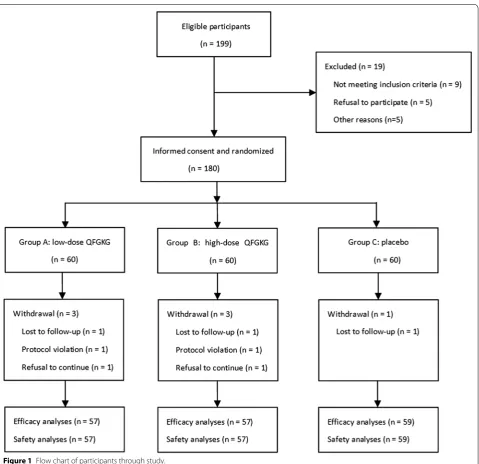
A total of 180 eligible participants were enrolled from five tertiary hospitals across China between April 2011 and March 2012, and randomly assigned 1:1:1 to receive low-dose QFGKG (group A, n = 60), high-dose QFGKG (group B, n = 60), or placebo (group C, n = 60). Of these, seven participants were withdrawn from the study for sev-eral reasons, including protocol violation (group A, n = 1; group B, n = 1), lost to follow-up (group A, n = 1; group B, n = 1; group C, n = 1), and refusal to continue (group A, n = 1; group B, n = 1). Overall, 173 participants were included in the efficacy and safety analyses (Figure 1). Compliance measured by daily diary card and returned medication was 96%. Use of concomitant medications including herbal and complementary medicines did not differ across the three groups (P = 0.9378). No differences in demographic or clinical characteristics were observed among the three groups at baseline (Table 3).
Time to cough resolution
The median time to cough resolution in groups A, B, and C was more than 10 days, 8 days, and more than 10 days, respectively. A significant therapeutic effect was noted in both QFGKG groups compared with the placebo condi-tion (group A, P < 0.0001; group B, P < 0.0001), and the time to cough resolution was faster in group B compared with group A (P = 0.0091) (Figure 2).
Time to cough alleviation
P = 0.0003; group B, P < 0.0001), except for the difference between group A and group B (P = 0.1843) (Figure 3).
CSS
Significant improvements in CSS (both daytime and nighttime) were observed from baseline to Day 10 in all three groups (group A, 3.84 ± 0.80 to 1.14 ± 1.11; group B, 3.79 ± 0.77 to 0.79 ± 1.19; group C, 3.86 ± 0.84 to 2.22 ± 1.54). Both QFGKG groups showed signifi-cantly greater improvements compared with the placebo [group A, −1.07, 95% confidence interval (CI) −1.55 to −0.6, P = 0.0005; group B, −1.41, 95% CI −1.89 to
−0.94, P < 0.0001]. Group B showed a greater, though non-significant, improvement compared with group A (P = 0.5406). Similar improvements were observed in both daytime and nighttime CSS (Table 4).
VAS
Significant changes from baseline in VAS score were found in all three groups (group A, 6.04 ± 1.44 to 1.81 ± 1.87; group B, 5.90 ± 1.23 to 1.12 ± 1.70; group C, 5.96 ± 1.33 to 3.41 ± 2.11). Both QFGKG groups showed significantly greater improvements compared with the placebo condi-tion (group A, −1.63, 95% CI −2.31 to −0.95, P = 0.0002;
group B, −2.26, 95% CI −2.95 to −1.58, P < 0.0001). Group B showed a greater, though non-significant, improvement compared with group A (P = 0.4200) (Table 4).
CQLQ
Significant improvements in the total CQLQ scores were observed from baseline to Day 10 in all three groups (group A, 64.51 ± 9.58 to 48.27 ± 14.30; group B, 64.95 ± 7.31 to 44.82 ± 14.10; group C, 64.78 ± 6.46 to 54.89 ± 10.59). Compared with the placebo condition, participants in either QFGKG group had a better quality of life (group A, −6.17, 95% CI −10.4 to −1.88, P = 0.0258;
group B, −9.65, 95% CI −13.9 to −5.4, P = 0.0003), but there was no significant difference between the high- and low-dose QFGKG groups (P = 0.5720) (Table 4).
TCM syndrome score
Again, improvements in the total TCM syndrome score were observed from baseline to Day 10 in all three groups (group A, 12.02 ± 2.60 to 3.49 ± 3.51; group B, 11.46 ± 1.97 to 2.00 ± 3.00; group C, 11.97 ± 2.17 to 6.17 ± 4.00). Both QFGKG groups showed significantly greater improvements compared with the placebo condi-tion (group A, −2.7, 95% CI −3.97 to −1.42, P = 0.0031; Table 3 Demographic and clinical characteristics at baseline
Values are reported as mean ± SD or as frequency (%).
CQLQ cough-specific quality of life questionnaire, CSS cough symptom score, PIC postinfectious cough, TCM traditional Chinese medicine, VAS visual analogue scale. * P values obtained via variance analysis for continuous variables, or Chi square tests for categorical variables.
Characteristics Group A (n = 57) Group B (n = 57) Group C (n = 59) P values*
Age (years) 44.37 ± 12.38 43.07 ± 12.67 44.07 ± 12.65 0.8663
Gender (female/%) 35 (61.40) 35 (61.40) 31 (52.54) 0.5336
Body weight (kg) 62.41 ± 9.91 62.45 ± 10.76 63.44 ± 10.87 0.6680
Height (cm) 164.26 ± 7.89 163.22 ± 7.99 164.47 ± 8.59 0.6097
Former smoker (n (%)) 10 (17.54) 5 (8.77) 5 (8.47) 0.2255
Cough duration (days) 33.00 ± 10.32 29.96 ± 7.09 30.80 ± 8.96 0.3685 Previous diagnosis of PIC (n (%)) 9 (15.79) 8 (14.04) 10 (16.95) 0.9696
VAS score 6.04 ± 1.44 5.90 ± 1.23 5.96 ± 1.33 0.8341
CSS 3.84 ± 0.80 3.79 ± 0.77 3.86 ± 0.84 0.9648
Daytime CSS 2.12 ± 0.38 2.02 ± 0.35 2.14 ± 0.43 0.2084
Nighttime CSS 1.72 ± 0.65 1.77 ± 0.68 1.73 ± 0.69 0.7752
CQLQ score 64.51 ± 9.58 64.95 ± 7.31 64.78 ± 6.46 0.9068
TCM syndrome score 12.02 ± 2.60 11.46 ± 1.97 11.97 ± 2.17 0.1492
group B, −4.05, 95% CI −5.33 to −2.76, P < 0.0001), but the difference between the two QFGKG groups did not reach significance (P = 0.3692) (Table 4).
Safety
There were neither serious AEs nor participant with-drawal because of AEs during the study. Participants taking QFGKG regardless of dosage reported more AEs than those in the placebo group (7.02 vs. 7.02 vs. 1.69%; P = 0.3313). In group A, AEs were reported in four par-ticipants. One participant reported dizziness and a rough tongue (at Day 1), which were resolved within 10 days. One participant complained of arm itchiness (at Day 1), which was resolved within 4 days. Another two repro-ductive-aged women showed a slightly elevated level of white blood cells in routine urine tests after treatment without any symptoms of urinary tract infection at Day 7
and 10, respectively; the events were resolved after drink-ing more water. In group B, four participants reported AEs. One male participant had mild hepatic dysfunction with baseline alanine aminotransferase 48 U/L increas-ing to 60 U/L after treatment, but droppincreas-ing to normal when measured again 3 days later without any interven-tion. One participant developed URTI with an elevated level of white blood cells (7.31 × 10⁹/L pretreatment to
11.17 × 10⁹/L posttreatment); the event was resolved
7 days later after the administration of antibiotics. Two reproductive-aged women experienced an elevated level of white blood cells in routine urine tests after treatment without any discomfort at Day 6 and 11, respectively; the events were resolved after drinking more water. In group C, one participant complained of a mild episode of diz-ziness. All the reported AEs were generally considered mild in severity, manageable, and reversible.
Figure 3 Time to cough alleviation in participants with PIC.
Table 4 Analyses of CSS, VAS, CQLQ scores, and TCM syndrome score
Values are reported as mean ± SD.
CQLQ cough-specific quality of life questionnaire, CSS cough symptom score, TCM traditional Chinese medicine, VAS visual analogue scale. * P < 0.01 for group A/group B vs. group C.
Outcome variables Change from baseline to Day 10
Group A (n = 57) Group B (n = 57) Group C (n = 59) P values*
CSS −2.70 ± 1.30* −3.00 ± 1.28* −1.64 ± 1.64 <0.0001
Discussion
To our knowledge, this is the first randomized, double-blind, placebo-controlled clinical trial of CHM in the treatment of PIC induced by pathogenic wind invad-ing lungs syndrome. QFGKG could shorten the dura-tion of cough, decrease cough severity and frequency, and improve cough-specific quality of life. In addition, this study found QFGKG to be safe and well tolerated. High-dose QFGKG appeared to be superior to low-dose QFGKG in shortening the duration of cough.
QingfengGanke granule improved cough and cough-related quality of life in both QFGKG groups. Similarly, significant improvements were found in the placebo group, most likely because of the self-limiting nature of PIC. In addition to natural recovery, the placebo effects might encompass several other components: regression of cough response toward the mean, true placebo effect, voluntary control, and effects related to expectancy and meaning of the treatment [20].
Although the pathogenesis of PIC remains unknown, airway inflammation, epithelial disruption, and cough hyper-responsiveness are involved [8]. The resurgence of pertussis or whooping cough has prompted wide pub-lic and clinical concerns over the last 20 years [21–23]. There is an increasing recognition of the presence of Bor-detella pertussis infection in PIC, although URTI is the most common cause. Approximately 12–50% of cases with cough duration of 2 weeks or more show evidence of recent B. pertussis infection despite aggressive vaccina-tion [24]. Although some medications are available, there is no proven effective therapy for patients with prolonged cough attributed to pertussis [25]. A recent double-blind, placebo-controlled RCT [26] indicated that nebulized ipratropium bromide in combination with salbutamol could reduce PIC. Another recent placebo-controlled RCT [27] showed that montelukast, a cysteinyl leukot-riene type 1 receptor antagonist, was not an effective treatment for PIC. Whether there is a potential therapeu-tic effect of QFGKG on pertussis-related cough deserves further study.
In terms of safety, no deaths or serious AEs were reported; all AEs reported were of mild severity. Three AEs were categorized as possibly or probably related to the study medication: dizziness, rough tongue, and arm itchiness. An elevated level of white blood cells in rou-tine urine tests, which occurred in four female partici-pants in the QFGKG groups, was considered unrelated to the study medication and probably associated with an increased risk of urinary tract infection in young women of reproductive age. Some mild abnormalities observed in laboratory safety evaluations in the high-dose QFGKG group were judged as unrelated to the study medica-tion. However, Mahuang in QFGKG may have some
side effects, such as increased blood pressure, cardiac arrhythmia, excitability, insomnia, nausea, poor appetite, or convulsions [28].
Some potential limitations of the present study should be considered. First, cough frequency was subjectively assessed in this study using a cough diary. There is increas-ing evidence that acoustic cough-monitorincreas-ing devices can be valid and reliable instruments with which to assess cough frequency. However, the absence of good responsive-ness and inconsistency with other instruments has limited their wide use in cough research [16, 29]. Second, our study protocol specifically excluded elderly people and those with mild cough, limiting the generalizability of the study find-ings in real-life clinical practice. Third, there was no follow-up after treatment, so the effect of QFGKG on relapse rate after treatment was unknown. Moreover, the accuracy of determining the time to cough alleviation might have been impaired, as 2 days was needed to define cough alleviation.
Conclusion
QingfengGanke granule is efficacious in the treatment of PIC induced by pathogenic wind invading lungs syndrome.
Abbreviations
AE: adverse events; CHM: Chinese herbal medicine; CI: confidence interval; CONSORT: consolidated standards of reporting trials; CQLQ: cough-specific quality of life questionnaire; CSS: cough symptom score; PIC: postinfectious cough; QFGKG: QingfengGanke granule; RCT: randomized controlled trial; TCM: traditional Chinese medicine; URTI: upper respiratory tract infection; VAS: visual analogue scale.
Authors’ contributions
HLJ, BM and LW conceived the study. HLJ, BM, LW, FGJ, YLX, JM and QPL designed the study. BM, LW, RMZ and BS performed data analysis. HLJ wrote the manuscript. BM and LW revised the manuscript. All authors read and approved the final manuscript.
Author details
1 Pneumology Group, Department of Integrated Traditional Chinese and
West-ern Medicine, West China Hospital, Sichuan University, No. 37 Guoxue Street, Chengdu 610041, Sichuan Province, People’s Republic of China. 2
Depart-ment of Respiratory Medicine, Tangdu Hospital, The Fourth Military Medical University, No. 1 Xinsi Road, Xi’an 710038, Shaanxi Province, People’s Republic of China. 3 Department of Respiratory Medicine, The Affiliated Hospital
to Liaoning University of Traditional Chinese Medicine, No. 33 Beiling Street, Shenyang 110032, Liaoning Province, People’s Republic of China. 4
Depart-ment of Respiratory Medicine, Nanjing First Hospital, No. 68 Changle Road, Nanjing 210006, Jiangsu Province, People’s Republic of China. 5 Department
of Respiratory Medicine, Baotou Central Hospital, No. 61 Huangcheng Road, Baotou 014025, Inner Mongolia, People’s Republic of China.
Additional files
Additional file 1. Informed consent. Additional file 2. Study protocol.
Acknowledgements
We would like to thank Ms. Yan Chen, Ms. Lin Tu, Department of Integrated Traditional Chinese and Western Medicine, West China Hospital, Sichuan Uni-versity, China, for their care of these participants. Furthermore, we also express our gratitude to all the participants for their participation and to the investiga-tors at the hospitals for data collection and laboratory testing. In addition, we are very grateful to Ms Xiang Diao for her polishing the manuscript. We would like to express our great appreciation to the anonymous reviewers for their comments and suggestions, and Diane Williams, EdanzQC SCM, and the other editors for their efficient and professional processing of our manuscript. We particularly wish to thank QiHuang Drug Clinical Research Center for statistical assistance, Baotou Chinese Traditional Medicine Co., Ltd (Inner Mongolia, China) for providing QFGKG and placebo granules. This project is partly sup-ported by Administrative Bureau of Traditional Chinese Medicine of Sichuan province, People’s Republic of China (No. 2012-B-081).
Compliance with ethical guidelines
Competing interests
This study was partly funded by Baotou Chinese Traditional Medicine Co., Ltd, and BM, FGJ, YLX, JM and QPL reported receiving Grant support from Baotou Chinese Traditional Medicine Co., Ltd. However, the funder had no input into the study design or analysis, nor the interpretation of data. The authors declare that there are no other competing interests regarding the publication of this article.
Received: 16 October 2014 Accepted: 6 July 2015
References
1. Kwon NH, Oh MJ, Min TH, Lee BJ, Choi DC (2006) Causes and clinical features of subacute cough. Chest 129:1142–1147
2. Ishida T, Yokoyama T, Iwasaku M, Saigusa M, Fukuyama H, Nakagawa H et al (2010) Clinical investigation of post-infectious cough among adult patients with prolonged cough. Nihon Kokyuki Gakkai Zasshi 48:179–185 3. Irwin RS, Madison JM (2000) The diagnosis and treatment of cough. N
Engl J Med 343:1715–1721
4. Robertson PW, Goldberg H, Jarvie BH, Smith DD, Whybin LR (1987) Borde-tella pertussis infection: a cause of persistent cough in adults. Med J Aust 146:522–525
5. Davis SF, Sutter RW, Strebel PM, Orton C, Alexander V, Sanden GN et al (1995) Concurrent outbreaks of pertussis and Mycoplasma pneumoniae
infection: clinical and epidemiological characteristics of illnesses mani-fested by cough. Clin Infect Dis 20:621–628
6. Ryan NM, Vertigan AE, Ferguson J, Wark P, Gibson PG (2012) Clinical and physiological features of postinfectious chronic cough associated with H1N1 infection. Respir Med 106:138–144
7. Yan Y, Yang L, Song Q, Li WC, Li DY, Li YT et al (2014) Study on TCM syndrome of post -infectious cough based on factor analysis. Zhonghua Zhongyiyao Xuekan 32:217–219
8. Braman SS (2006) Postinfectious cough: ACCP evidence-based clinical practice guidelines. Chest 129:138s–146s
9. Liu W, Jiang HL, Mao B (2013) Chinese herbal medicine for postinfectious cough: a systematic review of randomized controlled trials. Evid Based Complement Alternat Med 2013:906765
10. Ma JL, Shi LQ, Xi N (2007) Analysis and study on 60 cases of post-infectious cough treated with eliminating wind and releasing lungs medicines. Beijing Zhongyiyao Daxue Xuebao 30:67–69
11. Goodyear MD, Krleza-Jeric K, Lemmens T (2007) The declaration of Hel-sinki. BMJ 335:624–625
12. Gagnier JJ, Boon H, Rochon P, Moher D, Barnes J, Bombardier C (2006) Reporting randomized, controlled trials of herbal interventions: an elabo-rated CONSORT statement. Ann Intern Med 144:364–367
13. Asthma Work Group, Chinese Society, Respiratory, Diseases (CSRD), Chinese Medical Association (2011) The Chinese national guidelines on diagnosis and management of cough December 2010. Chin Med J (Engl) 124:3207–3219
14. Zheng XY (2002) Guiding principle of clinical research on new drugs of traditional Chinese medicine (trial implementation). Chinese Medical Science and Technology Press, Beijing
15. French CT, Irwin RS, Fletcher KE, Adams TM (2002) Evaluation of a cough-specific quality-of-life questionnaire. Chest 121:1123–1131
16. Schmit KM, Coeytaux RR, Goode AP, McCrory DC, Yancy WS Jr, Kemper AR et al (2013) Evaluating cough assessment tools: a systematic review. Chest 144:1819–1826
17. Min CY (2011) Effect of Butu Xuanfei formula for 75 cases of cough induced by common cold. Zhongyi Zazhi 52:572–574
18. Wu W, Wang B, Wang W, Gao F (2011) The clinical research for treat-ment of post-infectious cough with Shufeng Xuanfei method. Xiandai Zhongxiyi Jiehe Zazhi 20:3051–3052
19. Zhang YP, Chao Y, Miao Q, Zhao D, Lin L, Sun ZT et al (2008) Randomized controlled study on Suhuang Zhike capsule for treatment of post-cold cough. Zhongguo Zhongxiyi Jiehe Zazhi 28:698–701
20. Eccles R (2010) Importance of placebo effect in cough clinical trials. Lung 188(Suppl 1):S53–61
21. Bentley J, Pinfield J, Rouse J (2013) Whooping cough: identification, assessment and management. Nurs Stand 28:50–57
22. Clark TA (2014) Changing pertussis epidemiology: everything old is new again. J Infect Dis 209:978–981
23. Xu Y, Wang L, Xu J, Wang X, Wei C, Luo P et al (2014) Seroprevalence of pertussis in China: need to improve vaccination strategies. Hum Vaccin Immunother 10:192–198
24. Cherry JD (2005) The epidemiology of pertussis: a comparison of the epi-demiology of the disease pertussis with the epiepi-demiology of Bordetella pertussis infection. Pediatrics 115:1422–1427
25. Wang K, Bettiol S, Thompson MJ, Roberts NW, Perera R, Heneghan CJ et al (2014) Symptomatic treatment of the cough in whooping cough. Cochrane Database Syst Rev 9:CD003257
26. Zanasi A, Lecchi M, Del Forno M, Fabbri E, Mastroroberto M, Mazzolini M et al (2014) A randomized, placebo-controlled, double-blind trial on the management of post-infective cough by inhaled ipratropium and salbu-tamol administered in combination. Pulm Pharmacol Ther 29:224–232 27. Wang K, Birring SS, Taylor K, Fry NK, Hay AD, Moore M et al (2014) Mon-telukast for postinfectious cough in adults: a double-blind randomised placebo-controlled trial. Lancet Respir Med 2:35–43
28. Shaw D (2010) Toxicological risks of Chinese herbs. Planta Med 76:2012–2018
29. Leconte S, Ferrant D, Dory V, Degryse J (2011) Validated methods of cough assessment: a systematic review of the literature. Respiration 81:161–174
Submit your next manuscript to BioMed Central and take full advantage of:
• Convenient online submission • Thorough peer review
• No space constraints or color figure charges • Immediate publication on acceptance
• Inclusion in PubMed, CAS, Scopus and Google Scholar • Research which is freely available for redistribution