Volume. 5, Issue. 2, Ser. 10, (2016), 105-122
The Effect of Portfolio Assessment on the
Development of Metadiscourse Markers
Awareness in EFL Learners’
Oral Performance
Tooba Mardani
MA in Translation
Studies Young Researchers and Elite Club
Isfahan (Khorasgan) Branch, Islamic Azad University
Isfahan, Iran
Mardani [email protected]
Abstract.
Portfolio assessment as one of the alternatives to testing is defined as the systematic collection of student work measured against predetermined scoring criteria. This paper aimed to investigate the ef-fect of portfolio assessment in the oral performance of EFL learners in an attempt to examine its impact on their metadiscourse awareness. To de-termine the impact of portfolio assessment on the oral performance and metadiscourse awareness of EFL learners, 60 university students ma-joring in English language teaching were initially selected. After being homogenized for their proficiency level, they were randomly divided into an experimental group (EG) and a control group (CG). As the treat-ment, portfolio assessment was employed as the teaching technique for the experimental group. Data was then subjected to different statistical procedures. The results of data analysis revealed that the participants in the EG outperformed those in the CG with regard to the achieve-ment in their overall oral performance. Second, the findings showed that experimental groups’ awareness to metadiscourse markers significantly increased after instruction. The findings of the present study have im-plications for learners and teachers in the realm of TEFL in particular and education in general.Keywords:Metadiscourse awareness, portfolio assessment, traditional assessment, oral performance, portfolio-based instruction
Received: December 2015; Accepted: May 2016
105
Journal of Studies in Learning
and Teaching English
Volume. 5, Issue. 2, Ser. 10, (2016), 105-122
The Effect of Portfolio Assessment on the
Development of Metadiscourse Markers
Awareness in EFL Learners’
Oral Performance
Tooba Mardani
MA in Translation
Studies Young Researchers and Elite Club
Isfahan (Khorasgan) Branch, Islamic Azad University
Isfahan, Iran
Mardani [email protected]
Abstract.
Portfolio assessment as one of the alternatives to testing is defined as the systematic collection of student work measured against predetermined scoring criteria. This paper aimed to investigate the ef-fect of portfolio assessment in the oral performance of EFL learners in an attempt to examine its impact on their metadiscourse awareness. To de-termine the impact of portfolio assessment on the oral performance and metadiscourse awareness of EFL learners, 60 university students ma-joring in English language teaching were initially selected. After being homogenized for their proficiency level, they were randomly divided into an experimental group (EG) and a control group (CG). As the treat-ment, portfolio assessment was employed as the teaching technique for the experimental group. Data was then subjected to different statistical procedures. The results of data analysis revealed that the participants in the EG outperformed those in the CG with regard to the achieve-ment in their overall oral performance. Second, the findings showed that experimental groups’ awareness to metadiscourse markers significantly increased after instruction. The findings of the present study have im-plications for learners and teachers in the realm of TEFL in particular and education in general.Keywords:Metadiscourse awareness, portfolio assessment, traditional assessment, oral performance, portfolio-based instruction
Received: December 2015; Accepted: May 2016
105
Journal of Studies in Learning
and Teaching English
Volume. 5, Issue. 2, Ser. 10, (2016), 105-122
The Effect of Portfolio Assessment on the
Development of Metadiscourse Markers
Awareness in EFL Learners’
Oral Performance
Tooba Mardani
MA in Translation
Studies Young Researchers and Elite Club
Isfahan (Khorasgan) Branch, Islamic Azad University
Isfahan, Iran
Mardani [email protected]
Abstract.
Portfolio assessment as one of the alternatives to testing is defined as the systematic collection of student work measured against predetermined scoring criteria. This paper aimed to investigate the ef-fect of portfolio assessment in the oral performance of EFL learners in an attempt to examine its impact on their metadiscourse awareness. To de-termine the impact of portfolio assessment on the oral performance and metadiscourse awareness of EFL learners, 60 university students ma-joring in English language teaching were initially selected. After being homogenized for their proficiency level, they were randomly divided into an experimental group (EG) and a control group (CG). As the treat-ment, portfolio assessment was employed as the teaching technique for the experimental group. Data was then subjected to different statistical procedures. The results of data analysis revealed that the participants in the EG outperformed those in the CG with regard to the achieve-ment in their overall oral performance. Second, the findings showed that experimental groups’ awareness to metadiscourse markers significantly increased after instruction. The findings of the present study have im-plications for learners and teachers in the realm of TEFL in particular and education in general.Keywords:Metadiscourse awareness, portfolio assessment, traditional assessment, oral performance, portfolio-based instruction
1. Introduction
The theoretical foundation that underpins this study is the notion of
“con-structivism” which refers to more recent views on teaching and learning
proposing that all individuals learn by constructing information about
the world and by using active and dynamic mental processes (O’
Mal-ley & Valdez Pierce,1996). Following this line of investigation, many
researchers have come to recognize that alternative assessment is an
important means of gaining a dynamic picture of students’ academic
and linguistic development. “Alternative assessment refers to
proce-dures and techniques used within the context of instruction which can
be easily incorporated into the daily activities of the school or
class-room” (Hamayan, 1995, p. 213). In contrast to traditional testing,
through alternative assessment, students are evaluated on what they
integrate and produce rather than on what they are able to reproduce
and recall (Hamp-Lyons, 1996).
Johnson (1996) defines portfolios as a cumulative collection of work
students do. In other words, portfolios show a student’s work from
beginning of the term to the end. Yang (2003) defined portfolio as a
compilation of students’ work, which documented their effort, progress
and achievement in their learning, and their reflection on the materials
negotiated for the portfolio. Crosby (1997) indicated that the primary
purpose of portfolios in EFL context was to increase the level of students’
motivation and to give them a sense autonomous learning.
Portfolio assessment as one of the alternatives to testing is defined
as the systematic collection of student work measured against
predeter-mined scoring criteria. These benchmarks may include scoring guides,
rubrics, check lists, or rating scales (O’Malley & Valdez Pierce, 1996).
Portfolio assessment is a systematic collection of a variety of teacher
observations and student products, collected over time, that reflect a
student’s developmental status and progress (cited in Shabban, 2001
). Among such alternatives to testing, portfolio assessment was singled
out in this study because it might have potential effect on instruction. So,
this paper aimed to explore the effect of portfolio assessment on the
students’ oral performance, especially on their knowledge and use of
1. Introduction
The theoretical foundation that underpins this study is the notion of
“con-structivism” which refers to more recent views on teaching and learning
proposing that all individuals learn by constructing information about
the world and by using active and dynamic mental processes (O’
Mal-ley & Valdez Pierce,1996). Following this line of investigation, many
researchers have come to recognize that alternative assessment is an
important means of gaining a dynamic picture of students’ academic
and linguistic development. “Alternative assessment refers to
proce-dures and techniques used within the context of instruction which can
be easily incorporated into the daily activities of the school or
class-room” (Hamayan, 1995, p. 213). In contrast to traditional testing,
through alternative assessment, students are evaluated on what they
integrate and produce rather than on what they are able to reproduce
and recall (Hamp-Lyons, 1996).
Johnson (1996) defines portfolios as a cumulative collection of work
students do. In other words, portfolios show a student’s work from
beginning of the term to the end. Yang (2003) defined portfolio as a
compilation of students’ work, which documented their effort, progress
and achievement in their learning, and their reflection on the materials
negotiated for the portfolio. Crosby (1997) indicated that the primary
purpose of portfolios in EFL context was to increase the level of students’
motivation and to give them a sense autonomous learning.
metadiscourse markers.
According to Douglas (2000), portfolio assessment is particularly
applicable to foreign-language assessment. Standardized tests, noted
O’Mall- ey and Chamot (1990), provide foreign language teachers with
an incomplete picture of student needs and learning. Hamp-Lyons &
Condon (2000) argued that the “greatest theoretical and practical strength
of a portfolio, used as an assessment instrument, is the way it reveals and
informs teaching and learning” (p.4). Lee (2001) pointed out that
port-folio assessment prioritized student-centered over conventional concept
of teaching.
Hamp-Lyons & Condon (2000) believed that in portfolio assessment
both reliability and validity were necessary and must be addressed.
Will-iams (1998, 2000) argued that without standards for implementation and
outcomes, portfolio assessment will become unfair because “it increases
the subjectivity teachers bring to evaluation” (2000, p.136). Reliability
needs to be based on performance instead of idiosyncratic scores that
have no preset criteria (O’Malley & Pierce, 1996). One of the main
problems of reliability in L2 portfolio assessment is inter-rater reliability,
consistency of scores because teacher are not used to this new concept
of assessment. The psychometric view of reliability is too narrow to
take into account the “less standard forms of assessment” such as the
portfolio. Portfolio assessment requires that readers be trained to agree
and to score papers based on a common rubric that describes numerical
points. Rubrics should include development and organization, fluency of
idea (problem) description, and mechanics (O’Malley & Pierce, 1996). If
readers agree, there is a reliable rate of agreement. If readers do not
agree, there is low inter-rater reliability. Without a sufficiently high rate
of reliability, scores cannot be considered valid. Portfolios can be used
to support or even determine a grade when a well-defined scoring guide
or rubric is developed by both the teacher and the learner (Defina, 1992,
P. 37).
Portfolios as teaching tools demand of teachers and students’ rich
concepts and a careful consideration about what kind of good works
to be put into them. As students and their teachers work together on
the development of the portfolio over the term, the teacher is able to
metadiscourse markers.
According to Douglas (2000), portfolio assessment is particularly
applicable to foreign-language assessment. Standardized tests, noted
O’Mall- ey and Chamot (1990), provide foreign language teachers with
an incomplete picture of student needs and learning. Hamp-Lyons &
Condon (2000) argued that the “greatest theoretical and practical strength
of a portfolio, used as an assessment instrument, is the way it reveals and
informs teaching and learning” (p.4). Lee (2001) pointed out that
port-folio assessment prioritized student-centered over conventional concept
of teaching.
Hamp-Lyons & Condon (2000) believed that in portfolio assessment
both reliability and validity were necessary and must be addressed.
Will-iams (1998, 2000) argued that without standards for implementation and
outcomes, portfolio assessment will become unfair because “it increases
the subjectivity teachers bring to evaluation” (2000, p.136). Reliability
needs to be based on performance instead of idiosyncratic scores that
have no preset criteria (O’Malley & Pierce, 1996). One of the main
problems of reliability in L2 portfolio assessment is inter-rater reliability,
consistency of scores because teacher are not used to this new concept
of assessment. The psychometric view of reliability is too narrow to
take into account the “less standard forms of assessment” such as the
portfolio. Portfolio assessment requires that readers be trained to agree
and to score papers based on a common rubric that describes numerical
points. Rubrics should include development and organization, fluency of
idea (problem) description, and mechanics (O’Malley & Pierce, 1996). If
readers agree, there is a reliable rate of agreement. If readers do not
agree, there is low inter-rater reliability. Without a sufficiently high rate
of reliability, scores cannot be considered valid. Portfolios can be used
to support or even determine a grade when a well-defined scoring guide
or rubric is developed by both the teacher and the learner (Defina, 1992,
P. 37).
assess the student’s growth and learning in the course as well as the
excellence reached by the end of the course. Portfolios, then, are ‘a
tool for thoughtful classroom assessment’ (Hamp-Lyons, 1996).
Portfo-lios have been associated with alternative assessment not only in general
education but more particularly in second language education as well
(Darling-Hammond, 1994; Hamayan, 1995; Shohamy, 2001). The
litera-ture reveals a degree of controversy and confusion concerning the use of
portfolio assessment as an alternative to traditional testing. It is argued
that portfolio assessment is more than merely one of many homogeneous
alternatives in assessment (Brown & Hudson, 1998). As further argued
by Lynch and Shaw (2005, p. 264),“the portfolio, as an exemplar of
alternative assessment, represents a different paradigm or culture that
requires an approach to validity evidence (i.e., to establishing the
trust-worthiness of the inferences made from the assessment process) differing
in certain critical aspects from the approach used in traditional testing.”
Many teachers and experts have offered suggestions on portfolio
contents based on their experience with using PA. Portfolios are often
grouped into four types according to Mandell and Michelson (1990):
* Showcase-student only puts best example or best product in for each
objective
* Cumulative-Student place all work relevant to each objective into
port-folio
* Process-Student places pre/post-samples of work for each objective
into the portfolio
* Each type of portfolio should include all of the essential components
of a portfolio listed above
Crockette(1998) considers portfolio contents to fall into five categories:
•
Found samples, which refer to pieces done to fulfill class assignment
•
Processed samples, or the students’ analyses and self-assessment of a
work previously graded by the teacher
•
Reflections, which are related to the processed samples but are applied
to the portfolio as a whole, providing a chance for students to think
about who they are, what strengths and weaknesses are
•
Portfolio projects, which cover work designed for the sole purpose of
inclusion in student portfolios.
Crockette (1998) suggests that the portfolio should include the contents
mentioned above as well as other items considered relevant to its specific
purpose.
And essential components of a portfolio suggested by Campell,
Me-lenyzer and Nettles, D. & Wyman, R. (2000) should be:
* Table of contents with page numbers
* Personal introduction describing the student’s background and
cap-stone experience
* Program outcomes, with artifacts linked to the outcomes
Each artifact should be described in a short narrative(included with
ar-tifact) reflecting upon what it is, how it demonstrates obtainment of the
objective, and what the student learned as a result (self-reflective).
Re-quiring more than one artifact/objective increases scoring reliability
(Campell, Melenyzer, Nettles & Wyman, 2000).
Portfolio assessment is a systematic collection of a variety of teacher
observations and student products, collected over time, that reflect a
stu-dent’s developmental status and progress (cited in Shabban, 2001).
Gene-see and Upshur (1996) provided a plausible reason for the application
of portfolio assessment: “A portfolio is purposeful collection of students’
work that demonstrates to the students and others their efforts, progress,
and achievements in given areas” (p. 99). They maintained that the
pri-mary value of portfolios was in the assessment of student achievement
because they provide a continuous record of students’ language
develop-ment that can be shared with others.
many researchers (e.g., Genesee & Upshur, 1996; Upshur and Turner
1998; Kormos 1999; Papajohn, 1999; Lynch, 2001; Khoshsima, 2006, to
just mention a few) investigated the effect of portfolio assessment on
learning process in classroom context. Their findings depicted plausible
impact on the assessment of students’ classroom performance.
The implementation of a portfolio assessment system in many
class-rooms today is of great interest to teachers and researchers at every
level of education. Murphy (1999) stated that they are implemented in
classrooms in order to accomplish various goals. These goals range from
providing students with a sense of ownership, motivation,
accomplish-ment to assessing curriculum needs for demonstrating competency.
Be-cause of the number of goals associated with the implementation of
portfolios, Murphy categorized them into three groups: “teaching tools,
professional development, and assessment purposes” (Murphy, S. 1999,
p. 4). Following this line of investigations, the current study has taken
both the formative and summative functions of portfolio assessment in
the classroom so as to clearly portray the oral performance of the
stu-dents through their real performances during the course and at the end
of the instruction. This research specifically focuses on participants’ use
of “metadiscourse markers”. As Hyland (2005) stated in his book on
metadiscourse, “the term metadiscourse was coined by Zelling Harris
in 1959 to offer a way of understanding language in use, representing
a writer’s or reader’s attempts to guide a receiver’s perception of a
text” (P. 3). The concept has been further developed by writers such
as Williams (1981), Vande Kopple (1985) and Crismore (1989).
ex-plored metadiscourse markers in 21 textbooks and found 405 instances of
metadiscourse markers in each text, around one per 15 words. Hyland
has concluded that metadiscourse play an important part in
commu-nication. Crismore (1984) defined metadiscourse as “discoursing about
spoken or written discourse” (p.66). She has added that metadiscourse
provides readers or listeners with direction rather than information.
Indubitably, the advantages of metadiscourse are many. For instance,
discourse structuring functions of metadiscourse guide readers through a
text and help them organize content while reading, thus creating global
comprehension (Crismore, 1989). Metadiscourse has been recognized as
one of the major rhetorical features and strategies in the production of
a text (Hyland, 1998). In fact, it “is not indispensable stylistic device
which authors can vary at will. It is integral to the contexts in which it
occurs and is intimately linked to the norms and expectations of
partic-ular cultural and professional communities” (Hyland, 1998).
According to Vande Kopple (2002), metadiscourse refers to elements
in texts that convey meanings other than those that are primarily
ref-erential. As Hyland (2004) stated, the importance of metadiscourse lies
in its underlying rhetorical dynamics which relate it to the contexts in
which it occurs.
The present study proposes Hyland’s (2004) divisions of
metadis-course markers as the framework of itself.
Hyland (2004) divides metadiscourse markers into two broad
cate-gories, each one with a set of subcatecate-gories, interactive (textual) and
interactional (interpersonal):
I.
Interactive Markers: They enable the writer to manage the
informa-tion flow so as to provide his preferred interpretainforma-tions. They include the
following subtypes:
1. Transitions: These markers mainly indicate: additive, contrastive, and
consequential steps in the discourse. Some examples are: in addition, but,
thus, and, etc.
3. Endophoric markers: They refer to information in other parts of the
text and make the additional material available to the readers. Some
examples are: in section, see figure, noted above, etc.
4. Evidentials: They refer to sources of information from other texts,
such as: X states, (Y, 2010), According to X, etc.
5. Code glosses: They help readers grasp functions of ideational
mate-rial. They show the restatements of ideational information, like: namely,
such as, in other words, e.g., etc.
II.
Interactional Markers: They involve the reader in the argument. They
‘focus on the participants of the interaction and seek to display the
writer’s persona and a tenor consistent with the norms of the disciplinary
community’ [Hyland 2004, p.139]. The interactional resources include:
1. Hedges: They withhold writer’s full commitment to proposition.
Ex-amples: might, about, perhaps, possibly, etc.
2. Boosters: They emphasize force or the writer’s certainty in
proposi-tion.Examples: it is clear that, in fact, definitely, etc.
3. Attitude markers: They indicate the writer’s appraisal or attitude to
propositional information. Some examples are: unfortunately,
surpris-ingly, I agree, etc.
4. Engagement markers: They explicitly refer to or build a relationship
with the reader. Examples: consider, you can see that, note that, etc.
5. Self-mentions: They explicitly refer to authors’ presence in terms of
first person pronouns and possessives. Examples: I, we, our, my, your,
etc.
2. Research Questions
The purpose of this study was to investigate the implementation of
port-folio assessment in an academic context in an attempt to examine its
effect on the students’ oral performance, especially their metadiscourse
awareness.
Taking the above purpose into consideration, the present study
ad-dressed the following research questions:
1) Is portfolio assessment an effective way to improve English language
learners’ oral performance?
2) To what extent do EFL students develop metadiscourse markers
knowledge (awareness) in oral performance by the treatment of
port-folio assessment?
3. Methodology
This study is intended to determine the effect of portfolio assessment
on the development of metadiscourse markers awareness in EFL
learn-ers’ oral performance. The design for this study is Quasi-experimental
in nature, since the classroom groups are already in place and had to
be intact. In order to have a strong quasi-experimental design, internal
threats to validity were controlled by use of pretesting. To be
confi-dent that there were no significant difference among the subjects of the
Experimental Group (EG) and Control Group (CG) regarding the
vari-ables under investigation, both groups were tested at the beginning of
the experiment. Both group’s knowledge of metadiscourse markers were
addressed in this testing.
4. Participants
method used before, but the experimental one was exposed to a portfolio
based teaching and assessment method with the metadiscourse
aware-ness in focus.
5. Data Collection Procedures
The 60 selected students were randomly divided into two groups. They
were tested in advance to be sure about their homogeneity in oral
per-formance. The instructional methods, textbooks, and assignments in
both the experimental and the control groups were identical, and both
groups were taught by the same instructor. Students in portfolio-based
group were advised on format of portfolio- based instructional
proce-dures. These portfolios contained all samples of their works including
both classroom assignments and homework as well as self-assessment
records. Self-assessment records were the students’ self-ratings of their
own works based on the criteria defined by the teacher at the
begin-ning of the treatment. The study extended over a timeframe of 16
weeks. Scores obtained on the scale of 1-6 comprised students’ course
grades. In compliance with the class syllabus, the instructor taught
stu-dents how to do their translation and how to use the metadiscourse
markers to improve their oral performance.
In order to eliminate instructor bias resulting from factors other than
the work submitted (e.g., attendance, participation, student disposition
toward the class or teacher) (Baker, 1993) an independent scorer were
invited to evaluate final assessment of portfolios.
6. Results
The Effect of Portfolio Assessment on the ...
115
were computed in order to provide the average mean scores for both
experimental and control groups. The obtained data are described and
summarized in table 1 below.
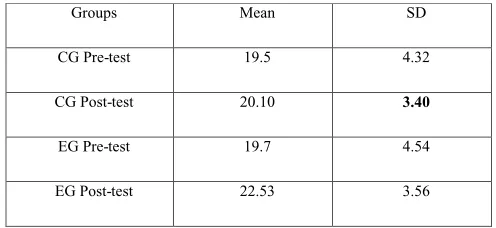
Table 1:
Descriptive statistics: pre-test and post-test concerning CG
and EG
The descriptive statistics in Table 1 indicates that there is a difference
between the mean scores of the pre-test and the post-test in the control
and experimental groups. The participants’ performance on the second
sample was better than their performance on the first one. Specifically,
Table 1 reveals that the participants’ oral performances in the
experi-mental group seem to have improved after being exposed to the
treat-ment in the classroom. In order to investigate the first null hypothesis,
an independent sample
t
-test was run. The
t
-observed value for the
com-parison of the control and experimental groups’ mean scores on the test
is 2.70. As shown in Table 2, this amount of
t
-value exceeds the
t
-critical. It can be claimed that there is a significant difference between
the two groups mean scores on the test, so the first null hypothesis is
rejected. The findings imply that the experimental group with a mean
of 22.53 outperformed the control group whose mean is 20.10.
Table 2:
A comparison of the post-test mean scores: control and
experimental groups
��� ����� �� ��������� ���������� �� ��� ���
���
�� ����� �� ����������� ��� ���� ����������� � ������ �� ����������� ������
����� ���� �� ������ ��� ���������� ���� ���� ��� ����������� ����������
���� �������� �� ����� �� ������� ��� ������� ���� ������ ��� ����
������������ ��� ������� ������� ��� �������� ���� ��� ��������� ���
���������� �� ����� � ������
����� ��
����������� ����������� �������� ��� ��������� ���������� ��
��� ��
��� ����������� ���������� �� ����� � ��������� ���� ����� �� � ���������
������� ��� ���� ������ �� ��� �������� ��� ��� ��������� �� ��� �������
��� ������������ ������� ��� ������������� ����������� �� ��� ������
������ ��� ������ ���� ����� ����������� �� ��� ���� ���� ������������
����� � ������� ���� ��� ������������� ���� ������������ �� ��� �������
������ ����� ���� �� ���� �������� ����� ����� ������� �� ��� ������
���� �� ��� ���������� �� ����� �� ����������� ��� ���� ���� �����������
�� ����������� ������ ������ ��� ���� ��� ���������� ����� ��� ��� ����
������� �� ��� ������� ��� ������������ ������� ���� ������ �� ��� ����
�� ����� �� ����� �� ����� �� ���� ������ �� ������� ������� ��� ��
��������� �� ��� �� ������� ���� ����� �� � ���������� ��������� �������
��� ��� ������ ���� ������ �� ��� ����� �� ��� ���� ���� ���������� ��
��������� ��� ������� ����� ����� ��� ������������ ����� ���� � ����
�� ����� ������������ ��� ������� ����� ����� ���� �� ������
����� ��
� ���������� �� ��� ��������� ���� ������� ������� ���
������������ ������
�������������������������������������������������������������������������������������������� �������������� ������������ ��� ����� ������������ ��� ��������� ��������� ����������� ��������� ��� ��������������������������������������������������������������������������������������������� �������������������� ���� ��������� ������������������������� ��������������������������������� ������������������������������������������������������������������������������������������������������������������������ � � ��������������������������������������������������������������������������������������������������� ���������������������������������������������������������������������������������������������� ������������������������������������������������������������������������������������������ ���������������������������� � ������������������������������������������������������������������������������������������������������� � ����������������������������������������������������������������������������� ������� ����� ��� ������������ ����� ����� ������������� ������ ����� ������������ ����� ����� ������������� ������ ����� ���� ������������ ����������� ��� ������ �� � ���������� ����� ������ ��� �� ����������� �������� ���� ����� ������� ��� ���� ��������� ���� ���� ���������� ��� ���� �������� ���� ������������� �������� ���� ���������������������������������������������������������������������������������������������� ������������������������������������������������������������������������������������������������ ������ ����� ��� ����� ��������� ������ ������ �������� ��� ���� ���������� ��� ���� �������������������������� ����������������������������������������������������������������������������������������������������������������� ����������������������������������������������������������������������������������������������� ��������������� �������������������������������������������������������������������������� ������������������������������������������������������������������������������������������������ ����������������������������������������������������������������������������������������������� ���������������������������������������������������������������������������������������������������� ����� �� ��������� ���������� �� ��� ���
���
�� ����� �� ����������� ��� ���� ����������� � ������ �� ����������� ������
����� ���� �� ������ ��� ���������� ���� ���� ��� ����������� ����������
���� �������� �� ����� �� ������� ��� ������� ���� ������ ��� ����
������������ ��� ������� ������� ��� �������� ���� ��� ��������� ���
���������� �� ����� � ������
����� ��
����������� ����������� �������� ��� ��������� ���������� ��
��� ��
��� ����������� ���������� �� ����� � ��������� ���� ����� �� � ���������
������� ��� ���� ������ �� ��� �������� ��� ��� ��������� �� ��� �������
��� ������������ ������� ��� ������������� ����������� �� ��� ������
������ ��� ������ ���� ����� ����������� �� ��� ���� ���� ������������
����� � ������� ���� ��� ������������� ���� ������������ �� ��� �������
������ ����� ���� �� ���� �������� ����� ����� ������� �� ��� ������
���� �� ��� ���������� �� ����� �� ����������� ��� ���� ���� �����������
�� ����������� ������ ������ ��� ���� ��� ���������� ����� ��� ��� ����
������� �� ��� ������� ��� ������������ ������� ���� ������ �� ��� ����
�� ����� �� ����� �� ����� �� ���� ������ �� ������� ������� ��� ��
��������� �� ��� �� ������� ���� ����� �� � ���������� ��������� �������
��� ��� ������ ���� ������ �� ��� ����� �� ��� ���� ���� ���������� ��
��������� ��� ������� ����� ����� ��� ������������ ����� ���� � ����
�� ����� ������������ ��� ������� ����� ����� ���� �� ������
����� ��
� ���������� �� ��� ��������� ���� ������� ������� ���
������������ ������
����� ��� ������ ������������� ���� �������� ������ ������ ����� ��� ���������������������������������������������� ����������������������������������������������������������������������������������������������������� ����������������������������������������������������������������������������������� � ���������� � ����� ����������� ���� � ��� ����� ������������������� � ������������������������������������������������������������������������������������������������� ���������������������������������������������������������������������������������������������� ����������� ��� ��������������������������������������������������������������������������������������������������������������������������� � � ������������������������������������������������������������������������������������������������ ���������������������������������������������������������������������������������������������� ���� ������������� ��� ������ �������� ��������� ��� ���� ������������� ������������������������������������������������ ���������������������������������������������������������������������������� � ����������������������������������������������������������������������������������������������� �������������� ���������� ��� ���� �������������� ����� ������������� ���� ����������� ����� ���� ��������� ����� ������������ ���������� ���� ����� ��� ������ ��� �������� ���� ���������� ��� �������������� �������� ����� ���������� ���� �������������� ��� ���� ������������������������������������������ ������������������������������������� � �������� ���� ��������� ��� ���� ����� ������������� ��� ���� ��������� ��� ����� ������� ���� ������� ��� �������������������������������������������������������������������������������������������� ����� ���������� ���������� ��� ������������ ���� ������������ ����� ������ �� �������� ������ �� ����������� ���� ����� �������� ������������ ���� ������������ ��� �������������� �������� � ���� ���������������������������������������������������������������������������������������������� ��������������������������������������������������������������������������������������������� ������������������������������������������������������������������������������������������ ������������������������������������������������������������������������������������������������������������ � ������������������ ��� ������������������������������������� � ���������������������� � ���������������� ����������� �� ���� ����� �� � ���� ����� ���� ����� �� ��������� ���������� �� ��� ���
���
�� ����� �� ����������� ��� ���� ����������� � ������ �� ����������� ������
����� ���� �� ������ ��� ���������� ���� ���� ��� ����������� ����������
���� �������� �� ����� �� ������� ��� ������� ���� ������ ��� ����
������������ ��� ������� ������� ��� �������� ���� ��� ��������� ���
���������� �� ����� � ������
����� ��
����������� ����������� �������� ��� ��������� ���������� ��
��� ��
��� ����������� ���������� �� ����� � ��������� ���� ����� �� � ���������
������� ��� ���� ������ �� ��� �������� ��� ��� ��������� �� ��� �������
��� ������������ ������� ��� ������������� ����������� �� ��� ������
������ ��� ������ ���� ����� ����������� �� ��� ���� ���� ������������
����� � ������� ���� ��� ������������� ���� ������������ �� ��� �������
������ ����� ���� �� ���� �������� ����� ����� ������� �� ��� ������
���� �� ��� ���������� �� ����� �� ����������� ��� ���� ���� �����������
�� ����������� ������ ������ ��� ���� ��� ���������� ����� ��� ��� ����
������� �� ��� ������� ��� ������������ ������� ���� ������ �� ��� ����
�� ����� �� ����� �� ����� �� ���� ������ �� ������� ������� ��� ��
��������� �� ��� �� ������� ���� ����� �� � ���������� ��������� �������
��� ��� ������ ���� ������ �� ��� ����� �� ��� ���� ���� ���������� ��
��������� ��� ������� ����� ����� ��� ������������ ����� ���� � ����
�� ����� ������������ ��� ������� ����� ����� ���� �� ������
����� ��
� ���������� �� ��� ��������� ���� ������� ������� ���
������������ ������
��� ����� �� ��������� ���������� �� ��� ���
���
�� ����� �� ����������� ��� ���� ����������� � ������ �� ����������� ������
����� ���� �� ������ ��� ���������� ���� ���� ��� ����������� ����������
���� �������� �� ����� �� ������� ��� ������� ���� ������ ��� ����
������������ ��� ������� ������� ��� �������� ���� ��� ��������� ���
���������� �� ����� � ������
����� ��
����������� ����������� �������� ��� ��������� ���������� ��
��� ��
��� ����������� ���������� �� ����� � ��������� ���� ����� �� � ���������
������� ��� ���� ������ �� ��� �������� ��� ��� ��������� �� ��� �������
��� ������������ ������� ��� ������������� ����������� �� ��� ������
������ ��� ������ ���� ����� ����������� �� ��� ���� ���� ������������
����� � ������� ���� ��� ������������� ���� ������������ �� ��� �������
������ ����� ���� �� ���� �������� ����� ����� ������� �� ��� ������
���� �� ��� ���������� �� ����� �� ����������� ��� ���� ���� �����������
�� ����������� ������ ������ ��� ���� ��� ���������� ����� ��� ��� ����
������� �� ��� ������� ��� ������������ ������� ���� ������ �� ��� ����
�� ����� �� ����� �� ����� �� ���� ������ �� ������� ������� ��� ��
��������� �� ��� �� ������� ���� ����� �� � ���������� ��������� �������
��� ��� ������ ���� ������ �� ��� ����� �� ��� ���� ���� ���������� ��
��������� ��� ������� ����� ����� ��� ������������ ����� ���� � ����
�� ����� ������������ ��� ������� ����� ����� ���� �� ������
����� ��
� ���������� �� ��� ��������� ���� ������� ������� ���
������������ ������
��� ����� �� ��������� ���������� �� ��� ���
���
�� ����� �� ����������� ��� ���� ����������� � ������ �� ����������� ������
����� ���� �� ������ ��� ���������� ���� ���� ��� ����������� ����������
���� �������� �� ����� �� ������� ��� ������� ���� ������ ��� ����
������������ ��� ������� ������� ��� �������� ���� ��� ��������� ���
���������� �� ����� � ������
����� ��
����������� ����������� �������� ��� ��������� ���������� ��
��� ��
��� ����������� ���������� �� ����� � ��������� ���� ����� �� � ���������
������� ��� ���� ������ �� ��� �������� ��� ��� ��������� �� ��� �������
��� ������������ ������� ��� ������������� ����������� �� ��� ������
������ ��� ������ ���� ����� ����������� �� ��� ���� ���� ������������
����� � ������� ���� ��� ������������� ���� ������������ �� ��� �������
������ ����� ���� �� ���� �������� ����� ����� ������� �� ��� ������
���� �� ��� ���������� �� ����� �� ����������� ��� ���� ���� �����������
�� ����������� ������ ������ ��� ���� ��� ���������� ����� ��� ��� ����
������� �� ��� ������� ��� ������������ ������� ���� ������ �� ��� ����
�� ����� �� ����� �� ����� �� ���� ������ �� ������� ������� ��� ��
��������� �� ��� �� ������� ���� ����� �� � ���������� ��������� �������
��� ��� ������ ���� ������ �� ��� ����� �� ��� ���� ���� ���������� ��
��������� ��� ������� ����� ����� ��� ������������ ����� ���� � ����
�� ����� ������������ ��� ������� ����� ����� ���� �� ������
����� ��
� ���������� �� ��� ��������� ���� ������� ������� ���
������������ ������
The Effect of Portfolio Assessment on the ...
115
were computed in order to provide the average mean scores for both
experimental and control groups. The obtained data are described and
summarized in table 1 below.
Table 1:
Descriptive statistics: pre-test and post-test concerning CG
and EG
The descriptive statistics in Table 1 indicates that there is a difference
between the mean scores of the pre-test and the post-test in the control
and experimental groups. The participants’ performance on the second
sample was better than their performance on the first one. Specifically,
Table 1 reveals that the participants’ oral performances in the
experi-mental group seem to have improved after being exposed to the
treat-ment in the classroom. In order to investigate the first null hypothesis,
an independent sample
t-test was run. The
t-observed value for the
com-parison of the control and experimental groups’ mean scores on the test
is 2.70. As shown in Table 2, this amount of
t-value exceeds the
t-critical. It can be claimed that there is a significant difference between
the two groups mean scores on the test, so the first null hypothesis is
rejected. The findings imply that the experimental group with a mean
of 22.53 outperformed the control group whose mean is 20.10.
Table 2:
A comparison of the post-test mean scores: control and
experimental groups
��� ����� �� ��������� ���������� �� ��� ���
���
�� ����� �� ����������� ��� ���� ����������� � ������ �� ����������� ������
����� ���� �� ������ ��� ���������� ���� ���� ��� ����������� ����������
���� �������� �� ����� �� ������� ��� ������� ���� ������ ��� ����
������������ ��� ������� ������� ��� �������� ���� ��� ��������� ���
���������� �� ����� � ������
����� ��
����������� ����������� �������� ��� ��������� ���������� ��
��� ��
��� ����������� ���������� �� ����� � ��������� ���� ����� �� � ���������
������� ��� ���� ������ �� ��� �������� ��� ��� ��������� �� ��� �������
��� ������������ ������� ��� ������������� ����������� �� ��� ������
������ ��� ������ ���� ����� ����������� �� ��� ���� ���� ������������
����� � ������� ���� ��� ������������� ���� ������������ �� ��� �������
������ ����� ���� �� ���� �������� ����� ����� ������� �� ��� ������
���� �� ��� ���������� �� ����� �� ����������� ��� ���� ���� �����������
�� ����������� ������ ������ ��� ���� ��� ���������� ����� ��� ��� ����
������� �� ��� ������� ��� ������������ ������� ���� ������ �� ��� ����
�� ����� �� ����� �� ����� �� ���� ������ �� ������� ������� ��� ��
��������� �� ��� �� ������� ���� ����� �� � ���������� ��������� �������
��� ��� ������ ���� ������ �� ��� ����� �� ��� ���� ���� ���������� ��
��������� ��� ������� ����� ����� ��� ������������ ����� ���� � ����
�� ����� ������������ ��� ������� ����� ����� ���� �� ������
����� ��
� ���������� �� ��� ��������� ���� ������� ������� ���
������������ ������
�������������������������������������������������������������������������������������������� �������������� ������������ ��� ����� ������������ ��� ��������� ��������� ����������� ��������� ��� ��������������������������������������������������������������������������������������������� �������������������� ���� ��������� ������������������������� ��������������������������������� ������������������������������������������������������������������������������������������������������������������������ � � ��������������������������������������������������������������������������������������������������� ���������������������������������������������������������������������������������������������� ������������������������������������������������������������������������������������������ ���������������������������� � ������������������������������������������������������������������������������������������������������� � ����������������������������������������������������������������������������� ������� ����� ��� ������������ ����� ����� ������������� ������ ����� ������������ ����� ����� ������������� ������ ����� ���� ������������ ����������� ��� ������ �� � ���������� ����� ������ ��� �� ����������� �������� ���� ����� ������� ��� ���� ��������� ���� ���� ���������� ��� ���� �������� ���� ������������� �������� ���� ���������������������������������������������������������������������������������������������� ������������������������������������������������������������������������������������������������ ������ ����� ��� ����� ��������� ������ ������ �������� ��� ���� ���������� ��� ���� �������������������������� ����������������������������������������������������������������������������������������������������������������� ����������������������������������������������������������������������������������������������� ��������������� �������������������������������������������������������������������������� ������������������������������������������������������������������������������������������������ ����������������������������������������������������������������������������������������������� ���������������������������������������������������������������������������������������������������� ����� �� ��������� ���������� �� ��� ���
���
�� ����� �� ����������� ��� ���� ����������� � ������ �� ����������� ������
����� ���� �� ������ ��� ���������� ���� ���� ��� ����������� ����������
���� �������� �� ����� �� ������� ��� ������� ���� ������ ��� ����
������������ ��� ������� ������� ��� �������� ���� ��� ��������� ���
���������� �� ����� � ������
����� ��
����������� ����������� �������� ��� ��������� �������