Please cite this article as: M. Asadollahzadeh, M. Torab-mostaedi, R. Torkaman, Studies of Drop Behavior and Prediction of Sauter Mean Drop Diameter in Various Rotary Agitated Extraction Columns, International Journal of Engineering (IJE), TRANSACTIONSB: Applications Vol. 29, No. 8, (August 2016) 1047-1055
International Journal of Engineering
J o u r n a l H o m e p a g e : w w w . i j e . i rStudies of Drop Behavior and Prediction of Sauter Mean Drop Diameter in Various
Rotary Agitated Extraction Columns
M. Asadollahzadeh*, M. Torab-mostaedi, R. Torkaman
Nuclear Fuel Cycle Research School, Nuclear Science and Technology Research Institute, Tehran, Iran
P A P E R I N F O
Paper history:
Received 20 February 2016 Received in revised form 02 June 2016 Accepted 02 June 2016
Keywords:
Liquid-liquid Extraction Oldshue-rushton Column Kühni Column Mean Drop Diameter Rotary Agitated Extractors
A B S T R A C T
Knowledge of droplet behavior is one of the most important criteria for determination of mass transfer kinetics for choosing the type of liquid-liquid extraction columns. Mean drop size data of dispersed phase droplets in continuous phase were obtained for various rotary agitated liquid-liquid extraction columns. The effects of operational variables such as rotor speed and dispersed and continuous phase velocities were investigated. In addition, the effect of mass transfer direction was studied on the Sauter mean drop diameter. The Sauter mean drop diameter was influenced mainly by mass transfer direction and agitation speed. In this research work, previous experimental works in agitated extraction columns (RDC, ARDC, PRDC, Scheibel, Oldshue-Rushton and Kühni columns) are reviewed. Calculations with the literature correlations cannot predict experimental data, thus unified correlations considering the physical properties, operating conditions and geometric parameters were provided to predict the mean drop size (d32). The results of the proposed correlation were compared with the experimental data
obtained from the literature and the present investigation. This correlation covers several physical systems for various rotary agitated extractors. Findings of this study demonstrated that the proposed correlation leads to an accurate prediction for the Sauter mean drop diameter in rotary extraction columns.
doi: 10.5829/idosi.ije.2016.29.08b.03
1. INTRODUCTION1
Liquid-liquid extraction is a process in which a particular solute is removed from a liquid phase by another immiscible liquid phase [1, 2]. The extraction of natural products from plants, purification in biodiesel production and other green chemistry technologies use the solvent extraction process for product cleaning and selective separation of products [3-5].
In the industry, a great variety of different equipment designs is used in extraction processes. Mixing in these columns generates a large interfacial area with efficient mass transfer of the desired solute between the two immiscible liquids [6]. The rotating disc contactor (RDC) consists of a number of compartments formed by a series of stator rings, with a rotating disk centered in each compartment and supported by a common rotating
1*Corresponding Author’s Email: [email protected] (M.
Asadollahzadeh)
on a central shaft. The Kühni column is also similar to the Scheibel column, but does not contain any packing. The principal features of the column are the use of a shrouded turbine impeller to promote radial discharge within the compartments [14, 15]. Knowledge of droplet behavior is one of the most important criteria for determination of mass transfer kinetics for choosing the type of extraction equipment. In addition, viscosity and surface tension are the criteria for the agitation energy needed to disperse a phase and these parameters have main effect on the droplet size in agitation extraction columns [16]. A number of correlations have been proposed to predict the mean drop size in liquid–liquid extraction columns using different columns and
systems. Kumar and Hartland suggested two
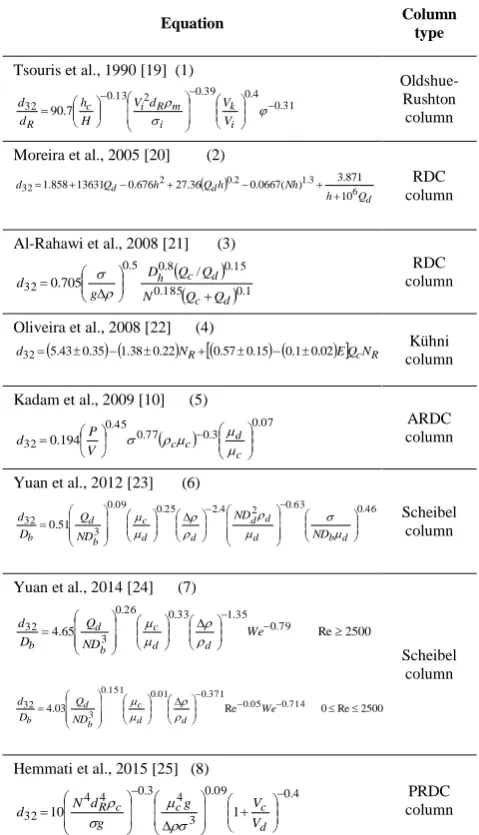
correlations for low and high rotor speed for RDC column [17]. A unified correlation for prediction of the drop size in mechanically agitated columns, namely Kühni, rotating disc, asymmetric rotating disc and Wirtz-II was reported by Kumar and Hartland [18]. Different correlations for Sauter mean drop diameter are shown in Table 1. However, no reliable equation for the prediction of drop diameter in all agitated contactors has been proposed so far.
The aim of this research work is to acquire a sufficient understanding of drop behavior in rotary agitated columns in order to obtain basic data required for design of extraction columns.
Drop size in two rotary agitated columns (Oldshue-Rushton and Kühni columns) has been studied by changing the operating parameters such as disperse and continuous phase flow rates and agitation speed. The results are discussed and compared with the predicted values from several available data and correlations in the literature for rotary agitated columns. Finally, two correlations are proposed for prediction of Sauter mean drop diameter with the experimental data from Oldshue-Rushton and Kühni columns and other experimental data in the literature.
2. EXPERIMENTAL
2. 1. Experimental Materials Studied systems were n-butanol–water, n-butyl acetate–water and toluene–water in the experiments without mass transfer. Two systems involving toluene-acetone (3.5%)-water and n-butyl acetate–acetone (3.5%)-water were used in the experiments with two directions of mass transfer. The data analysis was divided into three cases: no solute transfer; solute transfer from the continuous (c) to the dispersed (d) phase, and solute transfer from the (d) to the (c) phase. These liquid–liquid systems have been recommended by the European Federation of Chemical Engineering as official test systems for investigation of extraction. Distilled water was used as the continuous phase and technical grade of toluene; n-butyl acetate
and n-butanol were used as the dispersed phase. The physical properties of the chemical systems are given in Table 2.
TABLE 1. Unified correlations for prediction of the drop size in mechanically agitated columns
Equation Column
type
Tsouris et al., 1990 [19] (1)
31 . 0 4 . 0 39 . 0 2 13 . 0
32 90.7
i k i m R i c R V V d V H h d d Oldshue-Rushton column
Moreira et al., 2005 [20] (2) d d d Q h Nh h Q h Q
d32 2 0.2 1.3 6
10 871 . 3 ) ( 0667 . 0 36 . 27 676 . 0 13631 858 . 1 RDC column
Al-Rahawi et al., 2008 [21] (3)
0.1 185 . 0 15 . 0 8 . 0 5 . 0 32 / 705 . 0 d c d c h Q Q N Q Q D g d
column RDC
Oliveira et al., 2008 [22] (4)
NR EQcNR
d325.430.351.380.22 0.570.150.10.02 Kühni
column
Kadam et al., 2009 [10] (5)
0.3 0.07 77 . 0 45 . 0
32 0.194
c d c c V P d ARDC column
Yuan et al., 2012 [23] (6)
46 . 0 63 . 0 2 4 . 2 25 . 0 09 . 0 3 32 0.51
d b d d d d d c b d b ND ND ND Q D d Scheibel column
Yuan et al., 2014 [24] (7)
2500 Re 65
.
4 0.79
35 . 1 33 . 0 26 . 0 3 32 We ND Q D d d d c b d b 2500 Re 0 Re 03 .
4 0.05 0.714
371 . 0 01 . 0 151 . 0 3
32
We ND Q D d d d c b d b Scheibel column
Hemmati et al., 2015 [25] (8)
4 . 0 09 . 0 3 4 3 . 0 4 4
32 10 1
d c c c R V V g g d N d
column PRDC
TABLE 2. Physical properties of systems studied at 20 ºC [26]. Physical property Toluene-Water n-Butyl acetate-Water n-Butanol-Water
ρc [kg/m3] 998.2 997.6 985.6
ρd [kg/m3] 865.2 880.9 846.0
μc [mPa.s] 0.963 1.027 1.426
μd [mPa.s] 0.854 0.734 3.364
2. 2. Experimental Pilot Plant Setup The schematic diagram of the Kühni and Oldshue-Rushton contactors used in the present study is depicted in Figure 1. The Kühni contactor consists of glass section, 700 mm in length and with an inside diameter of 113 mm, at 10 stages. Agitation at each stage is achieved with 50 mm diameter shrouded six-blade turbine agitator with an accurate speed control. The Oldshue-Rushton column is built of a cylindrical glass section and is equipped with impellers with accurate speed control, whereas the internal parts are constructed of stainless steel. The main section is made of Pyrex glass with 113 mm internal diameter and the height of the column with nine stages is 700 mm. Mixing is obtained by nine 6-blade impellers of 50 mm diameter located at the center of each stage and these impellers are driven by an electric motor via a variable gear box. In the two columns, the organic phase (dispersed phase) and water (continuous phase) were fed into the extraction column at the bottom and on the top respectively in counter-current mode. The inlet and outlet of the extraction column were connected to four tanks, each of 85 L capacity.
2. 3. Drop Size Measurement The drop size was measured by means of a very high-resolution Nikon D5000 digital camera used to take a digital photo of the extractor contents. Next, droplet dimensions were compared with the thickness of the stators as a reference. The four different heights of active column were selected to determine the size of the droplets. A minimum of 1000 drops was analyzed with the digital image analysis software for each experimental condition in order to guarantee the statistical significance of the determined size distributions. The Sauter mean diameter was then calculated according to the following equation:
N
i i i N
i i i
d n
d n d
1 2 1
3
32 (9)
where ni is the number of droplets of mean diameter di within a narrow size range i.
3. RESULTS AND DISCUSSION
In this research work, the effects of operating variables such as continuous and dispersed phase velocities, rotor speed and mass transfer direction on the Sauter mean drop diameter in the Oldshue-Rushton and Kühni columns are evaluated.The pictures of drop sizes in both columns are shown in Figure 2.
3. 1. Effect of Rotor Speed on Sauter Mean Drop Size in Two Agitated Columns The experimental
results for Sauter mean drop size in two columns with rotor speed are shown in Figure 3. It is observed that the agitation rate is increased, the average drop size significantly decreases. The rotor speed had a strong effect on the Sauter mean drop diameter. The explanation for this effect is related to the increment in the frequency of drop collisions against the internal parts of the column extractor in more turbulent fluid flow in their ascending path inside the equipment.
Figure 1. Schematic diagram of the Oldshue-Rushton and Kuhni column extractors.
Figure 2. Variation of drop sizes in (a) Oldshue-Rushton column extractor and (b) Kuhni column for toluene-water
An increase in the energy supplied via agitation to the dispersed phase overcomes the interfacial forces of the droplets and, therefore, the droplets break.
From the results presented in Figure 3, it was observed that smaller drops were generated from the low interfacial system (n-butanol-water) rather than medium or higher interfacial system (n-butyl acetate-water or toluene-acetate-water).
3. 2. Effect of Dispersed Phase Velocities on Sauter Mean Drop Size in Two Agitated Columns The effects of the dispersed phase velocities on the Sauter mean drop diameter were tested, which is shown in Figure 4. According to this figure, increasing dispersed phase velocity leads to an increase in the mean drop size, however, it is changed slightly at low interfacial tension. This observation relates to the increasing drop collisions with the acceleration of the dispersed phase velocity and consequently the coalescence frequency among the drops is increased. 3. 3. Effect of Continuous Phase Velocities on Sauter Mean Drop Size in Two Agitated Columns Sauter mean drop diameter is plotted as a function of continuous phase velocities in Figure 5.
Figure 3. Effect of rotor speed on Sauter mean drop diameter
in Oldshue-Rushton and Kühni columns (Vc=Vd=0.66 mm/s).
Figure 4. Effect of dispersed phase velocity on Sauter mean drop diameter in Oldshue-Rushton and Kühni columns for (a) toluene-water, (b) n-butyl acetate-water, (c) n-butanol-water
(Vc=0.66 mm/s).
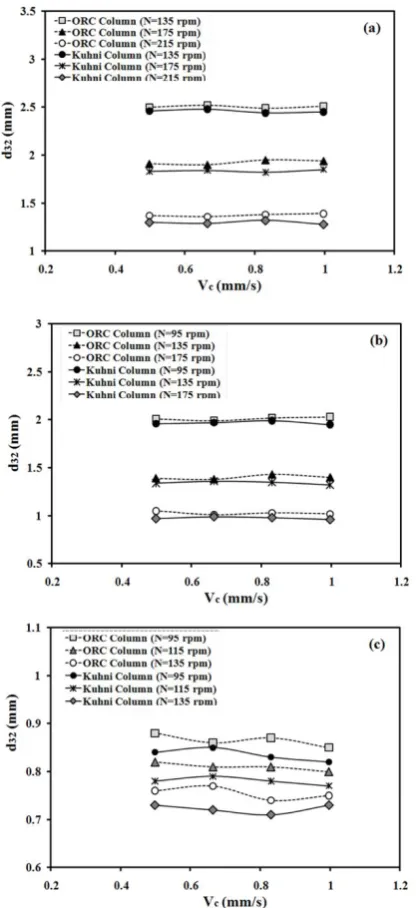
It is observed that the variations in the mean drop diameter with increasing continuous phase velocity are insignificant. Thus, the figure reveals that this effect has a negligible effect on the mean drop size.
Figure 5. Effect of continuous phase velocity on Sauter mean drop diameter in Oldshue-Rushton and Kühni columns for (a) toluene-water, (b) n-butyl acetate-water, (c) n-butanol-water
(Vd=0.66 mm/s).
The presence of a solute leads to lower interfacial tension between the two immiscible liquids. The smaller drop sizes are observed due to the higher breakage rates for the mass transfer occurring from the continuous to the dispersed phase (c to d). For mass transfer in the opposite direction (d to c), the larger drops are created by the coalescence rate.
When mass transfer occurs from the dispersed to continuous phase, the concentration in the liquid film between the drops is equilibrated rapidly with the drop concentration. The solute concentration in the draining
film between the two approaching drops will be higher than in the surrounding continuous liquid. This phenomenon creates interfacial tension gradients which in turn causes interfacial flow. The enhanced mobility of the interface squeezes the continuous phase film between the drops rapidly and, therefore, the drop coalescence rate is increased.
TABLE 3. Effect of mass transfer direction on Sauter mean drop diameter in Oldshue-Rushton column for toluene-acetone-water system.
O
ld
sh
u
e
-R
u
sh
to
n
c
o
lu
m
n
Vd Vc rpm transfer c to d no mass transfer transfer d to c
0.6648 0.4986 155 2.21 2.27 2.32 0.6648 0.6648 155 2.24 2.29 2.34 0.6648 0.8309 155 2.22 2.25 2.31 0.6648 0.9971 155 2.23 2.26 2.33 0.6648 0.4986 195 1.42 1.49 1.55 0.6648 0.6648 195 1.43 1.47 1.52 0.6648 0.8309 195 1.40 1.48 1.53 0.6648 0.9971 195 1.41 1.51 1.54 0.4986 0.6648 155 2.11 2.16 2.19 0.6648 0.6648 155 2.24 2.29 2.34 0.8309 0.6648 155 2.33 2.36 2.41 0.9971 0.6648 155 2.41 2.45 2.52 0.4986 0.6648 195 1.36 1.40 1.46 0.6648 0.6648 195 1.43 1.47 1.52 0.8309 0.6648 195 1.47 1.53 1.58 0.9971 0.6648 195 1.55 1.65 1.69 0.6648 0.6648 135 2.49 2.52 2.59 0.6648 0.6648 155 2.24 2.29 2.34 0.6648 0.6648 175 1.85 1.9 1.95 0.6648 0.6648 195 1.43 1.47 1.52 0.6648 0.6648 215 1.31 1.36 1.41 0.6648 0.6648 235 1.03 1.11 1.18
K
u
h
n
i c
o
lu
m
n
Vd Vc rpm
c to d transfer
no mass transfer
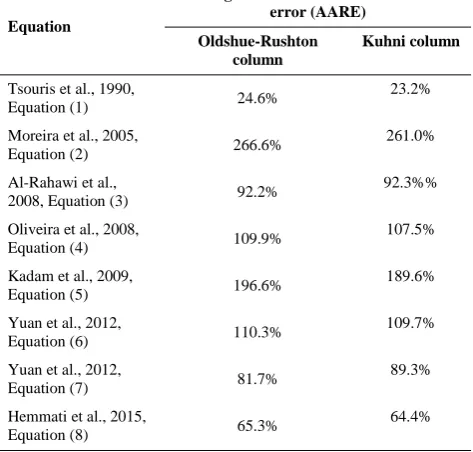
3. 5. Comparison of the Experimental Results with Previous Correlation The previous correlations in Table 1 were selected for comparison with the experimental data. The averaged absolute values of the relative error (AARE) of the calculated values of the Sauter mean drop diameter obtained by applying previous correlations to the experimental results are listed in Table 4. It is obvious from the results that the previous correlations could not accurately predict and fit the measured data.
3. 6. Prediction of New Correlations As can be seen in Table 4, the amount of error is not acceptable for prediction of experimental data in Oldshue-Rushton and Kuhni columns. Therefore, a new correlation is proposed for prediction of the Sauter mean drop diameter in these columns. Also, the experimental data on the other rotary agitated columns is used to improve the accuracy of the correlation and generalized equation for these columns.
All the independent variables may be rearranged in terms of dimensionless groups to give a general form. By using regression analysis, the following correlation was obtained from experimental data and other researchers [9, 10, 19, 20, 22-25, 27-32]:
01 . 0 98 . 0 07 . 0 25 . 0 2 14 . 0 05 . 0 3 4 19 . 0 4 4 1
32 (1 )
d c c c d d c c c R g V V V g g d N C d (10)
The effect of mass transfer on Sauter mean drop diameter is shown by constant parameter (C1) in the above equation. The values of this parameter for mass transfer condition are presented in Table 5.
TABLE 4. The values of AARE in the predicted values of Sauter mean drop diameter obtained by previous correlations
Equation
Averaged absolute values of the relative error (AARE)
Oldshue-Rushton column
Kuhni column
Tsouris et al., 1990,
Equation (1) 24.6%
23.2%
Moreira et al., 2005,
Equation (2) 266.6%
261.0%
Al-Rahawi et al.,
2008, Equation (3) 92.2%
92.3%%
Oliveira et al., 2008,
Equation (4) 109.9%
107.5%
Kadam et al., 2009,
Equation (5) 196.6%
189.6%
Yuan et al., 2012,
Equation (6) 110.3%
109.7%
Yuan et al., 2012,
Equation (7) 81.7%
89.3%
Hemmati et al., 2015,
Equation (8) 65.3%
64.4%
TABLE 5. The constants and AARE values of Equation (10) and Equation (11)
Equation (10) C1 AARE%
no mass transfer 5.7709 9.65
continuous to dispersed transfer (c→d) 7.1299 10.52
dispersed to continuous transfer (d→c) 6.7009 9.80
Equation (11) C2 AARE%
no mass transfer 0.06475 10.41
continuous to dispersed transfer (c→d) 0.07083 10.95
dispersed to continuous transfer (d→c) 0.07104 9.45
The comparison of the obtained results via the experimental data reported by researchers in various rotary agitated columns and experimental work in two columns is shown in Figure 6. The correlation predicts the results with an average error of 9.99%.
In the second correlation, the same variables are considered as for the first correlation and the column geometry term. This correlation is derived based on the experimental results of the present work and the data taken from other researchers [9, 10, 19, 20, 23-25, 28, 29, 31]: 44 . 0 37 . 0 25 . 0 2 61 . 0 03 . 0 3 4 21 . 0 4 4 2
32 (1 )
c R c c d d c c c R HD d h g V V V g g d N C d (11)
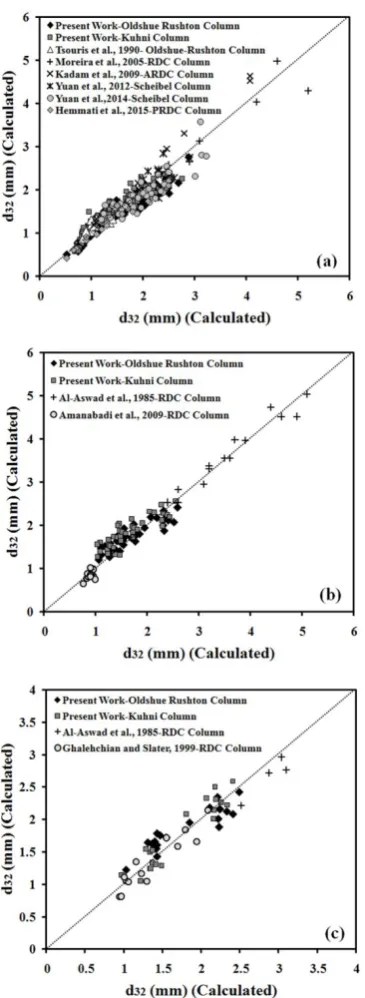
The effect of mass transfer in this equation is shown by constant parameter (C2) in the above equation. The values of this parameter for mass transfer condition and average absolute relative error are shown in Table 5. Comparison of the experimental results with the calculated values from the proposed correlation is shown in Figure 7.
Figure 7. Comparison between experimental data and estimated values using Equation (11) for (a) no mass transfer, (b) d to c transfer and (c) c to d transfer.
The Sauter mean drop diameter predicted by the proposed correlations is in good agreement with the experimental results.The obtained results show that the proposed equation can be used for prediction of Sauter mean drop diameter of rotary agitated extraction columns (RDC, ARDC, Scheibel, Oldshue-Rushton and Kühni columns) for different physically equilibrated
systems and can be extended to the cases with mass transfer.
4. CONCLUSION
An experimental study of the mean drop size measurements in the two agitated columns (Oldshue-Rushton and Kühnicolumns) was carried out. It was shown that the smaller drop size was produced by an increase in the agitation speed in two columns. The drop size could be increased with increasing dispersed phase velocity, but the continuous phase velocity does not have a significant effect. The Sauter mean drop diameter, required for estimation of the interfacial area of mass transfer is correlated with the knowledge of phase flow rates, physical properties, agitation speed, mass transfer conditions and also the column geometry of rotary agitated columns in the present work and the previous experimental works in the literature.
The proposed equations pave the way for accurate predictions for the Sauter mean drop diameter in various rotary agitated columns with different physical properties. The present correlation is contrary to the previous studies in which the d32 was estimated for only one physical system such as toluene-water and for only one extraction column, but this correlation covers several physical systems for rotary agitated extractors. Therefore, this correlation can be incorporated in the design procedure for such contactors and this has been successfully extrapolated to the design of larger columns.
5. ACKNOWLEDGMENTS
The authors would like to thank Iran National Science Foundation (INSF) for providing the financial support for this project (Project No. 92038028).
6. REFERENCES
1. Mersmann, A., Kind, M. and Stichlmair, J., "Thermal separation technology, principles, method, process design, New York, Springer, (2011).
2. Kislik, V. S., "Solvent extraction: Classical and novel approaches, Elsevier, (2012).
3. Bart, H. J. and Pilz, S., "Industrial scale natural products extraction, Garmany, Wiley-VCH Verlag & Co, (2011). 4. Saloma, E. E., Vazquez-Villegas, P., Aguilar, O. and
Rito-Palomares, M., "Continuous aqueous two-phase systems devices for therecovery of biological products", Food Bioprod Process, Vol. 92, (2014), 101-112.
6. Dutta, B. K., "Principles of mass transfer and separation processes, India, Prentice-Hall of India, (2007).
7. Godfrey, J. C. and Slater, M. J., "Liquid-liquid extraction equipment, Wiley, (1994).
8. Attarakih, M., MazenAbu-Khader and Hans-JorgBart, "Modeling and dynamic analysis of a rotating disc contactor(rdc) extraction column using one primary and one secondary particle method (opospm)", Chemical Engineering Science, Vol. 91, (2013), 180-196.
9. Torab-Mostaedi, M. and Asadollahzadeh, M., "Mass transfer performance in an asymmetricrotating disc contactor", Chemical Engineering Research and Design, Vol. 94, (2015), 90-97. 10. Kadam, B. D., Joshi, J. B. and Patil, R. N., "Hydrodynamic and
mass transfer characteristics of asymmetric rotating disc extractors", Chemical Engineering Research and Design, Vol. 87, (2009), 756-769.
11. Wang, Y. D., Fei, W. Y. and Sun, J. H., "Hydrodynamics and masstransfer performance of modified rotating disc contactor(mrdc)", Chemical Engineering Research and Design, Vol. 80, (2002), 392-400.
12. Mjalli, F. S. and Abdel-Jabbar, N. M., "Control of scheibel extraction contactors using neural-network-based control algorithms", Industrial & Engineering Chemistry Research, Vol. 44, (2005), 2125-2133.
13. Ma, S., Li, P., Zhu, T., Chang, H. and LinSchool, L., "Reaction extraction of furfural from pentose solutions in a modifiedscheibel column", Chemical Engineering Process, Vol. 83, (2014), 71-78.
14. Rode, S., Durand, A., Mabille, I. and Favre, E., "Flooding characteristics of an aqueous two phase system in a countercurrent kühni type column", Chemical Engineering Science, Vol. 98, (2013), 98-103.
15. Buchbender, F., ArminFischer and AndreasPfennig, "Influence of compartment geometry on the residence time of single drops in kuhni extraction columns", Chemical Engineering Science, Vol. 104, (2013), 701-716.
16. Clift, R., Grace, J. R. and Weber, M. E., "Bubbles, drops and particles, New York, Academic Press, (1978).
17. Kumar, A. and Hartland, S., "Prediction of drop size in rotating disc extractors", The Canadian Journal of Chemical Engineering, Vol. 64, (1986), 915-924.
18. Kumar, A. and Hartland, S., "Unified correlations for the prediction of drop size in liquid-liquid extraction columns",
Industrial & Engineering Chemistry Research, Vol. 35, No., (1996).
19. Tsouris, C., Ferreira, R. and Tavlarides, L. L., "Characterization of hydrodynamic parameters in a multistage column contactor",
The Canadian Journal of Chemical Engineering, Vol. 68, (1990), 913-923.
20. Moreira, E., Eonardo, L., Pimenta, M., Carneiro, L. L., Faria, R. C. L. and Mansur, M. B., "Hydrodynamic behavior of a rotating disc contactor under low agitation conditions", Chemical Engineering Communications, Vol. 192, (2005), 1017-1035. 21. Al-Rahawi, A. M. I., "New predictive correlations for the drop
size in a rotating disc contactor liquid-liquid extraction column",
Chemical Engineering & Technology, Vol. 30, No. 2, (2007), 184-192.
22. Oliveira, N. S., Silva, D. M., Gondim, M. P. C. and Mansur, M. B., "A study of the drop size distributions and holdup in short kuhni columns", Brazilian Journal of Chemical Engineering, Vol. 25, No. 4, (2008), 729-740.
23. Yuan, S., Shi, Y., Yin, H., Chen, Z. and Zhou, J., "Correlation of the drop size in a modified scheibel extraction column",
Chemical Engineering & Technology, Vol. 35, No. 10, (2012), 1-8.
24. Yuan, S., Jin, S., Chen, Z., Yuan, Y. and Yin, H., "An improved correlation of the mean drop size in a modified scheibel extraction column", Chemical Engineering Technology, Vol. 37, No. 12, (2014), 2165-2174.
25. Hemmati, A., Torab-Mostaedi, M., Shirvani, M. and Ghaemi, A., "A study of drop size distribution and mean dropsize in a perforated rotating disc contactor (prdc)", Chemical Engineering Research and Design, Vol. 96, No., (2015), 54-62.
26. Misek, T., Berger, R. and Schroter, J., "Standard test systems for liquid extraction studies, EFCE Publication Series, (1985).
27. Kentish, S. E., Stevens, G. W. and Pratt, H. R. C., "Measurement of drop rise velocities within a ku1 hni extraction column", Industrial & Engineering Chemistry Research, Vol. 36, (1997), 4928-4933.
28. Aswad, K. K. A., Mumford, C. J. and Jeffreys, G. V., "The application of drop size discrete drop mass transfer distribution and models to assess the performance of a rotating disc contactor", AIChE Journal, Vol. 31, No. 9, (1985), 1488-1497. 29. Amanabadi, M., Bahmanyar, H., Zarkeshan, Z. and Mousavian, M. A., "Prediction of effective diffusion coefficient in rotating disc columns and application in design ", Chinese Journal of Chemical Engineering , Vol. 17, (2009), 366-372.
30. Martunus, Helwani, Z. and Othman, M. R., "Forward mixing model in a rotating disc contactor for kerosene–acetic acid– water system", Applied Mathematical Modelling, Vol. 34, (2010), 2901-2909.
31. Ghalehchian, J. S. and Slater, M. J., "A possible approach to improving rotating disc contactor design accounting for drop breakage and mass transfer with contamination", Chemical Engineering Journal, Vol. 75, (1999), 131-144.
32. Dongaonkar, K. R., Pratt, H. R. C. and Stevens, G. W., "Mass transfer and axial dispersion in a kuhni extraction column",
Studies of Drop Behavior and Prediction of Sauter Mean Drop Diameter in Various
Rotary Agitated Extraction Columns
M. Asadollahzadeh, M. Torab-mostaedi, R. Torkaman
Nuclear Fuel Cycle Research School, Nuclear Science and Technology Research Institute, Tehran, Iran
P A P E R I N F O
Paper history:
Received 20 February 2016 Received in revised form 02 June 2016 Accepted 02 June 2016
Keywords:
Liquid-liquid Extraction Oldshue-rushton Column Kühni Column Mean Drop Diameter Rotary Agitated Extractors
ديكچ ه
غیاه جارختسا ىَتس عًَ باختًا یارت مرج لاقتًا کیتٌیس يییؼت یارت نْه یاّرایؼهزا یکی ُرطق راتفر زا یّاگآ
-یه غیاه
-ىَتس رد ِتسَیپ زاف رد ُذٌکارپ زاف تارطق ُداد ُزاذًا طسَته قیقحت يیا رد .ذشات .ذییدرگ ییسررت فلتخه راد ىسوّ یاّ
ىَتسا لاقتًا ات مرج لاقتًا تْج رثا يیٌچوّ ٍ ِتسَیپٍ ُذٌکارپزاف تػرسٍرَتٍر تػرس ِلوجزا یتایلوػ یاّریغته تارثا
رَیتٍر تػریس ٍ مرج لاقتًا تْج ریثات تحت ًاتذوػ تارطق رطق طسَته رطق ِک داد ىاشً جیاتً .تفرگرارق یسررت درَه
یه .ذٌشات رد یلثق یترجت یاّراک،قیقحت يیارد ىَتس
ىسوّ جارختسا یاّ یایّ ىَتس ریظً( راد
RDC, ARDC, PRDC ،
َشذلٍا ،لثیش
ِیت طیتاٍر يییا ِیک داد ىایشً یلثق طتاٍر یٍر رت تاثساحه .تفرگ رارق ِؼلاطه درَه )یٌَّک ٍ ىَتشار
ُداد یٌیت شیپ ِت رداق یتَخ یوً یّاگشیاهزآ یاّ
،یکیسیف صاَخ ةسحرت یلک ِطتار کی يیارتاٌت .ذٌشات یتایلوػ طیارش
( تارطق ُزاذًا طسَته یٌیت شیپ ِت رداق ِک یًاوتخاس یاّرتهاراپ ٍ d32
یه ) ِیطتار زا لیصاح جیاتً .ذیدرگ داٌْشیپ ،ذشات
ُذیش ِیئارا ِیطتار .تفرگ رارق یسررت درَهرضاح شٍّژپٍ يیشیپ تاقیقحت زا ُذهآ تسذت یترجت یاّ ُداد ات ُذش ِئارا
نتسیس ر یدذؼته ییایویش یاّ ىَتس یارت ا
ىسوّ فلتخه یاّ یه رارق ششَپ درَه راد
ِیؼلاطه يییا زا لیصاح جیاتً .ذّد
ىَتس رد تارطق طسَته ُزاذًا قیقد یٌیت شیپ ِت قَف ِطتار ِک داد ىاشً ىسوّ یاّ
یه راد .دزادرپ