International Journal of Engineering
J o u r n a l H o m e p a g e : w w w . i j e . i r
Numerical Study of Progressive Collapse in Framed Structures: A New Approach for
Dynamic Column Removal
H. R. Tavakolia*, F. Kiakojourib
a Department of Earthquake Engineering, Babol University of Technology, Babol, Iran b Department of Structural Engineering, Islamic Azad University, Takestan Branch, Iran
P A P E R I N F O
Paper history:
Received 10 December 2012
Received in revised form 30 January 2013 Accepted 28 February 2013
Keywords:
Column Removal Analysis Dynamic Nonlinear Analysis Progressive Collapse Alternative Load Path
A B S T R A C T
Progressive collapse is a situation where local failure of a primary structural component leads to the collapse of adjoining members which, in turn, leads to additional collapse. Hence, the total damage is disproportionate to the original cause. The most common local failure in framed structure is assumed to be column failure. In this paper, a new approach for dynamic column removal in framed structures was proposed. Using this approach, the structural response of a 5-story steel frame building under the sudden loss of columns for different scenarios of column removal was numerically assessed. Both material and geometric nonlinearities were taken into account in the analysis. The modeling techniques were described in details. Special emphasis was focused on the evolution of vertical displacements of column removal point. According to the results progressive collapse potential are strongly dependent on location of column loss. It could be concluded that the proposed approach offers the advantages of computational simplicity and practicality for dynamic column removal of framed structures.
doi:10.5829/idosi.ije.2013.26.07a.02
1. INTRODUCTION 1
The term “progressive collapse” has been used to describe the spread of an initial local failure in a manner analogous to a chain reaction that leads to partial or total collapse of a building. The underlying characteristic of progressive collapse is that the final state of failure is disproportionately greater than the failure that initiated the collapse [1].
Progressive collapse first attracted the attention of researchers from the partial failure of Ronan Point, a 22 story apartment in London, UK, in 1968. The cause of the collapse was a gas explosion. After the event of 11 september 2001, more researchers have focused on the causes of progressive collapse and concepts of progressive collapse and structural robustness have been reflected in new guidelines [2].
The potential abnormal loads that can trigger progressive collapse are categorized as: aircraft impact, design error, construction error, fire, gas explosions, accidental overload, hazardous materials, vehicular collision, bomb explosions, etc. [1].
*Corresponding Author Email: [email protected] (H.R. Tavakoli)
Among many different methods used to analyze and design buildings against progressive collapse, the guidelines recommend the alternate load path method [2]. In this approach, the structure is designed such that if one member fails, alternate paths are available for the load and a total collapse does not occur. Alternative load path method is a threat-independent methodology, which means it does not consider the cause of initial local failure; rather it considers structural response after the initial failure.
Most of the published progressive collapse analyses are based on alternative load path method with sudden column loss as recommended in mentioned guidelines. In most of the published numerical studies of progressive collapse, open source or commercial nonlinear FE packages are used, such as Abaqus [3-5], SAP2000 [6-8] and Opensees [9-11]. Most of the considerations are confined to 2D frames using beam element. Detailed 3D numerical study using shell element is rare due to required computational times and poor pre-processing ability of general purpose finite element packages. An example of complete 3D finite element modeling is provided in some references [12]. As mentioned above, these papers are all based on
numerical study, but in recent years, some parametric [13-15] or experimental [16-18] studies also have been presented in literature.
Vlassis et al. [19] and Izzuddin et al. [20] proposed a simplified framework for progressive collapse assessment of buildings, considering sudden column loss. They analyzed the nonlinear static response with dynamic effects evaluated in a simple method. They offered a practical method for assessing structural robustness at various levels of structural idealization, and importantly took the debate on the factors influencing robustness away from the generalities towards the quantifiable parameters.
Kim and Kim [9] studied the progressive collapse capacity of 2D steel moment resisting frames using alternate path method. The linear static and nonlinear dynamic analysis procedures were carried out for comparison. It was observed that the results varied significantly depending on the variables such as applied load, location of column removal, or number of building story.
Fu [4] investigated structural behavior of the building under the sudden loss of columns for different structural systems and different scenarios of column removal. It was observed that the dynamic response of the structure is mainly related to the affected loading area after the column removal, which also determines the amount of energy needed to be absorbed by the structure.
In this study, current approaches for dynamic column removal is first discussed in details and then a new approach for dynamic column removal in framed structures is proposed. Using this approach, the structural response of the 5-story steel moment resisting frame under the sudden loss of columns for different scenarios of column removal is assessed and results are compared with traditional approaches. Special emphasis is focused on the evolution of vertical displacements of column removal point. According to the results progressive collapse potential are strongly dependent on location of column loss. The obtained results provide better insight into the dynamic response of steel moment frames subjected to sudden column loss. The proposed approach for dynamic column removal offers the advantages of computational simplicity and practicality in numerical study of progressive collapse in framed structure.
2. CURRENT APPROACHES FOR DYNAMIC COLUMN REMOVAL
Under extreme events, such as blast and impact, the dynamic influences are almost threat-independent. Although such scenario is not identical in dynamic effect on column damage resulting from impact or blast, it does capture the influence of column loss occurring
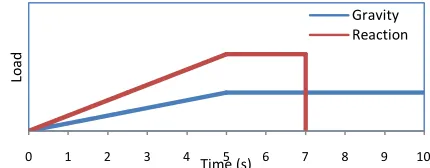
over a short duration relative to the response time of the structure [4]. For dynamic analysis, guidelines generally do not recommend the use of dynamic amplification factor, therefore the dynamic effects must be included in modeling. To carry out dynamic analysis, different approaches are suggested by different authors. These approaches are categorized into two main groups; either direct element deletion or reaction approaches. Direct element deletion is not applicable in all FE packages or subroutine is required. An example of this approach is presented in [4], in which the author used *Remove command from Abaqus library for column removal. In so-called reaction approaches, the reaction forces acting on a column are computed before its removal. Then the column is replaced by concentrated loads equivalent to its forces. To simulate the phenomenon that the column is suddenly removed, the member forces are removed after a certain time is elapsed as shown in Figure 1, where reaction includes the variables P, V, and M denoting the axial force, shear force, and bending moment. In many papers the forces were increased linearly for five seconds until they reached their full amounts, kept unchanged for two seconds until the system reached stable condition, and the upward force was suddenly removed at seven seconds to simulate the dynamic effect caused by sudden removal of the column [5, 9, 21]. The linear incensement of forces is used to eliminate any instability due to sudden application of gravity loads in first step of dynamic analysis. In some papers the linear increment of loads is neglected and complete load is applied on structures at first step of analysis [8, 22, 23]. For sufficiently long time before column removal, two methods produce the same results. Figure 2 shows this method. Some similar approaches can be found in references [16, 24]. In some papers column is not removed suddenly, but the column is removed over a time period, as shown in Figure 3 [25-27]. This time must be shorter than real column removal time due to certain triggering events. For example in blast-induced progressive collapse, column removal time must be shorter than time duration of blast loads. It is recommended for the case where a dynamic analysis is performed, the vertical supporting element should be removed over a time period that is no more than 1/10 of the period associated with the structural response mode for the vertical element removal [2].
Figure 1. Reaction approach, sudden column removal and linear increase
0 1 2 3 4 5 6 7 8 9 10
Lo
ad
Time (s)
Figure 2. Reaction approach, sudden column removal and sudden increasement
Figure 3. Reaction approach and gradual column removal
Figure 4. Degradation approach and sudden column removal
Figure 5. Assignment of time-dependent material to certain column
Figure 6. Degradation approach and gradual column removal
3. NEW APPROACH FOR DYNAMIC COLUMN REMOVAL USING MATERIAL DEGRADATION
As discussed in previous section, a lot of pre-analysis were required to calculate the reaction forces in each column removal scenario, then these forces must be defined as function of time and apply to the structure according to one of the 3 patterns presented in Figures 1- 3 or other similar patterns. This process is compute-intensive and time-consuming, especially when large number of columns are necessary to be checked.
Instead of using this method, we attempt to define time-dependent material using *Field command available in Abaqus library. As shown in Figure 4, strenght and stiffness of material is defined as function of time. Then this material is assigned to considered column(s) using predefined field command in Abaqus (See Figure 5). At start of the analysis, the column has its complete strength, but after a certain time is elapsed, its strength abruptly decreases to zero. This allows the development of full and sudden column removal as suggested in guidelines. This approach offers the advantages of simplicity and applicability; just one time-dependent material is nessesery to be defined, then it can be easily assigned to any desireable column and analysis is performed. Using this approach, there is no need to calculate the load components of columns before column removal. Gradual column loss is also possible as shown in Figure 6. Time-dependent definition of material is available in almost any general porpuse FE packages, therfore porposed approaches can be easily performed in any FE programs. If this option is not available in a code, the user may use some trick, e.g use temprature-dependent material, to implement this approach for column removal.
4. NUMERICAL STUDY
In this study finite element analysis is performed using
the general purpose finite element package
Abaqus/Explicit version 6.10. Abaqus/Explicit solves
0 1 2 3 4 5 6 7 8 9 10
Lo
ad
Time (s)
Gravity Reaction
0 1 2 3 4 5 6 7 8 9 10
Lo
ad
Time (s)
Gravity Reaction
0 5E+10 1E+11 1.5E+11 2E+11 2.5E+11
0 1 2 3 4 5 6 7 8
Co
lumn
P
rope
rty
Time (s)
Module of Elasticity
Yield Stress
0 5E+10 1E+11 1.5E+11 2E+11 2.5E+11
0 1 2 3 4 5 6 7 8
Co
lumn
P
rope
ry
Time (s)
dynamic response problems using an explicit direct-integration. In an implicit dynamic analysis the integration operator matrix must be inverted and a set of nonlinear equilibrium equations must be solved at each time increment. In an explicit dynamic analysis displacements are calculated in terms of quantities that are known at the beginning of an increment; therefore, the global mass and stiffness matrices need not be formed, it means that each increment is inexpensive compared to the increments in an implicit method. Therefore explicit method is more efficient than the implicit method for solving extremely short-term events such as blast and impact [28].
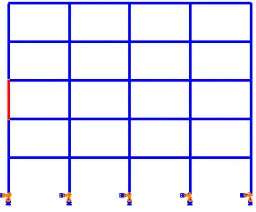
4. 1. Analytical Model The model structure is a 2D five story steel moment resisting frame, the floor height is 3.2 m and span length is 5m (See Figure 7). This steel moment frame is designed to resist both gravity and lateral loads due to strong earthquake according to Iranian building codes. More input data can be found in [5]. Column removal cases are shown in Table 1.
In this paper the beam element in the Abaqus element library was used to model the beams and columns. The selection of the type of element to be used is based on the fact that the investigation considers the global response of the frame in column removal scenario. For this purpose beam theory is sufficient. All beam elements in Abaqus are beam-column elements that mean they allow axial, bending, and torsional deformation [28]. However, torsion is not applicable to in-plane behavior of the 2D frames. The beam properties are input by defining the cross-section from the predefined cross-section library. At each increment of the analysis the stress over the cross-section of beam elements is numerically integrated to define the beams response as the analysis proceeds. The influence of mesh size has been studied and is sufficiently fine to ensure the accuracy of model structure. The analyses were conducted with 5% mass proportional damping, which is common for analysis of structures undergoing extreme loads.
Figure 7. Elevation of model and column removal cases
TABLE 1. Column removal analysis cases
Case Story Column
1 First Corner
2 First Second
3 Third Corner
4 Third Second
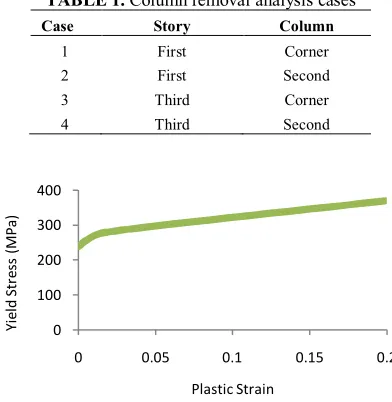
Figure 8. Yield stress versus plastic strain
4. 2. Material Property The adopted material
properties were: Young’s modulus, E= 210 GPa,
Poisson coefficient, v = 0.3, and density ρ =7850 kg/m3. The static yield stress was fy=240 MPa. The plastic property is shown in Figure 8. Abaqus provides the classical metal plasticity; the elastic part is defined by Young’s modulus and Poisson’s ratio. The plastic part is defined as the true stress and logarithmic strain. During the analysis, Abaqus calculates values of yield stress from the current values of plastic strain. It approximates the stress-strain behavior of steel with a series of straight lines that join the given data points to simulate the actual material behavior. For this purpose, any number of points can be used. In this study bilinear model was used. The material will behave as a linear elastic material up to the yield stress of the material. After this stage, it goes into the strain hardening stage until reaching the ultimate stress [28].
4. 3. Column Removal For nonlinear dynamic analysis the load DL+0.25LL was uniformly applied in the entire span of frame as vertical load as recommended in [2]. To carry out dynamic column removal analysis both mentioned approaches are considered in this study and results are compared. First, using reaction approach, time history of vertical displacement of column removal point is calculated. For this purpose, the reaction forces acting on a column are determined before its removal. Then the column is removed and replaced by concentrated loads equivalent to its forces as shown in Figure 1. In this study, the loads increased linearly for 5 seconds until they reached their full amounts, kept unchanged for 2 seconds, and
theconcentrated forces were suddenly removed at seven
seconds to simulate the column removal.
0 100 200 300 400
0 0.05 0.1 0.15 0.2
Yi
el
d
St
re
ss
(M
Pa)
Then, the dynamic column removal is performed using new approach described in section 3. For this purpose, after 5 seconds elapsed columns strength suddenly or gradually decreased to zero as shown in Figure 4 and Figure 6, respectively. The gradual column removal is performed over different period of time; 0.05 and 0.5 second, to study the influence of column removal time on dynamic response.
5. RESULTS AND DISCUSSION
Nonlinear dynamic analysis is performed using the general purpose finite element package Abaqus/Explicit version 6.10. Unless otherwise specified, all results are made based on the degradation approach. In this paper words "displacement" and "response" are used to refer "vertical displacement of column removal point".
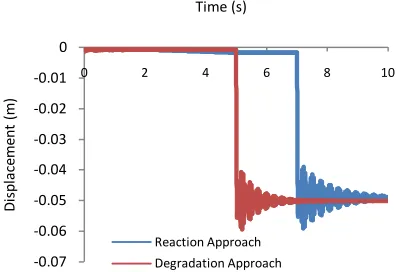
5. 1. Validation of New Approach In order to validate the proposed approach, numerical study is performed to determine structural response obtained via published traditional approach and novel approach. From the comparison of the two approaches, it can be observed that the structural response is almost identical. As shown in Figures 9 and 10 the differences between the results of new degradation approach and traditional reaction approach are negligible. Therefore, the proposed approach is sufficiently accurate to simulate the column removal in framed structures. Using this approach, the structural responses of frame under the sudden loss of columns for different scenarios of column removal (See Figure 11) were assessed.
5. 2. Dynamic Column Removal Cases When the corner column in first story was removed suddenly (case 1), the node on the top of the removed column vibrated and reached a maximum vertical displacement of 95 mm. For case 2, when the second column in first story was removed suddenly, the node on the top of the removed column vibrated and reached a peak vertical displacement of 59 mm.
From the comparison of case 1 and case 2, it can be observed that the building is more vulnerable to the removal of corner columns. This conclusion is consistent with the findings presented in reference [9].
When a column at a higher story was removed, displacement of column removal point significantly increased. This is because less structural member is contributed in energy absorption after column removal. In this analysis, when the corner column in third story was removed suddenly (case 3), the node on the top of the removed column vibrated and reached a peak vertical displacement of 166 mm. For case 4, when the second column in third story was removed suddenly, the node on the top of the removed column vibrated and reached a peak vertical displacement of 77 mm. This
conclusion can be obtained for any higher story; a column removal at a higher story will induce larger displacement than a column removal at first story. The findings obtained are consistent with the findings presented in [4]. Displacement of column removal point for case 1-4, obtained from degradation approach is shown in Figure 11.
Figure 9. Comparison of the two methods for case 1
Figure 10. Comparison of the two methods for case 2
Figure 11. Vertical displacement in column removal point
-0.12 -0.1 -0.08 -0.06 -0.04 -0.02 0
0 2 4 6 8 10
Di
sp
la
ceme
nt
(m)
Time (s)
Reaction Approach Degradation Approach
-0.07 -0.06 -0.05 -0.04 -0.03 -0.02 -0.01 0
0 2 4 6 8 10
Di
sp
la
ceme
nt
(m)
Time (s)
Reaction Approach Degradation Approach
-0.18 -0.16 -0.14 -0.12 -0.1 -0.08 -0.06 -0.04 -0.02 0
0 2 4 6 8 10
Di
sp
lc
eme
nt
(m)
Time(s)
5. 3. Influence of Column Removal Time As expected, sudden column removal provide larger structural response than gradual column removal. As shown in Figures 12 and 13, when gradual column removal is performed over 0.5 second, maximun vertical displacement in column removal point decrease up to 19 percent in case 1 and 45 percent in case 2.
Ordinary static strain rate is located in the range of 10-6-10-5 S-1, while earthquake loads are located in the range 10-3-10-1 S-1. On the other hand, blast and impact typically produce very high strain rates. Impact loads are in the range of 10-102 S-1 and blast pressures yield loads associated with strain rates are in the range of 102 -104 S-1 [29]. Therefore, the decision about either sudden column removal or gradual column removal is depended on the type of triggering event.
5. 4. Acceptance Criteria In nonlinear dynamic column removal analysis, the General Service
Administration guideline (Progressive Collapse
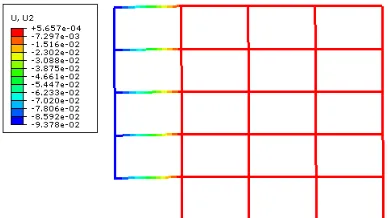
Analysis and Design Guidelines for New Federal Office Buildings and Major Modernization Projects) specify maximum plastic hinge rotation and ductility as acceptance criteria for progressive collapse potential (See Table 2). Ductility is the ratio of the maximum displacement and the yield displacement. The GSA guideline recommends the ductility limit of 20 for steel beams and columns regardless of the connection types. Rotation angle is obtained by dividing the maximum displacement to the length of the member. Abaqus automatically calculates rotation angle for each analysis step for each structural member. The acceptance criterion for plastic hinge rotation for steel beam and column is 0.21 radian. Vertical dispacement countor for case 1 and rotation contour for case 3 is shown in Figures 14 and 15. According to current results the limit state for ductility and rotation is not exceeded in the considered cases.
TABLE 2.GSA acceptance criteria [2]
Case Ductility Rotation (rad)
Steel Column 20 0.21
Steel Beam 20 0.21
Figure 12. Influence of column removal time for case 1
Figure 13. Influence of column removal time for case 2
Figure 14.Vertical dispacement countor for case 1
Figure 15. Rotation contour for case 3
5. 5. Discussion about new approach As mentioned, in so-called reaction approaches, the reaction forces acting on a column are computed before its removal, then the column is replaced by concentrated loads equivalent to its forces. These processes are time-consuming and a lot of calculation is needed (to determine the load component of each cosidered column and to define these loads as function of time). On the other hand, the new degradation approach is simple, there is no need for pre-analysis of structure, new time-dependent material can be easily assigned to any arbitrary column and analysis can be performed.
In traditional reaction approaches, there is always uncertainty about state of force and moment before collapse in remainning structure, because one structural
-0.1 -0.08 -0.06 -0.04 -0.02 0
0 2 4 6 8 10
Di
sp
la
ceme
nt
(m)
Time (s)
Sudden 0.05 Second 0.5 Second
-0.07 -0.06 -0.05 -0.04 -0.03 -0.02 -0.01 0
0 2 4 6 8 10
Di
sp
la
ceme
nt
(m)
Time (s)
member is removed and replaced with its load components, this situation is not exactly equal to before collapse situation of intact structure. This approach is very sensitive to user's mistake, since a lot of load components must be calculated and assigned as equivalent of column. On the other side, in degradation approach, modeling of before collapse situation is exact; there is no load equivalent and all members are intact before column removal.
One of the main advantages of new approach is its capability for threat-dependent study of column removal. This approach offers the capability of sudden, gradual and also development of week column, this capability is advantageous, especially in the study of blast-induced or seismic progressive collapse. Moreover using this approach parametric study of progressive collapse is possible.
6. CONCLUSION
In this paper, current approaches for dynamic column removal is first discussed in details and then a new approach for dynamic column removal in framed structures is proposed. Using this approach, the structural response of the 5-story steel moment resisting frame under the sudden loss of columns for different scenarios of column removal was assessed and results are compared with traditional approach and very good agreement between the two approaches is obtained.
The results of numerical study can be summarized as follow:
v Potential for progressive collapse is highest when a
corner column was suddenly removed, either in first or higher story.
v Column removal at a higher level will induce larger
vertical displacement than a column removal at first story, because less structural member contributed in energy absorption, when a column is removed at higher level.
v Sudden column removal provides larger structural
response than gradual column removal. When gradual column removal is performed over 0.5 second, maximum vertical displacement in column removal point decrease up to 45 percent. Therefore, the decision about using either sudden column removal or gradual column removal is depended on the type of triggering event.
The common structures are usually modeled by either brace or shear wall or moment resisting frame, however, in this study, only moment resisting frame has been used for studying sudden column loss. Therefore, the numerical results apply only to the steel moment resisting systems with almost same height. Further study is still required for accurate evaluation of column loss in framed structure with different structural systems and
with various numbers of stories using new proposed approach. It could be concluded that the proposed approach offers the advantages of computational simplicity and practicality for dynamic column removal of framed structures.
It should be noted that the current methodology presented in this paper for assessment of progressive collapse due to column loss in steel moment resisting frames, can be easily extended to other steel framed structures.
7. REFERENCES
1. Ellingwood, B. R., Smilowitz, R., Dusenberry, D. O., Duthinh, D., Lew, H., and Carino, N., "Best practices for reducing the potential for progressive collapse in buildings", US Department of Commerce, National Institute of Standards and Technology, (2007).
2. GSA, Progressive collapse analysis and design guidelines for new federal office buildings and major modernization projects, The U.S. General Services Administration, (2003)
3. Usmani, A., Chung, Y. and Torero, J. L., "How did the wtc towers collapse: A new theory", Fire Safety Journal, Vol. 38, No. 6, (2003), 501-533.
4. Fu, F., "Progressive collapse analysis of high-rise building with 3-d finite element modeling method", Journal of Constructional Steel Research, Vol. 65, No. 6, (2009), 1269-1278.
5. Tavakoli, H. R. and Kiakojouri, F., "Influence of sudden column loss on dynamic response of steel moment frames under blast loading",
International Journal of Engineering-Transactions B: Applications, Vol. 26, No. 2, (2012), 197.
6. Marjanishvili, S., "Progressive analysis procedure for progressive collapse", Journal of Performance of Constructed Facilities, Vol. 18, No. 2, (2004), 79-85.
7. Bae, S.-W., LaBoube, R. A., Belarbi, A. and Ayoub, A., "Progressive collapse of cold-formed steel framed structures", Thin-Walled Structures, Vol. 46, No. 7, (2008), 706-719.
8. Kim, J. and Lee, Y. H., "Progressive collapse resisting capacity of tube‐type structures", The Structural Design of Tall and Special Buildings, Vol. 19, No. 7, (2010), 761-777.
9. Kim, J. and Kim, T., "Assessment of progressive collapse-resisting capacity of steel moment frames", Journal of Constructional Steel Research, Vol. 65, No. 1, (2009), 169-179.
10. Kim, H.-S., Kim, J. and An, D.-W., "Development of integrated system for progressive collapse analysis of building structures considering dynamic effects", Advances in Engineering Software, Vol. 40, No. 1, (2009), 1-8.
11. Talaat, M. and Mosalam, K. M., "Modeling progressive collapse in reinforced concrete buildings using direct element removal", Earthquake Engineering & Structural Dynamics, Vol. 38, No. 5, (2009), 609-634.
12. Kwasniewski, L., "Nonlinear dynamic simulations of progressive collapse for a multistory building", Engineering Structures, Vol. 32, No. 5, (2010), 1223-1235.
13. Masoero, E., Wittel, F. K., Chiaia, B. M. and Herrmann, H. J., "Parametric study of the progressive collapse of 2d framed structures", (2009).
14. Fu, F., "3-d nonlinear dynamic progressive collapse analysis of multi-storey steel composite frame buildings—parametric study", Engineering Structures, Vol. 32, No. 12, (2010), 3974-3980.
15. Yuan, W. and Tan, K. H., "Modeling of progressive collapse of a multi-storey structure using a spring-mass-damper system", Structural Engineering & Mechanics, Vol. 37, No. 1, (2011), 79.
17. Demonceau, J.-F. and Jaspart, J.-P., "Experimental test simulating a column loss in a composite frame", Advanced Steel Construction, Vol. 6, No. 3, (2010).
18. Yi, W.-J., He, Q.-F., Xiao, Y. and Kunnath, S. K., "Experimental study on progressive collapse-resistant behavior of reinforced concrete frame structures", ACI Structural Journal, Vol. 105, No. 4, (2008), 433.
19. Vlassis, A., Izzuddin, B., Elghazouli, A. and Nethercot, D., "Progressive collapse of multi-storey buildings due to sudden column loss—part ii: Application", Engineering Structures, Vol. 30, No. 5, (2008), 1424-1438.
20. Izzuddin, B., Vlassis, A., Elghazouli, A. and Nethercot, D., "Progressive collapse of multi-storey buildings due to sudden column loss—part i: Simplified assessment framework", Engineering Structures, Vol. 30, No. 5, (2008), 1308-1318.
21. Kim, T. and Kim, J., "Collapse analysis of steel moment frames with various seismic connections", Journal of Constructional Steel Research, Vol. 65, No. 6, (2009), 1316-1322.
22. Kim, J., Choi, H. and Min, K. W., "Use of rotational friction dampers to enhance seismic and progressive collapse resisting capacity of structures",
The Structural Design of Tall and Special Buildings, Vol. 20, No. 4, (2011), 515-537.
23. Kim, J. and Shin, W. S., "Retrofit of rc frames against progressive collapse using prestressing tendons", The Structural Design of Tall and Special Buildings, (2011).
24. Parsaeifard, N. and Nateghi-A, F., "The effect of local damage on energy absorption of steel frame buildings during earthquake", International Journal of Engineering-Transactions B: Applications, Vol. 26, No. 2, (2012), 143.
25. Tsai, M.-H., "Evaluation of different loading simulation approaches for progressive collapse analysis of regular building frames", Structure and Infrastructure Engineering, Vol. 8, No. 8, (2012), 765-779.
26. Gerasimidis, S. and Baniotopoulos, C., "Steel moment frames column loss analysis: The influence of time step size", Journal of Constructional Steel Research, Vol. 67, No. 4, (2011), 557-564.
27. Fu, F., "Response of a multi-storey steel composite building with concentric bracing under consecutive column removal scenarios",
Journal of Constructional Steel Research, Vol. 70, (2012), 115-126.
28. Simulia, D. S., "Abaqus analysis user s manual", (2010).
29. Ngo, T., Mendis, P., Gupta, A. and Ramsay, J., "Blast loading and blast effects on structures–an overview", Electronic Journal of Structural Engineering, Vol. 7, (2007), 76-91.
Numerical Study of Progressive Collapse in Framed Structures: A New
Approach for Dynamic Column Removal
TECHNICAL NOTE
H. R. Tavakolia, F. Kiakojourib
a Department of Earthquake Engineering, Babol University of Technology, Babol, Iran b Department of Structural Engineering, Islamic Azad University, Takestan Branch, Iran
P A P E R I N F O
Paper history:
Received 10 December 2012
Received in revised form 30 January 2013 Accepted 28 February 2013
Keywords:
Column Removal Analysis Dynamic Nonlinear Analysis Progressive Collapse Alternative Load Path
هﺪﯿﮑﭼ
شﺰﯾروﺮﻓونآروﺎﺠﻣيﺎﻀﻋاﯽﺑاﺮﺧﻪﺑﺮﺠﻨﻣياهزﺎﺳﯽﻠﺻاﻮﻀﻋﮏﯾﯽﻌﺿﻮﻣﯽﺑاﺮﺧﻪﮐﺖﺳاﯽﺘﯿﻌﺿوهﺪﻧوﺮﺸﯿﭘﯽﺑاﺮﺧ ﺪﺷﺎﺑﺐﺳﺎﻨﺘﻣﺎﻧﯽﺑاﺮﺧيهﺪﻨﻨﮐدﺎﺠﯾاﺖﻠﻋﺖﺒﺴﻧﻪﺑهﺪﺷدﺎﺠﯾاﯽﻠﮐﯽﺑاﺮﺧﻪﮐيرﻮﻃﻪﺑدﻮﺷﯽﻣهزﺎﺳردﯽﻓﺎﺿايﺎﻫ
.
رد
ﺑﺎﻗيﺎﻫﻢﺘﺴﯿﺳ دﻮﺷﯽﻣضﺮﻓﺎﻫنﻮﺘﺳﯽﺑاﺮﺧ،ﯽﻌﺿﻮﻣﯽﺑاﺮﺧﻦﯾﺮﺗﺞﯾار،ﯽ
.
ﻪﯿﺒﺷياﺮﺑﺪﯾﺪﺟشورﮏﯾﺶﻫوﮋﭘﻦﯾارد
ﺖﺳاهﺪﺷﻪﺋاراﯽﺑﺎﻗيﺎﻫﻢﺘﺴﯿﺳردنﻮﺘﺳﯽﮑﯿﻣﺎﻨﯾدفﺬﺣيزﺎﺳ
.
ﯽﻧﺎﻤﺘﺧﺎﺳبﺎﻗﮏﯾياهزﺎﺳﺦﺳﺎﭘشورﻦﯾازاهدﺎﻔﺘﺳاﺎﺑ
يدﻻﻮﻓ
5
ﺖﺳاهﺪﺷهﺪﯿﺠﻨﺳنﻮﺘﺳفﺬﺣنﻮﮔﺎﻧﻮﮔيﺎﻫﻮﯾرﺎﻨﺳردﻪﻘﺒﻃ
.
ﺗ ﺎﻫﻞﯿﻠﺤﺗﻦﯾاردﯽﺳﺪﻨﻫوﺢﻟﺎﺼﻣﯽﻄﺧﺮﯿﻏتاﺮﯿﺛﺎ
ﺖﺳاهﺪﺷظﺎﺤﻟ
.
ﺖﺳاهﺪﺷهدادحﺮﺷتﺎﯿﺋﺰﺟﺎﺑيزﺎﺳلﺪﻣيﺎﻫشور
.
يﻪﻄﻘﻧﻢﺋﺎﻗنﺎﮑﻣﺮﯿﯿﻐﺗﻦﯿﻤﺨﺗياﺮﺑياهﮋﯾوﺰﮐﺮﻤﺗ
ﺖﺳاﻪﺘﻓﺮﯾﺬﭘترﻮﺻنﻮﺘﺳفﺬﺣ
.
درادنﻮﺘﺳفﺬﺣﺖﯿﻌﻗﻮﻣﻪﺑﯽﮕﺘﺴﺑﺎﺳﺎﺳاهﺪﻧوﺮﺸﯿﭘﯽﺑاﺮﺧﻞﯿﺴﻧﺎﺘﭘ،ﺞﯾﺎﺘﻧسﺎﺳاﺮﺑ
.
ﯽﻣ
ﺗ ﯽﮑﯿﻣﺎﻨﯾدفﺬﺣيزﺎﺳﻪﯿﺒﺷياﺮﺑارندﻮﺑﯽﻠﻤﻋوﯽﺗﺎﺒﺳﺎﺤﻣﺖﻟﻮﻬﺳنﻮﭼﯽﺗﺎﻧﺎﮑﻣا،هﺪﺷدﺎﻬﻨﺸﯿﭘشورﻪﮐﺖﻓﺮﮔﻪﺠﯿﺘﻧناﻮ
ﺪﻫدﯽﻣﻪﺋاراﯽﺑﺎﻗيﺎﻫهزﺎﺳردنﻮﺘﺳ
.