Please cite this article as: G. Kasana, K. Singh, S. Singh Bhatia, Singular Value Decomposition based Steganography Technique for JPEG2000 Compressed Images, International Journal of Engineering (IJE), TRANSACTIONS C: Aspects..Vol. 28, No. 12, (December 2015) 1720-1727
International Journal of Engineering
J o u r n a l H o m e p a g e : w w w . i j e . i rSingular Value Decomposition
based Steganography Technique for JPEG2000
Compressed Images
G. Kasana*a, K. Singhb, S. Singh Bhatia c
a Computer Science and Engineering Department, Thapar University, Patiala-147004 India.
bElectronics and Communication Engineering Department, Thapar University, Patiala-147004, India. c School of Mathematics, Thapar University, Patiala-147004, India
P A P E R I N F O
Paper history:
Received 18 June 2015
Received in revised form 17 November 2015 Accepted 24 December 2015
Keywords:
Discrete Wavelet Transform Singular Value Decomposition Peak Signal to Noise Ratio Genetic Algorithm Scaling Factor
A B S T R A C T
In this paper, a steganography technique for JPEG2000 compressed images using singular value decomposition (SVD) in wavelet transform domain is proposed. In this technique, discrete wavelet transform (DWT) is applied on the cover image to get wavelet coefficients and singular value decomposition is applied on these wavelet coefficients to get their singular values.Secret data bits are embedded into these singular values using scaling factor. Different compression rates are also considered for JPEG2000 images after embedding the secret images. Genetic algorithm (GA) is used to optimize the value of scaling factor (SF). Maximum capacity of the proposed technique is 25% of cover image size and maximum peak signal to noise ratio(PSNR) values between cover and its stego image is more than the PSNR of existing techniques. Embedding capacity of proposed technique is also higher than the embedding capacity of existing techniques. Also, PSNR between secret image and extracted image is high and hence the visual quality of the extracted secret image is good enough to the human visual system. Steganalysis tests are performed on the stego images to show imperceptibility of proposed technique.
doi: 10.5829/idosi.ije.2015.28.12c.04
1. INTRODUCTION1
In recent years, hasty expansion of public networks and development of digital multimedia technologies have dramatically increased the transmission of digital contents like digital images, videos and audios. One of the important requirements of this transmission is to prevent the data theft. Steganography is a data hiding technique, which is used in various applications of information security. It is used to transmit secret data by hiding its existence so that an attacker cannot identify the existence of secret data and hence is not able to misuse it. The main advantage of steganography is that it will not attract/fascinate the attackers. It pays attention to the degree of invisibility.
Steganography can be done in spatial domain, frequency domain and compressed domain. Many
* Corresponding Author’s Email: [email protected](G. Kasana)
algorithm for JPEG2000 image to embed secret messages directly into the output of the tier-2 process. Zhang et al. [6] proposed a steganography scheme for JPEG2000 baseline encoder in which bit plane encoding procedure is used twice to solve the problem due to bit stream truncation in tier-2 coding of JPEG2000 standard.
Recently, the concept of SVD has been exploited in data hiding technique [1, 15]. Liu et al. [7] used SVD to propose a watermarking algorithm for digital images. In their algorithm, singular values of the cover image are calculated and watermark is then added into these values to get resultant matrix of singular values. This resultant matrix of singular values is again transformed using SVD for finding the modified singular values. Ganic et al. [8] proposed a wavelet transform based watermarking technique in which the wavelet coefficients of the cover image are obtained using DWT and then SVD transform is performed on these wavelet coefficients and watermark image. To embed the watermark bits, singular values of watermark and the cover image are added and finally watermarked image is generated using inverse SVD transform. Chang et al. [9] used diagonal matrix and unitary matrix of cover image to conceal the bits of watermark. Chandra et al. [10] proposed a watermarking technique in which the singular values of the watermark are embedded in the singular values of the cover image.
Aslantas [11] combined the concept of GA [22] and SVD to propose a watermarking technique. In their technique, GA is utilized to obtain the highest robustness without losing transparency. Abdallah et al. [12] utilized left singular vectors of cover image to propose a steganography approach. Secret data bits in their approach are embedded into left singular vectors which reduces the embedding errors and the image fidelity is also maintained. Hybrid image watermarking scheme using DWT, DCT and SVD is proposed by Hu et al.[13]. In this scheme, the cover image is transformed into YCbCr color space from the RGB color space to obtain on grey level image and hybrid transforms are applied. SVD is then applied to obtain frequency components to embed the watermark bits.
Kasana et al. [14] proposed a histogram based steganography technique for JPEG2000 compressed images in the wavelet domain. Peak wavelet coefficients of the histogram are used to embed secret data and their technique provides a good embedding capacity and high visual quality stego image. But their technique is applicable to the lossless compression only. Going through these literature surveys, one can find that there is the need to design a steganography technique for JPEG2000 lossy compressed images which can provide high embedding payload as well as acceptable quality of stego images.
This paper proposes steganography technique using SVD for JPEG2000 compressed images. The singular values of the cover image are altered to embed the secret data by employing SF. Since the values of scale factors determine the strength of secret data embedded in the cover image. GA is used to find the optimal value in order to enhance the visual quality of the stego image and the robustness of the proposed technique.
The paper is structured into following sections. The embedding and extraction algorithms and optimization of SF are described in section 2. Experimental results and steganalysis tests are discussed in section 3 and section 4, respectively, prior to conclusion in last section.
2. PROPOSED STEGANOGRAPHY TECHNIQUE
In proposed technique, SVD is applied on wavelet coefficients of cover image and then secret data is embedded into transformed wavelet coefficients after scaling by a scaling factor SF before embedding process. SF is used to control the secret data strength.
2. 1. Embedding Algorithm Following steps are used to embed secret image into a cover image.
Step 1. Decompose the cover image upto three levels using DWT to obtain ten wavelet subbands ; 1 ≤ i ≤ 10.
Step 2.Apply SVD on each subband to get the following decomposition.
Step 3. Modify the singular values of using SF and secret image to get new matrix . Here is value of SF (0< <1) which is optimized using GA and is the secret image.
Step 4. Since the secret image is directly added to the singular values of the subbands using scaling factor, it is wise to reconstruct it by applying SVD again on modified singular values as a result three another matrices are obtained.
Step 5.Take inverse of SVD by taking product to form modified subbands .
2. 2. Use of Comment Marker JPEG2000 code stream is structured as a main header followed by a sequence of tile streams. There are many boxes in the main header which are used by the encoder as well as by the decoder. One of the boxes is comment (COM) marker box which provides a facility for including unstructured comment information in the code stream of a compressed image when this image is compressed using JPEG2000 encoder. The COM marker segment is shown in Figure 1. TY parameter is a two byte unsigned integer. TY=1 indicates that the Comment Data comprises a equence of bytes in the form of IS 8859-15:1999(Latin) character data. TY = 0 indicates general library Comment Data. No other values for TY are allowed in JPEG2000. The COM marker segment length satisfies 5<= LCOM<=65535. Here LCOM is the
length of the box.
Figure 1. COM marker of JPEG2000 Header
In this proposed technique, two SVD based vectors built by singular values for each wavelet subband of the cover image, and are transmitted to the decoder for the secret image extraction. This COM box is not used by the decoder so any value can be stored in this box. Extra information stored in the COM marker segment depends upon the size of the cover image. For example, size of cover image is 512×512. If three level wavelet transform is used to decompose the cover image, then we get three subbands of size 256×256, three subbands of size 128×128 and four subbands of size 64×64. If we apply SVD on 128×128 size data, singular values of size 128 are obtained. So for all subbands, total singular values are 1408. As and
need to be transmitted to the receiver side, so total
singular values are 1408 + 1408 = 2816. These are stored into COM marker and extracted on the receiver side which makes the proposed technique semi blind in nature.
2. 3. Extraction Algorithm
Step 1.Extract information stored in the COM marker and then apply Tier-2 of the JPEG2000 standard followed by Tier-1 on stego image. Then perform three level wavelet transform to get wavelet subbands .
Step 2.Apply SVD on each wavelet subbands to obtain matrix for each subband i.
Figure 2. Flowchart for GA based steganography
Step 3. Apply SVD on to obtain three matrices
and .
Step 4. Calculate the difference between and
where b is factor having value between 0 and 1in order to improve the quality of extracted image.
Step 5.Multiplying matrices , and to get new matrix .
= ( )
Step 6. Extract the secret data using below equation:
Here, T is the transpose of matrix.
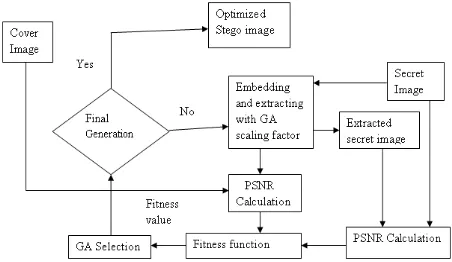
2. 4. Optimization of SF Using GA In proposed technique, the value of SF is optimized using GA in order to achieve visual quality of the stego images. An effective steganography has two conflicting requirements: which is PSNR between cover image and its stego version and whichis PSNR between original secret image and extracted secret image. These two requirements are correlated in such a way that maximization of one PSNR decreases the value of other PSNR and vice versa. If SF is increased then
of extracted image decreases and if the value of
SF is decreased increases. So there is the need to have optimal value of SF so that both requirements of
and are acceptable to the user. Using GA,
the optimal value of SF is obtained.
Search Space: GA’s search space includes all the
which is used to achieve optimization using the genetic operators like selection, reproduction, crossover and mutation and a fitness function.
The Fitness Function: Fitness function Fi used by GA
is formed by adding two common performance evaluation metrics PSNR1and PSNR2.
(2)
Steps are used in optimization of SF, as shown in Figure 2.
3. EXPERIMENTAL RESULTS
Proposed technique is implemented using JASPER software tool [16]. PSNR, evaluated between cover image and its stego version, is taken as an evaluation parameter. It gives the statistical difference between the cover image and stego image and it is calculated using following equation:
where z is the bit depth of the image, is the mean square error and is defined as:
∑ ∑ ( )
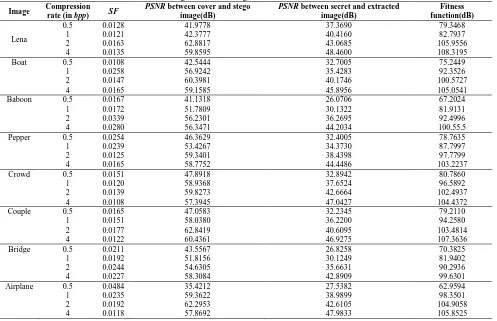
where is the pixel of stego image and X is the pixel of cover image, and are the height and width of the images, respectively. The larger the PSNR, better is the quality of stego image. In general, a stego image is acceptable by human perception if its PSNR is greater than 30 dB [20, 21]. The PSNR is used for evaluating the imperceptibility of data hiding techniques. In order to show the effectiveness of the proposed technique, eight images, namely, Lena, Boat, Baboon, Bridge, Couple, Crowd, Pepper and Airplane are used as cover images, each of size 512×512. Barbara image of size 256×256 is taken as secret image. These cover images are compressed using different bit rate, namely, 4 bits per pixel (bpp), 2 bpp, 1 bpp and 0.5 bpp. SF is used in embedding process and the optimal value of SF is determined using GA. Five generations with 20 population size are considered in GA optimal process using fitness of (2). Then secret image is embedded into cover image while compressing using JPEG2000 standard, using optimal SF value. Same value of SF is required in the extraction process to extract the bits of the secret image. These results are presented in Table 1.
TABLE 1. PSNR values of Stego, extracted images and Fitness Function at different bit rates
Image Compression rate (in bpp) SF PSNR between cover and stego image(dB) PSNR between secret and extracted image(dB) function(dB) Fitness
Lena
0.5 0.0128 41.9778 37.3690 79.3468
1 0.0121 42.3777 40.4160 82.7937
2 0.0163 62.8817 43.0685 105.9556
4 0.0135 59.8595 48.4600 108.3195
Boat 0.5 0.0108 42.5444 32.7005 75.2449
1 0.0258 56.9242 35.4283 92.3526
2 0.0147 60.3981 40.1746 100.5727
4 0.0165 59.1585 45.8956 105.0541
Baboon 0.5 0.0167 41.1318 26.0706 67.2024
1 0.0172 51.7809 30.1322 81.9131
2 0.0339 56.2301 36.2695 92.4996
4 0.0280 56.3471 44.2034 100.55.5
Pepper 0.5 0.0254 46.3629 32.4005 78.7635
1 0.0239 53.4267 34.3730 87.7997
2 0.0125 59.3401 38.4398 97.7799
4 0.0165 58.7752 44.4486 103.2237
Crowd 0.5 0.0151 47.8918 32.8942 80.7860
1 0.0120 58.9368 37.6524 96.5892
2 0.0139 59.8273 42.6664 102.4937
4 0.0108 57.3945 47.0427 104.4372
Couple 0.5 0.0165 47.0583 32.2345 79.2110
1 0.0151 58.0380 36.2200 94.2580
2 0.0177 62.8419 40.6095 103.4814
4 0.0122 60.4361 46.9275 107.3636
Bridge 0.5 0.0211 43.5567 26.8258 70.3825
1 0.0192 51.8156 30.1249 81.9402
2 0.0244 54.6305 35.6631 90.2936
4 0.0227 58.3084 42.8909 99.6301
Airplane 0.5 0.0484 35.4212 27.5382 62.9594
1 0.0235 59.3622 38.9899 98.3501
2 0.0192 62.2953 42.6105 104.9058
(a) (b) (c) (d)
(e) (f) (g) (h)
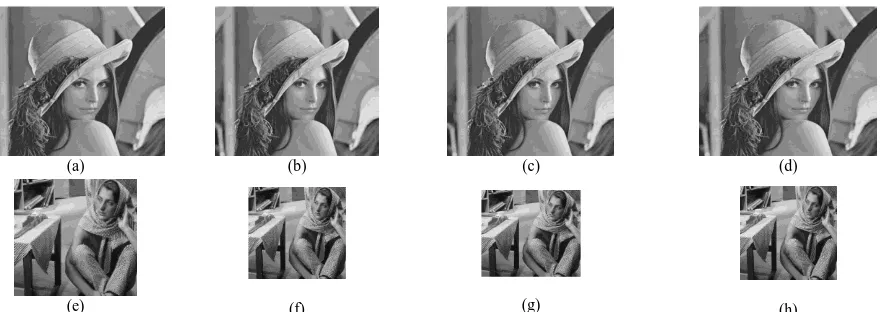
Figure 3. (a) Lena cover image, Lena Stego at (b) 4 bpp, (c) 2 bpp, (d) 1 bpp, (e) original Barbara secret image, extracted Barbara secret image at (f) 4 bpp, (g) 2 bpp and (h) at 1 bpp
TABLE 2. Embedding Capacity/PSNR comparison of stego image using proposed technique and existing techniques for JPEG2000 Images
Image Zhang et al.[6] Ishida et al. [17] Ishida et al. [18] Goudia et al. [19] Proposed Technique
Boat 14000/- - - - 524288/54.75
Lena 14000/- 19568/ 37.1 14936/37.4 6768/34.29 524288/51.77
Pepper 14000/- 19568/ 36.3 14936/35.2 - 524288/54.47
Baboon 19500/- 19568/ 30.1 14936/33.25 10480/34.01 524288/51.37
-means PSNR of stego images is not given for particular image in particular technique
Cover image Lena and stego images at different bit rates are shown in Figures 3(a) to 3(d). Original secret image and extracted secret images at different bit rates are shown in Figures 3(e) to 3(h). From these images, one cannot observe any difference between cover and stego images. Hence imperceptibility is maintained using the proposed steganography technique. Also, the visual quality of the secret image is not degraded.
Proposed technique is compared with existing steganography techniques applicable to JPEG2000 compressed images. For this comparison, maximum embedding capacity of each existing technique is considered and then PSNR value between stego and cover images are taken into consideration at that capacity.
Maximum undetectable capacity of Zhang et al. [6] is 19,500 bits for Baboon image; undetectable utmost capacity of Ishida et al. is 19,568 bits and 37.1 dB PSNR; most undetectable capacity of Ishida et al. is 14,936 bits and PSNR is 37.4 dB; maximum capacity of Goudia et al. is 10,480 bits and PSNR is 34.29 dB whereas maximum undetectable capacity of proposed technique is 5,24,288 bits and PSNR is 54.75 dB. This comparison shows that proposed technique provides higher PSNR than existing at high embedding capacity.
4. STEGANALYSIS TESTS
Steganalysis tests are used to detect whether an image contains a hidden data. By analyzing different features between stego and cover images, a steganalysis test is able to detect stego images. To test the effectiveness of the proposed technique, three steganalysis tests have been performed on the stego images.
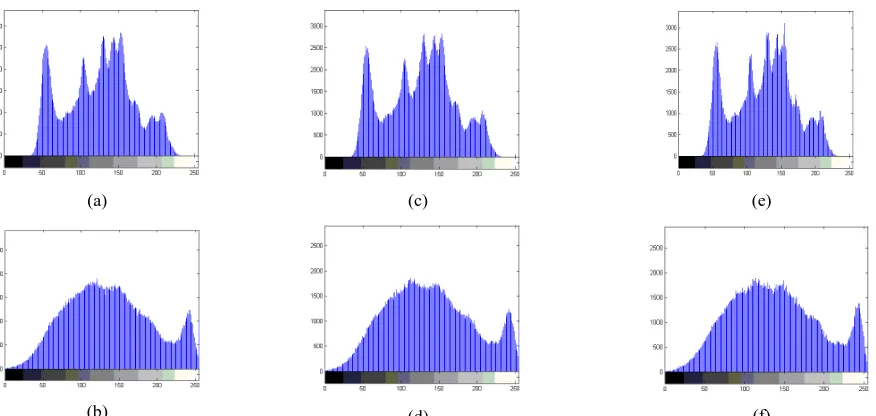
4. 1. Histogram Steganalysis First test is histogram steganalysis test. In this test, the histogram of cover image and its stego version is taken. Histograms of both types of images are almost similar. This shows that histogram steganalysis cannot detect the presence of secret image in the stego images.
Histogram of Lena and Baboon cover images are shown in Figure 4 (a) to 4(b) and histogram of stego images Lena, Baboon at 2 bpp and 1 bpp are shown in Figure: 4(c) to 4(f). From these figures, one can conclude that histogram of the cover and stego images are similar. Hence, on the basis of histogram, no one can suspect the existence of secret image embedded in the stego image.
expected set of data. . Let Cc and Cs denote the Chi-square value of cover and stego image, respectively, and are calculated at different compression rates. Differences and percentage differences between Cc and Cs are shown in Table 3.
From this comparison, one can observe that there is small difference between Chi-square values of the cover image and stego image, i.e visual quality of stego image is not deviated from cover image.
Hence, on the basis of this test, no one can suspect the existence of secret image embedded in the stego image. So imperceptibility is achieved by the proposed technique.
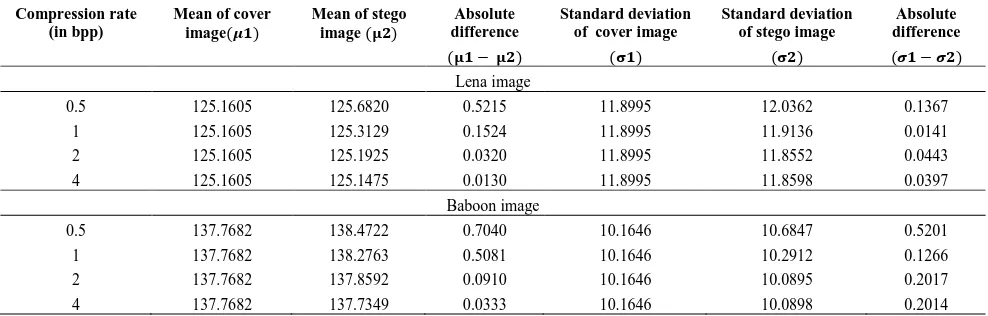
4. 3. First and Second Order Moments Steganalysis Tests In these steganalysis tests, first and second order moments of different cover and stego images are calculated. For steganalysis purpose and also to show imperceptibility, mean and standard deviation i.e. first and second order moments, of cover and stego images, are used. The comparison between these characteristics of cover and stego images are shown in Table 4. From this comparison one can observe that difference in first and second moments of cover and stego images are very small and that it does not create the suspicion on the existence of secret data in the stego images. So imperceptibility is achieved using the proposed technique.
(a) (c) (e)
(b) (d) (f)
Figure 4. Histogram of cover images (a) Lena and (b) Baboon. Histogram of Stego at 2 bpp (c) and Lena (d) Babbon . Histogram of Stego at 1 bpp (e) Lena and (f) Baboon
TABLE 3. Chi-square test difference between cover image and stego image at different bit rates
Compression rate (in bpp)
Cc of cover image
(in 106)
Cs of stego image
(in 106)
Absolute difference (Cs-Cc)
(in 106)
Percentage difference
Lena image
0.5 3.1889 3.2155 0.0266 0.8300
1 3.1889 3.1995 0.0106 0.3324
2 3.1889 3.2049 0.0160 0.5017
4 3.1889 3.1858 0.0031 0.0972
Baboon image
0.5 3.4384 3.2222 0.2162 6.2878
1 3.4384 3.4075 0.0309 0.8987
2 3.4384 3.5398 0.1014 2.9490
TABLE 4. First and second order moments of stego and cover images at different compression bit rates
Compression rate (in bpp)
Mean of cover
image
Mean of stego
image
Absolute difference
Standard deviation of cover image
Standard deviation of stego image
Absolute difference
Lena image
0.5 125.1605 125.6820 0.5215 11.8995 12.0362 0.1367
1 125.1605 125.3129 0.1524 11.8995 11.9136 0.0141
2 125.1605 125.1925 0.0320 11.8995 11.8552 0.0443
4 125.1605 125.1475 0.0130 11.8995 11.8598 0.0397
Baboon image
0.5 137.7682 138.4722 0.7040 10.1646 10.6847 0.5201
1 137.7682 138.2763 0.5081 10.1646 10.2912 0.1266
2 137.7682 137.8592 0.0910 10.1646 10.0895 0.2017
4 137.7682 137.7349 0.0333 10.1646 10.0898 0.2014
5. CONCLUSION
A novel steganography technique for JPEG2000 compressed images using SVD and GA is proposed in this paper. SVD is applied on the wavelet coefficients of the cover images. Embedding of secret data bits is performed in singular values using SF and GA is used to optimize SF. Different compression rates are considered to compress the cover images using JPEG2000 encoder. Proposed technique’s embedding capacity and PSNR are more than existing steganography techniques applicable for JPEG2000 compressed images. Steganalysis tests also confirm the imperceptibility of the stego images produced by proposed technique.
6. REFERENCES
1. Leon, S. J., Linear Algebra with Applications, Prentice Hall, New Jersey (Chapter 7), (1998).
2. Seo, Y., Kim, M. S., Park, H., Jung, H. Y., Chung, H. Y., Huh, Y. and Lee, J. D., “ A secure watermarking for JPEG2000”,
IEEE, (2001), 530-533.
3. Noda, H., Spaulding, J., Shirazi, M. N. and Kawaguchi, E., “Application of bit plane decomposition steganography to JPEG2000 encoded images”, IEEE Signal Processing Letters, Vol. 9, (2002), 410-413.
4. Su, P. C. and Kuo, J., “Steganography in JPEG2000 compressed images”, IEEE Transactions on Consumer Electronics, Vol. 49. (2003), 824-832.
5. Hai-ying, G., Yin, X. and Guo-qiang, L., “A steganographic algorithm for JPEG2000 images”, IEEE computer society,
International Conference on Computer Science and Software Engineering, (2008), 1263-1266.
6. Zhang, L., Wang, H., and Wu, R., “A high capacity steganography scheme for JPEG2000 baseline system”, IEEE Transactions on Image Processing, Vol.18, (2009), 1797-1803. 7. Liu, R. and Tan, T., “An SVD based watermarking scheme for protecting rightful ownership”, IEEE Transactions on multimedia, Vol. 4, (2002), 121-128.
8. Ganic, E. and Eskicioglu, A. M., “Robust embedding of visual watermarks using DWT-SVD”, Journal of Electronic Imaging, Vol. 14, (2005), 43-54.
9. Chang, C. C., Tsai, P. C. and Lin, C., “SVD based digital watermarking scheme”, Pattern Recognition Letters, Vol. 26 (2005), 1577-1586.
10. Chandra, D. S., “Digital image watermarking using singular value decomposition”, Proceedings of the 45th Midwest
Symposium on Circuits and Systems, Vol. 3, (2002), 264-267. 11. Aslantas, V., “A singular value decomposition-based image
watermarking using genetic algorithm”, International Journal of Electronics and Communications, Vol. 62, (2008), 386-394. 12. Abdallah, H. A., Hadhoud, M. M. and Shaalan A. A., “An
efficient SVD image steganographic approach”, IEEE, (2009), 257-262.
13. Hu, W. C., Chen, W. H. and Yang, C. Y., “Robust image watermarking based on discrete wavelet transform-discrete cosine transform-singular value decomposition”, Journal of Electronic Imaging, Vol. 21, (2012), 1-7.
14. Kasana, G., Singh, K. and Bhatia, S. S., “Steganography technique for JPEG2000 compressed images using histogram in Wavelet Domain”, International Journal of Security and its Applications, Vol. 8, No.6, (2014), 211-224.
15. Ling, H. C., Raphael, C., Phan, W. and Heng, S. H., “On the security of ownership watermarking of digital images based on singular value decomposition”, Journal of Electronic Imaging, Letters, (2011), 1-2.
16. JASPER software, www.ece.uvic.ca/~frodo/jasper/
17. Ishida, T., Yamawaki, K., Noda, H. and Niimi, M., “Performance improvement of JPEG2000 steganography using QIM”, Journal of Communication and Computer, Vol. 6, (2009), 1-5.
18. Ishida, T., Yamawaki, K., Noda, H. and Niimi, M., “An Improved QIM-JPEG2000 Steganography and Its Evaluation by Steganalysis”, Journal of Information Processing, Vol. 17, (2009), 267-272.
19. Goudia, D., Chaumont, M., Puech, W. and Said, N. H., “A Joint Trellis Coded Quantization Data Hiding Scheme in the JPEG2000 Part-2 Coding Framework”, 19th European Signal Processing Conference, Sept, (2011), 1110-1114.
21. Hassanpour H. and Ghadi A. R. “Image Enhancement via Reducing Impairment Effects on Image Components”,
International Journal of Engineering–Transaction B:
Applications Vol. 26, No. 11, (2013), 1267-1274.
22. Guo Z., Wang S., Yue X., Jiang D. and Li K. “Elite opposition –based Artificial Bee Colony algorithm for global optimization”,
International Journal of Engineering –Transaction C:Aspects, Vol. 28, No. 9,(2015),1268-1275.
Singular Value Decomposition
based Steganography Technique for JPEG2000
Compressed Images
G. Kasanaa, K. Singhb, S. Singh Bhatia c
a Computer Science and Engineering Department, Thapar University, Patiala-147004 India.
bElectronics and Communication Engineering Department, Thapar University, Patiala-147004, India. c School of Mathematics, Thapar University, Patiala-147004, India
P A P E R I N F O
Paper history:
Received 18 June 2015
Received in revised form 17 November 2015 Accepted 24 December 2015
Keywords:
Discrete Wavelet Transform Singular Value Decomposition Peak Signal to Noise Ratio Genetic Algorithm Scaling Factor
ديكچ ه
ناهنپ شور کی ،هلاقم نیا رد ریواصت یزاس هدرشف یارب یراگن
JPEG2000
هنماد رد درفنم رادقم هیزجت زا هدافتسا اب
تسا هدش هئارا کجوم لیدبت
.
هتسسگ کجوم لیدبت ،شور نیا رد
(DWT)
ات دوش یم لامعا دلج یور سکع رد
هیزجت و دیآ تسد هب کجوم بیارض درفنم رادقم
(SVD)
ناشدرفنم ریداقم ات دش لامعا کجوم بیارض نیا یور
.دنوش یم هداد رارق درفنم ریداقم نیا رد یدنب سایقم روتکاف زا هدافتسا اب ناهنپ یاه هداد تیب .ددرگ لصاح هدرشف خرن
ریواصت یارب زین فلتخم یزاس
JPEG2000
.دوش یم هتفرگ رظن رد یفخم ریواصت هیبعت زا سپ کیتنژ متیروگلا زا
(GA)
رادقم یزاس هنیهب یارب
SF
یداهنشیپ شور تیفرظ رثکادح .دوش یم هدافتسا 52
٪
تسا دلج یور سکع هزادنا زا
شزرا رثکادح و
PSNR
ریوصت و ششوپ نیب
stego
زا رتشیب
PSNR
.تسا دوجوم یاه کینکت یزاساج تیفرظ
چمه .تسا دوجوم یاه کینکت یزاساج تیفرظ زا رتلااب زین یداهنشیپ شور ،نین
PSNR
ریوصت و یفخم ریوصت نیب
ناسنا ییانیب متسیس یارب یفاک هزادنا هب هدش جارختسا یفخم ریوصت یرصب تیفیک ور نیا زا و تسا لااب هدش جارختسا
.تسا بوخ تست
Steganalysis
ریواصت رد
stego
.دهد یم ناشن ار یداهنشیپ شور ندوب سوسحم ریغ