Please cite this article as: F. Nateghi. A*, K. Tarbali, The effect of tuned mass damper on seismic response of building frames with uncertain structural characteristics, International Journal of Engineering (IJE), TRANSACTIONS B: Applications Vol. 28, No. 5, (May 2015) 662-670
International Journal of Engineering
J o u r n a l H o m e p a g e : w w w . i j e . i rThe Effect of Tuned Mass Damper on Seismic Response of Building Frames with
Uncertain Structural Characteristics
F. Nateghi. A*, K. Tarbali
International Institute of Earthquake Engineering and Engineering Seismology, Iran
P A P E R I N F O
Paper history:
Received 25 January 2015
Accepted in revised form 12 March 2015
Keywords: Cumulative Damage Uncertainty Failure Probability Tuned Mass Damper
A B S T R A C T
Tuned mass dampers (TMDs) could be used to absorb the input energy of the applied load, and reduce the response of the building frames. However, the effectiveness of TMD in reducing the response of the building frames could be affected by inherited uncertainties in the structural characteristics of the frames. In this study, in order to investigate the probabilistic response of steel moment-resisting frames equipped with TMDs, variation in the failure probability of the structure has been studied through cumulative damage representative for the stories of the structure. The damage representative of each story has been calculated from the cumulative damage index of the structural elements, based on the weighted average approach. Although the response of the deterministic model of the structure could be reduced by installing TMD, the results of the numerical simulations on the probabilistic response of the structures indicate that for the records that cause excessive damage in the stories of the structures, the effect of the TMD on failure probability of the structure could be detrimental.
doi: 10.5829/idosi.ije.2015.28.05b.03
1. INTRODUCTION1
Seismic assessment of a structure requires accurate modeling of the parameters that could have significant effects on the performance of the structure. Since the characteristic parameters of a structure and the effect of the surrounding environment on structures are not deterministic in nature, probabilistic evaluation is a proper approach to find the variability of the performance of the structure. The difference between the assumptions that are made in deterministic modeling of the structure and the its actual response could root from inherited uncertainty in material properties and the applied loads, faulty assumptions during the analysis and design process, and construction errors. Advancements in computational capabilities have provided the opportunity of considering these uncertainties in analysis of the engineering structures and again more knowledge about their probabilistic behavior [1].
1*Corresponding Author’s Email: [email protected] (F. Nateghi)
During the design phase of a structure, deterministic model of the structure, with the characteristic parameters set to their mean values; issued to evaluate the effect of each interfering parameter in performance of the structure. Designing and assessing the effectiveness of the devices such as vibration-absorbing equipment are mostly performed based on the response of the structure from the deterministic model. However, variations in the characteristics of the primary structure in uncertain manner could alter the effectiveness of these devices. Therefore, the inherited uncertainty in characteristics of the structure or the uncertain surrounding effects (loads and boundary conditions) should be considered in assessing the seismic performance of the structures equipped with vibration-absorbing devices. In this study, tuned mass dampers (TMDs) have been installed on the top story of 9 and 20-story steel moment-resisting steel frames. The main objective of using TMDs was to reduce the seismic response of these structures based on the cumulative and non-cumulative response of the structure.
The focus of this study has been placed on studying the effect of uncertainty in the structural characteristics
of the building frames on effectiveness of the implemented TMDs to improve the seismic response of the structures. The uncertainty in the capacity and stiffness of the structural elements, and also in the seismic mass and the damping characteristics of the structures are considered in the analyses. The uncertainty in the characteristics of the seismic loading is not considered in this study. Cumulative response of the structure has been used to study the effect of the TMD on seismic response of the structures. Regardless of the amount of extreme values of time-varying responses, the cumulative effect of the nonlinear deformations in the structural elements could cause the failure of the elements. In this regards, considering the effect of the damage accumulation could account properly for the induced damage in the structure. The cumulative damage of the elements in one story is used to calculate the damage representative of that story, based on the weighted average approach. In this study, the damage index of the structural elements is calculated based on the model developed by Mehanny and Deierlein [2].
Characteristic parameters of the TMDs are calculated based on the deterministic dynamic characteristics of the primary structures. For the structures with deterministic characteristics, first the effect of installing TMD on cumulative and non-cumulative responses of the structure is evaluated. Afterwards, in order to investigate the probabilistic response of the structure, with and without TMD, variation in the failure probability of the structure has been studied based on the cumulative response.
In the following sections, first, calculating the cumulative damage representative for the structural elements and the stories of the structure is discussed. Then, obtaining the failure probability of the structure by implementing the numerical simulation approaches is briefly explained. In addition, calculating the effective parameters of the TMDsis mentioned. Finally, the numerical analyses and the conclusion remarks are presented.
2. SEISMIC RESPONSE OF THE STRUCTURES
Determining the safety of an existing structure based on the concept of engineering performance requires proper representative for the measure of damage in the structure. Knowing the amount of the damage in the structural elements provides vital qualitative information to estimate the economical loss in the structure and helps making decision on repair or reconstruction of the structure. In this regard, many damage indices are developed and evaluated to consider the cumulative effects of seismic loading on the structural elements. Damage indices could be used to check the performance of a designed structure and study
the reliability of an existing structure to estimate its performance in the pre-earthquake seismic evaluation [3]. As mentioned before, the damage index developed by Mehanny and Deierlein is used in this study to capture the cumulative response of the structural elements. More details about this damage index could be found in Mehanny [4].
(1)
) (
1
å
=
= N
i i i DI
DI DI W
i
whereDIiis the damage index in a monitoring section (end sections of the structural elements), Nis the total number of the monitoring sections in each story, and
i DI
W is the weight of the damage in the corresponding monitoring section.
Then, the measure of damage in each story of the structure (DIstory) is calculated by summation of the damage in the monitoring sections with respect to their weight (Equation 2).
å
= ´
= N
i
i DI story W DI
DI i
1
(2)
Using damage index to evaluate the performance of the structure facilitates considering the effects of cumulative nonlinear deformation of the structural elements in probabilistic seismic evaluation of the building..
3.COMPUTING THE FAILURE PROBABILITY OF THE STRUCTURES
hundreds of samples for the desired responses of the structure should be involved [5-7], One of the pitfalls of the simulation techniques is that the number of the simulations is dependent upon the failure probability itself. The number of simulation required to maintain the accuracy of the obtained failure probability could be found by Equation (3), [6, 8]:
(3)
) ( . ] [ C.O.V
1
2 f f
f
p p
p
N=
-where is the coefficient of variation of the failure probability, which indicates the accuracy of the results. Based on Equation (3), in order to calculate a small failure probability, large numbers of samples are required. Since the designed building structures are supposed to enter the nonlinear phase and dissipate the applied excitation of the earthquake by plastic deformation, in order to calculate the failure probability of a structure in near-to-collapse state, rational number of samples could practically help the analyst to have a prior idea about the failure probability.
In this study, Monte Carlo Simulation technique has been used to investigate the variation in seismic response and failure probability of the tall moment-resisting steel frames, with and without TMD. In order to create the probabilistic model of the structures, the probabilistic capacity and stiffness of the structural elements are modeled through probabilistic material characteristics for the constructional steel, using the fiber-discretized model. Therefore, flexural, axial, and shear capacities and stiffness of all sections of an element are affected by randomness in the material characteristics. In this regard, by assigning a material with random characteristics to the fiber sections of the elements, probabilistic capacity and stiffness of the structural elements have been incorporated into the finite element model. A program has been prepared to calculate the damage index of each structural element based on the probabilistic capacity and demand of the element in each run of the nonlinear time history analysis.
4. DETERMINING THE PARAMETERS OF THE TUNED MASS DAMPER
A tuned mass damper (TMD) is composed of a mass, a spring, and a viscous damper, which are added to the primary structure to absorb the energy of the applied excitation and reduce the response of the structure [9-11]. TMD was first suggested by Frahm in 1919 to reduce the vibration of a ship. First time, Den Hartog introduced the optimum parameters of the TMD to reduce the response of a single degree of freedom system [9]. Many works have been done on obtaining
the optimum parameters of the TMD to minimize the response of the linear and nonlinear single and multi-degree-of-freedom systems [12-18]; to name a few).In this paper, the characteristic parameters of TMD (mass, damping, and stiffness) have been calculated based on the method proposed by Sadek et al. [16].This method is based on attaining equal damping ratios for first two modes of the TMD-structure system. Sadek et al. have studied the effectiveness of this method in reducing the maximum value of the time-varying seismic response (displacement and acceleration) of the multi-story buildings. In this study, as it is common in engineering practice, the parameters of the implemented TMDs are calculated based on the deterministic model of the primary structure. Afterwards, by considering the inherited uncertainty in the structural parameters of the sample structure, failure probability of the structures in presence of the TMDs has been investigated [16].
5. DESCRIPTION OF THE STRUCTURAL MODELS AND SEISMIC LOADS
5. 1. Structural Models In this study, tuned mass
dampers have been installed on the top story of 9 and 20-story steel moment-resisting building frames (Figure 1). These buildings have been designed for phase II of SAC project [19] according to the 1994 UBC seismic design code specifications for Los Angeles, California region. Detailed characteristics of them could be found in [20]. The OpenSees finite element platform [21] has been used to conduct the nonlinear time history analysis of the structures. Displacement-based nonlinear element with fiber-discretized sections has been used to model the beams and columns of the structure. As explained before, the uncertainty in the capacity and the stiffness of the structural elements are modeled through probabilistic fiber-discretized model. The uncertainty in the seismic mass and the damping characteristics of the structures are also considered in the analyses. The probabilistic parameters considered in analysis of the structures, along with their mean value, coefficient of variation (COV), standard deviation (SD), and distribution type are shown in Table 1.
5. 2. Characteristics of the Installed TMDs Two
Figure 1. Elevation of the 9-story and 20-story moment-resisting building frames
TABLE 1. Characteristics of the considered random variables
Parameter Mean COV (%) SD Distribution Type
Yield Stress in Beams 2606.1 kgf/cm^2 15 309.9 Lognormal
Modulus of Elasticity 2.1
´
106kgf/cm^2 3 6.3´
104 LognormalStory Seismic mass for 9-Story frame 504.1 kgf-sec^2/m 20 100.82 Lognormal
Story Seismic mass for 20- Story frame 280.9kgf-sec^2/m 20 56.2 Lognormal
Damping Ratio 5% 25 1.25% Lognormal
TABLE 2. Parameters of the installed TMDs
TMD Mass to Story(%) (%Mass Ratio Mass
TMD Damping Coefficient
m kgf -sec /
Spring Stiffness
m
kgf
/ for 9-story frame20 13625
21894 92617
TMD-1
60 32700
69679 194695
TMD-2
for 20-story frame
20 7022
5851 20609
TMD-1
60 16852
18726 46444
TMD-2
TABLE 3. Characteristics of the selected records
Earthquake Year Magnitude Station Closest distance to fault (km) PGA (g)
Landers 1992 7.3 24 Lucerne 1.1 1
Landers 1992 7.3 Barstow 36 1
Imperial Valley 1940 6.9 - 10 1
Imperial Valley 1979 6.5 - 1.2 1
Loma Prieta 1989 7 Gilroy 12 1
Kobe 1995 6.9 - 3.4 1
Northridge 1994 6.7 Newhall 7.5 1
Tabas 1974 7.4 - 1.2 1
5. 3. Ground Motion Records Among the
factors that could have significant effects on the seismic response of structures, are the characteristics of the applied seismic loads. Under different earthquakes, a structure could experience different levels of nonlinear behavior. Based on the presented results in next section of this paper, occurrence of excessive nonlinear behavior could influence the effect of TMDson seismic
stories. However, for other records, moderate nonlinear behavior and damage is observed. The effect of the TMD on the seismic response of the structure, when the uncertainty in structural parameters is considered, is dependent upon the level of the damage that is cause by the applied ground motion. The seismic response of the sample structures under the records with moderate nonlinear effects, alongside the records with excessive nonlinear effects, is discussed in next section. The characteristics of the selected records are presented in Table 3.
6. NUMERICAL ANALYSES AND DISCUSSION
In this section, the results of the numerical simulations of the seismic response of the sample structures, using the Monte Carlo simulation technique, have presented. In addition, the responses of the deterministic model of the structures, with and without TMDs, have been presented to investigate the effect of the excessive nonlinear response of the structure on effectiveness of the installed TMDs.The effect of the installing TMD on top story of the sample structures, in presence of the aforementioned uncertain parameters is discussed. In order to keep the brevity of the presented results, the results of the numerical analyses of the 9 and 20-story frames under Imperial Valley (1979) record are presented as the representative responses of the sample structures under the records with moderate nonlinear effects. In addition, the response of the 9-story frame under Loma Prieta record and the response of the 20-story frame under Tabas record are presented as the representative response, under the records with excessive nonlinear effects.
In order to calculate the failure probability of a structure under strong ground motions, rational number of random samples for the desired response could practically help the analyst to have a prior idea about the
failure probability of the structure. Based on Equation (3), for failure probability of 28%, 1000 simulations would result in 5% accuracy and for the failure probability greater than 28% higher accuracy will be secured. In this study, for each case, 1000 runs of nonlinear time history analysis of the fiber-discretized finite element model of the structures is performed. The damage index of each structural element is calculated based on the probabilistic value of the capacity and demand of the element.
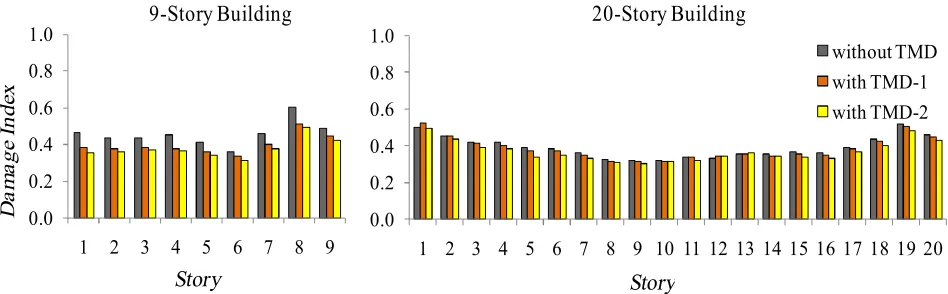
In order to investigate the effect of the nonlinear response of the structure on effectiveness of the installed TMDs, cumulative response (damage index) of the 9 and 20-story frames are calculated for the deterministic models of these structures. The response of the structures under Loma Prieta record is presented in Figure 3, for three cases: without TMD, with TMD-1, and with TMD-2. As shown in this figure, distribution of the cumulative damage in the structure is approximately uniform. As it can be observed from this figure, installing TMD could result in reduction of the damage in most of the stories of the deterministic model of the structures, when the structure experience moderate level on nonlinear behavior under the applied earthquake.
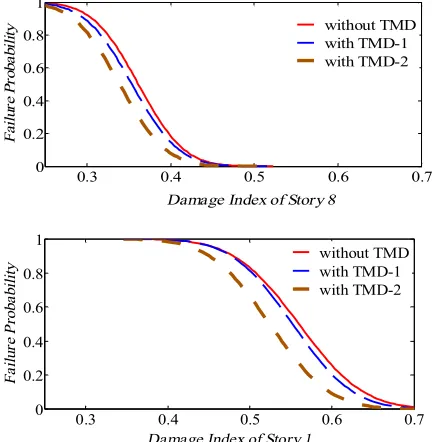
The failure probability of the sample structures under Loma Prieta record are presented in Figures 3 and 4. Based on these records and previous studies on the nonlinear response of the sample structures [22, 23], occurrence of moderate cumulative damage in the stories of a structure could result in positive effect of TMD in reducing the damage in the structure, when the characteristics of the structure are considered as probabilistic parameters. As shown in Figures 3 and 4, failure probability of the structure, due to the uncertainty in its structural parameters, has been decreased by installing the TMDs.This result is consistent with the reduction of the response in the deterministic model of the structure (see Figure 2).
Figure 2. Moderate damage occurrence in stories of the 9 and 20-story frames under Loma Prieta record
0.0 0.2 0.4 0.6 0.8 1.0
1 2 3 4 5 6 7 8 9
D
am
ag
e I
n
dex
Story
9-Story Building
0.0 0.2 0.4 0.6 0.8 1.0
1 2 3 4 5 6 7 8 9 10 11 12 13 14 15 16 17 18 19 20
Story
20-Story Building
Figure 3. Failure probability of the 9-story frame under Loma Prieta record
Figure 4. Failure probability of the 20-story frame under
Loma Prieta record
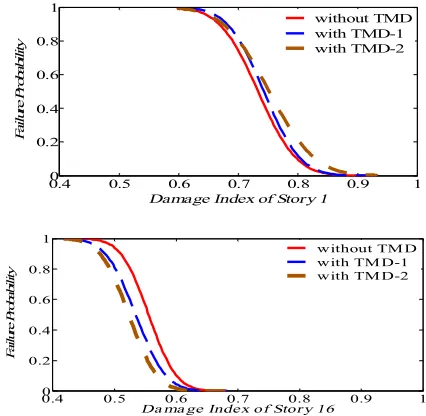
Figure 5 shows the damage index of the deterministic models of the 9 and 20-story frames, respectively under Imperial Valley and Tabas records. The results suggest that by installing TMD, damage could be reduced in most of the stories of the deterministic model of the structures. However, for the records that cause excessive nonlinear deformation in the stories of the structures (mostly in lower stories), for example Imperial Valley for 9-story frame and Tabas record for 20-story frame, the effect of the TMD on damage of the structure, in presence of the uncertain parameters, could be different. As shown in Figures 6 and 7, by installing TMDs, failure probability of some stories of the 9 and 20-story frames could increase.
The increase in the failure probability in some stories of the sample structure, under the records with excessive nonlinear effect, could be related to the effect of detuning of the TMD-structure system. Since the TMDs are tuned based on the dynamic characteristics of the deterministic model of the structures, random realization of the uncertain variables could cause detuning of the TMD-structure system. The effect of detuning is not detrimental in case of the records with moderate nonlinear effects, as seen in Figures 3 and 4. In this regard, for these records, the failure probability of the structures with TMDs is less than that for the structure without TMDs.In case of records with severe nonlinear effects, the response of the deterministic model of the structure with TMD is mostly smaller than that for the structure without TMD (see Figure 5). However, detuning of the TMD-structure system because of the randomness of the structural parameters could have negative effect on the failure probability of the structure (see Figures 6 and 7).Also, comparing the response of the structures with TMD with those without TMD could be carried out by studying the distribution of the damage index of the stories of the structures.Investigating the variation in the damage index with highest density could be a proper approach to study the effect of implementing TMD on the building frames, when the structural characteristics are considered as uncertain parameters.
0.3 0.4 0.5 0.6 0.7
0 0.2 0.4 0.6 0.8 1
Damage Index of Story 1
Fai
lu
re
P
ro
ba
bi
lity
without TMD with TMD-1 with TMD-2
0.3 0.4 0.5 0.6 0.7
0 0.2 0.4 0.6 0.8 1
Damage Index of Story 5
F
ail
ur
e
P
rob
ab
ility
without TMD with TMD-1 with TMD-2
0.3 0.4 0.5 0.6 0.7
0 0.2 0.4 0.6 0.8 1
Damage Index of Story 9
F
ail
ur
e
P
ro
ba
bility
without TMD with TMD-1 with TMD-2
0.3 0.4 0.5 0.6 0.7
0 0.2 0.4 0.6 0.8 1
Damage Index of Story 8
Fail
ur
e
P
ro
ba
bil
ity without TMD with TMD-1
with TMD-2
0.3 0.4 0.5 0.6 0.7
0 0.2 0.4 0.6 0.8 1
Damage Index of Story 1
F
ail
ur
e
P
rob
ab
ility
without TMD with TMD-1 with TMD-2
0.3 0.4 0.5 0.6 0.7
0 0.2 0.4 0.6 0.8 1
Damage Index of Story 16
F
ai
lu
re
P
ro
ba
bi
lity
Figure 5. Excessive damage occurrence in lower stories of the 9 and 20-story frames, respectively under Imperial Valley and Tabas records
Figure 6. Failure probability of the 9-story frame under
Imperial Valley record
Figure 7. Failure probability of the 20-story frame under
Tabas record
Figure 8. Distribution of the damage representative of story 8
of the 20-story frame under Loma Prieta and Tabas records
0.0 0.2 0.4 0.6 0.8 1.0
1 2 3 4 5 6 7 8 9 10 11 12 13 14 15 16 17 18 19 20
Story 20-Story Building without TMD with TMD-1 with TMD-2 0.0 0.2 0.4 0.6 0.8 1.0
1 2 3 4 5 6 7 8 9
D am ag e In dex Story 9-Story Building
0.4 0.6 0.8 1
0 0.2 0.4 0.6 0.8 1
Damage Index of Story 5
F ail ur e P ro ba bi lity without TMD with TMD-1 with TMD-2
0.4 0.6 0.8 1
0 0.2 0.4 0.6 0.8 1
Damage Index of Story 1
F ail ur e P rob ab ility without TMD with TMD-1 with TMD-2
Damage Index of Story Damage Index of Story 1
0.4 0.6 0.8 1
0 0.2 0.4 0.6 0.8 1
Damage Index of Story 9
F ai lu re P ro ba bil ity without TMD with TMD-1 with TMD-2
0.4 0.5 0.6 0.7 0.8 0.9 1
0 0.2 0.4 0.6 0.8 1
Damage Index of Story 8
F ail ur e Pr ob ab ility without TMD with TMD-1 with TMD-2
0.40 0.5 0.6 0.7 0.8 0.9 1
0.2 0.4 0.6 0.8 1
Damage Index of Story 1
Fa ilu re P rob ab ility without TMD with TMD-1 with TMD-2
0.4 0.5 0.6 0.7 0.8 0.9 1
0 0.2 0.4 0.6 0.8 1
Da ma ge Index of Stor y 16
F ai lu re P rob ab ili ty
without TM D with TM D-1 with TM D-2
0.4 0.5 0.6 0.7 0.8 0.9 1
0 1 2 3 4
Da ma ge Index of Stor y 8
D en si ty without TMD with TMD-1 with TMD-2 Tabas
0.25 0.3 0.35 0.4 0.45 0.5
0 2 4 6 8
Dama ge Index of Stor y 8
Figure 8 shows the variation in the distribution of the damage index of the of the 20-story frame, in 8-th story, under Loma Prieta and Tabas records. As presented in this figure, by installing TMD, the damage value with highest density has been shifted towards larger values under the Tabas record. This causes the higher failure probability for the structures with TMDs, under this record (see Figure 7). However, for the Loma Prieta record, the damage value with highest density is shifted towards lower values, which results in lower failure probability for the structures equipped with TMDs (see Figure 4).
6. CONCLUSION
The inherited uncertainties in the structural characteristics of the building frames could influence the performance of the structures that are equipped with tuned mass dampers (TMDs). In this study, the uncertainty in the structural characteristics of the building frames, such as the capacity and stiffness of the structural elements, seismic mass, and the damping characteristics of the structures are considered in simulation of the probabilistic response of 9 and 20-story steel moment-resisting frames. The response of the sample structures, in presence of the considered uncertain parameters under the records that cause excessive damage in the structure, indicate that failure probability of some stories of the structure could increase by installing TMDs.This increase could be related to the severe effect of detuning of the TMD-structure system under random realization of the uncertain structural parameters. The results also indicate that the even though the response of the deterministic model of the structure could be reduced by installing TMDs, the probabilistic variation in the response of the structure maybe cause higher failure probability for the structure with TMDs.
7. REFERENCES
1. Wen, Y., Ellingwood, B., Veneziano, D. and Bracci, J., "Uncertainty modeling in earthquake engineering", Mid-America Earthquake Center Project FD-2 report, (2003). 2. Mehanny, S.S. and Deierlein, G.G., "Seismic damage and
collapse assessment of composite moment frames", Journal of Structural Engineering, Vol. 127, No. 9, (2001), 1045-1053. 3. Kappos, A., "Seismic damage indices for rc buildings:
Evaluation of concepts and procedures", Progress in Structural Engineering and Materials, Vol. 1, No. 1, (1997), 78-87. 4. Mehanny, S.S.F. and Deierlein, G.G., "Modeling and assessment
of seismic performance of composite frames with reinforced concrete columns and steel beams", Stanford University, (1999),
5. Ditlevsen, O. and Madsen, H.O., "Structural reliability methods, Wiley New York, Vol. 178, (1996).
6. Nowak, A.S. and Collins, K.R., "Reliability of structures, CRC Press, (2012).
7. Baecher, G.B. and Christian, J.T., "Reliability and statistics in geotechnical engineering, John Wiley & Sons, (2005). 8. Soong, T.T. and Grigoriu, M., "Random vibration of mechanical
and structural systems", NASA STI/Recon Technical Report A, Vol. 93, (1993),
9. Den Hartog, J.P., "Mechanical vibrations, Courier Corporation, (1985).
10. McNamara, R.J., "Tuned mass dampers for buildings", Journal of the Structural Division, Vol. 103, No. 9, (1977), 1785-1798. 11. Soong, T.T. and Dargush, G.F., "Passive energy dissipation
systems in structural engineering", (1997).
12. Kaynia, A.M., Biggs, J.M. and Veneziano, D., "Seismic effectiveness of tuned mass dampers", Journal of the Structural Division, Vol. 107, No. 8, (1981), 1465-1484.
13. Lukkunaprasit, P. and Wanitkorkul, A., "Inelastic buildings with tuned mass dampers under moderate ground motions from distant earthquakes", Earthquake Engineering & Structural Dynamics, Vol. 30, No. 4, (2001), 537-551.
14. Mohebbi, M. and Joghataie, A., "Designing optimal tuned mass dampers for nonlinear frames by distributed genetic algorithms",
The Structural Design of Tall and Special Buildings, Vol. 21, No. 1, (2012), 57-76.
15. Rana, R. and Soong, T., "Parametric study and simplified design of tuned mass dampers", Engineering Structures, Vol. 20, No. 3, (1998), 193-204.
16. Sadek, F., Mohraz, B., Taylor, A.W. and Chung, R.M., "A method of estimating the parameters of tuned mass dampers for seismic applications", Earthquake Engineering and Structural Dynamics, Vol. 26, No. 6, (1997), 617-636.
17. Soto‐Brito, R. and Ruiz, S.E., "Influence of ground motion intensity on the effectiveness of tuned mass dampers",
Earthquake Engineering & Structural Dynamics, Vol. 28, No. 11, (1999), 1255-1271.
18. Warburton, G., "Optimum absorber parameters for various combinations of response and excitation parameters",
Earthquake Engineering & Structural Dynamics, Vol. 10, No. 3, (1982), 381-401.
19. Krawinkler, H. and Venture, S.J., "State of the art report on systems performance of steel moment frames subject to earthquake ground shaking, SAC Joint Venture, (2000). 20. Gupta, A. and Krawinkler, H., "Seismic demands for the
performance evaluation of steel moment resisting frame structures", Stanford University, (1999),
21. McKenna, F., Fenves, G. and Scott, M., "Open system for earthquake engineering simulation."Pacific earthquake engineering research center, berkeley. 2007.
22. Nateghi-Alahi, F. and Tarbali, K., "Reliability analysis of a steel moment-resisting frame equipped with tuned mass damper under earthquake excitation", in Proc. Fifteenth world Conference on Earthquake Engineering., (2012).
The Effect of Tuned Mass Damper on Seismic Response of Building Frames with
Uncertain Structural Characteristics
F. Nateghi. A, K. Tarbali
International Institute of Earthquake Engineering and Engineering Seismology, Iran
P A P E R I N F O
Paper history:
Received 25 January 2015
Accepted in revised form 12 March 2015
Keywords: Cumulative Damage Uncertainty Failure Probability Tuned Mass Damper
ﺪﯿﮑﭼ
هزﺎﺳتاوداهﺪﻧﻮﺷﻢﯿﻈﻨﺗﯽﻣﺮﺟيﺎﻫﺮﮔاﺮﯿﻣ
ا ﺪﻨﺘﺴﻬﯿﯾ ﻪﮐ
هزﺮﻟرﺎﺘﻓردﻮﺒﻬﺑوﻢﯿﻈﻨﺗياﺮﺑ
هزﺎﺳيا
ﺎﻫ ﻪﺑ
ﯽﻣﻪﺘﻓﺮﮔرﺎﮐ
ﻮﺷ ﺪﻧ .
وهداددﻮﺒﻬﺑاررﺎﺘﻓرًﺎﻣﻮﻤﻋتاوداﻦﯾا
ﯽﻣ ﺪﻨﻧاﻮﺗ ﺦﺳﺎﭘ
هزﺎﺳيﺎﻫ
ﻪﺑاريا
ﻢﺸﭼترﻮﺻ
ﺪﻨﻫدﺶﻫﺎﮐيﺮﯿﮔ
.
ﻦﯾارد
نﺎﯿﻣ ، ﻪﺘﺒﻟا
هزﺎﺳتﺎﺼﺨﺸﻣﻪﺑﻪﺟﻮﺗ
هزﺎﺳتﺎﺼﺨﺸﻣردﺖﯿﻌﻄﻗمﺪﻋﺎﯾيا
ﯽﻣدﻮﺟﻮﻣيا
وهﺪﯿﭽﯿﭘارﻪﻠﺌﺴﻣﻦﯾاﺪﻧاﻮﺗ
ﯾدراﻮﻣرد
رﺎﭼﺪ
ﺪﯾﺎﻤﻧﻞﮑﺸﻣ
.
هزﺮﻟرﺎﺘﻓرﻪﻟﺎﻘﻣﻦﯾارد
بﺎﻗيا
ﺖﯿﻌﻄﻗمﺪﻋﻦﺘﻓﺮﮔﺮﻈﻧردﺎﺑﺎﻫﺮﮔاﺮﯿﻣزاهدﺎﻔﺘﺳاﺎﺑموﺎﻘﻣيﺰﻠﻓيﺎﻫ
يﺎﻫ
دﻮﺟﻮﻣ
ﻪﻌﻟﺎﻄﻣدرﻮﻣ
ﻪﺘﻓﺮﮔراﺮﻗ ﺖﺳا
.
ﻦﯿﯾﺎﭘتﺎﻘﺒﻃرددﺎﯾزﻪﻠﺻﺎﺣترﺎﺴﺧﻪﮐﺖﺳاﻦﯾازاﯽﮐﺎﺣتﺎﻌﻟﺎﻄﻣﻪﺠﯿﺘﻧ
هزﺎﺳﺮﺗ
ﻪﻠﺌﺴﻣﻦﯾاﻪﺑيدﺎﯾزﯽﮕﺘﺴﺑهزﺎﺳبﻮﻠﻄﻣﺎﻧرﺎﺘﻓرﯽﻟﺎﻤﺘﺣاﺖﯿﺳﺎﺴﺣوﻪﺘﺷادهﺪﻧﻮﺷﻢﯿﻈﻨﺗﯽﻣﺮﺟﺮﮔاﺮﯿﻣرﺎﺘﻓرﻪﺑمﺎﺗﯽﮕﺘﺴﺑ
دراد
.
ﻦﻤﺿرد
،
هﺪﻧﻮﺷﻢﯿﻈﻨﺗﺮﮔاﺮﯿﻣمﺮﺟشﺎﻌﺗرالﺮﺘﻨﮐﻢﺘﺴﯿﺳﺮﯿﺛﺎﺗﻪﻌﻟﺎﻄﻣﻦﯾارد
(TMD)
عﻮﻗولﺎﻤﺘﺣاﺶﻫﺎﮐرد
ﺖﺳاهﺪﺷﯽﺳرﺮﺑيدﻻﻮﻓﯽﺸﻤﺧبﺎﻗهزﺎﺳردﯽﺑاﺮﺧ
.
هزﺎﺳيﺎﻬﻧﺎﻤﻟاﯽﺘﺨﺳوﺖﻣوﺎﻘﻣ
يا
ترﻮﺻﻪﺑﻪﻟﺰﻟزﯽﯾراﺬﮔرﺎﺑو
ﺖﺳاهﺪﺷلﺎﻤﻋاﯽﺿﺎﯾرلﺪﻣردﯽﺗﻻﺎﻤﺘﺣا
.
ﯽﻣنﺎﺸﻧﻪﻌﻟﺎﻄﻣﺞﯾﺎﺘﻧ
ﺪﻫد
ﻪﻟﺰﻟزياﺮﺑﻪﮐ
بوﺎﻨﺗهرودﺎﺑﻞﺴﮔزاروديﺎﻫ
ﺎﺑهزﺎﺳردﯽﺑاﺮﺧعﻮﻗولﺎﻤﺘﺣاﻦﯿﯾﺎﭘﻦﯿﮕﻧﺎﯿﻣ
TMD
هزﺎﺳزاﺮﺘﻤﮐ
زاهدﺎﻔﺘﺳاﺮﯿﺛﺎﺗوﺖﺳاﯽﻠﺻاي
TMD
تﺎﺼﺨﺸﻣﺎﺑ
ﺖﺳاتوﺎﻔﺘﻣهزﺎﺳﻒﻠﺘﺨﻣتﺎﻘﺒﻃردﻒﻠﺘﺨﻣ
.