VOLUME NO.2(2012),ISSUE NO.10(OCTOBER) ISSN2231-5756
A Monthly Double-Blind Peer Reviewed (Refereed/Juried) Open Access International e-Journal - Included in the International Serial Directories
Indexed & Listed at:
VOLUME NO.2(2012),ISSUE NO.10(OCTOBER) ISSN2231-5756
CONTENTS
CONTENTS
CONTENTS
CONTENTS
Sr.No.
TITLE & NAME OF THE AUTHOR (S)
Page No.
1. EFFICIENCY AND PERFORMANCE OF e-LEARNING PROJECTS IN INDIA SANGITA RAWAL, DR. SEEMA SHARMA & DR. U. S. PANDEY
1 2. AN ADAPTIVE DECISION SUPPORT SYSTEM FOR PRODUCTION PLANNING: A CASE OF CD REPLICATOR
SIMA SEDIGHADELI & REZA KACHOUIE
5 3. CONSTRUCT THE TOURISM INTENTION MODEL OF CHINA TRAVELERS IN TAIWAN
WEN-GOANG, YANG, CHIN-HSIANG, TSAI, JUI-YING HUNG, SU-SHIANG, LEE & HUI-HUI, LEE
9 4. FINANCIAL PLANNING CHALLENGES AFFECTING IMPLEMENTATION OF THE ECONOMIC STIMULUS PROGRAMME IN EMBU
COUNTY, KENYA
PAUL NJOROGE THIGA, JUSTO MASINDE SIMIYU, ADOLPHUS WAGALA, NEBAT GALO MUGENDA & LEWIS KINYUA KATHUNI
15
5. IMPACT OF ELECTRONIC COMMERCE PRACTICES ON CUSTOMER E-LOYALTY: A CASE STUDY OF PAKISTAN TAUSIF M. & RIAZ AHMAD
22 6. SOCIAL NETWORKING IN VIRTUAL COMMUNITY CENTRES: USES AND PERCEPTION AMONG SELECTED NIGERIAN STUDENTS
DR. SULEIMAN SALAU & NATHANIEL OGUCHE EMMANUEL
26 7. EXPOSURE TO CLIMATE CHANGE RISKS: CROP INSURANCE
DR. VENKATESH. J, DR. SEKAR. S, AARTHY.C & BALASUBRAMANIAN. M
32 8. SCENARIO OF ENTERPRISE RESOURCE PLANNING IMPLEMENTATION IN SMALL AND MEDIUM SCALE ENTERPRISES
DR. G. PANDURANGAN, R. MAGENDIRAN, L.S. SRIDHAR & R. RAJKOKILA
35
9. BRAIN TUMOR SEGMENTATION USING ALGORITHMIC AND NON ALGORITHMIC APPROACH
K.SELVANAYAKI & DR. P. KALUGASALAM
39
10. EMERGING TRENDS AND OPPORTUNITIES OF GREEN MARKETING AMONG THE CORPORATE WORLD
DR. MOHAN KUMAR. R, INITHA RINA.R & PREETHA LEENA .R
45 11. DIFFUSION OF INNOVATIONS IN THE COLOUR TELEVISION INDUSTRY: A CASE STUDY OF LG INDIA
DR. R. SATISH KUMAR, MIHIR DAS & DR. SAMIK SOME
51 12. TOOLS OF CUSTOMER RELATIONSHIP MANAGEMENT – A GENERAL IDEA
T. JOGA CHARY & CH. KARUNAKER
56 13. LOGISTIC REGRESSION MODEL FOR PREDICTION OF BANKRUPTCY
ISMAIL B & ASHWINI KUMARI
58 14. INCLUSIVE GROWTH: REALTY OR MYTH IN INDIA
DR. KALE RACHNA RAMESH
65 15. A PRACTICAL TOKENIZER FOR PART-OF SPEECH TAGGING OF ENGLISH TEXT
BHAIRAB SARMA & BIPUL SHYAM PURKAYASTHA
69 16. KEY ANTECEDENTS OF FEMALE CONSUMER BUYING BEHAVIOR WITH SPECIAL REFERENCE TO COSMETICS PRODUCT
DR. RAJAN
72 17. MANAGING HUMAN ENCOUNTERS AT CLASSROOMS - A STUDY WITH SPECIAL REFERENCE TO ENGINEERING PROGRAMME,
CHENNAI DR. B. PERCY BOSE
77
18. THE IMPACT OF E-BANKING ON PERFORMANCE – A STUDY OF INDIAN NATIONALISED BANKS MOHD. SALEEM & MINAKSHI GARG
80 19. UTILIZING FRACTAL STRUCTURES FOR THE INFORMATION ENCRYPTING PROCESS
UDAI BHAN TRIVEDI & R C BHARTI
85 20. IMPACT OF LIBERALISATION ON PRACTICES OF PUBLIC SECTOR BANKS IN INDIA
DR. R. K. MOTWANI & SAURABH JAIN
89 21. THE EFFECTIVENESS OF PERFORMANCE APPRAISAL ON ITES INDUSTRY AND ITS OUTCOME
DR. V. SHANTHI & V. AGALYA
92 22. CUSTOMERS ARE THE KING OF THE MARKET: A PRICING APPROACH BASED ON THEIR OPINION - TARGET COSTING
SUSANTA KANRAR & DR. ASHISH KUMAR SANA
97 23. WHAT DRIVE BSE AND NSE?
MOCHI PANKAJKUMAR KANTILAL & DILIP R. VAHONIYA
101 24. A CASE APPROACH TOWARDS VERTICAL INTEGRATION: DEVELOPING BUYER-SELLER RELATIONSHIPS
SWATI GOYAL, SONU DUA & GURPREET KAUR
108 25. ANALYSIS OF SOURCES OF FRUIT WASTAGES IN COLD STORAGE UNITS IN TAMILNADU
ARIVAZHAGAN.R & GEETHA.P
113
26. A NOVEL CONTRAST ENHANCEMENT METHOD BY ARBITRARILY SHAPED WAVELET TRANSFORM THROUGH HISTOGRAM
EQUALIZATION SIBIMOL J
119
27. SCOURGE OF THE INNOCENTS A. LINDA PRIMLYN
124 28. BUILDING & TESTING MODEL IN MEASUREMENT OF INTERNAL SERVICE QUALITY IN TANCEM – A GAP ANALYSIS APPROACH
DR. S. RAJARAM, V. P. SRIRAM & SHENBAGASURIYAN.R
128 29. ORGANIZATIONAL CREATIVITY FOR COMPETITIVE EXCELLENCE
REKHA K.A
133 30. A STUDY OF STUDENT’S PERCEPTION FOR SELECTION OF ENGINEERING COLLEGE: A FACTOR ANALYSIS APPROACH
SHWETA PANDIT & ASHIMA JOSHI
138
VOLUME NO.2(2012),ISSUE NO.10(OCTOBER) ISSN2231-5756
CHIEF PATRON
CHIEF PATRON
CHIEF PATRON
CHIEF PATRON
PROF. K. K. AGGARWAL
Chancellor, Lingaya’s University, Delhi
Founder Vice-Chancellor, Guru Gobind Singh Indraprastha University, Delhi
Ex. Pro Vice-Chancellor, Guru Jambheshwar University, Hisar
FOUNDER
FOUNDER
FOUNDER
FOUNDER PATRON
PATRON
PATRON
PATRON
LATE SH. RAM BHAJAN AGGARWAL
Former State Minister for Home & Tourism, Government of Haryana
Former Vice-President, Dadri Education Society, Charkhi Dadri
Former President, Chinar Syntex Ltd. (Textile Mills), Bhiwani
CO
CO
CO
CO----ORDINATOR
ORDINATOR
ORDINATOR
ORDINATOR
AMITA
Faculty, Government M. S., Mohali
ADVISORS
ADVISORS
ADVISORS
ADVISORS
DR. PRIYA RANJAN TRIVEDI
Chancellor, The Global Open University, Nagaland
PROF. M. S. SENAM RAJU
Director A. C. D., School of Management Studies, I.G.N.O.U., New Delhi
PROF. M. N. SHARMA
Chairman, M.B.A., Haryana College of Technology & Management, Kaithal
PROF. S. L. MAHANDRU
Principal (Retd.), Maharaja Agrasen College, Jagadhri
EDITOR
EDITOR
EDITOR
EDITOR
PROF. R. K. SHARMA
Professor, Bharti Vidyapeeth University Institute of Management & Research, New Delhi
CO
CO
CO
CO----EDITOR
EDITOR
EDITOR
EDITOR
DR. BHAVET
Faculty, M. M. Institute of Management, Maharishi Markandeshwar University, Mullana, Ambala, Haryana
EDITORIAL ADVISORY BOARD
EDITORIAL ADVISORY BOARD
EDITORIAL ADVISORY BOARD
EDITORIAL ADVISORY BOARD
DR. RAJESH MODI
Faculty, Yanbu Industrial College, Kingdom of Saudi Arabia
PROF. SANJIV MITTAL
University School of Management Studies, Guru Gobind Singh I. P. University, Delhi
PROF. ANIL K. SAINI
Chairperson (CRC), Guru Gobind Singh I. P. University, Delhi
DR. SAMBHAVNA
Faculty, I.I.T.M., Delhi
DR. MOHENDER KUMAR GUPTA
VOLUME NO.2(2012),ISSUE NO.10(OCTOBER) ISSN2231-5756
DR. SHIVAKUMAR DEENE
Asst. Professor, Dept. of Commerce, School of Business Studies, Central University of Karnataka, Gulbarga
DR. MOHITA
Faculty, Yamuna Institute of Engineering & Technology, Village Gadholi, P. O. Gadhola, Yamunanagar
ASSOCIATE EDITORS
ASSOCIATE EDITORS
ASSOCIATE EDITORS
ASSOCIATE EDITORS
PROF. NAWAB ALI KHAN
Department of Commerce, Aligarh Muslim University, Aligarh, U.P.
PROF. ABHAY BANSAL
Head, Department of Information Technology, Amity School of Engineering & Technology, Amity University, Noida
PROF. A. SURYANARAYANA
Department of Business Management, Osmania University, Hyderabad
DR. SAMBHAV GARG
Faculty, M. M. Institute of Management, Maharishi Markandeshwar University, Mullana, Ambala, Haryana
PROF. V. SELVAM
SSL, VIT University, Vellore
DR. PARDEEP AHLAWAT
Associate Professor, Institute of Management Studies & Research, Maharshi Dayanand University, Rohtak
DR. S. TABASSUM SULTANA
Associate Professor, Department of Business Management, Matrusri Institute of P.G. Studies, Hyderabad
SURJEET SINGH
Asst. Professor, Department of Computer Science, G. M. N. (P.G.) College, Ambala Cantt.
TECHNICAL ADVISOR
TECHNICAL ADVISOR
TECHNICAL ADVISOR
TECHNICAL ADVISOR
AMITA
Faculty, Government H. S., Mohali
DR. MOHITA
Faculty, Yamuna Institute of Engineering & Technology, Village Gadholi, P. O. Gadhola, Yamunanagar
FINANCIAL ADVISORS
FINANCIAL ADVISORS
FINANCIAL ADVISORS
FINANCIAL ADVISORS
DICKIN GOYAL
Advocate & Tax Adviser, Panchkula
NEENA
Investment Consultant, Chambaghat, Solan, Himachal Pradesh
LEGAL ADVISORS
LEGAL ADVISORS
LEGAL ADVISORS
LEGAL ADVISORS
JITENDER S. CHAHAL
Advocate, Punjab & Haryana High Court, Chandigarh U.T.
CHANDER BHUSHAN SHARMA
Advocate & Consultant, District Courts, Yamunanagar at Jagadhri
SUPERINTENDENT
SUPERINTENDENT
SUPERINTENDENT
SUPERINTENDENT
SURENDER KUMAR POONIA
VOLUME NO.2(2012),ISSUE NO.10(OCTOBER) ISSN2231-5756
CALL FOR MANUSCRIPTS
CALL FOR MANUSCRIPTS
CALL FOR MANUSCRIPTS
CALL FOR MANUSCRIPTS
Weinvite unpublished novel, original, empirical and high quality research work pertaining to recent developments & practices in the area of Computer, Business, Finance, Marketing, Human Resource Management, General Management, Banking, Insurance, Corporate Governance and emerging paradigms in allied subjects like Accounting Education; Accounting Information Systems; Accounting Theory & Practice; Auditing; Behavioral Accounting; Behavioral Economics; Corporate Finance; Cost Accounting; Econometrics; Economic Development; Economic History; Financial Institutions & Markets; Financial Services; Fiscal Policy; Government & Non Profit Accounting; Industrial Organization; International Economics & Trade; International Finance; Macro Economics; Micro Economics; Monetary Policy; Portfolio & Security Analysis; Public Policy Economics; Real Estate; Regional Economics; Tax Accounting; Advertising & Promotion Management; Business Education; Management Information Systems (MIS); Business Law, Public Responsibility & Ethics; Communication; Direct Marketing; E-Commerce; Global Business; Health Care Administration; Labor Relations & Human Resource Management; Marketing Research; Marketing Theory & Applications; Non-Profit Organizations; Office Administration/Management; Operations Research/Statistics; Organizational Behavior & Theory; Organizational Development; Production/Operations; Public Administration; Purchasing/Materials Management; Retailing; Sales/Selling; Services; Small Business Entrepreneurship; Strategic Management Policy; Technology/Innovation; Tourism, Hospitality & Leisure; Transportation/Physical Distribution; Algorithms; Artificial Intelligence; Compilers & Translation; Computer Aided Design (CAD); Computer Aided Manufacturing; Computer Graphics; Computer Organization & Architecture; Database Structures & Systems; Digital Logic; Discrete Structures; Internet; Management Information Systems; Modeling & Simulation; Multimedia; Neural Systems/Neural Networks; Numerical Analysis/Scientific Computing; Object Oriented Programming; Operating Systems; Programming Languages; Robotics; Symbolic & Formal Logic and Web Design. The above mentioned tracks are only indicative, and not exhaustive.
Anybody can submit the soft copy of his/her manuscript anytime in M.S. Word format after preparing the same as per our submission guidelines duly available on our website under the heading guidelines for submission, at the email address: [email protected].
GUIDELINES FOR SUBM
GUIDELINES FOR SUBM
GUIDELINES FOR SUBM
GUIDELINES FOR SUBMISSION OF MANUSCRIPT
ISSION OF MANUSCRIPT
ISSION OF MANUSCRIPT
ISSION OF MANUSCRIPT
1. COVERING LETTER FOR SUBMISSION:
DATED: _____________
THE EDITOR
IJRCM
Subject: SUBMISSION OF MANUSCRIPT IN THE AREA OF .
(e.g. Finance/Marketing/HRM/General Management/Economics/Psychology/Law/Computer/IT/Engineering/Mathematics/other, please specify) DEAR SIR/MADAM
Please find my submission of manuscript entitled ‘___________________________________________’ for possible publication in your journals.
I hereby affirm that the contents of this manuscript are original. Furthermore, it has neither been published elsewhere in any language fully or partly, nor is it under review for publication elsewhere.
I affirm that all the author (s) have seen and agreed to the submitted version of the manuscript and their inclusion of name (s) as co-author (s).
Also, if my/our manuscript is accepted, I/We agree to comply with the formalities as given on the website of the journal & you are free to publish our contribution in any of your journals.
NAME OF CORRESPONDING AUTHOR: Designation:
Affiliation with full address, contact numbers & Pin Code: Residential address with Pin Code:
Mobile Number (s): Landline Number (s): E-mail Address: Alternate E-mail Address:
NOTES:
a) The whole manuscript is required to be in ONE MS WORD FILE only (pdf. version is liable to be rejected without any consideration), which will start from the covering letter, inside the manuscript.
b) The sender is required to mention the following in the SUBJECT COLUMN of the mail:
New Manuscript for Review in the area of (Finance/Marketing/HRM/General Management/Economics/Psychology/Law/Computer/IT/ Engineering/Mathematics/other, please specify)
c) There is no need to give any text in the body of mail, except the cases where the author wishes to give any specific message w.r.t. to the manuscript. d) The total size of the file containing the manuscript is required to be below 500 KB.
e) Abstract alone will not be considered for review, and the author is required to submit the complete manuscript in the first instance.
f) The journal gives acknowledgement w.r.t. the receipt of every email and in case of non-receipt of acknowledgment from the journal, w.r.t. the submission of manuscript, within two days of submission, the corresponding author is required to demand for the same by sending separate mail to the journal.
2. MANUSCRIPT TITLE: The title of the paper should be in a 12 point Calibri Font. It should be bold typed, centered and fully capitalised.
3. AUTHOR NAME (S) & AFFILIATIONS: The author (s) full name, designation, affiliation (s), address, mobile/landline numbers, and email/alternate email address should be in italic & 11-point Calibri Font. It must be centered underneath the title.
VOLUME NO.2(2012),ISSUE NO.10(OCTOBER) ISSN2231-5756
5. KEYWORDS: Abstract must be followed by a list of keywords, subject to the maximum of five. These should be arranged in alphabetic order separated by commas and full stops at the end.
6. MANUSCRIPT: Manuscript must be in BRITISH ENGLISH prepared on a standard A4 size PORTRAIT SETTING PAPER. It must be prepared on a single space and single column with 1” margin set for top, bottom, left and right. It should be typed in 8 point Calibri Font with page numbers at the bottom and centre of every page. It should be free from grammatical, spelling and punctuation errors and must be thoroughly edited.
7. HEADINGS: All the headings should be in a 10 point Calibri Font. These must be bold-faced, aligned left and fully capitalised. Leave a blank line before each heading.
8. SUB-HEADINGS: All the sub-headings should be in a 8 point Calibri Font. These must be bold-faced, aligned left and fully capitalised. 9. MAIN TEXT: The main text should follow the following sequence:
INTRODUCTION REVIEW OF LITERATURE
NEED/IMPORTANCE OF THE STUDY STATEMENT OF THE PROBLEM OBJECTIVES
HYPOTHESES
RESEARCH METHODOLOGY RESULTS & DISCUSSION FINDINGS
RECOMMENDATIONS/SUGGESTIONS CONCLUSIONS
SCOPE FOR FURTHER RESEARCH ACKNOWLEDGMENTS REFERENCES APPENDIX/ANNEXURE
It should be in a 8 point Calibri Font, single spaced and justified. The manuscript should preferably not exceed 5000 WORDS.
10. FIGURES & TABLES: These should be simple, crystal clear, centered, separately numbered & self explained, and titles must be above the table/figure. Sources of data should be mentioned below the table/figure. It should be ensured that the tables/figures are referred to from the main text.
11. EQUATIONS: These should be consecutively numbered in parentheses, horizontally centered with equation number placed at the right.
12. REFERENCES: The list of all references should be alphabetically arranged. The author (s) should mention only the actually utilised references in the preparation of manuscript and they are supposed to follow Harvard Style of Referencing. The author (s) are supposed to follow the references as per the following:
•
All works cited in the text (including sources for tables and figures) should be listed alphabetically.•
Use (ed.) for one editor, and (ed.s) for multiple editors.•
When listing two or more works by one author, use --- (20xx), such as after Kohl (1997), use --- (2001), etc, in chronologically ascending order.•
Indicate (opening and closing) page numbers for articles in journals and for chapters in books.•
The title of books and journals should be in italics. Double quotation marks are used for titles of journal articles, book chapters, dissertations, reports, working papers, unpublished material, etc.•
For titles in a language other than English, provide an English translation in parentheses.•
The location of endnotes within the text should be indicated by superscript numbers.PLEASE USE THE FOLLOWING FOR STYLE AND PUNCTUATION IN REFERENCES: BOOKS
•
Bowersox, Donald J., Closs, David J., (1996), "Logistical Management." Tata McGraw, Hill, New Delhi.•
Hunker, H.L. and A.J. Wright (1963), "Factors of Industrial Location in Ohio" Ohio State University, Nigeria.CONTRIBUTIONS TO BOOKS
•
Sharma T., Kwatra, G. (2008) Effectiveness of Social Advertising: A Study of Selected Campaigns, Corporate Social Responsibility, Edited by David Crowther & Nicholas Capaldi, Ashgate Research Companion to Corporate Social Responsibility, Chapter 15, pp 287-303.JOURNAL AND OTHER ARTICLES
•
Schemenner, R.W., Huber, J.C. and Cook, R.L. (1987), "Geographic Differences and the Location of New Manufacturing Facilities," Journal of Urban Economics, Vol. 21, No. 1, pp. 83-104.CONFERENCE PAPERS
•
Garg, Sambhav (2011): "Business Ethics" Paper presented at the Annual International Conference for the All India Management Association, New Delhi, India, 19–22 June.UNPUBLISHED DISSERTATIONS AND THESES
•
Kumar S. (2011): "Customer Value: A Comparative Study of Rural and Urban Customers," Thesis, Kurukshetra University, Kurukshetra.ONLINE RESOURCES
•
Always indicate the date that the source was accessed, as online resources are frequently updated or removed.WEBSITES
VOLUME NO.2(2012),ISSUE NO.10(OCTOBER) ISSN2231-5756
A STUDY OF STUDENT’S PERCEPTION FOR SELECTION OF ENGINEERING COLLEGE: A FACTOR ANALYSIS
APPROACH
SHWETA PANDIT
LECTURER
PRESTIGE INSTITUTE OF MANAGEMENT
DEWAS
ASHIMA JOSHI
LECTURER
PRESTIGE INSTITUTE OF MANAGEMENT
DEWAS
ABSTRACT
This paper proposes and describes student’s perception towards selection of engineering college. Implicit in this theory is the notion that engineering college selection may be viewed as a process which consists of a sequence of interrelated stages. It is posited that students move through these series of stages as they search for desirable colleges. This paper attempts at studying all those aspect which are taken into consideration by a higher secondary passed student while taking admission in an engineering college. Now a days number of engineering institutes in India are catering to a lot of marketing activity, which perplex the students and have substantial effect on the decision making process, which again leads to their expectations. Selecting engineering institutes is high involvement decision for any individual as it determines his career and therefore, the information search behavior is very important. A brief questioner which measures the influence of factors on college choice was administered amongst 100 students seeking admission for engineering colleges. The relationship of these factors to gender, college, aptitude, distance of home and some important factors were examined through factor analysis approach. This research has been undertaken to study and examine the perception of students about the engineering colleges. From the research it is concluded that the five important variables contributing in decision making of the students for selection of institute are Placement activities of the institute and package offered by the recruiters, the recruiters, Alumni opinion, availability of workshops and laboratories and suggestion given by coaching institutes.
KEYWORDS
Factors, Factor analysis, motivation, Perceptions.
INTRODUCTION
n today’s competitive environment, rendering quality service is a key for success, and many experts concur that the most powerful competitive tool currently reshaping marketing and business strategy is service quality. Service quality is a pervasive strategic force and a key strategic issue in any organization. It is no surprise that practitioners and academicians are keen on accurately measuring and understanding issues affecting service quality delivery. Today, many universities are being driven towards commercial competition imposed by environmental challenges. Institutions, in general, need to be concerned not only with what the society values in the skills and abilities of their graduates, but also how their students feel about their educational experience (Bemowski, 1991).Perception plays a key role in college selection. How much prestige, honor, or academic glory can be attained by attending engineering institute? What about a university? Or, in contrast, the perceived status or Image plays a huge role in college selection. Perception is the act or faculty of apprehending by means of the senses or of mind: cognition; understanding. How students perceive service quality is critical because it determines how they evaluate the service. Students evaluate a service based on their expectations. Because expectations are dynamic, evaluations may also shift from time to time. Thus, how customers (students) evaluate what they term as a quality service today, (based on some criterion) may change tomorrow. This calls for continuous monitoring and evaluations of service quality in any service firm.
There are many factors that go into college selection, as well as college perception. The main socializing agents of family, friends, school, and media can help to create how engineering colleges are perceived; perhaps that is where India’s bias begins. Research suggests that some agents have more influence than others. The purpose of the study was to illuminate students’ views on how it affect and influence their career decisions. Many economists feel that the nation has failed to take advantage of its greatest resource, this being its diverse population. Some of the reasons for this failure are reflected in challenges that are apparent when seeking to attract a diverse population of students to the fields of engineering and other related professions. The college choice is a decision influenced by a number of demographic, economic, social, political, and institutional factors. Different types of students chose to attend certain universities on the basis of one or more factors that link directly to their characteristics and needs. Major factors cited in the literature to influence college choice are: the advice of parents, academic reputation of the institution, availability of the desired program, availability of financial aid, cost of attending the institution, and the location of the college.
Is the students’ perception of the college determined by their motivations to attend? For example, are students more satisfied if they chose to attend when they had other options or less satisfied if they were forced by their financial circumstances? This is the aim of this study to determine the perceptions and motivations of students attending engineering students. Therefore, to study the important attributes especially institutional factors that affect students’ college choice decision in higher education institutions become pertinent on the part of marketing strategy planning for students’ recruitment of higher educational institutions.
LITERATURE REVIEW
Joseph & Joseph (2000) concluded that course and career information, and physical aspects and facilities and facilities are critical issues that must be kept in mind when educational institutions are trying to create sustainable competitive advantages in marketing strategies. Leblance and Nguyen (1999) identified perceptions of price in the form of the price/quality relationship as most important factors, while Ford et al. (1999) recognized academic reputation, cost/time issues and program issues as the determinants of universities choice. Sevier (1986) stated that research has consistently shown that college or university location can be a major factor for potential student’s decision to apply and enroll. Some students may be looking for a school close to their hometown or place of work for convenience and accessibility (Absher & Crawford, 1996; Servier, (1994).A study by Kohn et al. (1976) discussed that an important factor in student predisposition to attend college is the close proximity of a higher education institution to home. It was found that a low-cost, nearby college was an important stimulator of a student’s decision to further his or her education. Hossler & Gallagher (1990) also concluded that the proximity to a college campus does affect college attendance rates. Students who live close to a campus are more likely to attend college though they may not attend the campus located near home. As a result, this study hypothesizes that location has a significant influence on college choice decision. Tapan Kumar Nayak & Manish Agrawal(2010), through their research focused on the most important factors that the students keep in the mind while selecting a particular B- School .and suggested how a marketing communication based on these factors can help to these B-school to gain competitive edge.
VOLUME NO.2(2012),ISSUE NO.10(OCTOBER) ISSN2231-5756
OBJECTIVES OF THE STUDY
• To identify and examine the factors responsible for the selection of engineering college. • To rank the effective factors responsible for the selection of engineering college.
• To identify the factors which are been ignored by the students while selecting the engineering College • To find out the sources through which students outlines an opinion about engineering colleges • To identify the key dimensions/factors that influence students’ decision in college selection.
• To determine the nature and strength of relationship between service quality dimensions and perception
METHODOLOGY
The objectives of the study indicate that the study must be carried out at micro level. We elucidate the concept of factor analysis and sampling design, based on the literature pertaining to the student’s perception about the engineering college. To study the factors affecting the selection of an engineering college in India the factor analysis is being used in our study.
FACTOR ANALYSIS
The factorial analysis allows a reduction in the number of variable to be groped in to common factors. The use of factor analysis in this study is relevant because it identifies the salient attributes, which potential students use to evaluate an engineering institute. Further, we have also used quantitative marketing research techniques to collect data from a sample of 100 students concerning their ratings of all the institutional attributes.
The main applications of factor analysis technique are: 1. To reduce the number of variables and
2. To detect structure in the relationship between variables, that is to classify variables.
Therefore, factor analysis is applied as data reduction or structured detection method. (Factor analysis was first introduced by Thurstone-1931). The research methodology is broadly divided under the heading as follows:
a) Sampling Design: The sampling technique used in the study is non-probability sampling. It is convenient sample with a judgmental basis. The sample unit is taken as students who have passed their higher secondary examination. The total sample size is 100.
b) Research Design: While determining the various factors, exploratory study was carried out with the help of secondary data. Once the basic factors of the study were found a descriptive study was carried out to know the preferences of the respondent.
c) Data Collection: Data was collected with the help of primary survey as well as secondary sources. The primary data was collected with the help of a close ended -structured questionnaire, designed on a semantic differential scale.
d) Data Analysis: The data is analyzed with the help of factor analysis, to reduce excessive data and correlation techniques. The factors are differentiated with the various variables that are strongly correlated to them. Independent but like factors were grouped by their factor loadings and the result were analyzed by the varimax rotation. The study is based on 44 independent/dependent variables, which were again toned down to 11 different factors with the help of data reduction technique (factor analysis), based on most significance to the respondents.
ANALYSIS AND INTERPRETAION
PARAMETERS TAKEN IN THE STUDY1) Institutional Service Standards: i) University
ii) Certified from National Board of Accreditation(NBA) iii) ISO Certification
iv) Placement Cell v) Recruiters
vi) Package offered by the recruiters vii) Training Programme
viii) Technical events
ix) Opportunity to handle live project
x) Academic qualification of Faculty Members xi) Teacher student ratio
2) Institutional Environment: i) College location ii) The city is attractive
iii) The city having facility for further study
iv) Easy transportation facility (Connectivity with other area) v) Accommodation
vi) Safety
vii) Existence of cultural activities viii) Existence of health care means 3) Brand :
i) Ranking given to the college ii) Golden History of the college iii) Reputation of the institute 4) Institutional Infrastructure: i) Size of the building ii) Physical Facilities iii) Accessibility of all facilities iv) Workshops & Laboratory v) Library resource
vi) Fast search facility in library vii) E-Library
viii) Wi-Fi zone
ix) Smart classroom equipped with modern pedagogy x) Canteen facilities
xi) Extracurricular activities organized by college
VOLUME NO.2(2012),ISSUE NO.10(OCTOBER) ISSN2231-5756
5) Sources used to form perception: i) Opinion of friends and family ii) Coaching institutes iii) Self visit to college iv) Alumni opinion v) Event & exhibition vi) Publicity 6) Financial factors : i) Fee structure ii) Loan facility iii) Scholarship
The above cited parameters have been classified Into 11 factors with the help of data reduction techniques (factor analysis). The results are shown as follows:
TABLE 1: KMO AND BARTLETT'S TEST(a)
The Bartlett’s Test of sphericity is used here to decide whether the results are worth considering or not. The Bartlett’s Test of sphericity significant to a level of significance of 0.000 indicates that there is a high level of correlation between variables; therefore factor analysis is being applied.
FACTOR ANALYSIS AND ITS RESULTS
A data of 100 students who have cleared Engineering Entrance Exam (PET) were randomly surveyed. The use of factor analysis in this study is relevant as it helps in identifying the variables which are taken into consideration by the students seeking admission. The main applications of factor analytic technique are: 1. To reduce the number of variables
2. To detect structure in the relationships between variables, that is to classify the variables.
The result of factor analysis after varimax rotation, has grouped the data into 11 factors. Table 2 below is the representation of the variance explained in terms of 11 factors extracted. The Eigen value chart is show below:
TABLE 2: TOTAL VARIANCE EXPLAINED
Component Initial Eigen Values(a) Extraction Sums of Squared Loadings Rotation Sums of Squared Loadings Total % of Variance Cumulative % Total % of Variance Cumulative % Total % of Variance Cumulative % 1 19.782 20.093 20.093 19.782 20.093 20.093 9.167 9.311 9.311 2 15.244 15.484 35.576 15.244 15.484 35.576 7.436 7.553 16.864 3 11.416 11.596 47.172 11.416 11.596 47.172 8.713 8.851 25.715 4 7.781 7.903 55.076 7.781 7.903 55.076 9.225 9.37 35.085 5 6.116 6.213 61.288 6.116 6.213 61.288 9.929 10.085 45.17 6 5.816 5.907 67.195 5.816 5.907 67.195 8.244 8.374 53.544 7 4.646 4.72 71.915 4.646 4.72 71.915 7.049 7.16 60.704 8 4.016 4.079 75.994 4.016 4.079 75.994 5.866 5.958 66.662 9 2.798 2.842 78.836 2.798 2.842 78.836 7.117 7.229 73.891 10 2.541 2.581 81.417 2.541 2.581 81.417 4.248 4.315 78.206 11 2.322 2.359 83.776 2.322 2.359 83.776 5.483 5.569 83.776
Kaiser-Meyer-Olkin Measure of Sampling Adequacy. .425 Bartlett's Test of Sphericity Approx. Chi-Square 4482.225
Df 946
VOLUME NO.2(2012),ISSUE NO.10(OCTOBER) ISSN2231-5756 TABLE 3: COMMUNALITIES
VOLUME NO.2(2012),ISSUE NO.10(OCTOBER) ISSN2231-5756
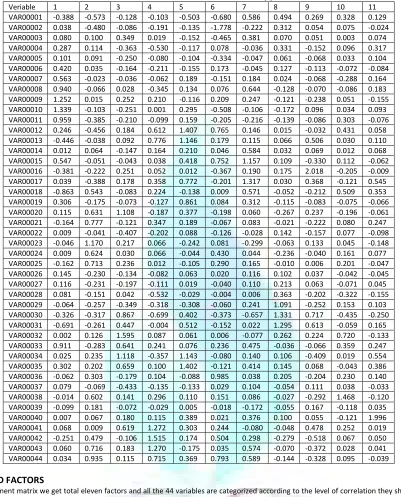
TABLE 4: ROTATED COMPONENT MATRIX (a)
Veriable 1 2 3 4 5 6 7 8 9 10 11
VAR00001 -0.388 -0.573 -0.128 -0.103 -0.503 -0.680 0.586 0.494 0.269 0.328 0.129 VAR00002 0.038 -0.480 -0.086 -0.191 -0.135 -1.778 -0.222 0.312 0.054 0.075 -0.024 VAR00003 0.080 0.100 0.349 0.019 -0.152 -0.465 0.381 0.070 0.051 0.003 0.074 VAR00004 0.287 0.114 -0.363 -0.530 -0.117 0.078 -0.036 0.331 -0.152 0.096 0.317 VAR00005 0.101 0.091 -0.250 -0.080 -0.104 -0.334 -0.047 0.061 -0.068 0.033 0.104 VAR00006 0.420 0.035 -0.164 -0.211 -0.155 0.173 -0.045 0.127 -0.113 -0.072 -0.084 VAR00007 0.563 -0.023 -0.036 -0.062 0.189 -0.151 0.184 0.024 -0.068 -0.288 0.164 VAR00008 0.940 -0.066 0.028 -0.345 0.134 0.076 0.644 -0.128 -0.070 -0.086 0.183 VAR00009 1.252 0.015 0.252 0.210 -0.116 0.209 0.247 -0.121 -0.238 0.051 -0.155 VAR00010 1.339 -0.103 -0.251 0.001 0.295 -0.508 -0.106 -0.172 0.096 0.034 0.093 VAR00011 0.959 -0.385 -0.210 -0.099 0.159 -0.205 -0.216 -0.139 -0.086 0.303 -0.076 VAR00012 0.246 -0.456 0.184 0.612 1.407 0.765 0.146 0.015 -0.032 0.431 0.058 VAR00013 -0.446 -0.038 0.092 0.776 1.146 0.179 0.115 0.066 0.506 0.030 0.110 VAR00014 0.012 0.064 -0.147 0.164 0.210 0.046 0.584 0.032 0.069 0.012 0.068 VAR00015 0.547 -0.051 -0.043 0.038 0.418 0.752 1.157 0.109 -0.330 0.112 -0.062 VAR00016 -0.381 -0.222 0.251 0.052 0.012 -0.367 0.190 0.175 2.018 -0.205 -0.009 VAR00017 0.039 -0.388 0.178 0.358 0.772 -0.201 1.317 0.030 0.368 -0.121 0.545 VAR00018 -0.863 0.543 -0.083 0.224 -0.138 0.009 0.571 -0.052 -0.212 0.509 0.353 VAR00019 0.306 -0.175 -0.073 -0.127 0.861 0.084 0.312 -0.115 -0.083 -0.075 -0.066 VAR00020 0.115 0.631 1.108 -0.187 0.377 -0.198 0.060 -0.267 0.237 -0.196 -0.061 VAR00021 -0.164 0.777 -0.121 0.347 0.189 -0.067 0.083 -0.021 -0.222 0.080 0.247 VAR00022 0.009 -0.041 -0.407 -0.202 0.088 -0.126 -0.028 0.142 -0.157 0.077 -0.098 VAR00023 -0.046 1.170 0.217 0.066 -0.242 0.081 -0.299 -0.063 0.133 0.045 -0.148 VAR00024 0.009 0.624 0.030 0.066 -0.044 0.430 0.044 -0.236 -0.040 0.161 0.077 VAR00025 -0.162 0.713 0.236 0.012 -0.105 0.290 0.165 -0.010 0.006 0.201 -0.047 VAR00026 0.145 -0.230 -0.134 -0.082 0.063 0.020 0.116 0.102 0.037 -0.042 -0.045 VAR00027 0.116 -0.231 -0.197 -0.111 0.019 -0.040 0.110 0.213 0.063 -0.071 0.045 VAR00028 0.081 -0.151 0.042 -0.532 -0.029 -0.004 0.006 0.363 -0.202 -0.322 -0.155 VAR00029 -0.064 -0.257 -0.349 -0.318 -0.308 -0.060 0.241 1.091 -0.252 0.153 0.103 VAR00030 -0.326 -0.317 0.867 -0.699 0.402 -0.373 -0.657 1.331 0.717 -0.435 -0.250 VAR00031 -0.691 -0.261 0.447 -0.004 0.512 -0.152 0.022 1.295 0.613 -0.059 0.165 VAR00032 0.002 0.126 1.595 0.087 0.061 0.006 -0.077 0.262 0.224 0.720 -0.133 VAR00033 0.911 -0.283 0.641 0.241 0.076 0.236 0.475 -0.036 -0.066 0.359 0.247 VAR00034 0.025 0.235 1.118 -0.357 1.143 -0.080 0.140 0.106 -0.409 0.019 0.554 VAR00035 0.302 0.202 0.659 0.100 1.402 -0.121 0.414 0.145 0.068 -0.043 0.386 VAR00036 -0.062 0.303 -0.179 0.104 -0.088 0.985 0.038 0.205 -0.204 0.230 0.140 VAR00037 0.079 -0.069 -0.433 -0.135 -0.133 0.029 0.104 -0.054 0.111 0.038 -0.033 VAR00038 -0.014 0.602 0.141 0.296 0.110 0.151 0.086 -0.027 -0.292 1.468 -0.120 VAR00039 -0.099 0.181 -0.072 -0.029 0.005 -0.018 -0.172 -0.055 0.167 -0.118 0.035 VAR00040 0.007 0.067 0.180 0.115 0.389 0.021 0.376 0.100 0.055 -0.121 1.996 VAR00041 0.068 0.009 0.619 1.272 0.303 0.244 -0.080 -0.048 0.478 0.252 0.019 VAR00042 -0.251 0.479 -0.106 1.515 0.174 0.504 0.298 -0.279 -0.518 0.067 0.050 VAR00043 0.060 0.716 0.183 1.270 -0.175 0.035 0.574 -0.070 -0.372 0.028 0.041 VAR00044 0.034 0.935 0.115 0.715 0.369 0.793 0.589 -0.144 -0.328 0.095 -0.039
THE EXTRACTED FACTORS
By principle component matrix we get total eleven factors and all the 44 variables are categorized according to the level of correlation they show. All the eleven factors are listed below:
Factor 1: Affiliations and Ranking (Variable) 1. University
2. Certified from National Board of Accreditation(NBA) 3. ISO Certification
4. Ranking given to the college 5. Golden History of the college 6. Reputation of the institute Factor 2: Job Orientation (Variable) 1. Placement Cell
2. Recruiters
3. Package offered by the recruiters 4. Training Program
5. Technical events
6. Opportunity to handle live project Factor 3: Financial factors (Variable) 1. fee structure
2. Loan facility
3. Scholarship & waiver scheme Factor 4: Teaching Philosophy (Variables) 1. City environment
VOLUME NO.2(2012),ISSUE NO.10(OCTOBER) ISSN2231-5756
Factor 5: Institutional Infrastructure (Variable) 1. Size of the building
2. Physical Facilities 3. Accessibility of all facilities 4. Canteen facilities
Factor 6: Physical Facility (Variable) 1. Workshops & Laboratory 2. Library resource
3. Fast search facility in library 4. E-Library
5. Wi-Fi zone
6. Smart classroom equipped with modern pedagogy Factor 7: Environment (Variable)
1. College location 2. The city is attractive
3. The city having facility for further study Factor 8: Food & Lodging (Variable)
1. Easy transportation facility (Connectivity with other area) 2. Accommodation
3. Safety
Factor 9: Orientation & Recognition (Variable) 1. Extracurricular activities organized by college 2. Technical events
3. Sponsorship to attend development program at university level 4. Stipend
Factor 10: Social Measures (Variable) 1. Existence of cultural activities 2. Existence of health care means 3. Transport facility
Factor 11: Word of mouth and observation (Variable) 1. Opinion of friends and family
2. Coaching institutes 3. Self visit to college 4. Alumni opinion 5. Event & exhibition 6. Publicity
RESULTS
FIGURE: 1
From the research point of view sample of 100 students was surveyed randomly. Out of which 20 respondents are females and 80 are males.
Gender Profile
0 20 40 60 80 100
Gender of Respondents
N
o
.
o
f
R
e
s
p
o
n
d
e
n
ts
Series1
Series1 20 80
VOLUME NO.2(2012),ISSUE NO.10(OCTOBER) ISSN2231-5756 FIGURE: 2
From fig 2 it is concluded that out of 100 respondent 26 students belong to rural area Out of which 6 were females, remaining 74 students are from urban area.14 respondent were female and 60 were male.
FIGURE: 3
From Fig: 1,2 &3 it is clear that maximum respondents are male from urban area and are of 18 years ,whereas least number of candidates are of 21 years. To make research comprehensive we try to trace the perception of both male and female of different civilization having different demographic characteristics.
INTERPRETATIONS
FIGURE: 3
Categorisation according to civilization
0 10 20 30 40 50 60 70
Gender of respondents
N o . o f R e s p o n d e n ts Rural Urban
Rural 6 20
Urban 14 60
Female Male
Demographich Profile of Respondents
0 5 10 15 20 25 30 35 40 45
Age and Gender of Respondents
N o . o f R e s p o n d e n ts Female Male
Female 2 15 3 0
Male 13 41 21 5
18 19 20 21
Major Influencing Factors
0% 10% 20% 30% 40% 50% 60% 70% 80% Alumni Opinion Workshops & Laboratory Package offered by the
VOLUME NO.2(2012),ISSUE NO.10(OCTOBER) ISSN2231-5756
It is observed that 71% of the students gave high weightage to the packages received by the passed out student of the particular institute through campus selection. At second order recruiters are considered important hence 64% student preferred it. Due to the increase number of engineering colleges in the Madhya Pradesh potential candidates relies on the advices received from the Alumni students rather than other sources of information. In our research 62%of the respondent gave emphasis on Alumni and 61% and gave emphasis to coaching institutes where as 57% respondent were of opinion that facilities of Workshop and laboratory is an important aspect while considering Engineering college.
On contrast least consideration is given to the certification of ISO. It is found that students are not aware of accreditations especially in rural area.
FINDINGS
Through the research it has been found that there are few factors which are considered vital by the students while they evaluate any engineering institute. A total of 44 variables were included in the study, which were categorized into eleven factors .The research findings are as follows:
• The entire Variable under the factor Job orientation has been weighted highest.
• Sources of information for Students are: Alumni, Opinion of friends and family, coaching institute, events and exhibition. They also gather information by visiting institutes (very rare).Among all these variables students relies most on opinion of Alumni.
• Infrastructural facilities of the institute are the next concerned area besides above mentioned factors.
LIMITATION
With the data collected being of multiple choice, data may have some limitations in terms of responses. The following points served as limitations to this study. 1. The sample size is small and it is limited to 100 students, and it does not represent the entire universe.
2. The sample is surveyed in Indore (MP) and nearby sregion. 3. Study focuses only those students who have appeared in MP-PET.
CONCLUSION
Initially work started with 44 factors which were further categorized into eleven factors from the research it is concluded that in today’s scenario where there is mushrooming of engineering institute’s, an attempt has been made to rank the variable contributing in decision making of the students for selection of institute. Considering all the sources it has been found that there are three major sources of information: Alumni opinion, coaching institutes, event and exhibition. Facts collected from Alumni and job orientation is valued as a major factor. This research helps Engineering institutes to market their services and also to the psychologist to read the brains of future technical leaders.
REFERENCES
1. A Conceptual Framework Faith Proper, Student Perception of Community Colleges.
2. BEVINS, S., BRODIE, M. and BRODIE, E A study of UK secondary school students' perceptions of science and engineering Available from Sheffield Hallam University Research Archive(SHURA) at:http://shura.shu.ac.uk/956/
3. Chapman, D. (1981). A model of student college choice. Journal of Higher Education, 52(5), 490-505.
4. Chapman, D. (1984). Toward a theory of college choice: A model of college search and choice behavior. Alberta, Canada: University of Alberta Press. 5. Committee on Public Understanding of Engineering Messages, Changing the Conversation: Messages for Improving Public Understanding of Engineering,
164 pgs. National Academies Press, Washington, DC(2008)
6. E. Seymour and N. Hewitt, Talking about Leaving: Why Undergraduates Leave the Sciences, 444 pgs.Westview Press, Boulder (1997).
7. Ford, J. B, Joseph, M. & Joseph, B. (1999). Importance-performance analysis as a strategic tool for service marketers: The case of service quality perceptions of business students in New Zealand and the USA. The Journal of Services Marketing, 13(2), 171-186.
8. Garma, R. & Moy, T. Y. (2003). University Selection: A comparison.
9. H. Hartman, and M. Hartman, Leaving Engineering: Lessons from Rowan University’s College of Engineering. J. Engineering Edu. 95, 49-61 (2006).
10. Joseph Sia Kee Ming 2010, Institutional Factors Influencing Students’ College Choice Decision in Malaysia: International Journal of Business and Social Science. 1 No. 3;
11. Kalmer E. Stordahl Vol. 63, No. 5 (Jan., 1970), pp. 209-212 , Student Perceptions of Influences on College Choice, The Journal of Educational Research Published by: Taylor & Francis, Ltd.
12. N. Hewitt and E. Seymour, A long, discouraging climb. Prism: J.of the American Society for Engineering Edu. 1, 24-28 (1992).
13. National Academy of Engineering, Educating the Engineer of 2020: Adapting Engineering Education to the New Century, 208 pgs. National Academies Press, Washington, DC (2005).
14. National Academy of Engineering, The Engineer of 2020: Visions of Engineering in the New Century, 118pgs. National Academies Press, Washington, DC (2004).
15. National Science Foundation, Science and Engineering Indicators 2006. <http://www.nsf.gov/statistics/seind06/c2/c2h.htm> (May 14, 2009). 16. R. Felder, and R. Brent, Understanding Student Differences. J. Engineering Edu. 94, 57-72 (2005).
17. T. Hilton and V. Lee, Student interest and persistence in science: changes in the educational pipeline in the last decade. J. of Higher Edu., 59, 510-526 (1988).
18. Tapan Kumar Nayak & Manish Agrawal (2010) Marketing of Business school in India: A Factor analysis approach, International Journal of Management Research and Technology(IJMRT)
VOLUME NO.2(2012),ISSUE NO.10(OCTOBER) ISSN2231-5756
REQUEST FOR FEEDBACK
Dear Readers
At the very outset, International Journal of Research in Commerce, IT and Management (IJRCM)
acknowledges & appreciates your efforts in showing interest in our present issue under your kind perusal.
I would like to request you to supply your critical comments and suggestions about the material published
in this issue as well as on the journal as a whole, on our E-mail i.e.
for further
improvements in the interest of research.
If you have any queries please feel free to contact us on our E-mail
.
I am sure that your feedback and deliberations would make future issues better – a result of our joint
effort.
Looking forward an appropriate consideration.
With sincere regards
Thanking you profoundly
Academically yours
Sd/-