R E S E A R C H
Open Access
Using text mining for study identification in
systematic reviews: a systematic review of
current approaches
Alison O
’
Mara-Eves
1, James Thomas
1*, John McNaught
2, Makoto Miwa
3and Sophia Ananiadou
2Abstract
Background:The large and growing number of published studies, and their increasing rate of publication, makes the task of identifying relevant studies in an unbiased way for inclusion in systematic reviews both complex and time consuming. Text mining has been offered as a potential solution: through automating some of the screening process, reviewer time can be saved. The evidence base around the use of text mining for screening has not yet been pulled together systematically; this systematic review fills that research gap. Focusing mainly on non-technical issues, the review aims to increase awareness of the potential of these technologies and promote further collaborative research between the computer science and systematic review communities.
Methods:Five research questions led our review: what is the state of the evidence base; how has workload reduction been evaluated; what are the purposes of semi-automation and how effective are they; how have key contextual problems of applying text mining to the systematic review field been addressed; and what challenges to implementation have emerged?
We answered these questions using standard systematic review methods: systematic and exhaustive searching, quality-assured data extraction and a narrative synthesis to synthesise findings.
Results:The evidence base is active and diverse; there is almost no replication between studies or collaboration between research teams and, whilst it is difficult to establish any overall conclusions about best approaches, it is clear that efficiencies and reductions in workload are potentially achievable.
On the whole, most suggested that a saving in workload of between 30% and 70% might be possible, though sometimes the saving in workload is accompanied by the loss of 5% of relevant studies (i.e. a 95% recall).
Conclusions:Using text mining to prioritise the order in which items are screened should be considered safe and ready for use in‘live’reviews. The use of text mining as a‘second screener’may also be used cautiously. The use of text mining to eliminate studies automatically should be considered promising, but not yet fully proven. In highly technical/ clinical areas, it may be used with a high degree of confidence; but more developmental and evaluative work is needed in other disciplines.
Keywords:Text mining, Automation, Screening, Study selection, Review efficiency
* Correspondence:[email protected]
1Evidence for Policy and Practice Information and Coordinating (EPPI)-Centre,
Social Science Research Unit, UCL Institute of Education, University of London, London, UK
Full list of author information is available at the end of the article
Background
The problem: lack of precision in systematic searches Systematic reviews are a widely used method to bring together the findings from multiple studies in a reliable way and are often used to inform policy and practice, such as guideline development [1,2]. Whilst they are often associated with medical research and randomised controlled trials, they can be used to address any re-search question using any relevant type of rere-search [3]. A critical feature of a systematic review is the application of scientific methods to uncover and minimise bias and error in the selection and treatment of studies [4,5]. However, the large and growing number of published studies, and their increasing rate of publication, makes the task of identifying relevant studies in an unbiased way both complex and time consuming [6].
In order to minimise the impact of publication bias [7], reviewers make efforts to identify all relevant re-search for inclusion in systematic reviews. This has al-ways been a challenging and time-consuming aspect of reviewing, but the challenge is growing due to the in-crease in the number of databases to search and the number of papers and journals being published; more-over, as recent work has suggested that there is an in-built North American bias in many major bibliographic databases (e.g. PubMed), a wide range of smaller databases needs to be searched in order to identify research for re-views that aim to maximise external validity [8]. In prac-tice, this means adopting a multi-layered approach to searching which combines: extensive Boolean searches of electronic bibliographic databases, specialised registers and websites; with individual approaches to authors and key informants; and the following of ‘citation trails’ (iden-tifying which papers are cited by a relevant study and which papers in turn cite the paper that it is reported in) [9]. Of these three approaches, searching databases yields around three quarters of the studies finally included [10].
Unfortunately, the specificity of sensitive electronic searches of bibliographic databases is low (for definitions of specificity, recall and other key metrics, see Table 1). Reviewers often need to look manually through many thousands of irrelevant titles and abstracts in order to identify the much smaller number of relevant ones [7]; a process known asscreening. Reviews that address com-plex health issues or that deal with a range of interven-tions (e.g. a typical public health review might be concerned with ‘interventions to promote physical ac-tivity’) are often those that have the most challenging numbers of items to screen. Given that an experienced reviewer can take between 30 seconds and several mi-nutes to evaluate a citation [11], the work involved in screening 10,000 citations is considerable (and the screening burden in some reviews is considerably higher than this) (see also [12]).
Reviewers are thus faced with two competing demands. Reviews that are to be used to inform policy and practice often need to be completed to externally defined (often short) timetables within limited budgets; but in order for a review to be an accurate reflection of the state of know-ledge in a given area, it needs to be comprehensive.
The need to complete reviews to tight timescales has led (particularly in health technology assessments and other rapid reviews) to the adoption of highly pragmatic (and relativelyspecific) strategies to searching in order to limit the number of studies to screen—even though rele-vant research is probably missed because of this [16]. Limiting the recall of a search may undermine one of the most important principles of a systematic review: that its results are based on an unbiased set of studies. The key problem—which this paper aims to begin to ad-dress—is that there are currently no widely accepted al-ternative ways of dealing with this issue. Reviews are at risk of either limiting their searches to such a degree that the validity of their findings is questionable or of in-creasing the time and resources they require and thus risk being unable to inform policy and practice.
Proposed‘solution’: the (semi)-automation of screening Broadly speaking, text mining is defined as the process of discovering knowledge and structure from unstruc-tured data (i.e., text) [17,18]. In the context of finding re-search for inclusion in a review, we are interested in automated techniques of discovering whether a given study (described by a title and abstract) is relevant to our review [19,20]. There are two ways of using text mining that are particularly promising for assisting with screening in systematic reviews: one aims to prioritise the list of items for manual screening so that the studies at the top of the list are those that are most likely to be relevant; the second method uses the manually assigned include/exclude categories of studies in order to‘learn’to apply such categorisations automatically [19]; whilst the technologies to perform each may be similar, we separate them here as they are conceptually distinct. The prioritisa-tion of relevant items may not appear to reduce workload (if all citations are to be screened manually anyway), but when there are large numbers of studies to screen manu-ally, identifying most of the relevant ones quickly enables some members of a reviewing team to begin the next stages of the review, whilst the remainder of mostly irrele-vant citations are screened by other team members. This reduces the time from review commencement to comple-tion, even if the total workload remains the same.
impact of publication bias and reduce the chances that relevant research will be missed (by enabling them to increase the recall of their searches). In turn, by
facilitating more timely and reliable reviews, this meth-odology has the potential to improve decision-making across the health sector and beyond.
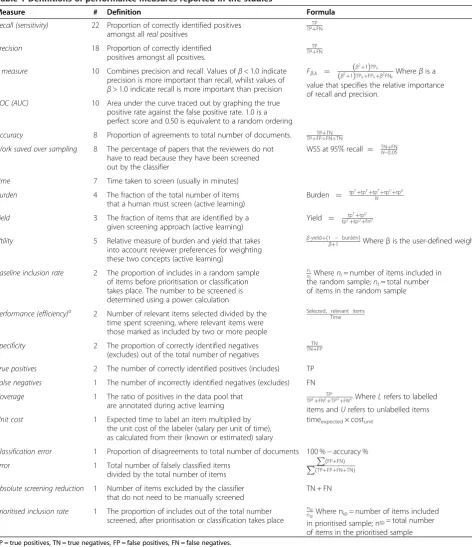
Table 1 Definitions of performance measures reported in the studies
Measure # Definition Formula
Recall (sensitivity) 22 Proportion of correctly identified positives amongst allrealpositives
TP TPþFN
Precision 18 Proportion of correctly identified positives amongst all positives.
TP TPþFN
F measure 10 Combines precision and recall. Values ofβ< 1.0 indicate precision is more important than recall, whilst values of
β> 1.0 indicate recall is more important than precision
Fβ;k ¼ β
2þ1
ð ÞTPk
β2þ1
ð ÞTPkþFPkþβ2FNkWhereβis a value that specifies the relative importance of recall and precision.
ROC (AUC) 10 Area under the curve traced out by graphing the true positive rate against the false positive rate. 1.0 is a perfect score and 0.50 is equivalent to a random ordering
Accuracy 8 Proportion of agreements to total number of documents. TPþTN TPþFPþFNþTN
Work saved over sampling 8 The percentage of papers that the reviewers do not have to read because they have been screened out by the classifier
WSS at 95%recall ¼ TNþFN
N−0:05
Time 7 Time taken to screen (usually in minutes)
Burden 4 The fraction of the total number of items
that a human must screen (active learning)
Burden ¼ tpTþtpTþtpNTþtpUþtpU
Yield 3 The fraction of items that are identified by a given screening approach (active learning)
Yield ¼ tpTtpþTtpþUtpþUfnU
Utility 5 Relative measure of burden and yield that takes into account reviewer preferences for weighting these two concepts (active learning)
β⋅yieldþð1 − burdenÞ
βþ1 Whereβis the user-defined weight
Baseline inclusion rate 2 The proportion of includes in a random sample of items before prioritisation or classification takes place. The number to be screened is determined using a power calculation
ni
ntWhereni= number of items included in the random sample;nt= total number
of items in the random sample
Performance (efficiency)a 2 Number of relevant items selected divided by the
time spent screening, where relevant items were those marked as included by two or more people
Selected; relevant items Time
Specificity 2 The proportion of correctly identified negatives (excludes) out of the total number of negatives
TN TNþFP
True positives 2 The number of correctly identified positives (includes) TP
False negatives 1 The number of incorrectly identified negatives (excludes) FN
Coverage 1 The ratio of positives in the data pool that are annotated during active learning
TPL
TPLþFNLþTPUþFNUWhereLrefers to labelled items andUrefers to unlabelled items Unit cost 1 Expected time to label an item multiplied by
the unit cost of the labeler (salary per unit of time), as calculated from their (known or estimated) salary
timeexpected× costunit
Classification error 1 Proportion of disagreements to total number of documents 100 %−accuracy %
Error 1 Total number of falsely classified items
divided by the total number of items
P
FPþFN
ð Þ
P
TPþFPþFNþTN
ð Þ
Absolute screening reduction 1 Number of items excluded by the classifier that do not need to be manually screened
TN + FN
Prioritised inclusion rate 1 The proportion of includes out of the total number screened, after prioritisation or classification takes place
nip
ntpWhere nip= number of items included
in prioritised sample; ntp= total number
of items in the prioritised sample
TP = true positives, TN = true negatives, FP = false positives, FN = false negatives.
a
Performance is the term used by Felizardo [13], whilst efficiency was used by Malheiros [14].
The research problem
Whilst the logic behind applying text mining to the screen-ing stage of systematic reviews has intuitive appeal, there are obvious concerns that might be raised by the systematic re-view community [21]. Firstly, there is not a lot of informa-tion about text mining written for systematic review audiences. The vast majority of papers on this topic are pro-duced by computer scientists in journals and conference proceedings in the field of medical informatics or artificial intelligence. This means that they are not particularly ac-cessible to systematic reviewers who need to make decisions about their review processes, both in terms of the level of technical detail presented in the reports and in the exposure such papers would have in systematic review communities.
Secondly, for these technologies to achieve broad up-take, they should be accessible to systematic reviewers without the need for a computer scientist to write be-spoke code or undertake custom processing of text for individual reviews. Specialist advice may be required, but it should be akin to the need for occasional special-ist statspecial-istical advice, rather than being at the level of op-erating the text mining tools. Any implementation issues need to be identified and resolved before rolling such technologies out to the intended users.
Thirdly, there are various ways in which workload could be reduced through these technologies (reducing number needed to screen; text mining as a second screener; increasing the rate (speed) of screening and improving workflow through screening prioritisation). However, not all technologies allow all types of workload reduction to be achieved. In order to make informed de-cisions about using such technologies, systematic re-viewers need to know which technologies can be used for which workload reduction goal.
Fourthly, systematic reviews are a relatively new area in which text mining technologies have been applied. Some of the assumptions of text mining technologies in other appli-cations do not hold when transferred to the review context. For instance, systematic reviewers generally place strong em-phasis on high recall—that is, a desire to identify all the rele-vant includable studies—even if that means a vast number of irrelevant studies need to be considered to find them. When applied in other areas, precision (reducing the number of ir-relevant items) and accuracy (correctly classifying items as relevant or irrelevant) are typically more valued. To be ac-ceptable to the systematic review community, new technolo-gies must address the particular challenges and demands of this context (We should also note at this point that we have no guarantee of perfect recall even with current methods, as search strategies are tailored to the resource available to screen results, and humans are likely to make mistakes dur-ing their manual siftdur-ing through records.).
Finally, the methods, their relative success and the metrics used to evaluate them have not yet been pulled
together in a systematic way; this current study aims to fill that research gap.
Aims and research questions of the review
The primary aim of this review is to gather and present the available research evidence on existing methods for text mining related to the title and abstract screening stage in a systematic review, including the performance metrics used to evaluate these technologiesa. The pur-pose of this is to inform systematic reviewers of the current state of text mining methods for use in reducing workload at the screening stage, with a consideration of the potential benefits and challenges when implement-ing such technologies. Whilst we have explored the more technical aspects of text mining technologies in our data extraction, the intended audience of this paper are users of the technologies rather than computer sci-entists, and so technical issues are largely dealt with at a conceptual level.
Following directly from the research problem as delin-eated above, we looked to answer the following questions:
1. What is the state of the evidence base related to automating (or semi-automating) the screening stage (based on titles and abstracts) of a systematic review? Specifically,
a. What methods are available; and b. How has the field developed over time?
2. How has the workload reduction issue been evaluated? Specifically,
a. What has been compared, using what research study designs?
b. What metrics are available for evaluating the performance of the approaches?
3. What are the stated purposes of (semi-)automating the screening stage through text mining in terms of workload reduction, what types of methods have been used to address each purpose, and how effective were they?
4. How, and with what effect, have key contextual problems of applying text mining to systematic review screening been addressed, specifically as relates to the following challenges:
a. The importance of high recall for systematic reviews?
b. The risk of hasty generalisation when training from a certain pool of known includes and excludes?
c. The problem of imbalanced datasets, in which there are typically many more excludes than includes?
d. Applying the technologies to review updates? 5. What challenges to implementation emerge from
Methods
We conducted a systematic review of research papers on applications of text mining to assist in identifying rele-vant studies for inclusion in a systematic review. The protocol can be sent on request by the authors.
Information management
All records of research identified by searches were uploaded to the specialist systematic review software, EPPI-Reviewer 4, for duplicate stripping and screening [22]. This software recorded the bibliographic details of each study considered by the review, where studies were found and how, reasons for their inclusion or exclusion, descriptive and evaluative codes and text about each in-cluded study, and the data used and produced during synthesis.
Search methods
Database and website searches were conducted in December 2013. Sources were searched from 2005 on-wards. This date was chosen because, according to Jonnalagadda and Petitti [23], the first proposed applica-tion of text mining to screening in systematic reviews was in 2005 (though this was not an evaluation of a method and so was not included in our review).
Details of the electronic search strategy, including data-bases searched and terms used, can be found in Additional file 1: Appendix A; the PRISMA flow diagram can be viewed in Additional file 2: Flow diagram.
We also included papers known to the team and as recommended by colleagues. We checked the reference lists of all included studies for additional relevant stud-ies. We also followed forward citation recommendations in Science Direct. A cut-off for identifying studies for in-clusion in the review was set at 28 February 2014.
After all searches were completed, 1,253 records were identified. These were screened for relevance to our re-view using the inclusion criteria outlined below.
Inclusion criteria
Studies were screened in a two-stage screening process. First, records were assessed against the following criteria based on their titles and abstracts:
1. Must be published after 2004 2. Must be relevant to text mining
3. Must be relevant to the screening (document selection) stage of a systematic review (or a review of the evidence that follows systematic principles, such as health technology assessment (HTA) or guidelines development)
After an initial piloting of the first stage criteria to es-tablish common understanding of the criteria, records
were screened once by two researchers (AOM and JT) who are familiar with systematic reviewing and text min-ing methods. Any records of doubtful relevance were marked with a ‘query’ tag and discussed by the two re-searchers until agreement was met (Agreement was al-ways reached, and so recourse to a third reviewer was not required.).
The full-text documents of records that met these cri-teria (n= 69) were retrieved and proceeded to the sec-ond stage of screening. The criteria for assessing the full-text documents were:
1. Must be relevant to text mining methods or metrics 2. Must be relevant to the screening stage of a
systematic review (or similar evidence review) 3. Must not be a general discussion of the use of text
mining in systematic reviewing screening. That is, the record must present a detailed method or evaluation of a method.
The second stage of screening was conducted by one researcher (AOM), with queried records checked by the second researcher (JT) (reviewer agreement was 100% at this stage). After full-text screening, a total of 44 records were identified as relevant to the review questions.
Data extraction
Data extraction was conducted by one researcher (AOM) and checked for accuracy and completeness by a second researcher (JT) and discrepancies resolved by a second check and/or discussion. We extracted and re-corded information on the following broad issues (see Additional file 1: Appendix B for the full data extraction tool, Appendix C for the list of studies included in the review and Appendix D for the characteristics of in-cluded studies):
Bibliographic details
Evaluation context (details of review datasets tested)
Evaluation of active learning (if applicable)
(see below for definition)
Evaluation of classifier
Evaluation of feature selection
Implementation issues
About the evaluation (the methodology and
metrics used)
Study type descriptors
Critical appraisal
Comments and conclusions
of certain characteristics. These two types of data were collected simultaneously. For example, a tick box was checked if a study reported using a support vector ma-chine (SVM) classifier, and line-by-line coding of text that described the SVM was associated with that tick box in the EPPI-Reviewer 4 software [22].
Synthesis methods
The reviewers discussed the key issues that needed to be covered in the review, as well as themes that had emerged through extracting data from the studies. On that basis, an outline structure for the synthesis was de-veloped. Under the outline subheadings, a narrative was developed that drew on both the line-by-line coded text and the categorical data. The categorical data allowed for the generation of frequency tables and cross tabula-tions that described the state of the evidence base; whilst the coded text allowed for a richer interrogation of the emerging themes.
Results
The results are presented in order of the research ques-tions posed. Since some issues raised apply beyond the systematic review context, which limited the range of papers about text mining that we formally included, we have inserted some commentary (entitled‘further infor-mation on this topic’) where information from other do-mains may illuminate a specific issue.
Development of the evidence base
In this section, we address research question 1: What is the state of the evidence base related to automating (or semi-automating) the screening stage (based on titles and abstracts) of a systematic review?
Chronological developments
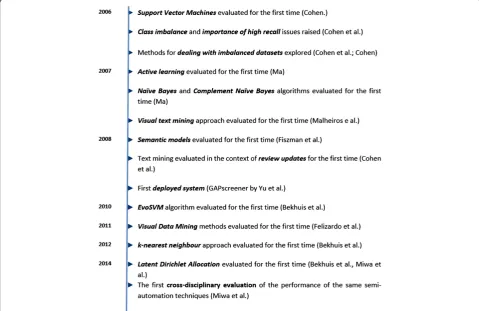
Our 44 included studies fall within the 8 years between January 2006 and January 2014—an average of 5.6 evalu-ations a year. As can be seen in the timeline presented in Figure 1, almost every year saw the evaluation of a newly applied type of classifier or some new consider-ation of the applicconsider-ation of text mining to screening. Indeed, most papers present a new ‘twist’ that distin-guishes it from those before, with very few replications or comparisons between papers. The developments highlighted in the timeline are those which we had de-fined a priori in our data extraction tool and therefore also how the synthesis below is structured; they should therefore be considered to be indicative of interesting developments, rather than being a comprehensive list of every innovation (For example, also worthy of note are the decision trees by Frunza and colleagues in 2010 [24]; and dual supervision and elicited utility by Wallace et al. (also in 2010 [25])).
This suggests a rapidly evolving evidence base (It also has implications for the later parts of this synthesis, as it is difficult to come to any overarching conclusions about which approach works best.).
Workload reduction approaches
In this section, we address research question 2: What are the stated purposes of (semi-)automating the screen-ing stage through text minscreen-ing in terms of workload re-duction, and what types of methods have been used to address each purpose?
It is evident from the literature that there are several possible ways to reduce screening workload. The ap-proaches that have received attention in terms of text mining are: reducing the number of items that need to be screened manually; reducing the number of people needed to screen the items; increasing the rate (or speed) of screening; and improving workflow. Table 2 shows the number of studies that implicitly or explicitly addressed each of these approaches. Each of these will be discussed in turn.
Reducing the number of items that need to be screened In many reviews, the number of items to be screened is very large. For example, 4 out of the 31 Cochrane Col-laboration systematic reviews published in March 2014 had over 10,000 items to screen [26-29]. This can be a particular problem for searches for certain types of study designs, such as is the case with searches for non-randomised controlled trials, for which database filters are not available or consistently used [30]. Large num-bers of items to screen is even more evident in non-clinical disciplines, in which search strategies tend to be broader in response to broader research questions, less precise or consistent terminology and the lack of con-trolled vocabularies; for example, EPPI-Centre reviews on topics in public health, education and social care regularly exceed 20,000 items to be screened. At its most extreme, one review identified upward of 800,000 items and another over 1 million items to be screened (see [31] for a description of such‘extreme reviewing’). Given that an experienced reviewer can take between 30 sec-onds and several minutes to evaluate a citation [11], the work involved in screening even as‘few’as several thou-sand citations is considerable.
guidelines specifically recommend favouring recall over precision in order to avoid missing relevant studies (e.g., the Campbell Collaboration’s guide to information re-trieval and the US Institute of Medicine of the National Academies [32,33]).
Therefore, resource-efficient approaches that maximise recall are needed, and a number of different models have been identified here. The vast majority of studies in-cluded in the review (n= 30) implicitly or explicitly propose using text mining for the purpose of reducing the number of studies that need to be screened manu-ally. Within this set of studies, there are two main
approaches to excluding items from a review. The first approach is to use a classifier that makes explicit in/ out decisions; 23 studies evaluated this approach [11,14,23,25,34-51]. The second approach is to use a
ranking or prioritisation systemand then exclude items
that fall below some threshold or criterion, or that lie within a ‘negative prediction zone’ [31,52-57]; seven studies used this approach. Whilst many classifiers employing the first approach inherently assign some kind of score that indicates confidence in how likely an item is to be an include or exclude (akin to the ranking in the second approach), this is usually ‘hidden’from the reviewer such that the decisions are presented as complete. In contrast, the second approach may re-quire a reviewer to continue manual screening until the (reviewer-specified) criterion is met.
It is important to note that the final approach, active learning, can fit loosely into both of the abovementioned camps. Active learning (evaluated in nine studies [11,23,25,31,40,45,48,49,58]) is an iterative process whereby the accuracy of the predictions made by the machine is im-proved through interaction with reviewers. The re-viewer—or review team—provides an initial sample of include/exclude decisions that the machine ‘learns’
Table 2 The number of studies implicitly or explicitly addressing screening workload problems (n= 44)
Workload reduction approach Number of studies
Reducing number needed to screen 30
Text mining as a second screener 6
Increasing the rate (speed) of screening 7
Improving workflow through screening prioritisation
12
Note.Some studies adopted more than one approach to workload reduction, so column total is greater than 44 studies.
from; the machine subsequently generates a ranked list and requests the reviewer to provide decisions on items high in the list that it will learn the most from. The ma-chine adapts its decision rule including the information from the additional items and generates a new list of items for the reviewer to screen. This process continues, with the number of reviewer decisions growing and a greater number of relevant items found than would otherwise be the case, until a given stopping criterion is reached and the process ends. Although the final in-clude/exclude decisions for any items not screened manually come from the classifier, the human screener still has some control over the training process and the point at which manual screening ceases.
In all cases, authors reported that the systems tested led to a reduction in workload; however, given the diversity of approaches and the lack of overlap (replication) between evaluations, it is impossible to conclude whether one ap-proach is better than the other in terms of performance. Typical performance reported a reduction in manual screening workload from less than 10% (e.g. [41]) up to more than 90% (e.g. [48]). Where expressed as a work-load reduction, studies tended to report reductions of between approximately 40% and 50% of work saved (e.g. [25,40,41,55]). Studies differed from one another in terms of the recall that they aimed for. Some expressed results in terms of 95% recall (e.g. [23]), whereas others expressed their results in terms of retrieving all relevant studies (e.g. [48]). Razavi and colleagues took a critical perspective with regard to manual decisions too, con-cluding that‘Since the machine learning prediction per-formance is generally on the same level as the human prediction performance, using the described system will lead to significant workload reduction for the human experts involved in the systematic review process’[44]. Text mining as a second screener
Methods guidance for conducting systematic reviews often suggests that more than one person should screen all (or some proportion) of the records returned by the searches (e.g., the Institute of Medicine (Washington, DC) states in Standard 3.3.3.‘Use two or more members of the review team, working independently, to screen and select studies’ [33]). The rationale behind this ap-proach is that a single screener can inadvertently intro-duce bias into the study selection process either because of their interpretation of the inclusion criteria or through their understanding of the content of titles and abstracts. Moreover, given the volume of records to be reviewed, it is conceivable that some relevant records might ‘slip through the net’. It is believed that if there is consistency in the inclusion decisions amongst two or more independ-ent screeners, then the screening process is not likely to be biased. This, however, becomes a very labour-intensive
process—particularly when the number of records to screen is high. Although some guidance suggests that if sufficient inter-reviewer reliability is achieved that it is ac-ceptable to ‘double screen’ only a proportion of the re-cords when there is a large number to screen, this still can add a substantial amount of resource to an already time-consuming procedure.
To combat this workload issue, six papers have advo-cated the use of text mining as a second screener: re-placing or supplementing the additional human reviewer that would be required at this stage [24,30,59-62]. In this model, one human reviewer screens all of the records and the machine acts as the independent check (or pre-sents a vastly reduced list of items to be screened to an additional human reviewer). The evaluations of workload reduction in this area have all been on a classifier model, in which explicit in/out decisions are made by the ma-chine. Results from the evaluations are positive—the clas-sifiers had good agreement with the human reviewer/s. Three of these papers were authored by Bekhuis and col-leagues [30,59,60], who report that their approach could reduce manual workload by between 88% and 98% [60]. Frunza and colleagues report two studies in this area [24,61] and Garcia one study [62]. Like Bekhuis, they re-port positive results from their evaluations, though they present their findings in terms of high recall rather than workload reduction, and so a direct comparison cannot be made.
Increasing the rate of screening
An alternative approach to those above, which empha-sises reducing the number of items that need to be screened manually, is to aid researchers in coming to a decision about each item more quickly; that is, to in-crease the rate of screening. To achieve this,visual data
mining (VDM) approaches attempt to create a visual
representation of the connections between documents (using term similarity and/or author connections) to as-sist the screener in identifying studies easily that are more likely to be similar to each other. Thus, once a relevant document is identified, they can quickly scan other documents that appear to be similar to the rele-vant document (and similarly, identify documents that are likely to be excluded quickly). The approach assumes that humans can make a decision about a study’s rele-vance faster using this additional visual information than relying on the textual information in the titles and ab-stracts alone [13].
items using VDM or without using VDM. The results sug-gest that humans can screen faster with VDM aids than without, although the accuracy of the human screeners does not appear to change substantially [13,14,63-65].
A second approach to speeding up the rate of screen-ing that is embedded within approaches to reducscreen-ing the number needed to screen is throughefficient citation
as-signment. The only example that was identified of this
type was by Wallace and colleagues [49]. In that paper, the authors emphasise that most review teams have a combination of expert and novice screeners. Within the context of an active learning approach, they developed an algorithm that incorporates both information about the relevance of each item and the expected time that it will take to annotate that item; on that basis, the algorithm se-lects citations specifically for expert and novice reviewers to label. The authors reported that this approach enabled more items to be screened in the same amount of time compared with typical active learning approaches.
Improving workflow efficiency through screening prioritisation
Screening prioritisation is ultimately a form of efficient cit-ation assignment, in that it aims to present reviewers with an ordered list of the items, with the items that are most likely to be relevant to their review at the top of the list. However, it differs from the model described by Wallace et al. [49] in that it is not necessarily embedded within an approach that is attempting to reduce the number needed to screen and it does not differentially assign items to dif-ferent types of reviewers (i.e., experts versus novices).
There are various proposed benefits of this approach to workflow efficiency. One is that reviewers gain a bet-ter understanding of the inclusion cribet-teria earlier in the process, as they encounter more examples of relevant studies sooner than would otherwise be the case. It also enables the retrieval of the full text of documents to start sooner than can occur when citations are screened essentially at random. This can be important, as obtain-ing the full-text reports brobtain-ings forward their full-text screening, the checking of their bibliographies and, crit-ically, enables contact to be made with study authors much earlier in the review. It is also possible that this will make the screening process faster, once the vast ma-jority of relevant studies are identified, as the screeners become more confident that items later in the list are less likely to be relevant. This could also help with the problem of over-inclusiveness that is often experienced in reviews, in which reviewers tend to be cautious and include many more items at this early stage than ultim-ately make it into the review.
Cohen highlighted another potential benefit:‘In reviews with searches that result in a large number of citations to be screened for retrieval, reviewing the documents in
order of their likely importance would be particularly use-ful. The remainder of the citations could be screened over the following months, perhaps by the members of the team with less experience, whilst the work of reviewing the includable studies is ongoing’ ([66] p. 692) (An on-going project at the EPPI-Centre, which had a large vol-ume of items to be screened (>38,000) but with a very tight timeframe, has taken advantage of this benefit [67].).
There are also potential benefits for review updates. Cohen stated that ‘by reviewing the most likely import-ant documents before other documents, the human re-viewers or curators are more likely to be able to“get up to speed” on the current developments within a domain more quickly’([68] p. 121). In quite a different applica-tion of text mining to the screening process, Cohen later explored the use of prioritisation for identifying when a review update was required, which would involve send-ing alerts to the review team when likely relevant new studies are published [69].
In other words, this approach emphasises improving workflow in a review and has proposed benefits for effi-ciency beyond reducing workload in the title and abstract screening phase. Four studies adopted a prioritisation ap-proach to improve workflow [58,66,68,69]. All four evalua-tions reported benefits of this approach.
Note that screening prioritisation can also be used to reduce the number of items needed to be screened if a screening cut-off criterion is established (see section on this workload reduction approach, above). Seven studies that have used screening prioritisation did so to reduce the number needed to screen and reported benefits in terms of the amount of work saved [31,52-57]. (Again, the metrics and processes varied, so it is not possible to estimate overall or mean statistics across these studies).
Specific issues relating to the use of text mining in systematic reviews
In this section, we address research question 3: How have key contextual problems of applying text mining to
systematic review screening been addressed?These reflect
the challenges that need to be addressed when applying methods developed for other applications to the case of systematic review screening.
policy demand 100% recall and informatics approaches such as ours are not able to guarantee 100% recall, the approaches may be doomed’([23] p. 15).
Many of the studies in this review explicitly refer to the importance of high recall and the implications it might have for text mining applications in this area (studies which discuss the importance of high recall in-clude [11,23,24,30,38,40,41,44,48,49,53,54,58,60,61,70]). However, few of the studies directly built into the technol-ogy an approach to maximising recall. Those that did dir-ectly attempt to maximise recall are discussed below.
Voting or committee approaches for ensuring high recall
One approach to ensuring that studies are not missed is to use a voting or committee approach. Essentially, mul-tiple classifiers are run simultaneously, and then a‘vote’ is taken on each item to determine whether it is likely to be relevant or not. A conservative approach would be to put forward for human screening any item that receives at least one ‘include vote’ (e.g., Wallace et al. [11]); an ap-proach that places additional emphasis on precision might set a minimum number of agreeing votes (e.g., >50% of the classifiers must agree that an item is an include [44]).
The appeal of such approaches is that the classification decision is less susceptible to missing studies that do not resemble the training set of includes, because each clas-sifier can start with a different training set. Several stud-ies have used this approach, with different numbers of classifiers used in the committee. Razavi used a commit-tee of five classifiers [44]; Wallace and Frunza used (up to) eleven classifiers [11,24,61]; Ma used two classifiers [40]. Only Frunza has considered whether the number of votes makes a difference, as discussed below [24,61].
In Frunza (2010), if at least one decision for an ab-stract was to include it in the systematic review, then the final label was ‘Included’ [24]. They then tested whether the number of votes (i.e., number of classifiers) made a difference to recall and precision. They con-cluded that the 2-vote technique is superior to the other voting techniques (1-vote, 3-vote, 4-vote) in terms of the F measure and work saved over sampling (WSS). The highest level of recall was achieved through the 4-vote technique. The success of combined human-machine screening was similar in their later study [61], with the conclusion that the 2-vote technique was the best per-former. Importantly, Frunza noted that precision de-creased slightly when the human decisions were added to the machine decisions (i.e., the human incorrectly in-cluded some items). This might be relevant to the obser-vation that human screeners tend to be over-inclusive (discussed in a later section).
(We will return to the issue of ‘voting’ approaches below, in the section on‘Hasty generalisation’).
Specialist algorithms
At least three types of classifiers have been modified to in-clude a specialist algorithm that adjusts the learning rate of the classifier to penalise false negatives. Cohen et al. ap-plied a‘false negative learning rate’to their voting percep-tron classifier expressing this as a ‘cost-proportionate rejection sampling’ strategy [36]. Matwin et al. added a heuristic weight factorization technique to their comple-ment naïve Bayes (CNB) algorithm to maximise recall when their original algorithm had unacceptably low recall (<95%) [41]. Bekhuis also modified a complement naïve Bayes classifier by optimising the decision parameters using F3: a summary measure of performance that over-weights recall relative to precision [60]. Wallace and col-leagues modified their support vector machine approach to penalise more severely for false negatives compared with false positives [48].
All of these studies were retrospective evaluations in which the performance of a classifier was compared against completed include decisions and all reported good results in terms of recall and workload reduction. Future evaluations of this approach should consider whether the amount and/or quality of the training data make a difference to the ability of these modifications to adequately penalise false negatives. The reason for this is that, if used in a‘live’review, there might be only a small number of human-labelled items in the training set to be able to determine whether the classifier has incor-rectly rejected a relevant study. If there are only a small number of includable studies in the entire dataset, then such penalties might not be implementable.
Human input
Ma proposed using active learning as a method for as-suring high recall [40]. The logic behind this is that the algorithm continues to ‘learn’as more items are manu-ally screened and so the decision rule is adaptable and less reliant on the initial training set. However, Ma’s [40] results suggest that recall actually declined when active learning was added to a support vector machine or deci-sion tree classifier and made no difference to the recall of a naïve Bayes classifier. Further research on this is needed to determine why this might be the case.
Hasty generalisation
automation (see [25]). To exclude relevant studies due to their use of different terminology from those that are included would be to inject a systematic bias which would be unacceptable in the vast majority of reviews.
Several methods for dealing with this have been evalu-ated or discussed: drawing on reviewer domain know-ledge, using patient active learning methods and employing an ensemble of classifiers that vote on whether an item should be included or not. These are elaborated on in the following sections.
Reviewer domain knowledge
Some studies evaluated or discussed drawing on the knowledge of the human reviewers to play a part in the text mining process. This is particularly suited to active learning approaches. Jonnalagadda and colleagues sug-gested that, in active learning,‘the dynamically changing query set, which decides which document will be psented next, could be easily modified at any stage by re-moving or adding terms to the query set. In this way, the possibility of not finding documents that use differ-ent words could be further minimised by allowing active participation of the users in defining the terms in the query set’ ([23] p. 15). They did not, however, test this approach empirically.
In addition to other text mining methods, Shemilt et al. employed an approach that used ‘reviewer terms’ (terms specified by the review team as being indicative of an includable or excludable study) [31]. The text con-tained in each title-abstract record that was yet to be screened was analysed and the number of relevant and irrelevant terms they contained was calculated. A simple ratio of these values was then generated, and items were ranked according to this ratio. The authors argue that
‘The purpose of this method is to act as a counterpoint to the automated technologies; whereas in ATR [auto-matic term recognition] and AC [auto[auto-matic classifica-tion], the results are heavily determined by those studies already identified as being relevant; RT [reviewer terms] offers another perspective on potential relevance, offer-ing some protection against the problem of hasty generalization’([31] p. 45). This might offer reassurance to review teams that no relevant items are being errone-ously discarded and is an easy approach to implement if the reviewers are familiar with the key terminology.
A more holistic approach was evaluated by Wallace et al. [25]. As in Shemilt et al. (above), reviewers pro-vided terms that were indicative of includes and excludes (although the terms were ranked in order of ‘ indicative-ness’in the Wallace paper). Wallace et al. suggested that combining prior reviewer knowledge with the machine model could be more effective at avoiding hasty general-isation and tested a variety of combinations in terms of the timing at which the reviewer knowledge rankings
were emphasised relative to the machine labelling. They concluded that beginning with a bias towards the reviewer rankings and subsequently decreasing its importance as la-belling proceeds would be the most effective way of com-bining reviewer domain knowledge in the process; however, they also noted‘How this should be done precisely remains a problem for future work’([25] p. 8).
In addition, in a study which came to light after our formal searches were complete, Small et al. utilised re-viewer ‘labelled features’within what they called a ‘ con-strained weight space SVM’ [71]. They found that, by allowing reviewers to influence the decisions made by the classifier, it is possible to obtain better results with smaller samples of training records.
Patient active learning
‘Patient active learning’ was first proposed by Wallace et al. as a means of overcoming hasty generalisation using an active learning approach [11]. The distinguishing fea-ture of ‘patient’active learning is that training is based on different‘views’of the records (e.g. classifiers based on ti-tles or abstract or MeSH terms) which are selected at ran-dom at each iteration of the active learning process. The additional variability that this approach injects into the process above the use of a single‘view’aims to ensure that the system as a whole is exposed to as wide a variety of relevant studies as possible and thus does not overly nar-row the range of items it considers to be relevant.
Wallace and colleagues evaluated four different active learning strategies and found that patient active learning outperformed the others [11]. In a study which repli-cated some of Wallace’s work on the same data, Miwa and colleagues evaluated a range of active learning en-hancements and found that patient active learning is cer-tainly better than some strategies, though not as good as others [45].
Voting or committee approaches for dealing with hasty generalisation
The concept of a committee of classifiers was earlier in-troduced for helping to ensure high recall. Given that hasty generalisation would logically lead to lower recall, it is unsurprising that this approach has also been sug-gested as a solution to hasty generalisation.
Dealing with imbalanced datasets
At the title and abstract screening stage of a typical sys-tematic review, the dataset is imbalanced in that there are usually far more excluded studies than included studies. One paper reported a median search precision (number of included studies divided by total number of items located through searching) of 2.9% across 94 health-related sys-tematic reviews [72]. This translates to an imbalance in which there are approximately 33.5 times as many ex-cludes as inex-cludes. Search precision can be much less than this, resulting in even greater imbalances.
In text mining evaluations, this is referred to as the
‘class imbalance’problem (where‘class’refers to the des-ignation as an include or an exclude). It is a problem for text mining as there are far fewer relevant items com-pared to non-relevant items on which to train the classi-fier or text mining technology. Also, Wallace et al. state that ‘class imbalance presents a problem for classifica-tion algorithms, because they have typically been opti-mised for accuracy, rather than the recall of a particular class’([11] p. 5). Since it is possible to have high accur-acy even if a system produces many false negatives [73], this could be a problem for systematic reviews where missing relevant studies is highly undesirable.
To counter the class imbalance, various methods have been proposed. They generally rely on up-weighting the number of includes or down-weighting the number of excludes; or undersampling the number of excludes used in the training set. The various approaches are described in the following sections.
Weighting
Weighting approaches assign greater weights to positive instances (includes) than to negative instances (ex-cludes). Generally, the weight is set to the ratio of the number of positive instances to the number of negative instances.
Compared to an un-weighted method or an aggressive undersampling method (described below), Miwa et al. reported better performance of active learning models on a variety of imbalanced datasets [45]. This was par-ticularly the case when weighting was used in conjunc-tion with a ‘certainty’approach, in which the next items to be annotated in the active learning process were se-lected because they had the highest probability of being relevant to the review, based on the output of classifiers trained on previously annotated items.
Cohen et al. also reported good results for a weighted model, in which they modified their voting perceptron classifier to incorporate a false negative learning rate (FNLR) [36]. Across 15 reviews, they found that the FNLR should be proportional to the ratio of negative to positive samples in the dataset in order to maximise performance.
Undersampling
Undersampling involves using fewer non-relevant stud-ies in the training set than might be expected given their prevalence in the entire dataset. Two different types of undersampling have been tested in this context: random and aggressive.
Random undersampling involves randomly selecting a
training set with the same number of relevant and non-relevant studies. This approach was adopted in four stud-ies that did not compare random undersampling to other methods for dealing with class imbalance [11,31,39,48].
Ma compared five undersampling methods with their ac-tive learning naïve Bayes classifier—one of which was ran-dom undersampling [40]. Method 1 involved selecting the negative examples whose average distances (a measure of similarity/dissimilarity) to the three farthest positive exam-ples are the smallest; Method 2 involved selecting the negative examples whose average distances to the three closest positive examples are the smallest; Method 3 in-volved selecting the negative examples whose average dis-tances to the three closest positive examples are the largest; Method 4 involved removing those examples that participated in Tomek links (see [74] for a definition); Method 5 involved selecting negative examples randomly. Ma concluded that random undersampling did not per-form the best.‘In general, the first and third undersampling methods work well with all feature selection methods. We have a very high recall after performing undersampling techniques. However, we have a big trade-off in precision’ ([40] p. 75).
Aggressive undersampling as defined by Wallace (in
the context of active learning) involves discarding the majority examples (i.e., excludes) nearest the current separating hyperplane [11]. The separating hyperplane represents the border between the two classes: includes and excludes. Therefore, by throwing away those nearest to the hyperplane, we are discarding those that are the most ambiguous as to whether they should be in the in-clude or exin-clude class. As such, the items that are more likely to be excludes are sent to the human reviewer for manual screening, which are then used to retrain the clas-sifier. The logic behind this approach is to‘explicitly push the decision boundary away from the minority class [in-cludes], as it has been observed that when there is class imbalance, SVMs are prone to discovering hyperplanes that are closer to the minority class than the ideal separat-ing boundary, resultseparat-ing in false negatives’([11] p. 5).
the active learning sequence, other methods overtook it as screening progressed [45].
It is difficult to draw conclusions across the papers, as the two that conducted a comparison differed in many other dimensions (classifier, reviews tested, etc.). This re-quires further exploration.
Cohen and colleagues observed that any kind of sam-pling strategy can result in the exclusion of a large propor-tion of the possible sample available from which the classifier can‘learn’[66].‘To address this, we sample the nontopic data, creating several different priming SVM models, and extract the support vectors from each of these models to use as priming vectors. The nontopic data are rejection sampled, that is, sampled without replacement. The probabilities of inclusion for each sample within a given nontopic are adjusted so that approximately the same number of samples from each nontopic is included.’ In their experiments they used 20 resamples.
Other methods for dealing with class imbalance
Some authors claimed that certain classifiers are particu-larly well suited to imbalanced datasets. Bekhuis Frunza, Kouznetsov and Matwin claimed that complement naïve Bayes (CNB) is suitable for imbalanced data, particularly when implemented in Weka [24,30,41,54,60,61]. Frunza and colleagues compared CNB with other classifiers (de-cision trees, support vector machine, instance-based learning and boosting) but concluded that CNB always performed better; it is not clear, however, whether this is because of the class imbalance problem or other differ-ences between the approaches [24,61].
Some authors have suggested that the selection of fea-tures for text mining might be important in addressing class imbalances. Although they did not test it in their paper, Bekhuis et al. suggested that selecting features within the positive (include) and negative (exclude) classes before grid optimization, rather than across all items, would be appropriate for dealing with class imbalance [30]. Frunza explicitly compared classifiers that had been
‘boosted’ in terms of having more representative features for the included class (a balanced dataset) with typical fea-ture selection technique (imbalanced dataset) but found no significant difference between these two approaches [24].
Updates versus‘new’reviews
Out of the 44 studies, the context of 36 was a new view, eight a review update, and for two studies the re-view context was not the primary area of investigation (the issue was the performance of classifiers). The con-text of new reviews is challenging, because there is so lit-tle training material available at the start of screening on which to conduct any machine learning. Whilst the con-cept of obtaining an unbiased set of training material using a random sample is widely employed, Wallace and
colleagues have outlined an explicit iterative method to determine whether the variation in likely ‘includes’ has been explored adequately enough for active learning to begin [11]. They do this drawing on the work of Brinker who has developed methods for incorporating diversity in active learning by evaluating the stability of a measure of similarity between ‘included’ citations between itera-tions [75]. Once the measure of similarity ceases to change between iterations, the sample can be considered ready to perform active learning.
In contrast, whilst the review update might appear to be the more straightforward situation, since there are preexisting citation decisions on which to ‘learn’, some of the earliest work included in our review—by Cohen— shows that review updates face many challenges of their own [35,66,68,69]. In particular, the issue of ‘concept drift’ looms large over the review update. As Bekhuis points out, there are many changing variables in a re-view update—the team, the searches and even aspects of the question may all change—and the data from the ori-ginal review may cease to be a reliable indicator of what should be included in the new one [60]. Dalal and col-leagues attempted to mitigate the effects of concept drift but were not entirely successful [70].
Additional information on this topic
Online learning methods which treat datasets as a stream, updating their model for each instance and dis-carding it after updates, can be used for new reviews. Some online learning algorithms adapt their models quickly to new coming data and can be adapted to deal with slight concept drift [76]. Domain adaptation, multi-task learning and transfer learning can improve models for a specific review by using related information from other reviews and problems. Such learning methods sup-port the learning of multiple, related review targets [77].
How has the workload reduction issue been evaluated? The following section addresses research question 4:How has the workload reduction issue been evaluated?There are three aspects that we explore: what has been compared and through what research design; and what metrics were used to evaluate the performance of the technologies?
The type of design is important, as prospective designs have the potential to tell us more about how the text mining technologies might work when implemented in
‘real life’. Whilst retrospective simulations are essential in determining the relative performance of different classi-fiers or establishing the optimal parameters of a classifier, some of the difficulties of implementing such technologies in a live review cannot be taken into account adequately (e.g., reviewer over-inclusiveness at different stages of the process, which might‘mislead’the classifier about what an include ‘looks like’). Moreover, many of the evaluations are of relatively ‘neat’ datasets, in that they have a suffi-cient number of includes on which to train (even if they are the minority class). How does text mining cope when there is a tiny number of includes, or in a so-called‘empty’ review, in which there are no included studies?b
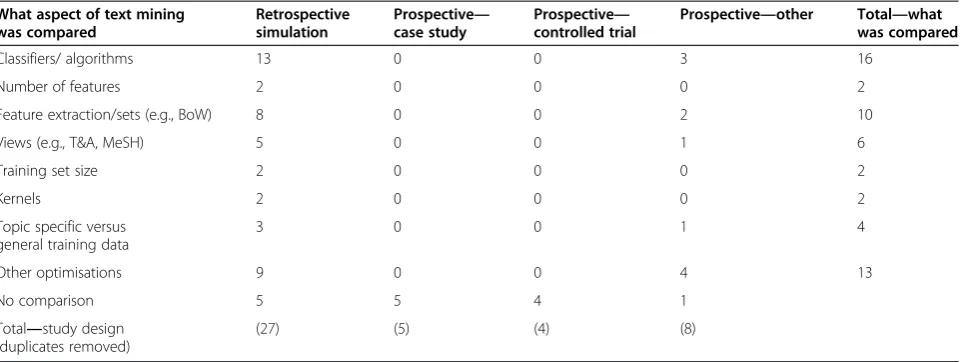
Related to the issue ofhowthe technologies were eval-uated is the question ofwhatwas evaluated. Most of the evaluations conducted to date (n= 29) make some form of comparison between different algorithms or methods for text mining [11,23-25,30,34,36,37,39-43,45,49,51-55,58, 60-62,66,68-70]. The main issues evaluated are: the rela-tive effecrela-tiveness of different methods for classifying stud-ies (i.e. ‘classifiers’ and different options for using them (‘kernels’)); how different approaches to‘feature selection’ (the way that aspects of studies—e.g. their titles, abstracts and MeSH headings are encoded for machine learning) impact on performance; how effective different ap-proaches to separating different pieces of ‘intelligence’ about the study are (e.g. separating titles from ab-stracts); and whether performance differs depending on how many studies are used for the initial training. The remaining 16 evaluations do not compare aspects of the methodology; rather, they report on the effectiveness of one chosen method for implementing text mining [13,14,31,35,38,44,46-48,50,56,57,63-65].
Unsurprisingly, study design is associated with certain types of comparisons (see Table 3). The four controlled trials all compared human performance with machine performance but did not compare different aspects of text mining technologies. None of the five case studies compared text mining features either, with an emphasis instead on how workload could be reduced in an ongoing review. The retrospective simulation studies tended to compare more features of text mining than other pro-spective studies, perhaps because of the comparative ease with which adaptations to the text mining approach can be made in a retrospective evaluation.
Metrics for assessing classifier performance
In this section, we address research question 3: What metrics are available for evaluating the performance of the approaches, in terms of both effectiveness and efficiency? The metrics are presented in order from the most popular
to the least in Table 1. Most studies reported more than one performance metric and generally considered the importance of both identifying relevant studies and re-ducing workload for the reviewers. The metrics are de-fined in Table 1.
There are various arguments used throughout the litera-ture as to which metric is the most appropriate. It should be noted that not all metrics are suitable for all evaluation designs or text mining technology types. For instance, coverage is only suitable for active learning approaches, whilst Cohen noted that‘If the task is not to separate doc-uments into positive and negative groups, but instead to prioritise which documents should be reviewed first and which later, then precision, recall and F measure do not provide sufficient information’(p. 121) [68].
Measures that allow the trade-off between recall and precision to be taken into account on a review-by-review basis seem particularly useful, as they allow re-viewers to change the relative importance of these two metrics depending on priorities in a given review. These metrics include notably the F measure, work saved over sampling and utility, which are summarised below.
F measure is a weighted harmonic mean of precision
and recall. The weighting can be determined on a review-by-review basis, allowing reviewers to assess the relative importance of recall and precision in their context.
Work saved over sampling (WSS) indicates how much
work (in terms of number of items needed to screen) is saved over and above the work saved by simple sampling for a given level of recall. It is typical to use a recall level of 0.95. See Cohen et al. [36].
Utility is relevant for active learning approaches and is calculated based on yield and burden. Yield represents the fraction of includes in the data pool that are identified by a given method, and burden represents the fraction of in-cludes in the data pool that have to be annotated/reviewed by reviewers. The formula to calculate utility includes a weighting factor so that the reviews can specify the relative importance of yield and burden. This weighting factor has been established for some contexts but might need to be re-established for application in other settings [25].
It is clear from the three metrics above that there is a subjective element to the performance metrics, as it is up to the evaluators to determine thresholds and weight-ing values. Whilst this has the advantage of makweight-ing the metrics tailored to the review and evaluation context, it (a) makes it difficult to compare across studies that use different thresholds/weights in their calculations, and (b) it is not always transparent or justified as to how the thresholds/weights were selected.
Evaluation metrics that emphasise high recall
adaptations to their text mining approach. They do, however, consider the importance of high recall in their choice of metric when evaluating the performance of the text mining technology. Examples included:
Bekhuis (2012) used F3—a summary measure that
overweights recall relative to precision—because they felt this was more in keeping with reviewer behaviour (than a metric which weights them
equally) [59]
Kouznetsov (2010) used false negatives (relevant
articles mistakenly ranked at the bottom of a ranked
list) as their primary performance measure [54]
Wallace (2011) [58] used U19—a weighted metric in
which recall is 19 times as important as cost. The value of 19 was determined through an expert
consultation process [25] (see Wallace [11])
Dalal (2013) evaluated performance using a range of
probability thresholds to better consider the impact on observed performance of using different recall and precision trade-offs: one metric was based on ‘sensitivity-maximising thresholds’whilst another ‘preserved good sensitivity whilst substantially
reducing the error rate [false positives]’(p. 348) [70]
In contrast to most of the studies in this review, Dalal (2013) argued that‘neither error minimization nor sensi-tivity maximisation are absolute goals’ (p. 348) [70]. In fact, Fiszman and colleagues (2008, 2010) used the F0.5 measure, which weights precision more highly than re-call [38,53]. They argue that clinical practice guideline developers value precision more than recall and there-fore performance should be evaluated on this basis. This
suggests that the relative importance of recall and preci-sion might vary from context-to-context, and a high re-call should not be assumed to be more important than high precision (though in most systematic review guid-ance—and practice—maximising recall is prioritised).
Evaluation metrics that account for class imbalance
As with the issue of the importance of high recall in sys-tematic reviews, some authors have reflected the class imbalance problem in their choice of evaluation meas-ure. Cohen (2010) argued that the AUC is independent of class prevalence [24,35], whilst Frunza [24] reported the F measure for the same reason. The choice of evalu-ation metric should consider whether class imbalance is likely to bias the results.
Further information on this topic
We should note that other evaluation metrics can also account for class imbalance. For example, if you care about both the TPs and the TNs, you’d use ROC-AUC, but if you only care about the TPs, you might prefer PR_AUC [78]. See also [79].
Implementation challenges
The following section attempts to answer research ques-tion 5: What challenges to implementation emerge from
reviewing the evidence base?Whilst almost all of the
pa-pers concluded that text mining was a ‘promising’ ap-proach to reduce workload in the screening stage of a systematic review, it was not always clear how these technologies would be rolled out for use in‘live’reviews. A few issues became clear that need to be considered for the knowledge gained in these studies to have practical
Table 3 Cross tabulation showing the number of studies employing certain research designs by the aspects of text mining that were compared (n= 44)
What aspect of text mining was compared
Retrospective simulation
Prospective— case study
Prospective— controlled trial
Prospective—other Total—what was compared
Classifiers/ algorithms 13 0 0 3 16
Number of features 2 0 0 0 2
Feature extraction/sets (e.g., BoW) 8 0 0 2 10
Views (e.g., T&A, MeSH) 5 0 0 1 6
Training set size 2 0 0 0 2
Kernels 2 0 0 0 2
Topic specific versus general training data
3 0 0 1 4
Other optimisations 9 0 0 4 13
No comparison 5 5 4 1
Total—study design (duplicates removed)
(27) (5) (4) (8)
Note.Many studies compared more than one aspect of text mining, therefore column total for‘Total—what was compared’sums to greater than 44. The row for
application (all of which apply to other uses of automa-tion and semi-automaautoma-tion in systematic reviews [80]).
Deployed systems
Only six different systems (reported in 12 papers) are currently ‘deployed’—that is, are in a packaged system that a reviewer could use without having to do any com-puter programming. Some are bespoke systematic review systems, whereas others are more generic software for predictive analytics which can be used in a systematic review. The bespoke systems for systematic reviews which were used in evaluations in this review are: Abstrackr [49,50], EPPI-Reviewer [31,57], GAPScreener [51] and Revis [64]. Many generic software applications support the kinds of machine learning evaluated in this re-view; the two that were used in our included papers were Pimiento [62] and RapidMiner [59,60]. However, even though no programming may be required to use these tools, reviewers using the systems are likely to require some training to be able to use them. Given concerns about the need for high recall, imbalanced datasets, etc., these are not packages that can be used without under-standing some of the behind-the-scenes decisions that are made with respect to handling the data.
Replication of evaluations
Only one study in the evidence base represents a true replication of another study (Felizardo [65]). There are some partial replications that used the same dataset; not-ably, Cohen and colleagues and Matwin and colleagues had an ongoing correspondence in the Journal of the American Medical Informatics Association in which they presented results across the same review datasets using different classifiers and parameters. Most studies differ in many ways: datasets used, classifiers tested, feature se-lection processes applied, citation portions viewed, com-parisons made, study designs employed, metrics used for evaluation, etc. This makes it impossible to compare re-sults across studies directly. It also makes it difficult to conclude whether any particular aspect of the above-mentioned differences is particularly important to adopt or fruitful to explore in future research.
It is hoped that future evaluations will attempt more replications of the same methodological applications but on different datasets, to determine whether findings hold when applied to new topic areas. For instance, Miwa [45] reported that a particular approach did not perform as well on ‘messy’ social science datasets as it did for
‘cleaner’ clinical datasets that had been used elsewhere (though other enhancements can make up for some of this deficit)—these sorts of partial replications of the method are helpful in understanding the cross-review and cross-disciplinary applicability of the evaluation findings [45].
Scalability
A further concern is whether some of the approaches will work on very large datasets—that is, can they be
‘scaled up’ from the small datasets used in the evalua-tions to the larger datasets that are often encountered in systematic reviews. The largest evaluation was on a data-set of more than 1 million citations [31], although that was a case study (and an extreme one at that!); the sec-ond largest evaluation was on a dataset of 47,274 [24]. However, the vast majority were conducted on review datasets that were well below 5,000 items, with the smal-lest datasets being only 57 items (20 in the training set, 37 in the test set; [64,65]).
Given that the purpose of using such technologies in systematic reviews is to reduce screening workload, then it seems appropriate to test them on datasets for which the workload is large or even unmanageable. Although we can extrapolate from the smaller datasets to larger reviews, there is a limit to how much we can assume that the tech-nologies will be able to detect true positives in such large (and thereby presumably more diverse) datasets.
The issue of scalability is particularly relevant to the vis-ual text mining approaches, as discussed earlier in the paper. Consideration will need to be paid to how to repre-sent connections between papers visually when many items are in the dataset; the visual image could be too overwhelming to be of any use in aiding human informa-tion processing. Either adaptainforma-tions to such tools will need to be made for scaling up, or an upper threshold of num-ber of items in the dataset might need to be established.
Further information on this topic
Methods such as stream-based active learning are promis-ing in handlpromis-ing large-scale data instances [81]. Stream ac-tive learning is closely related to online learning [3.3.4], but as it does not need to store all the instances in active learning, it can handle large-scale data instances.