The Thirty-Third AAAI Conference on Artificial Intelligence (AAAI-19)
Declarative Question Answering over Knowledge Bases
Containing Natural Language Text with Answer Set Programming
Arindam Mitra,
‡Peter Clark,
†Oyvind Tafjord,
†Chitta Baral
‡ †Allen Institute for Artificial Intelligence, Seattle, WA, U.S.A.‡Arizona State University, AZ, U.S.A.
{peterc,oyvindt}@allenai.org,{amitra7,chitta}@asu.edu
Abstract
While in recent years machine learning (ML) based ap-proaches have been the popular approach in developing end-to-end question answering systems, such systems often strug-gle when additional knowledge is needed to correctly an-swer the questions. Proposed alternatives involve translating the question and the natural language text to a logical rep-resentation and then use logical reasoning. However, this al-ternative falters when the size of the text gets bigger. To ad-dress this we propose an approach that does logical reason-ing over premises written in natural language text. The pro-posed method uses recent features of Answer Set Program-ming (ASP) to call external NLP modules (which may be based on ML) which perform simple textual entailment. To test our approach we develop a corpus based on the life cycle questions and showed that Our system achieves up to18%
performance gain when compared to standard MCQ solvers.
Developing intelligent agents that can understand natural language, reason and use commonsense knowledge has been one of the long term goals of AI. To track the progress to-wards this goal, several question answering challenges have been proposed (Levesque, Davis, and Morgenstern 2012; Clark et al. 2018; Richardson, Burges, and Renshaw 2013; Rajpurkar et al. 2016). Our work here is related to the school level science question answering challenge, ARISTO(Clark 2015; Clark et al. 2018). As shown in (Clark et al. 2018) existing IR based and end-to-end machine learning systems work well on a subset of science questions but there exists a significant amount of questions that appears to be hard for existing solvers. In this work we focus on one particular genre of such questions, namely questions about life cycles (and more generally, sequences), even though they have a small presence in the corpus.
To get a better understanding of the “life cycle” questions and the “hard” ones among them consider the questions from Table 1. The text in Table 1, which describes the life cycle of a frog does not contain all the knowledge that is necessary to answer the questions. In fact, all the questions require some additional knowledge that is not given in the text. Question
1requires knowing the definition of “middle” of a sequence. Question2requires the knowledge of “between”. Question
Copyright c2019, Association for the Advancement of Artificial Intelligence (www.aaai.org). All rights reserved.
Life Cycle of a Frog
order: egg→tadpole→tadpole with legs→adult
egg- Tiny frog eggs are laid in masses in the water by a female frog. The eggs hatch into tadpoles.
tadpole- (also called the polliwog) This stage hatches from the egg. The tadpole spends its time swimming in the water, eating and growing. Tadpoles breathe using gills and have a tail.
tadpole with legs- In this stage the tadpole sprouts legs (and then arms), has a longer body, and has a more dis-tinct head. It still breathes using gills and has a tail.
froglet- In this stage, the almost mature frog breathes with lungs and still has some of its tail.
adult- The adult frog breathes with lungs and has no tail (it has been absorbed by the body).
1.What is the middle stage in a frog’s life? (A) tadpole with legs (B) froglet
2.What is a stage that comes between tadpole and adult in the life cycle of a frog? (A) egg (B) froglet
3.What best indicates that a frog has reached the adult stage? (A) When it has lungs (B) When its tail has been absorbed by the body
Table 1: A text for life cycle of a Frog with few questions.
3 on other hand requires the knowledge of “a good indica-tor”. Note that for question3, knowing whether an adult frog has lungs or if it is the adult stage where the frog loses its tail is not sufficient to decide if option (A) is the indicator or option (B). In fact an adult frog satisfies both the con-ditions. An adult frog has lungs and the tail gets absorbed in the adult stage. It is the uniqueness property that decides that option (B) is an indicator for the adult stage. We believe to answer these questions the system requires access to this knowledge.
is applicable to any sequence in general and is not spe-cific to only life cycles, we aim to provide this knowledge to the question answering system and then plan to train it so that it can recognize the question types. The paradigm of declarative programming provides a natural solution for adding background knowledge. Also the existing semantic parsers perform well on recognizing questions categories. However the existing declarative programming based ques-tion answering methods demand the premises (here the life cycle text) to be given in a logical form. For the domain of life cycle question answering this seems a very demanding and impractical requirement due to the wide variety of sen-tences that can be present in a life cycle text. Also a life cycle text in our dataset contains25lines on average which makes the translation more challenging.
The question that we then address is, “can the system uti-lize the additional knowledge (for e.g. the knowledge of an “indicator”) without requiring the entire text to be given in a formal language?” We show that by using Answer Set Pro-gramming and some of its recent features (function symbols) to call external modules that are trained to do simple tex-tual entailment, it is possible do declaratively reasoning over text. We have developed a system following this approach that answers questions from life cycle text by declaratively reasoning about concepts such as “middle”, “between”, “in-dicator” over premises given in natural language text. To evaluate our method a new dataset has been created with the help of Amazon Mechanical Turk. The entire dataset con-tains5811questions that are created from 41 life cycle texts. A part of this dataset is used for testing. Our system achieved up to 18% performance improvements when compared to standard baselines.
Our contributions in this work are two-fold: (a) we pro-pose a novel declarative programming method that accepts natural language texts as premises, which as a result extends the range of applications where declarative programming can be applied and also brings down the development time significantly; (b) we create a new dataset of life cycle texts and questions (https://goo.gl/YmNQKp), which contains an-notated logical forms for each question.
Background
Answer Set Programming
An Answer Set Program is a collection of rules of the form,
L0:-L1, ..., Lm,notLm+1, ...,notLn.
where each of theLi’s is a literal in the sense of classical
logic. Intuitively, the above rule means that ifL1, ..., Lmare
true and ifLm+1, ..., Ln can be safely assumed to be false
thenL0must be true (Gelfond and Lifschitz 1988). The left-hand side of an ASP rule is called thehead and the right-hand side is called thebody. The symbol :- (“if”) is dropped if thebodyis empty; such rules are called facts. Through-out this paper, predicates and constants in a rule start with a lower case letter, while variables start with a capital let-ter. The following ASP program represents question3from Table 1 with three facts and one rule.
Listing 1: a sample question representation
qIndicator(frog,adult). option(a, has(lungs)). option(b, hasNo(tail)).
ans(X):- option(X,V), indicator(O,S,V), qIndicator(O,S).
The first fact represents that question 3 is an ‘indicator’ type question and is looking for something which indicates that afrogis in theadultstage. The later twofactsroughly describes the two answer choices, namely “(a) when it has lungs” and “(b) when its tail has been absorbed by the body”. The last rule describes that for an indicator type question, the option number X is a correct answer if the answer choiceV is an indicator for the organismObeing in stageSi.e. ifindicator(O, S, V)is true.
AggregatesA rule in ASP can contain aggregate functions. An aggregate function takes as input a set. ASP has four built-in aggregates namely#count, #max, #min, #sumwhich respectively computes the number of elements in a set, the maximum, minimum or the sum of numbers in the set. The follows rule defines the concept of an ‘indicator’ using the #countaggregate.
Listing 2: Defining Indicator of a stage
indicator(O,Stage,P) :-stageFact(O,Stage,P),
#count {stageFact(O,S1,P)} = 1.
Here, stageF act(O, Stage, P) captures the attributes P
that are true when the organism O is in the stageS. The above rule then describes thatPis an indicator forObeing in stageS ifP is true in S and it is only true inS i.e. the total number of stagesS1whereP ropis true is one.
String valued TermsThe object constants in ASP can take stringvalues (written inside quotes “ ”). This is useful while working with text. For example, the options in the question
3can also be represented as follows:
option(a, "when it has lungs"). option(b, "when its tail has
been absorbed by the body").
Function SymbolsAfunction symbolallows calling an ex-ternal function which is defined in a scripting language such as lua or python(Calimeri et al. 2008). An occurrence of a function symbol making an external call is preceded by the ‘@’ symbol. For e.g.,@stageF act(O, S, P)denotes a function symbol that calls to an external function named
stageF act which takes three arguments as input. A func-tion symbol can return any simple term such asname, num-berandstringsas output.
QA using Declarative Programming
A question answering (QA) system that follows declara-tive programming approach primarily requires three compo-nents: asemantic parserSP, aknowledge baseKBand a
set of rules(let’s call ittheory)T.
• The KB provides facts or “premises” with respect to which the question should be answered. For e.g. for the frog life cycle theKBmight look like the following:
Listing 3: A sample KB for part of the Frog life cycle
stageFact(frog,tadpole,has(tail)). stageFact(frog,froglet,has(lungs)). stageFact(frog,froglet,has(tail)). stageFact(frog,adult,has(lungs)). stageFact(frog,adult,hasNo(tail)).
• ThetheoryT contains inference enabling rules.
To answer a question, the system first translates the question into a logical form and then combines that with theKBand theT to create a consolidated program. The output (models) of which provides the answer.
For the running example of the ‘indicator’ question (Q3
from Table 1) if the theory T contains the rule in list-ing 2, some semantic parser provides the question rep-resentation in listing 1 and the KB contains the facts in listing 3, then the output will contain the deduced fact ans(b) describing that option (B) is the correct an-swer. This is because, the rule in listing 2 will deduce from the KBthat indicator(f rog, adult, hasN o(tail))is true. The last rule in listing 1 will then conclude that
ans(b) is true. Since there is no reason to believe that
indicator(f rog, adult, has(lungs)) is true, ans(a) will not be part of the output (model). The semantics of ASP is based on the stable model semantics (Gelfond and Lifs-chitz 1988). For further details interested readers can refer to (Gebser et al. 2012; Gelfond and Kahl 2014).
Proposed Approach
The issue in the running example is that it is difficult to get the facts in terms ofstageF act/3predicate and in the actual KBwe do not have facts in this format. Rather we have the life cycle texts (Table 1) describing the facts. To deal with this we replace such predicates with two external function symbols, namelygenerateandvalidate.
Generate Agenerate functionfor a predicate takes the ar-guments of the predicate and returns a textual description of the predicate instance following some template. For ex-ample, a generate function forstageFactcan take(frog, adult, hasNo(tail))as input and returns a string such as “an adult frog has no tail” or if it is for a predicate named parentit can take(x, y)and return “xis a parent ofy”.
Validate A validate function takes a string describing a proposition (e.g. “an adult frog has no tail”) and validates the truthfulness of the proposition against aKB contain-ing text (e.g. Table 1). For now let us assume avalidate functionreturns1or0depending on whether the proposi-tion is true or false according to the text in theKB.
With this transformation the “indicator” rule from listing 2 will look as follows:
indicator(O,Stage,Prop)
:-P = @g_StageFact(O,Stage,:-Prop), @v_StageFact(P) ==1,
#count { S1: v_StageFact(P1)==1, P1 = @g_StageFact(O,S1,Prop)} == 1.
The above rule could be read as follows: P rop de-notes that O is in stage S if the natural language de-scription of StageF act(O, Stage, P rop) which is ob-tained by calling the g StageF act function is true ac-cording to the v StageF act function and also the num-ber of stagesS1where the natural language description of
StageF act(O, S1, P rop)true is equal to1.
The pair ofgenerate-validatefunction symbols delegates the responsibility of verifying if a proposition is true or not to an external function and we believe that if the proposi-tion is simple enough and close to the texts described in a
KB, a simplevalidate function might be able to compute the truth value with good accuracy. However, one important issue with this rule is that it is not “safe”. In simple words the above rule does not specify what values the variables
O, Stage, P rop, S1can take and as a result what to pass as arguments to the g StageF act functions is undefined. To mitigate this issue one needs to add some domain predicates which describes the possible values of the unbounded vari-ables. For our question answering task, we have used the predicates that represent the question as domain predicates. The resulting rule, then, looks as follows:
indicator(O,Stage,Prop)
:-qIndicator(O,Stage),qOption(X,Prop), P = @g_StageFact(O,Stage,Prop), @v_StageFact(P) ==1,
#count { S1: isAStageOf(S1,O), v_StageFact(P1)==1,
P1 = @g_StageFact(O,S1,Prop)} == 1.
TheisAStageOf(S1, O)describes the stages in the life cy-cle of the organismOand is extracted from the “order” field in life cycle texts ( “Order” in Table 1).
On the choices of a Validate function The task of decid-ing if a proposition is true based on a given text is a much studied problem in the field of NLP and is known as tex-tual entailment. There exist several textex-tual entailment func-tions. All of which can be used as validate function. How-ever, the textual entailment functions returns a real value be-tween0to1denoting the probability that the proposition is true and thus one needs to decide a threshold value to ob-tain a boolean validate function. In the implementation of our system we have not used a boolean validate function but used the entailment score as it is. We describe how to use a fuzzy validate function in the next section after describing the life cycle dataset and the representation of the texts.
at the associated image in the website that describes the order of the stages or from the headings of the text (Table 1).
Representing Life Cycle Texts
Each life cycle text is represented in terms of two predi-cates, namely,stageAt(URL, O, P, S)anddescription(URL, O, T). ThestageAtpredicate describes that according to the sourceURL(from which the text is collected) the stage that comes at positionPin the life cycle ofOisS. The descrip-tionstores the text that describes the life cycle. The follow-ing ASP program shows the representation of the text in Ta-ble 1. To save space the actual value of theURLis replaced by ‘u’. TheKBcontains representations of41such texts.
stageAt(u,"frog",1,"egg"). stageAt(u,"frog",2,"tadpole").
stageAt(u,"frog",3,"tadpole with legs") stageAt(u,"frog",4,"froglet").
stageAt(u,"frog",5,"adult"). description(u,"frog",
"Egg: Tiny frog eggs are laid...").
Question Categories
The question that are created from these texts are divided into11categories. The first three types of questions namely look up, difference, indicator require reading the textual description of stages whereas the remaining six types of questions can be answered solely from the sequence of stages (egg→tadpole→tadpole with legs→adult).
Look Up Questions This category contains questions the answer to which can be directly looked up from the descrip-tion of the stages and does not require any special thinking. The following list shows some questions in this category:
How do froglets breath? (A) using lungs (B) using gills
The tail of a frog disappears at what stage? (A) adult (B) froglet
Where do female frogs lay their eggs? (A) In water (B) On land
Difference QuestionsThis category of questions compare two stages based on their physical attributes, abilities or need that is true in one stage but not in other. The following list shows examples:
What is an adult newt able to do that a tadpole cannot? (A) walk on land (B) swim in water
A tadpole just turned into an eft. What does it need now? (A) shade (B)water
A seedling develops what that a sprout does not have? (A) protective bark (B) root
Indicator Questions This category of questions mentions an organism, a stage, two answer choices and asks which one of those indicates that the organism is in the given stage. Question3in Table 1 provides an example of this.
Sequence Based Questions Questions from this category can be answered based on the sequence of stages that
describes journey of an organism from beginning to the end (e.g. egg → tadpole → tadpole with legs → adult). Questions in this category are further divided into8classes which takes one of the following forms: (1) Next Stage Questions: given a stage and an organism, asks for the next stage. (2) Before Stage Questions: given a stage and an organism, asks for the stages that appear before. (3)Between Stage Questions: given two stages and an organism, asks for the stages that appear between those two. (4) Stage At Questions: given an organism and a position, asks for the stages that appear at that position. (5) Count Questions: given an organism asks how many stages are there in the life cycle. (6)Correctly Ordered Questions: given an organism asks the sequence that describes the correct order of the stages. (7) Stage Of Questions: given an organism asks for the stages that appear in its life cycle. (8) Not a Stage of Questions: given an organism asks for the stages that do not appear in its life cycle. Table 2 shows an example of each types of questions.
Question Representation
The representation of a question comprises of four ASP facts. Given an MCQ question of the form “hQ?i (A) hanswer choice 1i(B) hanswer choice 2i ”, the first three facts are computed trivially as follows:
question(‘‘Q?’’).
option(a,‘‘answer choice 1’’). option(b,‘‘answer choice 2’’).
The fourth fact captures the type of the question (i.e. look up, difference etc.) and some associated attributes (i.e. or-ganism, stages, position). For each one of the 11 types of questions in the dataset there is a fixed template which de-scribes the associated attributes for each type of question. The fourth fact is an instantiation of that template which is computed by a semantic parser. Table 2 describes the ques-tions templates and shows an example instantiation.
Theory
Thetheorycontains a total of36ASP rules,3generate func-tions one for each of thelook up, differenceandstage indi-catorquestion type and a singlevalidatefunction. The val-idatefunction,@validate(T ext, Hypothesis)takes as in-put a life cycletextand ahypothesis (string) and returns a score between0to1. The score is computed using a textual entailment function as follows:
score=max{textual entailment(S, Hypothesis) : Sis a sentence inT ext}
To find the answer, a confidence score V ∈ [0,1]
is computed for each answer option X (denoted by
conf idence(X, V)). The rules in thetheorycomputes these confidence scores. The correct answer is the option that gets maximum score. The following rule describes this:
ans(X):- option(X,V), confidence(X,V), V == #max {V1:confidence(X1,V1)}.
Question Template Example Question Instantiated Template #Qs
qLookup(O) How do froglets breath? qLookup(“f rog”) 2525
qDif f erence(O, S1, S2) What is an adult newt able to do that a tadpole cannot?
qDif f erence(“newt”,“tadpole”,“adult”) 167
qIndicator(O, S) When do you consider a penguin to have reached the adult stage?
qIndicator(“penguin”,“adult”) 125
qN extStage(O, S) A salmon spends time as which of these after emerging from an egg?
qN extStage(“salmon”,“egg”) 346
qStageBef ore(O, S) Newt has grown enough but it is not yet in the tadpole stage, where it might be?
qStageBef ore(“newt”,“tadpole”) 123
qStageBetween(O, S1, S2) What is the stage that comes after egg and before eft in the newt life cycle?
qStageBetween(“newt”,“egg”,“ef t”) 123
qStageAt(O, P) What stage a longleaf pine will be in when it is halfway through its life?
qStageAt(“longleaf pine”, middle) 520
qCorrectlyOrdered(O) To grow into an adult, fleas go through several stages. Which of these is ordered correctly?
qCorrectlyOrdered(“f lea”) 43
qCountStages(O) From start to finish, the growth process of a wolf consists of how many steps?
qCountStages(“wolf00) 113
qIsAStageOf(O) The growth process of lizards in-cludes which of these?
qIsAStageOf(“lizard”) 1500
qIsN otAStageOf(O) To grow into an adult, fleas go through 4 stages. Which of these is not one of them?
qIsN otAStageOf(“f lea”) 227
Table 2: Question templates and total number of questions for each question category. Variables starting withO, P, S respec-tively refers to an organism, a position and a stage. A position could be a natural number or any member of{middle, last}.
Lookup Questions Given the representation of a lookup question such as: {qLookup(“frog”). question(“How do froglets breathe?”). option(a,“using gills”). op-tion(b,“using lungs”).}, the following rule computes the confidence score for each option.
confidence(X,V):-question(Q), qOption(X,C), H = @generate_lookup(Q,C),
qLookup(Org), description(URL,Org,P), V = @validate(P,H),
While creating the confidence for option “a” this rule will call the generate lookup(Q,C) function with Q = “How do froglets breathe?” and C = “using gills”. The gen-erate lookup function then returns a hypothesis “froglets breathe using gills”. Thevalidatefunction then takes the de-scription of the frog life cycle and the hypothesis and veri-fies if any of the sentence in the text supports the hypothesis: “froglets breathe using gills”. The confidence score of option “a” is the score returned by thevalidatefunction. Similarly it will compute the confidence score for option “b”.
The work of (Khot, Sabharwal, and Clark 2018) presents a function that creates a hypothesis from a question and an answer choice which was used to solve MCQ questions. The generate lookupfunction here reuses their implementation.
Difference Questions Given a difference question (e.g. “What is an adult newt able to do that a tadpole cannot?” and an answer choice (e.g. “walk on land”) a generate function returns two hypothesis H1 andH2. (“adult newt able to walk on land”, “a tadpole cannot walk on land”). The fuzzy truth value for each each hypothesis is computed with the validate function. The product of which is assigned to be the confidence score of the answer choice. A rule is written in ASP to describe the same.
Indicator Questions When dealing with a fuzzy validate function the definition of anindicatoris modified as follows: Letvbe the score for an answer choicecthat indicates that the organismOis in stageS. IfOgoes throughnstages,S
represents thej-th stage andpiis the truth value thatcis true
in stagei, thenv=pj∗Q n
k=1,k6=j(1−pk). The following
five ASP rules are written to describe the same.
stageIndicatorIndex(ID):-stageAt(URL, O, ID, S), qStageIndicator(O,S).
trueForStage(Idx,X,V):-qIndicator(O,S), option(X,C),stageAt(URL,O, Idx, S1), H = @generate_indicator(S1,C)
V = @validate(Text, H).
result(1, X , @product("1.0",V,1,ID)):-trueForStage(O, 1,X,V),
stageIndicatorIndex(SRC,ID).
result(O, N, X, @product(V1,V2,N,ID)):-result(O, N-1, X , V1),
trueForStage(O, N,X,V2), stageIndicatorIndex(ID).
confidence(X,V):- res(N, X , V), N = #max {P:stageAt(URL,O, P, S )}.
The first rule finds out the index of the stage specified in the question. The second rule computes the truth valuepi
(true-ForStage(Idx, X, V)) for each stage indexIdxand each option
X. The last three rules compute the confidence scorev = pj∗Q
n
k=1,k6=j(1−pk)iteratively. Hereproduct(V1, V2, N,
ID)function returns eitherV1∗V2orV1∗(1−V2) depend-ing on whetherN is equal toID. The generate indicator function follows a simple template. It takes as input a stage such as “froglet” and an answer choice, for e.g. “when it has lungs” and returns “In thehfrogletistage,hit has lungsi”.
Dataset Creation
We crowdsourced the dataset of 5811multiple-choice life cycle questions with their logical forms with the help of Amazon Mechanical Turk. The workers did not create the logical forms. We collected them using reverse-engineering without exposing the workers to the underlying formalism.
To obtain the sequence based questions we followed the crowdsourcing technique in (Wang, Berant, and Liang 2015). UsingstageAtpredicates in theKBand the rules in thetheorywe first computed a database of sequence based facts such asnextSatge(f rog, egg, tadpole). We then used a simple grammar to create an MCQ question out of it, for e.g, “What stage comes after egg stage in frog’s life? (A) tadpole (B) adult”. Finally we asked the workers to rephrase these questions as much as possible. Since the seed ques-tions were generated using logical facts we could also com-pute the logical form and the correct answer beforehand.
To collect indicator type questions we gave the workers a life cycle text and described what is meant by an stage indi-cator question. Each worker were then asked to create two multiple choice stage indicator questions and write down the correct option and associated stage for each question. There were two workers working on each text. As a result we got
41×2×2 = 164questions. We manually removed the ques-tions that did not meet the requirements and finally ended up with125 questions. Using the stage name that was written down for each question we were able to compute the logi-cal formqStageIndicator(organism, stage). Similarly, a separate task was created to collectstage difference ques-tions where the workers apart from the question and the an-swer choices also wrote down the two stages that are being compared. Using that we computed the logical form.
To obtain look up questions we gave the workers a life cy-cle text and asked them to create free form MCQ questions,
which gave us2710questions. We then manually filtered the questions that should belong to the other10categories and ended up with2525look up questions. Since the question template of a look up question only contains the organism name we did not need any extra supervision to create the logical form.
Related Work
Many question answering systems (Sharma et al. 2015; Mi-tra and Baral 2016; 2015; Wang, Lee, and Kim 2017; Lierler, Inclezan, and Gelfond 2017; Clark, Dalvi, and Tandon 2018; Moldovan et al. 2003) have been developed that use declara-tive programming paradigm. Among these the closest to our work are the works of (Lierler, Inclezan, and Gelfond 2017; Mitra and Baral 2016; Clark, Dalvi, and Tandon 2018) which try to answer a question with respect to a given text. But to do so they convert the associated text into some action language with existing natural language parsers (Bos 2008; He et al. 2017; Flanigan et al. 2014). Having a formal rep-resentation of the text is helpful but the ability to provide special domain knowledge should not be impaired by the absence of a formal representation of the text. Our work can be considered as a step towards that direction.
Our work is also related to (Eiter et al. 2006; Havur et al. 2014). Eiter et al. have used function symbols (referred to as external atoms) to interface ASP with an ontology lan-guage (e.g. OWL) that has different formats and semantics. In (Havur et al. 2014) function symbols are used to delegate some low level feasibility checks (such as “is it possible to move left without colliding”) in a robotics application.
The task of textual entailment (Dagan, Glickman, and Magnini 2006) and semantic parsing (Zelle and Mooney 1996) play a crucial role in our work. With access to new datasets both the task have received significant attention (Bowman et al. 2015; Parikh et al. 2016; Chen et al. 2018; Wang, Berant, and Liang 2015; Krishnamurthy, Dasigi, and Gardner 2017).
Finally, recently there has been a surge of new question answering datasets. Depending on their restrictions on the possible answers they can be divided into three categories: (1) the answer is an exact substring of the text (2) the answer can take values from a fixed which is decided by the training dataset and (3) multiple choice questions. We have used the accuracy of existing science MCQ solvers (Khot, Sabharwal, and Clark 2018) as baselines in our experiment.
Experiments
Setup To evaluate our system we divide the41texts and the5811questions in two different ways:
Text Split :In this case, we follow the machine compre-hension style question answering and divide the41life cycle texts into three sets. The training set then contains29texts and4kassociated questions, the dev set contains4texts and
487 questions and the test set contains 8 texts with1368
questions. Given a text and a MCQ question the task is to find the correct answer choice.
train, dev and test set each containing4011,579and1221
questions respectively. Here the knowledge base contains all the texts. Given a MCQ question the task is to find out the correct answer choice with respect to the knowledge base.
Our System We experiment with four different textual en-tailment functions. One of those is a neural network based model (Parikh et al. 2016). The remaining three are varia-tions of n-grams and lexical similarity based model (Jijk-oun and De Rijke 2006). The first variation (NGRAM-LS-1) uses WordNet based lexical similarity. The second variation uses (NGRAM-LS-2) weighted words (Jijkoun and De Ri-jke 2006) along with simple synonym based similarity. The third variation (NGRAM-LS-3) uses both word weights and WordNet based lexical similarity.
The semantic parser in (Krishnamurthy, Dasigi, and Gardner 2017) is trained to obtain the question template instances (e.g. qIndicator(“f rog”,“adult”)). We ob-served that the semantic parser predicts the question types (e.g.qIndicator) with high accuracy but often make errors in identifying the associated attributes (e.g. “adult”). For example it predicts that a given question is ofqStageAttype with100%accuracy but fails to identify the associated stage index attribute38%times. Since the question templates in our dataset is quite simple and only contains one organism name, maximally two stage names or one stage index, we employ a simple search to extract the attributes. The result-ing semantic parser then works as follows: it first obtains the question type from the trained parser of (Krishnamurthy, Dasigi, and Gardner 2017). Then it calls a function with a list containing all the organism names and the question. The function then returns the specified organism based on the first organism name that appears in the question. Similarly it makes subsequent calls for extracting stage names and positions. From now on we refer to the semantic parser in (Krishnamurthy, Dasigi, and Gardner 2017) as “KDG” and the customized version as “Customized-KDG”.
BaselinesWe use the performance of the entailment func-tions as baseline scores. For each option a hypothesis is cre-ated by combining the question and the answer choice using the code from (Khot, Sabharwal, and Clark 2018), which is then passed to an entailment function to compute the con-fidence score. A second set of baseline is computed using BiDaF (Seo et al. 2016) which performed well across sev-eral machine comprehension tasks. Given a passage and a question, BiDaF returns a substring of the passage as an answer. We then use that substring to compute the confi-dence score for each option. Two versions of BiDaF is used: BiDaF-1 which is trained on (Rajpurkar et al. 2016) and BiDaF-2 which is trained on both (Rajpurkar et al. 2016; Clark et al. 2018). To make the comparison fair, we have added a sentence of the type “Thei-th stage is S” for each
stageAt(O, I, S)fact in theKB. Also during the evaluation of “Question Split” only the necessary life cycle text is given as the passage.
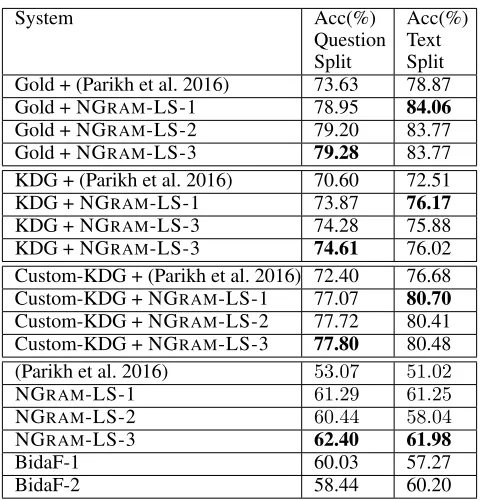
Results Table 3 presents the performance of all the sys-tems on both splits. The first four rows show the
accu-System Acc(%)
Question Split
Acc(%) Text Split Gold + (Parikh et al. 2016) 73.63 78.87
Gold + NGRAM-LS-1 78.95 84.06
Gold + NGRAM-LS-2 79.20 83.77
Gold + NGRAM-LS-3 79.28 83.77
KDG + (Parikh et al. 2016) 70.60 72.51
KDG + NGRAM-LS-1 73.87 76.17
KDG + NGRAM-LS-3 74.28 75.88
KDG + NGRAM-LS-3 74.61 76.02
Custom-KDG + (Parikh et al. 2016) 72.40 76.68 Custom-KDG + NGRAM-LS-1 77.07 80.70
Custom-KDG + NGRAM-LS-2 77.72 80.41 Custom-KDG + NGRAM-LS-3 77.80 80.48 (Parikh et al. 2016) 53.07 51.02
NGRAM-LS-1 61.29 61.25
NGRAM-LS-2 60.44 58.04
NGRAM-LS-3 62.40 61.98
BidaF-1 60.03 57.27
BidaF-2 58.44 60.20
Table 3: The first 12 rows show the performance of our method with different parsers and entailment functions. The last6rows show the performance of the baseline methods.
racy of our system when gold representation of the question is used. This shows the best performance that the system can achieve with the entailment functions at hand; which is
79.28%with the NGRAM-LS-3 entailment function on the “Question Split” and84.06%with the NGRAM-LS-2 entail-ment function on the “Text Split”. The next four rows show the performance with the KDG parser. The errors made by the parser result in an accuracy drop of ∼ 5%on “Ques-tion Split” and a drop of ∼ 8%on “Text Split”. However, when the customized-KDG parser is used the accuracy on both the split increases. The best accuracy on “Text Spit” is77.8%which is within1.5%of the achievable best with the entailments at hand. The accuracy drop on “Text split” also reduces from ∼ 8%to∼ 3.3%. Among the baseline methods which are shown in the last6rows, the best score is achieved by the NGRAM-LS-3 entailment function which is15.4%less than the best performance achieved by our sys-tem on “Question Split” and18.72%less on “Text Split”.
Conclusion
Acknowledgment The authors would like to thank Tushar Khot for his tremendous support during the experiments. The research is partially funded by NSF 1816039 and AI2 Key Scientific Challenges Program.
References
Bos, J. 2008. Wide-coverage semantic analysis with boxer. InProceedings of the 2008 Conference on Semantics in Text Processing. Association for Computational Linguistics. Bowman, S. R.; Angeli, G.; Potts, C.; and Manning, C. D. 2015. A large annotated corpus for learning natural language inference. arXiv preprint arXiv:1508.05326.
Calimeri, F.; Cozza, S.; Ianni, G.; and Leone, N. 2008. Com-putable functions in asp: Theory and implementation. In In-ternational Conference on Logic Programming. Springer. Chen, Q.; Zhu, X.; Ling, Z.-H.; Inkpen, D.; and Wei, S. 2018. Neural natural language inference models enhanced with external knowledge. In Proceedings of the 56th An-nual Meeting of the Association for Computational Linguis-tics (Volume 1: Long Papers), volume 1, 2406–2417. Clark, P.; Cowhey, I.; Etzioni, O.; Khot, T.; Sabharwal, A.; Schoenick, C.; and Tafjord, O. 2018. Think you have solved question answering? try arc, the ai2 reasoning challenge. arXiv preprint arXiv:1803.05457.
Clark, P.; Dalvi, B.; and Tandon, N. 2018. What happened? leveraging verbnet to predict the effects of actions in proce-dural text. arXiv preprint arXiv:1804.05435.
Clark, P. 2015. Elementary school science and math tests as a driver for ai: Take the aristo challenge! InAAAI.
Dagan, I.; Glickman, O.; and Magnini, B. 2006. The pas-cal recognising textual entailment challenge. In Machine learning challenges. evaluating predictive uncertainty, vi-sual object classification, and recognising tectual entail-ment. Springer. 177–190.
Eiter, T.; Ianni, G.; Schindlauer, R.; and Tompits, H. 2006. Effective integration of declarative rules with external eval-uations for semantic-web reasoning. InEuropean Semantic Web Conference, 273–287. Springer.
Flanigan, J.; Thomson, S.; Carbonell, J.; Dyer, C.; and Smith, N. A. 2014. A discriminative graph-based parser for the abstract meaning representation.
Gebser, M.; Kaminski, R.; Kaufmann, B.; and Schaub, T. 2012. Answer set solving in practice.Synthesis Lectures on Artificial Intelligence and Machine Learning6(3):1–238. Gelfond, M., and Kahl, Y. 2014.Knowledge representation, reasoning, and the design of intelligent agents: The answer-set programming approach. Cambridge University Press. Gelfond, M., and Lifschitz, V. 1988. The stable model se-mantics for logic programming. InICLP/SLP, volume 88. Havur, G.; Ozbilgin, G.; Erdem, E.; and Patoglu, V. 2014. Geometric rearrangement of multiple movable objects on cluttered surfaces: A hybrid reasoning approach. InRobotics and Automation (ICRA), 445–452. IEEE.
He, L.; Lee, K.; Lewis, M.; and Zettlemoyer, L. 2017. Deep semantic role labeling: What works and what’s next. In
Pro-ceedings of the 55th Annual Meeting of the Association for Computational Linguistics (Volume 1: Long Papers). Jijkoun, V., and De Rijke, M. 2006. Recognizing textual en-tailment: Is word similarity enough? InMachine Learning Challenges. Evaluating Predictive Uncertainty, Visual Ob-ject Classification, and Recognising Tectual Entailment. Khot, T.; Sabharwal, A.; and Clark, P. 2018. Scitail: A tex-tual entailment dataset from science question answering. In Proceedings of AAAI.
Krishnamurthy, J.; Dasigi, P.; and Gardner, M. 2017. Neural semantic parsing with type constraints for semi-structured tables. InProceedings of the 2017 Conference on Empirical Methods in Natural Language Processing, 1516–1526. Levesque, H. J.; Davis, E.; and Morgenstern, L. 2012. The winograd schema challenge. InKR.
Lierler, Y.; Inclezan, D.; and Gelfond, M. 2017. Action languages and question answering. InIWCS 2017—12th In-ternational Conference on Computational Semantics. Mitra, A., and Baral, C. 2015. Learning to automatically solve logic grid puzzles. InEMNLP, 1023–1033.
Mitra, A., and Baral, C. 2016. Addressing a question an-swering challenge by combining statistical methods with in-ductive rule learning and reasoning. InAAAI, 2779–2785. Moldovan, D.; Clark, C.; Harabagiu, S.; and Maiorano, S. 2003. Cogex: A logic prover for question answering. In Proceedings of the 2003 Conference of the North American Chapter of the Association for Computational Linguistics on Human Language Technology-Volume 1.
Parikh, A. P.; T¨ackstr¨om, O.; Das, D.; and Uszkoreit, J. 2016. A decomposable attention model for natural language inference. arXiv preprint arXiv:1606.01933.
Rajpurkar, P.; Zhang, J.; Lopyrev, K.; and Liang, P. 2016. Squad: 100,000+ questions for machine comprehension of text. arXiv preprint arXiv:1606.05250.
Richardson, M.; Burges, C. J.; and Renshaw, E. 2013. Mctest: A challenge dataset for the open-domain machine comprehension of text. InEMNLP, volume 1, 2.
Seo, M.; Kembhavi, A.; Farhadi, A.; and Hajishirzi, H. 2016. Bidirectional attention flow for machine comprehen-sion.arXiv preprint arXiv:1611.01603.
Sharma, A.; Vo, N. H.; Aditya, S.; and Baral, C. 2015. To-wards addressing the winograd schema challenge-building and using a semantic parser and a knowledge hunting mod-ule. InIJCAI.
Wang, Y.; Berant, J.; and Liang, P. 2015. Building a se-mantic parser overnight. In Proceedings of the 53rd An-nual Meeting of the Association for Computational Linguis-tics and the 7th International Joint Conference on Natural Language Processing (Volume 1: Long Papers), volume 1. Wang, Y.; Lee, J.; and Kim, D. S. 2017. A logic based approach to answering questions about alternatives in diy domains. InAAAI, 4753–4759.