S U R V E Y
Open Access
Ensuring data confidentiality via plausibly
deniable encryption and secure deletion – a
survey
Qionglu Zhang
1,2,3, Shijie Jia
1,2*, Bing Chang
4and Bo Chen
5*Abstract
Ensuring confidentiality of sensitive data is of paramount importance, since data leakage may not only endanger data owners’ privacy, but also ruin reputation of businesses as well as violate various regulations like HIPPA and
Sarbanes-Oxley Act. To provide confidentiality guarantee, the data should be protected when they are preserved in the personal computing devices (i.e.,confidentiality during their lifetime); and also, they should be rendered irrecoverable after they are removed from the devices (i.e.,confidentiality after their lifetime). Encryption and secure deletion are used to ensure data confidentiality during and after their lifetime, respectively.
This work aims to perform a thorough literature review on the techniques being used to protect confidentiality of the data in personal computing devices, including both encryption and secure deletion. Especially for encryption, we mainly focus on the novel plausibly deniable encryption (PDE), which can ensure data confidentiality against both a coercive (i.e., the attacker can coerce the data owner for the decryption key) and a non-coercive attacker.
Keywords: Data confidentiality, Plausibly deniable encryption, Secure deletion
Introduction
Modern computing devices (e.g., desktops, laptops, smart phones, tablets, wearable devices) are increasingly used to process sensitive or even mission critical data. Protect-ing confidentiality of those sensitive data is of paramount importance because: First, data leakage will endanger data owners’ privacy. For example, the data leakage of iCloud in 2014 disclosed almost 500 private pictures of various celebrities (Cbsnews: Apple’s celebrity icloud leak proba-bly has mundane causes2014). Second, it will ruin repu-tation of businesses. For example, Equifax data breach in July 2017 caused a leak of 145,500,000 consumer records; a few local governments like cities of Chicago and San Fran-cisco, as well as the Commonwealth of Massachusetts, have filed enforcement actions against Equifax (Ballard
*Correspondence:[email protected];[email protected]
1Data Assurance and Communication Security Research Center, Chinese Academy of Sciences, Beijing, China
2State Key Laboratory of Information Security, Institute of Information Engineering, Chinese Academy of Sciences, Beijing, China
5Department of Computer Science, Michigan Technological University, Houghton, USA
Full list of author information is available at the end of the article
Spahr LLP: State and local governments move swiftly to sue equifax2017); Third, it will directly violate regulations
like HIPAA (Congress 1996), Gramm-Leach-Bliley Act
(Congress1999), and Sarbanes-Oxley Act (Sarbanes and
Oxley2002). The data confidentiality should be ensured not only during their lifetime (i.e., the data are preserved in the devices), but also after their lifetime (i.e., the data have been removed from the devices). This is because, by recovering sensitive data which have been deleted, the attacker can achieve a similar gain compared to success-fully attacking the confidentiality of the data being pre-served in the devices. For example, by recovering a naked picture deleted by a victim, the adversary can still use it to embarrass the victim or ask the victim for ransom money. Correspondingly, the research efforts for protecting data confidentiality can be divided into two categories: encryption and secure deletion. Encryption can protect confidentiality of the data stored at rest by transform-ing them into another format ustransform-ing some secrets (e.g., keys), such that the adversary is not able to correlate the transformed format to the original format without obtaining the secrets. All types of existing encryption mechanisms like symmetric encryption and asymmetric
encryption can achieve the aforementioned security prop-erty. Secure deletion is to ensure that once the sensitive data are deleted, the probability of recovering them is negligibly small. This requires special techniques to com-pletely destroy data, eliminating any traces which may lead to a full/partial data recovery.
To protect confidentiality of the data stored in a com-puting device, conventional encryption may not work when both the computing device and the device’s owner are captured by an attacker, since the attacker can coerce the owner to disclose the secret (i.e., a coercive adver-sary). Once the secret is disclosed, the transformed format created by encryption will be reversed, and the sensitive data will be leaked. A novel encryption technique, plau-sibly deniable encryption (PDE) (Canetti et al.1997), has been designed to complement the traditional encryption to handle such a coercive attack. The high-level idea of PDE is, the original sensitive message is encrypted into ciphertexts in a special way, such that during decryption, if a true key is used, the original sensitive message can be recovered, but if a decoy key is used, a plausible mes-sage will be generated. Therefore, upon being coerced, the owner can simply disclose the decoy key to protect confidentiality of the original sensitive message.
To protect confidentiality of the data deleted from a computing device, the deleted data should be made completely unrecoverable. Conventionally, this is ensured by carefully over-writing the storage medium storing the data using garbage information (Joukov and Zadok 2005; Wei et al. 2011; Garfinkel and Shelat 2003; Sun
et al. 2008; Gutmann 1996) or deploying encryption
using ephemeral keys (Perlman 2005a, b, Geambasu
et al.2009, Tang et al.2012, Reardon et al.2012, Zarras et al. 2016). This unfortunately was shown to be insuf-ficient, since past existence of the deleted data will cre-ate impacts on both the data organization (Bajaj and Sion 2013b) and the other data which have not been deleted (Bajaj and Sion2013a). Those impacts can then be utilized by the adversary as an oracle to derive sen-sitive information about the deleted data. In the worst case, the adversary is able to completely recover the data being deleted (Chen et al.2016). Therefore, recent secure deletion approaches focus on eliminating those impacts (Bajaj and Sion2013a,b, Chen and Sion2015; Chen and Sion2016; Jia et al.2016).
In this work, we aim to conduct a thorough literature review on data confidentiality protection. We believe that data confidentiality should be always ensured no mat-ter the data are preserved in the computing device or have been removed. Therefore, our survey covers tech-niques being used to protect data confidentiality for both cases: 1) data are stored in the devices; 2) data have been removed from the devices. For the first case, we mainly focus on PDE which can provide confidentiality guarantee
against both the coercive adversaries and the non-coercive adversaries. We summarize the research for PDE the-ory and systems (including both the desktop systems and the mobile systems). For the second case, we summa-rize secure deletion approaches in various storage media including hard disk drives (HDDs) and NAND flash mem-ory. We also outline the new direction of secure deletion approaches by eliminating impacts of operation history.
Organization. In “Background” section, we introduce the background knowledge of flash memory, the architec-ture of a storage system, PDE as well as secure deletion. In “Models and assumptions” section, we unify the adver-sarial model for both PDE and secure deletion, and also summarize the assumptions required by PDE. We then summarize the literature for PDE in “Protecting data con-fidentiality against coercive adversaries via PDE” section and for secure deletion in “Ensuring confidentiality of the deleted data via secure deletion” section, respectively. In “Future directions” section, we discuss a few future directions of PDE and secure deletion. We conclude in “Conclusion” section.
Background
Flash memory
Flash memory is a solid-state non-volatile computer stor-age medium that can be electrically erased and repro-grammed. It can eliminate mechanical limitations and latency of hard drives, achieving a much higher I/O throughput with a much lower power consumption. Therefore, it gains popularity in main-stream mobile devices like smart phones, tablets, wearable devices. In addition, a lot of high-end laptops like Apple MacBook use flash memory as external storage. Even cloud providers allow their users to choose solid state drives (SSDs) as the underlying storage media (Amazon: New SSD-Backed Elastic Block Storage2016). The flash memory being used as the storage medium is mainly NAND flash. NAND flash stores data using an array of memory cells, which are grouped into pages (each page can store 512-byte, 2KB, or 4KB data), and multiple pages are further grouped into blocks (can contain 32, 64, or 128 pages).
worn out if the number of programs/erasures performed over it exceeds a certain threshold. Last, NAND flash is vulnerable to read/program disturb (Cai et al. 2015). In other words, frequently reading/writing the same flash location may corrupt the data stored nearby. Due to read/program disturb (Cai et al.2015), NAND flash usu-ally requires computing an error-correcting code (ECC) for each page, and storing the parity in the “spare area” of the corresponding page. In general, the raw flash can be managed through either flash translation layer (FTL) or flash-specific file system.
– Flash translation layer. To be compatible with traditional block-based file systems (e.g., EXT4), flash memory can be emulated as a block device by exposing a block-based access interface, which is the most popular form of flash-based products (e.g., SSDs, eMMCs, USB sticks). This is usually achieved by introducing special firmware, flash translation layer (FTL), between the file system and the raw flash. FTL can translate the logical block addresses to the underlying physical flash addresses, providing a block access interface to upper layers.
– Flash file systems. Another alternative of using raw flash is to directly build a flash-specific file system over it. A flash file system is a file system optimized specifically for flash memory. Popular flash file systems include YAFFS (Robust Flash Storage: YAFFS2002), UBIFS (Memory Technology Devices: UBIFS2015), JFFS2 (Sourceware: Jffs22003), and F2FS (Lee et al.2015). Note that flash file systems become less popular nowadays. Most of the recent mobile devices are only designed to be compatible with FTL-based flash devices, and usually do not allow directly accessing the raw flash. For example, the Google Nexus 6P Android phone uses eMMC cards as storage media, and only the old Android phones like Nexus One and Nexus S allow directly accessing the raw flash.
Special internal management (being incorporating into FTL or flash file systems) is usually required to han-dle the characteristics of flash memory, which may easily lead to deniability compromise or data leakage, making it challenging to provide deniability/secure deletion on flash-based storage systems.
The architecture of a storage system
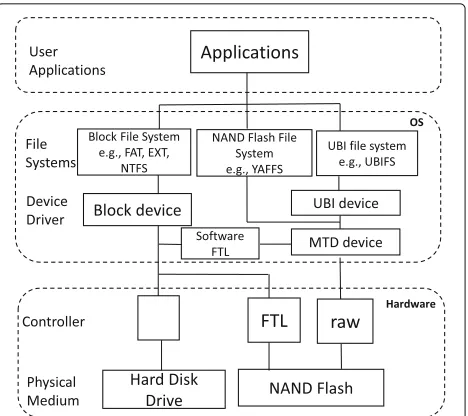
The storage media like magnetic HDDs and NAND flash are usually managed through a storage system, which is organized into a few layers. The layers interact with each other, and provide users a unified interface to access the data being stored in the storage media. Figure1shows a typical architecture for storage systems.
Fig. 1The architecture of storage systems
The lowest layer is the physical medium layer, where data are actually stored, e.g., HDDs or NAND flash. The physical storage medium is always accessed through a controller. The basic function of the controller is to trans-late data format on the physical storage medium (e.g., electrical voltage) into another format (e.g., binary values) understandable by upper layers. The controller offers a standardized and well-defined hardware interface, e.g., ATA (Team work systems: Advanced technology attach-ment2017) and SCSI (Incits: Scsi storage interfaces2016), which allows data to be read from/written to the physical storage medium. The HDD adopts in-place updates, and hence its controller usually consistently maps a logical block address to a certain storage location on the physical storage medium. On the contrary, NAND flash prefers out-of-place updates due to its special features, and is usu-ally managed through FTL or a flash specific file system (“Flash memory” section). Device drivers are to consol-idate access to different types of hardware by exposing a common simple interface in the form of software. The block device driver interface allows reading and writing of blocks in logical addresses. The block device driver can be used on top of an HDD control or NAND flash being encapsulated by FTL. The memory technology device (MTD), another type of device driver, is used to access raw NAND flash memory directly. MTD permits reading and writing, but blocks must be erased before being written, which occurs at a large granularity. Unsorted block images (UBI) is another interface for accessing flash memory, which builds on top of MTD interface and simplifies some aspects of using raw flash memory.
physical storage medium through the interface provided by the device driver. These include: 1) block file systems built on top of block device, e.g., FAT32, EXT4, and NTFS; 2) flash file systems built on top of MTD device, e.g.,
YAFFS (Robust Flash Storage: YAFFS 2002); 3) UBI file
system (Memory Technology Devices: UBIFS2015) built
on top of UBI device.
The highest layer is the application layer, offering an interface to the users.
Plausibly deniable encryption (PDE)
Conventional encryption is broadly used by individuals and businesses to protect sensitive data. Major operat-ing systems now increasoperat-ingly support the use of full disk encryption. For example, FileVault (Apple: Use filevault to
encrypt the startup disk on your mac 2017) in Mac OS
X 10.3 and later, BitLocker (Microsoft: Bitlocker2017) in Windows Vista and later, full-disk encryption in Android 4.4 and later, etc. However, traditional encryption may not work when data owners are captured by the adver-sary and coerced into disclosing their decryption keys. To protect sensitive data against this type of coercive adver-saries, plausibly deniable encryption (Canetti et al.1997;
Dürmuth and Freeman 2011; Howlader and Basu 2009;
Ibrahim 2009; Klonowski et al. 2008; Meng and Wang
2009; 2010; O’Neill et al.2011) (PDE) can be utilized to hide the sensitive data by denying their very existence. Dif-ferent from conventional encryption, PDE encrypts origi-nal sensitive message into ciphertexts in such a way that, upon decryption, if a true key is used, the original sensi-tive message can be recovered, but if a decoy key is used, a plausible message will be generated. When being coerced, the victim can simply disclose the decoy key. Using the decoy key, the adversary is able to decrypt the cipher-text into the plausible message which is non-sensitive, and is hence convinced that no sensitive information is stored.
Secure deletion
Secure deletion is a technique designed to ensure com-plete elimination of sensitive data once they become
obso-lete. It requires a guarantee that an adversary should
neither recover the deleted data, nor learn anything about
them. However, achieving such a guarantee in modern
computing systems is a challenging task due to the com-plication of the storage systems (“The architecture of a storage system” section). A modern storage system usually consists of multiple layers, and performing secure dele-tion in one layer is usually not able to eliminate the data, since data leakage may be observed in other layers. For example, given a Microsoft Word document, removing data from the document itself cannot guarantee that the deleted data really become inaccessible. Upon receiving a delete request issued by Microsoft Word (which belongs
to the application layer), the system may simply mod-ify the metadata in the file system layer (e.g., changing the block allocation table and invalidating the data being deleted) to make the data appear to have been removed in the application layer. However, the actual content is still preserved in the physical storage medium layer and may be recovered by the adversary through disk foren-sics (Breeuwsma et al.2007; Garfinkel and Shelat2003). Therefore, secure deletion requires ensuring that the con-tent being deleted should become inaccessible at each layer of the storage system.
In addition, the past existence of the deleted data may leave artifacts in the data organization (Bajaj and Sion 2013b) or side effects on the other data (Bajaj and Sion 2013a). After the data have been deleted, those artifacts or side effects may be utilized by the adversary to learn sen-sitive information of the deleted data (Chen et al. 2016). This also creates a barrier towards completely removing sensitive information.
Models and assumptions
A unified adversarial model for PDE and secure deletion
We unify the adversarial model for both PDE and secure deletion by considering a snapshot adversary who can have access to the state of a victim device. The adversary is assumed to be not able to control the code of the victim system, i.e., no malicious code can be injected and hence the code of the victim system is secure. Each access will allow the adversary to obtain a full snapshot of both the external storage and the memory. The adversary is com-putationally bounded, and tries to illegitimately derive sensitive information from the snapshots being captured. We consider that the adversary can have access to the victim device once (i.e., asingle-snapshot adversary) and multiple times (i.e., amulti-snapshot adversary).
The single-snapshot adversary captures a lot of real-world scenarios. For example, an attacker steals a smart phone (Yu et al.2014; Chang et al.2015) or a laptop, or breaks into a data center obtaining a snapshot of a vic-tim server. The multi-snapshot adversary also captures a lot of real-world scenarios. For example, an attacker peri-odically breaks into a hotel room, obtaining a “memory dump” of a victim’s smart phone; a border checker period-ically obtains snapshots from a victim’s smart device (Blass et al.2014; Peters et al.2015).
The only unique attack behavior for PDE is the adver-sary may coerce the data owner for the decryption keys. This behavior is not applicable to secure deletion, because no key for the deleted data will be preserved after the data have been securely removed.
The assumptions required by PDE
– The PDE software should be merged into the code stream of the device (e.g., part of the Android framework), such that its availability is widespread, and an attacker cannot simply compromise deniability based on the availability of software support. In addition, PDE requires changing a few system components (e.g., booting process). The adversary who can perform reverse engineering or dynamic analysis over those components will unavoidably compromise deniability. The PDE systems cannot defend against this type of adversary. – The adversary will know the design of PDE. However,
he/she does not have any knowledge on secret information (e.g., keys and passwords) being required to open/operate the PDE mode.
– The adversary is rational and will stop coercing the device’s owner once he/she is convinced that the decryption keys have been revealed.
– The adversary can not capture a device working in the PDE mode or after a crash of the PDE mode. Otherwise, he/she can trivially retrieve sensitive hidden data, compromising deniability.
– The operating system, bootloader, baseband OS, firmware are all malware-free. In addition, the PDE mode is malware-free.
Protecting data confidentiality against coercive adversaries via PDE
Ensuring confidentiality of the data being preserved in personal computing devices can be achieved by encryp-tion. However, traditional encryption cannot defend against coercive adversaries (“A unified adversarial model for PDE and secure deletion” section). Therefore, we mainly focus on plausibly deniable encryption (PDE), which can protect confidentiality of the data present in the computing devices against both coercive and non-coercive adversaries.
PDE – from Theory to Practice
An ideal PDE would be a special encryption, which can encrypt sensitive plaintexts into ciphertexts, such that the ciphertexts can be decrypted into either original sensitive plaintexts (using true key) or plausible non-sensitive plaintexts (using decoy key). This is to ensure that one key can be disclosed when the data owner is coerced. However, such an ideal encryption is impractical for stor-age systems because: First, the existing instantiation for PDE results in a growing size of ciphertexts (Canetti et al. 1997), which itself could be an indication of the existence of deniability. Second, a modern storage system is usually complicate, consisting of multiple layers, e.g., applica-tion layer, file system layer, physical storage medium layer (“The architecture of a storage system” section). Simply encrypting the data using PDE in the application
layer cannot ensure that traces of the sensitive data will not be observed by the snapshot adversary in the underlying file system and physical storage medium layer, especially when the sensitive data need to be updated over time and the adversary can obtain multiple snap-shots (“A unified adversarial model for PDE and secure deletion” section). Therefore, when being applied to stor-age systems, rather than simply use encryption, two types of PDE techniques, steganography and hidden volumes, are used to provide deniability.
The first type of PDE technique is steganography
(Anderson et al.1998). The basic idea of steganography is to hide sensitive data within regular file data. For exam-ple, the sensitive data can be computed by performing an XOR operation over a few cover files (Anderson et al. 1998). A main concern of the steganography technique is to avoid over-writing the hidden sensitive data, since they are actually part of the regular data. This can be mitigated by creating and storing (secretly) multiple copies of the sensitive data, which in return will lead to inefficient use of disk space.
The other type of PDE technique is hidden volumes
(TrueCrypt: Free open source on-the-fly disk encryption
software.version 7.1a 2012). The hidden volumes
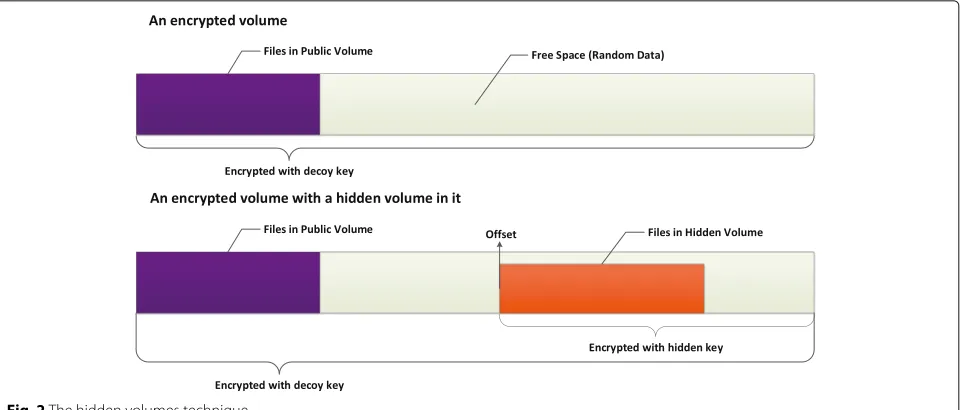
tech-nique works as follows: There are two encrypted volumes on the disk, a public volume and a hidden volume. The public volume is encrypted using a decoy key and the hid-den volume is encrypted using a hidhid-den key (i.e., the true key). The public volume is placed on the entire disk and the hidden volume is usually placed from a secret offset towards the end of the disk (i.e., the hidden volume is part of the public volume, see Fig. 2). Note that initially the entire disk is filled with random data and the data written to the public volume should be placed sequentially from the beginning of the disk to reduce probability of over-writing the hidden volume. When the victim is coerced into revealing the encryption key, he/she can disclose the decoy key, and the attacker will use the decoy key to decrypt the entire disk and cannot distinguish the hidden volume from the random noise being filled initially, and is thus convinced that no sensitive data are stored. The hid-den volumes technique can be viewed as a special type of steganography technique, which always hides the sensitive data in a contiguous region being placed at the end of the disk and remains undetected by the coercive adversaries.
Leveraging hidden volumes and steganography, vari-ous PDE systems have been built to enable deniability on computing devices. All those works can be divided into two categories, PDE for desktop computers and PDE for mobile devices.
PDE for desktop computers
Fig. 2The hidden volumes technique
recent works, researchers also incorporate Oblivious RAM (ORAM) in order to defend against multi-snapshot adversaries.
PDE using steganography. Steganographic file systems have been initially proposed by Anderson et al. (1998), with two alternative schemes. In their first scheme, the system has a number of cover files originally consisting of random bits and the user’s files can be computed using a subset of cover files. This scheme uses a password and the file name to determine which cover files are used. Its drawback is requiring storing a large number of cover files. Moreover, to accommodate files of arbitrary length, the cover files must be relatively large. Their second scheme is based on the computational security of block ciphers. The system is initialized by filling the entire hard disk with ran-dom data. A sensitive file is encrypted and stored at disk location being derived from the file name and the pass-word, and the encryption key is also derived in a similar manner. In this way, the adversary is not be able to dis-tinguish blocks containing hidden data from free blocks being filled with random noise. However, when the disk is increasingly filled by hidden files, collision of disk loca-tions may increase, leading to significant over-writes. This is mitigated by writing each block to several disk locations. Inspired by the second scheme of Anderson et al. (1998), McDonald et al. proposed StegFS (McDonald and Kuhn
2000), an EXT2-based file system which uses an
exter-nal block allocation table to record entries for disk blocks. StegFS supports a few security levels, each with a sep-arate password. To prevent overwriting the data from a security level which is closed, StegFS writes data in a redundant manner. When multiple security levels are open, since hidden and regular files are present in the
same file system, data leakage may occur. A user of StegFS cannot deny the existence of hidden files, due to exis-tence of the modified EXT2 driver and the external block table. However, the user can keep the number of security levels secret.
To further improve efficiency and reliability, Pang et al. designed another steganographic file system (Pang et al. 2003; 2004). They use a bitmap to mark the blocks being used by the hidden files, and thus eliminate the need of storing multiple copies of a file, alleviating the reliabil-ity issues and I/O inefficiencies. However, the adversary may be able to identify existence of hidden files, because the hidden blocks, being marked as used, do not pos-sess a directory record. Three approaches are used to mitigate the aforementioned compromise. First, a few blocks, which do not store hidden data, are abandoned and marked as being used during initialization. Second, when the system creates a new file, several additional blocks are allocated and filled with random noise. Third, to prevent adversaries from identifying whether a block stores hidden data, the system maintains a few dummy hidden files and periodically updates them in the back-ground. These mitigation approaches however, increase overhead of disk space usage.
can also reveal files which occupy only one data block after a sufficient number of access operations. Han et al. proposed a dummy-relocatable steganographic (DRSteg) file system (Han et al. 2010) to provide deniability in a multi-user environment. By sharing dummy data among multiple users in the system, DRSteg is able to increase the level of deniability being provided to individual users. In DRSteg, in order to free dummy data without destroy-ing user data, a novel dummy relocation mechanism is used to allow individual users to distinguish dummy data from other users’ data. It can also prevent adversaries from distinguishing dummy and user data even after obtain-ing multiple snapshots. There are also a few StegFS-based implementations including RubberhoseFS (Assange et al. 2012) and Magikfs (Varun et al.2017), which are no longer maintained and the existing implementations may not be compatible with modern Linux operating system.
PDE using hidden volumes. Disk encryption tools like TrueCrypt (TrueCrypt: Free open source on-the-fly disk
encryption software.version 7.1a 2012) and FreeOTFE
(Sourceforge: FreeOTFE A free “on-the-fly” transparent disk encryption program for PC and PDAs2017) use hid-den volumes to provide plausible hid-deniability. TrueCrypt supports user data encryption with several ciphers includ-ing AES, TwoFish, Serpent, and a cascade of these ciphers in the XTS mode. The header of each TrueCrypt volume is filled with random data (e.g., salt) or encrypted with the header key which is derived from the corresponding pass-word using PBKDF2. Therefore, the entire volume appears as being filled with randomness. When TrueCrypt loads a volume, since it does not store the cipher specifica-tion, all supported ciphers will be tried with a header key (being derived from the user’s password using PBKDF2) until it decrypts the volume and obtains the ASCII string “TRUE” from a certain block in the header. Then True-Crypt decrypts the encrypted master volume key using the header key. Note that the master volume key is gener-ated randomly upon creating the volume. If a TrueCrypt hidden volume is created, there will be also a hidden header, which contains offset of the hidden volume. The hidden header is tested before the public header when mounting a volume. TrueCrypt can also create a hidden OS in a hidden volume by creating a new partition and copying the current OS to the hidden volume. When the system is booted into the hidden OS, all unencrypted vol-umes and non-hidden encrypted volvol-umes are mounted in a read-only manner, ensuring that any OS/application-specific leakage stays within the hidden volume.
Czeskis et al. (2008) analyzed TrueCrypt and proposed three types of attacks against it. They consider three types of leakage sources: 1) the operating system; and 2) the primary applications (i.e., an application that is used to manage hidden data); and 3) the non-primary
applications. Modern operating systems are not designed to preserve deniability and may perform many unexpected behaviors. As a result, even when the operating system runs properly, information relevant to hidden data may be leaked. For example, some operating systems (e.g., Win-dows) automatically create shortcuts to hidden files when they are used, and those shortcuts may be stored in reg-ular non-hidden directories. The shortcuts may contain information about the hidden file, e.g., file name, loca-tion, length, access time, creation time and even volume serial number of the file system on which the hidden file is stored. If the adversary localizes those shortcuts, it may suspect existence of the hidden data, compromising deni-ability. Another possible leakage source is the primary application. The primary applications are not necessarily designed to preserve deniability, and may leak information about the hidden data. For example, primary applica-tions may create redundant files to prevent data loss. If those files are not properly deleted, the content of the hidden data may be leaked. Finally, non-primary applica-tions, such as desktop search applicaapplica-tions, may access the files being stored in the hidden volume. Those applica-tions may cache snapshots of the hidden files and store them for a later use. The adversary may also compromise deniability from those cached data.
Other PDE systems for desktop computers. If the adversary can capture multiple snapshots of hidden vol-ume at different points of time, they can detect exis-tence of the hidden volume, by simply comparing dif-ferent snapshots and identifying whether “free” blocks have been changed. Therefore, TrueCrypt cannot pro-vide deniability when facing a multi-snapshot adversary. Blass et al. proposed HIVE (Blass et al.2014) to allow the user to deny existence of the hidden volume when fac-ing a multi-snapshot attack. This is achieved by hidfac-ing every access of the disk using Oblivious RAM (ORAM) (Goldreich and Ostrovsky 1996; Stefanov et al. 2013), which was originally designed to hide patterns of access to remote storage. However, ORAM is known as expensive in terms of both computation and I/O. Although HIVE uses a less expensive write-only ORAM that only supports write operations, its performance is still far from being practical.
Roche et al. designed DetWoORAM (Roche et al.2017), an entirely new technique for write-only ORAM, which uses a deterministic and sequential writing pattern, elim-inating the need of any “stashing” of blocks in local state. In DetWoORAM, since the write will always succeed and occur in a free block, the notion of stash can be com-pletely removed. They also pointed out that the construc-tion of DataLair does not satisfy write-only obliviousness, since the process of finding free blocks leaks information about which blocks are free, and the adversary can tell whether recent writes have been performed on the same address or not.
Zuck et al. presented Ever-Changing Disk (ECD) (Zuck et al. 2017) to achieve deniable storage system. Their design follows three requirements: 1) resistance to multi-snapshot adversaries; and 2) ensuring that hidden data will not be destroyed when a user is writing the public volume; and 3) using normal system operations on public data to disguise writes to hidden data. In ECD, the storage space is separated into two parts: a part containing the public data volume and the other containing the hidden data volume. The hidden volume is visible to the system when the user enters the secret key. ECD uses a large volume of pseu-dorandom data to hide the sensitive data. A portion of data from the volume are periodically migrated using nor-mal firmware operations to obfuscate writes to the hidden data. Since hidden and pseudorandom data blocks are constantly relocated and modified, the hidden data may eventually be overwritten without knowing the secret key. To mitigate the overwrite issue, the rate of internal data migration is controlled by the user and the user should enter the secret key periodically.
Zhao et al. proposed Gracewipe (Zhao and Mannan 2015), by which the victim can provably destroy/erase data when being coerced, hoping that a reasonable adversary will find no reason to keep holding him/her. Gracewipe works as follows: During setup, the user selects three pass-words, which can be used to derive the key for encrypting the corresponding volume: 1) hidden password that only
derives the hidden volume key; and 2) decoy password that derives only the decoy volume key; and 3) deletion password that derives the decoy volume key and over-writes the hidden volume key. When coerced, the victim can fake compliance, and enter the deletion password, and then can prove to the attacker that Gracewipe has been executed and the real key is no longer available.
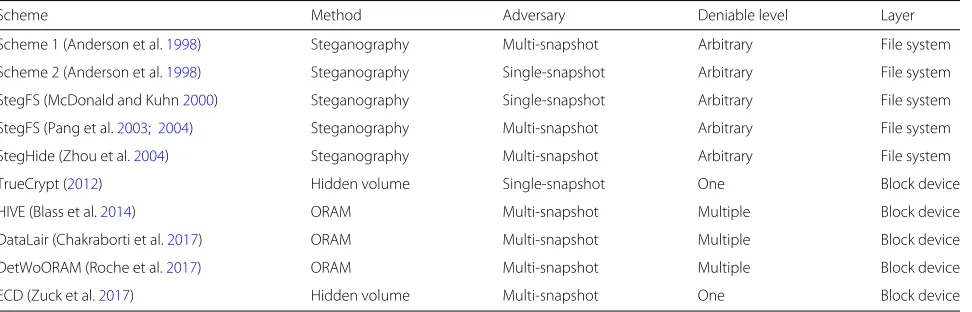
Table1summarizes the existing PDE systems for desk-top computers, being incorporated into different lay-ers of the storage systems. To defend against snapshot adversaries, they may rely on hidden volumes, steganog-raphy, or ORAM, and provide one or multiple denia-bility levels with different overheads. Schemes based on
steganography (e.g., McDonald and Kuhn 2000; Pang
et al.2003) suffer from high performance overhead since they write multiple copies of files or dummy writes for steganography. Hidden volume mechanism (True-Crypt: Free open source on-the-fly disk encryption soft-ware.version 7.1a2012) introduces low overhead since the hidden files are stored in the free space and the over-write problem is mitigated by linear space allocation. Since ORAM is known to be expensive, schemes based on ORAM (e.g., Blass et al.2014; Chakraborti et al.2017; Roche et al.2017) unavoidably have high overheads.
PDE for mobile devices
Compared to desktop computers, mobile devices are usu-ally different in two aspects: First, they are equipped with less computational power. Second, they usually use flash memory (“Flash memory” section) as storage. The exist-ing PDE systems for mobile devices can be divided into two categories: 1) The PDE systems built on top of block devices. This type of PDE systems views flash memory as a black box, which exposes a block-access interface through FTL (“The architecture of a storage system” section). 2) The PDE systems built on top of flash memory. This type of PDE systems directly work on top of flash memory to provide deniability while handling the special nature of flash.
Table 1Summary of PDE systems for desktop computers
Scheme Method Adversary Deniable level Layer
Scheme 1 (Anderson et al.1998) Steganography Multi-snapshot Arbitrary File system Scheme 2 (Anderson et al.1998) Steganography Single-snapshot Arbitrary File system StegFS (McDonald and Kuhn2000) Steganography Single-snapshot Arbitrary File system StegFS (Pang et al.2003;2004) Steganography Multi-snapshot Arbitrary File system StegHide (Zhou et al.2004) Steganography Multi-snapshot Arbitrary File system
TrueCrypt (2012) Hidden volume Single-snapshot One Block device
PDE systems on top of block devices. Skillen et al. (Skillen and Mannan2013,2014; Skillen2013) designed Mobiflage, the first PDE scheme for mobile devices. They provided two versions of implementations: one in external storage for FAT32 file system (Skillen and Mannan2013), and the other in internal storage for modified EXT4 file
system (Skillen and Mannan 2014). The main
contribu-tion of Mobiflage lies in its first incorporacontribu-tion of hidden volumes technique to the Android devices. It works as follows: First, it fills the external storage with random data. Second, it creates two volumes, a public volume for storing public non-sensitive data, applications and set-tings, and a hidden volume for storing sensitive data. Correspondingly, there are two operation modes, a pub-lic mode and a PDE mode. The pubpub-lic mode is used to manage the public volume for daily use, providing stor-age encryption without deniability. In this mode, the data are encrypted with a decoy key, which is derived from a decoy password. The user will be asked to provide the decoy password during the booting in order to enter the public mode. The PDE mode is used to manage the hid-den volume which stores sensitive data whose existence needs to be denied when being coerced. In this mode, the data are encrypted with a true key, which is derived from a true password. The user should provide the true pass-word during system boot to activate the PDE mode. The exact location of the hidden volume is derived from the true password.
The FAT32 version of Mobiflage (Skillen and Mannan 2013) is specially designed for external storage formatted using FAT32 file system, which requires the support of a physical or an emulated FAT32 SD card. This is because, the hidden volume is part of the public volume, and is placed at the end of the disk. In other words, if an EXT-like file system is deployed for the public volume, the data stored in the hidden volume may be easily overwritten by the public data due to the nature of EXT file sys-tem’s random allocation. To eliminate the aforementioned assumption, the EXT4 version of Mobiflage (Skillen and Mannan2014) modifies the EXT4 driver such that it can support a sequential inode allocator and can be deployed for the public volume to avoid overwriting the hidden vol-ume. However, the modification of the EXT4 driver itself may be an indication of the existence of PDE.
Yu et al. proposed MobiHydra (Yu et al. 2014) to
improved Mobiflage in three aspects: 1) It can mitigate a novel booting-time attack being faced by Mobiflage; 2) It can support multiple levels of deniability. 3) It sup-ports mode switching without rebooting. To mitigate the booting-time attack, MobiHydra obfuscates the time required for a wrong password (i.e., an arbitrary password except the true and the decoy password) during booting such that the adversary is not able to identify the existence of PDE by simply entering a wrong password. To support
fast mode switching, MobiHydra introduces a special par-tition called shelter volume on the external storage, which is used as a temporary storage partition which can tem-porarily store the sensitive data being created in the pub-lic mode, without the need of entering the PDE mode for storing hidden sensitive data. The data stored in the shelter volume will be immediately synchronized to the hidden volume when the hidden mode is entered, and are then eliminated from the shelter volume. To avoid deniability compromise, the sensitive data stored in the shelter volume will be encrypted by a random key which is encrypted by the public key and stored in the shelter volume. In addition, some dummy files are maintained in the shelter volume and updated periodically to obfuscate the writes of hidden sensitive data to the shelter volume. MobiHydra, however, cannot eliminate the assumption of requiring a physical or an emulated FAT32 SD card.
To eliminate the limitations of Mobiflage and MobiHy-dra, Chang et al. designed MobiPluto (Chang et al.2015), a file system friendly PDE design. The basic idea of Mobi-Pluto is introducing an additional software layer between the PDE and the file system. This software layer should satisfy three requirements: 1) Its existence should not be an indication of PDE; 2) It should provide virtual vol-umes to file systems, and any block-based file systems can be deployed on a virtual volume; 3) It should convert non-sequential allocation from a file system to sequential allocation in the underlying PDE. To build such a layer, MobiPluto uses thin provisioning (Thornber), because: First, thin provisioning has been implemented by dm-thin-pool module, which has been a well-established tool in Linux kernel; Second, thin provisioning can allow to create thin volumes, each of which can be used to deploy any block-based file systems. Third, thin provisioning can transform non-sequential allocation on the thin volume to sequential allocation on the underlying storage. By com-bining thin provisioning and hidden volumes, MobiPluto is able to achieve a “file system friendly” PDE design.
data. However, users tend to choose weak passwords, thus security may not be ensured. To address this issue, they proposed to use NFC cards to store strong passwords for the user. Their observation is that most of the modern mobile devices are equipped with NFC features.
MobiCeal (Chang et al.2018) designed the first block-based PDE system for mobile devices which can defend against a multi-snapshot adversary. The fundamental idea of MobiCeal is to use dummy writes to obfuscate writes performed in hidden mode. In this way, even though the adversary can have access to multiple snapshots of the block image, it cannot tell whether a write is issued by the hidden mode or not. In addition, MobiCeal can sup-port multiple deniability levels. Finally, it identifies various side channel leakage present in prior PDE schemes for mobile device and eliminates them.
PDE systems on top of flash memory. Flash memory has significantly different nature compared to mechanical disks, e.g., flash memory is update unfriendly and vulner-able to wear (“Flash memory” section). All the aforemen-tioned block-based PDEs unfortunately may suffer from deniability compromises in the underlying flash storage due to the handling of the unique nature of flash memory. This is because: The unique characteristics of flash mem-ory require a special internal management, which creates a different view of data in flash memory, independent of the view on the block layer. By having access to the raw flash, the adversary can obtain this different view, which may allow it to observe those unexpected “traces” of sensi-tive data, whose existence needs to be denied. To eliminate the aforementioned deniability compromise, a few PDE systems directly incorporate PDE into flash memory.
Peters et al. (2015) introduced DEFY, a deniable
encrypted file system based on flash file system YAFFS2 (Robust Flash Storage: YAFFS2002). In DEFY, operations on a higher security level are indistinguishable from the operations on a lower security level. In addition, DEFY can mitigate over-writes of hidden data in the higher secu-rity level by taking advantage of special properties offered by a log-structured file system. DEFY however, suffers from a few limitations. First, it strongly relies on system
properties in YAFFS2 to provide deniability. Therefore, it is incompatible with the flash-based block devices using FTL, the most popular form of flash storage being used in mobile devices nowadays. Second, it suffers from deni-ability compromises (Jia et al.2017). This is because, to prevent data at lower security levels from overwriting the data at higher security levels, it disables garbage collection at the lower security levels. The adversary can easily iden-tify this abnormal behavior and suspect existence of PDE (Jia et al.2017).
DEFTL (Jia et al. 2017) incorporated PDE into FTL.
DEFTL also has two modes, a public and a hidden mode. The deniability of DEFTL is achieved by using the data (and their behavior) in the public mode to deny the data (and their behavior) in the hidden mode. Most importantly, to prevent the data written in the public mode from over-writing the data written in the hidden mode, DEFTL carefully modifies the block allocation and garbage collection strategies in the FTL such that the two modes can be “stealthily” isolated without being known by the adversary. Specifically, the public volume will allo-cate flash blocks from the head of the block pool and the hidden volume will allocate flash blocks from the tail of the pool. In addition, garbage collection in the two modes will be modified as: In the public mode, garbage collec-tion will be performed actively to fill the head of the pool; in the hidden mode, garbage collection will be performed actively to fill the tail of the pool. This can avoid that the public mode has used all the blocks in the head and starts to use the blocks in the tail, over-writing the hidden sensitive data. DEFTL also provides a few attacks on the existing PDE systems for mobile devices.
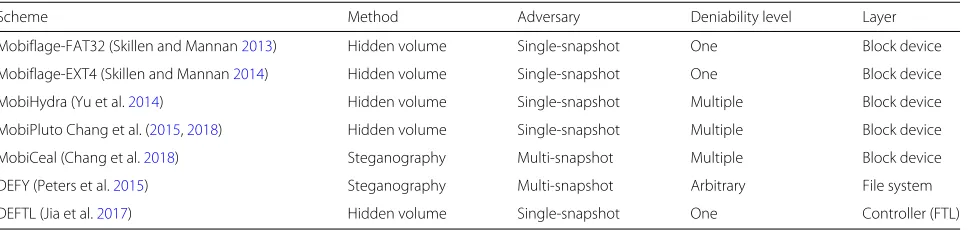
Table2summarizes the existing PDE systems for mobile devices. They either use hidden volumes or steganogra-phy, and provide one or multiple deniability levels when facing single-snapshot or multi-snapshot adversaries. Schemes based on hidden volumes (Skillen and Mannan 2013, 2014; Yu et al. 2014; Chang et al. 2015, 2018) usually have low performance overhead, but they can only defend against single-snapshot adversaries. DEFY (Peters et al. 2015) relies on steganography to defend against multi-snapshot adversaries, but the performance
Table 2Comparison of PDE systems for mobile devices
Scheme Method Adversary Deniability level Layer
overhead is high. MobiCeal (Chang et al. 2018) uses a lightweight “dummy write” mechanism to defend against multi-snapshot with acceptable performance overhead.
Discussions
About randomness being used in hidden volumes technique.The idea of hidden volumes technique is to hide the encrypted hidden volume among the random-ness being filled initially. To make sure that the ciphertexts being generated are indistinguishable from random bits, the random bits can be drawn from the same distribution as the ciphertext space by using the encryption function itself as the PRNG (Skillen and Mannan2014). This can ensure that the ciphertexts and the randomness are from the same source. In addition, the encryption being used in the hidden volumes technique is full disk encryption (FDE), which treats each disk sector as an autonomous unit and assigns sector-specific IVs for chaining modes
such as CBC and XTS (Skillen and Mannan2014). This
can help eliminate the correlations among ciphertexts due to similarities in files (e.g., file heads).
Transferring data between desktop computers and mobile devices. Since PDE can be deployed in either desktop computers or mobile devices, there is a possibility that the data owner would like to exchange data (e.g., files) between these two different platforms. The data exchange should be conducted in such a way that deniability should not be compromised. When the file is non-sensitive, it can be simply transferred from a desktop computer to a mobile device (or vice versa) without any deniability con-cern. This can be done by simply using Internet or direct copying via cable, when both the source device and the destination device are working in the public mode. When the file is sensitive whose existence needs to be denied, to transfer it from a desktop computer to a mobile device (or vice versa), there are two known options: 1) If the file is transferred via Internet, to allow the data owner to deny the transferring of this file (the attacker can collude with Internet ISPs and identify this event), covert communica-tions approaches (Frèche et al.2017; Hu et al.2017) can be used. 2) If the file is transferred via direct copying, the file can be read from the source device and written to the des-tination device, when both devices are working the hidden mode. Since the attacker cannot capture the device
work-ing in the hidden mode (“The assumptions required by
PDE” section), the deniability will not be compromised. Once the file is successfully transferred, it will be pro-tected by the PDE system in the destination device.
Ensuring confidentiality of the deleted data via secure deletion
PDE is used to ensure confidentiality of sensitive data which are preserved in the personal computing devices.
However, once sensitive data are discarded, the data owner may want to permanently remove them. Protec-tion of data confidentiality requires securely disposing those data to prevent the adversary from recovering all or portion of them. This is achieved by using secure deletion. Hard disk drives (HDDs) and NAND flash mem-ory dominate the storage media of personal computing devices. However, they are completely different in nature, and hence different secure deletion approaches should be used to eliminate data from them. In the following, we summarize secure deletion approaches for HDDs-based and flash memory-based storage systems, respectively. We also summarize the recent works which complement conventional secure deletion approaches by taking care of the impacts created by past existence of the deleted data.
Secure deletion for HDDs-based storage systems
An HDD is a magnetic medium which supports in-place updates. Therefore, in HDDs-based storage sys-tems, when a file block is updated (or deleted), its old version can be simply replaced by its new version (or random noise) in the storage medium to achieve secure deletion.
Physical medium layer.Due to lack of semantics of file system, single-file sanitization is not feasible at the phys-ical medium layer. To delete the data, a naivest way is to overwrite/destroy all the data on the physical medium. Tools such as degaussers can be used to sanitize data on HDDs (Kissel et al.2006).
Controller layer.At the controller layer, there are sev-eral standardized interfaces that permit reading/writing of fixed-sized blocks. Similarly, there are no semantics of file system in this layer, thus the controller must sani-tize every block to achieve secure deletion. To delete the data, sanitize commands and overwrite techniques are widely used in HDDs, e.g., secure erase commands offered by both SCSI (Incits: Scsi storage interfaces 2016) and ATA (Team work systems: Advanced technology
attach-ment 2017). These sanitization commands work like a
button that erases all data on the device by exhaustively overwriting every block with zeros or ones.
Block device layer. Reardon et al. (2013) proposed a secure deletion approach targeting persistent storage. Their approach relies on encryption and key wrapping. They use a key disclosure graph to model the adversarial knowledge about key generation and wrapping history. In addition, a small securely-deleting key-value map is used to discard encryption key of the data, achieving secure deletion.
to a kernel daemon, which maintains a list of blocks that must be sanitized. If the free block stores data from a sensitive file, instead of returning it to the file system as an empty block, this free block will be added to the work queue. When the system is idle, the sanitization dae-mon runs asynchronously to perform sanitization over the work queue, allowing the user to achieve immediate file deletion.
(Joukov and Zadok 2005) proposed a file system
extension, purgefs, which uses block-based overwrit-ing when blocks are returned to the file system’s free blocks list. It supports overwriting file data and metadata for all files or just files marked as sensitive. (Joukov
and Zadok 2006) also proposed three secure deletion
approaches for EXT3. The first approach is called EXT3 basic, which securely deletes data (but not metadata) once by overwriting it. The second approach is called EXT3 comprehensive, which overwrites file data and metadata by a configurable overwriting scheme. Both the aforementioned two overwriting-based approaches can securely delete all the data or just files whose extended attributes include a sensitive flag. The third approach is based on intercepting files deletion events, i.e., unlinking and truncating a file. The file to be deleted is moved into a special secure deletion directory, and
a background user-level tool shred (Plumb 2010) will
delete the files in the secure deletion directory at regular intervals.
Peterson et al. (2005) optimized secure deletion for versioning file systems using an all-or-nothing transform (AONT). Using AONT, each data block is extended into an encrypted data block along with a small stub. If any part of the ciphertext is deleted, the entire message can not be decrypted any more. In this way, a specific version of a file can be quickly deleted by simply overwriting all the stubs. In addition, to delete a large log file to which data have been appended only, securely deleting all the blocks in its most recent version will achieve secure deletion on all its past versions.
Application layer.The application layer can only inter-act with file system through a POSIX-compliant interface. A user-level application can securely erase all the data on the storage medium by invoking a secure erase
com-mand (Incits: Scsi storage interfaces 2016; Team work
systems: Advanced technology attachment 2017) in the
hardware controller’ interface. A few files overwriting tools, e.g, srm (Jagdmann2015) and wipe (Durak2006), can be used to securely remove files. Gracewipe (Zhao
and Mannan 2015), as has been discussed in “PDE for
desktop computers” section, can achieve secure and veri-fiable deletion of encryption keys through a special dele-tion password by taking advantage of TPM and Intel TXT, thus making the encrypted data permanently inac-cessible. In the case of database, there is also a secure
deletion interface, which can be used to overwrite data with zeros in the underlying file system. For MySQL, (Stahlberg et al. 2007) proposed an approach to delete entries by overwriting them with zeros, and the trans-action log is encrypted and can be securely disposed by deleting the encryption key. For SQLite (SQLite: Pragma statements2017), there is a compile-time option to enable a secure deletion feature that overwrites deleted records with zeros.
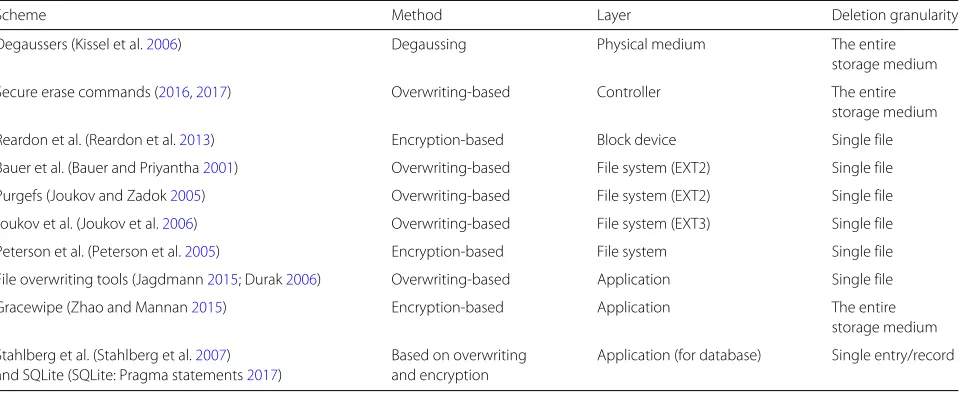
Table 3 summarizes the existing secure deletion
approaches for HDDs-based storage systems. Those approaches are incorporated into different layers of a stor-age system and rely on either overwriting or encryption for secure deletion. They may also have different dele-tion granularity. Generally, the encrypdele-tion-based secure deletion approaches for HDDs-based storage systems
(Reardon et al. 2013; Peterson et al. 2005; Zhao and
Mannan2015) have relatively low performance overheads since only keys need to be deleted to achieve secure deletion.
Secure deletion for flash memory-based storage systems
The aforementioned secure deletion approaches for HDDs-based storage systems rely on properties of hard disks: magnetism-based and supporting in-place updates. However, flash memory does not possess these proper-ties. Wei et al. (2011) performed a series of experiments to show that the deletion techniques that work well for HDDs may not work properly for NAND flash. As NAND flash is not magnetism-based, the degaussing method may damage NAND flash chips and render data unreadable, but all the data may still remain intact (Wei et al.2011). Wei et al. (2011) created 1000 small files on an SSD, then dismantled the drive, and searched for the content of those files. They found that the SSD contained up to 16 stale copies of the tested files. This is because the FTL creates redundant file copies during garbage collec-tion and out-of-place updates, which unfortunately will complicate the secure deletion design for flash memory. They also tested 13 single-file overwriting-based saniti-zation tools (LSoft Technologies Inc: Active@ KillDisk
2017; GEEP EDS LLC: Darik’s Boot and Nuke2017), to
Table 3Comparison of features offered by different secure deletion approaches for HDDs-based storage systems
Scheme Method Layer Deletion granularity
Degaussers (Kissel et al.2006) Degaussing Physical medium The entire storage medium
Secure erase commands (2016,2017) Overwriting-based Controller The entire storage medium
Reardon et al. (Reardon et al.2013) Encryption-based Block device Single file Bauer et al. (Bauer and Priyantha2001) Overwriting-based File system (EXT2) Single file Purgefs (Joukov and Zadok2005) Overwriting-based File system (EXT2) Single file Joukov et al. (Joukov et al.2006) Overwriting-based File system (EXT3) Single file Peterson et al. (Peterson et al.2005) Encryption-based File system Single file File overwriting tools (Jagdmann2015; Durak2006) Overwriting-based Application Single file Gracewipe (Zhao and Mannan2015) Encryption-based Application The entire
storage medium
Stahlberg et al. (Stahlberg et al.2007) Based on overwriting Application (for database) Single entry/record and SQLite (SQLite: Pragma statements2017) and encryption
Overwriting-based secure deletion for NAND flash.
A common idea for the overwriting-based secure deletion approaches is to replace the deleted data with meaningless information, e.g., noisy random data.
Physical medium layer.Similar to the physical medium layer in the HDDs-based storage systems (“Secure dele-tion for HDDs-based storage systems” section), data can not be deleted in this layer due to lack of semantics of the file system. To realize secure deletion in this layer, the entire flash chip should be destroyed.
Controller layer.A main type of flash controller is using FTL to handle the special nature of NAND flash and to provide a block access interface to upper layers (“The architecture of a storage system” section). To securely delete data, the simplest way is to erase the correspond-ing flash blocks in the FTL (i.e., block erasure). However, erasures can only be performed in terms of flash blocks (“Flash memory” section). This will be overkill if only a portion of data being stored in a flash block needs to be deleted. Considering content of a file may be distributed in different pages of different flash blocks, sanitizing a file using block erasure will be unavoidably expensive.
Wei et al. proposed scrubbing (Wei et al. 2011) to
address the aforementioned issue. As programming indi-vidual pages is possible, the idea of scrubbing is to re-program the page, where the data should be securely deleted, to turn all its remaining ‘1’ bits into ‘0’. Note that flash memory allows to individually program bit ‘1’ to ‘0’, but the reverse operation is not feasible except perform-ing a block erasure. A major concern of scrubbperform-ing is that it may result in undefined behaviors due to possibility of introducing read errors. To handle this concern, Wei et al. examined error rates for different types of flash memory and showed that the error rates vary widely. For some flash devices, scrubbing causes frequent errors, while for
some others, it does not cause any errors. They intro-duced scrub budget, which refers to the number of times that the NAND flash can allow to be scrubbed with-out exhibiting a significant risk of data errors. When the scrub budget for a block is exceeded, secure deletion will be instead performed by other approaches (e.g., invok-ing garbage collection). More recently, Qin et al. (2013) incorporated RAID-5 architecture to enhance the reliabil-ity and eliminate the negative effect of reprogram on flash memory.
File system layer. Sun et al. (2008) proposed a secure deletion method in YAFFS by investigating characteris-tics of NAND flash memory. They proposed two secure deletion approaches, zero overwrite (similar to the scrub-bing (Wei et al.2011)) and block erase. Especially, they define a costs-benefits model by comparing the overwrite cost on the deleted pages and the erase cost on the block that contains the deleted pages. Additionally, a new adap-tive hybrid scheme is applied to select the cheaper one between the two secure deletion approaches. Another kernel-level zero-overwriting secure deletion approach was also proposed by Reardon et al (2012).
By adding a new communication channel between the file system and the device driver, the file system can inform the device that particular blocks are no longer valid, e.g., Trim (Intel Corporation: Intel Solid-State Drive Optimizer2009) command and TrueErase (Diesburg et al. 2012). With the information of invalid blocks, the device driver can implement its own efficient secure deletion without requiring data blocks to be explicitly overwrit-ten by the file system. Especially, TrueErase is designed for the blocks belonging to files specifically marked as sensitive.
be achieved by filling the entire remaining free space. Reardon et al. (2012) proposed two user-level filling-based secure deletion approaches for YAFFS: purging and bal-looning. Their basic idea is to fill the entire free space of the file system, such that all unused blocks of the physi-cal medium will no longer contain sensitive information. By completely filling the file system’s empty space with noise, all previously data deleted by the user are guaran-teed to have been erased. Compared to purging which ensures rapid secure deletion of data from user-space, bal-looning achieves a probabilistic continuous secure dele-tion guarantee by reducing the block reallocadele-tion period. Braga et al. (2014) proposed two user-level approaches to securely delete files on Android smart phones. The one that is designed to delete unencrypted files is also based on filling. The cost of the filling-based secure deletion approaches is proportional to the size of free space avail-able on the physical medium. A larger size of free space will lead to a higher overhead in order to fill it (Reardon et al.2013). The efficiency can be improved by perpetually maintaining the free space of the physical medium within a limited range (Reardon et al.2012).
Encryption-based secure deletion for NAND flash.
Data can be rendered inaccessible by encrypting them and deleting the corresponding key. Boneh et al. pro-posed the first encryption-based solution that securely deletes encrypted data stored on the tape by deleting the cryptographic keys (Boneh and Lipton1996).
Controller layer.Reliably destroying keys is challenging, as side-channel attacks based on semiconductor memory
data remnants (Halderman et al. 2009) may allow an
attacker to recover the key or key-related information. Swanson et al. (2010) proposed scramble and finally erase (SAFE), which combines encryption and erasure tech-niques to provide almost instant secure deletion with ver-ifiability. SAFE relies on the assumptions that data in the SSDs are stored encrypted and the SSDs implement best practices of key management (e.g., the keys should never leave the controller). It works as follows: Upon receiving a sanitize command, it erases the controller’s key mem-ory, such that the driver is not able to encrypt/decrypt the data. It then erases every block on the device, and writes all the pages with a known pattern, and erases them again. Finally, it reinitializes the device and performs a low-level format operation on the drive, and provides a new key to the controller.
File system layer. Lee et al. (2008, 2010) proposed a secure deletion approach for YAFFS, a log structured NAND flash file system. By modifying YAFFS, they encrypt files and force all keys of a specific file to be stored in the same block. Therefore, only one erase oper-ation needs to be performed in order to securely delete a file. Lee et al. (2011) then extended the aforementioned
approach to perform standard data sanitization which can satisfy government agencies’ requirements (NSA/CSS and DoD 5220.22-M) for the secure deletion.
Reardon et al. (2012) proposed data node encrypted file system (DNEFS), which enables secure data deletion for flash memory. They also incorporate DNEFS into flash file system UBIFS (Memory Technology Devices: UBIFS 2015). In DNEFS, they divide the entire flash memory into two areas: a small key storage area and a large main data storage area. They encrypt each data node (i.e., the unit of I/O) with a unique key, and collocate the keys in the key area. Secure deletion is achieved by removing keys, which can be performed efficiently, as keys are condensed in a small area.
DEFY (Peters et al. 2015) also provides secure dele-tion, complementary to its deniability. It leverages all-or-nothing transform (AONT), a cryptographic function which can ensure that a missing portion of a message will render the entire message irrecoverable. In this way, DEFY can efficiently achieve secure deletion by only removing a small portion of the data being deleted. Braga et al.
(Braga and Colito 2014) proposed two secure deletion
approaches for Android phones, one of which is based on encryption. They modified the key management of EncFS (Wang et al.2012), an encrypted file system, to ensure that every file is encrypted with a unique key and a random IV. The removal of the unique key and IV makes the file irrecoverable.
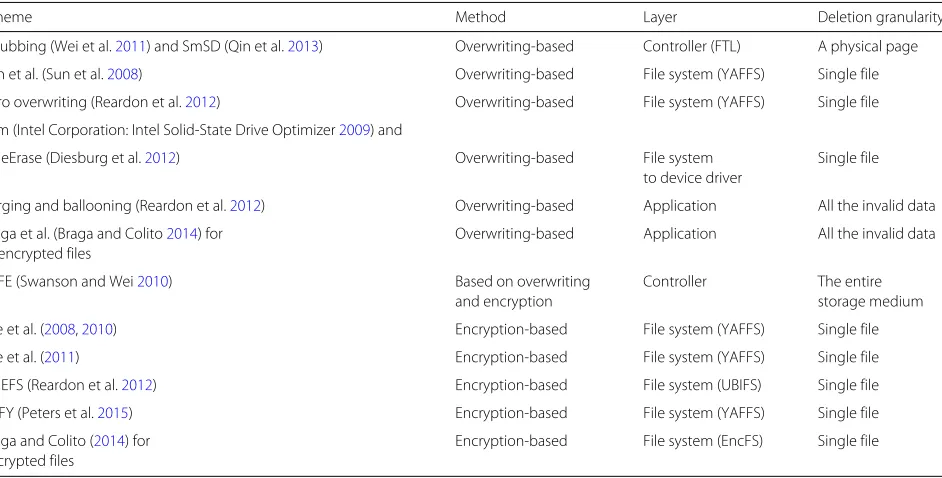
Table 4 summarizes the features offered by different
secure deletion approaches for flash-based storage sys-tems, including overwriting-based and encryption-based approaches. These approaches may also have differ-ent deletion granularity. Generally, the scrubbing-based secure deletion approaches (Wei et al. 2011; Qin et al. 2013; Sun et al.2008; Reardon et al.2012), which only targets at the invalid data, and the encryption-based secure deletion approaches (Lee et al.2008,2010,2011;
Reardon et al. 2012), which only need to delete keys,
have relatively low performance overheads compared to the overwriting-based approaches. A major advantage of encryption-based approaches is that, deleting a small key usually can be much more efficiently achieved compared to deleting data which are large in size.
A new direction for secure deletion
Table 4Comparison of features offered by secure deletion approaches for flash-based storage systems
Scheme Method Layer Deletion granularity
Scrubbing (Wei et al.2011) and SmSD (Qin et al.2013) Overwriting-based Controller (FTL) A physical page Sun et al. (Sun et al.2008) Overwriting-based File system (YAFFS) Single file Zero overwriting (Reardon et al.2012) Overwriting-based File system (YAFFS) Single file Trim (Intel Corporation: Intel Solid-State Drive Optimizer2009) and
TrueErase (Diesburg et al.2012) Overwriting-based File system Single file to device driver
Purging and ballooning (Reardon et al.2012) Overwriting-based Application All the invalid data Braga et al. (Braga and Colito2014) for Overwriting-based Application All the invalid data unencrypted files
SAFE (Swanson and Wei2010) Based on overwriting Controller The entire
and encryption storage medium
Lee et al. (2008,2010) Encryption-based File system (YAFFS) Single file Lee et al. (2011) Encryption-based File system (YAFFS) Single file DNEFS (Reardon et al.2012) Encryption-based File system (UBIFS) Single file DEFY (Peters et al.2015) Encryption-based File system (YAFFS) Single file Braga and Colito (2014) for Encryption-based File system (EncFS) Single file encrypted files
existence of the deleted data may leave artifacts in the lay-out at all layers of a computing system (Bajaj and Sion 2013b; Chen and Sion 2015) or create side effects on the other data which have not been deleted (Bajaj and Sion2013a), and the adversary can potentially take advan-tage of those structural artifacts or side effects to learn sensitive information about the deleted data (Bajaj and Sion2013a,b; Chen and Sion2015).
To justify the impact of the past existence of the deleted data, we use a balanced binary search tree (BST) (Chen et al.2016). We first create a balanced BST by inserting five nodes in the order of 2, 11, 13, 14, 1, and obtain tree
T1 (Fig. 3a). We then delete node 2, obtaining tree T2
(Fig.3b). However, if we directly create the balanced BST by inserting nodes in the order of 11, 13, 14, 1, we will obtain treeT3(Fig.3c). This example indicates that, due to the past existence of node 2,T2andT3have different
structures. This also indicates that, although node 2 have been deleted, its structural artifacts remain in the data organization. Therefore by having access to treeT2, the
adversary may suspect the past existence of the sensitive data which have been deleted, and tries to partially or fully recover them.
We also describe some concrete attack scenarios which can take advantage of structural artifacts (Jia et al.2016;
Chen et al.2016). Commodity NAND flash-based block
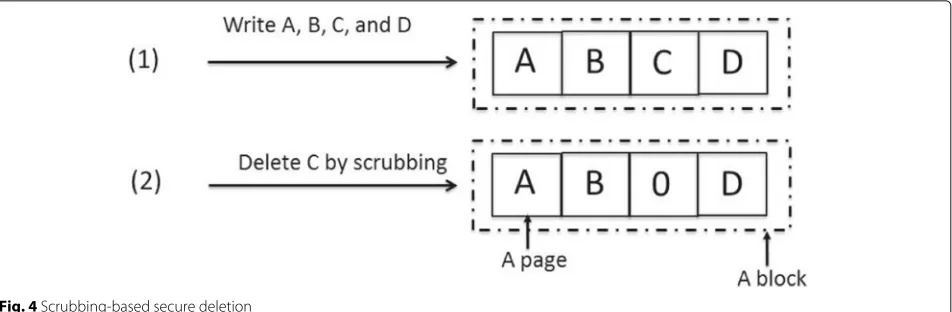
devices usually adopt a log-structured writing technique, in which flash blocks as well as pages within a block are allocated sequentially (Min et al.2012). As shown in Fig.4, A, B, C, and D are the data being written to NAND flash, and each occupies a flash page. To securely delete C, the user has two options: 1) We perform a scrubbing (Wei et al.2011) over the corresponding flash page. The scrubbing technique however, will convert this page to a
Fig. 4Scrubbing-based secure deletion
page with all “0” bits (i.e., a zero page). By having access to the storage state after deletion of C, the adversary will notice the zero page and suspect that a past deletion has been performed on it. 2) We encrypt A, B, C, and D with different keys, and delete key for C (Reardon et al. 2012). However, the adversary can also find out that C has been deleted since it cannot be successfully decrypted to plaintexts which are semantically meaningful. A further attack will be performed to fully or partially recover C by taking advantage of the correlation between C and its neighboring data (Chen et al. (2016) provides a concrete attack scenario which can take advantage of the structural artifacts to recover bitcoin transactions).
To remove impacts of the past existence of the deleted data (including both structural artifacts and side effects), a few recent works investigate undetected secure dele-tion, truly secure deledele-tion, history independence, as well as untraceable deletion.
Undetectable secure deletion. Jia et al. (2016) tried to achieve the secure deletion guarantee by hiding the dele-tion history. Intuitively, if the deledele-tion history is concealed from the adversary, he/she should not be able to find out whether there was a deletion in the past, eliminating his/her possibility in recovering the deleted data or learn-ing anythlearn-ing about the deleted data. Based on this key observation, Jia et al. investigated a novel security notion for NAND flash-based block devices, i.e., undetectable secure deletion, to achieve two security properties: 1) Data to be deleted are completely removed from NAND flash memory, which ensures that the adversary cannot have access to the data once they have been deleted; 2) The deletion history is concealed from the adversary, which ensures that the adversary cannot gain any knowledge about whether there was a deletion in the past.
To realize undetectable secure deletion, Jia et al. pro-posed NAND Flash Partial Scrubbing (NFPS), an unde-tectable secure deletion scheme for NAND flash-based block devices. Having observed that deleting data from
flash with a full scrubbing (Wei et al.2011) or a block era-sure may provide the adversary a clue that there was a deletion in the past, Jia et al. proposed to perform a par-tial scrubbing, i.e., parpar-tial page reprogramming and parpar-tial block erasure, to only modify a portion of the bits in the page/block storing the deleted data, avoiding producing a zero page or an all-“1” block.
Truly secure deletion. NFPS (Jia et al. 2016) aimed to conceal the past existence of the deleted data in the NAND flash memory. However, it still cannot sanitize the structural artifacts introduced by the deleted data. Chen et al. (2016) investigated another novel security notion, namely, truly secure deletion, which can ensure the saniti-zation of both the data and the structural artifacts.
To achieve truly secure deletion, Chen et al. (2016) pro-posed TedFlash, a truly secure deletion scheme for NAND flash-based block devices. In TedFlash, the data of every write to NAND flash will be placed to an empty loca-tion which is randomly selected. Note that as the random placement of data is independent and does not affect the placements of any other data, TedFlash can elimi-nate the structural artifacts brought by each write. Most importantly, the random placement technique is exclu-sively feasible for NAND flash, because: 1) Random seeks on flash memory are as efficient as sequential seeks. 2) The random placements can distribute data evenly among flash, naturally achieving a good wear leveling.
History independence. History independence is pro-posed to prevent historic information about the pattern of access to a data structure from being leaked through its representation when observed by an adversary (Chen and
Sion 2015). History independence ensures that by