source delivery of educational resources by print and online: A case study. AACE Journal, 15(4), 389-411.
Using Extensible Markup Language (XML) for the
Single Source Delivery of Educational Resources by
Print and Online: A Case Study
LUCAS WALSH Deakin University Melbourne, Victoria Australia
This article seeks to provide an introduction to Extensible Markup Language (XML) by looking at its use in a single source publishing approach to the provision of teaching resources in both hardcopy and online. Using the develop-ment of the International Baccalaureate Organisation’s online Economics Subject Guide as a practical example, this discussion reflects on some of the key technological and educational strengths and limitations of using XML for this kind of approach.
This article seeks to provide educators with a brief introductory overview of Extensible Markup Language (XML) by looking at its use in a single source publishing approach to the provision of teaching resources in both hardcopy and online. Using the development of the International Baccalaureate’s online Economics Subject Guide as a practical example, this discussion reflects on some of the key strengths, as well as technological and educa-tional limitations of using XML.
In 2001, the International Baccalaureate Organisation’s1 (IBO) Online
The pilot project to test the technical and educational effectiveness of this process of “single source publishing” was the Economics Subject Guide for the International Baccalaureate (IB) Diploma Programme2. Single source publishing is a process whereby a master source of information is prepared in an authoring and editorial process, and then used to drive a production process to delivery to end-users through mass print and the Web. Using this approach, paper-based documents would look and be structured as normal; however, the online version of the same content would be reformatted in an automated process to be more interactive and web-friendly.
The use of XML within this kind of data-base driven framework has developed tremendously during the last decade; however, many educators are still coming to terms with how to best apply this technology to a learning object approach to the delivery of educational resources, so that learning content is reusable, interactive and can be customised by the end-user3. The following discussion explores some of the issues arising from the use of single source publishing to drive the delivery of printed and online curricu-lum resources to IB teachers. Using the development of the Economics Subject Guide as a practical example, this article reflects on some of the key technological and educational limitations and advantages of using XML. The first section of the article sets out the context of discussion, in which a single source publishing approach was adopted by the Online Curriculum Centre (OCC) to enhance the way teaching resources were delivered to teachers of the IB throughout the world. The second part provides an introductory overview of XML. The third part describes the workflow process required to repurpose the Guide using this approach. The fourth section looks at the challenges and limitations encountered when implement-ing XML. The final part of this article looks at the technological and educational strengths of this XML-based single source approach.
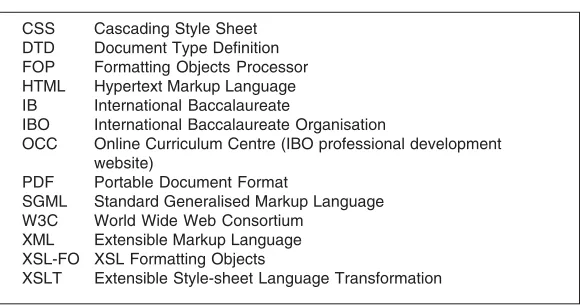
Table of Acronyms
CSS Cascading Style Sheet DTD Document Type Definition FOP Formatting Objects Processor HTML Hypertext Markup Language IB International Baccalaureate
IBO International Baccalaureate Organisation
OCC Online Curriculum Centre (IBO professional development website)
PDF Portable Document Format
SGML Standard Generalised Markup Language W3C World Wide Web Consortium
XML Extensible Markup Language XSL-FO XSL Formatting Objects
XSLT Extensible Style-sheet Language Transformation
CONTEXT
When the Online Curriculum Centre commenced development of a single source publishing approach using XML in 2001, its website was seeking to deliver educational resources and services in English, French, and Spanish to over 25,000 IB teachers working in around 1,300 authorised IB schools across more than 100 countries. Originally established in 1999, this pass-word-protected website was developed in response to the expansion of the IBO across the world and the need to disseminate information quickly and efficiently. Designed to support the IBO curriculum in all three academic programmes, this website is an online database and digital repository of educational resources for IB teachers to communicate and share their knowledge. The site enabled teachers to: (a) view curriculum materials; (b) exchange details of useful resources (e.g., websites, books, magazines) and teaching ideas; (d) discuss curriculum issues with other teachers trans-nationally; (e) take part in online training through bespoke, curriculum-specific educational modules; and (f) keep up to date with IB curriculum developments and general news about the IBO.
documents and other teaching resources were stored; (b) the dissemination of data—how documents were prepared and delivered to users (IB teachers, school administrators, and support staff) through both print and the Web; and (c) the presentation of data—how the documents looked both on paper and on the Web, which at the time was generally the same because the majority of content on the OCC website was taken directly from printed source files stored in Portable Document Format (PDF).
A major component of the renovation of the OCC was to develop a frame-work for publishing online versions of curriculum materials, redesigning them from their original format for paper publication. The goal was to develop a framework in which content could be repurposed (i.e., restruc-tured and reformatted) from standard printed publications to the Web in a way that maximised the medium. Storage of OCC data, such as curriculum documents and other teaching materials on the IBO’s internal computer network, came from multiple sources and formats (e.g., PDF, HTML, MS Word, and WordPro), which lead to inefficiencies in data management and unnecessary duplication of labour. Previously, teaching resources such as Subject Guides were prepared in printed format (typically standard black and white A4 sized documents), then marked-up in HTML in a separate process for the OCC website. The layout and format of online versions were predominantly text-based and looked similar to the printed versions. Often, the PDF used for printing was directly uploaded to the Web as a single file. In some cases, these PDF files designed for printing purposes were often scanned off a master document and posted directly to the website in a format that was sometimes difficult to view with a web-browser—especially when these PDF files were extremely large in size (particularly those containing images). Furthermore, these files were typically “static,” in the sense that they were not designed for interactivity (e.g., many did not include hyper-links or navigation facilities). This static way of storing content in PDF and HTML was not dynamic and under-utilised the power of the database driving the OCC website. Furthermore, raw content was formatted using different word-processing, web-design, and other packages without a single standard approach.
Diploma Programme Subject Guide for Economics was used as the proof of concept for this approach. This Subject Guide consisted of around 7,000 words of text outlining the objectives, syllabus, and assessment requirements for the subject. The IB Economics curriculum was taught at two levels, Higher Level (HL) and Standard Level (SL), as outlined in the Subject Guide (IBO, 2003a). Though published in English, Spanish, and French, this article will focus on the development of the English language version of the Economics Guide.
A Brief Introduction to XML
Kasdorf (2003) writes that XML “provides a well-defined, broadly accept-ed syntax for creating markup schemes to [enable] the development of tag sets focused on projects as small as a single book or journal…or whole collections or classes of books or journals…or to achieve a particular functionality” (p. 87). It consists of elements (markup that encloses content), attributes (which embellish content), comments (such as human-readable annotations) and entities (which enable any chunk of digital content to be given a name and then referred to by that name instead of being directly incorporated into the XML document itself. These chunks can include content of external files, including non-XML files.)
Rather than replace HTML, which is primarily a presentational format “designed for a specific way of viewing the given content” on the Web, XML is a “language designed for marking up content of all sorts (text, graphics, computer code, commercial information, intellectual information) in order to specify what the component parts of that content are, and to describe them” (Kasdorf, 2003, p. 91). Like HTML, XML makes use of tags (words bracketed by “<” and “>”) and attributes (of the form name= “value”). Unlike HTML, XML has a potentially infinite number of tags. Data stored in an XML file usually consists of strings of words, rather than numbers. These words can have explicit meaning assigned by the creators of the content that refer to information about what the elements in the source content are and how they relate. As Kasdorf (p. 91) further ex-plained, “XML is, in its best use, a source markup, designed to be trans-formed into something else, to be archived and used in different ways.” As one of the many tag sets that can be defined in XML, HTML is one of the many possible outputs from an XML source.
HTML, which has a fixed set of tags and will typically attempt to display a webpage even though it may be missing certain tags. XML will not tolerate any mistakes; consequently, browsers may display inappropriately tagged data as a “jumble” of data (Berners-Lee, Hendler, & Lassila, 2001, p. 32). This “draconian error handling” is deliberately designed by the developers of XML to promote stability in data-handling (Kasdorf, 2003).
WORKFLOW
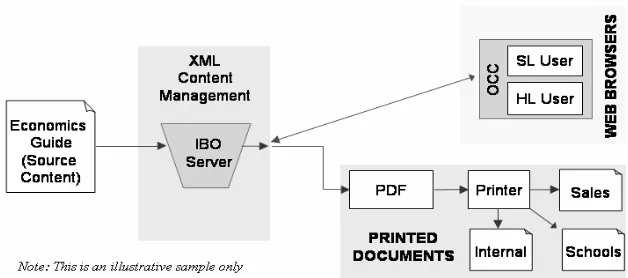
For the Economics Subject Guide, XML was not only used to generate the HTML version for the Web, but also to generate fully formatted PDF versions of selected portions of the same source of content, which could be mass printed and made available to teachers in hardcopy. The basic steps for repurposing the Economics Guide for viewing on the Web and mass printing were as follows:
Step 1: The Economics Guide was created in Microsoft Word, through which the basic styles (e.g., for topic headings) were formatted. Word was used because the software was familiar to authors;
Step 3: The document was then validated to ensure that it conformed to the DTD structure;
Step 4: This involved exporting / converting the Guide to the “raw,” single source XML document that served as the source for both online and printed versions. Having styled the content in Word format using DocBook tags, the Guide was then exported from YAWC to create a basic, structured XML document. (Essentially, Word styles were replaced with XML tags.) This XML was then refined using XMetaL software to define in more detail certain features of the XML document, such as roles, attributes, and table widths for the layout of the Guide.
This XML document also served as a container for metadata; that is, information about the content in the Guide. Metadata was added consisting of attributes and values that identified, for example, the language in which the Guide was written (i.e., English, Spanish, or French), the author, the teaching level (HL or SL), publication date, security, rights information, version, and so forth. Other metadata was added describing how the content of the Guide would appear and relate to other online content (such as the online discussion forums). For the online version, this metadata enabled the Guide to be customised to deliver the relevant material to end-users, pitched at a teaching level based on a user-profile stored in the OCC system. For example, when a Higher Level Economics teacher requested the Subject Guide online, the data-base driving the website was programmed to find the data tagged at that teaching level and covering only the subject matter required in the teacher’s working written language. The system was pro-grammed to find the data tagged at their teaching level, visually highlighting the teaching level of subject matter specified. If, on the other hand, a print-out was requested, the entire Guide, including both Higher and Standard Levels, was automatically generated from the same single source.
of the Subject Guide. Users were able to add different types of resources to selected keywords and headings. Resources included information about books, websites, and teaching ideas, such as course outlines, lesson plans, student activities, tests, and quizzes. Resources such as specimen questions, diagrams, glossary, and command terms were added later to the online-only version of the Guide by clicking on specific words or phrases within the syllabus. The Subject Guide was also tagged to enable portals to other related resources on the World Wide Web ([Web]; e.g., Biz/ed 2004). A holistic approach was taken in an attempt to integrate the Guide with the OCC website’s other facilities, such as the discussion forums.
Step 5A: The XML file containing the Subject Guide was then converted into HTML for viewing on the Web using an Extensible Style-sheet Lan-guage Transformation (XSLT). XSLT is an XML-based lanLan-guage for transforming XML into other formats. (Bradbury, 2001; Clark, 1999; Holman, 2000). For the Guide, XSLT was used to take the XML file containing the Subject Guide and convert it to HTML. The XSLT style-sheet rules ensured that certain “online-only” features were recognised in the XML document (such as the Subject Guide’s glossary of economic terms, graphs, and other illustrations).
Step 5B: While one XSLT was used to create the online version, another was used to create a printed version (in conjunction with XSL-FO to generate the PDF) using the same source-file in XML. This XSLT style-sheet effectively converted the same XML file to a format for print (FOP7). The style-sheet ensured that online-only tags were ignored for the printed version. A Java application, XEP, was used to render the content in PDF. The Guide was then printed for mass distribution to IB schools.
XML as an Encoding Mechanism
First, XML was used as an encoding mechanism to structure and manipulate information. It was not designed as a programming language; rather, it was developed to improve the way computers generate data, read data, and ensure that the data structure is unambiguous and more stable. So, XML provided a set of rules, guidelines, and conventions for designing text formats that enabled the structuring of data.
Using XML to Divorce Display From Content
XML was useful for storing information that needed to be presented in a variety of formats. Using XML, it was possible to divorce display from content using separate style-sheets. As previously mentioned, the same source of content used for the printing process was used for the Web; however, both outputs used their own XSLT so that they looked and functioned differently. Figure 1 offers a visual comparison between the printed and online versions of the same source of content:
Printed Version Online Version
(IBO,2003a) (IBO,2003b)
Cascading Style-Sheets (CSS) were used with the Subject Guide’s XML file to turn its XML tags into layout instructions (specifying the fonts, back-grounds, colours, etc.). An instruction was written into the XML file specifying how it should use the CSS file to define the way web browsers displayed the file online. Changing the whole look of the Subject Guide only required a change to the CSS file, rather than to the whole document. If another website was going to display the Subject Guide, they could, in theory, apply their own CSS file to the file to make it look more consistent with their own website (the IBO uses a number of websites for different purposes and audiences). Using XML, it became possible to also specify that only parts of the Guide appear on certain websites. Selective versions of the Guide could be created dynamically on demand in response to a user’s / website’s request. The content could then appear differently on various IBO and external websites, customised to the needs of their respective users and according to the design motif adopted by the respective websites.
Figure 2. An example of single source publishing
XML as an Open Standard
As a standard for open information interchange, using XML meant that the organisation did not have to be overly dependent on commercially devel-oped proprietary, closed standards that can be extremely expensive. (By extension, XSLT and XSL-FO are based on open standards.) XML can be authored using any basic word processing package, reducing the need to depend on specific vendors or software. Nevertheless, it was still necessary in this case to use PDF, a widely adopted page description language that remains controlled by Adobe Systems.
XML as a Storage Medium
Limitations of XML
Another problem encountered at the delivery stage was that XML was not recognised by some web-browsers. At the time, browsers such as Internet Explorer displayed the Guide; however, older browsers such as Netscape 4 were unable to effectively process the XML, displaying the data as seeming-ly garbled strings of text. XML handling techniques were not always user-friendly. As previously mentioned, a web-browser will reject an XML file if it is not well-formed. For example, failure to put closing tags around a single piece of information resulted in the Guide appearing incorrectly in the end-user’s browser.
Accessibility was a critical issue. OCC users accessed the Web from a range of sites (home, classroom, staff room) by way of a range of browsers and modem connection speeds. For this reason, the content of the Guide needed to be fast; however, there were problems when web-users requested content from the Guide in a PDF format to print from work or home. FOP tended to slow the process of delivery. The process had to be refined for usability to increase the speed of PDF files produced “on the fly” (i.e., the PDF file was automatically spawned from the server) or retrieved from a cache.
Further technical challenges emerged when seeking to integrate XML with the broader IBO network. At the time of implementation, there was a lack of support on server, browser, and development tool sides.
BENEFITS OF XML
to be made once. Storing all content in a single source meant that there was no longer a need to store this content separately in different media. Different versions could be created as necessary through specific style-sheets.
The systemic approach required for XML to work effectively compelled the creation of standards for the storage and presentation of content across the authoring, designing, formatting, and deliver stages of content creation, which promoted a consistent approach.
Aside from longer-term saving of human resources, the need to find more inexpensive and environmentally friendly ways of disseminating information was an important consideration and driver of web-based delivery. Given the large quantity of data on the OCC, which occupied space on the server and consumed energy, XML was an appealing system.
XML was particularly useful for divorcing the display from the content when delivering data by way of the Web. By looking at the relevant XML tags, a back-end application could manipulate data in different ways (e.g., see Figure 1; Bradbury, 2001). The print version was provided for teachers to reference as a linear outline of the syllabus, while the online version enabled teachers to access this content strategically using a variety of navigational paths, as well as access extra resources.
Another benefit of XML was “future-proofing” the content of the Guide against technological and organisational change. Because XML is useful for storing information that will be presented in a variety of formats, it can be useful as an intermediate step while transforming from one format to another. During the last few years, XML has become widely adopted as data interchange format in areas such as digital publishing (Kasdorf, 2003, p. 86). XML can be converted to other formats relatively easily, so that even if XML becomes obsolete, the source file for the Guide could, in principle, be converted to the new standard for printing and/or the Web. Given that web-based technology changes so rapidly, this ability to future-proof data storage and handling will undoubtedly be beneficial in the longer term.
onscreen by users. Where certain categories were considered of equal importance, then the design of the user-interface was critical to visually organising this information on screen efficiently and effectively without overloading the user8.
Consequently, the authors of the Economics Guide were invited to rethink how they could develop the structure of curriculum beyond a conventionally linear, static printed document as a dynamic, organic body of learning objects that can be interconnected and presented in a variety of ways. Authors were invited to adopt a more spatial approach to curriculum development for the Web, which brought about fresh, new thinking and challenges. For example, in rethinking how the structure of the Economics Subject Guide could be redeveloped for the Web, the introduction of XML compelled content authors to reflect on questions, such as: How can the authors of curriculum imagine content differently? What can be done online that is not done through other media, such as paper? How can the Web be used to extend/deepen understanding of the subject area? How are end-users expected to use the content? Are they expected to upload their own resourc-es, download resources (such as PDF versions of the Guide)? Engage problem-solving activities or simply glean information?
Standard printed content that was previously designed in a static and conventionally linear “narrative” was explored as a nonlinear space, whose structure was visualised as a three-dimensional mezzanine in which content is dynamic, interrelated, and shaped by the collective efforts of content producers and users, as opposed to a typical printed guide, which when imagined as a space, had a linear structure consisting of a corridor (the contents-page of the Guide) leading to several separate and distinct rooms (chapters within the Guide).
online delivery of content to add value to existing conventional practices (e.g., in print).
Authors were further encouraged to begin reflecting on what kind of common vocabulary (i.e., ontology) may be necessary to express more subjective information, such as the learning objectives of the Guide as an online resource. Determining this ontology is a major challenge experienced by other educational institutions seeking to exploit XML (Saini, 2003). As a result of this approach, content became more “web-friendly” and more easily managed and updated. By maintaining only one source of content, the Subject Guide could be updated regularly and be more directly responsive to the needs of the user. In summary, the process of reflection stimulated by a single source approach using XML promoted a more organic approach to content development, shifting the use of the Web from a means of dissemi-nating informational data, to thinking about online educational content as a virtual space of living, breathing knowledge.
XML was used in this pilot study to enable the basic architecture for knowledge management so that Subject Guides could become more flexible in their delivery and use by teachers. The vision behind this pilot approach was that, in future, the delivery and use of curriculum resources could be adapted by teachers according to their pedagogical insights and needs across different settings and learning environments. As such, the development of this online approach was not only to supplement conventional curriculum forms and established teaching pedagogies, but also to open up opportuni-ties for new curriculum forms that can be adapted and improved by teachers themselves.
CONCLUSION
Since then, the range of XML tools, vocabularies, parsers, and published DTDs has grown. Consequently, the use of XML by the IBO has changed considerably. Certain applications were abandoned due to instability and usability issues. New tools and applications have since been trialled, such as upCast to streamline the use of MS Word to author XML documents and oXygen to edit XML. Refinement and improvements in the technology have impacted upon workflows.
XML was adopted because it is extensible, platform-independent and supports internationalisation and localisation by enabling the same content to be manipulated according to the different needs of users. As XML uses text, any platform that can handle text could, in principle, handle XML. The XML standard was free to access and enabled the possibility for powerful data management. Establishing the basic architecture for XML opened the way for more sophisticated use of metadata, a reduction in the duplication of human resources and enhanced online display and interactivity of content across different sites of delivery. There were also educational benefits consistent with the use of educational content in database driven approaches to e-learning.
The most visible benefits of adopting XML in the manner described in this article were long term rather immediate. This approach would appear to work best on content that is intended for delivery on a large scale, and the process was not easy! Despite Kasdorf’s (2003) assertion that XML could be used on projects as small as a single book or journal, it is strongly recommended to educators that XML may be inappropriate for “one-off” or small projects. Furthermore, XML will not work if generic standards are not adopted for the mass dissemination of content.
References
Apache Software Foundation (2006). “FOP,” The Apache XML Site. Re-trieved June 20, 2006, from http://xml.apache.org/fop/
Berners-Lee, T., Hendler, J., & Lassila, O. (2001). The semantic web. Sci-entific American, 284(5), 29-37.
Bosak, J., & Bray, T. (1999). “XML and the second-generation Web.” Sci-entific American, 280(5), 89-93.
Biz/ed (2004). Biz/ed Website. Retrieved June 26, 2006, from http:// www.bized.ac.uk/
Bradbury, D. (2001, December). How XML will change your life. Create Magazine, 70-72.
Bray, T., Paoli, J., Sperberg-McQueen, C. M., Maler, E., Yergeau, F., & Cowan, J. (2004, February 4). Extensible markup language (XML) 1.1. W3C Recommendation Retrieved November 10, 2005, from http:// www.w3.org/TR/2004/REC-xml11-20040204/
Clark, J. (1999). XSL transformations (XSLT) Version 1.0. W3C Recom-mendation 16 November 1999. Retrieved November 10, 2005, from http://www.w3.org/TR/xslt
Collis, B. (1999). Designing for differences: Cultural issues in the design of www-based course-support sites. British Journal of Educational Technology, 30(3), 201-215.
Collis, B., & Moonen, J. (2001). Flexible learning in a digital world. Lon-don: Kogan Page.
Holman, K.G. (2000, August 16). What is XSLT? Retrieved 11 November 11, 2005, from http://www.xml.com/pub/a/2000/08/holman/
International Baccalaureate Organisation ([IBO]; 2004). International Bac-calaureate Organisation. Retrieved July 15, 2004, from http:// www.ibo.org
International Baccalaureate Organisation ([IBO]; 2003a). Economics guide. United Kingdom: International Baccalaureate Organisation.
International Baccalaureate Organisation ([IBO]; 2003b). Economics guide. Online curriculum centre. International Baccalaureate Organisation. Retrieved April 10, 2003, from http://online.ibo.org
Kasdorf, W.E. (2003). Markup: XML & related technologies. In W.E. Kas-dorf (Ed.), The Columbia guide to digital publishing. New York: Co-lumbia University Press
Krug, S. (2000). Don’t make me think: Common sense approach to web us-ability. Indianapolis, IN: New Riders Publishing.
Saini, P. (2003, October). Role of XML in building ontology(s) for e-learn-ing domain. In G. Richards (Ed.), Proceedings of World Conference on E-Learning in Corporate, Government, Healthcare, and Higher Educa-tion 2003 (pp. 132-135), Phoenix, AZ. Chesapeake, VA: Association for the Advancement of Computing in Education.
Salminen, A. (2005). Building digital government by XML. In R. H. Spra-gue, Jr. (Ed.), Proceedings of the Thirty-Eighth Hawaii International Conference on System Sciences. Los Alamitos, CA: IEEE Computer Society. Retrieved August 1, 2007, from http://www.cs.jyu.fi/~airi/ papers/HICSS-2005.pdf
Sorenson, N. (2002, January). Six criteria for evaluating your web site. The Editorial Eye, (p. 8).
Wollowski, M. (2002, October). Xml based course websites. In G. Richards (Ed.), Proceedings of World Conference on E-Learning in Corporate, Government, Healthcare, and Higher Education 2002 (pp. 1043-1048), Montreal, QC, Canada. Chesapeake, VA: Association for the Advance-ment of Computing in Education.
World Wide Web Consortium (W3C). (2003). Retrieved June 20, 2006, from http://www.w3.org/XML/
W3Schools (2004). XML Tutorial. Retrieved 20 June 2006 from http:// www.w3schools.com/default.asp
Acknowledgement and Disclaimer
Notes
1. Founded in 1968, the International Baccalaureate Organisation (IBO) is a nonprofit educational foundation that delivers an internationalised curriculum to children and young people aged 3-19 across three programmes: the Diploma Programme, the Middle Years Programme and the Primary Years Programme. As of July 2004, 1,381 authorised IB schools offered a total of 1,634 IB programmes in 117 countries to approximately 200,000 students (IBO, 2004).
2. The IB Diploma Programme is a preuniversity course of study that leads to examinations designed for secondary school students aged 16 to 19. The Programme, which incorporates elements of national systems, is a two-year international curriculum available in English, French, and Spanish, that generally allows students to fulfil the require-ments of their national or state education systems.
3. The term “content” is used here to include all text, illustrative, and audio-visual materials delivered by printed hardcopy and the Web, such as Subject Guides, teaching support materials, and general educational resources.
4. The acronym XML not only refers to the language itself, but also to a whole family of standards that have developed around it, such as XSL, which is outlined next (Kasdorf, 2003, p. 88).
5. For example, the tag for content relevant to Higher Level (HL) teachers of IB Economics, was: section role=”hl.” For sections of the Guide relevant to both Higher Level and Standard Level (SL) teachers, the tag defined this portion of content as: section role=”hl,sl.” These tags enabled manipulation of how Higher and Standard Level content appeared online. A Higher Level section of the Guide could, for example, appear as highlighted text for users logged into the website as Higher Level Economics teachers.
Language Formatting Objects (XSL-FO) provided a way of creating paginated print versions of data stored in XML documents. XSL-FO is a page description language which tells a formatter how to structure text on a page (e.g., specifying size of margins). The source XML document was transformed into FO using a style-sheet and then rendered as a file format suitable for printing, such as PostScript and PDF (Kasdorf, 2003).