R E S E A R C H
Open Access
Extraction of high-quality genomic DNA from
different plant orders applying a modified
CTAB-based method
Nadia Aboul-Ftooh Aboul-Maaty and Hanaa Abdel-Sadek Oraby
*Abstract
Background:Reliable measurement of DNA concentration and purity is important for almost all molecular genetics studies. Different plant species have varying levels of polysaccharides, polyphenols, and other secondary metabolites which combine with nucleic acids during DNA isolation and further affect the quality of the extracted DNA. The current extraction protocol is based upon the conventional cetyl trimethylammonium bromide (CTAB) method with further modifications for the extraction of DNA from variable plant seeds and crops belonging to seven different orders. The principle modifications currently employed for DNA extraction involved the use of higher CTAB concentration and higher levels of 2-β-mercaptoethanol. Additionally, higher concentrations of sodium chloride and potassium acetate were added simultaneously with absolute ice cold isopropanol for the precipitation of DNA free from polysaccharides. Results and conclusion:The prescribed modifications in the present method establish a quick and efficient standardized protocol for DNA extraction from different plant orders. The current extraction protocol, therefore, can be of great value for molecular analysis involving large numbers of different plant samples from different orders. These modifications consistently produced pure and high-quality DNA suitable for further molecular analysis. Successful PCR amplification with random amplified polymorphic DNA primer, NPTII gene, and the complete digestion of the isolated DNA with the HindIII restriction enzyme validated the quality of the isolated DNA. Moreover, it reflects the efficiency of the protocol and proves its suitability for further applications for the assessment of food safety, detection of genetically modified (GM) crops, and conservation of biodiversity.
Keywords:Isolation of nucleic acid, Plant seeds, Cetyl trimethylammonium bromide, CTAB, Molecular techniques, Quality of nucleic acids, Plants’genomic DNA, GMO detection
Background
Isolation and purification of DNA are a crucial step in DNA molecular techniques used in plant studies for the identification of genotypes, economical traits associated with genes of interest, and genetic diversity. Reliable mea-surement of DNA concentration and purity is also impor-tant for the assessment of food safety, especially with the increase of the global cultivation area of genetically
modi-fied (GM) crops (Ateş Sönmezoğlu and Keskin2015). To
facilitate protection of biodiversity and to guarantee rational use of these GM crops, sufficient measurements for purity, quality, and amount of DNA present in these products
must be determined to comply with labeling regulation requirements.
DNA molecular techniques are mainly based on poly-merase chain reaction (PCR) assay that requires isolation of genomic DNA of suitable purity. Various extraction protocols have been established in order to isolate pure and intact whole genomic DNA from plant tissues
(Saghai-Maroof et al.1984; Doyle and Doyle1990; Scott
and Playford 1996; Sharma et al. 2000; Pirttilä et al.
2001; Shepherd et al. 2002; Mogg and Bond 2003;
Haymes1996).
However, many difficulties have been reported for
isola-ting good-quality DNA from plants (Novaes et al. 2009;
Silva2010; Moreira and Oliveira 2011). These difficulties were attributed to the fact that different plant species have varying levels of polysaccharides, polyphenols, and other * Correspondence:[email protected]
Cell Biology Department, Genetic Engineering and Biotechnology Research Division, National Research Centre, Cairo, Dokki 11622, Egypt
secondary metabolites. These components are usually hin-dering the process of DNA purification and its further use
in molecular studies (Khanuja et al. 1999). These plant
components have a similar structure of nucleic acids that allow secondary metabolites and polysaccharides to inter-fere with total DNA isolation (Shioda and
Marakami-Muofushi1987). They strongly combine with nucleic acids
during DNA isolation and affect the quality of the extracted DNA from higher plants (Scott and Playford
1996). These metabolites also affect the quantity and
purity of the isolated nucleic acids (Porebski et al.1997). The removal of such contaminants needs complicated and time-consuming protocols. A single DNA isolation proto-col is not likely to be applicable for all the plant tissues
(Loomis 1974). Most of the cetyl trimethylammonium
bromide (CTAB)-based protocols used for the extraction of DNA were tailored according to the internal
compo-nents of each single plant species (Wang et al. 2012;
Moreira and Oliveira2011).
The present work describes an inexpensive CTAB-based
method with modifications for the extraction of
high-quality genomic DNA from 19 different plant seeds and crops belong to seven different plant orders. These plant samples are rich in proteins, polysaccharides, and polyphenols. In comparison, we used the classical protocol
of Doyle and Doyle (1990) for isolation of DNA from the
same samples. In order to validate the quality of the DNA extracted by the modified protocol, PCR amplification of genomic DNA extracted from different plant seeds applying the two utilized protocols was carried out using random amplified polymorphic DNA (RAPD). PCR amplification of neomycin phosphotransferase gene (nptII) was used to evaluate the efficacy of the present protocol to produce good-quality DNA suitable for detection of genetically modified crops.
Materials and methods
Plant materials
Twenty-seven plant samples were purchased locally from
plant seed suppliers in Egypt (Table1). They were chosen
to be enrolled in this study because they have varying amounts of polysaccharides, proteins, and polyphenols and they belong to seven different orders. These plant samples were mainly imported from different countries distributed in Europe, America, and Asia. Additionally, four animal diet samples (D1, D2, D3, and D4) were also purchased from different suppliers. These four diet samples contain mix-tures of soybean and corn.
Reagents
– 3× extraction buffer containing: 3% CTAB (w/v), 1.4 M NaCl, 0.8 M Tris-HCl pH 8.0, 0.5 M EDTA pH 8.0 (autoclaved)
– 0.3% 2-β-Mercaptoethanol.
– Chloroform:isoamyl alcohol (24:1v/v).
– 6 M NaCl
– 3 M potassium acetate
– Ice cold 100% isopropyl alcohol
– 70% ethanol
– 1× TE buffer (10 mM Tris-HCl, pH 8.0; 1 mM EDTA, pH 8.0, autoclaved).
– Agarose (molecular grade)
Modified DNA extraction protocol
i. Preheat the 3× extraction buffer in water bath at 65 °C. Add 0.3% 2-β-mercaptoethanol to the 3× CTAB extraction buffer immediately before use.
ii. Grind 50 mg of plant samples into powder in liquid nitrogen using pre chilled mortar and pestle. While still in the mortar, add 800μl of the preheated 3× CTAB extraction buffer to the grinded plant samples and swirl gently to mix using the pestle. iii. Transfer the sample mixture to a 2-ml
microcentri-fuge tube, incubate in water bath at 60–65 °C for 1 h, mix gently every 20 min by inverting the tube for 20 times each, then cool down to the room
temperature.
iv. Add an equal volume of chloroform:isoamyl alcohol (24:1v/v) and mix by slight inversion.
v. Centrifuge at 13,000 rpm for 15 min at room temperature (RT).
vi. Using a wide bore pipet, carefully transfer the upper aqueous phase, which contains the DNA, to a new 1.5-ml eppendorf tube.
Repeat the extraction steps (iv–vi), when necessary
until the upper aqueous phase is clear.
vii. Estimate the volume of the aqueous phase (approximately 700μl) then add half this volume (350μl) of 6 M NaCl and mix well. Successively, add 1/10 the volume (70μl) 3 M potassium acetate and simultaneously mix with 500μl ice cold 100% isopropyl alcohol (approximately two thirds the volume of the aqueous phase). Invert gently to precipitate DNA until the formation of DNA threads. viii.Incubate at−20 °C for 30 min.
ix. Centrifuge at 13,000 rpm for 5 min, discard supernatant.
x. Invert the tube containing the DNA pellet on tissue paper to complete draining off the supernatant. xi. Wash DNA pellet with 500μl of 70% ethanol and
invert once (to dissolve residual salts and to increase purity of the DNA).
xiii.Discard 70% alcohol from tubes. invert the on filter paper, and allow tubes containing pellet to air dry at room temperature for 15 min.
xiv. Re-suspend the DNA pellet in 50μl 1× TE buffer. Incubate the DNA at 50 °C for 1 to 2 h to ensure complete re-suspension.
xv. Store at−20 °C till further use.
Quantitative and qualitative analysis of DNA extracted by established CTAB method and modified protocol
DNA concentration, purity, and quality
DNA concentration was determined
spectrophotometri-cally at 260 nm (A260) absorption using NanoDrop1000
(Thermo Scientific). Purity of DNA from protein and
poly-saccharide contamination (Wilson and Walker 2005) was
assessed by estimating the absorbance ratio at A260/A280 and A260/A230 respectively. The quality of the extracted DNA using both protocols was also evaluated by
electrophoresis separation for all DNA samples on 0.8% agarose gel stained with ethidium bromide (1μg/ml).
DNA digestion analysis
HindIII restriction enzyme was used to digest the DNA samples according to the procedure of Fang and
col-leagues (1992). Approximately 20μg of genomic DNA
was digested separately for 1 h at 37 °C with HindIII restriction enzyme (Amersham Pharmacia Biotech. UK Ltd). All stained electrophoresis separation matrices for PCR amplification and both extracted and digested DNA samples were resolved by SYNGENE Bio Imaging Gel Documentation System (UK).
Random amplified polymorphic DNA analysis
PCR amplification of genomic DNA extracted from dif-ferent plant seeds applying the two protocols utilized was carried out using random amplified polymorphic DNA (RAPD) decamer primer (OPZ-09) that was Table 1List of plant seeds and tubers collected for the present investigation
No. Samples Genus species Order Origin
1 Yellow corn (Benicia) Zea mays Poales Ireland (www.Maizetech.ie/seeds/)
Yellow corn Zea mays Poales Egypt
2 Golden rice (Parboiled rice) Oryza sativa Poales Thailand
Thai rice (Jasmine rice) Oryza sativa Poales Thailand
3 Potato (Cara) Solanum tuberosum Solanales Denmark
Potato (Spunta) Solanum tuberosum Solanales Netherlands
Potato (Cara) Solanum tuberosum Solanales Netherlands
Potato (Cara) Solanum tuberosum Solanales France
4 Tomato (Castle Rock) Solanum lycopersicum Solanales USA
5 Berenjena Romy (black beauty) Solanum melongena Solanales USA
6 Sweet pepper Capsicum annuum Solanales Japan
Sweet pepper (Moaz) Capsicum annuum Solanales USA
7 Watermelon Citrullus lanatus Cucurbitales USA
8 Melon Cucumis melo Cucurbitales USA
9 Squash (Escandarani F1) Cucurbitales maxima Cucurbitales Holland
10 Cucumber (Hybrid Assel) Cucumis sativus Cucurbitales France
Cucumber (Hybrid beit alpha) Cucumis sativus Cucurbitales USA
11 Lupine Lupinus lupinus Fabales Egypt
12 Chickpea Cicer arientinium Fabales Egypt
13 French bean Phaseolus vulgaris Fabales Egypt
14 Faba Vicia faba Fabales UK
15 Lentil (yellow) Lens culinaris Fabales Egypt
16 Soybean (Glycine maxL.) Glycine max Fabales Egypt
17 Cabbage (Brunswick) Brassica oleracea Cruciferas Denmark
18 Wheat (Romania) Triticum aestivum Cyperales Romania
Wheat Triticum aestivum Cyperales Egypt
synthesized by Operon Primer Kits (Operon, USA). The
primer sequence is 5′-CAGCACTGAC-3′. PCR was
performed for all samples according to the method described by Devi and colleagues (2013).
Detection of genetically modified (GM) crops
The efficacy of the present protocol to produce good-quality DNA suitable for detection of genetically modi-fied crops was also assessed. The isolated genomic DNA from different plant samples by means of the present protocol and the conventional method was used as a template for PCR amplification of neomycin phospho-transferase gene (nptII), which is utilized as a selectable marker gene in the transformation processes. The exis-tence of NPTII (173 bp target) was investigated in the plant seeds enrolled in the present work, using specific
primers for this gene (F: 5′-GGATCTCCTGTCATCT-3′
and R: 5′-GGATCTCCTGTCATCT-3′). The PCR
amp-lification was carried out in a 25-μl reaction mixture
containing 12.75μl of DNase free water, 100 ng template
DNA (2μl), 200μM of each dNTP (2.5μl), 2.5 pmol of
each primer (2.5μl), and 2.5 units of taq DNA
poly-merase (0.25μl) in a reaction buffer (2.5μl) containing
75 mM Tris-HCl, pH 8.0, 2 mM MgCl2, 50 mM KCl, 20
mM (NH4)2SO4, and 0.001% BSA.
PCR amplifications were performed in a TM Thermal cycler (MJ Research PTC-100 thermocycler) programmed to perform an initial denaturation step of 98 °C for 2 min, followed by 40 cycles consisting of 30 s at 95 °C for de-naturation, 45 s at annealing temperature (50 °C), and 30 s at 72 °C for extension. A final extension step of 7 min at 72 °C was performed. Following completion of the cycling
reaction, 2μl of a loading dye (bromophenol blue) was
added to 10μl of each reaction product and separated by
2% agarose gel electrophoresis stained with 1μg/ml
eth-idium bromide. PCR products were analyzed, using SYN-GENE Bio Imaging Gel Documentation System, for the presence of a fluorescent band of the expected base pair (bp) size (173 bp).
Results
Applying the present standardized method, the extracted DNA concentrations varied with the different plant species
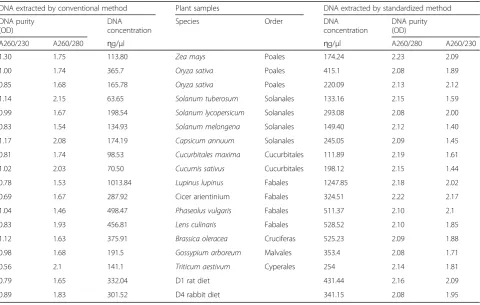
used in the present work (Table 2). The yield of isolated
DNA ranged from 2.238ηg/mg of seeds in case of
Cucurbi-tales maxima to 24.957 ηg/mg of seeds in the case of
Lupinus lupinus. The other classical CTAB method
Table 2Purity and concentration of DNA extracted by classical and standardized methods from 15 plant species representing seven plant orders
DNA extracted by conventional method Plant samples DNA extracted by standardized method
DNA purity (OD)
DNA concentration
Species Order DNA
concentration
DNA purity (OD)
A260/230 A260/280 ɳg/μl ɳg/μl A260/280 A260/230
1.30 1.75 113.80 Zea mays Poales 174.24 2.23 2.09
1.00 1.74 365.7 Oryza sativa Poales 415.1 2.08 1.89
0.85 1.68 165.78 Oryza sativa Poales 220.09 2.13 2.12
1.14 2.15 63.65 Solanum tuberosum Solanales 133.16 2.15 1.59
0.99 1.67 198.54 Solanum lycopersicum Solanales 293.08 2.08 2.00
0.83 1.54 134.93 Solanum melongena Solanales 149.40 2.12 1.40
1.17 2.08 174.19 Capsicum annuum Solanales 245.05 2.09 1.45
0.81 1.74 98.53 Cucurbitales maxima Cucurbitales 111.89 2.19 1.61
1.02 2.03 70.50 Cucumis sativus Cucurbitales 198.12 2.15 1.44
0.78 1.53 1013.84 Lupinus lupinus Fabales 1247.85 2.18 2.02
0.69 1.67 287.92 Cicer arientinium Fabales 324.51 2.22 2.17
1.04 1.46 498.47 Phaseolus vulgaris Fabales 511.37 2.10 2.1
0.83 1.93 456.81 Lens culinaris Fabales 528.52 2.10 1.85
1.12 1.63 375.91 Brassica oleracea Cruciferas 525.23 2.09 1.88
0.98 1.68 191.5 Gossypium arboreum Malvales 353.4 2.08 1.71
0.56 2.1 141.1 Triticum aestivum Cyperales 254 2.14 1.81
0.79 1.65 332.04 D1 rat diet 431.44 2.16 2.09
0.89 1.83 301.52 D4 rabbit diet 341.15 2.08 1.95
employed (Doyle and Doyle1990) also produced
compar-able range of DNA concentration (Tcompar-able 2), yet with less
purity in most cases. Most of DNA samples extracted by
the original CTAB method had A260/A280 ratio below
1.8, while the A260/A280 ratios ranged from 2.08 to
2.23 in DNA samples extracted by our modified protocol.
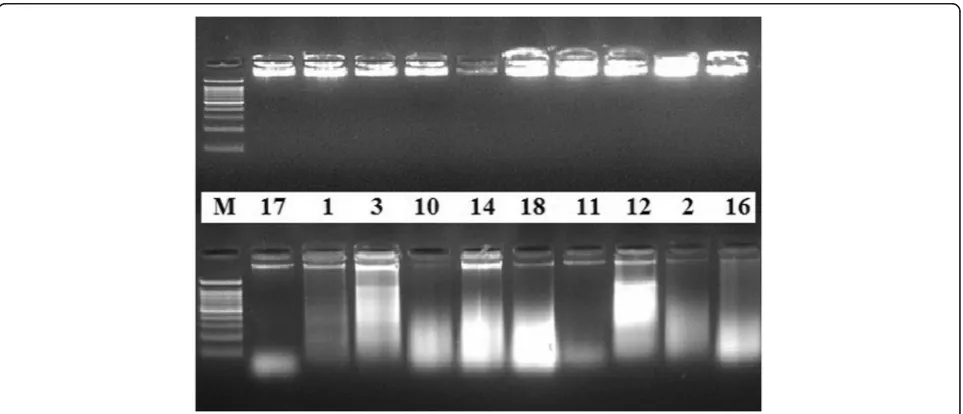
The quality of the total DNA extracted by the present protocol, from different plant species, was also evaluated by electrophoresis separation. Results showed intense bands
very close to the gel wells (Fig. 1, upper lane). Genomic
DNA extracted by the CTAB method of Doyle and Doyle
(1990) from the same samples did not produce distinct or
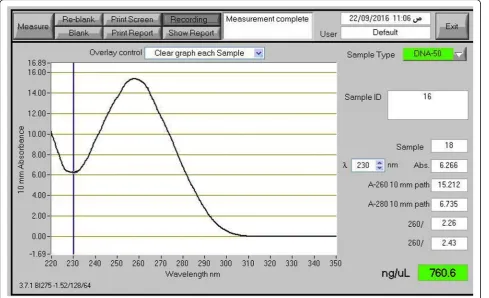
intact bands (Fig.1, lower lane). The NanoDrop
spectro-photometer measurement profile showed a single ab-sorbance peak at 260 nm in DNA samples extracted by
our standardized protocol. Figure 2 shows an example
of a NanoDrop measurement profile of extracted
gen-omic DNA from Glycine max sample using our
proto-col. DNA samples extracted by the present modified extraction protocol were efficiently digested with the HindIII restriction enzyme (Fig.3).
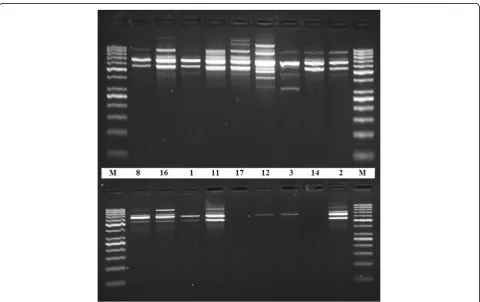
PCR amplification with RAPD primer (OPZ-09) showed clear and well-differentiated band patterns
(Fig. 4) in case of DNA samples extracted by the
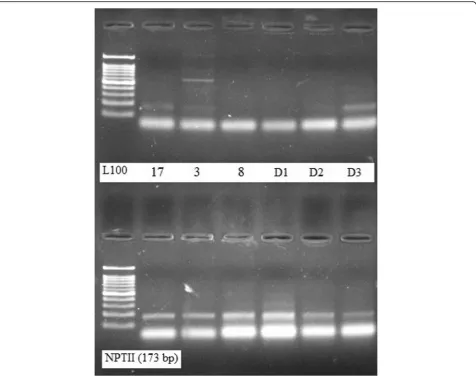
present DNA extraction protocol, whereas genomic DNA extracted by the other method from the same plant seed samples was rather difficult to be amplified (Fig.4). Figure5 shows the differences in the quality of the PCR amplification products of nptII (173 bp target)
in plant samples which were extracted by both the conventional method and by the modified protocol.
Discussion
The extraction of DNA from plant seeds is an essential step for satisfactory results in molecular studies particularly those involving plant genetics (Junior et al.2016). Different seeds belonging to related genera or different orders contain many components with variable complexities that badly interfere with purity of the extracted DNA and molecular investigations following isolation procedures (Porebski et al.1997; Ribeiro and Lovato2007).
To insure isolation of DNA with better yield and quality from seeds of diverse plant orders, we implemented several steps in the present modified protocol. Liquid ni-trogen was used to break the cell wall and disrupt the cell
membrane (Clark 1997) while keeping cellular enzymes
and other undesired chemicals deactivated, thus reducing shearing and damaging of the DNA. Other methods used for disrupting plant tissues, such as digestion with pecti-nase and cellulose (Manen et al.2005), are not as reprodu-cible or accurate as the use of liquid nitrogen.
High concentration of the 3× CTAB was also used to disrupt the cells and nuclear membranes in order to
expose the genetic components (Amani et al. 2011). In
the present modified method, the 3× CTAB buffer also contains the highest recommended concentration level
(0.3%) of 2-β-mercaptoethanol which successfully
re-moved polyphenols (Horne et al. 2004; Li et al. 2007)
giving rise a clear translucent DNA pellet. The CTAB
extraction buffer also includes 1.4 M of NaCl which im-proved the quality of the extracted DNA (Sahu et al.2012).
To remove the remaining polysaccharides during DNA extraction from all plant samples included in the present work, a modification for the precipitation of DNA was
also performed by increasing the concentration of sodium chloride and potassium acetate. The concentration of NaCl varied with plant species in a range between 0.7 M
(Clark 1997) and 6 M (Aljanabi et al.1999; Moreira and
Oliveira 2011). In the present standardized protocol, we
Fig. 2NanoDrop measurement profile. NanoDrop measurement profile of the extracted genomic DNA from theGlycine maxsample using the modified protocol
used 6 M NaCl (Moreira and Oliveira 2011) and 3 M
potassium acetate (Paterson et al. 1993). These
modifica-tions successfully removed polysaccharides impurities from DNA extracted by this modified protocol from all plant samples and produced pure and high-quality DNA suitable for further molecular analysis. Proteins, most lipids, and cellular debris were removed by binding with non-aqueous compounds and precipitated during the chloroform-isoamyl alcohol step.
Longer incubation of the extracted DNA at −20 °C
also enhanced precipitation of DNA. In general, the quantity and quality of isolated DNA depend on
precipi-tation temperature and duration (Michiels et al. 2003).
Low-temperature precipitation employed in the present modified protocol increased DNA yield. Extracted DNA were re-suspended in minimum amount of 1× TE buffer since the presence of chelating agents in TE buffer can affect the PCR and other molecular analysis of the extracted DNA.
The method employed in the present work proved to be successful and applicable for extraction of DNA with high yield and purity from 19 different plant species that belong to seven different plant orders. The matrix variation effects on the purity and quality of the isolated genomic
DNA were minimized by using the same plant samples as starting materials for both protocols employed in the present investigation.
Electrophoresis separation of DNA extracted by the present protocol showed intense bands very close to the
gel wells (Fig. 1, upper lane) signifying high degree of
purity and intact DNA. It is known that the presence of smear could be a sign of degradation of the extracted DNA which easily affects the quality of the subsequent molecular application results (Devi et al.2013).
DNA samples extracted by the present protocol were assessed for successful PCR amplification with RAPD primer (OPZ-09). The presence of clear and well-differen-tiated band patterns (Fig. 4) reflects the efficiency of the protocol to produce genomic DNA with high purity suit-able for molecular studies that based on PCR techniques (Devi et al.2013).
Purification of DNA is also an important step for analy-zing and measuring genetically modified (GM) food
pro-ducts (Ateş Sönmezoğlu and Keskin 2015). The DNA
extracted by our standardized protocol yielded detectable and reproducible bands for NPTII (173 bp target) proving its suitability for PCR amplification as well as for the identi-fication of GM crops using the PCR assay.
The A260/A280 purity ratio is an important measure for estimating the polyphenol contamination levels of
the extracted DNA. Ratios of A260/A280 below 1.8
ren-der the extracted DNA inappropriate for molecular
in-vestigations (Sambrook and Russell 2001). Therefore,
higher level of 2-β-mercaptoethanol (0.3%) used in the
present standardized method successfully removed polyphenols giving rise to translucent final DNA pellets (Suman et al.1999).
In the present modified CTAB-based protocol, although the RNase A enzyme was not used during isolation and purification of DNA, the ratios of absorption A260/A280of
the extracted DNA (Table2) were higher than the
recom-mended optimal limit of DNA purity (Sambrook and Rus-sell2001). Similar results were also observed by Sambrook and Russell (2001) which were taken to be associated with RNA contamination. In our case, the resulted intact DNA bands, very close to the wells (Fig.1, upper lane), indicated
high purity of the extracted DNA with no RNA contami-nation, particularly that the recommended and the most ac-curate way to determine RNA contamination is to run the sample on an agarose gel where another band of the RNA, if present, will be visible in the gel (Wang et al. 2012). Therefore, the higher ratios of absorption A260/A280in our case may be attributed to slight changes in the pH of the extracted samples (Wilfinger et al.1997).
Polysaccharide contamination was also assessed
(Table 2) by estimating the absorbance ratio A260/A230
as a secondary measure of nucleic acid purity (Wilson
and Walker 2005). This ratio is important to evaluate
the level of salt residues in the purified DNA. It is re-commended to be greater than 1.5 and preferably close to 1.8. The reported values of A260/A230ratio in most of the DNA plant samples extracted by the present modi-fied protocol are higher than those of the DNA samples extracted by the other classical method.
Conclusion
The principle modifications currently employed for DNA extraction involved the use of higher CTAB
con-centration and higher levels of 2-β-mercaptoethanol.
Additionally, higher concentrations of sodium chloride and potassium acetate were added simultaneously with absolute ice cold isopropanol for the precipitation of DNA free from polysaccharides.
The prescribed modifications in the present method establish a quick and efficient standardized protocol for DNA extraction from different plant orders. These mo-difications consistently produced pure and high-quality DNA suitable for further molecular analysis. The DNA standardized extraction protocol presented here is important for the assessment of food safety, detection of genetically modified crops, and biodiversity conserva-tion. Therefore, it is of great value for molecular analysis involving large number of different plant samples.
Abbreviations
bp:Base pair; CTAB: Cetyl trimethylammonium bromide; DNA: Deoxyribonucleic acid; GMO: Genetically modified organisms; HCl: Hydrochloric acid; NaCl: Sodium chloride;
NPTII: Neomycinphosphotransferase II gene; OD: Optical density; RAPD: Random amplified polymorphic DNA
Acknowledgements
Not applicable
Funding
The authors declare that this work was funded by the National Research Centre in Egypt (the 11th Research Project Plan, 2016-2019, Project ID: 11040201).
Availability of data and materials
We declare that all data generated or analyzed during this study are included in this article.
Authors’contributions
NA-M made substantial contributions to conception and design of the work, involved in conducting the practical section of the work, and also involved in drafting the manuscript. HO made substantial contributions to conception, planning of the work, analysis, and interpretation of results and also involved in drafting the manuscript and revising it critically for important intellectual content, as well as gave the final approval of the version to be published. Each author has participated sufficiently in the work to take public responsibility for appropriate portions of the content and agreed to be accountable for all aspects of the work in ensuring that questions related to the accuracy or integrity of any part of the work are appropriately investigated and resolved. Both authors read and approved the final manuscript.
Ethics approval and consent to participate
Not applicable
Consent for publication
Not applicable
Competing interests
The authors declare that they have no competing interests.
Publisher’s Note
Springer Nature remains neutral with regard to jurisdictional claims in published maps and institutional affiliations.
Received: 15 August 2018 Accepted: 31 January 2019
References
Aljanabi MS, Forget L, Dookun A (1999) An improved and rapid protocol for the isolation of polysaccharide and polyphenol free sugarcane DNA. Plant Mol Biol Rep 17:1–8
Amani J, Kazemi R, Abbasi AR, Salmanian AH (2011) A simple and rapid leaf genomic DNA extraction method for polymerase chain reaction analysis. Iran J Biotech 9:69
AteşSönmezoğlu Ö, Keskin H (2015) Determination of genetically modified corn and soy in processed food products. J App Biol Biotech 3:032
Clark MS (ed) (1997) Plant molecular biology- a laboratory manual. Springer, New York, pp 305–328
Devi KD, Punyarani K, Singh S, Devi HS (2013) An efficient protocol for total DNA extraction from the members of order Zingiberales - suitable for diverse PCR based downstream applications. Springer Plus 2:669.https://doi.org/10.1186/ 2193-180-2-669
Doyle JJ, Doyle JL (1990) Isolation of plant DNA from fresh tissue. Focus 12:13 Fang G, Hammar S, Grumet R (1992) A quick and inexpensive method for
removing polysaccharides from plant genomic DNA. BioTechniques 13:52–56 Haymes KM (1996) Mini-prep method suitable for a plant breeding program.
Plant Mol Biol Rep 14:280
Horne EC, Kumpatla SP, Patterson MG, Thompson SA (2004) Improved high-throughput sunflower and cotton genomic DNA extraction and PCR fidelity. Plant Mol Biol Rep. 22:83
Júnior CDS, Teles NMM, Luiz DP, Isabel TF (2016) DNA Extraction from Seeds. In: Micic M, editor. Sample Preparation Techniques for Soil, Plant, and Animal Samples. Springer Protocols Handbooks. Humana Press, New York, pp.265-276.https://doi.org/10.1007/978–1-4939-3185-9_18
Khanuja SPS, Shasany AK, Darokar MP, Kumar S (1999) Rapid isolation of DNA from dry and fresh samples of plants producing large amounts of secondary metabolites and essential oils. Plant Mol Biol Rep. 17:1
Li JT, Yang J, Chen DC, Zhang XL, Tang ZS (2007) An optimized mini-preparation method to obtain high-quality genomic DNA from mature leaves of sunflower. Genet Mol Res 6:1064
Loomis MD (1974) Overcoming problems of phenolics and quinones in the isolation of plant enzymes and organelles. Methods Enzymol 31:528 Manen JF, Sinitsyna O, Aeschbach L, Markov AV, Sinitsyn A (2005) A fully
automatable enzymatic method for DNA extraction from plant tissues. BMC Plant Biol 5:23
Michiels A, Van den Ende W, Tucker M, Van Riet L (2003) Extraction of high-quality genomic DNA from latex-containing plants. Anal Biochem 315:85
Mogg RJ, Bond JM (2003) A cheap, reliable and rapid method of extracting high-quality DNA from plants. Mol Ecol Notes 3:666
Moreira PA, Oliveira DA (2011) Leaf age affects the quality of DNA extracted from
Dimorphandra mollis(Fabaceae), atropical tree species from the Cerrado region of Brazil. Genet Mol Res 10:353
Novaes RML, Rodrigues JG, Lovato MB (2009) An efficient protocol for tissue sampling and DNA isolation from the stem bark of Leguminosae trees. Genet Mol Res 8:86–96
Paterson AH, Brubaker CL, Wendel JF (1993) A rapid method for extraction of cotton (Gossypium spp.) genomic DNA suitable for RFLP or PCR analysis. Plant Mol Biol Rep. 11:122
Pirttilä MA, Hirsikorpi M, Kämäräinen T, Jaakola L, Hohtola A (2001) DNA isolation methods for medicinal and aromatic plants. Plant Mol Biol Rep. 19:273 Porebski S, Bailey LG, Baum BR (1997) Modification of a CTAB DNA extraction
protocol for plants containing high polysaccharide and polyphenol components. Plant Mol Biol Rep. 15:8–15
Ribeiro RA, Lovato MB (2007) Comparative analysis of different DNA extraction protocols in fresh and herbarium specimens of the genus Dalbergia. Genet Mol Res 6:173
Saghai-Maroof MA, Soliman KM, Jorgensen RA, Allard RW (1984) Ribosomal DNA sepacer-length polymorphism in barley: Mendelian inheritance,
chromosalmal localtionk, and population dynamic. Proc Natl Acad Sci U S A 81:8014
Sahu SK, Thangaraj M, Kathiresan KDNA (2012) Extraction protocol for plants with high levels of secondary metabolites and polysaccharides without using liquid nitrogen and phenol. Mol Biol 12:1
Scott KD, Playford J (1996) DNA extraction technique for PCR in rain forest plant species. Bio Techniques 20:974
Sharma KK, Lavanya M, V A (2000) A method for isolation and purification of peanut genomic DNA suitable for analytical applications. Plant BioTechniques Rep 18:393a
Shepherd M, Cross M, Stokoe RL, Scott LJ (2002) High-throughput DNA extraction from forest trees. Plant Mol Biol Rep. 20:425
Shioda M, Marakami-Muofushi K (1987) Selective inhibition of DNA polymerase by a polysaccharide purified from slime ofPhysarum polycephalum. Biochem Biophys Res Commun 146:61–66
Silva MN (2010) Extraction of genomic DNA from leaf tissues of mature native species of the Cerrado. Rev. Árvore 34:973–978
Suman PSK, Ajit KS, Darokar MP, Sushil K (1999) Rapid isolation of DNA from dry and fresh samples of plants producing large amounts of secondary metabolites and essential oils. Plant Mol Biol Rep. 17:1
Wang X, Xiao H, Zhao X, Li C, Ren J, Wang F , Pang L. Isolation of high-quality DNA from a desert plant Reaumuria soongorica, genetic diversity in plants, Mahmut Caliskan (Ed.), ISBN: 978–953–51-0185-7, InTech; 2012.https://doi. org/10.5772/38367
Wilfinger WW, Mackey K, Chomczynski P (1997) Effect of pH and ionic strength on the spectrophotometric assessment of nucleic acid purity. BioTechniques 22:474–481