This is an open access journal, and articles are distributed under the terms of the Creative Commons Attribution-Non Commercial-ShareAlike 4.0 License, which allows others to remix, tweak, and build upon the work non-commercially, as long as appropriate credit is
An evaluation of Ceftriaxone use in the antimicrobial
stewardship program for surgical patients at a Hospital in
Bandung
Sri Rahayu Evrilia
1*, Ahmad Muhtadi
1, Melisa I. Barliana
2,3, Rina Winarni
41Department of Pharmacology and Clinical Pharmacy, Faculty of Pharmacy, Universitas Padjadjaran, Jl. Bandung Sumedang, KM. 21, Jatinangor, Sumedang, Indonesia,
45363. 2Department of Biological Pharmacy, Universitas Padjadjaran, Sumedang, Indonesia. 3 Center of Excellence in Higher Education for Pharmaceutical Care Innovation,
Universitas Padjadjaran, Indonesia.4Dr. Hasan Sadikin Hospital, Bandung, Indonesia.
Correspondence: Sri Rahayu Evrilia.Department of Pharmacology and Clinical Pharmacy, Faculty of Pharmacy, Universitas Padjadjaran, Jl. Bandung Sumedang, KM. 21, Jatinangor, Sumedang, Indonesia, 45363. E-mail: [email protected]
ABSTRACT
The use of rational antibiotic Ceftriaxone in surgery requires paying attention to factors such as antimi-crobial activity at the wound location and the duration of administration because Ceftriaxone includes broad-spectrum antibiotics. An antimicrobial stewardship program aimed to measure the use of antibiotics in hospitals using the average daily dose calculations (DDD). This research aimed to know the differences of DDD values of antibiotic Ceftriaxone before and after the program in surgical patients. This study was an observational analytic study using retrospective analysis of surgical inpatients from December 2015-July 2016. The study involved 197 subjects consisting of 98 subjects before the program, and 99 subjects after the program. The value of DDD /100 patient-day Ceftriaxone antibiotics after the antimicrobial stewardship program was lower than before the program (consecutively 71,194 and 72,692 DDD/100 patient-day, p= 0,001). The use of antibiotics Ceftriaxone was decreased in neurosurgery in digestive patients after an antimicrobial stewardship program.
Keywords: Antimicrobial stewardship program, Ceftriaxone, DDD, surgery.
Introduction
The increased prevalence of infection caused by antibiotic-resistant pathogenic bacteria has been observed in the surgical department. The bacteria mentioned included extended-spectrum beta-lactamase (ESBL) bacteria Escherichia coli and Klebsiella spp., Enterococcus species, Pseudomonas aeruginosa and Acinetobacter baumannii resistant carbapenems, and Klebsiella pneumoniae carbapenemase producers. [1]
The results of Antimicrobial Resistance in Indonesia (AMRIN
Study) between the years of 2000-2005 showed that 43% of
Escherichia coli were resistant to various types of antibiotics including ampicillin (34%), cotrimoxazole (29%), and chloramphenicol (25%). Out of 781 patients currently hospitalized, 81% had Escherichia coli resistance to various antibiotics including ampicillin (73%), cotrimoxazole (56%), and chloramphenicol (43%), ciprofloxacin (22%), and gentamicin (18%). The results of this study proved that the problem of antimicrobial resistance also occurred in Indonesia.
[2]
Antimicrobial Stewardship Program has been an essential program in hospitals. One of its objectives is to prevent the emergence of antimicrobial resistance. Another aim is to reduce the incidence of drugs’ side effects including secondary infections (e.g., Clostridium difficile infection) by optimizing the selection of optimal antibiotic regimens such as the dosage, duration of therapy, and the mode of administration of antibiotics in each patient. [3] To control the antimicrobial
resistance in hospitals, in April 2016 Dr. Hasan Sadikin implemented the Antimicrobial Stewardship Program (ASP). It
Access this article online
Website: www.japer.in E-ISSN: 2249-3379
How to cite this article: Sri Rahayu Evrilia, Ahmad Muhtadi, Melisa I.
Barliana, Rina Winarni. An evaluation of Ceftriaxone use in the antimicrobial stewardship program for surgical patients at a Hospital in Bandung. J Adv Pharm Edu Res 2019;9(1):53-56.
54 Journal of Advanced Pharmacy Education & Research | Jan-Mar 2019 | Vol 9 | Issue 1
complied with the decree from the president director of Dr.
Hasan Sadikin Bandung Number
HK.03.05/C011/15167/IX/2015 which assigned the members of the Antimicrobial Resistance Control Team (PPRA) for its implementation in the surgical patientward. [4]
The assessment of the quantity of antibiotic use in the hospitals was measured using the defined daily dose (DDD). It was relatively easy to do, and was recommended by the World Health Organization (WHO). [5]
This study intended to evaluate the implementation of an antimicrobial stewardship program on the quantity of antibiotic Ceftriaxone by calculating the average daily dose in surgical patients at RSUP Dr. Hasan Sadikin Bandung before and after the intervention.
Methods
The study employed Analytical observations with a cross-sectional design and retrospective data retrieval in surgical treatment room before and after ASP intervention from December 2015 to July 2016. The subjects of the study were selected based on a set of criteria. The first criterion was the age group, namely the adult group (18-65 years old) and the geriatric group (above 65 years old), irrespective of their gender. The next criterion was whether the patients were administered with Ceftriaxone antibiotics for, Ceftriaxone empirical, definitive or prophylactic therapy. The next was the duration of its use (long-term therapy for > 14 days, and short-term one for <14 days)). The rest of the criteria were ASA I-II classification, net operating patients, clean-contaminated operations, blood samples, and complete medical records. The measurement of the amount of an antibiotic used followed the ATC/DDD standard, recommended by WHO, 2011. The formula for the calculation DDD was:
DDD/100 day treatment = [use of antibiotics annually (g) × 100]/[DDD (g/d) × LOS all patients]
Statistical analysis was performed using Student’s t-test for the paired data. A level of p=0,001 was considered significant.
Results
The patients who received antibiotics in an antimicrobial stewardship program, were treated in a surgical treatment room during December 2015- May 2016, and met the inclusion criteria amounted to 197 people. The study subjects consisted of 98 subjects before the antimicrobial stewardship program, and 99 subjects after the antimicrobial stewardship program that began in April 2016.
The essential characteristics of study subjects such as age, sex, outpatient room, length of stay have been represented in Table 1.
Table 1: The Basic Characteristics of Study Subjects
Characteristics Before ASP (n= 98) After ASP (n= 99)
Age
<20 years 29 (29.5) 33 (33.3) 20-35 years 48 (48.9) 46 (46.4) >35 years 21 (21.4) 20 (20.2)
Sex Female 36 (36.7) 31 (31.3) Male 62 (63.3) 68 (68.7) Outpatient
room Kemuning Kana 47 (47.9) 51 (52.0) 39 (39.4) 60 (60.6)
Length of stay
3 days 16 (16.3) 19 (19.2)
4 days 23 (23.5) 25 (25.2) 5 days 28 (28.6) 32 (32.3) >5 days 31 (31.6) 23 (23.2)
Description: data presented in (%)
Patients receiving antibiotic therapy should be cultured to receive appropriate antibiotic therapy for therapeutic purposes. Most of the blood culture results in both groups found no bacterial growth of 87.5% in the study subjects before ASP, and 79.2% in subjects after ASP. In the subjects before ASP, 14 positive cultures were found to contain bacteria, 3 gram-negative superbug germs (1 Pseudomonas aeroginosa (MDR), 2
Escherichia coli (ESBL), 1 Citrobacter freundii, 4 Acinobacter baumannii, 1 actinobacter gram positive (Kocuria kristiae (MDR), 2
Klebsiella pneumonia, 2 Enterobacter cloacae and 1 gram-positive coccus (Staphylococcus epidermidis).
On the post-ASP subjects, 20 positive cultures were found to be bacteria, 2 germs of super gram-positive coccus (1 germ of
Enterococcus faecalis, 1 germ Staphylococcus haemolyticus, 14 super gram-negative bugs, 3 Acinetobacter baumannii, 5 Escherichia coli, 6 germs Pseudomonas aeroginosa, 1 Candida tropicalis, 1 Klebsiella pneumoniae, 1 Citrobacter freundii, and 1 Proteus mirabilis.
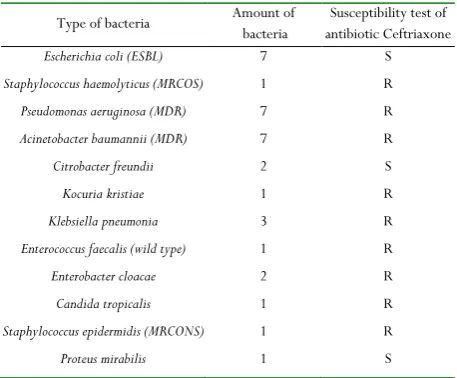
The results of blood cultures and susceptibility tests of antibiotic Ceftriaxone can be seen in Table 2.
Table 2. Results of blood cultures and susceptibility test of antibiotic Ceftriaxone
Type of bacteria Amount of bacteria antibiotic Ceftriaxone Susceptibility test of
Escherichia coli (ESBL) 7 S
Staphylococcus haemolyticus (MRCOS) 1 R
Pseudomonas aeruginosa (MDR) 7 R
Acinetobacter baumannii (MDR) 7 R
Citrobacter freundii 2 S
Kocuria kristiae 1 R
Klebsiella pneumonia 3 R
Enterococcus faecalis (wild type) 1 R
Enterobacter cloacae 2 R
Candida tropicalis 1 R
Staphylococcus epidermidis (MRCONS) 1 R
Proteus mirabilis 1 S
Most positive blood cultures were resistant to Ceftriaxoneantibiotics.
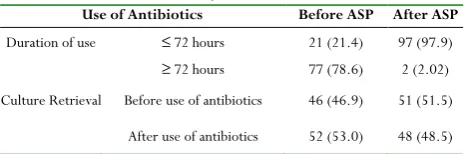
Table 3 shows the characteristics of Ceftriaxone antibiotic use Ceftriaxonein the study subjectsn.
Table 3. Characteristics of antibiotic use Ceftriaxonein the study subjects
Use of Antibiotics Before ASP After ASP
Duration of use ≤ 72 hours 21 (21.4) 97 (97.9)
≥ 72 hours 77 (78.6) 2 (2.02) Culture Retrieval Before use of antibiotics 46 (46.9) 51 (51.5)
After use of antibiotics 52 (53.0) 48 (48.5) Description: data presented in (%)
Less than 72 hour-long antibiotic administration before ASP was 21.4%, and more than 72-hours duration of antibiotic Ceftriaxones was 78.6% (p=0.001). While less than 72-hour duration of administration after ASP of Ceftriaxones was as much as 97.9%, and the duration of Ceftriaxone for more than 72 hours was 2.02% (p=0.001). Before ASP, the culture taken showed 46.9% and 53.0% before and after antibiotic administration; respectively. After ASP, the culture retrieval performed before and after antibiotic administration showed 51.5% and 48.5%; respectively.
Description: data presented in DDD/100 patient-day The Ceftriaxone antibiotic value of DDD/100 patient-day Ceftriaxone after ASP was lower than after ASP (successively 71,194 and 72,692) with p=0.001.
Discussion
For administration of antibiotics in surgery, it was needed to take into account some essential things that included: antimicrobial activity should appear on the site of the wound during the wound closure, antibiotics must be active against predicted contaminant microorganisms, and long-term administration of drugs after surgical procedures should not be justified and potentially would result in adverse conditions. Sterility factors and surgical techniques should also receive attention to minimize the risk of infection. [6]
The most commonly found irrationality in the use of antibiotics has been the presence of more effective antibiotics. It is because Ceftriaxone that should be given as a second-line therapy is used as that of a first-line, causing Ceftriaxone to become the most widely used antibiotic. There are other antibiotics that are more effective for use as first-line surgery, namely cephalosporins (such as cefazolin). [7]
There is a need for particular attention to the high use of Ceftriaxone in surgery because Ceftriaxone is a cutting-edge, broad-spectrum antibiotic that acts as a therapeutic drug. In case of infection when Ceftriaxone is used as prophylactic therapy, the choices of antibiotics for therapy become significantly complicated. In addition, Ceftriaxone is also an antibiotic that can induce the onset of the Extended-Spectrum
Doctors should be more selective in using Ceftriaxone. A common problem in surgery is prescribing antibiotics more than 24 hours after unconscious surgery. According to Shah et al., the incidence of nosocomial infections in the surgical wards is high enough to cause surgeons to choose antibiotics on the alert for infections despite no clear indications. [10]
According to Slobogean et al.’s research, prophylactic antibiotics given in more significant quantities or the same minimal amount will give surgical wounds infections that do not vary much. Provision of antibiotics in the minimum amount will provide benefits regarding cost, and antibiotics overuse can cause resistance to these antibiotics. [11]
The study showed that there were 48.97% and 46.5% incidences of inpatients who underwent a surgical procedure and were at the age of 20-35. There was a slight difference between men and women regarding incidence due to surgery in both groups; male subjects before ASP showed 63.26% and women subjects showed as much as 36.73%. Meanwhile, after ASP, the numbers shown for male and female subjects were 68.7% and 31.3%; respectively. In addition, male patients had higher incidence rates in neurosurgery and urological surgery. The result of a positive blood culture before ASP was 12.5%, and after ASP was 20.8%. Patients receiving antibiotic therapy should be cultured to receive appropriate antibiotic therapy for therapeutic purposes. Most of the blood culture results in both groups found no bacterial growth in 87.5% of the study subjects before ASP and 79.2% after ASP. Negative blood culture results may be due to several factors such as the patients’ clinical condition, and the duration of antibiotics for seven days before blood culturing. The results showed that some of the most common bacteria found in blood cultures are Escherichia coli (ESBL), Acinetobacter baumannii, and Pseudomonas aeroginosa
which can be sources of infection in surgical wounds.
The results of the characteristics of Ceftriaxone showed a significant difference with the value of p=0.001. Whereas before long ASP, antibiotic value of Ceftriaxone in less than 72 hours, was 21.4%, and during ASP, antibiotic value of Ceftriaxone in more than 72 hours, was 78.6%. While after ASP, antibiotic value of Ceftriaxone in less than 72 hours, was as much as 97.9%, and during using antibiotic value of Ceftriaxone in more than 72 hours, was as much as 2.02% (Tables 3 & 4). This was in accordance with the principle of antibiotic use, where the duration of empirical antibiotics administration was within 48-72 hours. Reducing the duration of antibiotic use has also been one of the ASP interventions to reduce antibiotic use in hospitals.
The DDD/100 patient-day y-level results after ASP were lower than before ASP. The results also showed that the use of Ceftriaxone antibiotics in the surgical wards was lower than the WHO standard, that is 2 DDD daily, which showed that the daily use of Ceftriaxone antibiotics was 0.71 DDD. The results complied with the principle of wise use of antibiotics: the smaller the antibiotic DDD results obtained, the better the use of antibiotics on patients.
56 Journal of Advanced Pharmacy Education & Research | Jan-Mar 2019 | Vol 9 | Issue 1
after ASP can be seen in Table 4.
Table 4. DDD / patient-day antibiotic values Ceftriaxone before and after ASP
DDD Before ASP After ASP Difference (95% CI)
DDD / 100 patient-day 72,692 71,194 1,498
Conclusion
The value of DDD/100 patient-days of Ceftriaxone antibiotic after antimicrobial stewardship program was lower than before the antimicrobial stewardship program in the neurosurgeon and digestive patients.
Acknowledgments
We would like to thank the Dean of the Faculty of Pharmacy, Universitas Padjadjaran, Bandung, Indonesia and the director of the Dr. Hasan Sadikin Hospital, Bandung, Indonesia who facilitated the present work in this teaching hospital. This article’s publication was supported by the United States Agency for International Development (USAID) through the Sustainable Higher Education Research Alliance (SHERA) Program for Universitas Indonesia’s Scientific Modeling, Application, Research and Training for City-centered Innovation and Technology (SMART CITY) Project, Grant #AID-497-A-1600004, Sub Grant #IIE-00000078-UI-1.
References
1. Ashiru-Oredope D, Cookson B, Fry C. Advisory
Committee on Antimicrobial Resistance and Healthcare Associated Infection Professional Education Subgroup. Developing the first national antimicrobial prescribing and stewardship competences. J Antimicrob Chemother 2014;69:2886–2888
2. Regulation of the Minister of Health No. 8 of 2015 Concerning the Program to Control Antimicrobial Resistance in Hospitals.
3. Ohl CA, Dodds Ashley ES. 2011. Antimicrobial
stewardship programs in community hospitals: The evidence base and case studies. Clin Infect Dis; 53(Suppl 1):S23–S28.
4. Decision of the Director of RSUP Dr. Hasan Sadikin Number: HK.03.05 / C011 / 15167 / IX / 2015 concerning PPRA RSUP Dr. Hasan Sadikin Bandung. 5. Morris AM. Antimicrobial Stewardship programs:
Appropriate measures and metrics to study their impact. Curr Treat Options Infect Diss. 2014; 6: 101-12
6. Brunton, L.L. (Ed). 2006. Goodman and Gilman’s The Pharmacological Basics of Therapeutics, 11th ed. McGraw-Hill Companies Inc: United States.
7. Rasyid HN. The principle of giving prophylactic antibiotics to surgery. Presented at the Hospital Infection Prevention and Control Seminar; October 13-16, 2008; Dr. Hospital Hasan Sadikin, Bandung, Indonesia.
8. Huang Y, Carroll KC, Cosgrove SE, Tamma PD.
Determining the optimal CeftriaxoneMIC for triggering Extended-Spectrum β-Lactamase confirmatory testing. J Clin Microbiol. 2014; 52(6):2228–30. doi: 10.1128/JCM.00716-14
9. Urbánek K, Kolár M, Lovecková Y, Strojil J, Santavá L. Influence of third generation cephalosporin utilization on the occurrence of ESBL-positive Klebsiella pneumoniae strains. J Clin Pharm Ther. 2007; 32(4):403–8. doi: 10.1111/j.1365-2710.2007.00836.x 10. Shah FH, Gandhi MD, Mehta VP, Udani DL, Mundra MN, Swadia NN. Nosocomial infections in surgical wards. Internet J Surgery. 2010;24:1