This is an open access journal, and articles are distributed under the terms of the Creative Commons Attribution-Non Commercial-ShareAlike 4.0 License, which allows others to remix, tweak, and build upon the work non-commercially, as long as appropriate credit is given and the new creations are licensed under the identical terms.
© 2019 Journal of Advanced Pharmacy Education & Research | Published by SPER Publication
7
Impact of early pulmonary rehabilitation on post liver
transplantation
Shimaa Hussein Ahmed Roshdy
1, Nesreen Ghareeb El- Nahas
1, Azza Abd el Aziz Abd el Hady
1,
Moheb Wadeea El Faizy
21 Faculty of Physical Therapy, Cairo University, Egypt, 2El Sahel Teaching Hospital, Cairo, Egypt.
Correspondence:Shimaa Hussein Ahmed Roshdy. Faculty of Physical Therapy, Cairo University, Egypt.
ABSTRACT
Background: Postoperative pulmonary complications (PPC) are noteworthy reasons of mortality Post liver transplantation (LT), which occur in approximately 35% to 50% of the recipients. Pulmonary dysfunction has likewise been widely reported among patients anticipating LT. Objectives: This study was conducted to estimate the impact of early pulmonary rehabilitation post liver transplant. Subjects: 30 men patients with mean age of 49.27 ± 7.12 yrs. Post liver transplantation surgery participated in this study, all patients received traditional Physical therapy program including deep breathing exercise in form of diaphragmatic, apical, costal breathing, and POWERbreathe Plus device with early ambulation. This program was done 14 sessions/week twice daily for 21 days. Arterial blood gases analysis was measured on 1st day before training then 7th day in Intensive care unit (ICU), then re-measured after 21 days in the ward. Distance in 6-minute walk test was measured in the 7th day and after 21 days. Results: There was a statistically significant difference in pH, PCO2, PO2, Lactate, HCO3 measured in the 1th, 7th, and 21st day, and distance in 6-minute walk test was measured two times in 7th and 21st days. Conclusion: It was concluded that the POWERbreathe Plus device was effective in rehabilitation in post liver transplantation patients and helped in improvement of quality of life, and enhances patients’ compliance and independence.
Keywords: Liver transplantation, pulmonary complications, power breath plus device
Introduction
Liver transplantation (LT) has turned into the pillar for the treatment of end-stage liver disease, acute liver failure, hepatocellular cancer, and some metabolic liver diseases [1]. Postoperative pulmonary complications following liver transplantation (LT) are common and have been related with expanded morbidity and mortality. Infectious complications, prolonged ventilator time, need for reintubation, atelectasis, pleural effusions, acute respiratory distress syndrome, and pulmonary edema have been recognized as the main pulmonary
complications following LT [2].
Both preoperative and intraoperative factors are thought to have a role in the development of pulmonary complications, and although there have been significant advances in critical care and hemodynamic monitoring of LT recipients, pulmonary complications continue to be a significant problem. Studies have identified pre-LT risk factors for postoperative pulmonary complications, including age, severity of liver dysfunction [3], perioperative fluid administration, smoking history [4], female sex [5], and preexisting diabetes [6].
Inspiratory muscle training (IMT) improves performance, exercise tolerance and quality of life in patients with conditions affecting the pulmonary system such as cystic fibrosis, Parkinson’s disease, and myasthenia gravis [7].
Deep breathing exercises and chest physiotherapy reduce postoperative pulmonary complications following major abdominal surgery [8].
POWERbreathe is a hand-held specific inspiratory muscle trainer available on National Health Service (NHS) prescription that improves maximal static inspiratory mouth pressure [9] in healthy humans and patients with lung disease [10]. It is simple to Access this article online
Website: www.japer.in E-ISSN: 2249-3379
How to cite this article:Shimaa Hussein Ahmed Roshdy, Nesreen Ghareeb
El- Nahas, Azza Abd el Aziz Abd el Hady, Moheb Wadeea El Faizy. Impact of early Pulmonary Rehabilitation on Post Liver Transplantation. J Adv Pharm Edu Res 2019;9(2):7-12.
8 Journal of Advanced Pharmacy Education & Research | Apr-Jun 2019 | Vol 9 | Issue2 use and easy to learn. It has not been used previously in
rehabilitating patients post-surgery.
Materials and Methods:
Subjects and design study:
This study aimed to determine the effect of POWERbreathe Plus device in the rehabilitation of patients post liver transplantation. It was conducted in Wadi El Nil hospital, Cairo, Egypt. It was done from May 2017 to August 2018. Thirty men post liver transplantation participated in the study; their ages ranged from 40-50 years old. All patients were free from neurological and neuromuscular diseases, total liver transplantation, cardiac disease, alcoholic hepatitis, and Blind individuals. They were assigned as one group. They received training by POWER breathe plus device in addition to traditional chest physiotherapy (deep breathing exercises: Apical breathing, costal breathing, and diaphragmatic breathing) twice daily for 21 days, 15-20 minutes for each session.
This study was approved by ethical committee of Faculty of Physical Therapy, Cairo University, with approval number of P.T.REC/012/001571
For Evaluation:
Weight and height measures were taken, and body mass index was calculated.
Arterial blood gases were measured. Parameters tested included: pH, PCO2, PO2, Lactate, and HCO3 All parameters were measured pertaining in 1st, 7th, and 21st days. The distance was also measured in the 6-minute walk test in the seventh day and after 21 days.
For treatment:
POWERbreathe plus device was used for all patients. POWERbreathe plus device is a scientifically proven Inspiratory Muscle Training (IMT) referred to as a breathing training device - developed by leading scientists for improving the strength and endurance of the muscles used to breathe in, primarily the diaphragm and intercostals/rib cage muscles. As with any other muscle, respiratory muscles can be trained so that they are more resistant to fatigue. This resistance to fatigue results in reduced breathlessness and enhanced exercise tolerance.
POWERbreathe Plus uses scientifically proven pressure threshold training. This provides a specific and consistent pressure to train against. When breathing in through POWERbreathe, the load calibrated spring provides the resistance put the nose-clip on, so that it pushes nostrils together (this is optional but prevents patient from breathing in through nose). Breathe in quickly and forcefully through POWERbreathe device for 30 breaths twice a day (preferably morning and night so you allow inspiratory muscles to recover between sessions). This is the scientifically proven training regimen. The inspiratory muscle strength and stamina improve, adjust and increase the resistance. Within a few days the inspiratory muscles were felt stronger; within 3-weeks patient feel less breathless. Traditional chest physical therapy (deep breathing exercises: apical breathing, costal breathing, and
diaphragmatic breathing) was also done twice daily for 21 days, 15-20 minutes for each session.
Follow up procedures:
The follow up procedures including blood gases were measured before training, in the 1st, 7th, and 21st days. Distance of the six-minute walk test was also estimated before training, in the seventh day and after 21 days of training.
Results:
Results are expressed as mean ± standard deviation, minimum and maximum. Test of normality, Kolmogorov-Smirnov test, was used to measure the distribution of data measured before treatment. Accordingly, comparison between normally distributed data measured at different times of measurement (1st, 7th, and 21st days) was performed using ANOVA test followed by Bonferroni test, if significant results were recorded. Also, comparison between the 7th and 21st days was performed using paired test. In not normally distributed data, comparison between different times of measurement (1th, 7th and 21st days) was performed using Friedman ANOVA test followed by Wilcoxon signed ranks test if significant results were recorded. Correlation between different variables was performed using either Pearson or Spearman correlation coefficient whenever it was appropriate. Statistical Package for Social Sciences (SPSS) computer program (version 19 for
windows) was used for data analysis. P value ≤ 0.05 was
considered significant.
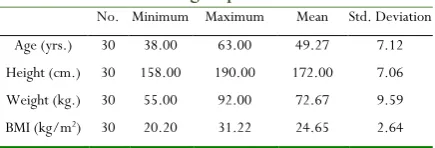
The mean value (± SD) of age, height, weight and BMI of the studied group were 49.27 ± 7.12 yrs., 172.0 ± 7.06 cm, 72.67 ± 9.59 kg and 24.65 ± 2.64 kg/m2, respectively (Table 1).
Table 1: General (Physical) characteristics of the studied group.
No. Minimum Maximum Mean Std. Deviation Age (yrs.) 30 38.00 63.00 49.27 7.12 Height (cm.) 30 158.00 190.00 172.00 7.06 Weight (kg.) 30 55.00 92.00 72.67 9.59 BMI (kg/m2) 30 20.20 31.22 24.65 2.64
1. PH
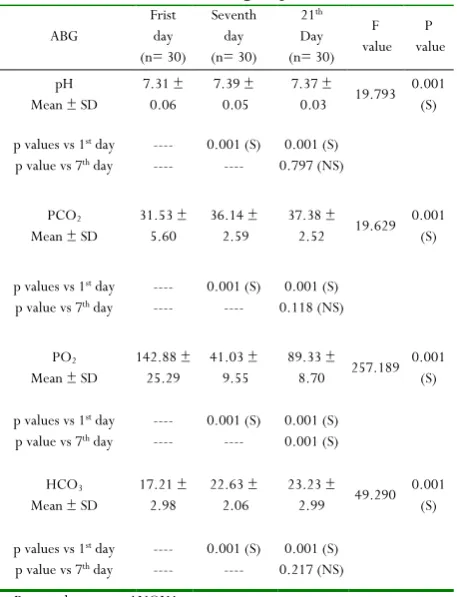
The mean value of PH measured in the first, seventh and twenty-first days post-liver transplantation were 7.31 ± 0.06, 7.39 ± 0.05 and 7.37 ± 0.03, respectively. There was a statistically significant difference between the three times of measurement (F=19.793, p= 0.001), where the 7th and 21st days were significantly increased (p= 0.001) when compared with its corresponding value measured at the first day. On the other hand, there was no statistically significant difference between the 7th and 21st days (p= 0.797) (Table 2; Fig. 1).
2. PCO2
Journal of Advanced Pharmacy Education & Research | Apr-Jun 2019 | Vol 9 | Issue2 9
significant difference between the three times of measurement (F=19.629, p= 0.001), where the 7th and 21st days were significantly increased (p= 0.001) when compared with its corresponding value measured at the first day. There was no statistically significant difference between the 7th and 21st days (p= 0.118) (Table 2; Fig 2.).
3. PO2
The mean value of PO2 in the first, seventh and twenty-first days post-liver transplantation were 142.88 ± 25.29, 41.03 ± 9.55, and 89.33 ± 8.70, respectively. There was a statistically significant difference between the three times of measurement (F=257.189, p= 0.001), where the 7th and 21st days were significantly decreased (p= 0.001) when compared with its corresponding value measured at the first day. Also, there was a statistically significant increase in the 21st day when compared with its corresponding value measured at the 7th day (p= 0.001) (Table 2; Fig3.)
4. HCO3
The mean value of HCO3 in the first, seventh and twenty- first days post-liver transplantation were 17.21 ± 2.98, 22.63 ± 2.06, and 23.23 ± 2.99, respectively. There was a statistically significant difference between the three times of measurement (F= 49.290, p= 0.001), where the 7th and twenty- first days were significantly increased (p= 0.001) when compared with its corresponding value measured at the first day. On the other hand, there was no statistically significant difference between the 7th and 21st days (p= 0.217) (Table 2; Fig. 4).
Table 2: Comparison between mean values of PH, PCO2 Po2,
and HCO3 measured at different times of measurement in
the studied group.
ABG Frist day (n= 30) Seventh day (n= 30) 21th Day (n= 30) F value P value pH Mean ± SD
7.31 ± 0.06
7.39 ± 0.05
7.37 ± 0.03 19.793
0.001 (S)
p values vs 1st day p value vs 7th day
---- ---- 0.001 (S) ---- 0.001 (S) 0.797 (NS) PCO2 Mean ± SD
31.53 ± 5.60
36.14 ± 2.59
37.38 ± 2.52 19.629
0.001 (S)
p values vs 1st day p value vs 7th day
---- ---- 0.001 (S) ---- 0.001 (S) 0.118 (NS) PO2
Mean ± SD 142.88 ± 25.29 41.03 ± 9.55 89.33 ± 8.70 257.189 0.001 (S)
p values vs 1st day p value vs 7th day
---- ---- 0.001 (S) ---- 0.001 (S) 0.001 (S) HCO3 Mean ± SD
17.21 ± 2.98
22.63 ± 2.06
23.23 ± 2.99 49.290
0.001 (S)
p values vs 1st day p value vs 7th day
---- ---- 0.001 (S) ---- 0.001 (S) 0.217 (NS) F= Repeated measures ANOVA test.
S= p< 0.05= significant. NS= p> 0.05= not significant.
5. Lactate
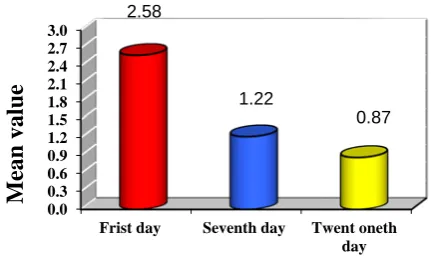
The mean value of lactate in the first, seventh and twenty- first days post-liver transplantation were 2.58 ± 1.42, 1.22 ± 0.36, and 0.87 ± 0.35, respectively. There was a statistical significant difference between the three times of measurement (Chi square value= 33.395, p= 0.001), where the 7th (Z= -4.045; p= 0.001) and 21st days (Z= -4.342; p= 0.001) were significantly decreased when compared with its corresponding value measured at the first day. Also there was a statistically significant decrease in the 21st day when compared with its corresponding value measured at the 7th day (Z= -4.178; p= 0.001) (Table 3; Fig. 5)
Table 3: Comparison between mean values of lactate measured at different times of measurement in the studied
group.
First day (n= 30)
Seventh day(n= 30)
21st day (n= 30) Chi square value P value Mean ± SD 2.58 ± 1.42 1.22 ± 0.36 0.87 ±
0.35 33.395 0.001
(S) Z & p values
vs 1st day ----
Z= -4.045 & p= 0.001 (S)
Z= -4.342 & p= 0.001 (S)
Z & p value
vs 7th day ---- ----
Z= -4.178 & p= 0.001 (S) Chi square test= Friedman ANOVA test.
Z value= Wilcoxon Signed Ranks test. S= p< 0.05= significant.
6. Distance
There was a statistically significant increase in the mean value of distance measured at the twenty- first day (546.10 ± 88.78) when compared with its corresponding value measured at the 7th day (175.67 ± 85.72) (t= -18.270; p= 0.001) (Table4, fig, 6).
Table 4: Comparison between mean values of lactate measured at different times of measurement in the studied
group.
Seventh day (n= 30)
21st day
(n= 30) t value P value Mean ± SD 175.67 ± 85.72 546.10 ± 88.78 -18.276 0.001 (S) S= p< 0.05= significant.
Figure 1:Comparison between mean values of PH measured at different times of measurement in the studied group.
7.0 7.1 7.2 7.3 7.4 7.5
Frist day Seventh day Twent oneth
10 Journal of Advanced Pharmacy Education & Research | Apr-Jun 2019 | Vol 9 | Issue2
Figure 2:Comparison between mean values of PCO2 measured at different times of measurement in the studied
group.
Figure 3: Comparison between mean values of PO2 measured at different times of measurement in the studied group.
Figure 4:Comparison between mean values of HCO3 measured at different times of measurement in the studied
group.
Figure 5:Comparison between mean values of lactate measured at different times of measurement in the studied
group.
Figure 6:Comparison between mean values of distance measured at different times of measurement in the studied
group.
Discussion:
The aim of this study was to determine the effect of POWERbreathe plus device on rehabilitation of patients post liver transplantation.
Dysfunction of the respiratory muscles is considered the main cause of post- operative pulmonary complications, and can cause alveolar collapse that contributes to the formation of atelectasis leading to pulmonary infections. Inspiratory muscle training (IMT) appears to be an alternative to prevent these complications [11].
The results of the present study showed that POWERbreathe plus training has significantly improved the arterial blood gases among patients underwent liver transplantation surgery. There was a significant difference of all parameters of blood gases (PH) was increased 1.09% between 1st and 7th days, was increased 0.82% between 1st and 21st days. PCO2 was increased 14.62% between 1st and 7th days, then was increased 18.55% between
25 28 31 34 37 40
Frist day Seventh day Twent oneth
day
31.53
36.14
37.38
M
ean
val
u
e
0 20 40 60 80 100 120 140 160 180
Frist day Seventh day Twent oneth
day
142.88
41.03
89.33
M
ean
val
u
e
9 12 15 18 21 24 27
Frist day Seventh day Twent oneth day 17.21
22.63 23.23
M
ean
val
u
e
0.0 0.3 0.6 0.9 1.2 1.5 1.8 2.1 2.4 2.7 3.0
Frist day Seventh day Twent oneth day
2.58
1.22
0.87
M
ean
val
u
e
0 100 200 300 400 500 600
Seventh day Twent oneth day
175.67
546.1
M
ean
val
u
Journal of Advanced Pharmacy Education & Research | Apr-Jun 2019 | Vol 9 | Issue2 11
1st and 21st days. PO2 was increased 74.60% between 1st and 7th days, then was increased 44.70% between 1st and 21st days. Lactate was decreased 52.71% between 1st and 7th days, then was decreased 66.28% between 1st and 21st. HCO3 was increased 68.62% between 1st and 7th days, then was increased 75.25% between 1st and 21st days. And also the distance was improvement 210.87% in the 6-minute walk test between 7th and 21st days.
The results of this study coincided with the concept achieved by [12] who considered that using IMT postoperative makes the
patients more resistant to the detrimental consequences of surgery, promoted postoperative recovery and that this to be an important post-surgical intervention that appears to be effective at reducing morbidity.
The results were constant with a study done by [13] who concluded that inspiratory muscle training by IMT device for one month in post liver transplantation patients significantly improved the diaphragmatic strength represented by diaphragmatic excursion of these patients in addition to improvement of breathing mechanics for the study group.
In agreement with this study [14] concluded that postoperative inspiratory muscle training is well tolerated and appreciated and seems to reduce the incidence of atelectasis in patients scheduled for elective abdominal aortic aneurysm surgery.
The results of this study coincided accordance with [15] who concluded that 6Mwt results was improved in post liver transplantation patients and it was also demonstrated that performance improves over time post liver transplantation, improves functional capacity and quality of life after liver transplantation.
The results of this study agreed with [16] who concluded that resistive respiratory muscle training improves blood gases and pulmonary function suggesting this intervention as an efficacious therapy for patients with cervical spinal cord injury.
Conclusion:
The current respiratory device (Power breathe Plus) provided an adequate physiotherapy method to post liver transplantation patients, helped in improvement of blood gases (PH, PCO2, PO2 Lactate and HCO3) and the distance of the 6MWT, enhance patients' compliance and improvement in the quality of life post liver transplantation.
Conflict of interest
The authors declared that present study was performed in absence of any conflict of interest.
Acknowledgement
The authors are extremely grateful to all participants in this study and to Wadi El Nile hospital for help and support.
References
1. Müllhaupt, B., Dimitroulis, D., Gerlach, J. T., & Clavien, P. A. (2008). Hot topics in liver transplantation: organ allocation–extended criteria donor–living donor liver transplantation. Journal of hepatology, 48, S58-S67.
2. Feltracco, P., Carollo, C., Barbieri, S., Pettenuzzo, T., & Ori, C. (2013). Early respiratory complications after liver transplantation. World Journal of Gastroenterology: WJG, 19(48), 9271.
3. Lin, Y. H., Cai, Z. S., Jiang, Y., Lü, L. Z., Zhang, X. J., & Cai, Q. C. (2010). Perioperative risk factors for pulmonary complications after liver transplantation. Journal of International Medical Research, 38(5), 1845-1855.
4. Bozbas, S. S., Yilmaz, E. B., Dogrul, I., Ergur, F. O., Savas, N., Eyuboglu, F., & Haberal, M. (2011). Preoperative pulmonary evaluation of liver transplant candidates: results from 341 adult patients. Annals of transplantation, 16(3), 88-96.
5. González, E., Galán, J., Villalaín, C., Valero, J. C., Silla, I., & Rodríguez, G. (2006). Risk factors for acute respiratory failure after liver transplantation. Revista espanola de anestesiologia y reanimacion, 53(2), 75-81. 6. Huang, C. T., Lin, H. C., Chang, S. C., & Lee, W. C.
(2011). Pre-operative risk factors predict post-operative respiratory failure after liver transplantation. PloS one, 6(8), e22689.
7. Enright, S., Chatham, K., Ionescu, A. A., Unnithan, V. B., & Shale, D. J. (2004). Inspiratory muscle training improves lung function and exercise capacity in adults with cystic fibrosis. Chest, 126(2), 405-411.
8. Fagevik Olsén, M., Hahn, I., Nordgren, S., Lönroth, H., & Lundholm, K. (1997). Randomized controlled trial of prophylactic chest physiotherapy in major abdominal surgery. British Journal of Surgery, 84(11), 1535-1538.
9. Hart, N., Sylvester, K., Ward, S., Cramer, D., Moxham, J., & Polkey, M. I. (2001). Evaluation of an inspiratory muscle trainer in healthy humans. Respiratory medicine, 95(6), 526-531.
10. Beckerman, M., Magadle, R., Weiner, M., & Weiner, P. (2005). The effects of 1 year of specific inspiratory muscle training in patients with COPD. Chest, 128(5), 3177-3182.
11. Barbalho-Moulim, M. C., Miguel, G. P. S., Forti, E. M. P., Campos, F. D. A., & Costa, D. (2011). Effects of preoperative inspiratory muscle training in obese women undergoing open bariatric surgery: respiratory muscle strength, lung volumes, and diaphragmatic excursion. Clinics, 66(10), 1721-1727.
12 Journal of Advanced Pharmacy Education & Research | Apr-Jun 2019 | Vol 9 | Issue2 training to prevent postoperative pulmonary
complications in high-risk patients undergoing CABG surgery: a randomized clinical trial. Jama, 296(15), 1851-1857.
13. Ahmed, N. Serry Z., Taha N. and Mohamed G. (2013). Effect of inspiratory muscle training on the diaphragmatic excursion post liver transplantation. Master Thesis, Faculty of physical therapy, Cairo University.
14. Dronkers, J., Veldman, A., Hoberg, E., Van Der Waal, C., & Van Meeteren, N. (2008). Prevention of pulmonary complications after upper abdominal surgery
by preoperative intensive inspiratory muscle training: a randomized controlled pilot study. Clinical rehabilitation, 22(2), 134-142.
15. VanWagner, L. B., Uttal, S., Lapin, B., Lee, J., Jichlinski, A., Subramanian, T., & Tapia, C. S. (2016). Use of six-minute walk test to measure functional capacity after liver transplantation. Physical therapy, 96(9), 1456-1467.