B
EATAK
OWALSKA−K
ROCHMAL1, I
ZABELAD
OLNA1, K
RZYSZTOFS
ZUFNAROWSKI2,
E
WAD
WORNICZEK1, R
OMANF
RANICZEK1, H
ANNAD
ASZKOWSKA3, G
RAŻYNAG
OŚCINIAK1,
I
RENAC
HOROSZY−K
RÓL1Frequency and Antibiotic Susceptibility of Enterococcal
Strains Isolated from Patients of Different Departments
of a University Teaching Hospital in Wrocław
Częstość izolacji i lekowrażliwość szczepów z rodzaju
Enterococcus
pochodzących od pacjentów hospitalizowanych w klinikach
Akademickiego Szpitala Klinicznego we Wrocławiu
1Department and Unit of Microbiology, Silesian Piasts University of Medicine in Wrocław, Poland 2University Teaching Hospital, Hospital Infections Group, Wrocław, Poland
3Microbiology Laboratory of the University Laboratory Diagnostic, Wrocław, Poland Adv Clin Exp Med 2008, 17, 3, 259–268
ISSN 1230−025X
ORIGINAL PAPERS
© Copyright by Silesian Piasts University of Medicine in Wrocław
Abstract
Background.Strains of Enterococcushave in recent years become one of the most frequent etiology factors in nosocomial infections, both in children and adults. The biggest threat are the strains resistant to glycopeptide and to high level aminoglycosides
Objectives. Estimation of frequency of isolation and drug susceptibility of enterococci obtained from differen clin− ical samples from patients from University Teaching Hospital (UTH) in Wrocław.
Material and Methods. One thousand nine hundred thirty three (1933) strains of Enterococcus isolated from patients from different clinic of UTH were enrolled in this study. Frequency of isolation of enteroccocci in rela− tion to general number of strains (N = 12435) and in relation to Gram−positive bacteria (5581) collected in period 1.01.2006–28.02.2007 was determined. Susceptibility to ampicillin, doxycycline, ciprofloxacin, gentamicin, van− comycin and teicoplanin was estimated.
Results. More than 2/3 of enterococci were isolated in pediatric wards. Highest number of strains was isolated from children from the Department of Bone Marrow Transplantation (23.6%), from Pediatric and Gastroenterology Hospital (20.6) and from adults from Gastroenterology Hospital (11.4%). Most frequently ente− rococci were obtained from stool and urine. Twenty strains were isolated from blood, 5 from cerebrospinal fluid and 11 strains from other physiological sterile fluids. Fiftheen strains were resistant to vancomicin, all of which belonged to the species E. faeciumand were obtained from nephrology department patients (1 child and 14 adults). The percentage of HLGR strains reached 23,6% in the E. faecalisgroup and 40.3% in E. faeciumgroup. E. fae− calisstrains were more susceptible to to ampicillin (97,3% i 3,4% respectively) and less susceptible to doxycycline (28.0% i 67.6% respectively).
Conclusions. Isolation of VRE strains from Nefrological Departments suggest necessity monitoring of glycopep− tide susceptibility among strains obtained as from urine as other clinical samples especially from stool (VRE col− onization) (Adv Clin Exp Med 2008, 17, 3, 259–268).
Key words: Enterococcus, frequency of isolation, antibiotic susceptibility.
Streszczenie
Wprowadzenie. Szczepy z rodzaju Enterococcusw ostatnich latach stały się jednym z najczęstszych czynników etiologicznych zakażeń szpitalnych, zarówno u dzieci, jak i dorosłych. Największym zagrożeniem stają się szcze− py oporne na glikopeptydy oraz duże stężenia aminoglikozydów.
Cel pracy. Ocena częstości izolacji i lekowrażliwości enterokoków pochodzących z różnych próbek klinicznych od pacjentów z klinik Akademickiego Szpitala Klinicznego (ASK) we Wrocławiu.
Bacteria of the genus Enterococcus have in recent years become one of the most frequent eti− ological factors in nosocomial infections, both in adults and children. Among the reasons for the increased role of enterococci in infections can be the misuse and irrational use of wide−spectrum antibiotics, especially cephalosporins, as well as the widespread use of invasive medical proce− dures. The above practices lead to the selection of multi−resistant strains, posing a serious therapeutic problem. The largest threat are strains resistant to glycopeptides (mainly vancomycin, i.e. VRE strains), antibiotics which are the drugs of choice in serious infections caused by multi−resistant Gram−positive cocci. The increasingly frequent occurrence of high−level aminoglycoside−resistant (HLAR) strains among pathogenic enterococci makes standard therapy with these antibiotics in
combination with β−lactams impossible.
Material and Methods
Evaluated were the frequency of occurrence and drug susceptibility of enterococci isolated between Jan. 1, 2006, and Feb. 28, 2007, from patients of the departments of the University Teaching Hospital (UTH) in Wrocław, including the following pediatric hospitals: Bone Marrow Transplantation Hospital; Pediatric Oncology and Hematology Hospital (Hematology (Hem.) and Transplantation (Transp.) departments); Pediatric Nephrology (Ped. Nephr.) Hospital; Pediatric Surgery and Urology Hospital (Ped. Surg.); Pediatric, Gastroenterology, and Nutrition Hospital (Ped. Gastr.); Department of Intensive Pediatric Therapy and Anesthesiology (IPTA); Pediatrics and Infectious Diseases Hospital (Ped. Inf.); Pediatrics, Cardiology, and Allergology Hospital (Ped. Allerg.); and the Neonatology Hospital (Neonat.), and the following hospitals for
adult patients: Angiology, Arterial Hypertension, and Diabetology (Ang); Nephrology and Trans− plantation Medicine Hospital (Nephr.); Vascular Surgery, General Surgery, and Transplantation Surgery Hospital and General, Gastroentero− logical, and Endocrinological Surgery Hospital (Surg.); Alimentary Tract and General Surgery Hospital (Alim. Tract Surg.); Trauma and Hand Surgery Hospital (Trauma Surg.); Gynecology, Reproduction, and Obstetrics Hospital (Gyn.); Gastrology and Hepatology Hospital (Gastr.); and the Internal and Allergic Diseases Hospital (Int.− Allerg.). Bacteriological tests, including the isola− tion, identification, and assessment of bacterial susceptibility to antibiotics, were performed using routine methods at the Microbiology Laboratory of the University Laboratory Diagnostic Center of Silesian Piasts University of Medicine in Wrocław. Resistance to vancomycin was con− firmed at the Department of Microbiology of Silesian Piasts University of Medicine in Wrocław using the agar dilution method (in line with CLSI guidelines) [1].
Results
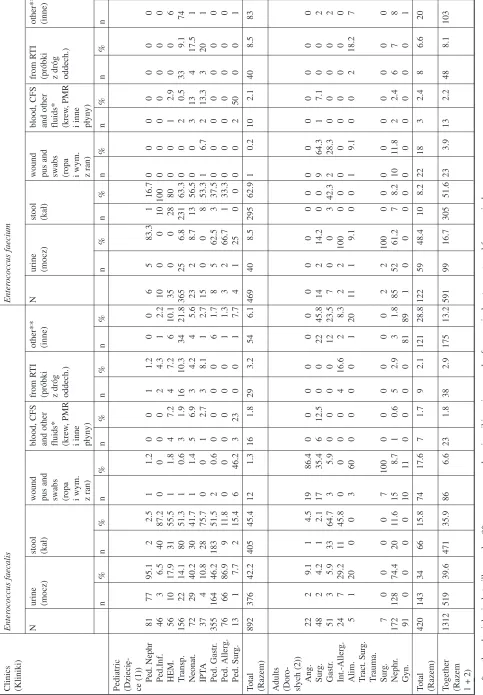
The frequencies of the enterococcal strains isolated from different clinical material obtained from patients treated in the hospitals and depart− ments between Jan. 1, 2006, and Feb. 28, 2007, are presented in Tables 1 and 2. During this time, 1993 enterococcal strains were isolated, which consti− tuted 15.5% of the total number of bacterial strains isolated (N = 12435) and 34.6% of the Gram−pos− itive bacteria (N = 5581). More than 2/3 of the fecal streptococci were isolated in pediatric wards (71.3%, 1378 strains), representing 17.0% of the total number of isolates (N = 8105) and 32.9% of the Gram−positive bacteria (N = 4189) isolated from children at the UTH. Enterococcal strains
jak i do Gram−dodatnich bakterii (5581) wyosobnionych od pacjentów w okresie od 1.01.2006 do 28.02.2007 r. Oceniono wrażliwość na ampicylinę, doksycyklinę, ciprofloksacynę, gentamycynę, wankomycynę i teikoplaninę. Wyniki. Ponad 2/3 enterokoków pochodziło z oddziałów pediatrycznych. Najwięcej szczepów wyizolowano z Od− działu Przeszczepów Szpiku (23,4%) i z Kliniki Pediatrii i Gastroenterologii (20,6%) oraz od dorosłych z Kliniki Gastroenterologii (11,4%). Enterokoki były najczęściej wyosobniane z kału i moczu. Dwadzieścia wyizolowano z krwi, 5 z płynu mózgowo−rdzeniowego i 11 z innych fizjologicznie jałowych płynów. Piętnaście szczepów by− ło opornych na wankomycynę, wszystkie należały do gatunku E. faecium, wyizolowanych od 14 dorosłych i 1 dziecka z oddziałów nefrologicznych. Odsetek szczepów HLGR wynosił 23,6% wśród E. faecalisi 40,3% wśród E. faecium. Szczepy E. faecalisbyły bardziej niż E. faeciumwrażliwe na ampicylinę (odpowiednio 97,3 i 3,4%) i ciprofloksacynę (49,5 i 11,3%), a mniej wrażliwe na doksycyklinę (odpowiednio 28,0 i 67,6%). Wnioski. Izolacja szczepów bakterii z rodzaju Enterococcusopornych na wankomycynę VRE z oddziałów nefro− logii sugeruje konieczność stałego monitorowania wrażliwości na glikopeptydy zarówno enterokoków izolowa− nych z moczu, jak i z innych materiałów, zwłaszcza z kału (kolonizacja szczepami VRE) (Adv Clin Exp Med 2008, 17, 3, 259–268).
isolated from adult patients (28.7%, n = 555) rep− resented 12.8% of the total number of strains (N = 4330) and 39.9% of the Gram−positive bacte− ria (N = 1392).
The frequency of isolation of enterococci in the individual hospitals and departments was assessed both in relation to the general number of strains and to the number of Gram−positive bacte− ria isolated from patients of the individual wards. Considering the general number of isolates, the highest number of enterococci was isolated from children from the Department of Transplants and from the Pediatric and Gastroenterology Hospital, where they represented 23.4 and 20.6%, respec− tively, of the total number of isolated strains, and from adult patients of the Gastroenterology Hospital and the Alimentary Tract Surgery
Hospital, representing 11.4 and 10.8%, respective− ly, of the total number of strains. However, when only Gram−positive bacteria are considered, fecal streptococci constituted more than 60% of all the strains isolated at the Gastroenterology Hospital and at the Pediatric and Gastroenterology Hospital, slightly less than 50% at the Nephrology and Pediatric Nephrology Hospital, and only 8% at the Pediatric Surgery Hospital and 14% at the Internal and Allergic Diseases Hospital.
E. faecalis strains (N = 1312) prevailed (67.9%) among the fecal streptococci isolated from UTH patients. Strains isolated from children (N = 892) constituted 64.7% of all enterococci iso− lated at pediatric hospitals and were isolated most frequently from feces (n = 405, 45.4%) and urine (n = 376, 42.2%). Fecal strains represented more
Clinics Total Entero− Total Entero− Total E. faecalis E. faecium Other E.
(Kliniki) number coccus number coccus number % % (Inne E.)
(Ogólna % (Ogólna % (Ogólna %
liczba) liczba) liczba)
Gram (+) Gram (+) Entero−
i Gram (–) coccus (E)
Pediatrics (Dziecięce)
Ped. Nephr. 533 16.9 196 45.9 90 90 6.7 3.3
Ped. Inf. 352 15.9 163 34.4 56 82.2 17.8 0
Hem. 612 14.9 317 28.7 91 61.5 38.5 0
Transp. 2229 23.4 1583 33 522 29.9 69.9 0.2
Neonat. 1132 8.4 565 16.8 95 75.8 24.2 0
IPTA 631 8.4 315 16.8 53 69.8 28.3 1.9
Ped. Gastr. 1814 20.6 602 62.1 374 94.9 2.1 3
Ped. Allerg. 601 13.3 354 22.6 80 95 3.8 1.2
Ped. Surg. 201 8.4 94 8.1 17 76.5 23.5 0
Total 8105 17 4189 32.9 1378 64.7 34 1.3
(Razem) Adults (Dorosłych)
Ang. 219 7.3 89 25.8 23 95.7 0 4.3
Surg. 513 8.8 180 35 63 76.2 22.2 1.6
Gastr. 361 11.4 89 65.2 58 87.9 12.1 0
Int.−Allerg. 440 4.7 198 14.1 28 85.8 7.1 7.1
Alim.−Tract.Surg. 111 10.8 52 30.8 16 31.2 68.8 0
Trauma. Surg. 81 8 48 20.8 10 70 20 10
Nephr. 2092 6.7 562 47.2 265 64.9 32.1 3.2
Gyn. 513 8.3 263 35 92 98.9 1.1 0
Total 4330 12.8 1392 39.9 555 75.7 22 2.3
(Razem)
Together pediatrics 12435 15.5 5581 34.6 1933 67.9 30.6 1.5
and adults clinics (Razem dziecięce i dorosłych)
Table 1. Frequency of isolation of enterococci obtained from patients from Wrocław University Teaching Hospital
Tabela 1. Częstość izolacji enterokoków pochodzących od pacjentów z Akademickiego Szpitala Klinicznego we Wrocławiu
Clinics Enter ococcus faecalis Enter ococcus faecium (Kliniki) N urine stool wound blood, CFS from R T I other** N urine stool wound blood, CFS from R T I other** (mocz) (kał) pus and and other (próbki (inne) (mocz) (kał) pus and and other (próbki (inne) swabs fluids* z dróg swabs fluids* z dróg (ropa (krew , PMR oddech.) (ropa (krew , PMR oddech.) i wym. i inne i wym. i inne z ran) płyny) z ran) płyny) n % n % n % n % n % n % n % n% n% n% n % n %
Pediatric (Dziecię− ce (1)) Ped. Nephr
. 8 1 7 7 95.1 2 2.5 1 1.2 0 0 1 1.2 0 0 6 5 83.3 1 16.7 0 0 0 0 0 0 0 0 Ped.Inf. 46 3 6.5 40 87.2 0 0 0 0 2 4.3 1 2.2 10 0 0 10 100 0 0 0 0 0 0 0 0 HEM. 56 10 17.9 31 55.5 1 1.8 4 7.2 4 7.2 6 10.1 35 0 0 28 80 0 0 1 2.9 0 0 6 17.1 T ransp. 156 22 14.1 80 51.3 1 0.6 3 1.9 16 10.3 34 21.8 365 25 6.8 231 63.3 0 0 2 0.5 33 9.1 74 20.3 Neonat. 72 29 40.2 30 41.7 1 1.4 5 6.9 3 4.2 4 5.6 23 2 8.7 13 56.5 0 0 3 1 3 4 17.5 1 4.3 IPT A 3 7 4 10.8 28 75.7 0 0 1 2.7 3 8.1 1 2.7 15 0 0 8 53.3 1 6.7 2 13.3 3 2 0 1 6.7 Ped. Gastr . 355 164 46.2 183 51.5 2 0.6 0 0 0 0 6 1.7 8 5 62.5 3 37.5 0 0 0 0 0 0 0 0 Ped. Aller g. 7 6 6 6 86.9 9 1 1.8 0 0 0 0 0 0 1 1.3 3 2 66.7 1 33.3 0 0 0 0 0 0 0 0 Ped. Sur g. 13 1 7.7 2 15.4 6 46.2 3 2 3 0 0 1 7.7 4 1 25 0 0 0 0 2 5 0 0 0 1 25 T otal 892 376 42.2 405 45.4 12 1.3 16 1.8 29 3.2 54 6.1 469 40 8.5 295 62.9 1 0.2 10 2.1 40 8.5 83 17.8
(Razem) Adults (Doro− s¦ych (2)) Ang
22 2 9.1 1 4.5 19 86.4 0 0 0 0 0 0 0 0 0 0 0 0 0 0 0 0 0 0 0 Sur g. 48 2 4.2 1 2.1 17 35.4 6 12.5 0 0 22 45.8 14 2 14.2 0 0 9 64.3 1 7.1 0 0 2 14.3 Gastr 51 3 5.9 33 64.7 3 5.9 0 0 0 0 12 23.5 7 0 0 3 42.3 2 28.3 0 0 0 0 2 28.3 Int.−Aller g. 24 7 29.2 1 1 45.8 0 0 0 0 4 16.6 2 8.3 2 2 100 0 0 0 0 0 0 0 0 0 0 Alim. 5 1 20 0 0 3 6 0 0 0 0 0 1 20 1 1 1 9.1 0 0 1 9.1 0 0 2 18.2 7 63.6 T ract. Sur g. T rauma. Sur g. 7 0 0 0 0 7 100 0 0 0 0 0 0 2 2 100 0 0 0 0 0 0 0 0 0 0 Nephr . 172 128 74.4 20 1 1.6 15 8.7 1 0.6 5 2.9 3 1.8 85 52 61.2 7 8.2 10 1 1.8 2 2.4 6 7 8 9.4 Gyn. 91 0 0 0 0 10 1 1 0 0 0 0 81 89 1 0 0 0 0 0 0 0 0 0 0 1 100 T otal 420 143 34 66 15.8 74 17.6 7 1.7 9 2.1 121 28.8 122 59 48.4 10 8.2 22 18 3 2.4 8 6.6 20 16.4
(Razem) Together 1312
519 39.6 471 35.9 86 6.6 23 1.8 38 2.9 175 13.2 591 99 16.7 305 51.6 23 3.9 13 2.2 48 8.1 103 17.4
(Razem 1 + 2)
T
able 2.
Frequency of isolation of enterococci from dif
ferent clinical samples
T
abela 2.
Częstość izolacji enterokoków z różnych próbek klinicznych
* – other physiological sterille samples, ** – wymazy z pochwy i szyjki macicy; samples from vaginal wet mounts and from cervic
al smears.
IPT
A
–
Department of Intensive Pediatric Therapy and Anaesthesiology
. Oddział Intensywnej T
erapii Dziecięcej i Anestezjologii.
N – number of
E. faecalis
or
E. faecium
isolated from particular Clinics, n – number of enterococci isolated from particular clinical samples.
Clinics (Kliniki) Pediatric (Dziecię− ce (1))
Ped. Nephr Ped.Inf. HEM. Transp. Neonat. IPT
A Ped. Gastr . Ped. Aller g. Ped. Sur g. T otal
(Razem) Adults (Doro− słych (2)) Ang. Sur g. Gastr . Int.−Aller g.
Alim. Tract. Sur
g. T rauma. Sur g. Nephr . Gyn. T otal
than 75% of the E. faecalisisolated from children from the Infectious Diseases Hospital (87.2%) and the Intensive Care Unit (75.7%) and more than 50% of the strains isolated at the Hematology (55.4%), Gastroenterology (51.5%), and Transplantation (51.3%) wards. Urinary strains
represented 95.1% of E. faecalis isolated from
children at the Nephrology Hospital and 86.9% of the isolates from the Allergic Diseases Hospital.
E. faecalisstrains isolated from adult patients (N = 420) constituted 75.7% of the total number of enterococci and were most frequently isolated from urine (n = 143, 34%) and other materials (n = 121, 28.8%). Urinary strains constituted 74.4% of
E. faecalis isolated from patients of the Nephrology Hospital, 29.9% at the Internal Diseases Hospital, and less than 10% at other hos− pitals. Strains from other materials represented
89% of E. faecalis isolated from patients of the
Gynecology Hospital (mainly from vaginal wet mounts and cervical smears). Fecal strains were isolated mainly from patients of the Gastroenterology Hospital and constituted 64.7% of E. faecalis. Strains isolated from pus and wound
infections prevailed among E. faecalis isolated
from the patients of the Department of Angiology and Surgery Departments.
E. faecium (N = 591) represented 30.6% of the
total number of strains of the genus Enterococcus
obtained from UTH patients. E. faecium strains
isolated in pediatric wards (N = 469, 34.0%) were most frequently isolated from the feces (n = 295,
62.9%). The largest number of E. faecium were
obtained in the Transplantation Ward (365/469, 77.8%), with fecal strains representing 63.3%.
E. faecium strains isolated from adult patients (N = 122) represented 22% of all enterococci and were isolated most often from urine (n = 59, 48.4%) and were obtained primarily at the Nephrology Department.
Twenty enterococci strains were isolated from
blood, including 14 E. faecalis strains and 6 E. fae−
cium strains. Twelve E. faecalis and 5E. faecium
strains were isolated at pediatric hospitals from young patients of the Oncology and Hematology
Department (4 E. faecalis and 1 E. faecium),
Transplantation Department (3 and 2, respective− ly), and the Neonatology Hospital (5 and 2). As for adult patients, only 3 strains were isolated from blood (and all at surgical hospitals), including 2 E. faecalisstrains and 1 E. faecium strain.
Five enterococci strains were isolated from the cerebrospinal fluid, all from children, including 3 strains isolated at the Pediatric Surgery
Department (2 E. faecalis and 1 E. faecium) and
2 E. faeciumstrains each isolated at the ICU and at the Neonatology Hospital. Enterococci were also
isolated from the fluids from body cavities, with 11 strains in total, including 4 from children, i.e.
2 from the Surgery Department (1 E. faecalisand
1 E. faecium) and 2 from the ICU (1 E. faecalis
and 1 E. faecium), and 7 from adult patients, i.e.
4 E. faecalis strains from the Vascular Surgery Department and 3 strains from the Nephrology
Department (2 E. faeciumand 1 E. faecalis).
Drug Susceptibility
Among the strains of the genus Enterococcus
isolated from patients treated at the UTH, 15 van− comycin−resistant strains were found, all of which
belonged to the species E. faeciumobtained from
nephrology department patients, including 1 obtai− ned from a child and the remaining ones from
adults (Fig. 1). In the E. faecalis group, the per−
centage of high−level gentamycin resistant (HLGR) strains reached 23.6%, while in the
E. faecium group it stood at 40.3%. E. faecalis
strains were more susceptible to ampicillin than
were E. faeciumstrains (97.3% and 3.4%, respec−
tively) and ciprofloxacin (49.5% and 11.3%) and less susceptible to doxycycline (28.0% and 67.6%, respectively).
Comparison of the susceptibility of enterococ− ci isolated from children and from adults shows
that in the E. faecalis strain group (Fig. 2) no sig−
nificant susceptibility differences were found,
while in the E. faecium group (Fig. 3) a much
higher percentage of the strains isolated from adults (19.4% and 0.5%, respectively) was resis− tant to vancomycin; in this group of bacteria, HLAR strains were more frequently isolated from children (55.3% vs. 22.2%).
An analysis of the drug susceptibility of the enterococcal strains isolated at individual hospitals and departments was performed. Because of the small numbers of strains from the individual hos− pitals for which drug susceptibility analysis was conducted, data from three hospitals were taken for the comparative study, including the Nephrology and Gynecology Hospital for adults and the Department of Transplantation of the pedi− atric hospitals. In comparison with the strains iso− lated from patients of the nephrology and bone
marrow transplantation departments (MT), E. fae−
calis strains (Fig. 4) isolated from patients from the gynecology departments were more suscepti− ble both to ciprofloxacin (62.1, 42.7, and 38.7%, respectively) and to doxycycline (45, 24%, no analysis was performed for MT). A smaller per− centage of HLGR strains was also found (12.5,
25.3%, and 28.6%, respectively). Of the E. faeci−
um strains (Fig. 5) isolated from the nephrology
resistant (MIC ≥128 µg/ml) and only 2.2% were HLGR strains, while no strains isolated at the bone marrow transplantation department were resistant to vancomycin, but the percentage of HLGR stood at a high 52.1%.
Discussion
This study of epidemiological data from hos− pitals and departments of the University Teaching Hospital in Wrocław conducted from Jan. 1, 2006, to Feb. 28, 2007, showed that fecal enterococci represented 15.5% of the total number of isolated bacterial strains and 34.6% of the Gram−positive bacteria. In a study conducted in Greece in the last years of the 20th century (quoted in [2]),
Enterococcusstrains constituted 7.1% of all isolat− ed bacteria and 23.9% of Gram−positive bacteria. Reports from Slovakia [3] show as much as 40.2% of enterococcal infections among newborns in 1999–2000, while according to Czech data, ente− rococci were responsible for 13% of infections of diabetics in December 1998 to December 1999 [4]. The last two reports concerning the two south− ern neighbors of Poland confirm that small chil− dren, especially newborns and diabetics, are prone to infections, including enterococcal infections. Infections with fecal enterococci are also frequent in ICUs; in a study conducted in 2000 in Great Britain [5] they represented 14.3% of all infections caused by Gram−positive bacteria. The analysis of
data gathered at the UTH shows that the entero− cocci strains isolated from children hospitalized at the Transplantation Department and at gastroen− terology hospitals were isolated mainly from
0 10 20 30 40 50 60 70 80 90 100
ampicillin ampicylina
doxycycline doksycyklina
gentamicin 120 gentamycyna120
ciprofloxacin ciprofloksacyna
vancomycin wankomycyna
teikoplanin teikoplanina
E. faecalis E. faecium
% susceptibility % wra¿liwoœci
Fig. 1. Comparison of drug susceptibility (%) of total isolated strains of Enterococcus faecalisand Entero− coccus faecium(University Teaching Hospital in Wro− cław, 1.01.2006–28.02.2007)
Ryc. 1. Porównanie lekoowrażliwości (%) ogólnej liczby szczepów Enterococcus (E.) faecalisiEntero− coccus (E.) faecium(Akademicki Szpital Kliniczny, Wrocław, 1.01.2006–28.02.2007 r.)
0 20 40 60 80 100
E. faecalis– kliniki d
Paediatric Clinics zieciêce
E. faecalis– kliniki d
Clinic of Adults oros³ych
ampicillin ampicylina
doxycycline doksycyklina
gentamicin 120 gentamycyna120
ciprofloxacin ciprofloksacyna
vancomycin wankomycyna
teikoplanin teikoplanina % susceptibility
% wra¿liwoœci
Fig. 2. Comparison of drug susceptibility (%) of E. fa− ecalisisolated from children and adults hospitalized at the University Teaching Hospital in Wrocław, 1.01.2006–28.02.2007
Ryc. 2. Porównanie lekowrażliwości (%) szczepów Enterococcus faecalisizolowanych od dzieci i od do− rosłych hospitalizowanych w Akademickim Szpitalu Klinicznym we Wrocławiu (1.01.2006–28.02.2007 r.)
0 20 40 60 80 100
E. faecium– kliniki d
Paediatric Clinics zieciêce
E. faecium– kliniki d
Clinic of Adults oros³ych
ampicillin ampicylina
doxycycline doksycyklina
gentamicin 120 gentamycyna120
ciprofloxacin ciprofloksacyna
vancomycin wankomycyna
teikoplanin teikoplanina % susceptibility
% wra¿liwoœci
Fig. 3. Comparison of drug susceptibility (%) of E. fa− eciumisolated from children and adults hospitalized at the University Teaching Hospital in Wrocław,
1.01.2006–28.02.2007
feces. It is common knowledge that these microor− ganisms constitute the normal flora of the alimen− tary tract, but their presence in patients with impaired immunity may have clinical significance, especially regarding multi−resistant strains (including VRE). The possibility to identify such strains during long−term treatment with antibi− otics, especially in immunosuppressed patients, and the translocation of the enterococci to other systems and organs facilitated by invasive medical procedures indicate the need for routine monitor− ing of drug susceptibility of the such fecal isolates.
According to reports from around the world,
E. faecalis strains prevailed among isolated fecal enterococci and constituted 56–90% of all entero−
cocci [5–10]. E. faecium strains were isolated less
frequently (5.2–27.6%), and the remaining
Enterococcus species represented 2.9–25%. The
analyzed material showed that E. faecalis repre−
sented 67.9% of all fecal enterococci isolated,
E. faecium 30.6%, and the remaining species 1.5%. The SENTRY Antimicrobial Surveillance Program [9] covering the period 1997–2000 showed geographical differences in the frequency
of isolation of individual Enterococcus species: in
Europe, E. faecalis constituted 67%, in
Asia–Pacific 76%, in Latin America 76%, and in
North America 56%; E. faecium constituted,
respectively, 17, 15, 5, and 19%, while the remain− ing species were 16, 9, 19, and 25%, respectively. In the present study the frequency of isolation of
E. faecaliswas close to the above European data,
and deviations concerned E. faecium and the
remaining species. Data from some European countries, such as Greece [2], Great Britain [5], Turkey [7], and Croatia [6], published in 2000–2005 included a larger percentage share of
E. faecalisin enterococcal infections (from 72.4% in Greece to 83.7–90.2% in Croatia). In similar data from Cuba [10] published in 2005 the fre−
quency of isolation of E. faecalisreached 85%.
In the present study concerning isolates from
the UTH, E. faecium strains which are more resis−
tant to antibiotics than E. faecalis represented as
much as 30.6% of the total number of enterococci, while data from literature sources indicate that the percentage share of this species in other countries, not only in Europe, but in the rest of the world, was lower, and only in some countries exceeded 20% (Greece 27.6% [2], 24.5% Great Britain [5], and Lebanon 22.9% [11]), while in Latin America [8–10] and in Turkey [7] it did not exceed 10%. What is interesting is the significant percentage share of other enterococcal species observed espe− cially in North America (25%) [9] and Latin America (ca. 19%) [9, 10], except for Cuba (5%) [10]. In the present study, the share of
Gynaecology Oddzia³ Ginekologiczny Adults Nephrology Oddzia³ Nefrologiczny Children Bone Marrow
Dzieciêcy Oddzia³ Przeszczepu Szpiku
0 10 20 30 40 50 60 70 80 90 100 % susceptibility % wra¿liwoœci
ampicillin ampicylina
doxycycline doksycyklina
gentamicin 120 gentamycyna120
ciprofloxacin ciprofloksacyna
vancomycin wankomycyna
teikoplanin teikoplanina
Fig. 4. Comparison of drug susceptibility (%) E. faecalis isolated from children from the department of Bone Marrow Transplantation and from adults in the Gyneco− logy and Nephrology Hospitals (1.01.2006–28.02.2007)
Ryc. 4. Porównanie lekowrażliwości (%) szczepów En− terococcus faecalisizolowanych od dzieci z Oddziału Przeszczepów Szpiku i od dorosłych z Kliniki Gineko− logii i Kliniki Nefrologii (1.01.2006–28.02.2007 r.)
Adults Nephrology Oddzia³ Nefrologiczny Children Bone Marrow
Dzieciêcy Oddzia³ Przeszczepu Szpiku
0 10 20 30 40 50 60 70 80 90 100 % susceptibility % wra¿liwoœci
ampicillin ampicylina
doxycycline doksycyklina
gentamicin 120 gentamycyna120
ciprofloxacin ciprofloksacyna
vancomycin wankomycyna
teikoplanin teikoplanina
Fig. 5. Comparison of drug susceptibility (%) E. fae− ciumisolated from children from the department of Bone Marrow Transplantation and from adults in the Nephrology Hospital (1.01.2006–28.02.2007)
Enterococcus strains reached only 1.5%, while other Polish data from 1996 collected at four hos− pitals [12] showed a twice higher frequency of iso−
lation of Enterococcus spp.
The pathogenic properties of fecal enterococci are confirmed by the presence of the above microorganisms in such materials as urine, blood, and wound exudate. As confirmed by literature
sources, Enterococcus species are most frequently
isolated from patients with urinary tract infections. Multicenter studies carried out in Poland and cov− ering the period 1998–1999 [13] indicate that ente− rococci were the dominant urinary tract pathogen among Gram−positive cocci isolated from hospi− talized patients. The present study showed that in the E. faecalis group, strains isolated from urine
represented 39.6% and in the E. faecium group
16.7%, and only 8.5% of E. faecalisisolated from
children was derived from urine in comparison
with as much as 48.4% of E. faecalisisolated from
adult patients. Other authors confirm the role of enterococcal bacteria as urinary tract pathogens. In a study carried out in Turkey [7], enterococci iso− lated from urine constituted 70% of the total num− ber of enterococci, in Croatia 52.7% [6], and in Mexico [8] and Cuba [10] more than 30%.
In total, strains isolated from blood, cere− brospinal fluid, and other body fluids constituted 1.9% of the analyzed material (blood 1.0%, cere− brospinal fluid 0.3%, and other fluids 0.6%). Strains isolated from pus represented 6.0% and from the respiratory tract 4.5%. According to other authors, of the total number of isolated enterococ− ci, strains isolated from blood represented 3.1% in Croatia [6], 7.2% in Poland [12], and 11.8% in the pediatric hospital in Mexico [8].
According to a study performed in
Washington, USA, concerning nosocomial entero− coccal infections in children, septicemia was diag− nosed in 62% of the patients and CNS inflamma− tion in 1%. In the above study the authors indicat− ed that the factors contributing to nosocomial enterococcal infections are the presence of central catheters, mechanical ventilation, pathological changes, procedures within the alimentary tract, as well as long−term antibacterial treatment, especial− ly with such antibiotics as ampicillin, cefotaxim, ceftazidime, clindamycin, gentamycin, or van− comycin.
Enterococci, which have a natural resistance to cephalosporins, low concentrations of amino− glycosides, licosamides, and cotrimoxazole, are characterized by variable susceptibility to aminopenicillin antibiotics, tetracyclines, fluoro− quinolones, glycopeptides, and high concentra− tions of aminoglycosides. The drug susceptibility of individual strains varies depending on the genus
and origin of the strain (outpatients/inpatients, patients from various hospital wards). The present study showed that 15 (3.8%) of the studied strains were resistant to vancomycin, while retaining their sensitivity to teicoplanin. All VRE strains
belonged to the species E. faecium. Multicenter
studies covering Europe, Asia−Pacific, Latin America, and North America [9] showed that in 2000 the highest percentage of glycopeptide−resis− tant enterococci (GRE) was observed in North
America (12% VAR, 10% TPR) and the lowest in
Asia (both 1%), while in Europe, 2% of the strains were found to be resistant to vancomycin and 1% to teicoplanin. The present study as well as those by other authors show that GRE strains were
found mainly in the E. faecium group; in the
United States the percentage of these strains reached as much as 50% [9] and in some European countries it ranged from 3.1% in France [14] to 18% in Great Britain [5], while in Cuba it was 10% [10]. The available data indicate that both in European countries such as Great Britain [15], Germany [16], Belgium [17], and Poland (data from 2003–2005 in [18]) and in the United States [9] and Argentina [19], Van A strains were domi− nant (resistant both to vancomycin and teicoplanin), while in the present study, van− comycin−resistant strains were susceptible to teicoplanin, which excludes the above resistance phenotype. Interesting data on VRE colonization in pediatric wards were presented by Gray and George from Birmingham [15], who observed col− onization by the above strains in 38.3% of children from the hematology and oncology ward and only 2.3% of the pediatric patients from the ICU. Reports from Belgium [17] show that GRE strains were not characterized by high resistance to gen− tamycin, and only 23% of them were HLSR. Nearly 70% of the VRE strains isolated from pedi− atric patients at the hospital in Birmingham [15] were susceptible to tetracycline and ciprofloxacin, although both of these antibiotics are not recom− mended for children.
The analysis of the drug susceptibility of ente− rococci isolated from UTH patients shows signifi−
cant differences in the susceptibilities of E. fae−
Italy [21], and 82% in the Netherlands [20]), and to tetracycline (67% in Italy [21], 78% in the Netherlands [20]). The percentage of HLGR strains ranged from 11.5% in outpatients to 37% in inpatients in Croatia [3], 15% in Italy [10], and as much as 40% of ICU strains in Great Britain [5].
The majority of E. faecium strains isolated from
UTH patients were resistant to ampicillin (the per− centage of sensitive strains isolated from children was as small as 3.2% and for adults the percentage was 3.7%) and fluoroquinolons (14.8 and 7.9%, respectively), but a large number of them were sus− ceptible to doxycycline (71.4 and 66.7%). The per− centage of HLGR strains was 55.3 and 22.2%, respectively. Studies by other authors show either
total resistance of E. faeciumstrains to ampicillin
[7, 12], small susceptibility (4%) in Great Britain [5], and greater susceptibility (24%) in Greece [2]. The percentage of strains susceptible to fluoro− quinolons presented in available literature was also very diversified and ranged from 13.3% in Poland in 1996 [12] and 15.5% in Italy in 1997–1999 [21] to 70–80% in Cuba in 2001 [10], while the percent− age of strains susceptible to tetracycline was similar to or lower than the results of the present study and ranged from 45 in Japan [22] to 60% in Italy [21] and Lebanon [11], while in Cuba it was as low as
10% [10]. The share of HLGR strains among E. fae−
ciumwas diversified and ranged from 10–15% in
Italy [21] to 88% in Turkey [7].
References
[1]Performance standards for antimicrobial susceptibility testing; sixteenth informational supplement. National Committee for Clinical Laboratory Standard Institution M100−S16, 2006, 26, 3.
[2] Papaparaskevas J, Vatopoulos A, Tassios PT, Avlami A, Legakis N J, Kalapothaki V:Diversity among high− level aminoglycoside−resistant enterococci. J Antimicrob Chemother 2000, 45, 277–283.
[3] Bilikova E, Koprnova J, Hafed BM, Svetlansky I, Chovancova D, Drobna M, Huttova M, Krcmery V: Nosocomial enterococcal infections in neonates. Int J Infect Dis 2004, 8, 127–129.
[4] Fejfarová V, Jirkovská A, Petkov V, Bouček P, Skibová J:Comparison of microbial findings and resistance to antibiotics between transplant patients, patients on hemodialysis, and other patients with the diabetic foot. J Diabetes Complicat 2004, 18, 108–112.
[5] Johnson AP, Henwood C, Mushtaq S, James D, Warner M, Livermore DM: The ICU Study Group: Susceptibility of Gram−positive bacteria from ICU patients in UK hospitals to antimicrobial agents. J Hosp Infect 2003, 54, 179–187.
[6] Barišić Z, Punda−Polić V:Antibiotic resistance among enterococcal strains isolated from clinical specimens. Int J Antimicrob Agents 2000, 16, 65–68.
[7] Kaçmaz B, Aksoy A: Antimicrobial resistance of enterococci in Turkey. Int J Antimicrob Agents 2005, 25, 535–538.
[8] Miranda G, Lee L, Kelly C, Solórzano F, Leaños B, Muñoz O, Patterson JE:Antimicrobial resistance from enterococci in a pediatric hospital. Plasmids in Enterococcus faecalis isolates with high-level gentamicin and streptomycin resistance. Arch Med Res 2001, 32, 159–163.
[9] Mutnick AH, Biedenbach DJ, Jones RN:Geographic variations and trends in antimicrobial resistance among Enterococcus faecalis and Enterococcus faecium in the SENTRY Antimicrobial Surveillance Program (1997–2000). Diagn Microbiol Infect Dis 2003, 46, 63–68.
[10] Quiñones D, Goñi P, Rubio MC, Duran E, Gómez-Lus R:Enterococci spp. isolated from Cuba: species fre-quency of occurrence and antimicrobial susceptibility profile. Diagn Microbiol Infec Dis 2005, 51, 63–67.
[11] Zouain MG, Araj GF:Antimicrobial resistance of enterococci in Lebanon. Int J Antimicrob Agents 2001, 17, 209–213.
[12] Hryniewicz W, Zaręba T, Kawalec M:Susceptibility patterns of Enterococcusspp. isolated in Poland during 1996. Int J Antimicrob Agents 1998, 10, 303–307.
[13] Hryniewicz K, Szczypa K, Sulikowska A, Jankowski K, Betlejewska K, Hryniewicz W:Antibiotic suscepti− bility of bacterial strains isolated from urinary tract infections in Poland. J Antimicrob Chemother, 2001, 47, 773–780.
[14] Bertrand X, Thouverez M, Bailly P, Cornette C, Talon Dand members of Réseau Franc−Comtois de Lutte con− tre les Infections Nosocomiales: Clinical and molecular epidemiology of hospital Enterococcus faecium isolates in eastern France. J Hosp Infec 2000, 45, 125–134.
[15] Gray JW, George George H:Experience of vancomycin−resistant enterococci in a children’s hospital. J Hosp Infect 2000, 45, 11–18.
[16] Elsner H.−A, Sobottka I, Feucht H−H, Harps E, Haun C, Mack D, Ganschow R, Laufs R, Kaulfers P−M: Nosocomial outbreak of vancomycin−resistant Enterococcus faeciumat a German University Pediatric Hospital. Int J Hyg Environment Health 2000, 147–152.
[17] Descheemaeker P, Ieven M, Chapelle S, Lammens C, Hauchecorne M, Wijdooghe M, Vandamme P, Goossens H: Prevalence and molecular epidemiology of glycopeptide−resistant enterococci in Belgian Renal Dialysis Units. J Infect Dis 2000, 181, 235–241.
[19] Lopardo H, Corso A, Gagetti P, Carbonaro M, Andión E, Ruvinsky S, Torroija C, Mastroianni A, Bologna R:Prevalence studies of vancomycin−resistant enterococci for monitoring a passive surveillance program in a pediatric hospital. Int Congress Series 2006, 1289, 107–110.
[20] Waar K, Willems RJL, Slooff MJH, Harmsen HJM, Degener JE:Molecular epidemiology of Enterococcus faecalisin liver transplant patients at University Hospital Groningen. J Hosp Infect 2003, 55, 53–60.
[21] Dicuonzo G, Gherardi G, Lorino G, Angeletti S, Battistoni F, Bertuccini L, Creti R, Di Rosa R, Venditti M, Baldassarri L:Antibiotic resistance and genotypic characterization by PFGE of clinical and environmental iso− lates of enterococci. FEMS Microbiol Lett 2001, 201, 205–211.
[22] Takeuchi K, Tomita H, Fujimoto S, Kudo M, Kuwano H, Ike Y:Drug resistance of Enterococcus faeciumclin− ical isolates and the conjugative transfer of gentamicin and erythromycin resistance traits. FEMS Microbiol Lett 2005, 243, 347–354.
Address for correspondence:
Beata Kowalska−Krochmal
Department and Unit of Microbiology Silesian Piasts University of Medicine Chałubińskiego 4
50−367 Wrocław Poland
Conflict of interest: None declared