
Copyright © 2013 IJECCE, All right reserved
UDP-Based Multi-Stream Communication Protocol
Vandana Vijay Belkhode
Sinpa Coet, Amravaty Email: [email protected]
Prof. D. M. Dakhane
Sinpa Coet, Amravaty
Prof. R. L. Pardh
Sinpa Coet, Amravaty
Abstract–A network of the system is build with the help of all hardware and software. These all software and hardware components connected together. But the question is how used these devices or components together? The answer is, to share the resources of these device and component together! These resources could be containing various files, a printer and also web pages, e-mail, massages, pictures, MMS etc. The goal of networking and internet technology is to make resource shared by the remote system function like a resource on a local system. As discussed, there are various components involved while constructing a network. In these we have to discuss about two basic protocols one is connectionless and other is connection-oriented. In connectionless protocol handshaking are not required but in connection-oriented protocol handshaking process are most important. UDP (user datagram protocol) is an example of connectionless protocol, TCP (transmission control protocol) is connection-oriented protocol. A connection-oriented communication is a data communication made that requires an overhead in setting up a request for connection before sending any type of data communication message. In Connectionless Protocol cannot require any type of handshaking process for sending a data. This communication method in which communication occurs between hosts. The device at one end of the communication transmits data to the other, without first ensuring that the delivery report is available and ready to accepting the data. The server sending a message to sends it addressed to the intended recipient. The Internet Protocol (IP) and User Datagram Protocol (UDP) are connectionless protocols, but TCP/IP (the most common use of IP) is connection-oriented. Here we have to study how to use UDP connectionless protocol as a connection oriented protocol. But these two protocols are not sufficient for today’s internet. Today we want more flexible, more efficient protocol. For fulfill is requirement we developed the new generation protocol SCTP. The full name is Stream Control Transmission Protocol. SCTP is fulfilling the each and every requirementof today’s internet very effectively. It is basically more similar with TCP because it is also a connection-oriented protocol. In SCTP there are four step connection setup processes. All basic features of TCP and UDP are included in SCTP protocol.
Keywords – Multistream, Multihoming, Load Balancing, Reliable Massages, Communication Protocol.
I. I
NTRODUCTIONThis work is totally base on the study of the reliable communication from single user to multi- stream, on available multiple devices. The major purpose behind this paper is to provide reliable communication functionality from one single user to multiple users. It should be noted that similar transport layer contain two Transport protocol
TCP and SCTP don’t provide the kind of functionality that
this protocol provides. The Stream Control Transmission Protocol (SCTP) is a reliable message-oriented protocol with transparent support for multihoming. It allows multiple not dependent complex exchanges which all share
Copyright © 2013 IJECCE, All right reserved The most common way of developing the networking
protocol is to implementing the part of kernel space (kernel space and user space). This is not divided into two, but also its configuration, tweaking and portability to multiple operating systems more difficult.
1. Related work
1.1 Combination of UDP and
TCP-We know only to basic protocol one is TCP and another one is UDP. These are used to connect distributed applications and allow messages to flow between them. These protocols have been used successfully to design and developed Internet applications as we know them: e-mail, HTTP, name services and so forth. In modern generation we required most powerful protocol which provides stream data transmission and reliable data transmission and most important is more secure. The combination of these features protocol is stream control protocol.
The Stream control transmission protocol stack and provides transport layer functions to many Internet applications. SCTP has been approved by the IETF as a proposed standard in 2000 and updated over the years. SCTP is a reliable transport protocol operating on top of a connectionless packet network such as IP. SCTP protocol is a combination of TCP and UDP because each has some advantages and some drawback.
UDP transmit the data in the form of stream and TCP transmit the data in the form of bytes. Transition of the data in the of stream is faster than transmission of bytes.
SCTP association startup and shutdown
SCTP association start and closed connection guidelines are described here.
SCTP association is comprised of a four way handshake connection establishing process that takes place in the following order:
1. The client sends an INIT signal to the server to initiate an association.
2. On receipt of the INIT signal, the server sends an INIT-ACK response to the client. This INIT-ACK signal contains a state cookie. This state cookie must contain a Message Authentication Code (MAC). Of the state cookie, and the information necessary to establish the association.
3. On receipt of this INIT-ACK signal, the client sends a COOKIE-ECHO response, which just echoes the state cookie.
4. The authenticity of the state cookie verifying using the secret key, after this step the server then allocates the resources for the association, sends a COOKIE-ACK response acknowledging the COOKIE-ECHO signal, and moves the association to ESTABLISHED state.
The following sequence of connection closed events occurs:
1. If the client ready to connection closed, client sends a SHUTDOWN signal to the server.
2. The server responds by sending a SHUTDOWN-ACK acknowledgement.
3. The client then sends a SHUTDOWN-COMPLETE signal back to the server.
In addition to the differences specified above between SCTP and existing transport protocols, SCTP provides the following characteristic:
Data delivered on stream: SCTP protocol context contain a stream, this stream refer to a sequence of user data and file that are transferred between one or more endpoints. An SCTP association can support various streams. Within each stream the order of data delivery is strictly maintained however, across the streams data delivery is not dependable.
If one stream can loss the data it never affect on others. Data fragmentation in SCTP: The network level can also performed fragmentation processes; the fragmentation process provides various advantages over IP-layer fragmentation in transport layer. Some of these advantages not re-send entire messages when fragments are lost in the network and reducing the burden on routers, if this is not done then IP fragmentation process should be performed.
Reliable data transmission: For reliable data delivery packet acknowledgment is necessary. When SCTP does not get an acknowledgment for a packet it sends with a specified time, it triggers an again transmission of the same packet.
Congestion control transmission: SCTP follows congestion control algorithms similar to those used by TCP. In addition to using cumulative acknowledgements like TCP, for a acknowledge packets selectively SCTP uses Selective Acknowledgment (SACK) mechanism
Developing a bundle of chunk: The SCTP control information and user data are present in a chunk. In the same SCTP header contain bundles of multiple chunks together. Chunk bundling requires assembly of chunks into SCTP packet at the sending end and subsequently disassembly of the packet into chunks at the receiver end.
Verification packet tag: Each SCTP packet has a verification tag field that is set during the time of association startup by each endpoint.
Address path: At the time of connection setup, each endpoint provided the list of transport addresses. Only one initial path is defined for the SCTP connection and it is used for the normal data transfer. In case the initial path goes down, the other transport addresses are used. SCTP
Socket Applications
The features of SCTP socket application include consistency, accessibility, and compatibility.
SCTP socket applications were designed to provide the following features:
1. Existing socket application maintains the consistency. 2. For access to new SCTP Features provide the base. 3. With few changes SCTP can be migrated to TCP and UDP protocol and provide the capability.
There are two different styles of SCTP application have been formulated:
1. UDP-
Style application: it provided the connectionless protocols like UDP with multi-stream communication.2. TCP-
Style application: It provided connection-oriented protocols like TCP. Connection oriented protocol provides reliability, flexibility and give the delivery report.1.2 Connectionless protocol
Copyright © 2013 IJECCE, All right reserved datagram. A datagram comprises one message unit UDP
transfer the data in the form of stream. The first eight (8) bytes of a datagram contain header information and the remaining bytes contain message data. UDP (User Datagram Protocol) is a communications protocol that offers a limited amount of service when messages are exchanged between computers in a network that uses the Internet Protocol (IP). UDP is an alternative to the Transmission Control Protocol (TCP) and, together with IP, is sometimes assign to as UDP/IP. Some as the Transmission Control Protocol, UDP uses the Internet Protocol to actually get a data unit (called a datagram) from one server to another. Unlike TCP, however, UDP does not provide the service of dividing a message into packets (datagrams) and reassembling it at the other end. Specifically, UDP provide unsequencing of the packets that the data arrives in. This means that the application program that uses UDP must be able to make sure that the entire message has arrived and is in the right order. Network applications that want to save processing time because they have very small data units to exchange (and therefore very little message reassembling to do) may prefer UDP to TCP. The Trivial File Transfer Protocol uses UDP instead of TCP.
UDP provides two services not provided by the IP layer. It provides port numbers to help distinguish different user requests and, optionally, a checksum capability to verify that the data arrived intact. Connectionless service is more appropriate in some contexts. At lower layers (internet and network), connectionless service is more robus
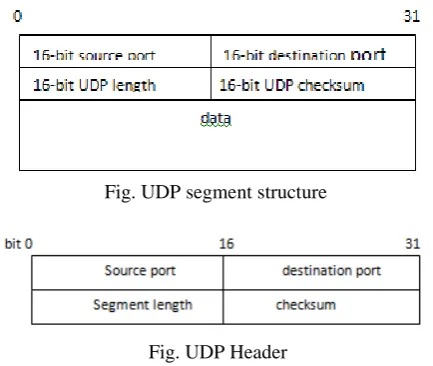
UDP segment structure and Header
Fig. UDP segment structure
Fig. UDP Header
The UDP header provided four fields each of 2 bytes in length
1. Source Port: It is a service access point (SAP) to indicate the session on the local client that originated the packet.
2. Destination Port: UDP packet use this as a service access point (SAP) to indicate the service required from the remote server.
3. UDP length: The length field indicates the entire length of the UDP segment, including header and data.
4. UDP Checksum: The checksum is used by the receiving host to check if error has been introduced into the segment during the course of its transmission from
source to destination. UDP checksum provide error finding methods. UDP at the sender side performs the
one’s complement of the sum of all the 16-bit words in the segment. This result put into the checksum field of the UDP segment. Checksum applies to the entire UDP segment plus a pseudo header prefixed to the UDP header at the time of calculation and is the same pseudo header used for TCP
1.3 Connection-oriented protocol
The TCP is a connection-oriented protocol; this required four step handshaking processes. The TCP is a reliable end-to-end transmission functionality in the overall Internet architecture. All the functionality required to take a simple base of IP datagram delivery and build upon this a control model that implements flow control, reliability, sequencing, and data streaming is embedded within TCP. TCP provides a communication channel between processes on each user system. The channel is reliable, full-duplex, and streaming. To attainment these features, the TCP drivers break up the session data stream into discrete segments, and connect a TCP header to each segment. An IP header is attached to this TCP packet, and the composite packet is then passed to the network for delivery. This TCP header has numerous fields that are used to support the intended TCP functionality.
TCP has the following functional
features:-1. Unicast protocol: TCP is based on a unicast network model, and supports data exchange between two servers. It does not support multicast network models.
2. Connection state: Rather than impose a state within the network to support the connection, TCP uses synchronized state between the two endpoints.
3. Reliable : Reliability implies that the stream of octets passed to the TCP driver at one end of the connection will be transmitted across the network so that the stream is presented to the remote process as the same sequence of octets, in the same order as that generated by the sender.
4. Full duplex: TCP is a full-duplex protocol; it allows both parties to send and receive data within the context of the single TCP connection.
5. Streaming: Although TCP uses a packet structure for network transmission, TCP is a real streaming protocol, and application-level network operations are not transparent.
6. Rate adaptation: TCP is also a rate-adaptive protocol, in that the rate of data flow is intended to adapt to the prevailing load conditions within the network and adapt to the processing capacity of the receiver.
The TCP Protocal Header:
Copyright © 2013 IJECCE, All right reserved Fig. TCP Header
The acknowledgment sequence number is used to inform the remote end of the data that has been successfully received. The acknowledgment sequence number is actually one greater than that of the last octet correctly received at the local end of the connection. The data offset field indicates the number of four-octet words within the TCP header. Six single bit flags are used to indicate various conditions. URG is used to indicate whether the urgent pointer is valid. ACK is used to indicate whether the acknowledgment field is valid. PSH is set when the sender wants the remote application to push this data to the remote application. RST is used to reset the connection. SYN (for synchronize) is used within the connection startup phase, and FIN (for finish) is used to close the connection in an orderly fashion. The window field is a 16-bit count of available buffer space. It is added to the acknowledgment sequence number to indicate the highest sequence number the receiver can accept. The TCP checksum is applied to a synthesized header that includes the source and destination addresses from the outer IP datagram. The final field in the TCP header is the urgent pointer, which, when added to the sequence number, indicates the sequence number of the final octet of urgent data if the urgent flag is set.
1.4 Techniques related to protocol
Some of the underlying principles used in the design of our Protocol were first mentioned (as concepts).In a (multi)point-to-(multi)point communication protocol was proposed which uses delay for congestion control, rather
Than a congestion window (like TCP, SCTP and our protocol). In a one-to-many communication method based
On constructing an application-aware overlay was proposed. This differs from our approach, in the sense that an overlay needs to be constructed and maintained. In the authors maintain the idea of constructing an overlay for multicast communication, but this overlay is hidden
“under” an “overlay socket”. In the sense of introducing
new types of sockets, this approach is similar to ours. In regard to the user space implementation of our communication protocol, many previously proposed protocols were also implemented in user space. Recently, an Internet draft proposal was published for encapsulating SCTP packets in UDP packets (i.e., implementing SCTP
in user space over UDP), in order to address SCTP’s lack
of kernel-level implementation availability and NAT traversal issues.
II. C
OMPARE THEF
EATURES OFSCTP, TCP
AND
UDP
Table of comparison between UDP, TCP and SCTP[7]. Feature
Name
TCP UDP SCTP Features
Reliable transport
Yes No Yes Protocol provide reliable delivery of application message. This is typically achieved by storing the user message locally for retransmission on till the user message are successfully delivered.
Connection oriented
Yes No Yes A connection setup with the peer side is required for use message transport. Connection oriented protocol has connection setup phase, data transfer phase and connection termination phase.
Preserve message boundary
No Yes Yes Transport protocol supporting preserving of application ensure that at the receiving side exactly same message is delivered to the receiving application.
In sequence delivery
Yes Yes Yes All user messages are delivery to the peer side application in the same sequence in which those were delivered by originating application. Reliable
without sequence in
delivery
No No Yes This failure is only supported by SCTP protocol; it is used to delivered reliable data.
Checksum Yes Yes Yes To detect corrupting of packet within the P network, originating side transport protocol sends the checksum filed with each packet and the receiving side uses this filed to determine the packet was receiver correctly.
III. B
ASICO
PERATION OFM
ULTI-S
TREAMC
OMMUNICATIONP
ROTOCOL3.1 Connection
Connection establishes is most important operation in protocol for obtaining the reliability and flow control mechanisms. The protocol initializes and maintains certain status information for each stream. Each connection has unique endpoint stream and port. Before the two processes communicate establishing the connection is most required and communication is complied. When communication is complied then connection is close and the resources are freed. In connection, handshaking process is used for avoiding timeout-based sequence numbers is used to avoid erroneous initialization of connections.
3.2 Congestion control and data flow
Congestion in an internet and network create obvious problems for the end system reduced availability and throughput and lengthened response times. Congestion can only be controlled by limiting the total amount of data entering the internet to the amount that the internet can carry. This is the underlying objective of the congestion control mechanisms. This task is difficult one because of the following factors;
1. IP is a connectionless, stateless protocol that includes no provision for detecting, much less controlling congestion.
Copyright © 2013 IJECCE, All right reserved 3. There is no cooperative, distribute algorithm to bind
together the various TCP entities. Therefore TCP entities cannot cooperate to maintain a certain total level of flow.
3.3 Data transfer
The protocol packs some number of octets into packets for transmission through the networking system. This way, the protocol is able to transfer a stream of octets in each direction grouped into messages.
3.4 Reliable data
In the process of data transmission some time data lost, duplicated, damaged or delivered not in ordered protocol must be recovering and never entered in any of the unknown state. A reliable protocol is one that provides reliability properties with respect to the delivery of data to the intended recipient(s), as opposed to an unreliable protocol, which does not provide notifications to the sender as to the delivery of transmitted data.
3.5Multiplexing the multi-stream data
Multiplexing is the process of combining two or more data streams into a single physical connection. By using source and destination port numbers TCP provides multiplexing facilities. These port numbers allow TCP to set up a number of virtual connections over a physical connection and multiplex the data stream through that connection. Typically, a transmitting host will attempt to connect to a well-known port number at the destination host. The protocol must allow for multiple distinct communications to take place on the same machine or by the same process, but each one must use a different source endpoint.
IV. A
UTOMATICR
EPEATQ
UERY(ARQ)
Automatic repeat query is also known as automatic repeat request (ARQ); this is an error-control method for data transmission that used acknowledgement and timeout to obtaining reliable data transmission over an unreliable service. If the time is out and sender never received the acknowledgment then ARQ retransmitted the packet of data until the sender received an acknowledgment. When error found in packet then automatically requester transmitter to send until the packet is error free.
Go-Back-N ARQ is a specific instance of the automatic repeat request (ARQ) protocol. Go-Back-N ARQ is more efficient than Stop-and-wait ARQ since unlike waiting for an acknowledgement for each packet, the connection is still being utilized as packets are being sent. In other words, during the time that would otherwise be spent waiting, more packets are being sent. This method also results in one frame possibly being sent more than once and the receiver has to be aware of duplicates and discard them. At the link layer, ARQ operates on blocks of data, known as frames, and attempts to deliver frames from the link sender to the link receiver over a channel. The channel provides the physical-layer connection over which the link protocol operates. In its simplest form, a channel may be a direct physical-layer connection between the two link nodes (e.g., across a length of cable or over a wireless medium). ARQ may also be used edge-to-edge across a subnetwork, where the path includes more than one
physical-layer medium. Frames often have a small fixed or maximum size for convenience of processing by Medium-Access Control (MAC) and link protocols .This contrasts with the variable lengths of IP datagrams, or 'packets'. A Link-layer frame may contain all, or part of, one or more IP packets.
V. H
EADERF
ORMATThe network stack implemented with any protocol each layer encapsulates the ones above. In computer network designing of modular communication protocol used encapsulation. It means that encapsulation is method of designing of modular communication. The network contain the logically separate function are abstract from their underlying structure by information hiding. The UDP protocol encapsulates our protocol header and adds destination and source addresses and destination and source port numbers.
Contain of the header format, 1. Version (8-bit)
2. Source stream (8-bit) 3. Destination stream (8-bit) 4. Flags (8-bit)
5. Sequence number (32-bit) 6. Acknowlegment number (32-bit) 7. Data payload size (32-bit) 8. Cyclic redundancy check (32-bit) 9. Payload data (variable length)
VI. O
PEN ANDC
LOSEC
ONNECTIONWhen opening a connection three way handshake process can be performed for each stream of this connection. This procedure similar to TCPs connection opener is used. In connection opening process performed three process open the process then send the request for establishing the connect and wait for acknowledgment after this process connection establish and data has been send.
In the case of a normal connection close, each side termi- nates its end of the connection by sending a special packet with the FIN (finish) flag set. The packet is called a FIN message and serves as a connection termination request to the other device. The device receiving the FIN responds with an acknowledgment (ACK) and a FIN to indicate that It was received and it is ready to close.
R
EFERENCES[1] W. R. Stevens, TCP/IP Illustrated, Volume 1: The Protocols. Addison Wesley, 1994.
[2] J. Postel, “RFC 768 – User Datagram Protocol”, 1980 [Online]. Available: http://tools.ietf.org/html/rfc768
[3] R. Stewart et al., “RFC 2960 –Stream Control Transmission Protocol”, 2000 [Online]. Available: http://tools.ietf.org/html/ rfc2960
Copyright © 2013 IJECCE, All right reserved [5] William Stalling, High Speed Networks and Internet Second
Edition page no.47, 50, and 51,322.
[6] Valentin Stanciu, Mugurel Ionut¸ Andreica, Design and development of a UDP-Based Connection-Oriented Multi-Stream One-to-Many Communication Protocol,2012.
![Table of comparison between UDP, TCP and SCTP[7].FeatureTCPUDPSCTPFeatures](https://thumb-us.123doks.com/thumbv2/123dok_us/8789557.1765822/4.595.58.283.38.202/table-comparison-between-udp-tcp-and-sctp-featuretcpudpsctpfeatures.webp)
