Syed Q. Shah
1, A, D–F, Mohammad R. Khan
2, E, FSynthesis of
99mTc Labeled Temafloxacin Complex
and Biodistribution in Male Wistar Rats Artificially
Infected with
Streptococci
pneumonia
Synteza kompleksu temafloksacyny znakowanego
99mTc i biodystrybucja
u samców szczurów szczepu Wistar sztucznie zakażonych szczepami
Streptococcus pneumoniae
1 Nuclear Medicine Research Laboratory (NMRL), University of Peshawar, Peshawar, KPK, Pakistan
2 Phytopharmaceutical & Neutraceuticals Research Laboratory (PNRL), University of Peshawar, Peshawar, KPK,
Pakistan
A – research concept and design; B – collection and/or assembly of data; C – data analysis and interpretation;
Adv Clin Exp Med 2013, 22, 3, 319–325 ISSN 1899–5276
oRIgINAL PAPERS
© Copyright by Wroclaw Medical University
D – writing the article; E – critical revision of the article; F – final approval of article; G – other
Abstract
Background. Radiotracers techniques are offering a unique way to diagnosis deep tissue infection in its early stages. The radiotracers including radio-antibiotics have shown promising results in the early diagnosis of infection and its discrimination from infectious foci but wide ranges of microorganisms still poses threats.
Objectives. Synthesis of Technetium-99m (99mTc)-temafloxacin (TMC) complex for the localization of in vivo Streptococci pneumoniae infection in the early stages.
Material and Methods. The 99mTc-TMC complex was prepared by adding 50 µg of stannous chloride (SnCl 2) with
37 MBq (0.5 mL) of sodium pertechnetate (Na99mTco
4-) at a pH of 5.2. Then 1 mg of the TMC was added to the
mixture followed by incubation at room temperature for 10 min. The same procedure was repeated by changing the amount of the SnCl2 from 50 to 250 µg along with the TMC from 2 to 5 mg and Na99mTco4– from 74 to 185 MBq.
In higher concentrations of cysteine the stability of the 99mTc-TMC complex was evaluated. In vitro Streptococci pneumoniae uptake was investigated to validate the accuracy and preciseness of the 99mTc-TMC complex. In vivo
uptake of the 99mTc-TMC complex was evaluated in ten (10) normal male Wistar rats (MWR) (140–160 g) divided
into two groups (I and II).
Results. Maximum stability of 98.00 ± 0.34% at 30 min after reconstitution was observed by mixing 2.5 mg of TMC, 100 µg of SnCl2 with 74 MBq of the Na99mTco4–. The stability of the complex remained 90% up to 4 hours. In serum
the complex showed stability up to 16 hours. A saturated in vitro binding was noted with live Streptococci pneu-moniae. In the infected region (left thigh) of the MWR, almost five times higher uptake was observed as compared to the inflamed and normal muscles.
Conclusions. The above results confirm the suitability of the 99mTc-TMC complex as a potential Streptococci pneu-moniae infection localizing agent (Adv Clin Exp Med 2013, 22, 3, 319–325).
Key words:99mTc-Temafloxacin, Streptococci pneumoniae, infection localization.
Streszczenie
Wprowadzenie. Techniki wykorzystujące radioznaczniki oferują unikalny sposób rozpoznawania zakażenia tkanek głębokich w jego początkowej fazie. Radioznaczniki, w tym antybiotyki, wykazały obiecujące wyniki w wczesnej dia-gnostyce infekcji i odróżnianie jej ognisk zakaźnych, ale szeroki zakres drobnoustrojów nadal stwarza zagrożenia.
Cel pracy. Synteza kompleksu technetu 99m (99mTc) i temafloksacyny (TMC) w celu umiejscowienia in vivo wcze-snego zakażenia szczepami Streptococcus pneumoniae.
Materiał i metody. Kompleks 99mTc-TMC został przygotowany przez dodanie 50 µg chlorku cyny (SnCI2) do
37 MBq (0,5 ml) nadtechnecjanu sodu (Na99mTco4–) przy pH 5,2. Następnie 1 mg TMC dodano do mieszaniny,
Deep soft tissue bacterial infection is currently the focal point of the investigators for rapid and more accurate diagnosis of infectious foci and its discrimination from inflammation during early stages [1]. The role of modern diagnostic facili-ties like ultrasonography (USg), computerized tomography (CT) and magnetic resonance imag-ing (MRI) have proven inadequate in the early di-agnosis of infections and its differentiation from non-infectious foci. However, radionuclide imag-ing technology has shown promisimag-ing results in ra-dio tracing of deep tissue infections [2, 3].
Nowadays, radiolabeled antibiotics have played a significant role in the early diagnosis of infection and its discrimination from inflammation. The re-ported technetium-99m (99mTc) radiolabeled
anti-biotics, including authors’ newly developed ones, have shown promising radio-yield for a maximum period of time. The reported radiolabeled antibi-otics have shown significantly higher stability in saline, serum, saturated in vitro binding with bac-teria and higher uptake in infected muscle as com-pared to the inflamed and normal muscle, target to non-target ratio [4–10].
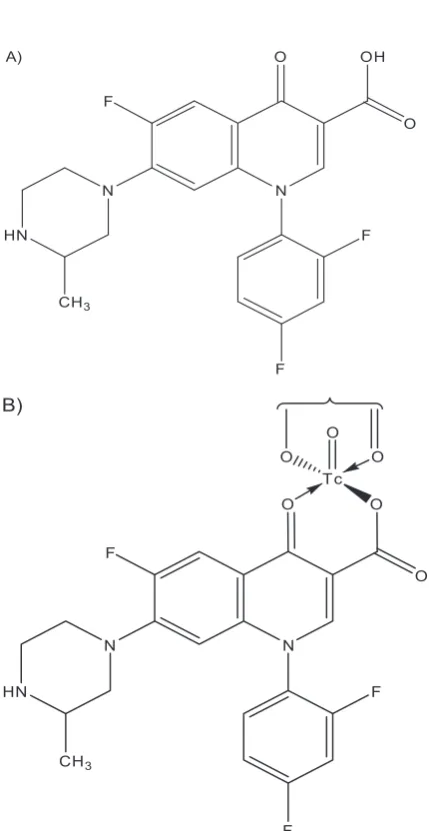
Temafloxacin (TMC) (Fig. 1a) [1-(2,4-Di- fluorophenyl)-6-fluoro-7-(3-methylpiperazin-1-yl)-4-oxoquinoline-3-carboxylic] is a broad-spectrum fluorinated quinolone antibiotic representing helpful in vivo and in vitro pharmacokinetics. TMC, similar to other quinolone antibiotics, has demonstrated higher activity against a wide vari-ety of bacteria including Staphylococcus aureus, Moraxella catarrhalis, Haemophilus influenzae, Legionella pneumophila and Klebsiella pneumoni-ae. TMC has shown almost eight times higher an-tibiotic activity against Streptococci pneumoniae
and Streptococcus pyogenes [11, 12].
In the current investigation the authors ex-ploit the elevated antibacterial affinity of TMC for the radio-diagnosis of the infection caused by Streptococci pneumoniae after labeling it with technetium-99m (99mTc) using stannous chloride
as reducing agent. The labeled TMC was further characterized in terms of radiochemical stability
in saline, serum, in vitro binding with Streptococci pneumoniae and biodistribution in a male Wistar rat (MWR) model artificially infected with live and heat killed Streptococci pneumoniae.
ilość SnCl2 od 50 do 250 ug, TMC od 2 do 5 mg, Na99mTco4– od 74 do 185 MBq. W większych stężeniach cysteiny
oceniono stabilność kompleksu 99mTc-TMC. Badano wychwyt szczepów Streptococcus pneumoniaein vitro w celu
sprawdzenia dokładności kompleksu 99mTc-TMC. Wychwyt kompleksu 99mTc-TMC oceniano in vivo u dziesięciu
(10) zdrowych samców szczurów Wistar (MWR) (140–160 g), które podzielono na dwie grupy (I i II).
Wyniki. Maksymalną stabilność 98,00 ± 0,34% 30 minut po rozpuszczeniu obserwowano przez zmieszanie 2,5 mg TMC, 100 ng SnCl2 z 74 MBq w Na99mTco
4–. Stabilność kompleksu pozostała na poziomie 90% do 4 godzin. W
suro-wicy kompleks wykazał stabilność do 16 godzin. Nasycone wiązania in vitro stwierdzono u żywych Streptococcus pneumoniae. Z zakażonego obszaru ciała (lewe udo) MWR zaobserwowano prawie pięciokrotnie większy wychwyt w porównaniu do mięśni zdrowych i zmienionych zapalnie.
Wnioski. Powyższe wyniki potwierdzają przydatność kompleksu 99mTc-TMC jako środka do umiejscawiania
poten-cjalnego zakażenia Streptococcus pneumoniae (Adv Clin Exp Med 2013, 22, 3, 319–325).
Słowa kluczowe:99mTc-temafloksacyna, Streptococcus pneumoniae, umiejscawianie zakażenia.
N N HN CH3 F O F F O O Tc O O O B)
Fig. 1. A) Chemical structure of the temafloxacin (TMC); B) Speculated structure of the 99mTc-TMC
complex
Ryc. 1. A) Struktura chemiczna temafloksacyny (TMC), B) hipotetyczna struktura kompleksu
99mTc-TMC N N HN CH3 F
A) O OH
O
F
Material and Methods
Temafloxacin (TMC) (Shanghai Sciencya Biotechnology Co., Ltd. Shanghai, China), Thin Layer Chromatographic (TLC) Strips (Merck) and all the other chemicals and solvents of analytical grade (Sigma). RP-HPLC (Shimadzu, Japan) well counter and scalar count rate meter (Ludlum, USA), dose calibrator (Capintech, USA) and gam-ma camera gKS-1000 (gEADE Nuclearmedizin system, germany).
Radiolabeling of Temafloxacin
(TMC)
Ten nitrogen filled sterilized vials were taken and 25 to 250 µg in 25 µg increments of stannous chloride was injected through insulin syringe into each, followed by addition of 0.5 to 5.0 mCi in 0.5 mCi increments of Na99mTco
4– in sequential order.
Thereafter, to the above mixture, 0.5 to 5.0 mg in 0.5 mg increments of TMC was added. The pH of the mixture was adjusted to 5.5 with a 0.01N HCl solution. Subsequently, the preparations were in-cubated for 10 minutes at room temperature fol-lowed by filtration through a Millipore filter.
HPLC Radiocharacterization
Radiolabeled TMC (99mTc-TMC complex) was
radio-characterized with HPLC using the previ-ously reported method [7]. Briefly, to the main Shimadzu HPLC unit fitted with UV detector (op-erating at 254 nm) and C-18 (4.6 × 150 mm) col-umn, 5 µL of the 99mTc labeled TMC was injected.
Thereafter, a mobile phase of a mixture of trieth-ylaminophosphate (TEAP) and methyl alcohol (MA) (MA:TEAP) was employed for 20 min with a flow rate of 1 mL/min., engaged for 0–3 min (100:00%), 3–6 min (75:25%), 6–8 min (53:47%), 8–10 min (25:75%), 10–12 min (00:100%) and 12– 15 min (50:50%). The radio-eluents received dur-ing the elution were separately collected in clean vials and counted for radioactivity in each vial for determination of radiochemical stability using a well counter interface with count rate meter.
Stability in Serum
and Challenge Assay
TLC was used to determine the stability of the
99mTc labeled TMC using the previously
report-ed method [7]. Briefly, at 37ºC the labelreport-ed TMC (0.2 mL) was incubated for 16 hours with 1.8 mL of serum. After that 1 µL aliquots were withdrawn
from the incubated mixture and evaluated for sta-bility using (CH2Cl2:CH3oH (9:1) (v/v) as a
devel-oping solvent.
Additionally, the 99mTc-TMC radio-stability was
verified in a challenge assay. An equimolar solution of the 99mTc-TMC was incubated with the increasing
amount of cysteine (1 x 10⁷ mol/L) at 37°C. Thereafter,
aliquots were taken out from the incubated mixture for stability determination using (CH2Cl2:CH3oH
(9:1) (v/v) as a developing solvent.
Binding with
Streptococci
pneumoniae
In vitro binding of 99mTc-TMC with Strepto-cocci pneumoniae was evaluated using the report-ed method [13]. Briefly, 0.2 mL of the 99mTc-TMC
was vortexed with 0.1 mL of the sodium phosphate buffer (SPB) followed by addition of 0.8 mL (50% v/v) 0.01 M acetic acid containing 1 x 10⁸ colony
forming units (CFU) of Streptococci pneumoniae. The mixture was incubated at 4ºC for 1 hour with a pH of 5. After 1 hour the mixture was centri-fuged for 10 min at 2000 rpm. Thereafter, the supernatant from the mixture was removed and re-suspended in 2 mL SPB followed by centrifu-gation at 2000 rpm for 10 min. The supernatant was again removed and the level of activity in the pellets was measured using a well counter interface with count rate meter.
Biodistribution in Rats
In vivo distribution of the 99mTc-TMC in
dif-ferent organs of the MWR artificially infected with live and heat killed Streptococci pneumoniae was investigated at 30, 60, 90 and 120 min post injection (p.i). Ten (10) normal MWR (140–160 g) were di-vided into two groups (I and II). Intramuscularly, 0.2 mL of sterile turpentine oil was injected into the left thigh of each MWR of group I and II. There-after, in 0.2 mL saline, 2 × 10⁸ live organisms of
the Streptococci pneumoniae were injected into the right thigh of each MWR of group I and heat killed into group II. After 18 hours of the I.M. injections, 0.2 mL of the freshly prepared 99mTc-TMC was
Results and Discussion
Temafloxacin (TMC) (Figure 1A) was tagged with 99mTco using the method reported earlier to
give 99mTc-TMC as given in Figure 1B. The basic
structure of the complex (Figure 1B) can be specu-lated by comparison with the reported properties of the TcN core [14].
Radiochemistry of
99mTc-TMC
Complex
Technetium have a number of oxidation states but the +V state is the most frequent in TcN com-plexes. The two sets of molecular orbitals (Mo) will be the highest occupied non-bonding Mo (HoMo) and the lowest two unoccupied degener-ate π* antibonding orbitals (LUMo) together can account for the arrangement of the square pyrami-dal structure of the TcN complexes.
From the crystal structural studies on TcN
complexes, it has been shown that when the four coordinated atoms are π-donor Lewis bases, then square pyramidal (sp) geometry is preferred [15]. The speculated structure of 99mTc-TMC (Figure 1B)
with bidentate ligand will have a square pyramidal geometry with 99mTc-TMC:Ligand ratio of 1:2.
HPLC Radiocharacterization
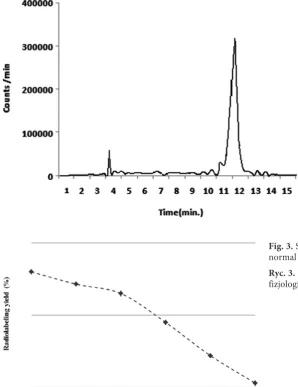
Figure 2 the HPLC radiochromatogram of the99mTc-TMC complex gave two clearly different
peaks at 3.2 and 11.1 min of retention. The HPLC peak at 3.2 signifies the unlabeled free 99mTc and
that at 11.1 represents the 99mTc-TMC complex.
The 99mTc-TMC complex showed stability in
normal saline up to 240 min after its reconstitution with a minimum de-tagging as shown in Figure 3. After 30 min of reconstitution, the level of bound activity was 98.00 ± 0.34%. The radiochemical sta-bility profile of the 99mTc-TMC complex was found
promising by mixing 2.5 mg TMC, 100 µg
stan-Fig. 2. HPLC radiochromatogram of the 99mTc-TMC complex
Ryc. 2. Radiochromatogram HPLC kompleksu 99mTc-TMC
Fig. 3. Stability of the 99mTc-TMC complex in
normal saline
Ryc.3. Stabilność kompleksu 99mTc-TMC w soli
nous chloride and 2 mCi of the Na99mTco4–. The
minimum stability observed at 240 min after re-constitution was 90.30 ± 0.22%.
Stability in Serum
and Challenge Assay
The 99mTc-TMC complex showed stability
up to 16 hours after incubation with serum at 37 °C. The stability profile of the 99mTc-TMC
com-plex is given in Figure 4A. overall the free activity (side product appeared due to de-tagging) within 16 hours was 15.65%.
The challenge assay profile of the 99m
Tc-TMC complex suggested stability as shown in Fi-gure 4B. In increasing concentrations of the cysteine (1 x 10⁷ mol/L), the compound decreased to 8.85%.
Binding with
Streptococci
pneumoniae
The 99mTc-TMC complex showed saturated
in vitro binding with Streptococci pneumoniae as shown in Figure 5. It was observed that at 90 min of incubation 62.65 ± 0.44% of the 99mTc-TMC
complex was taken up by the Streptococci pneu-moniae.
Biodistribution in Rats
The percent uptake of the 99mTc-TMC complex
in different organs of the MWR artificially infected with live and heat killed Streptococci pneumoniae
at 30, 60, 90 and 120 min post p.i. is given in Ta-ble 1. It was observed that the level of 99mTc-TMC
complex in the blood, liver, spleen, stomach and intestine in the gaining was high which decreased with time and appeared in the kidneys and infected muscle of the MWR infected with live Streptococci pneumoniae. In group I MWR, the level of activity in the blood, liver, spleen, stomach and intestine was decreased from 18.55 ± 0.28 to 3.80 ± 0.40%, 13.55 ± 0.34 to 4.00 ± 0.40%, 8.35 ± 0.38 to 4.15 ± 0.44% and 8.10 ± 0.42 to 4.00 ± 0.00% within 120 min of p.i respectively. A similar pro-file of the 99mTc-TMC complex was seen in group
II. However, the activity of the 99mTc-TMC
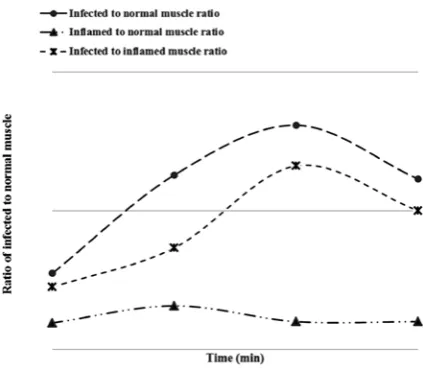
com-plex in infected muscle was different from the in-flamed and normal muscles in group I and II. The level of activity in the infected muscle of group I was almost five times higher than the inflamed and normal muscles, while in group II, the activ-ity was almost similar in infected, inflamed and normal muscles. The ratios of the infected to nor-mal, inflamed to normal and infected to inflamed
Fig. 4. A. Stability of the 99mTc-TMC complex at 37°C
in serum up to 16 h. B. Challenge assay test of stability of the 99mTc-TMC complex
Ryc. 4. A. Stabilność kompleksu 99mTc-TMC w
tempe-raturze 37°C w surowicy do 16 godz. B. Test stabilności kompleksu 99mTc-TMC
A
B
Fig. 5.Streptococci pneumoniae in vitro binding with
9mTc-TMC complex at 30, 60, 90 and 120 min.
muscles is given in Figure 6. The level of activity was initially found to be low in the kidneys and it went up from 9.00 ± 0.40 to 24.50 ± 0.00% within 120 min p.i. group II also showed a similar profile. The disappearance of activity from the circulatory system and appearance in the urinary system es-tablished the normal path of excretion.
The authors concluded that 99mTc-TMC
com-plex was synthesized and characterized in terms of radiochemical stability in saline and serum, in vitro binding with live and heat killed Streptococci pneumoniae and biodistribution in male Wistar rat (MWR) models. The complex showed a maximum radiochemical stability of 98.00 ± 0.34% at 30 min. In serum, the complex was found stable at 37ºC up to 16 hours and saturated in vitro binding with live Streptococci pneumoniae was noted. Based on the above results, the suitability of the 99mTc-TMC
complex as a potential Streptococci pneumoniae
infection localizing agent is confirmed.
Fig. 6. Ratio wise distribution of the 99mTc-TMC
com-plex in MWR model
Ryc. 6. Rozkład kompleksu99mTc-TMC w modelu MWR
Table 1. Biodistribution of the 99mTc-TMC complex in the blood, liver, spleen, stomach, intestines, kidneys, infected, inflamed and normal
muscles of Streptococci pneumoniae infected MWR model
Tabela 1. Biodystrybucja kompleksu 99mTc-TMC we krwi, wątrobie, śledzionie, żołądku, jelitach, nerkach, zakażonych, zmienionych
zapal-nie i zdrowych mięśniach zakażonych Streptococci pneumoniae w modelu MWR
organs/ tissues – gm (Narządy/ tkanki – gm)
Uptake in different p.i. – min (Wychwyt w różnych p.i. – min)
live S. aureus heat killed S. aureus
30 60 90 120 30 60 90 120
Infected muscle (Mięsień zakażony)
6.15 ± 0.44 9.95 ± 0.30 13.15 ± 0.38 11.25 ± 0.00 3.00 ± 0.32 3.50 ± 0.38 3.50 ± 0.40 3.00 ± 0.36
Inflamed muscle (Miesień zmieniony zapalnie)
3.00 ± 0.38 3.50 ± 0.30 3.00 ± 0.42 3.00 ± 0.34 3.00 ± 0.42 3.50 ± 0.36 3.00 ± 0.30 3.00 ± 0.42
Normal muscle (Zdrowy mięsień)
2.50 ± 0.40 3.00 ± 0.30 2.50 ± 0.36 2.50 ± 0.00 2.50 ± 0.38 3.00 ± 0.34 2.50 ± 0.40 2.50 ± 0.42
Blood
(Krew) 18.55 ± 0.28 10.20 ± 0.36 8.15 ± 0.00 3.80 ± 0.40 18.44 ± 0.22 10.25 ± 0.32 8.20 ± 0.44 3.55 ± 0.38 Liver
(Wątroba) 13.55 ± 0.34 10.25 ± 0.30 8.40 ± 0.00 4.00 ± 0.40 13.50 ± 0.36 10.10 ± 0.34 8.15 ± 0.44 4.15 ± 0.40 Spleen
(Śledziona) 8.35 ± 0.38 6.90 ± 0.34 5.65 ± 0.36 4.15 ± 0.44 8.20 ± 0.40 7.10 ± 0.34 5.45 ± 0.00 3.95 ± 0.38 Kidney
(Nerka) 9.00 ± 0.40 14.20 ± 0.34 18.50 ± 0.36 24.50 ± 0.00 8.65 ± 0.38 14.60 ± 0.34 19.00 ± 0.36 23.6 ± 0.44 Stomach
& intestines (Żołądek i jelita)
References
[1] Basu S, Chryssikos T, Moghadam-Kia S, Zhuang H, Torigian DA, Alvai A: Positron Emission Tomography as a diagnostic tool in infection: Present role and future possibilities. Semin Nucl Med 2009, 39, 36–51.
[2] Chattopadhyay S, Das SS, Chandra S, De K, Mishra M, Sarkar BR, Sinha S, Ganguly S: Synthesis and evaluation of 99mTc-moxifloxacin, a potential infection specific imaging agent. Appl Radiat Isotopes 2010, 68, 314–316.
[3] Zhang J, Guo H, Zhang S, Lin Y, Wang X: Synthesis and biodistribution of a novel 99mTcN complex of
ciprofloxa-cin dithiocarbamate as a potential agent for infection imaging. Bioorg Med Chem Lett 2008, 18, 5168–5170.
[4] Oh SJ, Ryu J, Shin JW, Yoon EJ, Ha H, Cheon JH, Lee HK: Synthesis of 99mTc-ciprofloxacin by different methods
and its biodistribution. Appl Radiat Iso 2002, 57, 193–200.
[5] Shah SQ, Khan AU, Khan MR: Radiosynthesis and biodistribution of 99mTc-rifampicin: A novel radiotracer for in-vivo infection imaging. Appl Radiat Isot 2010, 68, 2255–2260.
[6] Shah SQ, Khan AU, Khan MR:99mTc-novobiocin: A novel radiotracer for infection imaging. Radiochim Acta
2011, 99, 53–58.
[7] Shah SQ, Khan MR: Radiosynthesis and biological evaluation of 99mTc-Prulifloxacin in artificially infected animals.
Nuklearmedizin 2011, 50, 134–140.
[8] Shah SQ, Khan MR: Radiosynthesis and characterization of the 99mTc-fleroxacin (99mTc-FXN) complex: A novel Escherichia coli infection imaging agent. Transition Metal Chem 2011, 36, 283–287.
[9] Shah SQ, Khan MR: Radiosynthesis and biological evaluation of the 99mTc-tricarbonyl moxifloxacin
dithiocarba-mate complex as a potential Staphylococcus aureus infection radiotracer. Appl Radiat Isot 2011, 69,686–690.
[10] Shah SQ, Khan AU, Khan MR: Radiosynthesis, biodistribution and scintigraphy of the 99mTc-Teicoplanin
com-plex in artificially infected animal models. J Label Compd Radiopharm 2010, 54, 145–149.
[11] Segreti J:In vitro activity of temafloxacin against pathogens causing sexually transmitted diseases. Am J Med 1991, 91, S24–S26.
[12] Jacobs MR: Evaluation of the bactericidal activity of temafloxacin. Am J Med 1991, 91, 31S–34S.
[13] Welling MM, Paulusma-Annema A, Batler HS, Pauwels EKJ, Nibbering PH: Technetium-99m labelled anti-microbial peptides discriminate between bacterial infections and sterile inflammations. Eur J Nucl Med 2000, 27, 292–301.
[14] Baldas J, Bonnyman J, Poer PM, Williams GA, Mackay MF: Synthesis and Structure of bis(diethyldithiocarbamato) nitridotechnetium(V) – a technetium-nitrogen triple bond. J Chem Soc Dalton Trans 1981, 9, 1798–1801.
[15] Schwochau K: Technetium chemistry and radiopharmaceutical applications, Wiley-VCH, Weinheim, germany, 2001.
Address for correspondence:
Syed Qaiser Shah Director NMRL University of Peshawar Peshawar
KPK Pakistan
Tel.: 00 92 91 9216701-20 Mobile: 0333 9254009
E-mail: [email protected] Conflict of interest: None declared Received: 15.06.2011