The Journal of Threatened Taxa is dedicated to building evidence for conservation globally by publishing peer-reviewed articles online every month at a reasonably rapid rate at www.threatenedtaxa.org. All articles published in JoTT are registered under Creative Commons Attribution 4.0 International License unless otherwise mentioned. JoTT allows unrestricted use of articles in any medium, reproduction, and distribution by providing adequate credit to the authors and the source of publication.
OPEN ACCESS
www.threatenedtaxa.org
ISSN 0974-7907 (Online) | ISSN 0974-7893 (Print) Building evidence for conservation globally
Journal of Threatened Taxa
For Focus, Scope, Aims, Policies and Guidelines visit https://threatenedtaxa.org/index.php/JoTT/about/editorialPolicies#custom-0 For Article Submission Guidelines visit https://threatenedtaxa.org/index.php/JoTT/about/submissions#onlineSubmissions For Policies against Scientific Misconduct visit https://threatenedtaxa.org/index.php/JoTT/about/editorialPolicies#custom-2 For reprints contact <[email protected]>
Short Communication
Contribution to the Macromycetes of West Bengal, India:
28–33
Rituparna Saha, Arun Kumar Dutta, Soumitra Paloi, Anirban Roy & Krishnendu Acharya
26 December 2018 | Vol. 10 | No. 15 | Pages: 13006–13013 10.11609/jott.4188.10.15.13006-13013
Threatened Taxa
Member
Partners
Shor
t C
ommunica
tion
DOI:https://doi.org/10.11609/jott.4188.10.15.13006-13013
Editor:R.K. Verma, Tropical Forest Research Institute, Jabalpur, India. Date of publication: 26 December 2018 (online & print)
Manuscript details: Ms # 4188 | Received 10 April 2018 | Final received 28 September 2018 | Finally accepted 21 November 2018
Citation:Saha, R., A.K. Dutta, S. Paloi, A. Roy & K. Acharya (2018). Contribution to the Macromycetes of West Bengal, India: 28–33. Journal of Threatened Taxa
10(15): 13006–13013; https://doi.org/10.11609/jott.4188.10.15.13006-13013
Copyright: © Saha et al. 2018. Creative Commons Attribution 4.0 International License. JoTT allows unrestricted use of this article in any medium, reproduction and distribution by providing adequate credit to the authors and the source of publication.
Funding: Department of Environment, the Government of West Bengal, India.
Competing interests:The authors declareno competing interests.
Acknowledgements: The authors would like to acknowledge the Department of Environment, the Government of West Bengal, India, for providing financial assistance. The facilities provided by the department of Botany (UGC-CAS Phase VI, VII), University of Calcutta, and infrastructural support by DST-FIST are also duly acknowledged.
Contribution to the Macromycetes of West Bengal, India: 28–33
Rituparna Saha 1 , Arun Kumar Dutta 2 , Soumitra Paloi 3 , Anirban Roy 4
& Krishnendu Acharya 5
1,2,3,5 Molecular and Applied Mycology and Plant Pathology Laboratory, Department of Botany, University of Calcutta,
Kolkata, West Bengal 700019, India
1,2,3,4 West Bengal Biodiversity Board, Prani Sampad Bhawan, 5th floor, LB 2, Sector III, Salt Lake City, Kolkata, West Bengal 700106, India
1 [email protected], 2 [email protected], 3 [email protected], 4 [email protected], 5 [email protected] (corresponding author) ISSN 0974-7907 (Online)
ISSN 0974-7893 (Print)
OPEN ACCESS
West Bengal has a diverse range of biogeographical and ecological conditions due to the presence of the coastal region of the Bay of Bengal on one side and the subalpine mountains of the eastern Himalayan region on the other. This wide array of phyto-topographical features facilitates the luxuriant growth of macrofungi belonging to several types and stature like poroid, dentate, and gilled. The habitat of these fungi varies from saprophytic to humicolous and mycorrhizal (Pradhan et al. 2016).
The genus Ganoderma (Basidiomycota: Polyporales) is a woody, poroid group of saprotrophic fungi. The Abstract: The present paper deals with the report of six poroid woody macro fungi belonging to the family Ganodermataceae from West Bengal in India. The taxonomic account of these collected fungi is represented herein with detailed macro- and micro-morphological features.
Keywords: Basidiomycota, Ganoderma species, Polyporales, taxonomy.
distinguishing features of this genus include the presence of truncate basidiospores and the colour reaction of pileus and pore surface, which never turn permanently dark in 10% KOH solution (Sharma 2012).
The present study reports six poroid fungi with their detailed morpho-taxonomic enumeration from the state.
Material and Methods
Journal of Threatened Taxa | www.threatenedtaxa.org | 26 December 2018 | 10(15): 13006–13013
Contribution to the Macromycetes of West Bengal Saha et al.
13007
of the dried basidiocarps stained with congo red and Melzer’s reagent. Identification and colour terminology followed Kornerup & Wanscher (1978), Bhosle et al. (2010), and Sharma (2012). Thirty measurements of basidiospores were taken from each sample for calculating the dimensions of the basidiospore. Length/ breadth ratio denotes the Q value. Mean Q value (Qm) was measured by dividing the total sum of Q value by the total number of spores observed. Hand drawings of different identifying characters were obtained with a camera lucida and a 0.1mm rotring pen, which was used to trace the lines. The voucher specimens were preserved following Pradhan et al. (2015) and were deposited in the Calcutta University Herbarium (CUH), Kolkata, India.
Taxonomy
Ganoderma lucidum (Curtis) P. Karst.
Revue mycol., Toulouse 3(no. 9): 17 (1881) (Fig. 1; Image 1)
Basidiocarp annual, laterally stipitate. Pileus applanate when young and funnel-shaped at maturity, 45–111 mm in length and 36–70 mm in breadth, 17mm thick near the base. Pileus upper surface reddish-brown (8D6, 8E6), shiny, glabrous, laccate. Margin lobed, whitish (1A1), thin. Pore surface whitish (1A1), greyish-orange (5B3) on bruising. Pores 4–6 per mm, circular. Tubes not stratified, brown (7E5), 3–6 mm deep. Context soft, double layered, upper reddish golden brownish-orange (6C3) and lower light brown (7D4) near the tubes, 4–10 mm thick near the base. Stipe cylindrical, central when young and lateral at maturity, 70–95 mm in length and 10–25 mm in breadth, reddish-brown (8E7), laccate, glabrous, shiny.
Hyphal system trimitic. Generative hyphae of context greyish-yellow (4C3), thin walled, clamped at septa, 2.5–3.5 µm in breadth; binding hyphae branched, interwoven, 0.7–2 µm wide, hyaline; skeletal hyphae unbranched at base and branched towards apex, 3.5–4.5 µm wide, greyish-yellow (4C3), interwoven. Generative hyphae of the tube layer greyish-yellow (4C3), thin-walled, clamped at septa, difficult to observe, 2.5–3.5 µm in breadth; binding hyphae branched, 0.5–2 µm wide, hyaline; skeletal hyphae unbranched at base and branched towards apex, 3.5–5 µm wide, greyish-yellow (4C3). Cuticular hyphae regular, closely packed with clavate end cells, sometimes cells are cylindrical or tubular, golden (4C6) to brownish-orange (6C8), thick, 6–12 µm wide. Basidiospores truncate, (7–)7.5–8(–8.5) × (3.5–)4–4.5(–5) µm, Q = 1.6–2.0, Qm = 1.84, double
walled, exospores hyaline, thin and endospore thick, brownish-orange (7C5).
Habit and habitat: Solitary to gregarious, grown on dead wooden log of angiosperm.
Specimen examined: CUH AM532, 26.vii.2017,
22.3490N & 88.0690E, elevation 12m, Uluberia, Kolkata,
West Bengal, India, coll. A.K. Dutta & S. Paloi.
Remarks: Ganoderma lucidum is well characterized Image 1. Ganoderma lucidum. Scale = 10mm
© A.K. Dutta
Figure 1. Ganoderma lucidum.
a - hyphae of the cutis, b - basidiospores, c - context hyphae, d - tube layer hyphae. Bars = 5µm. Drawing by R. Saha.
a
c b
by its laccate-shaped, laterally stipitate, reddish-brown coloured basidiocarp with whitish margin, distinctly double layered context differentiated by reddish golden brownish-orange upper and light brown (7D4) lower near the tubes, presence of regular, closely packed clavate end cells at the cutis, and basidiospores measuring 7–8.5 × 3.5–5 µm in diameter with Qm of 1.84.
The taxon has a worldwide distribution and was previously reported from India (Sharma 2012). The description of the morphological features of the collected specimen matches that of the earlier report. The present collection does not reveal the presence of gasterospores and differs from the material reported from Portugal (Steyaert 1975). The collection reported from East Anglia by Corner (2009), however, varies a bit from the present collection with regard to the size of the basidiospores (9.5–12 × 6–6.5 µm vs 7–8.5 × 3.5–5 µm), which may be attributed to climatic and geographic variations.
Among macro-microscopically related taxa,
Ganoderma flexipes differs by having a reddish-brown margin, chlamydospore in the context and trama, and larger basidiospores (7.5–10.5 × 6–7.5 µm); G. curtisii
differs by having purplish-brown to black coloured pileus and larger spores (8.5–11 × 5–7 µm; Sharma 2012).
Ganoderma applanatum(Pers.) Pat.
Hyménomyc. Eur. (Paris): 143 (1887) (Fig. 2; Image 2)
Basidiocarp sessile, dull, non-laccate, glabrous, perennial, woody, applanate, 50–86 × 30–35 mm in diameter, 35–44 mm thick. Upper surface of pileus greyish to reddish-brown (8D3, 9E4) with concentric zonation, sulcate. Margin 6–15 mm thick, round, reddish-brown (9E4) in colour. Pore surface whitish (1A1), pore 4–5 per mm, round. Tube multilayered (3–4 layered), dark brown (7F7). Context thick, single layered, dark brown (7F7).
Hyphal system trimitic. Generative hyphae of context thin walled, 4.5–5.5 µm wide, yellowish-brown (6D4, 5D7), clamp connection present at septa, difficult to observe; skeletal hyphae dominant, 4.5–6 µm wide, dark brown (9F4), branched; binding hyphae branched, hyaline, 1.7–2.5 µm wide. Generative hyphae of tube layer thin walled, 4–5.5 µm wide, yellowish-brown (6D4, 5D7), clamp connection present at septa, difficult to observe; skeletal hyphae dominant, 4.5–6.5 µm wide, dark brown (9F4), branched; binding hyphae branched, hyaline, 1.7–2.5 µm wide. Cutis irregular, trichodermis type with spores embedded within the gelatinous layer, cutis hyphae 1.5–5.5 µm wide, brown (7E5).
Basidiospore truncate, (6.5–)7.5–9(–10) × 3.5–4.5(–6) µm in diameter, Q = 1.6–2.1, Qm = 1.8, double walled, exospores hyaline, thin, endospore pale yellow to dark Image 2. Ganoderma applanatum. Scale = 10mm
© K. Acharya
Figure 2. Ganoderma applanatum.
a - hyphae of the cutis, b - basidiospores, c - context hyphae, d - tube layer hyphae. Bars = 5µm. Drawing by R. Saha.
a
c b
Journal of Threatened Taxa | www.threatenedtaxa.org | 26 December 2018 | 10(15): 13006–13013
Contribution to the Macromycetes of West Bengal Saha et al.
13009
brown (6D7, 8E5) with elongated ridges.
Habit and habitat: Solitary, grown on hard wood of angiosperm.
Specimen examined: CUH AM 531, 16.vii.2017,
26.6950N & 89.5510E, elevation 47m, near Boxa Tiger
Reserve, Dooars, Alipurduar District, West Bengal, India, coll. K. Acharya & A. Roy.
Remarks: Ganoderma applanatum is characterized by its perennial habit, the presence of a sessile basidiocarp coloured greyish to reddish-brown, a trichodermis type cutis, multilayered tubes, trimitic hyphal system, and basidiospores measuring 6.5–10 × 3.5–6.0 µm.
The taxon was previously reported from Maharashtra (Bhosle et al. 2010), Dehradun (Sharma 2012), and Punjab (Kaur et al. 2017) in India. Our collection matches the specimens reported from Punjab and Dehradun except for slight variations in the numbers of tube layers present. While the present specimen had 3–4 tube layers, that from Dehradun had 4–7 (Sharma 2012).
Among macro-microscopically similar taxa,
Ganoderma australe (Fr.) Pat. differs by the presence of one or several crustaceous layers in the pileus context and larger basidiospores (7–13 × 5–8.5 µm); G. philippi
(Bres. & Henn. ex Sacc.) Bres. Differs by having a blackish-brown upper surface and a very short tube (up to 3mm deep; Sharma 2012).
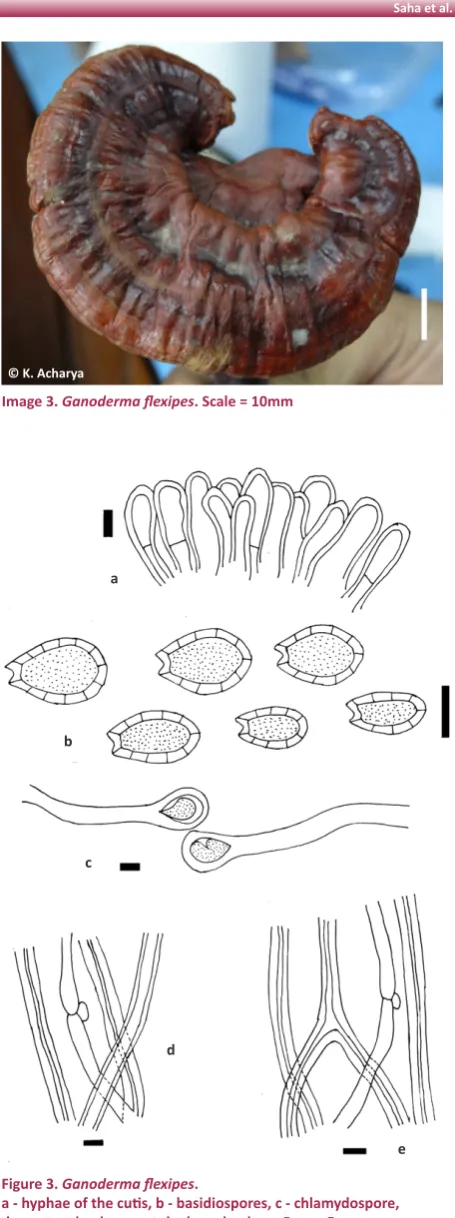
Ganoderma flexipes Pat.
Bull. Soc. mycol. Fr. 23(2): 75 (1907) (Fig. 3; Image 3)
Basidiocarp annual, distinctly stipitate. Pileus glabrous, laccate, 75 × 53 mm in diameter, 4–10 mm thick near the base. Upper surface reddish-brown (8E7, 9E8) in colour, uneven. Margin slightly wavy, reddish-brown (8E7) in colour. Pore surface reddish-brownish-grey (7C2) in colour, greyish-brown (7D3) on bruising, pores 4–5 per mm. Tubes brown (7E5) in colour, 4–5 mm deep, not stratified. Context thin, 1.5–2 mm double layered, upper light brown (7D5) and lower brown (7E5) near the tubes. Stipe dorsi-lateral, 100mm long, 8–12 mm in diameter, laccate, glabrous, reddish-brown to dark brown (8F7, 9F6) in colour.
Hyphal system trimitic. Generative hyphae of context reddish blond brownish-orange to yellowish-brown (5C3, 5D6), clamped at septa, thin walled, branched, 2.5–3.5 µm wide; skeletal hyphae brownish-orange (5C4), thick walled, unbranched at base and branched towards apex, arboriform, 3.5–5 µm, interwoven; binding hyphae branched, hyaline, 0.7–1.5 µm wide, interwoven. Generative hyphae of tube layer pale reddish blond brownish-orange to yellowish-brown
(5C3, 5D6), clamped at septa, thin walled, branched, 2.5–3.5 µm wide; skeletal hyphae brownish-orange Image 3. Ganoderma flexipes. Scale = 10mm
© K. Acharya
Figure 3. Ganoderma flexipes.
a - hyphae of the cutis, b - basidiospores, c - chlamydospore, d - context hyphae, e - tube layer hyphae. Bars = 5µm. Drawing by R. Saha.
a
c b
d
(5C4), thick walled, unbranched at base and branched towards apex, arboriform, 3.5–5.5 µm, interwoven; binding hyphae branched, hyaline, 0.7–1.5 µm wide, interwoven. Cuticular hyphae regular, closely packed with clavate end cells, light brown (6D5) in colour, 4–7 µm wide. Basidiospores truncate, 7–9(–10) × 4–5.5(– 6.5) µm in diameter, Q = 1.4–2.2, Qm = 1.7, bitunicate, exospores hyaline, thin walled, endospore light brown (7D6). Chlamydospore present in the context and trama, 9.5–10.5 µm in diameter, ovoid, reddish-blond brownish-orange (5C3) in colour.
Habit and habitat: solitary, grown on dead dicotyledonous wood.
Specimen examined: CUH AM534, 09.viii.2015,
22.5950N & 88.2630E, elevation 4m, Howrah, West
Bengal, India, coll. K. Acharya.
Remarks: The present specimen is characterized by a laccate pileus coloured reddish-brown, distinctly double layered context (upper light brown and lower brown) near the tubes, a dorsi-lateral stipe, presence of closely packed clavate end cells at the cutis, basidiospores measuring 7–10 × 4–6.5 µm in diameter (Qm = 1.7), and presence of chlamydospore in the pileus context and trama.
Based on the artificial key proposed by Sharma (2012), the presence of chlamydospores characterises the specimen to be Ganoderma flexipes. This taxon has a worldwide distribution and was reported from China (Zhou et al. 2015), India (Uttarakhand) (Sharma 2012), and Vietnam (Steyaert 1972). Our present specimen mostly matches the description of that from India except for having a slightly larger chlamydospore (9.5–10.5 µm vs 6–9.5 µm). The specimen from China differs from the present collection with regard to slightly longer basidiospores (8.5–11 × 5–7 µm vs 7–10 x 4–6.5 µm).
The collection from Vietnam had slightly larger sized basidiocarps and comparatively larger basidiospores (8–13 × 5.5–8 µm).
Among morphologically related species, Ganoderma
lucidum differs by the presence of white coloured pileus
margin and the absence of chlamydospore; G. curtisii
(Berk.) Murrill differs by the presence of purplish-brown to black pileus and the absence of chlamydospores; G.
ahmadii differs by the presence of uniform coloured
context and the absence of chlamydospores (Sharma 2012).
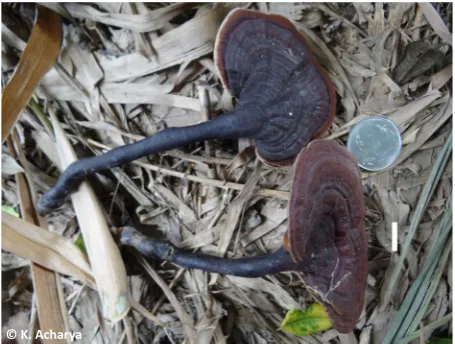
Ganoderma ahmadii Steyaert
Persoonia 7(1): 91 (1972) (Fig. 4; Image 4)
Basidiocarp annual, laterally stipitate. Pileus glabrous, laccate, flabelliform, 45–55 × 60–75 mm in diameter, 4–8 mm thick near the base. Upper surface of pileus glabrous, laccate, shiny, dark brown (9F6). Margin lobed, whitish (1A1) to straw (4B1) coloured, thick. Pore surface whitish (1A1) to straw (4B1) in colour, greyish-brown (8D3) on bruising, pores 4–7 per mm. Tubes reddish-brown (9E4) in colour, 2–7 mm deep, not
Image 4. Ganoderma ahmadii. Scale = 10mm
© K. Acharya Figure 4. a - hyphae of the cutis, b - basidiospores, c - context hyphae, Ganoderma ahmadii. d - tube layer hyphae. Bars = 5µm. Drawing by R. Saha.
a
c b
Journal of Threatened Taxa | www.threatenedtaxa.org | 26 December 2018 | 10(15): 13006–13013
Contribution to the Macromycetes of West Bengal Saha et al.
13011
stratified. Context 1–5 mm thick, single layered, reddish-brown (8E4) in colour. Stipe dorsi-lateral, 100–125 mm long and 8–10 mm broad, laccate, shiny, glabrous, dark brown (8F5, 9F5) in colour.
Hyphal system trimitic. Generative hyphae of context greyish-brown (6D3), thin walled, branched, clamped at septa, difficult to observe, 3–4.5 µm wide; skeletal hyphae dominant, light brown (6D4), thick walled, unbranched at base and branched towards apex, arboriform, 4.5–6 µm, interwoven; binding hyphae branched, greyish-brown (6D3), septate, 1–2 µm wide, interwoven. Generative hyphae of tube layer greyish-brown (6D3), thin walled, branched, clamped at septa, difficult to observe, 3–4.5 µm wide; skeletal hyphae light brown (6D4), thick walled, unbranched at base and branched towards apex, arboriform, 4.5–5.5 µm, interwoven; binding hyphae branched, greyish-brown (6D3), septate, 0.7–1.5 µm wide, interwoven. Cuticular hyphae regular, closely packed with clavate end cells, light brown (6D4, 6D5) in colour, 7–11 µm wide. Basidiospores truncate, brown, bitunicate, (7.5–)8–9(– 10.5) × 4–5(–6.5) µm in diameter, Q = 1.4–2.2, Qm = 1.7, exospores hyaline, thin walled, endospore thick, brown (6E6) with elongated ridges.
Habit and habitat: solitary, growing on dead and rotten Bambusa bambos wood.
Specimen examined: CUH AM530, 18.vii.2017,
26.3880N & 89.5260E, elevation 43m, Kaljani, Coochbehar
District, West Bengal, India, coll. K. Acharya & A. Roy.
Remarks: Ganoderma ahmadii possesses
characteristic features of an annual habit; laterally stipitate, laccate basidiocarp coloured reddish-brown to dark brown with white to straw coloured pileus margin; single layered context coloured reddish-brown; presence of a dorsi-lateral stipe measuring 100–125 mm long; pileus surface consisting of regular, closely packed clavate end cells; and truncate, double walled basidiospores measuring 7.5–10.5 × 4–6.5 µm in diameter.
Ganoderma ahmadii was previously reported from
Uttarakhand, India (Sharma 2012). Our collection matches the previous report. The specimen reported from Pakistan differs by having double layered context coloured cinnamon buff towards the cutis and Verona brown near the tubes and larger spores (8–11 × 5.5–7 µm; Steyaert 1972).
Among the macro- and micro-morphologically related species, Ganoderma flexipes differs from G.
ahmadii on the basis of the presence of chlamydospore
in the context and trama. Ganoderma ahmadii is also morphologically different from G. applanatum on the
basis of size, shape, and colour of the basidiocarp. The
basidiocarp of G. applanatum has sessile, non-laccate pileus with stratified tube, and trichodermis type cutis (Sharma 2012).
Ganoderma lucidum var. lucidum (Curtis) P. Karst.
Revue mycol., Toulouse 3(no. 9): 17 (1881) (Fig. 5; Image 5)
Basidiocarp annual, laterally stipitate. Pileus reniform, up to 90mm in diameter, 10–12 mm thick near the base. Upper surface reddish-brown (8D6, 8D7), shiny, glabrous, laccate. Margin thin, obtuse, white to orange grey (5A1, 5B2) in colour. Pore surface white (1A1), light brown (7D4) on bruising, pore sub orbicular, 4–5 per mm. Tubes not stratified, reddish-brown (8E5) in colour, 3–6 mm deep. Context soft, spongy, double layered, yellowish-brown (6E5) at upper side and brown (7E5) lower near to the tubes, 10–11 mm thick near the base. Stipe lateral, shiny, glabrous, laccate, reddish-brown (8E6), 50–70 mm in length and 10–20 mm broad. Hyphal system trimitic. Generative hyphae of context light brown (6D5), thin walled, branched, 3.5–5 µm wide, clamped at septa, difficult to observe; skeletal hyphae dominant, brown (7E5), thick walled, unbranched at base and branched towards apex, 4.5–7 µm in breadth, interwoven; binding hyphae colourless, branched, 0.7–1.8 µm wide, interwoven. Cuticular hyphae regular, closely packed with clavate end cells, yellowish-brown (5D6) to light brown (7E5) in colour, thick walled, 4–11.5 µm wide. Basidiospores truncate, 5–6.5(–7.5) × 3.5–4.5(–5.5) µm in diameter, Q = 1.0–1.8, Qm = 1.5, bitunicate, exospores hyaline, thin-walled and endospore with elongated ridges, light brown (6D5) to brown (7E5) in colour.
Habit and habitat: Cespitose, grown on dead wooden log of angiosperm.
Specimen examined: CUH AM529, 25.vii.2016,
22.9920N & 88.5310E, elevation 10m, near Chandirampur,
Birohi, Nadia, West Bengal, India, coll. K. Acharya. Remarks: The present variety is easily recognized by the smaller size of the basidiospores (5.3–7.5 × 3.5–5.3 µm in diameter with Qm = 1.5). Ganoderma lucidum var.
lucidum was previously reported from India (Maharastra,
Bhosle et al. 2010). According to the key of Bhosle et al. (2010), under G. lucidum complex, if the spore index is 1.5, then the specimen is considered as G. lucidum var.
lucidum. In the case of our collection, the spore index
was 1.5. Hence, it could be identified as G. lucidum var.
lucidum.Though the specimen from Maharashtra had a
Image 5. Ganoderma lucidum var. lucidum. Scale = 10mm
the same (Bhosle et al. 2010). Among other varieties of
G. lucidum, G. lucidum var. capense has a Q value of 1.6
(Bhosle et al. 2010).
Ganoderma resinaceum Boud., in Patouillard
Bull. Soc. mycol. Fr. 5(2,3): 72 (1889) (Fig. 6; Image 6)
Basidiocarp annual, sessile. Pileus flabelliform,
Image 6. Ganoderma resinaceum. Scale = 10mm
50 × 40 mm in diameter and 10–13 mm thick. Upper surface reddish-brown (8E8) with shiny concentric zones, irregular, laccate, darker (8F8) towards base. Margin thin, whitish (1A1) in colour, dark brown (7F7) on bruising. Pore surface white (1A1), dark brown (7F7) on bruising, pore circular, 3–4 per mm. Tubes not stratified, 5–7 mm deep, reddish-brown (8E4). Context double layered, upper brown (7E7) and lower reddish-brown
© K. Acharya © K. Acharya
Figure 5. Ganoderma lucidum var. lucidum.
a - hyphae of the cutis, b - basidiospores, c - context hyphae, d - tube layer hyphae. Bars = 5µm. Drawing by R. Saha.
Figure 6. Ganoderma resinaceum.
a - hyphae of the cutis, b - basidiospores, c - context hyphae, d - tube layer hyphae. Bars = 5µm. Drawing by R. Saha.
a
c b
d
a
c b
Journal of Threatened Taxa | www.threatenedtaxa.org | 26 December 2018 | 10(15): 13006–13013
Contribution to the Macromycetes of West Bengal Saha et al.
13013
(8E5) near the tubes, up to 10mm thick near the base. Stipe absent.
Hyphal system trimitic. Generative hyphae of context brown (7E6) to dark brown (7F7), thin walled, clamped at septa, difficult to observe, 3–4.5 µm in breadth; binding hyphae interwoven, 2.5–3.5 µm wide, hyaline; skeletal hyphae unbranched at base and branched towards apex, 3.5–5 µm wide, dark brown (7F7), interwoven. Generative hyphae of tube layer brown (7E6) to dark brown (7F7), thin walled, clamped at septa, difficult to observe, 3.5–4.5 µm in breadth; binding hyphae branched, 2.5–3.5 µm wide, hyaline; skeletal hyphae unbranched at base and branched towards apex, 3.5–5 µm wide, dark brown (7F7). Cuticular hyphae regular, closely packed with clavate end cells, brown (7E8) in colour, thick, 7–10 µm wide. Basidiospores truncate, (7–)9–12.5(–13.5) × 4–5.5(–7) µm in diameter, Q = 1.3– 2.3, Qm = 1.7, bitunicate, exospores hyaline, thin and endospore thick, brown (7E8).
Habit and habitat: Solitary, grown on root of Areca
catechu.
Specimen examined: CUH AM562, 13.xi.2017, 22.5270N & 88.3620E, elevation 13m, Ballygunge Science
College campus, Kolkata, West Bengal, India, coll. K. Acharya.
Remarks: Ganoderma resinaceum is characterized by features like a sessile, laccate basidiocarp coloured reddish-brown with white margin, double layered context separated by brownish upper and reddish-brown lower side near the tubes, the presence of closely packed clavate end cells at the cutis, and truncate basidiospores measuring 7–13.5 × 4–7 µm.
Ganoderma resinaceum was earlier reported from Italy (Corner 1983) and India (Bhosle et al. 2010; Sharma 2012). Our collection matches those in earlier reports.
Among morphologically related species,
Ganoderma lucidum has a distinct stipe, G. flexipes
has chlamydospores, and G. applanatum differs by the presence of trichodermis type cutis (Sharma 2012).
References
Bhosle, S., K. Ranadive, G. Bapat, S. Garad, G. Deshpande & J. Vaidya (2010). Taxonomy and diversity of Ganoderma from the western parts of Maharastra (India). Mycosphere 1(3): 249–262.
Corner, E.J.H. (1983). Ad Polyporaceas I. Amauroderma and Ganoderma. Beihefte zur Nova Hedwigia 75: 1–182.
Kaur, G., A.P. Singh & G.S. Dhingra (2017). Diversity of the genus
Ganoderma in Punjab (India). Mycobiota 7: 25–49; https://doi. org/10.12664/mycobiota.2017.07.05
Kornerup, A. & J.H. Wanscher (1978).Methuen Handbook of Colour.
Methuen Publishing Ltd, London, 256pp.
Pradhan, P., A.K. Dutta & K. Acharya (2015). A low cost long term preservation of macromycetes for fungarium. Protocol Exchange.
Available online 17 March 2015; https://doi.org/10.1038/ protex.2015.026
Pradhan, P., A.K. Dutta, S. Paloi, A. Roy & K. Acharya (2016). Diversity and distribution of macrofungi in the eastern Himalayan ecosystem.
EurAsian Journal of BioSciences 10: 1–12.
Sharma, J.R. (2012).Aphylloporales of Himalaya. Botanical Survey of India, 590pp.
Steyaert, R.L. (1972). Species of Ganoderma and related genera mainly of the Bogor and Leiden herbaria. Persoonia 7(1): 55–118. Steyaert, R.L. (1975). Ganoderma lucidum. CMI Descriptions of
Pathogenic Fungi and Bacteria 445: 1–2.
Zhou, L.W., Y. Cao, S.H. Wu, J. Vlasak, D.W. Li, M.J. Li & Y.C. Dai (2015). Global diversity of the Ganoderma lucidum complex (Ganodermataceae, Polyporales) inferred from morphology and multilocus phylogeny. Phytochemistry 114: 7–15.
Key to the species Ganoderma reported in the study
1. Pileus upper surface laccate; hyphae of the cutis regular, closely packed with clavate end cells ... 2 1a. Pileus upper surface non-laccate; hyphae of the cutis irregular, clavate end cells absent ... G. applanatum
2. Pileal context double layered, upper yellowish-brown and lower brown to dark brown near the tubes ... 3 2a. Pileal context uniformly coloured brown to dark brown ... G. ahmadii
3. Basidiocarp containing a well-developed stipe ... 4 3a. Basidiocarp sessile ... G. resinaceum
4. Chlamydospore present in the context and trama; fruitbody reddish-brown with concolorous margin ...
... G. flexipes
4a. Chlamydospore absent; fruit body reddish brown with discolorous, white margin …...…… 5
5. Basidiospores measuring 7–8.5 × 3.5–5 µm with Qm > 1.5 ………...………. G. lucidum 5a. Basidiospores smaller, measuring 5–7.5 × 3.5–5.5 µm with Qm of 1.5 ... G. lucidum var. lucidum
ISSN 0974-7907 (Online); ISSN 0974-7893 (Print)
December 2018 | Vol. 10 | No. 15 | Pages: 12907–13046 Date of Publication: 26 December 2018 (Online & Print)
DOI: 10.11609/jott.2018.10.15.12907-13046
www.threatenedtaxa.org
peer-reviewed articles online every month at a reasonably rapid rate at www.threatenedtaxa.org. All articles published in JoTT are registered under Creative Commons Attribution 4.0 International License
unless otherwise mentioned. JoTT allows unrestricted use of articles in any medium, reproduction, and distribution by providing adequate credit to the authors and the source of publication.
Articles
Dietary preference and feeding patterns of the urban Rhesus Macaque
Macaca mulatta (Mammalia: Primates: Cercopithecidae) in Asola-Bhatti Wildlife Sanctuary in India
-- Ishita Ganguly & Netrapal Singh Chauhan, Pp. 12907–12915 Postembryonic development of the Tri-spine Horseshoe Crab
Tachypleus tridentatus (Merostomata: Xiphosura) in a nursery habitat in the Philippines
-- Dorkas Kaiser & Sabine Schoppe, Pp. 12916–12932
Communications
Copulatory behavior of the Jaguar Panthera onca (Mammalia: Carnivora: Felidae)
-- Pedro Nacib Jorge-Neto, Cristiane Schilbach Pizzutto, Gediendson Ribeiro de Araujo, Thyara de Deco-Souza, Leanes Cruz da Silva, Jorge Aparecido Salomão Jr. & Hernan Baldassare, Pp. 12933–12939
Amphibians of the Dibang River Basin, Arunachal Pradesh: an annotated checklist with distribution records
-- Jayanta K. Roy, Ramie H. Begum & M. Firoz Ahmed, Pp. 12940–12952 Taxonomic studies on the gaudy grasshoppers (Orthoptera: Pyrgomorphoidea: Pyrgomorphidae) from the northeastern states of India
-- M. Imran Khan, M. Kamil Usmani, Shahnila Usmani & Hira Naz, Pp. 12953–12968
Odonata (Insecta) diversity of Kuldiha Wildlife Sanctuary and its adjoining areas, Odisha, eastern India
-- Subrat Debata & Kedar Kumar Swain, Pp. 12969–12978
Short Communications
On the diversity of the vertebrate fauna (excluding fishes) of Panchet Hill (Garh Panchkot), Purulia, West Bengal, India
-- Sanjib Chattopadhyay, Somenath Dey & Utpal Singha Roy, 12979–12985 First record of the rare Furry Lobster Palinurellus wieneckii (De Man, 1881) (Decapoda: Palinuridae) from the Arabian Sea
-- K.K. Idreesbabu, C.P. Rajool Shanis & S. Sureshkumar, Pp. 12986–12989 Description of life stages of dung beetle Scaptodera rhadamistus
(Fabricius, 1775) (Coleoptera: Scarabaeidae: Scarabaeinae) with notes on nesting and biology
-- Suvarna S. Khadakkar, Ashish D. Tiple & Arun M. Khurad, Pp. 12990–12994 An updated list of Odonata of southwestern Bangladesh
-- M. Sajjad Hossain Tuhin & M. Kawsar Khan, Pp. 12995–13001 On the reproductive biology of Salacia fruticosa Wall. ex M.A. Lawson - an endemic medicinal plant of the Western Ghats, india
-- K. Subin, P.A. Jose & T.V. Sarath, Pp. 13002–13005
Contribution to the Macromycetes of West Bengal, India: 28–33 -- Rituparna Saha, Arun Kumar Dutta, Soumitra Paloi, Anirban Roy & Krishnendu Acharya, Pp. 13006–13013
Notes
The identification of Takin Budorcas taxicolor (Mammalia: Bovidae) through dorsal guard hair
-- Manokaran Kamalakannan, Pp. 13014–13016
Photographic evidence of Striped Hyena Hyaena hyaena (Mammalia: Carnivora: Hyaenidae) in Ramnagar forest division, Uttarakhand, India -- Vipul Maurya, Jai Pratap Singh, Kahkashan Naseem, Surender Mehra, Parag M. Dhakate, Neha Verma & A.G. Ansari, Pp. 13017–13019 Range extension of the Least Leaf-nosed Bat Hipposideros cineraceus
Blyth, 1853 (Mammalia: Chiroptera: Hipposideridae): to central India -- M. Kamalakannan, C. Venkatraman, Tauseef Hamid Dar & Kailash Chandra, Pp. 13020–13023
A report on the possible interbreeding between Grizzled Giant Squirrel
Ratufa macroura and Indian Giant Squirrel Ratufa indica from Chinnar Wildlife Sanctuary in the southern Western Ghats, India
-- Kiran Thomas, D.K. Vinodkumar, Jomals Mathews John, M. Shaji & P.O. Nameer, Pp. 13024–13028
Ischnura fountaineae (Insecta: Odonata: Zygoptera) in Oman, eastern Arabia -- Elaine Mary Cowan & Peter John Cowan, Pp. 13029–13031
First record of Leptogenys hysterica Forel, 1900 (Hymenoptera: Formicidae: Ponerinae) from Pakistan
-- Muhammad Tariq Rasheed, Imran Bodlah, Ammara Gull e Fareen & Xiaolei Huang, Pp. 13032–13036
First report of darkling beetle Blaps orientalis Solier, 1848 (Coleoptera: Tenebrionidae) from India
-- V.D. Hegde, D. Vasanthakumar & S.V. Manthen, Pp. 13037–13038
Notes on the occurrence of orchids Bulbophyllum medioximum, Herminium edgeworthii and H. macrophyllum (Orchidaceae) in Arunachal Pradesh, India
-- Krishna Chowlu, Avishek Bhattacharjee & Pankaj Kumar, Pp. 13039–13043 Lectotypification of two names in the genusGymnostachyum (Acanthaceae) -- M.C. Shameer & V.K. Sreenivas, Pp. 13044–13045
Miscellaneous
National Biodiversity Authority