Volume -2, Issue-5, September - October 2016, Page No. 29 - 37
Corresponding Author: Dr. K.Mahalakshmi, Page No. 29 - 37
Pag
e29
ISSN: 2455 - 1597
Performance of Ontology classification for Self-Assessment in Educational Data Mining K. Deepak Kumar1, Dr. K.Mahalakshmi2, A.Nagajothi3
1
Student, Department of Information Technology
2
Professor, Department of Information Technology
3
Assistant Professor, Department of Computer Science
1, 2, 3
Karpagam College of Engineering, Coimbatore Tamil Nadu, India
E-Mail Id: [email protected], [email protected] Abstract
Students, through all phases of training, handle new information with regards to learning remembered all through their
past instruction. To self-foresee individual capability in training, self-appraisal goes about as an essential learning input.
The in-house created Studio suit for instructive self-appraisal empowers to show the instructive space as a metaphysics
based information structure, associating evaluation inquiries and learning material to every component in the cosmology.
Self-appraisal tests are then made by using a sub-metaphysics, which outlines a customized testing environment fitting to
the focused on instructive field. In this paper we give an outline of how the instructive information is demonstrated as
space metaphysics and present the ideas of various relations utilized as a part of the Studio framework. We will deduct
how the introduced self-evaluation makes utilization of the information structure for web testing and how it adjusts the
test to the execution of the understudy. Further we highlight where possibilities are for the following phases of
improvement.
Keywords: Education, Adaptive Test, Self-Assessment, Educational Ontology
1. Introduction
Students investigating new fields of training are constantly gone up against with inquiries in regards to their individual
advancement: what amount do they know after cycles of learning, in which bearings would it be advisable for them to
advance to fill the field most viably, how to get a handle on the blueprint and subtle elements of the field and what amount
of their time would it be advisable for them to put resources into learning? Particularly in advanced education, where
learning turns into a self-directed, customized process, Students need persistent self-evaluation to catch their present
condition of capability. In the meantime, the unframed, casual self-expectation of Students in regards to their own abilities
is regularly substantive and methodicallly defective [1]. Here a deliberate and target answer for self-appraisal is generous
to keep a wrong or one-sided self-assessment and to bolster the self-forecast of the individual capability.
Taking after Jonassen, learning in training could be part into nine sorts crosswise over three classifications to catch the
human's subjective conduct. In his talk, eight out of nine information sorts underline that learning in the extent of learning
is interrelated and unequivocally connected with past encounters [2]. All things considered, a supporting answer for
self-appraisal ought to get a handle on and formalize the learning to survey with regards to related information.
The Studio suit for instructive self-evaluation, displayed in this paper, gives here a product answer for testing the
individual capability with regards to related learning. It empowers to model zones of instruction as a significant hotspot
© IJERGS, All Rights Reserved.
Pag
e30
Pag
e30
Pag
e30
Pag
e30
Pag
e30
Pag
e30
Pag
e30
Pag
e30
Pag
e30
Pag
e30
Pag
e30
Pag
e30
Pag
e30
Pag
e30
Pag
e30
Pag
e30
Pag
e30
Pag
e30
Pag
e30
Pag
e30
Pag
e30
target and versatile online information test. To take after the common learning process and empower a simple
augmentation, the product inserts the evaluated information into a system of logical learning, which empowers to adjust
the appraisal to the reactions of the Students.
This paper will give an outline of the Studio instructive area philosophy and the parts of the framework supporting
customized self-appraisal. Further it will highlight possibilities for information mining on the accumulated instructive
information with a point of view toward the following phases of assessment.
2. The Studio Approach For Self-Assessment
The fundamental idea of Studio is to demonstrate the engaged instruction as an interrelated information structure, which
separates the training into sub-territories and learning things to know. The oversaw structure formalizes the connection
between information ranges as a learning setting and models the necessities to ace particular parts of the instruction. This
structure is utilized to make and bolster information tests for Students. Through this mix of appraisal and learning
structure, the understudy picks up the flexibility to investigate single information things as well as the training with
regards to related information regions, while the implanted necessities are utilized to outline displayed information against
the normal instructive result. The evaluation framework is intended to be joined by periods of learning inside the
framework, where the understudy accesses learning material, taking into account and upheld by the test input. This
consolidated methodology offers a special self-evaluation to the Students, where the support information setting is utilized
to adjust the appraisal in reliance of the test execution of the understudy. Prior to any normal examination Students may
utilize Studio to evaluate their insight all alone. It is the guide's obligation to set the course of self-evaluation test in Studio
framework by selecting learning territories and sub-information regions which are pertinent for the objective instruction
from the area philosophy. At that point the edge will be naturally finished with components from the philosophy which
detail the chose learning zones and are demonstrated as required for this a player in the instruction. As the framework
stores appraisal questions for every information component, Studio will then consequently set up an evaluation test, taking
into account the characterized choice and the area philosophy. The subsequent information test is then available as a
self-evaluation test for the understudy, who investigates the supported information structure, which pictures the normal
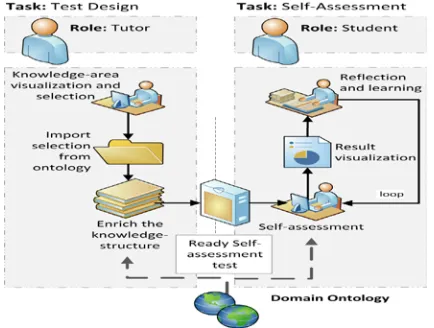
learning result, in cycles of testing, reflection and learning. The procedure of test definition and evaluation is appeared in
Figure 1, while the outcome planning for reflection and learning is talked about in area 2.5.
© IJERGS, All Rights Reserved.
Pag
e31
Pag
e31
Pag
e31
Pag
e31
Pag
e31
Pag
e31
Pag
e31
Pag
e31
Pag
e31
Pag
e31
Pag
e31
Pag
e31
Pag
e31
Pag
e31
Pag
e31
Pag
e31
Pag
e31
Pag
e31
Pag
e31
Pag
e31
Pag
e31
2.1.The Educational Domain Ontology
The Studio framework depends on a predesigned instructive philosophy, clarified in subtle element by Vas in [3]. Area
philosophy is a habitually utilized term as a part of the field of semantic advancements and underlines the capacity and
conceptualization of space learning and is regularly utilized as a part of various activities and arrangements [4][5][6] and
could address an assortment of areas with various qualities in their creation, structure and granularity, contingent upon the
point and the displaying individual [7]. A specialization as far as the field is the instructive space cosmology which is an
area metaphysics adjusted to the region and ideas of training. They could focus to show distinctive parts of instruction as
the educational programs or viewpoints important for the assignment of learning and course creation [8][9][10] or portray
the configuration, use and recovery of learning materials till making courses [11], and in addition straightforwardly the
learner inside the training [12]. Inside the territory of instructive ontologies, area ontologies tend to show excessively
particular points of interest of the training, trying to demonstrate the particular field as complete as could be expected
under the circumstances. This empowers a complete perspective on the field yet it comes at the expense of sweeping
statement, with the possibility to be resolute to handle changes. Different ideas show the training crosswise over various
ontologies, coordinating ideas like the learner, the instruction and the course portrayal, presenting an expansive skyline yet
with extra overhead to consolidate demonstrated bits of knowledge and reason on new occurrences. The claim of the
Studio instructive cosmology is the size and center of the principle classes and their connections between each other. The
information to learn is the primary interfacing idea in the center of training. It empowers an incredible adaptability to be
clever for various training related inquiries. An illustration is here the business procedure administration expansion
PROKEX, which maps process necessities against information zones to make evaluation test, mirroring the prerequisites
of appended procedures [13]. A critical variable in learning is the separation between the desire of the coach and the
learning execution of the understudy. Here a short cycle of rehashed appraisal and learning is a main consideration for a
superior individual learning execution [14]. This perspective straightforwardly profits by the engaged fixation on
information territories as the principle trade idea amongst Students and guides. As much further the nearby associations
amongst learners and instructors by means of direct coaching is one noteworthy empowering influence for PC helped
frameworks [15], every progression towards a more straightforward cooperation through centered ideas is an extra
supporter. The class structure melds interrelated information with a model of the fundamental sorts of instructive ideas,
required in circumstances of individual learning. Figure 2 pictures the class ideas as information components, together
with the connection sorts, used to display the conditions between various parts of information and learning inside the
instructive metaphysics.
The Knowledge Area is the super-class and center idea of the metaphysics. The metaphysics characterizes two
characteristics of principle relations between learning territories: Knowledge regions could be a sub-information range of
other learning regions with the "has_sub-knowledge_area" connection or be required for another learning territory with
the "requires_knowledge_of" connection. A learning range may have different associated information regions, connected
as a prerequisite or sub-region. The "requires_knowledge_of" connection characterizes that a hub is required to finish the
© IJERGS, All Rights Reserved.
Pag
e32
Pag
e32
Pag
e32
Pag
e32
Pag
e32
Pag
e32
Pag
e32
Pag
e32
Pag
e32
Pag
e32
Pag
e32
Pag
e32
Pag
e32
Pag
e32
Pag
e32
Pag
e32
Pag
e32
Pag
e32
Pag
e32
Pag
e32
Pag
e32
instruction and yields the possibility to survey perquisites of learning, simple to the fundamental thought of perquisites
inside learning spaces, created by Falmagne [16]. Instruction is an organized procedure which parts the information to
learn into various sub-parts of learning. Learning zones in the cosmology are stretched out by an extra sub-layer of
information components keeping in mind the end goal to adequately bolster instructive and testing necessities. Figure 2
envisions the sub-components also, their relations. By part the surveyed information into sub concepts, the cognizance and
relationship of self-appraisal inquiries could be communicated all the more productively and with the capability of a more
definite instructive criticism.
Figure 2: Model of the Educational Ontology
Hypotheses express in a consolidated and organized way the crucial experiences inside learning regions. They intertwine
and clarify the essential ideas of the delineated learning and set them in connection to the earth of learning with
illustrations. Various hypotheses could be "part_of" an information zone. Each hypothesis may characterize various Basic
Concepts as a "reason" or "conclusion", to structure how the parts of the information region are connected. Cases improve
this parts as a solid grapple for self-appraisal questions and "refer_to" the hypotheses and essential ideas as a "part_of"
one or more learning ranges.
2.2 The Test bank
Keeping in mind the end goal to associate the assignment of self-appraisal with the model of the instructive area, the
framework coordinates a store of evaluation questions. Every inquiry addresses one component of the general learning and
is straightforwardly connected with one learning territory or information component occurrence inside the metaphysics.
The area cosmology gives here the structure to the online self-evaluation while the archive of inquiries supplements the
territories as a test bank.
The objective of the self assessment is to persistently enhance the individual learning inside the evaluated instructive
© IJERGS, All Rights Reserved.
Pag
e33
Pag
e33
Pag
e33
Pag
e33
Pag
e33
Pag
e33
Pag
e33
Pag
e33
Pag
e33
Pag
e33
Pag
e33
Pag
e33
Pag
e33
Pag
e33
Pag
e33
Pag
e33
Pag
e33
Pag
e33
Pag
e33
Pag
e33
Pag
e33
Learning Material associated with the test bank and the learning zones, simple to the test questions. The learning material
is sorted out into segments as an organized content with blended media, as pictures and recordings, and depends on a wiki
engine to keep up the substance, including outside connections.
2.3 Creating and Maintaining Tests
The creation and proceeds with upkeep of the area philosophy is an assignment of philosophy building. The philosophy design (the cosmologist), makes, utilizes and assesses the cosmology [17], with a solid spotlight on keeping up the structure and substance. Inside Studio, this procedure is guided and upheld by a particular organization work process and parts in three back to back errand territories, in accordance with diminishing access rights:
• Ontology engineering (instance level): The creation and linking of instances of the existing knowledge-area classes
into the overall domain ontology.
• Test definition: Knowledge areas, which are relevant to a target self-assessment test, are selected and grouped into
specialized containers called Concept Groups (CG). These concept groups are organized into a tree of groups, in line
with the target of the assessment. The final tree in this regards captures a sub-ontology. Concept groups are internally
organized based on the overall ontology and include all relations between knowledge elements, as defined within the
domain ontology.
• Question and learning material creation: Questions and learning materials alike are directly connected to single
knowledge areas within the designed test frame and get imported, if already existing, from the domain ontology. More
questions and learning materials are defined now, in line with the additional need of the targeted education and are
available for future tests.
3. System Evaluation
The system has been used, extended and evaluated in a number of European and nationally funded research projects,
including applications in business process management and innovation-transfer [20], medical education [21] and job
market competency matching [22].
Currently the system is being evaluated based on a running study with 200 university students in the field of business
informatics. The study will conclude on two current research streams which are improving the systems testing and
analysis capability. The first direction looks into potentials for the integration of learning styles into adaptive learning
systems to offer valuable advice and instructions to teachers and students [23]. Within the second direction the question is
challenged on how to adapt the presented self-assessment further towards the performance of the students, based on
extracting assessment paths from the knowledge structure [24].
For each running test, Studio collects basic quantitative data about the number of assigned questions, how often tests are
taken and how many students open which test and when. This is completed by qualitative measures, collecting which
questions and knowledge elements the students passed or failed. To conclude further on the mechanisms and impacts of
Studio within the current study, a new logging system was developed, collecting the interaction with the system and
detailed information about the feedback as detailed events.
© IJERGS, All Rights Reserved.
Pag
e34
Pag
e34
Pag
e34
Pag
e34
Pag
e34
Pag
e34
Pag
e34
Pag
e34
Pag
e34
Pag
e34
Pag
e34
Pag
e34
Pag
e34
Pag
e34
Pag
e34
Pag
e34
Pag
e34
Pag
e34
Pag
e34
Pag
e34
Pag
e34
Table 1: Event blueprint to store events concerning system interaction.
Attribute Description
Event description code Which type of event and what factors are relevant.
Location code On which part of the assessment-process or interface the event has occurred.
Session identifier Each access of the system is one session for one user.
Numerical value storage Multi-purpose field, filled depending on the event type.
String value storage Multi-purpose field, filled depending on the event type.
Event-time The time of the start of the event.
Item reference A unique reference code, identifying the correlated item within the ontology. E.g. a question or a knowledge-element ID.
All events are stored in order of their occurrence, so if no explicit end event is defined, the next event for the same session
and user is acting as the implicit end date. Extending the existing storage of information within Studio, the new logging
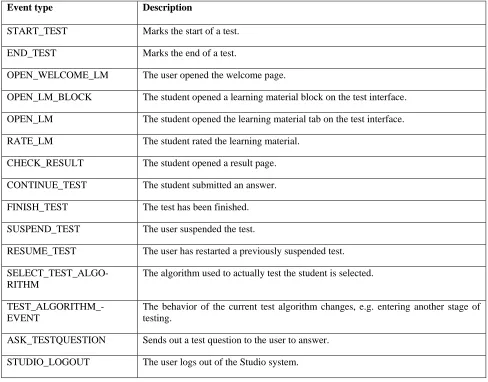
system stores the additional events, as shown in Table 2 below:
Table 2: Assessment events and descriptions.
Event type Description
START_TEST Marks the start of a test.
END_TEST Marks the end of a test.
OPEN_WELCOME_LM The user opened the welcome page.
OPEN_LM_BLOCK The student opened a learning material block on the test interface.
OPEN_LM The student opened the learning material tab on the test interface.
RATE_LM The student rated the learning material.
CHECK_RESULT The student opened a result page.
CONTINUE_TEST The student submitted an answer.
FINISH_TEST The test has been finished.
SUSPEND_TEST The user suspended the test.
RESUME_TEST The user has restarted a previously suspended test.
SELECT_TEST_ALGO-RITHM
The algorithm used to actually test the student is selected.
TEST_ALGORITHM_-EVENT
The behavior of the current test algorithm changes, e.g. entering another stage of testing.
ASK_TESTQUESTION Sends out a test question to the user to answer.
© IJERGS, All Rights Reserved.
Pag
e35
Pag
e35
Pag
e35
Pag
e35
Pag
e35
Pag
e35
Pag
e35
Pag
e35
Pag
e35
Pag
e35
Pag
e35
Pag
e35
Pag
e35
Pag
e35
Pag
e35
Pag
e35
Pag
e35
Pag
e35
Pag
e35
Pag
e35
Pag
e35
4. Next Steps
The domain ontology offers a functional and semantically rich core for supporting learning and education. Yet not all the
semantic potentials are fully leveraged to support and test the learner’s progress. The “requires_knowledge_of”
relation-requirement is a potential start-concept to model sub-areas as groups which together compose the dependency. This could
act as an additional input for the assessment, where the system derives more complex decision how to further explore the
related parts of the structure [25]. This could also be visualized, enabling the learner to grasp the personal knowledge as a
visible group of concepts. Besides giving colors to the different types of relations, the visualizing of edges between
knowledge areas is yet unfiltered, offering no further support for navigation. A next stage of implementation could be the
introduction of a visual ordering and grouping of knowledge areas and relations. Underlying relations of sub-nodes could
be interpreted visually through the thickness of relations between nodes, easing the perception of complex parts of the
domain ontology, especially within administration and maintenance tasks. The feedback of the current evaluation study of
Studio will provide additional insights into the usage of the system by the students. Based on this new data it is possible to
mine profiles over time on the knowledge structure. One major application is here the creation of behavior profiles, as
proposed in [23].
5. References
[1]. D. Dunning, C. Heath, and J. M. Suls, “Flawed self-assessment implications for health, education, and the
workplace,” Psychological science in the public interest, vol. 5, no. 3, pp. 69–106, 2004.
[2]. D. Jonassen, “Reconciling a Human Cognitive Architecture,” in Constructivist Instruction: Success Or Failure?, S.
Tobias and T. M. Duffy, Eds. Routledge, 2009, pp. 13–33.
[3]. R. Vas, “Educational Ontology and Knowledge Testing,” Electronic Journal of Knowledge Management, vol. 5, no. 1,
pp. 123 – 130, 2007.
[4]. M. Y. Dahab, H. A. Hassan, and A. Rafea, “TextOntoEx: Automatic ontology construction from natural English text,”
Expert Systems with Applications, vol. 34, no. 2, pp. 1474–1480, Feb. 2008.
[5]. S.-H. Wu and W.-L. Hsu, “SOAT: a semi-automatic domain ontology acquisition tool from Chinese corpus,” in
Proceedings of the 19th international conference on Computational linguistics-Volume 2, 2002, pp. 1–5.
[6]. M. Missikoff, R. Navigli, and P. Velardi, “The Usable Ontology: An Environment for Building and Assessing a
Domain Ontology,” in The Semantic Web — ISWC 2002, I. Horrocks and J. Hendler, Eds. Springer Berlin Heidelberg,
2002, pp. 39–53.
[7]. T. A. Gavrilova and I. A. Leshcheva, “Ontology design and individual cognitive peculiarities: A pilot study,” Expert
Systems with Applications, vol. 42, no. 8, pp. 3883–3892, May 2015.
[8]. S. Sosnovsky and T. Gavrilova, “Development of Educational Ontology for C-programming,” 2006.
[9]. V. Psyché, J. Bourdeau, R. Nkambou, and R. Mizoguchi, “Making learning design standards work with an ontology
of educational theories,” in 12th Artificial Intelligence in Education (AIED2005), 2005, pp. 539–546.
[10]. T. Nodenot, C. Marquesuzaá, P. Laforcade, and C. Sallaberry, “Model Based Engineering of Learning Situations for
Adaptive Web Based Educational Systems,” in Proceedings of the 13th International World Wide Web Conference on
© IJERGS, All Rights Reserved.
Pag
e36
Pag
e36
Pag
e36
Pag
e36
Pag
e36
Pag
e36
Pag
e36
Pag
e36
Pag
e36
Pag
e36
Pag
e36
Pag
e36
Pag
e36
Pag
e36
Pag
e36
Pag
e36
Pag
e36
Pag
e36
Pag
e36
Pag
e36
Pag
e36
[11]. A. Bouzeghoub, C. Carpentier, B. Defude, and F. Duitama, “A model of reusable educational components for the
generation of adaptive courses,” in Proc. First International Workshop on Semantic Web for Web-Based Learning in
conjunction with CAISE, 2003, vol. 3.
[12]. W. Chen and R. Mizoguchi, “Learner model ontology and learner model agent,” Cognitive Support for
Learning-Imagining the Unknown, pp. 189–200, 2004.
[13]. G. Neusch and A. Gábor, “PROKEX – INTEGRATED PLATFORM FOR PROCESS-BASED KNOWLEDGE
EXTRACTION,” ICERI2014 Proceedings, pp. 3972–3977, 2014.
[14]. H. L. Roediger III, “Relativity of Remembering: Why the Laws of Memory Vanished,” Annual Review of
Psychology, vol. 59, no. 1, pp. 225–254, 2008.
[15] J. D. Fletcher, “Evidence for learning from technology-assisted instruction,” Technology applications in education: A
learning view, pp. 79–99, 2003.
[16]. J.-C. Falmagne, M. Koppen, M. Villano, J.-P. Doignon, and L. Johannesen, “Introduction to knowledge spaces: How
to build, test, and search them,” Psychological Review, vol. 97(2), pp. 201–224, 1990.
[17]. F. Neuhaus, E. Florescu, A. Galton, M. Gruninger, N. Guarino, L. Obrst, A. Sanchez, A. Vizedom, P. Yim, and B.
Smith, “Creating the ontologists of the future,” Applied Ontology, vol. 6, no. 1, pp. 91–98, 2011.
[18]. “Ext JS API.” [Online]. Available: http://www.objis.com/formationextjs/lib/extjs-4.0.0/docs/index.html. [Accessed:
04-May-2015].
[19]. K.-P. Yee, D. Fisher, R. Dhamija, and M. Hearst, “Animated exploration of dynamic graphs with radial layout,” in
IEEE Symposium on Information Visualization, 2001. INFOVIS 2001, 2001, pp. 43–50.
[20]. M. Arru, “Application of Process Ontology to improve the funding allocation process at the European Institute of
Innovation and Technology.,” in 3rd International Conference on Electronic Government and the Information Systems
Perspective (EGOVIS)., Munich, Germany, 2014.
[21]. M., M., Ansari, F., Dornhöfer Khobreh and M. Fathi, “An ontology-based Recommender System to Support Nursing
Education and Training,” in LWA 2013, 2013.
[22]. V. Castello, L. Mahajan, E. Flores, M. Gabor, G. Neusch, I. B. Szabó, J. G. Caballero, L. Vettraino, J. M. Luna, C.
Blackburn, and F. J. Ramos, “THE SKILL MATCH CHALLENGE. EVIDENCES FROM THE SMART PROJECT,”
ICERI2014 Proceedings, pp. 1182–1189, 2014.
[23]. H. M. Truong, “Integrating learning styles and adaptive e-learning system: Current developments, problems and
opportunities,” Computers in Human Behavior, 2015.
[24]. C. Weber, “Enabling a Context Aware Knowledge-Intense Computerized Adaptive Test through Complex Event
Processing,” Journal of the Sientific and Educational on Forum on Business Information Systems, vol. 9, no. 9, pp. 66–74,
2014.
© IJERGS, All Rights Reserved.
Pag
e37
Pag
e37
Pag
e37
Pag
e37
Pag
e37
Pag
e37
Pag
e37
Pag
e37
Pag
e37
Pag
e37
Pag
e37
Pag
e37
Pag
e37
Pag
e37
Pag
e37
Pag
e37
Pag
e37
Pag
e37
Pag
e37
Pag
e37
Pag
e37
[26]. K.Mahalakshmi , Manikandan and Nithyanantham “Unsupervised Learning Technique Using Hybrid Optimization
for Non-Functional Requirements Classification” , in International Journal of Advanced Engineering Technology, 2016,
pp., 1072-1079
[27]. Mahalakshmi, K., and R. Prabhakar. "Performance Evaluation of Non Functional Requirements." (2013).
[28]. Mahalakshmi, K., and R. Prabhakar., “Hybrid Optimization Of Svm For Improved Non-Functional Requirements