Volume 1; Issue 1; Page No. 50-54
e
50
An Analysis of Cloud Computing Model by using Service Architecture
Komal Jain, M.C.A. Scholar [email protected]
Jayoti Vidyapeeth Women’s University, Jaipur, Rajasthan
Abstract
In this research paper, cloud computing is a model for providing computing power as services, on-demand network access to a shared pool of configurable computing resources. The cloud service architecture is simple although it does
require some intelligent management and those entire computer assign the task processing to multitudes of user.
The Cloud computing model there are certain services and model working behind the same making the cloud computing feasible and accessible to end users the working models for cloud computing.Key Words: Cloud, Computing, Public, Private, Internet, Model, Security, Service, Architecture
1. Introduction
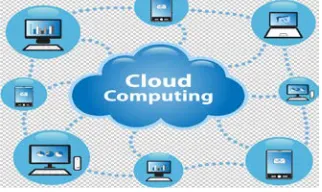
The cloud refers the network and internet can provide the services over the network i.e. .public network and private network. It is important to distinguish the term "cloud" and the cloud symbol from the Internet. As a specific environment used to remotely provision resources, a cloud has a finite boundary. There are many individual clouds that are accessible via the Internet [1]. In this “cloud" doing most of the work, this frees us up to access the cloud however we choose and It could be a super-charged computer PC designed for high level-end gaming, or client laptop running the Linux operating system with a instead of a conventional hard drive, or even and iphone ,android or Blackberry. Cloud computing: cloud computing using the internet for the tasks you perform on your computer is based on computing shared the resource software and information are provided to other device can demand the grid such as yahoo, Gmail, hotmail. Cloud computing provides means by which can be access the application utilities over the internet and allows the configure and customize the business application online.
Figure 1: Cloud
2. Cloud Computing Model
Cloud computing is a model for providing computing power as services, on-demand network access to a shared pool of configurable computing resources such as networks, servers, storage, applications, and services that can be rapidly provisioned and released with minimal management effort or service provider interaction.
Cloud computing provides computation, software, data access, and storage services that do not require the knowledge about the physical location and configuration of the system that delivers to the end user as a service on pay for use basis. This concept resembles to the concept of using the electricity grid, where end-users consume power without needing to understand the component devices or infrastructure required to provide the service [3].
Figure 2: Cloud Computing Model
Pag
e
51
Pag
e
51
Pag
e
51
Pag
e
51
Pag
e
51
Pag
e
51
Pag
e
51
Pag
e
51
Pag
e
51
Pag
e
51
Pag
e
51
Pag
e
51
Pag
e
51
Pag
e
51
Pag
e
51
Pag
e
51
Pag
e
51
Pag
e
51
Pag
e
51
Pag
e
51
Pag
e
51
The Cloud computing model there are certain services and model working behind the same making the cloud computing feasible and accessible to end users the working models for cloud computing.
There are the two type of model
Deployment model: Deployment model are refers to the location and management of the cloud’s infrastructure. Model are define the type of access to the cloud i.e. how the cloud is located.
Deployment model are four types
i. Public Clouds: public cloud allows the system and services to be easily allocate to the general public. Public cloud
may be less secure because of its openness e.g. e-mail Amazon Elastic Compute Cloud (EC2), IBM's Blue Cloud, Sun
Cloud, Google App Engine and Windows Azure Services Platform [4].
Figure 3: Public Clouds
A public cloud is one in which a service provider serves customers, with functionality like applications, infrastructure, and storage. . These services are available to businesses and individuals over the Internet. Public cloud services may be free or offered on a pay-per-usage model.
ii. Private Cloud: The private cloud allows the system and services are the accessible within the organization.
Figure 4: Private Cloud
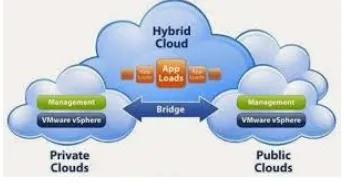
This service allows the provider to switch certain non-sensitive functions to a public cloud to free up more space in the private cloud for the sensitive functions that require it. Private clouds can even be integrated with public cloud services to form hybrid clouds where non-sensitive functions are always allocated to the public cloud to maximize the efficiencies on offer [5].
Private clouds are two types
A.On-premises: It is multiple of generation the business. it department the capital and operational cost for physical resources with this model. On-premise model are used for application are they require complete control and configurability and security.
B.off -premises: It is used by one organization and posted by a third party specialized in cloud infrastructure .it is recommended for organization that the risk associated with physical resources.
iii.Hybrid Cloud: The Hybrid Cloud is mixture of public and private cloud
Figure 5: Hybrid Cloud
e
52
e
52
e52
e
52
e52
e
52
e52
e
52
e52
e
52
e
52
e
52
e
52
e52
e
52
e52
e
52
e52
e
52
e52
e
52
iv.Community Cloud: Community clouds are multi-tenant infrastructures that are shared among different organization
of the same community defined as specific groups with common computing concerns such as mission, security requirements, policies, audit requirements, regulatory compliance considerations or performance requirements.
Figure 6: Community Cloud
Community clouds are a subset of public clouds customized to a specific vertical industry, such as healthcare or finance and federal agencies that all offer a variety of services including Software as a Service (SaaS), Business as a Service (BaaS) or Platform as a Service (PaaS) [7].
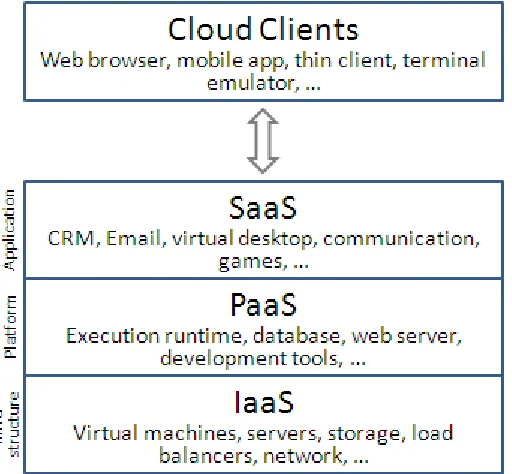
3. Service Models of Cloud Computing: service model are reference model which are the cloud computing is based the
consist of particular types of services and access the cloud computing platform.
Figure 7: Service Models of cloud computing
There are many other service models all of which can take the form like XaaS, i.e., anything as a Service. This can be Network as a Service, Business as a Service, Identity as a Service, Database as a Service or Strategy as a Service [8].
4. Types of Basic Services Models
A. Infrastructure as a Service (IaaS): It is the hardware and software that supply are the all servers storage hardware
Pag
e
53
Pag
e
53
Pag
e
53
Pag
e
53
Pag
e
53
Pag
e
53
Pag
e
53
Pag
e
53
Pag
e
53
Pag
e
53
Pag
e
53
Pag
e
53
Pag
e
53
Pag
e
53
Pag
e
53
Pag
e
53
Pag
e
53
Pag
e
53
Pag
e
53
Pag
e
53
Pag
e
53
B. Software as a service (SaaS): software as a service is using an application online. Software a Service (SaaS ) model
allows providing software application as a service to the end users. It refers to software that is deployed on a hosted service and is accessible via Internet. There are several SaaS applications, some of them are listed below: Billing and Invoicing System, Customer Relationship Management (CRM) applications, Help Desk Applications, Human Resource (HR) Solutions. Some of the SaaS applications are not customizable such as an Office Suite. But SaaS provides us Application Programming Interface (API), which allows the developer to develop a customized application [10].
C. Platform as a service (PaaS): platform as a service the runtime environment for application and development It also
offers development & deployment tools, required to develop applications. PaaS has a feature of point-and-click tools that enables non-developers to create web applications. Google's App Engine, Force.com is examples of PaaS offering vendors. Developer may log on to these websites and use the built-in API to create web-based applications. But the disadvantage of using PaaS is that the developer lock-in with a particular vendor. For example, an application written in Python against Google's API using Google's App Engine is likely to work only in that environment. Therefore, the vendor lock-in is the biggest problem in PaaS. The following diagram shows how PaaS offers an API and development tools to the developers and how it helps the end user to access business applications [10].
5. Platform as a service type
A.Application delivery only environment: The Application Delivery environment in the include Pass on-demand
service and application security and web based of the environment and provides application.
B. Open platform as service: Open platform as service offers an open source software that helps a Pass provider to run
applications .open sources are software provider and resources of security provide.
C.Add -on development facilities: The Add-on Plat from as a service allows to customer the existing SaaS platform and
customer are resource of providers in software.
D.Stand alone development environments: The Stand-alone PaaS works as an independent entity for a specific
function. It does not include licensing, technical dependencies on specific SaaS applications.
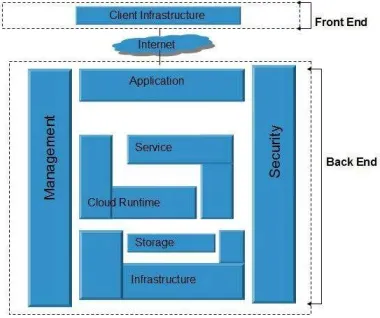
6. Cloud Architecture: The cloud architecture is simple although it does require some intelligent management and those
entire computer assign the task processing to multitudes of user. Cloud Architectures are designs of software applications that use Internet-accessible on-demand services [3]. Applications built on Cloud Architectures are such that the underlying computing infrastructure is used only when it is needed (for example to process a user request), draw the necessary resources on-demand (like compute servers or storage), perform a specific job, then relinquish the unneeded resources and often dispose themselves after the job is done. While in operation the application scales up or down elastically based on resource needs
Figure 8: Cloud Architecture
Basically Cloud Architecture dividing in two parts
A. Front End: Front end refers to the client part of cloud computing system. It consist of application that require to
access the cloud computing platform [2]. It all starts with the front end interfaces by individual users select a task or service and users request then gets passed to the system management and the all correct resources and system appropriate provisioning services.
B. Back End: Back end refers to the cloud it consist of all the resource to provided cloud computing services and
e
54
e
54
e54
e
54
e54
e
54
e54
e
54
e54
e
54
e
54
e
54
e
54
e54
e
54
e54
e
54
e54
e
54
e54
e
54
end to provide built in security mechanism and traffic control protocols are server employs protocol known as the connected devices to communicate each other of protocols and users.
7. Infrastructure of Cloud: cloud infrastructure consists of services, storage, network, management, software
deployment, software platform virtualization. It providers rely on virtual machine technology to deliver servers that can run applications. Virtual machines are containers that are assigned specific resources. The software that runs in the virtual machines is what defines the cloud computing system. Management software are the helps to maintain configure the infrastructure.
i. Storage: cloud storage are users to distributed file system for storage purpose and are the storage files it can be
extracted from another to cloud computing more reliable. Cloud storage means "the storage of data online in the cloud" a company's data is stored in and accessible from multiple distributed and connected resources that comprise a cloud.
ii. Service: service are the compete the resource sharing and other service such as resources allocation and deal location,
monitoring resources and security.
iii.Security: security is the most important issue in terms of data, infrastructure and virtualization etc. Collective of
information is not only a competitive asset, but it often consist of information of customers, consumers and employees that, in the wrong hands, could create a civil obligation and perhaps criminal charges. Cloud computing can be made secure but securing cloud computing data is a contractual issue as well as a technical one [10]. Security in cloud computing is a major concern and data is cloud should be stored in encrypted form. Security is an evolving sub-domain of computer security, network security, entertainment data storage, social networking, management, education etc. These applications use the computer power of App Engine as well as the integrated features like distributed in-memory cache, task queues and data store, to create robust applications quickly and easily
8. Application of Cloud Computing: A cloud application (or cloud app) is an application program that functions in the
cloud, with some characteristics of a pure desktop app and some characteristics of a pure Web app. A desktop app resides entirely on a single device at the user's location (it doesn't necessarily have to be a desktop computer). A Web app is stored entirely on a remote server and is delivered over the Internet through a browser interface.[10]
Some of the cloud computing applications are using
Business application: cloud computing has made of the businesses more collaborative and easy incorporating various
applications of the business are use in client to server in use the application are the per to pear use.
Data storage & backup: The data storage are the box.com, mozyare there application offering data storage and recover
of storage in application and data recovery.
9. References
[1]. http://whatiscloud.com/basic_concepts_and_terminology/cloud.
[2]. http://www.gazonindia.com/cloud_computing.html.
[3]. http://www.tutorialspoint.com/cloud_computing/cloud_computing_architecture.htm.
[4]. http://blog.pluralsight.com/private-vs-public-cloud.
[5]. http://webzworld.com/hosting/private-cloud-server
[6]. http://wikibon.com/the-hybrid-cloud-market-lacks-maturity.
[7]. http://www.atomrain.com/it/technology/dissecting-cloud-iv-community-clouds.
[8]. http://www.inspurglobal.com/article-366.html.
[9] http://searchcloudcomputing.techtarget.com/definition/Infrastructure-as-a-Service-IaaS.
[10]. file:///E:/notes%20mca%20final/cloud%20computing/cloudbook/hi/cloud_computing_tutorial.pdf.