Normalizing Whiteness on College Campuses
Chris Corces-Zimmerman
University of Arizona
Abstract
When problematizing issues of racial inequity and white supremacy on today’s college and university campuses, many situate the problem in the thoughts and actions of individual students, staff, faculty, or administrators. While certainly a part of the problem, this individual-level racism is often symptomatic of larger institutional-individual-level sources of marginalization and oppression. In this study, I explore how a subset of Historically white Colleges (HwCs) communicates and normalizes an institutional culture of whiteness through the words and images presented in their promotional viewbook materials. Drawing from a framework within Critical whiteness Studies known as white Institutional Presence, this article implements a Critical Content Analysis of the visual and textual content of promotional viewbooks from five HwCs to explore how these institutions utilize their marketing materials to normalize whiteness at both individual and institutional levels. Findings from the analysis include (a) Students of Color as over-represented but peripheral, (b) the conditions of whiteness, and (c) the impacts of white expectations.
Keywords: whiteness, race, white supremacy, higher education
Understanding & Dism
antl
ing Privilege
e Off
icial Jou
rn
al of T
h
e Wh
ite
Pr
ivi
lege
Co
n
fe
re
n
ce
an
d
T
h
e M
at
rix Ce
n
te
r
for
the
Advan
ce
m
en
t o
f Social E
q
u
ity
an
d
In
clu
sion
When most college students arrive on campus they bring with them a range of expectations and aspirations about the institution and the experiences they will have while there. Far from happenstance, these preconceived notions are often rooted in the intentional messages and images that institutions of higher education project in their efforts to portray the institution as desirable, high quality, and worth the price of admission. For Historically white1
Colleges (HwCs) a large—albeit often covert—part of this messaging is a promise of an educational experience that is rooted in, and supportive of, whiteness. In reality what makes these institutions “historically white” is not just a legacy of racially exclusive admissions practices, but also a past and present cultural ideology that centers white ways of being, speaking, thinking, and learning (Gusa, 2010). While these messages are communicated through a variety of mediums, one common example comes in the form of promotional
viewbooks.
Osei-Kofi, Torres, and Lui (2013) define viewbooks as, “promotional
admissions brochures created by marketing professionals in order to ‘sell’ institutions to prospective students and their families” (p. 386). Common to these booklets are images of students engaged in one-on-one
interactions with peers and professors, picturesque campus photos, descriptions of course offerings and campus organizations, and other information intended to
communicate a certain message about the institution. While numerous studies have examined the content, structure, and significance of college viewbooks (Hartley & Morphew, 2008; Klassen, 2001; Osei-Kofi, Torres, & Lui, 2013), the vast majority analyzed these materials from the
perspective of how they communicate different messages to the target audience of
the institution (Hite & Yearwood, 2001). Although this is certainly one function of these brochures, it is also possible to view them through a critical lens as a
representation of how universities perceive themselves and how they use these
seemingly neutral communication mediums to establish a particular racialized
institutional culture. Such a shift in
perspective allows for a better understanding of what priorities these institutions are really communicating through both overt and subconscious messaging.
While viewbooks are no longer the predominant means through which
institutions craft their brand identity, they remain a powerful visual and textual artifact to explore the ways that institutions of higher education frame their commitment to racial diversity and inclusion. As artifacts, these resources serve as a window into the internal identity of an institution and to understand how the leadership of the institution aims to position itself within the larger population of colleges and
universities (Pippert, Essenburg, & Matchett, 2013). Similar to an
archaeological artifact, these viewbooks help to explain how universities have historically constructed their institutional identity, in essence serving as a case study of how HwCs have worked to normalize whiteness in the past in order to understand how they may continue to do so in the present.
To that end, the purpose of this paper is to understand how HwCs use their
promotional viewbooks to create and advance a specific institutional culture that is rooted in notions of whiteness and white privilege. Throughout this paper I use the term Historically white Colleges (HwCs) as opposed to the more commonly used
order to focus on the systemic and historical legacy of whiteness in the establishment and evolution of most institutions of higher education in the United States. Drawing on a framework from Critical whiteness Studies called white Institutional Presence (Gusa, 2010), viewbooks from five liberal arts institutions in the United States were analyzed to explore how they craft and maintain an identity that serves to uplift and advantage a culture of whiteness. Further, using a Critical Content Analysis (CCA) methodology that Short (2016) describes as, “bringing a critical lens to an analysis of a text or group of texts in an effort to explore the possible underlying messages within those texts, particularly as related to issues of power” (p. 6), I explore the question: How do Historically white Colleges utilize promotional viewbooks to normalize whiteness at their institutions?
Sociocultural context
Central to the practice of CCA is a belief that to fully understand the meaning and significance of a piece of textual or visual content, one must first consider the sociocultural context in which the piece was created (Short, 2016). This is particularly true of college viewbooks, as institutions of higher education are situated within, and largely reactive to, the complex social, political, and historical context at both national and local levels. As the racial demographics of the United States have shifted over the past 25 years (Smith, 2015), institutions of higher education have faced increasing pressure, both internally and externally, to prioritize and demonstrate a commitment to “diversity” and
“multiculturalism” in the values of their institutions (Alemán & Salkever, 2001). While this does not always result in actual change to campus environments, what has changed significantly is the image of
inclusivity that these colleges and
universities project both within and without the institution.
In addition, the past three years have brought a heightened level of student
activism and demand for reform to the way that institutions of higher education treat and value Students of Color and other
marginalized student populations on campus (Arthur, 2016). Although not a new
development, what is distinct about these current movements is their visibility due to the increased use of social and electronic forms of media (Valenzuela, 2013). Taken together, this overall trend toward a more racially diverse applicant pool, coupled with an amplified pressure and attention drawn to issues of racial discrimination and
oppression on campuses, one would
reasonably expect that institutions of higher education might utilize their college
viewbooks as one means of projecting an internal and external image of tolerance, inclusion, and acceptance.
Review of Literature
Given the role that college
viewbooks have played in the recruitment of prospective students, it is not surprising that the existing literature that uses viewbooks as data sources is substantial in both breadth and quality. These studies range in their field of origin, type of analysis, type of institutions sampled, and the framework in which the study was situated. As it pertains to field of origin, studies have been
(Osei-Kofi & Torres, 2015; Osei-Kofi et al., 2013), the majority tended to implement a more quantitative or statistical review of the viewbooks (Hite & Yearwood, 2001; Pippert et al., 2013). Regarding the sampling
strategy used in each study, most relied on some form of ranking system like U.S. News and World Report (Hite & Yearwood, 2001; Pippert et al., 2013) while others looked at institution type, size, or mission (Klassen, 2001; Roediger, 2005). Lastly, while most studies didn’t specify a theoretical
framework for their analysis, two studies situated their analysis in organizational theory (Hartley & Morphew, 2008) and Critical Race Theory (Osei-Kofi et al., 2013).
While the studies themselves tend to be quite distinct, the findings from each are consistent and supportive of one another. Of the studies that look at the visual and textual communication through an organizational or business lens, the primary findings show that institutions of higher education craft their viewbooks to appeal to the needs and interests of their target population(s). In an analysis of viewbooks from 91 colleges and universities, Hite and Yearwood (2001) found significant differences in the content of viewbooks based on the size and type of institution. For example, larger, often public institutions were found to communicate that their size was a strength that led to increased opportunity for learning and engagement, whereas smaller, often private or liberal arts institutions expressed a value on community and intimate relationships with peers and professors. In a similar study, Klassen (2001) looked at viewbooks from 16 colleges and universities from the top and bottom of the U.S. News rankings and found that institutional messages differed based on (a) primary focus of messaging, (b) location and surrounding environment, (c) student experience at the institution, and (d) the core
purpose of college being one of learning and enjoyment versus a means of obtaining a necessary degree. Lastly, Hartley and Morphew (2008) looked at the ways that institutions of higher education
communicated messages about their academic purpose and found that most universities placed relatively little focus on academics in favor of very similar, cookie-cutter, images of college as a place of enjoyment, entertainment, and extra-curricular engagement.
Though studies conducted through a business or organizational lens are helpful in understanding general depictions and
messages that colleges and universities communicate through their viewbooks, they lack the important critical perspective to problematize many of the narratives advanced in these materials. In his critique of how HwCs utilized racialized images and narratives to portray themselves as inclusive and accepting, Roediger (2005) cited
numerous examples of colleges and
universities using or falsely creating images of People of Color to make themselves appear more racially diverse. He then poses the question of “whether such multiracial marketing actually imagines itself appealing mainly to prospective students of Color or to liberal and not-so-liberal White students and parents who associate a degree of multiracial presence with a successful college and with one that cannot be charged with racism” (p. 209).
Pippert, Essenburg, and Matchett (2013) used a quantitative analysis to explore the accuracy of depictions of racial demographics at 165 colleges and
the portrayed diversity of each institution. Then, using demographic data provided by
U.S. News and World Report, they compared the actual and portrayed racial demographics of these institutions, resulting in three key findings. First, given the
consistency with which these
misrepresentations occurred, the authors suggested that they resulted from intentional decisions, rather than by accident or
coincidence. Second, most institutions misrepresented the racial composition of their student body, often over-representing Black, Asian, and to a lesser extent, White students, and significantly
under-representing Latinx and non-White other students. Lastly, institutions tended to convey racial diversity along a Black-White binary as though other Students of Color were not present or unimportant.
The most relevant study to the
current analysis was conducted by Osei-Kofi et al. (2013). In this study they used a
Critical Discourse Studies methodology to critique representations of diversity and whiteness in viewbooks from 20 colleges and universities ranked highly in the U.S. News and World Report Diversity Index. They classified the findings from their analysis into four themes:
1. Messages of racial diversity are intended to appeal to White audiences;
2. Institutions often use digital means to construct images that portray exaggerated levels of diversity; 3. Institutions use messages around
study abroad and service to “other” People of Color domestically and abroad; and
4. Racial diversity is peripheral to the institutional mission, and Students of Color are treated as tokens. In
summarizing their study, Osei-Kofi et al. (2013) say, “In the quest to appear diverse, bodies of color are positioned against a white norm and are used in viewbooks to invoke racial harmony on college campuses.” (p. 402)
Whiteness Defined
To fully explore what it means for an institution of higher education to normalize whiteness through the visual and textual components of their promotional viewbooks, it is first important to understand how
scholars in the field of education and beyond define and conceptualize whiteness. Much of this work is done in the field of
Critical whiteness Studies (CwS), the term used to describe and classify a cross-disciplinary collection of scholarship and theory that critically centers and exposes the various ways in which whiteness has been created and maintained as the dominant racial discourse in the United States (Leonardo, 2009). Drawing on works from philosophy (Fanon, 2005; Mills, 1997; Yancy, 2012), sociology (Du Bois, 1999), education (Leonardo, 2009; Matias, 2016), history (Painter, 2010), and literature (Morrison, 1992), the field of CwS is a growing discipline that seeks to make visible the myriad practices that serve to uphold whiteness as dominant and superior.
organization of society” (p. 92). Taking his theorizing of whiteness a step further, Yancy (2012) explains, “whiteness is secured through marking what it is not. Yet what it (whiteness) is not (Blackness in this case) is a false construction that Whites themselves have created to sustain their false sense of themselves as ontologically superior” (p. 20). What these works convey is that while whiteness is a socially constructed concept created by White people to control People of Color, whiteness is also extremely socially destructive in the real, material privileges that it affords to those who are identified as White.
As it pertains to the focus of this study, whiteness in institutions of higher education is frequently understood to exist at both individual and institutional levels. At the individual level, White students, faculty, and administrators receive benefits from and maintain a culture in which white ways of being and knowing are considered to be superior and more desirable. These dynamics play out in racially biased
admissions practices (Chang, 2003), access to special educational opportunities (Bondi, 2012), and a freedom from day-to-day oppression in the form of microaggressions or overt acts of racism (Sue, 2010). While individual-level expressions of whiteness serve to disproportionately privilege White college students, it is arguably those
institutional-level policies and practices that are far more oppressive and influential in maintaining whiteness on college campuses. Examples of institutional-level
manifestations of whiteness include curricula that center white experiences or histories, residential policies that physically segregate students along racial lines, and hiring and promotion criteria that result in a disproportionately White faculty and administration.
Critical Framework
The framework of white Institutional Presence as developed by Gusa (2010) is one of the few education-focused theories in Critical whiteness Studies that centers a critique of the ways that whiteness is advanced through the institutional level policies and practices. In describing the concept, Gusa explains how overt and covert forms of whiteness determine the practices, values, and organizational structures of HwCs. She says HwCs “do not have to be explicitly racist to create a hostile
environment. Instead, unexamined
historically situated white cultural ideology embedded in the language, cultural
practices, traditions, and perceptions of knowledge allow these institutions to remain racialized” (p. 465). As she explains, the concept of white Institutional Presence refers to the ways that HwCs have been, both in their inception and in their present formation, structured in ways that center White identity and culture.
Within the framework of white Institutional Presence, Gusa (2010) highlights four core tenets of (a) white ascendency, (b) monoculturalism, (c) white blindness, and (d) white estrangement. While all four tenets explain a different process through which institutions of higher education perpetuate the dominance of whiteness through institutional practices and cultures, for the purpose of this analysis I focused specifically on the tenet of monoculturalism as it most directly addresses the ways that whiteness
aforementioned beliefs in the superiority and normalcy of white culture” (pp. 474–475). Central to the notion of monoculturalism is that whiteness is omnipresent and engrained in the very fabric of institutions of higher education. Thus, whiteness is not only the guiding ideology that structures the day-to-day operations of HwCs, but its absence is a sign of lesser quality and possibility.
Through monoculturalism, HwCs not only privilege White students by centering their experiences and bodies as normal and meritorious, they also directly and indirectly force Students of Color to assimilate to white-centric ways of learning and being. Gusa (2010) suggests that monoculturalism can occur through pedagogy, curriculum, institutional values, or the physical structure of the institution. As it pertains to
pedagogical practices, she says, “I use the term encapsulated brain to describe the outgrowth of white values that emphasize separateness, uniqueness, and survival of the fittest, which are the foundations of
mainstream pedagogical and classroom management approaches” (p. 476).
Gusa’s conceptualization of monoculturalism and the ways that HwCs have come to center whiteness at both individual and institutional levels also explains the ways that institutions normalize whiteness as a way of representing their brand as desirable, of high quality, and attractive to prospective students and their families. In this way the normalization of whiteness becomes a marker of an
institution that promises to meet the needs and expectations of White students. Just as Harris (1993) described the various ways in which whiteness acts as a form of property that White people invest in and maintain through social and legal means, Gusa explains that HwCs employ visual and textual messages about the monocultural nature of their institution to demonstrate the
value that comes from an institution where whiteness is both normal and central to the experiences of students on campus.
Methods
Critical Content Analysis (CCA) as explained by Short (2016), is a methodology of textual and visual analysis that combines many of the techniques used in traditional content analysis with the addition of a critical lens that serves to identify and challenge dominant forms of oppression. Originally developed for applications in analyzing children’s literature, the methodology has largely been used to explore how issues of racism, patriarchy, ableism, and adultism are conveyed through children’s books. Moreover, most of these studies tend to situate their analyses within frameworks from Postcolonial Theory, Critical Race Theory, or Feminist Theory. To date no piece has used a Critical whiteness Studies lens as a framework for analysis nor has the CCA methodology been applied to an analysis of promotional
viewbooks.
Researcher Positionality
While an awareness of the role that the positionality of the researcher plays is important to all forms of research, it is particularly important that White researchers, like me, who engage in the study of whiteness acknowledge the limitations that our White racial identity places on us as researchers. Given the ways that White individuals are consciously and unconsciously invested in the maintenance of whiteness (Mills, 1997), White
researchers are likely to perpetuate
issues of race along a Black-White binary, and conceptualizing of racial equity and antiwhiteness in terms of changes to compositional diversity as opposed to core challenges to institutional racism. Moreover, while CCA is often rooted in an analysis of the visual and textual aspects of a given work, findings from this study reinforced that one of the primary ways that HwCs normalize whiteness is through the images and texts that they choose to omit. As such, White researchers who utilize a CCA
methodology must maintain an awareness of not just what they observe, but also what is not present in the pieces being analyzed.
Selection of Texts
The promotional viewbooks that were analyzed as a part of this study were specifically drawn from liberal arts colleges as they have historically been institutions dominated by white cultural values, practices, beliefs, and students/faculty
(Alemán & Salkever, 2001). Rather than
rely on a national ranking system like U.S. News and World Report, the institutions selected were five colleges featured in a book called Colleges That Change Lives
(Pope, 2012). Institutions highlighted in this publication were deemed to be particularly innovative and impactful for the students who attended them, promising close interactions with faculty, student-centered pedagogical practices, and extensive opportunities for involvement and
engagement on campus and beyond. As will be demonstrated, it is important to consider whose lives are being “changed” at these institutions and how racially minoritized students are used as a vehicle for this change as opposed to being a recipient of it. The institutions selected were Whitman College (WA), Denison University (OH), Beloit College (WI), Eckerd College (FL), and Centre College (KY). Viewbooks from the
Fall 2016 recruitment cycle were obtained electronically via the colleges’ admissions websites. All images and the surrounding text were used as units of analysis to examine both visual and textual representations of whiteness and racial diversity in the viewbooks.
Data Analysis
Following Short’s (2016) guidance, I began the data analysis process with an initial review of each viewbook, focusing in one reading on the images and in the second on the text, making notes of possible themes and commonalities throughout each book. After this initial review I returned to Gusa’s white Institutional Presence framework and the tenet of monoculturalism to reground my analysis in the ways that institutions of higher education center whiteness through their physical and ideological presence. In doing this I paid specific attention to the ways that whiteness was normalized through visual and textual representations around student interactions, curricular offerings, visible representations of race, and physical representations of the campus.
Through this second review of the viewbooks, I focused on quantitative representations of race as displayed through (a) the number of people in general and of each perceived racial group in each picture, (b) the presence of Students or Faculty of Color in relation to White students/faculty, and (c) whether a picture appeared to be candid or posed. With these themes in mind, I proceeded to review the viewbooks three additional times, each time coding for one theme. As it pertained to the number of people in each picture, images were classified into four groups (no people, one person, two people, or groups of three or more) and within the one-person
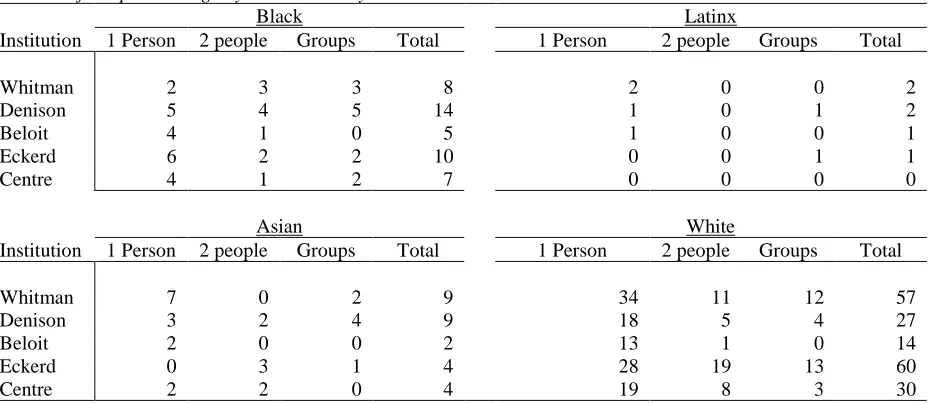
down to solo pictures or specific profiles of students or faculty (Table 1). At this step I also made notes as to the racial composition of each image as being all White students, all Students of Color, or representing multiple racial groups (Table 2). I also went through each image in which a student or faculty Member of Color was present and further disaggregated the data to classify each by their perceived racial identity (Black, Latinx, Native American, Asian) (Table 3). It is important to note that because there was no reliable way to categorize people by their self-identified racial identity, I was forced to make a subjective assignment of racial identity that may or may not be accurate for all
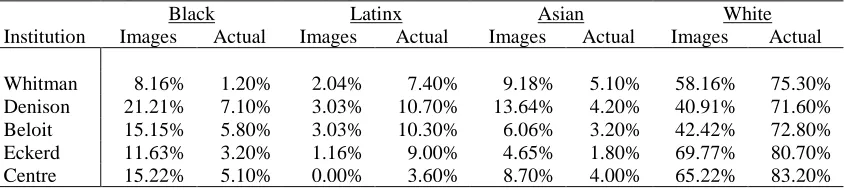
individuals pictured in the viewbooks. On the third reading, I reviewed the images and classified them as either candid or posed (Table 4). Candid photos were defined as those that appeared to have been taken without any staging or setup, while posed photos were those that appeared to have been set up in some way, implying that the dynamic displayed in the photo was not necessarily naturally occurring. Lastly, I followed a methodology like that used by Pippert et al. (2013) to explore how the portrayed racial demographics compared to the actual racial demographics as reported by the institutions themselves (Table 5). In order to do this I utilized the reported racial demographics for each university through the US News and World Report website and then used general calculations to determine the representation of each racial group in the viewbooks themselves.
While this largely quantitative analysis of the visual representation of racial diversity in the viewbooks served to answer parts of the question that guided this study, a thorough qualitative review of materials was also necessary to fully understand how
whiteness was normalized through these promotional materials. Returning to each viewbook for a final review, I specifically focused on more subtle components of the visual and textual materials, such as the positioning and size of the photos, the descriptions applied to students in the images, and the specific actions being depicted through these images. This qualitative review was essential as the normalization of whiteness was not just operationalized through the compositional representations of White students and Students of Color, but rather also stemmed from the racialized messages that were, and more importantly weren’t, embedded in the content of the viewbooks.
Findings
When considered through the lens of monoculturalism, and informed by
knowledge gained from past studies, three key themes emerged from the data analysis process: (a) Students of Color as
over-represented but peripheral, (b) the conditions of whiteness, and (c) the impacts of white expectations. It should also be made clear from the start that no institution in this study devoted even one single page to efforts or opportunities related to racial diversity or equity.
Students of Color as Over-represented but Peripheral.
number of Black- and Asian-identified students, while at the same time under-representing depictions of White and Latinx students. For example, Black students at Denison College composed a total of 7% of the student population and yet were
represented as 21% of the individuals displayed in the viewbook. Similarly, Asian-identified students represented 4% of the actual student body while they were
depicted in nearly 14% of the images. These numbers contrast with the representations of White students who made up 72% of the population but only 41% of the images, and of Latinx students who made up 11% of the population but only 3% of the images. What this leads to is an overemphasis or
tokenization of some Students of Color and a comparable underemphasis of the ubiquity of White students on campus. While it is difficult to know exactly why the institutions elected to over-represent Black and Asian students, previous studies have suggested that often White people will associate “diversity” with the presence of Black students (Hikido & Murray, 2016), while other studies have explained how White students tend to view Asian students as less threatening or challenging to whiteness (Cabrera, 2014).
Despite this over-representation of Black- and Asian-identified students, when one looks through the viewbooks there is still an overwhelming sense that whiteness is the norm at these institutions. What makes these materials and institutions appear so white is not just who is depicted, but more importantly how they are depicted. For example, most of those students and faculty who are featured in “profile” placements are White, which means that the largest and most prominent images are of White people. Moreover, what one might consider as focal points in the viewbooks (the cover page, full-page spreads, etc.) almost always
feature White individuals or majority White groups. The other side of this dynamic is that when portrayed, Students of Color are often shown in smaller images or as one Black or Brown face in a sea of whiteness.
A final component of the numerical representations of People of Color comes from the noticeable absence of images of Faculty of Color in the viewbooks. While all five colleges and universities devoted
substantial space to praising and highlighting the caliber of their faculty members, only 10 out of a total of 53 images that included faculty members depicted a faculty Member of Color. What this communicates is that not only are the pedagogical practices likely to center or normalize white ways of learning, but most of the individuals teaching the material will also be White. This number is even more telling when one realizes that of the 10 Faculty of Color displayed in images, most (n=5) were featured in only two photos at graduation ceremonies. The covert message communicated through these images, or lack thereof, is that White students can expect that their racial identity will be reflected in their instructors, and likely in the material to which they will be exposed.
The Conditions of Whiteness.
Building from initial findings about the quantitative representation of race and whiteness, it is also important to consider how whiteness is normalized by having some representation of racial diversity, but not too much. Numerous studies have
they were almost always shown alone or as the only Person of Color in a group of White peers. Whether it is in individual pictures or as the one Student of Color in a pair or group of others, the overwhelming message is that as a Student of Color on campus, you are likely to be the only one in most settings. The converse of this is a message to White students that Students of Color are
essentially like sprinkles of racial diversity for the benefit of White students who desire some interaction with people of other races, but not too much. In thinking about
whiteness as a form of property (Harris, 1993), this finding demonstrates the ways in which whiteness is normalized through the ability to control and regulate the extent to which racially minoritized individuals are included in and permitted to influence the dominant white institutional norms.
Perhaps most striking about the conditional representation of racially
minoritized peoples was the finding that not a single image out of the 329 total images across the five viewbooks was of a group of three or more students in which everyone in the image was a Student of Color. The absence of any representation of a space featuring all Students of Color is both exclusionary and quite remarkable. The message communicated is thus that either (a) there are so few Students of Color at the institution that it is not possible to find an image in which everyone present is a Student of Color, or (b) that these spaces do exist but that including them in a
promotional viewbook might challenge the bounds that whiteness places on the
presence of Students of Color on campus. Connected to the first theme, this lack of spaces or interactions amongst groups of all Students of Color further strengthens the normalization of whiteness and the message that White students do not have to be
concerned about potential challenges to their racial identity.
Lastly, the analysis of posed versus candid images further reinforced the notion that to be a Student of Color at these institutions is to be rare and isolated. If one assumes that candid images are more likely to serve as a true depiction of the college experience, while posed images are more likely a fixed or crafted depiction (Osei-Kofi et al., 2013), the discrepancies between how White students and Students of Color are depicted becomes increasingly significant. While the total number of posed (n=147) and candid (n=141) images was fairly equal, the difference between the number of White students (n=113) and Students of Color (n=28) featured in candid photos was quite noticeable. Moreover, it is important to note that when pictured in candid photos, many the Students of Color tended to be athletes, students partaking in what appeared to be a “culturally focused event,” or those marked by some sort of stereotypical designation of race (a flag, “traditional clothing,” etc.). Taken together this finding communicates two very powerful messages: (a) that Students of Color are confined to
stereotypical roles and representations, and (b) that in order to portray a racially diverse and integrated campus community,
institutions needed to craft posed images of Students of Color.
The Impacts of White Expectations.
whiteness becomes central to the
institutional culture. For example, White students are far more likely to expect Students of Color to be featured or depicted in sections related to culturally themed groups or events, study abroad
opportunities, or in situations in which a White person is assisting or teaching the student of Color (Hikido & Murray, 2016). This expectation is closely related to the ways in which whiteness serves to set boundaries on the numbers and ways in which Students of Color may engage in a white space. The myriad ways in which these institutions catered to the demands of white expectations range from the images themselves to the descriptions of the
students in those images. For example, when Students of Color were profiled in different viewbooks, it was almost always connected to some form of study abroad or
international education, or in a story of overcoming great odds to arrive at the institution. Similarly, it was far more likely for Asian-identified students to be depicted in laboratory or science settings, while Black students were depicted in athletic, arts, or service-learning activities. Meanwhile, the range of activities and settings in which White students were depicted was seemingly endless.
While these institutions used visual representations to meet white expectations, what is also important to understand is how what they did not include in the viewbooks also served to meet these same expectations. For example, there are no images of students engaged in any sort of campus activism, let alone activism for racial equity. There are also no images or statements in which the institution advocates for the security and rights of undocumented students, nor are there attempts to acknowledge that each of these institutions was built on land that was stolen from Indigenous peoples (Wilder,
2014). Moreover, there are also no
suggestions as to the ways that institutions provide minimal financial and physical resources to support Students of Color inside and outside of the classroom (Gusa, 2010). Lastly, and perhaps most surprisingly, nowhere in any of the five viewbooks were the words “race” or “racism” used, which as many scholars have suggested (Harper, 2012), is a key strategy in advancing a race-neutral and race avoidant campus climate that only serves to center the white status quo. Though the suggestion that institutions include such representations may seem ridiculous or extreme, the reality is that all of these dynamics are both extremely
common at today’s HwCs, and central to the ways that whiteness is normalized at these institutions. By choosing not to depict them in their promotional materials, these
institutions are again catering to white expectations in avoiding any sort of critical assessment of the ways in which whiteness permeates the institution’s culture and values.
Discussion
Having explored the various findings from this analysis, what is most striking is not that Historically white Colleges present themselves as predominantly white spaces, but rather how they go about doing this. Specifically, two findings stand out as being significant contributions to future research and practice around whiteness in higher education: (a) what is not said is equally as important as what is said, and (b) the ways that these HwCs communicate about racial diversity on campus show that they are appealing to a White audience.
HwCs. The result is that, whether one is aware of it or not, systemic whiteness informs and influences virtually every aspect of these institutions. Many scholars have used the term invisibility to explain how whiteness functions in education and society more generally, as though it is an omnipresent reality rooted in the historical foundations of the United States (Leonardo, 2009). This invisibility ultimately serves to protect White students and systems of white supremacy from direct challenge and
critique, preserving the status quo and ensuring the persistence of racial oppression in education. What the findings from this study demonstrate is the need to question what White scholars and educators do not see when they look at institutions of higher education. Without this heightened
consciousness, they often default to conducting research through their own personal lenses and as a result, miss many of the subtle and pervasive ways that whiteness operates. To a similar extent these findings also reinforce the value of using frameworks from CwS to guide and inform research on whiteness in education. By centering a critique of systemic whiteness throughout the research process, White scholars can not only remain conscious of their personal biases, but also work to pull back the curtain on the invisible whiteness at the core of HwCs.
In framing the present study I sought to answer the question: How do Historically white Colleges utilize promotional
viewbooks to normalize whiteness at their institutions? The findings from this analysis offer a resounding answer to this question, they communicate that racial diversity is peripheral and inauthentic, and that whiteness is not only normal but ever present. When conceptualizing this paper, I wondered as to whether an analysis of these viewbooks from HwCs would confirm what
Morrison (1992) and others have explained as the propensity for White authors and institutions to communicate about race in a way that speaks to the values and concerns of White audiences. Whether it is by centering White students through full-page profiles or tokenizing Students of Color as the only one in a crowd of White peers, the content in these viewbooks both overtly and covertly communicates that to be White on these campuses is to see yourself reflected in the people around you and in the functioning of the institution as a whole. As was
previously mentioned, the question is not if these institutions portray themselves as racially diverse communities—they clearly do—but what is more important is how they do this. By sprinkling in images of, and allusions to, Students of Color, these colleges and universities send the message to White students that “if you come to this university, you will interact with some People of Color, but not in a way that may make you uncomfortable or de-center your experiences.” While it may appear subtle or inconsequential to some, it is this
commodification of Students of Color that serves to reinforce the systemic whiteness and enable the establishment of a white Institutional Presence (Gusa, 2010).
Implications
Having read through this study, it is reasonable to assume that some may openly ask the question “So what?” Is the solution for institutions to misrepresent their racial diversity, including copious images of and references to Students of Color and their experiences as central to their viewbooks? Should they simply do away with
in this study are already misrepresenting their racial diversity and doing so in a way that communicates a desired image to prospective White students. Moreover, the problem again is not that these institutions miscommunicate messages of racial diversity but rather how they go about this miscommunication. As such, what they should do is to communicate their values around racial diversity in ways that are authentic and considerate of different worldviews and experiences. Even if these messages are aspirational in the present moment, as long as they are backed by an institutional commitment to challenging whiteness and white supremacy at both individual and institutional levels, then they are on the right track. Moreover, the process of challenging and decentering whiteness is one that must entail a self-examination by White people and institutions that has nothing to do with adding in pictures of Students of Color to promotional materials. At the end of the day, the question is
whether primarily White administrators and others are willing to value racial equity enough to challenge the white status quo that restricts People of Color to the periphery.
A second, but equally important implication from this study is that scholars who wish to utilize Critical Content Analysis methodologies to challenge whiteness and racial oppression should consider frameworks within CwS. When conducting the literature review for this study, I was challenged to find any studies, about viewbooks or otherwise, in which CwS frameworks were used as guides for research that implemented a CCA. This is unfortunate for two reasons, first because the result is often a study that allows for whiteness to remain invisible and thus unchallenged, and second because the opportunity to apply CwS frameworks to
CCA methodologies is quite expansive, given how whiteness is communicated through visual and textual representations. While these frameworks will not be appropriate for every study, it is important that CCA scholars begin to familiarize themselves with the work being done in the field of CwS. Similarly, CwS scholars would be well served to consider the use of CCA methods when conducting their studies, particularly when addressing the ways that discourses of whiteness are advanced through textual or visual materials and messages.
Conclusion
The messages that we communicate to others daily, both intentionally and unconsciously, craft and control how others perceive us as individuals or institutions. What we say and what we don’t say come together to paint a picture of who we are and what we value. For colleges and universities, viewbooks serve as one means through which to reinforce their institutional identity and communicate to prospective students. Findings from this study suggest that there is still much work to be done for HwCs to authentically represent themselves as racially diverse (or homogenous)
communities. While the potential for change exists, these and other institutions must commit to taking the necessary steps to challenge and change the persistent white Institutional Presence that remains central to the institutional culture and operations at the core of their universities.
1 In this paper I have opted not to capitalize whiteness or white
when they are referring to entities or systems, and to capitalize
References
Ahmed, S. (2012). Living a feminist life. Durham: Duke University Press.
Alemán, A. M., & Salkever, K. (2001). Multiculturalism and the mission of liberal
education. The Journal of General Education, 50(2), 102–139.
Arthur, M. M. L. (2016). Student activism and curricular change in higher education. London: Routledge.
Bondi, S. (2012). Students and institutions protecting whiteness as property: A critical race theory analysis of student affairs preparation. Journal of Student Affairs Research and Practice, 49(4), 397–414.
Cabrera, N. L. (2014). Exposing whiteness in higher education: White male college students
minimizing racism, claiming victimization, and recreating white supremacy. Race
Ethnicity and Education, 17(1), 30–55.
Chang, M. J. (2003). Compelling interest: Examining the evidence on racial dynamics in colleges and universities. Stanford, CA: Stanford University Press.
Du Bois, W. E. B. (1999). Darkwater: Voices from within the veil. Boston: Dover Publications. Fanon, F. (2005). The wretched of the earth. New York: Grove Press.
Gusa, D. L. (2010). White institutional presence: The impact of whiteness on campus
climate. Harvard Educational Review, 80(4), 464–490.
Harper, S. R. (2012). Race without racism: How higher education researchers minimize racist institutional norms. The Review of Higher Education, 36(1), 9–29.
Harris, C. I. (1993). Whiteness as property. Harvard Law Review, 106, 1707–1791.
Hartley, M., & Morphew, C. C. (2008). What's being sold and to what end?: A content analysis of college viewbooks. The Journal of Higher Education, 79(6), 671–691.
Henslee, C., Leao, M., Miller, K., Wendling, L. A., & Whittington, S. (2017). Do you see what I see?: Undergraduate students’ perceptions of IUPUI campus viewbooks and
experiences. Journal of the Student Personnel Association at Indiana University, 48, 64– 82.
Hikido, A., & Murray, S. B. (2016). Whitened rainbows: How white college students protect whiteness through diversity discourses. Race Ethnicity and Education, 19(2), 389–411.
Hite, R. E., & Yearwood, A. (2001). A content analysis of college and university viewbook
Kenney, K. (2005). A visual rhetorical study of a virtual university’s promotional efforts. In K. L. Smith, S. Moriarty, K. Kenney, & G. Barbatsis (Eds.), Handbook of visual
communication: Theory, methods, and media (pp. 153–65). Hillside, NJ: Lawrence Erlbaum.
Klassen, M. L. (2001). Lots of fun, not much work, and no hassles: Marketing images of higher
education. Journal of Marketing for Higher Education, 10(2), 11–26.
Leonardo, Z. (2009). Race, whiteness, and education. London: Routledge.
Matias, C. E. (2016). Feeling white: Whiteness, emotionality, and education. Boston: Sense Publishers.
Mills, C. W. (1997). The racial contract. Ithaca, NY: Cornell University Press.
Morrison, T. (1992). Playing in the dark: Whiteness and the literary imagination. New York: Vintage Books.
Osei-Kofi, N., & Torres, L. E. (2015). College admissions viewbooks and the grammar of
gender, race, and STEM. Cultural Studies of Science Education, 10(2), 527–544.
Osei-Kofi, N., Torres, L. E., & Lui, J. (2013). Practices of whiteness: Racialization in college
admissions viewbooks. Race, Ethnicity, and Education, 16(3), 386–405.
Painter, N. I. (2010). The history of white people. London: W. W. Norton.
Pippert, T. D., Essenburg, L. J., & Matchett, E. J. (2013). We've got minorities, yes we do: Visual representations of racial and ethnic diversity in college recruitment
materials. Journal of Marketing for Higher Education, 23(2), 258–282.
Pope, L. (2012). Colleges that change lives. New York: Penguin.
Roediger, D. (2005). What's wrong with these pictures?: Race, narratives of admission, and the
liberal self-representations of historically white colleges and universities. Washington
University Journal of Law & Policy, 18, 203.
Short, K. G. (2016). Critical content analysis as a research methodology. In H. Johnson, J.
Mathis, & K. G. Short (Eds.), Critical content analysis of children’s and young adult
literature (pp. 1–15). London: Routledge.
Smith, D. G. (2015). Diversity's promise for higher education: Making it work. Baltimore: JHU Press.
Valenzuela, S. (2013). Unpacking the use of social media for protest behavior: The roles of information, opinion expression, and activism. American Behavioral Scientist, 57(7), 920–942.
Wilder, C. S. (2014). Ebony and ivy: Race, slavery, and the troubled history of America's universities. New York: Bloomsbury Publishing.
Appendix Data Analysis
Table 1
Results from Initial Review of Images
Institution
No People Images w People
Outside Inside Design 1 person 2 people** Groups**
Solo/Profile W/SoC* Total W/SoC/Mxd Total W/SoC/Mxd
Whitman 14 9 0 34/7 34/8 16 11/1/3 18 12/0/4
Denison 12 6 0 16/12 18/10 11 5/1/5 8 4/0/4
Beloit 6 0 3 9/11 13/7 3 1/0/2 1 0/0/1
Eckerd 7 0 0 25/13 28/5 23 19/1/3 18 13/0/5
Centre 6 0 1 5/16 19/7 11 8/2/1 7 3/0/4
Note. *W/SoC. **W/SoC/Mxd. Outside and inside are in reference to the location of the images
Table 2
Number of People in Image by Racial Identity and Institution
Institution
Black Latinx
1 Person 2 people Groups Total 1 Person 2 people Groups Total
Whitman 2 3 3 8 2 0 0 2
Denison 5 4 5 14 1 0 1 2
Beloit 4 1 0 5 1 0 0 1
Eckerd 6 2 2 10 0 0 1 1
Centre 4 1 2 7 0 0 0 0
Institution
Asian White
1 Person 2 people Groups Total 1 Person 2 people Groups Total
Whitman 7 0 2 9 34 11 12 57
Denison 3 2 4 9 18 5 4 27
Beloit 2 0 0 2 13 1 0 14
Eckerd 0 3 1 4 28 19 13 60
Centre 2 2 0 4 19 8 3 30
Table 3
Number of Faculty in Image by Racial Identity and Institution
Institution
Faculty Faculty Profiles
White FoC FoC Race* White FoC
Whitman 7 0 0 1 0
Denison 6 5 4/0/1 3 1
Beloit 6 2 2/0/0 0 0
Eckerd 11 1 0/0/1 6 0
Centre 13 2 2/0/0 5 0
Total 43 10 8/0/2 15 1
Note. *Bl/Ltn/Asn
Table 4
Type of Image by Racial Identity and Institution
Institution
Posed Candid
White SoC* White SoC*
Whitman 24 7 45 8
Denison 11 9 18 11
Beloit 10 5 8 2
Eckerd 45 11 30 3
Centre 18 7 12 4
Total 108 39 113 28
Note. *SoC
Table 5
Accuracy of Depictions of Racial Demographics by Insitution
Institution
Black Latinx Asian White
Images Actual Images Actual Images Actual Images Actual
Whitman 8.16% 1.20% 2.04% 7.40% 9.18% 5.10% 58.16% 75.30%
Denison 21.21% 7.10% 3.03% 10.70% 13.64% 4.20% 40.91% 71.60%
Beloit 15.15% 5.80% 3.03% 10.30% 6.06% 3.20% 42.42% 72.80%
Eckerd 11.63% 3.20% 1.16% 9.00% 4.65% 1.80% 69.77% 80.70%