INTRODUCTION
A child’s language proficiency is the characterization of his/ her language skills relative to some benchmark or
expectation. Developmental Language Disorders (DLDs) is a term developed to refer to children who do not acquire language as would be expected for their chronological age and for whom language difficulties are not related to other factors. According to the Diagnostic and Statistical Manual of Mental Disorders – Fifth Edition (DSM-5), has moved to a broader categorization of communication disorders, and it includes: (a) Language Disorder, (b) Speech Sound Disorder, (c) Social (Pragmatic) Communication Disorder, which are
ORIGINAL ARTICLE
Augmentative and Alternative Communication and
Speech Prosody in Turkish-Speaking Children with
Developmental Language Disorders: A Randomized
Controlled Study of Awareness and Developmental
Language Intervention
Cagla Dinsever Elikucuk1 , Gonca Ozyurt2
1Hacettepe University School of Medicine, Institute of Health Sciences, Department of Audiology and Speech Pathology, Ankara, Turkey 2 Izmir Katip Celebi University School of Medicine, Department of Child and Adolescent Psychiatry, Izmir, Turkey
ABSTRACT
Objective: One of the most common child psychiatry and language speech therapy problems in the preschool age group is Developmental Language Delay (DLD)’s. Voice output communication aids (VOCAs) are a key form of aided communication within the field of augmentative and alternative communication (AAC).This study aimed to evaluate effectiveness of AAC, using a VOCA device on language and emotion regulation of children diagnosed with developmental language disorders (DLDs).
Methods: 44 children (36–72 months old), who were diagnosed with DLDs, were randomly placed in the experimental (n=22) or the control (n=22) group. The experimental group attended the AAC treatment while the control group received a routine treatment. Test of Early Language Development –Third Edition-Turkish (TELD 3-Turkish) was used to evaluate language profiles and emotion regulation skills were evaluated with the Emotion Regulation Checklist.
Results: After the intervention, children who were assigned to the experimental AAC treatment group gained significant improvements in receptive and expressive language skills. The Mean Length of Utterances (MLU) and Language Sample Size (LSS) increased significantly for both the experimental and the control group, but the ratio of change was higher for the experimental group. When the values obtained from language skills and the subscales of emotion regulation before the intervention, a significant relationship between language delay and speech prosody was found.
Conclusions: AAC can be useful for developing language skills of children with DLDs as well as supporting their emotion regulation. Our study is the first to be applied in the treatment of preschool age in terms of different models and practices that work to obtain successful results.
Keywords: Developmental language disorders, augmentative and alternative communication, mean length of utterances, speech prosody, emotion regulation
Corresponding author: Cagla Dinsever Elikucu,
Hacettepe University School of Medicine, Institute of Health Sciences, Department of Audiology and Speech Pathology, Ankara, Turkey
E-mail: [email protected]
Received: May 02, 2018 Accepted: August 08, 2018
characterized by deficits in the development and use of language, speech, and social communication, respectively, (d) Childhood-Onset Fluency Disorder (Stuttering), and (e) Unspecified Communication Disorder (1). Although there is no specific definition for “language development delay,” the term has been used in the scientific literature universally to identify children aged 18‒36 months who fail to achieve the minimum expressive vocabulary milestones expected for their age and gender. It is a synonym for “language acquisition delay” and “early language delay”. The more informal term “late talkers” is also widely used in the literature (2). A given child’s language proficiency can be similar to that expected for their age, above expectations for their age, or in the case of language impairment, below developmental expectations. Descriptive terms are often used to characterize children’s degree of language proficiency. For example, a child with acceptable language skills for their age may be characterized as exhibiting ‘‘average’’ language skills or their language skills may be classified as “above average”, “advanced”, or “very advanced”for their age. In the case of language impairment, proficiency labels represent severity of impairment. For example, a language impaired child’s language skills may be characterized as “delayed”, “very delayed”, “below average”, “low”, “very low”, or their language impairment may be classified as “mild”, “moderate”, “severe”, or “profound”. (3,4).
The aim of the present study was to examine the speech prosody skills of DLDs children and check to see whether the speech prosodies changed in case of developmental language delay. Previous studies have also documented that children with DLDs can have delayed play skills which include diminished symbolic play and lower levels of complexity of play in comparison to typical same-aged peers (5). Through prosody, individuals can expresses pauses, intonations and accents in their speech (6). Children with prosodic impairment cannot adjust the volume, pitch, and timing of their voice during a conversation (7, 8).This situation may impair the quality of an individual’s social life and lead to social isolation (9).
The prosody of speech is evaluated in two ways; 1) objective evaluation and 2) subjective evaluation. Objective evaluation method is voice analysis (10). Subjective evaluation can be conducted with Likert-type scales and such scales are auditory-perceptual measures based on questioning the existence of pauses that distinguish proper units of speed, tonality, and meaning (11).
In this present study, we aimed was to examine whether there was speech disorder in language area and to implement treatment that could improve speech prosody skills in the future and determine the effectiveness of the treatments to DLDs.
Augmentative Alternative Communication (AAC) is an area of educational and clinical practice which aims to supplement or replace an individual’s natural speech and/or handwriting through unaided approaches such as manual signing and gestures and/or aided approaches such as graphic symbols, communication boards, speech-generating devices (SGDs; also known as voice output communication aids or VOCAs), and mobile technologies with AAC-specific applications (12).
A number of researchers argue that these integrated into computer-based AAC systems, independent of the level of technology, are positive for the linguistic, cognitive, and social development of children who have complex communication needs (13). Research studies have documented that those who participate in AAC mediated interaction orient to a number of different aspects of the technological design of a communication aid (14).
is a measure without standardization work in terms of reliability study.
The aim of the present study was to examine the effectiveness of AAC, using a VOCA device that had a touch-sensitive screen-input system, for autistic symptoms, language features and emotion regulation of children diagnosed with DLDs. Furthermore, prosodic assessment should not be by passed in terms of clinical evaluation and effectiveness of the therapy process. In fact, it is argued that the prosodic skills of DLDs may also be affected positively.
METHODS
Setting and Protocols
44 children (36‒72 months old), who were diagnosed with DLDs, were randomly grouped into the experimental (n = 22) or the control (n = 22) group. The experimental group attended the AAC treatment while the control group received a routine treatment. Denver II Developmental Screening Test (17) (the validity and reliability was established by Anlar and Yalaz (18 and Turkish version of the Test of Early Language Development (TELD)-3 (a norm-based assessment instrument developed by Hresko, Reid and Hammill (19) / Test of Early Language Development –Third Edition: Turkish (TELD 3:T) (developed by Topbaş and Güven (20) were used to evaluate language development and other developmental areas in the study. Both Form A and B of TELD was used in the study.
We divided our sample into two subgroups based on severity by using Test of Early Language Development – Third Edition:Turkish (TELD 3: T) Language score. The inclusion criterion for our overall DLD group was chosen according to the suggested cut-off on the TELD 3:T (16.12 % -compound score: 80-89 / below average, 6.87 % -compound score: 70-79 / poor, 2.34 % -compound score: 35- 69 / very poor). [Altered linguistic development]. Therefore, we used this cut off to divide our children with DLD into what we have termed mild-moderate-severe DLD ( n = 44, whose TELD 3: T Language score fell between the average and very poor).
The further stratification of our DLD sample into severity subgroups provided evidence of maturational delay in children with DLD who scored at or below the average on our language measure, that is, in those we identified as having moderate–severe DLD. Children with mild DLD appeared to have few delays. Children who function within what we have termed the mild DLD range (below average). The participants also exhibited normal range nonverbal cognitive skills measured by a standard score of 90‒110 (111 + SEM) or above. [Appropriate linguistic development].
Speech Therapy Sessions
Parents of DLDs who have developmental language disorders (DLDs) worked with VOCAs for 55 minutes every day for five days a week over the course of eight weeks making a total of 40 days. Each speech therapy session focused on a 40-minute to VOCAs are a key form of aided communication within the field of AAC. The parents actively participated in the therapy process and regulated the home environment in a way that would facilitate the recognition of verbal cues which the start of a requesting opportunity. The parents were shown different sizes and types of graphic representations (e.g., line drawings, photographs) and were asked their opinions regarding the visual features as well as number and content of messages that would be most useful for teaching each child to use a VOCA during children’ existing daily routines. They were also asked to use the selected vocabulary for simple talk since it was considered that the core word category would increase the interest of the children and stimulate them to give more natural answers by their parents’ encouragement to talk more about the story or topic, interact, initiate a joke, or complete a sentence. Further studies, which include parental intervention should be conducted in order to show increases in minimally verbal children’s spontaneous communication (27).
VOCA devices which included picture or word representations of 1 to 8 preferred items or activities were used in this study. A VOCA device with an active panel was given to parents of children with DLDs. A microswitch with a picture representing a verbal recording request and/or obtain any of several preferred activity items. Through this process, children with DLDs were given the power to turn their interactions into a conversation. In addition, the therapists provided verbal and physical prompts to enable children to complete work-related tasks such as sorting items.
Clinical evaluations were conducted twice a week through examining and controlling the children and family relationships. Computer-assisted methods of transcript analyses (28,29) were used to analyze the spontaneous language samples, production of non-targeted actions on
either a target or non-target focus, and phonological awareness processes that were recorded during treatment sessions. Mean length of utterances (MLU) were calculated using the systematic analysis of language transcripts (SALT) software as a language reference point. In addition, the number of utterances that were used to calculate MLU was also used to calculate children’ language sample size (LSS) in their utterances. These procedures were performed by an audiology and language speech therapist and a child psychiatrist.
The participants were 44 children who had been admitted to Nevsehir State Hospital between September 2015 and September 2016. No language other than Turkish was spoken in the homes of either of the groups. Those children met the following included criteria for minimal expressive vocabulary: less than 14 spoken words produced spontaneously according to; a) a teacher report, b) a parent report, and c) a language sample collected during our assessment process.
Children who had chronically organic diseases, epilepsy, genetic diseases or motor mental disabilities (non-verbal cognitive delay, middle ear pathology, and hearing impairment , intellectual disability-associated disorders (e.g., Down’s syndrome), cerebral palsy, perinatal pathology, autism spectrum disorder, preterm or low birth weight (less than 2,500 grams) infants, a history of meningitis, non-febrile seizures or epilepsy, neurosurgery, congenital heart diseases, cancer were excluded from study. Also children who had language problems due otolaryngologic problems (cleft palate or lip) were excluded.
Audiological Outcomes
All participants in this investigation exhibited normal range hearing sensitivity as measured by an audiometric pure tone screening at 25 dB HL at 500 Hz, and 20 dB HL at 1, 2, and 4 kHz (30) using a play-based pure tone audiometry.
Ethical Considerations
the children could participate in the study. The consent form was prepared in accordance with the Declaration of Helsinki as amended by the World Medical Association Declaration of Helsinki (World Medical Association, 2013). Parents signed the informed consent form which was approved by the Non-Invasive Clinical Trials Ethics Committee at Nevşehir Hacı Bektaş Veli University. Verbal and written consent was obtained from the mothers who participated in the study. [Nevşehir Hacı Bektaş Veli University Ethics Committee 03.12.2015 date and approval by the board decision no. 2015.12.02 .]
Statistical Analysis
Cross chi-square test was used in comparing the classified categorical variables. Chi-square test was used determine whether there was a difference in frequency between groups, or Fisher's test if assumptions cannot be provided. Distribution of the data was primarily assessed by using the Kolmogorov-Smirnov method. The binary groups were assessed by using Mann-Whitney U test and the Wilcoxon analysis was used to evaluate changes in the same group when the data did not show a normal distribution. The p value was accepted to be statistically significant at p<0.05.Analysis of prosody data obtained in the study was done using the SPSS 21.0 package program. Arithmetic average of speech prosody scores received. Results which were above 2 points were considered to be suggesting sufficient speech prosody. Likewise results below 2 points were considered to be suggesting inadequate speech prosody.
RESULTS
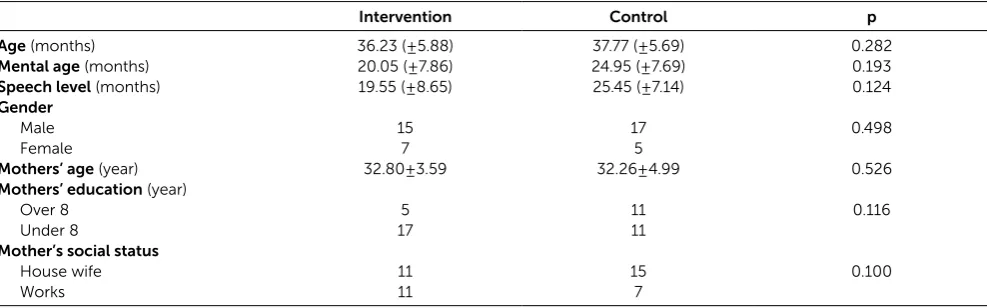
The average age was determined as 36.23 (± 5.88) months for children in the intervention group while it was 37.77 (± 5.69) months for children in the control group. The difference between the groups was not statistically significant (p=0.28). Denver Developmental Screening Test results showed that there was not a significant difference between control group and the intervention group with regards to childrens’ mental age (p=0.19). The average mental age for the intervention group was 20.05 (±7.86) months and 24.95 (±7.69) months for the control group. As for childrens’ speech levels, the results showed that the experimental group’s average speech level was 19.55 (±8.65) months and the control group’s 25.45 (±7.14; p=0.12) months. There were not significant differences between groups in terms of gender distribution, maternal age, parents’ education and working conditions. The socio-demographic characteristics of the groups are displayed in Table 1. Both groups’ emotion regulation abilities were compared applying with Mann-Whitney U test to childrens’ scores in terms of receptive and expressive language use prior to the intervention. No significant differences were found between the intervention and control group. Table 2 shows the values obtained from language skills and the subscales of emotion regulation before the intervention. As it can be seen from the table none of the test results were significant which supports the idea that there were not significant differences between the control and the intervention group.
Table 1: Comparison of groups’ age, mental age, language levels, and sociodemographic data
Intervention Control p
Age (months) 36.23 (±5.88) 37.77 (±5.69) 0.282
Mental age (months) 20.05 (±7.86) 24.95 (±7.69) 0.193
Speech level (months) 19.55 (±8.65) 25.45 (±7.14) 0.124
Gender
Male 15 17 0.498
Female 7 5
Mothers’ age (year) 32.80±3.59 32.26±4.99 0.526
Mothers’ education (year)
Over 8 5 11 0.116
Under 8 17 11
Mother’s social status
House wife 11 15 0.100
Post-intervention results, however, showed that children who were in the intervention group scored significantly better (Mn = 29.25; 30.61) than those in the control group (Mn = 15.75; 14.39) in terms of receptive and expressive language respectively (p<0.001; see Table 3). Test results also indicated that there was a significant difference (p<0.001) between the groups in terms of emotional lability and intervention group’s scores were much lower (Mn= 14.36) than the control group (Mn= 30.64) which suggested that childrens in the intervention group were better in regulating their emotions.
The calculation of mean length of utterances (MLU) requires sufficient numbers of intelligible utterances per sample. Table 4 reports on the pre and post-treatment
results for both groups. As can be seen in the table, both groups have showed significant development in terms of MLU and Language Sample Size (LSS). The average MLU score for childrens’ in the intervention group (Mn=2.11) was considered “average” and after the treatment their average score increased to 3.28 which was considered “superior”. On the other hand, the average MLU score for children in the control group (Mn=3.81) which was considered to be “superior” already and their average increased to 4.28 which was considered “very superior”. While both groups developed in terms of MLU and LSS, a close examination of the each group’s scores pre and post-treatment suggests that the intervention group showed a better level of development (see Table 4).
Table 2: The scores of Test of Early Language Development and Emotion Regulation Checklist prior to the intervention
Group N Mean Rank Sum of Ranks p z
Receptive language Int. 22 24.18 532.00 0.384 -0.871
Cont. 22 20.82 458.00
Expressive language Int. 22 22.61 497.50 0.953 -0.590
Cont. 22 22.39 492.50
Emotional lability Int. 22 21.34 469.50 0.547 -0.602
Cont. 22 23.66 520.50
Emotional regulation Int. 22 20.43 449.50 0.276 -1.090
Cont. 22 24.57 540.50
*p<0.05
Table 3: The scores of Test of Early Language Development and Emotion Regulation Checklist after post intervention
Group N Mean Rank Sum of Ranks p z
Receptive language Int. 22 29.25 643.50 0.000 -3.506
Cont. 22 15.75 346.50
Expressive language Int. 22 30.61 673.50 0.000 -4.209
Cont. 22 14.39 316.50
Emotional lability Int. 22 14.36 316.00 0.000 -4.234
Cont. 22 30.64 674.00
Emotional regulation Int. 22 25.61 563.50 0.104 -1.627
Cont. 22 19.39 426.50
*p<0.05
Table 4: Mean length of utterance (MLU) and language sample size (LSS) before and after intervention
Pre-intervention Post-intervention
MLU LSS MLU LSS
Intervention 2.11±0.33 57.32±24.33 3.28±0.34* 83.57±31.83*
Average Superior
Control 3.81±0.64 117.46±31.82 4.28±0.94* 127.14±33.16*
Superior Very superior
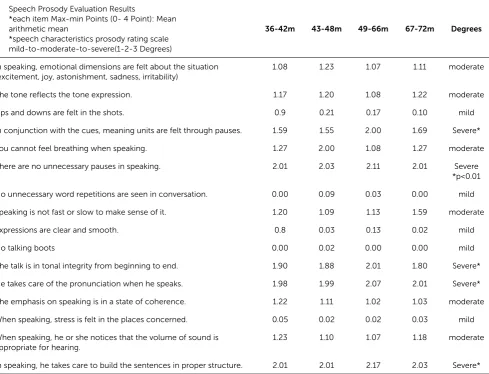
The scores of the speech prosody (x = 1.92; sd. = .466) were found to be below the average in general for the intervention group pre-treatment. According to Table 5, the speech prosody scores were found .A weak positive correlation was found between developmental delay and speech prosody of children with DLDs (r=0.036; p <0.05). According to these results, it can be said that there is a reciprocal relationship with the speech prosody. 63% of the children who participated in the study had low levels of speech procedures and 37% had low levels of speech prosody. It was found that the children were fewer than 50% on the speech prosody scale. 16 children were found to score 29 points or below points out of 60 points. We can say that
children with DLDs are at the normal prosodic level. According to Table 4, prosodic disorder can be seen in children aged 49‒66 months. There was a significant relationship between language delay and speech prosody. Speech prosody scores for the control group are above the average. It was also observed that they paid attention to create sentences using appropriate structures. 88% (n=38) of the children in the control group had high level of speech procedures and 3 % (n=2) speech prosodies. In boys the speech prosody was found to be on the middle point. There are significant differences among in both groups (p=0.025). These childrens’ prosodic scores are summarized in Table 5.
Table 5: Speech prosody evaluation results according to months and degrees in DLD groups ‘intervention groups’
Speech Prosody Evaluation Results
*each item Max-min Points (0- 4 Point): Mean arithmetic mean
*speech characteristics prosody rating scale mild-to-moderate-to-severe(1-2-3 Degrees)
36-42m 43-48m 49-66m 67-72m Degrees
In speaking, emotional dimensions are felt about the situation (excitement, joy, astonishment, sadness, irritability)
1.08 1.23 1.07 1.11 moderate
The tone reflects the tone expression. 1.17 1.20 1.08 1.22 moderate
Ups and downs are felt in the shots. 0.9 0.21 0.17 0.10 mild
In conjunction with the cues, meaning units are felt through pauses. 1.59 1.55 2.00 1.69 Severe*
You cannot feel breathing when speaking. 1.27 2.00 1.08 1.27 moderate
There are no unnecessary pauses in speaking. 2.01 2.03 2.11 2.01 Severe
*p<0.01
No unnecessary word repetitions are seen in conversation. 0.00 0.09 0.03 0.00 mild
Speaking is not fast or slow to make sense of it. 1.20 1.09 1.13 1.59 moderate
Expressions are clear and smooth. 0.8 0.03 0.13 0.02 mild
No talking boots 0.00 0.02 0.00 0.00 mild
The talk is in tonal integrity from beginning to end. 1.90 1.88 2.01 1.80 Severe*
He takes care of the pronunciation when he speaks. 1.98 1.99 2.07 2.01 Severe*
The emphasis on speaking is in a state of coherence. 1.22 1.11 1.02 1.03 moderate
When speaking, stress is felt in the places concerned. 0.05 0.02 0.02 0.03 mild
When speaking, he or she notices that the volume of sound is appropriate for hearing.
1.23 1.10 1.07 1.18 moderate
DISCUSSION
The aim of the present study was to evaluate the effectiveness of AAC, using a VOCA device, language features and emotion regulation of DLDs. Results obtained in this study showed that AAC is highly effective in improving language development, language supra-segmental features, of DLDs. Findings of the present study are discussed below in relation to the current literature.
First, to the best of our knowledge this is the first study to provide preliminary evidence supporting the effectiveness of AAC in emotion dysregulation of children with DLDs. As discussed in the introduction, recent studies have reported high rates of emotion dysregulation in children with DLDs (31). Language impairments are associated with an increased likelihood of emotional difficulties later in childhood or adolescence, but our knowledge how early language impairments impact on the growth of emotional problems is limited (32). Bakopoulou and Dockrell (33), who studied language impairments in children, challenge our current understanding of socio-emotional functioning for children with language impairments by pointing to the crucial role of social cognition and prosocial behaviour. That is to say, factors other than expressive and receptive language play a role in the socio-emotional functioning of children with DLD. Bakopoulou and Dockrell‘s result is significant in the development of efficient treatment for emotion dysregulation that could also improve the social communication and interaction (33). It may be reciprocal and development in linguistic and social areas may provide positive effects on emotional dysregulation. Overall, results of this study showed that DLDs experienced significant improvements in emotional regulation.
In DLD with children there is a significant difference in terms of rhythmic speech, intonation, melodic speech after monotone speech, and repetition of phonetic balanced sentences. A longitudinal prospective cohort study examining language development process in children with DLD is necessary in the future for further
support. Additionally, there were statistically significant relationships between the use of AAC with VOCA and the language development and linguistic skills of children diagnosed with DLDs. The use of VOCA provides a visual representation for communication and incorporates visual discriminations as part of the communication process and this process has the potential to enhance the speed of learning for children with DLDs (34,35). The advantages of using ACC, as evidenced in the present study, suggests that this type of treatment can be used for receptive and expressive language development for children. In this present study, the correlations between Language Sample Size (LSS) and Mean Length of Utterances (MLU) reached statistical significance after AAC treatment. Based on the results, it can be interpreted that language sample size is not necessarily a confounding variable; however, a useful component that should be included in an attempt to predict language development. In addition, there were statistically significant relationships between AAC with VOCA and the children with DLDs language development with MLU-TELD results. In light of Bedore & Leonard’s study results (36) and growing evidence that problems with finite verb morphology continue into the school years in children with DLD and children with typically developing language skills, the verb morpheme composite was considered to hold promise as a clinical marker for DLD and children with typically developing language skills. In the literature, MLU is not considered to be a language malfunction indicator but to support language disorder recognition grammatical morpheme development (37, 38, 39). Results obtained in this study supported previous studies’ findings.
In terms of limitations, our sample size and the duration of the intervention are not sufficient to generalize the results; however, promising for emotional regulation and social communication and interaction. Therefore, further research in this area is encouraged. One of the most common child psychiatry and language speech therapy problems in the preschool age group is Developmental Language Delay (DLD)’s. Positive progress can be achieved with the collective work of the
family and child psychiatrists, audiology and language speech therapist in the AAC system. In addition, regarding the point of view that early intervention of language impairment in DLD groups is critical and play a vital role. Our study is the first to be applied in the treatment of preschool age in terms of different models and practices that work to obtain successful results in Turkey.
Conflict of Interest: Authors declared no conflict of interest. Financial Disclosure: Authors declared no financial support.
REFERENCES
1. APA. Diagnostic and statistical manual of mental disorders. 5th ed. Washington, DC: American Psychiatric Association; 2013. 2. Blumenfeld A, Olalla JC, D’Angelo SI, González NS, Sadras Y,
Graizer S, Macario A, and Salamanco, G. Language development delay in 24-month-old children at a health care center of the City of Buenos Aires. Arch Argent Pediatr 2018;116(4):242-7. 3. Spaulding TJ. Comparison of severity ratings on
norm-referenced tests for children with specific language impairment. Journal of Communication Disorders 2012;45:59–68.
[CrossRef]
4. Kwok EYL, Joanisse MF, Archibald LMD and Cardy JO. Immature Auditory Evoked Potentials in Children With Moderate– Severe Developmental Language Disorder. Journal of Speech, Language, and Hearing Research 2018;1–13. [CrossRef]
5. Seol KI, Song SH, Kim KL, Oh ST, Kim YT, Im WY, et al. A comparison of receptive-expressive language profiles between children with autism spectrum disorder and developmental language delay. Yonsei Med J. 2014; 55:1721–1728. [CrossRef]
6. Boutsen F. Prosody: The music of language and speech. ASHA Leader 2003; 5:7-9. [CrossRef]
7. Cruttenden DH. The philosophy of language; or, Language as an exact science, subjectively and analytically arranged (Rev. bs.). New York: J. M. Bradstreet & Son;1869.
8. Turkbay T, Congologlu M. Dilin prozodik ozellikleri, disprozodi ve iliskisel bozukluklar. Turk J Child Adolesc Ment Health 2007;14(2):113-119.
9. Keskin HK, Bastug M, Akyol H. Speech reading and speech prosody: A relational study. Mersin University Journal of Education Faculty 2013; 9(2):168-180.
10. Sataloff RT. Professional voice: The science and art of clinical care. Plymouth, UK: Plural Publishing;1991
11. Mary L. Extraction and representation of prosody for speaker, speech and language recognition. New York: Springer;2011. 12. Adamson LB, Romski M, Bakeman R, Sevcik RA. Augmented
language intervention and the emergence of symbol-infused joint engagement. J Speech Lang Hear Res. 2010;53(6):1769-1773. [CrossRef]
13. von Tetzchner S, Grove N. The development of alternative language forms. In:von Tetzchner S, Groves RM, editors. Augmentative and Alternative Communication Developmental Issues. London: Whurr Publishers. 2003; 1-27.
14. Clarke M, Wilkinson R. Communication aid use in children's conversation: Time, timing and speaker transfer. In:Gardner H, Forrester M, editors. Analysing interactions in childhood: Insights from conversation analysis. Chicester: Wiley-Blackwell 2010;249-268.
15. Filipe MG, Branco P, Frota S, Castro SL, Vicente SG. Affective prosody in European Portuguese: Perceptual and acoustic characterization of one-word utterances. Speech Communication 2015; 67:58-64. [CrossRef]
16. Breznitz Z. Fluency in reading: Synchronization of processes. Mahwah NJ: Lawrence Erlbaum Associates;2006
17. Frankenburg WK, Dodds J, Archer P, Shapiro H, Bresnick B. The Denver II: A major revision and restandardization of the Denver Developmental Screening Test. Pediatrics 1992;89(1):91-97. 18. Anlar B, Yalaz K. Denver II gelisimsel tarama testi, Türk
cocuklarına uyarlanması ve standardizasyonu. HÜTF Ped Nöroloji Bilim Dalı. Ankara 1995;1-43.
19. Hresko WP, Reid DK, Hammill DD. TELD-3: Test of Early Language Development. Austin, TX: Pro-Ed;1999.
20. Topbas S, Guven S. Test of Early Language Development: Turkish (TELD3: T) [Türkçe Erken Dil Gelişimi Testi (TEDİL)]. Ankara: Detay Yayıncılık 2011.
21. Shields A, Cicchetti D. The development of an emotion regulation assessment battery: Reliability and validity among at-risk grade-school children. Poster presented at the Society for Research in Child Development; Indianapolis, IN; 1995 22. Shields A, Cicchetti D. Emotion regulation among school-age
children: The development and validation of a new criterion Q-sort scale. Dev Psychol 1997; 33(6):906-916. [CrossRef]
23. Shields A, Dickstein S, Seifer R, Giusti L, Dodge-Magee K, Spritz B. Emotional competence and early school adjustment: A study of preschoolers at risk. Early Educ Dev 2001; 12(1):73-96.
[CrossRef]
24. Batum P, Yagmurlu B. What counts in externalizing behaviors? The contributions of emotion and behavior regulation. Current Psychology: A Journal For Diverse Perspectives On Diverse Psychological Issues 2007;25(4):272-294.
26. Kapci EG, Uslu RI, Akgun E, Acer D. Psychometric properties of the Turkish adaptation of the emotion regulation checklist. Turk J Child Adolesc Ment Health 2009; 16(1):13-20.
27. Tomasello M. Perceiving intentions and learning words in the second year of life. In:Bowerman M, Levinson S, editors. Language Acquisition and Conceptual Development. Cambridge: Cambridge University Press 2001;132-158.
[CrossRef]
28. MacWhinney B. The CHILDES project: Tools for analyzing talk. 3rd ed. Mahwah, NJ: Lawrence Erlbaum Associates;2000. 29. Miller JF.Systematic analysis of language transcripts (SALT):
Software for analyzing English and Spanish language samples (Version 9). Madison, WI: Language Analysis Lab;2006.
30. American National Standards Institute. Specification for Audiometers. ANSI S3.6-2004. New York: ANSI; 2004.
31. Li GK, Liu GH, Qian QF, Ge P, Xie YQ, Yang MY, Wang ZQ, Ou P. Influence of home nurture environment on language development and social emotion in children with developmental language disorder. Zhongguo Dang Dai Er Ke Za Zhi 2017; 19(5):555-559.
32. Yew SG, O'Kearney R. Early language impairments and developmental pathways of emotional problems across childhood. Int J Lang Commun Disord 2015; 50(3):358-373.
[CrossRef]
33. Bakopoulou I, Dockrell JE.The role of social cognition and prosocial behaviour in relation to the socio-emotional functioning of primary aged children with specific language impairment Res Dev Disabil. 2016;49-50:354-70. [CrossRef]
34. Nygaard LC, Herold DS, Namy LL. The semantics of prosody: Acoustic and perceptual evidence of prosodic correlates to word meaning. Cognitive Science 2009; 33(1):127-146.
[CrossRef]
35. Wagner M, Watson DG. Experimental and theoretical advances in prosody: A review. Lang Cogn Process 2010;25(7-9):905-945. [CrossRef]
36. Bedore LM, Leonard LB. Specific language impairment and grammatical morphology: a discriminant function analysis.J Speech Lang Hear Res 1998;41(5):1185-92. [CrossRef]
37. Moyle MJ, Karasinski C, Ellis Weismer S, Gorman BK. Grammatical morphology in school-age children with and without language impairment: a discriminant function analysis.Lang Speech Hear Serv Sch 2011; 42(4):550-60. [CrossRef]
38. Beverly BL, Williams CC. Present tense be use in young children with specific language impairment: less is more.J Speech Lang Hear Res 2004;47(4):944-56. [CrossRef]