Determination of fire performance indices of selected building
materials in Nigeria
Olorunwa Eric Omofunmi
1*, Damilohun James Abiwo
2 (1. Department of Agricultural and Bioresources Engineering, Federal University, Oye-Ekiti;2. Federal Technical College, Okitipupa, Ondo State)
Abstract: Fire incidences in buildings are nearly always man-made as they result from human error or negligence. This study
assessed fire performance indexes of selected building materials in Nigeria. The building materials used for the study included imperial ceiling board, aluminum alloy, clay brick, Nigerite ceiling board, Iroko hard wood (Chlorophora excelsa), Oomo hard wood (Cordial Spp) cement brick and aluzinc. Fire propagation test was used to determine the fire performance indices. The results of the performance index showed that imperial ceiling board had the highest performance index of 16.91, while Aluzinc had 3.11 as the least performance index. The finding indicated that Aluzinc roofing sheet was classified under building regulations class 0, while other materials were classified under class 2. It can be concluded from the result that the higher the value of the performance index (I), the greater the materials contribution to fire growth. The value of sub-index (i1) was
directly proportional to the temperature of the material and it did not depend on time. All the materials were good for building construction. The materials under class 2 and above must be treated before used for the building construction.
Keywords: fire propagation test, fire performance indices, building material, material flammability, fire class
Citation: Omofunmi, O. E., and D. J. Abiwo. 2019. Determination of fire performance indices of selected building materials in
Nigeria. Agricultural Engineering International: CIGR Journal, 21(2): 26–33.
1 Introduction
Fire incidences in buildings are nearly always man-made; it results from human error or negligence. Fire is a chemical process and can be defined as a rapid oxidation of a material in the presence of oxygen, releasing heat, light, and various reactions products (EN 13823, 2002). Fire involves oxygen, heat and a fuel as the sources and all must be present and the removal of any one of these three will terminate the reaction (Stollard and Abraham, 2009). These three ingredients of a fire are essential that they are referred to as the triangle of fire. Removal of any of the three (heat, fuel or oxygen) will terminate the reaction and put out the fire. Primitive man used heat for cooking, warming and lighting his dwelling with the inherent risk that misuse or accident in his control of fuel might precipitate disaster.
Due to human advancement both knowledge and
Received date: 2018-08-17 Accepted date: 2018-10-25 * Corresponding author: Olorunwa Eric Omofunmi, Federal
University Oye-Ekiti, PMB 373, Oye-Ekiti, Ekiti State, Nigeria. Email: [email protected]. Tel: +2348033046416.
civilization, fire risk has not been totally eliminated despite the apparent sophistications and attitudes to fire protection. Fire precautions also develop, sometime subtly, but mostly from bitter experiences. Fire properties of building materials must be known so as to safeguard life and property (Qunitiere, 1998; Nyman, 2002). Any material burning with a flame is considered flammable.
Flame can be defined as a stream of the gaseous fuel that produces heat (including radiant energy) and usually visible light and combustion products (Cool, et al., 1991). The most elementary view of flammability is provided by the fire triangle, which indicates that three components, fuel, oxidizing agent, and heat are necessary to start a fire. However, the fire triangle does not describe all the conditions for a flaming fire because it does not include the chemical chain reactions and reactive molecules in flame gases (Cool, et al., 1991).
conductivity, sound-proofing and sound capacity, and resistance to radiation, which were all physical properties. Chemical properties included acid resistance, alkali resistance and resistance to the simultaneous action of several corrosive agents, and mechanical properties were hardness, elasticity, brittleness, ductility, yield creep, and abrasion resistance. Ellis (2002) opined that fire properties were expressed as fire resistance levels, or in terms of early hazard or combustibility properties. Fire properties of building materials also included the five resistance of the material, flammability, combustibility, ignitability, surface spread of flame, fire propagation and potential for smoke obscuration (Dunn, 2002)
Fire propagation test is used to measure the amount of heat absorbed in the surface during the fire. The materials which require a rate of heat transfer before they ignite will not present a serious hazard in practical situations (Emmons, 2002). Rogowski (1970) reported that:
(a) The fire propagation test is used to distinguish between materials which spread flame beyond maximum spread point allowed for class 1 materials.
(b) This test of measurements of performance index is taken frequently throughout the 20 minute test and then calculated using a special formula to achieve an ‘index rating’.
(c) A surface to be classified as Class 0, the index figure that must be produced after 90 seconds must be 6 or less and after the full 20 minutes must be 12 or less.
(d) A material satisfying Building Regulations Class 0 would have to satisfy the condition that i1 ≤6 and I≤12
(NFPA 255, 2006)
(e) A Class 0 material is defined within the Irish Building Regulations as either: (a) Composed throughout of materials of limited combustibility (including non-combustible materials) or (b) a Class 1 material that has a fire propagation index (I) of not more than i2 and a
sub-index (i1) of not more than 6 (NFPA 255, 2006;
ASTM E 84, 2003; ASTM E 108, 2007).
(f) The lower the performance indexes (I), the better the materials (ASTM E 108, 2007).
Airapetov (2006) defined building materials as “natural and man-made products used as structural elements and for furnishing purpose and special purposes
such as “heat insulating, acoustical, scaling, water-proofing and roofing materials”. They are combined with items such as sand, cement, wood, glass and others to form interconnected components that serve for definite predetermined functions.
Building materials are classified according to their purpose and field of application. Folorunso (2006) reported that the most common classification of both natural and man-made materials included wood, natural stone, ceramics, metals, natural and synthetic polymers and composite.
A composite material is essentially a combination of two or more chemically heterogeneous components whose properties are unparalled by any of the component materials taken individually. Composite materials are made in many combinations and form for a variety of applications. Three primary forms are matrix system, laminates and sandwich structures. The classification of prefabricated items by purpose are (a) Structural material: these are load-bearing structures, filters, heat-insulating and sound-proof materials, roofing materials, vapor barrier, water-proof material, materials for window and door, heat and fire resistant materials; (b) Structural/ furnishing materials: these are balcony and logia facing materials, floor and stairs covering, collapsible, movable and other partition materials, furniture, and road pavement materials; (c) Furnishing: these are road materials for exterior facing of buildings, interior facing, decorative and protective (corrosion-resistant, flame resistant etc.) coatings (Onwuka, 1989). Building materials may belong to same class, but be different in overall index of performance due to the different physical, chemical, mechanical properties and climate (Babrauskas, 2003). Fire hazard has caused lots of damages and destroyed lots of properties both residential and industrials buildings. These have occurred because of the human error or negligence of the fire propagation index of those building materials used. This study was to assess fire performance index of selected building materials in Nigeria.
2 Methodology
2.1 Sample collection
samples were collected from departments of building, materials and metallurgical engineering and civil engineering respectively at federal University of Technology, Akure.
2.2 Instrumentation and sample preparation
The instruments used for samples preparation and experimentation include Vanier calliper, meter rule, hack saw, bench vice, stop watch, tong, vertical muffle furnace and thermocouples. The samples thickness was measured by the Vanier calliper and the length and breadth were measured by meter rule. The samples were cut with the hack saw with aided bench vice. The required samples to be tested are:
Aluminium: Aluzinc – Thickness 0.25 mm; Aluminium Alloy – Thickness 0.25 mm Ceiling board: Asbestos (imperia product) – 2.35 mm (thickness); Asbestos (Nigerite product) – 3.5 mm (thickness)
Wood: Omo hard wood (Cordial Spp) – 36.5 mm (thickness); Iroko hard wood (Chlorophora excalsa) – 23.5 mm (thickness)
Bricks: Clay (brick) – 36.3 mm (thickness); Cement Brick – 37.5 mm (thickness)
All these materials were first tested under standard conditions and they satisfied the Nigeria building code and standard organization of Nigeria (SON).
2.3 Fire propagation test
The fire propagation test is intended to assess the contribution which a combustible material makes to the growth of a fire in a chamber. It is also used to distinguish between materials which spread flame beyond maximum spread point allowed for class 1 materials. The chamber is heated internally by two electric elements and a number of small gas flames with a heat output of 570 W. In the test, the specimen was firstly exposed to the gas flames for two minutes and then to the electrical heating at a rate of 1500 W. After two minutes, the electrical heating was reduced to 1300 W. During the test the duct gas temperatures are measured by two thermocouples, 0.45 mm diameter wires inserted in the chimney cowl. The apparatus is first calibrated by obtaining a record of the rise in temperature of the duct gases with an incombustible specimen in place of the test specimen. The samples were inserted into the Muffle furnace by the
aided tongs and the temperatures of the samples were measured using thermocouples. The temperatures recorded at prescribed intervals of 0.5 mins for 3 mins interval from 4 to 10 mins and at 2 mins from 12 to 20 mins. The times were measured with the stop watch. The experiments were replicated for all the materials. The initial temperature of furnace ranges from 1235°C to 1250°C.
2.4 Data analysis
The following equations were used to calculate the difference between the temperature rises obtained with the specimen tested and that with non-combustible materials used as standard, related to time, the performance indices or fire propagation indices for the tested specimen were calculated using the following equations.
Performance indices
1
3
1
1/2 10
s c
i
θ θ
i
t −
=
∑
for I minute interval (1)2
10
2
4 10
s c
i
θ θ
i
t −
=
∑
for 1 minute interval (2)3
20
3
12 10
s c
i
θ θ
i
t −
=
∑
for 2 minute interval (3)Source: Shields and Slcock
(
1987)Performance indices are calculated as follows.
1 2 3
I i= + +i i (4)
1 2 3
3 10 20
1/2 4 12
1
10 10 10
s c s c s c
i i i
θ θ θ θ θ θ
t t t
⎛ ⎞
⎛ − ⎞ ⎛ − ⎞ −
= ⎜⎜ ⎟⎟+ ⎜⎜ ⎟⎟+ ⎜⎜ ⎟⎟
⎝ ⎠ ⎝ ⎠ ⎝ ⎠
∑
∑
∑
(5)where, I = overall index of performance; i1 = calculated at
1/2 min intervals over period 30 (s)-180 (s); i2 =
calculated at 1 min intervals over period 240 (s)-600 (s);
i3 = calculated at 1 min intervals over period 720 (s)- 1200 (s); θs = Temperature rise recorded for material at time t; θc = Temperature rise recorded for the non-combustible standard at time t (30-1200 s); t = time in minutes from the start of the test; 10t = calibration time factor for the non-combustible standard at time t; i1, i2, i3,
= sub-indices for the three time components.
3 Results and discussion
Fire propagation values of Index I and Sub-Indices i1, i2 and i3 calculated for specimens aluzinc and aluminium,
Nigerite and imperial ceiling boards, Iroko hard wood and Oomo hard wood, and cement brick and Ikere clay brick are presented in Table 1, 2, 3 and 4 respectively.
3.1 The values of index and sub-indices for aluzinc and
aluminium alloy roofing sheets
Table 1 showed the computation of Index I and Sub-Indices i1, i2 and i3 for specimens (aluzinc and
aluminium). Both index and indices of the materials
decreased as the time increased, which showed that the temperature increased as the times interval increased, and the highest values were occurred between 0.5 to 3 mins (Table 1). i1 period which reflects an ignitable materials
and heat contribution in the early stages of fire spread revealed that aluminium produced more heat than aluzinc. Hence, aluzinc was better than aluminium in terms of both flame spreading and fire hazard. The result agrees with the Babrauskas (2003) that building materials depended on ignition temperature and time which was affected by the physical and chemical composition of the materials.
Table 1 Fire propagation index I and sub-indices i1, i2 and i3 for aluzinc and aluminium alloy roofing sheets
Time
(min) 10t Calibration temp. (°C) Aluzinc roof temp. Ts1 (°C)
Aluminium roof temp.
Ts2 (°C) 10
s c
θ θ
t
−
(Aluzic)
10
s c
θ θ
t
−
(Aluminium)
Sub-indices
(Aluzic) (Aluminium) Sub-indices
0.50 5 19.00 25.00 45.00 1.80 1.80
1.00 10 21.00 26.00 52.00 0.50 3.10
1.50 15 22.00 26.00 57.00 0.26 2.30
2.00 20 24.00 26.30 63.00 0.12 1.95
2.50 25 26.00 26.40 68.00 0.02 1.68
3.00 30 29.00 27.00 74.00 0.00 1.50
i1=2.70 i1= 15.70
4.00 40 67.80 28.00 85.00 0.10 0.44
5.00 50 108.00 31.00 94.00 0.15 0.00
6.00 60 131.00 35.00 105.00 0.16 0.00
7.00 70 149.50 39.00 115.00 0.00 0.00
8.00 80 165.50 45.00 126.00 0.00 0.00
9.00 90 176.50 52.00 136.00 0.00 0.00
10.00 100 186.50 60.00 147.00 0.00 0.00
i2= 0.41 i2= 0.44
12.00 120 199.50 78.00 168.00 0.00 0.00
14.00 140 211.50 99.00 188.00 0.00 0.00
16.00 160 220.00 122.00 208.00 0.00 0.00
18.00 180 232.00 146.00 228.00 0.00 0.00
20.00 200 232.50 170.00 248.00 0.00 0.08
i3 =0.00 i3 =0.08
I = 3.11 I = 16.22
3.2 The values of index and sub-indices for Nigerite
and imperial ceiling boards
Table 2 showed the time and temperature for the Nigerite ceiling board and imperial ceiling board materials. The Nigerite specimen got crack before 20 minutes at 200°C, while the imperial did not crack. It had similar trend as the above. The result was in agreement with the Babrauskas (2003) that building materials depended on ignition temperature and time which was affected by the physical and chemical composition of the materials.
3.3 The values of index and sub-indices for Iroko
hard wood and Oomo hard wood
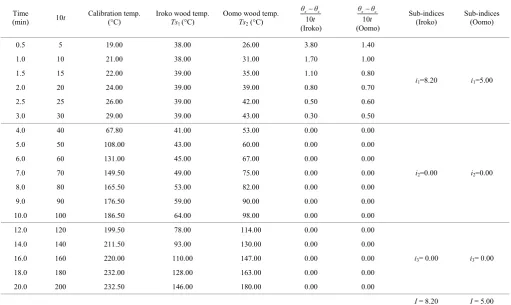
Table 3 showed that the temperature increased as the
times interval increased. Hardwood started producing smoke before the expatriation of the 20 minutes. This finding was in agreement with Simms and Law (2005) and Li and Drysdale (1992) that wooden materials exhibited physical changes (char and smoke) during burning. The value of the index of the individual material was equal to their indices and it was occurred at 0.5 to 3 mins respectively (Table 3).
3.4 The values of index I and sub-indices i1, i2 and i3
for Cement brick and Ikere clay brick
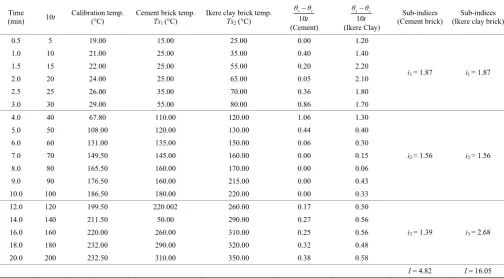
Table 4 showed the computation of index I and sub-indices i1, i2 and i3 for Cement brick and Ikere clay
interval increased also the temperature increased and the highest values were occurred between 0.5 to 3 mins (Table 4). This result was in agreement with Babrauskas
(2003) that building materials depended on ignition temperature and time, which was affected by the physical and chemical composition of the materials.
Table 2 Fire propagation index I and sub-indices i1, i2 and i3 for Nigerite and imperial ceiling boards
Time (min) 10t
Calibration temp. (°C)
Nigerite ceiling temp. Ts1 (°C)
Imperial ceiling temp.
Ts2 (°C) 10
s c
θ θ
t
−
(Nigerite)
10
s c
θ θ
t
−
(Imperial)
Sub-indices (Imperial)
Sub-indices (Nigerite)
0.50 5 19.00 26.00 30.00 1.40 2.20
1.00 10 21.00 46.00 40.00 2.50 1.90
1.50 15 22.00 53.00 50.00 2.10 1.80
2.00 20 24.00 59.00 60.00 1.80 1.80
2.50 25 26.00 64.00 70.00 1.50 1.70
3.00 30 29.00 68.00 80.00 1.30 1.70
i1= 11.10 i1= 10.60
4.00 40 67.80 76.00 100.00 0.20 0.80
5.00 50 108.00 83.00 120.00 0.00 0.24
6.00 60 131.00 91.00 140.00 0.00 0.15
7.00 70 149.50 98.00 159.00 0.00 0.13
8.00 80 165.50 105.00 175.00 0.00 0.12
9.00 90 176.50 115.00 178.00 0.00 0.24
10.0 100 186.50 120.00 220.00 0.00 0.34
i2= 2.02 i2= 2.02
12.00 120 199.50 126.00 260.00 0.00 0.50
14.00 140 211.50 151.00 300.00 0.00 0.63
16.00 160 220.00 167.00 340.00 0.00 0.75
18.00 180 232.00 183.00 358.00 0.00 0.70
20.00 200 232.50 200 475.00 0.00 1.21
i3= 3.79 i3= 0.00
I =16.91 I = 10.80
Table 3 Fire propagation index I and sub-indices i1, i2 and i3 for Iroko hard wood and Oomo hard wood
Time
(min) 10t
Calibration temp. (°C)
Iroko wood temp. Ts1 (°C)
Oomo wood temp.
Ts2 (°C) 10
s c
θ θ
t
−
(Iroko)
10
s c
θ θ
t
−
(Oomo)
Sub-indices (Iroko)
Sub-indices (Oomo)
0.5 5 19.00 38.00 26.00 3.80 1.40
1.0 10 21.00 38.00 31.00 1.70 1.00
1.5 15 22.00 39.00 35.00 1.10 0.80
2.0 20 24.00 39.00 39.00 0.80 0.70
2.5 25 26.00 39.00 42.00 0.50 0.60
3.0 30 29.00 39.00 43.00 0.30 0.50
i1=8.20 i1=5.00
4.0 40 67.80 41.00 53.00 0.00 0.00
5.0 50 108.00 43.00 60.00 0.00 0.00
6.0 60 131.00 45.00 67.00 0.00 0.00
7.0 70 149.50 49.00 75.00 0.00 0.00
8.0 80 165.50 53.00 82.00 0.00 0.00
9.0 90 176.50 59.00 90.00 0.00 0.00
10.0 100 186.50 64.00 98.00 0.00 0.00
i2=0.00 i2=0.00
12.0 120 199.50 78.00 114.00 0.00 0.00
14.0 140 211.50 93.00 130.00 0.00 0.00
16.0 160 220.00 110.00 147.00 0.00 0.00
18.0 180 232.00 128.00 163.00 0.00 0.00
20.0 200 232.50 146.00 180.00 0.00 0.00
i3= 0.00 i3= 0.00
Table 4 Fire propagation test index I and sub-indices i1, i2 and i3 for Cement brick and Ikere clay brick
Time (min) 10t
Calibration temp. (°C)
Cement brick temp. Ts1 (°C)
Ikere clay brick temp.
Ts2 (°C) 10
s c
θ θ
t
−
(Cement)
10
s c
θ θ
t
−
(Ikere Clay)
Sub-indices (Cement brick)
Sub-indices (Ikere clay brick)
0.5 5 19.00 15.00 25.00 0.00 1.20
1.0 10 21.00 25.00 35.00 0.40 1.40
1.5 15 22.00 25.00 55.00 0.20 2.20
2.0 20 24.00 25.00 65.00 0.05 2.10
2.5 25 26.00 35.00 70.00 0.36 1.80
3.0 30 29.00 55.00 80.00 0.86 1.70
i1 = 1.87 i1 = 1.87
4.0 40 67.80 110.00 120.00 1.06 1.30
5.0 50 108.00 120.00 130.00 0.44 0.40
6.0 60 131.00 135.00 150.00 0.06 0.30
7.0 70 149.50 145.00 160.00 0.00 0.15
8.0 80 165.50 160.00 170.00 0.00 0.06
9.0 90 176.50 160.00 215.00 0.00 0.43
10.0 100 186.50 180.00 220.00 0.00 0.33
i2 = 1.56 i2 = 1.56
12.0 120 199.50 220.002 260.00 0.17 0.50
14.0 140 211.50 50.00 290.00 0.27 0.56
16.0 160 220.00 260.00 310.00 0.25 0.56
18.0 180 232.00 290.00 320.00 0.32 0.48
20.0 200 232.50 310.00 350.00 0.38 0.58
i3 = 1.39 i3 = 2.68
I = 4.82 I = 16.05
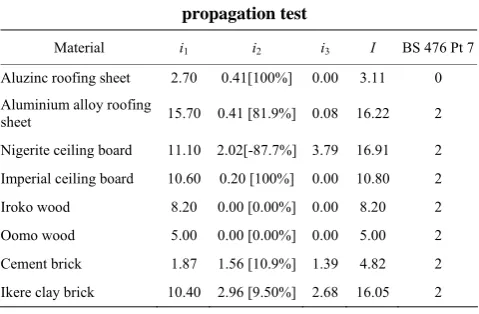
The test results are given as an index of performance (I) which is based on three sub-indices (i1, i2, i3). The higher the value of the index (I), the greater the materials contribution to fire growth. The higher the value of the sub-index I, the greater the ease of ignition and flame spread. This findings were in agreement with Nyman (2002) and Lim and Wade (2002) that the higher the value of the index the greater the materials contribution to fire growth. This findings showed that imperial ceiling board made of asbestos had the highest performance index contribute more to fire growth, while aluzinc had the least value of 3.11 (Table 5). Hardwood started producing smoke before the expatriation of the 20 minutes that was slated for the experiment. This is an indication that wood can catch fire easily but wooden materials to be fire resistant, fire retardants must be added to the wood so that, it will not ignite easily. The plywood product that was tested also got burnt completely before 20 minutes slated time for the experiment. This is also an indication that such materials can catch fire, but for it to fire resistant, fire retardants must be added to it. Based on this, wood and its product like plywood are combustible building materials that must be treated with fire retardants chemicals such as ammonium phosphate, ammonium sulphate, borax/boric acid and melamine phosphate. These other materials, cement brick and Ikere clay brick
do not produce smoke during the 20 minutes slated time for the experiment. This showed that the materials are non-combustible. They may contribute to heat build-up and that can lead to fire growth in buildings
3.5 Fire propagation phase
The fire propagation phase represents fire conditions in the compartment (furnace) from the early ignitability initial (initiation), to flashover conditions (Figure 1). It depends on burning rateand rate of spread of flame. The fire propagation phases are presented by the performance indices (i1, i2, and i3).
Figure 1 Graphical presentation of temperature-time profile of the selected building materials in the study area
The i1 index encompasses the period of localised
heating of the materials to flaming ignition. It is characterised by the early stages of fire spread, early period (ranges from 0.5-3.0 mins) and low flammability (Figure 1).
4-10 mins) flashover conditions and high flammability and rapid temperature rises.
The i3 index represents the combustion period from
ignition to flameout in the furnace. It is characterized by late periods (ranges from 12-20 mins) and temperature rises slowly to steady state with rapid temperature rises. Temperature-time profile of the selected building materials is presented in Figure 1. The rate of temperature could be attributed to different materials with different in physical and chemical compositions.
3.6 Performance indices in the fire propagation and
classification
The performance indices were shown in Table 5. The
i1 period reflects an ignitable materials' heat contribution
in the early stages of fire spread, while the indices i2, i3
and the overall composite I suggest a categorisation of material type indicated fire resistivity and level of treatment. Comparatively, aluminium alloy roofing sheet was followed by Nigerite, imperial ceiling and Ikere clay brick which contribute significant heat relatively early as indicated by a large numerical index i1 consequently
resulting in a large I value. The values of i2 in the bracket
attributed to the inherent nature of the material and denoted the i2 period and advance of aluzinc (100%),
aluminium (81.9%), Imperial ceiling (100%), Cement brick (10.9%) and Ikere clay brick (9.50%) and late of Nigerite (87.6%) of the i3 period represent the
combustion period from ignition to flameout in the combustion chamber. Aluzinc roofing sheet was classified under building regulations class 0 and it was proved to be best material that the greatest resistance to surface spread of flame and safer from fire hazard as compared with other materials and it did not require any treatment. The other materials were classified under class 2, which lesser resistance to surface spread of fire and they required treatment for them to the classified under class 1. Majority (87.5%) of the materials were classified as class 2. The finding was in agreement with Babrauskas (2003) and Emmons (2002) that building materials may belong to the same class but be different in overall index of performance. The index performance attributed to different physical, chemical, mechanical properties of the materials and climate. Secondly, their fire performance indexes for all the materials were good for building
construction.
The significance of the class of fire and the fire performance index on the building materials as structural element in the study area were as follows:
(i) Suitability for insulation: to know the time it takes to produce an increase in temperature of the material as a structural element;
(ii) Suitability for integrity: to know the length of time the material as structural element to retain its integrity against flames or hot gases;
(iii) Suitability for load carrying capacity: to know the length of time the material as structural element able to carry the current load in normal fire development phase;
(iv) Suitability for mechanical effect: to know the ability of the material as a structural element able to cope with the mechanical impact in a standard fire.
Table 5 Summary of the performance indices in the fire propagation test
Material i1 i2 i3 I BS 476 Pt 7
Aluzinc roofing sheet 2.70 0.41[100%] 0.00 3.11 0 Aluminium alloy roofing
sheet 15.70 0.41 [81.9%] 0.08 16.22 2
Nigerite ceiling board 11.10 2.02[-87.7%] 3.79 16.91 2 Imperial ceiling board 10.60 0.20 [100%] 0.00 10.80 2
Iroko wood 8.20 0.00 [0.00%] 0.00 8.20 2
Oomo wood 5.00 0.00 [0.00%] 0.00 5.00 2
Cement brick 1.87 1.56 [10.9%] 1.39 4.82 2
Ikere clay brick 10.40 2.96 [9.50%] 2.68 16.05 2
4 Conclusions
The performance indices of the selected building materials were determined. The findings different from just merely looking which you call observation made it are evident that, the materials with lesser sub-index i1 will
contribute a lot to the propagation, particularly during the early stages. This indicated that they are more hazardous materials than those with higher sub-index i1, during fire
situation. The value of sub-index (i1) was directly
effects on the result. Therefore, the fire propagation test was proved to be one of reliable methods for assessing or measuring the potential fire hazard of the materials. All these materials were good for building construction.
References
Airapetov, D. 2006. Architectural Materials Science. 5th ed. Moscow: Mir Publisher.
ASTM E84. 2003. Standard test method for surface burning characteristics of building materials. W. Conshohocken, PA: ASTM International.
ASTM E 108. 2007. Standard test methods for fire tests of roof coverings. West Conshohocken, PA: ASTM International. Babrauskas, V. 2003. Ignition Handbook. 5th ed. Issaquah: Fire
Science Publishers.
Dunn, A. 2002. Performance of Timber in Buildings during Bush Fire. (DA NSW), Australian Timber Design. pp. 87–120. Cambridge: University Press.
Ellis, P. 2002. The Adequacy of the Australian Standards AS359 – 2002. Statement to the Select Committee of the NSW Parliament on Bush Fire. CSIRO, Forestry and Forest Products, Kingston Act, 60–69
Emmons, H. W. 2002. Overview—Flammability of materials. In Proc. from Conf. on Fundamentals of Flammability and Combustion of Materials, 79-90. Salt Lake City, Utah, 10-14 July.
EN 13823, 2002. Reaction to fire tests for building products-Building product excluding floorings exposed to the thermal attack by a single burning item. Germany. European Commission for Standardization (CEN), Germany.
Folorunso, C. O. 2006. Maintenance reduction through climatic complaint building materials utilization. Journal of Land Use and Development Studies, 2(1): 23–31.
Cool, J. C., F. J. Schijff, and T. J. Viersma. 1991. Regeltechniek (Control Engineering) 2nd ed., pp. 412-415. Overburg.
Germany: Delta Press
Kruppa, J. 1997. Performance-based code in fire resistance: first
attempt by Eurocodes. In Proc. of International Conf. on Performance-based Codes and Fire Safety Design Method, D. P. Lund, 217–228. Boston, MA: Society of Fire Protection Engineers.
Li, Y., and D. Drysdale. 1992. Measurement of the ignition temperature of wood. In Proc. of the First Asian-Oceania Symposium on Fire Science and Technology, 380-385. Hefei, China, 9–12 October.
Lim, L., and C. Wade. 2002. Experimental fire test of two-way concrete stabs. Fire Engineering Research Report 02/12. Christchurch: University of Canterbury
NFPA 255. 2006. Standard method of test of surface burning characteristics of building materials. Quincy, WA: National Fire Protection Association.
Nyman, J. 2002. Equivalent fire resistance ratings of construction elements exposed to retaliate fire. Fire Engineering Research Report 02/13. Christchurch: University of Canterbury Olusanya, S. O. 1998. Benefits of effective building maintenance
habit. Journal of Building Science and Management, 8(2): 2–8. Onwuka, E. E. 1989. Maintenance in building and construction
works. Journal of Nigeria Institute of Quantity Surveyor, Lagos, 3(1): 3–8.
Qunitiere, J. G. 1998. Principles of Fire Behaviour. 2nded. Albany, N. Y.: Delmar Publishers.
Rogowski, B. F. W. 1970. The fire propagation test: its development and application. Fire Research Note No. 739 Shield, T. J., and G. W. H. Slcock. 1987. Building and Fire. 2nd ed.
Singapore: Longman Singapore Publisher (Pte) Ltd.
Simms, D. L., and M. Law. 2005. The Ignition of Wet and Dry Wood by Radiation. Fire Research Note No. 586, Ministry of Technology and Fire Offices’ Committee Joint Fire Research Organization, Borehamwood, UK, 345–352
Stollard, P., and J. Abraham. 2009. Fire from First Principles: A Design Guide to Building Fire Safety, 5th ed. Padstow,
Conwell: International Ltd.