Objectives
• Understand the relationship between Boolean logic and digital computer circuits.
• Learn how to design simple logic circuits.
Boolean Algebra
• Boolean algebra is a mathematical system for the manipulation of variables that can have one of two values.
– In formal logic, these values are “true” and “false.” – In digital systems, these values are “on” and “off,”
1 and 0, or “high” and “low.”
• Boolean expressions are created by
performing operations on Boolean variables.
Boolean Algebra
• A Boolean operator can be completely described using a truth table.
• The truth table for the Boolean operators AND and OR are
shown at the right.
Boolean Algebra
• The truth table for the
Boolean NOT operator is shown at the right.
• The NOT operation is
most often designated by an overbar. It is
sometimes indicated by a prime mark ( ‘ ) or an
Boolean Algebra
• A Boolean function has:
• At least one Boolean variable or literal, • At least one Boolean operator, and
Boolean Algebra
• The truth table for the Boolean function:
is shown at the right.
• To make evaluation of the Boolean function easier, the truth table contains
extra (shaded) columns to hold evaluations of
Boolean Algebra
• As with common arithmetic, Boolean
operations have rules of precedence.
• The NOT operator has highest priority, followed by AND and then OR.
• This is how we chose the (shaded) function
Boolean Algebra
• Digital computers contain circuits that implement Boolean functions.
• The simpler that we can make a Boolean function, the smaller the circuit that will result.
– Simpler circuits are cheaper to build, consume less power, and run faster than complex circuits.
• With this in mind, we always want to reduce our Boolean functions to their simplest form.
Boolean Algebra
• Most Boolean identities have an AND (product) form as well as an OR (sum) form.
Boolean Algebra
Boolean Algebra
Boolean Algebra
Boolean Algebra
• Sometimes it is more economical to build a
circuit using the complement of a function (and complementing its result) than it is to implement the function directly.
• DeMorgan’s law provides an easy way of finding the complement of a Boolean function.
Boolean Algebra
• DeMorgan’s law can be extended to any number of variables.
• Replace each variable by its complement and change all ANDs to ORs and all ORs to ANDs. • Thus, we find the the complement of:
Boolean Algebra
• Through our exercises in simplifying Boolean expressions, we see that there are numerous ways of stating the same Boolean expression.
– These “synonymous” forms are logically equivalent.
– Logically equivalent expressions have identical truth tables.
• In order to eliminate as much confusion as
Boolean Algebra
• There are two canonical forms for Boolean
expressions: sum-of-products and product-of-sums.
– Recall the Boolean product is the AND operation and the Boolean sum is the OR operation.
• In the sum-of-products form, ANDed variables are ORed together.
– For example:
• In the product-of-sums form, ORed variables are ANDed together:
Boolean Algebra
• It is easy to convert a function to sum-of-products form using its truth table.
• We are interested in the values of the variables that make the function true (=1).
• Using the truth table, we list the values of the variables that result in a true function value. • Each group of variables is then
Boolean Algebra
• The sum-of-products form for our function is:
• We have looked at Boolean functions in abstract terms.
• In this section, we see that Boolean functions are
implemented in digital computer circuits called gates. • A gate is an electronic device that produces a result
based on two or more input values.
– In reality, gates consist of one to six transistors, but digital designers think of them as a single unit.
– Integrated circuits contain collections of gates suited to a particular purpose.
• The three simplest gates are the AND, OR, and NOT gates.
• They correspond directly to their respective Boolean operations, as you can see by their truth tables.
• Another very useful gate is the exclusive OR (XOR) gate.
• The output of the XOR operation is true only when the values of the inputs differ.
Logic Gates
• NAND and NOR are two very
important gates. Their symbols and truth tables are
shown at the right.
Logic Gates
• NAND and NOR are known as
universal gates because they are inexpensive to manufacture and any Boolean
Logic Gates
• Gates can have multiple inputs and more than one output.
– A second output can be provided for the complement of the operation.
Digital Components
• The main thing to remember is that combinations of gates implement Boolean functions.
• The circuit below implements the Boolean function:
Combinational Circuits
• We have designed a circuit that implements the Boolean function:
• This circuit is an example of a combinational logic circuit.
• Combinational logic circuits produce a specified output (almost) at the instant when input values are applied.
Combinational Circuits
• Combinational logic circuits give us many useful devices. • One of the simplest is the
half adder, which finds the sum of two bits.
Combinational Circuits
• As we see, the sum can be found using the XOR
Combinational Circuits
• We can change our half adder into to a full adder by including gates for
processing the carry bit. • The truth table for a full
Combinational Circuits
Combinational Circuits
Combinational Circuits
• Just as we combined half adders to make a full adder, full adders can connected in series.
• The carry bit “ripples” from one adder to the next; hence, this configuration is called a ripple-carry adder.
Combinational Circuits
• Decoders are another important type of combinational circuit.
• Among other things, they are useful in selecting a memory location according a binary value placed on the address lines of a memory bus.
• Address decoders with n inputs can select any of 2n
locations.
Combinational Circuits
• This is what a 2-to-4 decoder looks like on the inside.
Combinational Circuits
• A multiplexer does just the opposite of a decoder.
• It selects a single output from several inputs.
• The particular input chosen for output is determined by the value of the multiplexer’s control lines.
• To be able to select among n inputs, log2n control lines are needed.
Combinational Circuits
• This is what a 4-to-1 multiplexer looks like on the inside.
If S0 = 1 and S1 = 0, which input is
Combinational Circuits
• This shifter moves the bits of a nibble one
position to the left or right.
Sequential Circuits
• Combinational logic circuits are perfect for situations when we require the immediate
application of a Boolean function to a set of inputs. • There are other times, however, when we need a
circuit to change its value with consideration to its current state as well as its inputs.
– These circuits have to “remember” their current state.
Sequential Circuits
• As the name implies, sequential logic circuits require a means by which events can be sequenced.
• State changes are controlled by clocks.
– A “clock” is a special circuit that sends electrical pulses through a circuit.
Sequential Circuits
• State changes occur in sequential circuits only when the clock ticks.
• Circuits can change state on the rising edge,
Sequential Circuits
• Circuits that change state on the rising edge, or falling edge of the clock pulse are called edge-triggered.
Sequential Circuits
• To retain their state values, sequential circuits rely on feedback.
• Feedback in digital circuits occurs when an output is looped back to the input.
• A simple example of this concept is shown below.
Sequential Circuits
• You can see how feedback works by examining the most basic sequential logic components, the SR flip-flop.
– The “SR” stands for set/reset.
Sequential Circuits
• The behavior of an SR flip-flop is described by a characteristic table.
Sequential Circuits
• The SR flip-flop actually has three inputs: S, R, and its current output, Q. • Thus, we can construct
a truth table for this
circuit, as shown at the right.
• Notice the two undefined values. When both S
Sequential Circuits
• If we can be sure that the inputs to an SR flip-flop will never both be 1, we will never have an
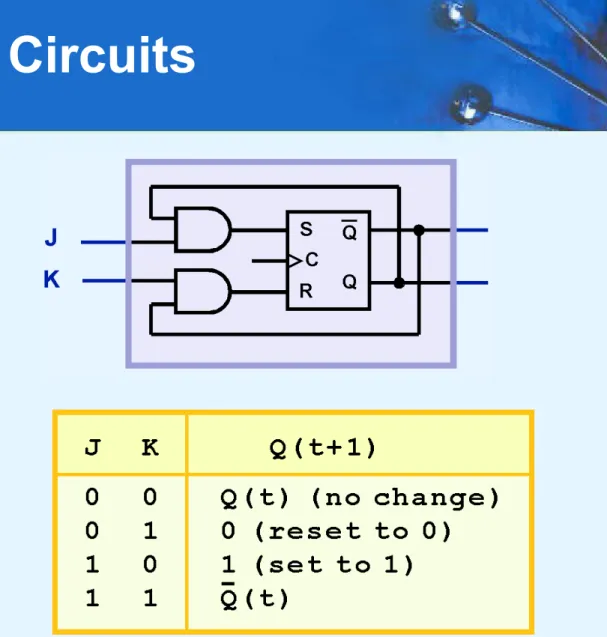
unstable circuit. This may not always be the case. • The SR flip-flop can be modified to provide a
stable state when both inputs are 1. • This modified flip-flop is
called a JK flip-flop, shown at the right.
- The “JK” is in honor of
Sequential Circuits
• At the right, we see how an SR flip-flop can be modified to create a JK flip-flop. • The characteristic
Sequential Circuits
• Another modification of the SR flip-flop is the D flip-flop, shown below with its characteristic table. • You will notice that the output of the flip-flop
remains the same during subsequent clock
Sequential Circuits
• The D flip-flop is the fundamental circuit of computer memory.
– D flip-flops are usually illustrated using the block diagram shown below.
Sequential Circuits
• The behavior of sequential circuits can be
expressed using characteristic tables or finite state machines (FSMs).
– FSMs consist of a set of nodes that hold the states of the machine and a set of arcs that connect the states.
• Moore and Mealy machines are two types of FSMs that are equivalent.
– They differ only in how they express the outputs of the machine.
• Moore machines place outputs on each node, while Mealy machines present their outputs on the
Sequential Circuits
• The behavior of a JK flop-flop is depicted below by a Moore machine (left) and a Mealy machine
Sequential Circuits
• Although the behavior of Moore and Mealy
machines is identical, their implementations differ. This is our Moore
Sequential Circuits
• Although the behavior of Moore and Mealy
machines is identical, their implementations differ. This is our Mealy
Sequential Circuits
• It is difficult to express the complexities of actual implementations using only Moore and Mealy machines.
– For one thing, they do not address the intricacies of timing very well.
– Secondly, it is often the case that an interaction of
numerous signals is required to advance a machine from one state to the next.
• For these reasons, Christopher Clare invented the algorithmic state machine (ASM).
Sequential Circuits
Sequential Circuits
• Sequential circuits are used anytime that we have a “stateful” application.
– A stateful application is one where the next state of the machine depends on the current state of the machine and the input.
• A stateful application requires both combinational and sequential logic.
• The following slides provide several examples of circuits that fall into this category.
Sequential Circuits
• This illustration shows a 4-bit register consisting of D flip-flops. You will
usually see its block
diagram (below) instead.
Sequential Circuits
• A binary counter is another example of a sequential circuit.
• The low-order bit is
complemented at each clock pulse.
• Whenever it changes from 0 to 1, the next bit is complemented, and so on through the
Sequential Circuits
• Convolutional coding and decoding requires sequential circuits.
• One important convolutional code is the (2,1)
convolutional code that underlies the PRML code that is briefly described at the end of Chapter 2. • A (2, 1) convolutional code is so named because
two symbols are output for every one symbol input.
• A convolutional encoder for PRML with its
Sequential Circuits
This is the Mealy
Sequential Circuits
F(1101 0010) = 11 01 01 00 10 11 11 10.
• The fact that there is a limited set of possible state transitions in the encoding process is crucial to the error
correcting capabilities of PRML.
Sequential Circuits
F(11 01 01 00 10 11 11 10) = 1101 0010
• The decoding of our code is provided by
inverting the inputs and outputs of the Mealy machine for the
encoding process. • You can see by our
Sequential Circuits
F(00 10 11 11) = 1001
• Yet another way of
looking at the decoding process is through a lattice diagram.
• Here we have plotted the state transitions
Sequential Circuits
F(00 10 11 11) = 1001
• Suppose we receive the erroneous string: 10 10 11 11.
• Here we have plotted the accumulated errors based on the
allowable transitions. • The path of least error
outputs 1001, thus
Designing Circuits
• We have seen digital circuits from two points of view: digital analysis and digital synthesis.
– Digital analysis explores the relationship between a circuits inputs and its outputs.
– Digital synthesis creates logic diagrams using the values specified in a truth table.
• Digital systems designers must also be mindful of the physical behaviors of circuits to include minute
Designing Circuits
• Digital designers rely on specialized software to create efficient circuits.
– Thus, software is an enabler for the construction of better hardware.
• Of course, software is in reality a collection of algorithms that could just as well be
implemented in hardware.
Designing Circuits
• When we need to implement a simple, specialized algorithm and its execution speed must be as fast as possible, a hardware solution is often preferred.
• This is the idea behind embedded systems, which are small special-purpose computers that we find in many everyday things.
• Computers are implementations of Boolean logic. • Boolean functions are completely described by
truth tables.
• Logic gates are small circuits that implement Boolean operators.
• The basic gates are AND, OR, and NOT.
– The XOR gate is very useful in parity checkers and adders.
• Computer circuits consist of combinational logic circuits and sequential logic circuits.
• Combinational circuits produce outputs (almost) immediately when their inputs change.
• Sequential circuits require clocks to control their changes of state.
• The basic sequential circuit unit is the flip-flop: The behaviors of the SR, JK, and D flip-flops are the most important to know.
• The behavior of sequential circuits can be
expressed using characteristic tables or through various finite state machines.
• Moore and Mealy machines are two finite state machines that model high-level circuit behavior. • Algorithmic state machines are better than
Moore and Mealy machines at expressing timing and complex signal interactions.
• Examples of sequential circuits include memory, counters, and Viterbi encoders and decoders.
• Difference between
combinatorial circuit and sequential circuit latch and flip flop
SOP and POS