ELAINE N. MARIEB
EIGHTH EDITION
3
PowerPoint
®Lecture Slide Presentation by Jerry L. Cook, Sam Houston University
ESSENTIALS
OF HUMAN
ANATOMY
&
PHYSIOLOGY
PART B
Cellular Physiology: Membrane Transport
Membrane Transport
– movement of
substance into and out of the cell
Transport is by two basic methods
Passive transport
No energy is required
Active transport
Solutions and Transport
Solution
– homogeneous mixture of two or
more components
Solvent
– dissolving medium
Solutes
– components in smaller
quantities within a solution
Intracellular fluid
– cytosol
Interstitial fluid
– fluid on the exterior of the
Selective Permeability
The plasma membrane allows some
The Cell Membrane
Figure 3-4
PLAY
Passive Transport Processes
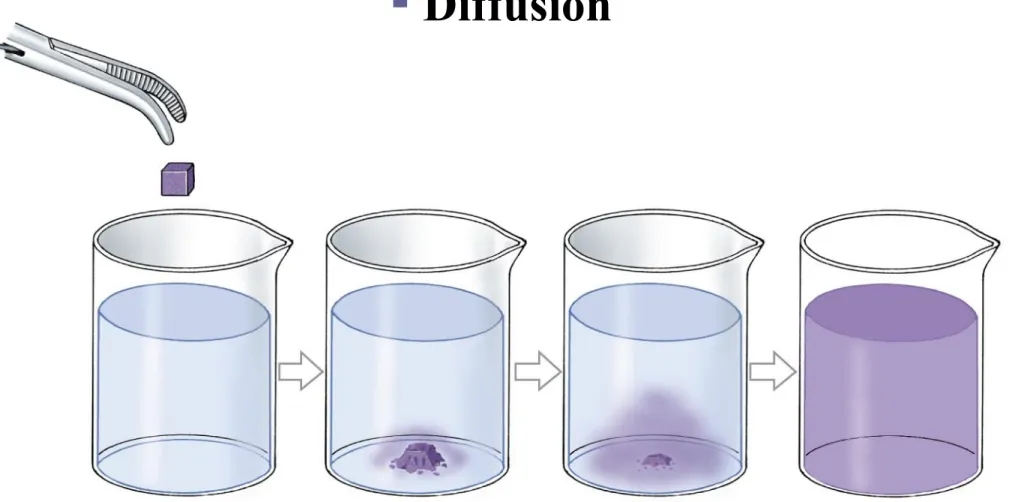
Diffusion
Particles tend to distribute themselves evenly within
a solution
Movement is from high
concentration to low
Passive Transport Processes
Types of diffusion
Simple diffusion
Unassisted process
Solutes are lipid-soluble materials or small
Passive Transport Processes
Types of diffusion
Osmosis
– simple diffusion of water
Highly polar water easily crosses the plasma
membrane
Facilitated diffusion
Substances require a protein carrier for
Diffusion through the Plasma Membrane
Passive Transport Processes
Filtration
Water and solutes are forced through a
membrane by fluid, or hydrostatic
pressure
The Cell Membrane
Figure 3-7
Osmotic
Flow across a
Cell
Active Transport Processes
Transport substances that are unable to pass by
diffusion:
may be too large
may be hydrophillic
may have to move against a concentration
gradient
Two common forms of active transport
Solute pumping
Active Transport Processes
Solute pumping
Amino acids, some sugars and ions are
transported by solute pumps
ATP energizes protein carriers
ACTIVE TRANSPORT ANIMATION
Active Transport Processes
Bulk transport
Exocytosis
Moves materials out of the cell
Active Transport Processes
Bulk transport
Endocytosis
Extracellular substances are engulfed by
being enclosed in a membranous vescicle
Types of endocytosis
Endocytosis
Cell Life Cycle
Cells have two major periods
Interphase
Cell grows
Cell carries on metabolic processes
Cell division
Cell replicates itself
DNA Replication
Genetic material
duplicated and readies
a cell for division into
two cells
Occurs toward the
end of interphase
DNA uncoils and
each side serves
as a template
The Cell Life Cycle
Protein Synthesis
Gene
– DNA segment that carries a blueprint
for building one protein
Proteins have many functions
Building materials for cells
Act as enzymes (biological catalysts)
Events of Cell Division
Mitosis
Division of the nucleus
Results in the formation of two
daughter nuclei
Cytokinesis
Division of the cytoplasm
Begins when mitosis is near completion
Results in the formation of two
Stages of Mitosis
Interphase
No cell division occurs
The cell carries out normal metabolic
activity and growth
Prophase
Stages of Mitosis
Metaphase
Spindle from centromeres are attached to
Stages of Mitosis
Anaphase
Daughter chromosomes are pulled toward
the poles
The cell begins to elongate
Telophase
Daughter nuclei begin forming
Stages of Mitosis