Development and evaluation of an adaptive neuro-fuzzy interface
models to predict performance of a solar dryer
Nikrooz Bagheri
1*, NazillaTarabi
2, HosseinJavadikia
3(1. Assistant professor of Agricultural Engineering Research Institute,AREEO, Iran;
2. Former MS.c Student in Mechanics of Agricultural Machinery, University of Tehran,Iran;
3. Assistant professor in Mechanical Engineering of Agricultural Machinery, Razi University of Kermanshah, Iran.)
Abstract: This research is carried out to predict energy efficiency of a solar dryer by adaptive neuro-fuzzy inference system (ANFIS) model. In this model, temperatures in the collector inlet, collector outlet and in the dry chamber exit and also absorbed heat energy by collector and necessary energy for evaporation of product moisture were considered as an ANFIS network inputs. To investigate the capability of ANFIS models in prediction of dryer efficiency, empirical model was used and its result was compared by ANFIS models. To evaluate an accuracy of ANFIS models, statistical parameters, namely, mean absolute error, mean squared error, sum squared error, correlation coefficient (R) and probability (P) were calculated. Results indicated that coefficient of determination for ANFIS models were in comparison with empirical models whereas amounts of SSE and MSE were lower. From the results of this research, it is concluded that ANFIS models could be efficient in predicting the energy efficiency of a forced-convection solar dryer.
Keywords: solar drying, energy efficiency, ANFIS, empirical modelling
Citation: Bagheri, N., H. Javadikia, and N. Tarabi. 2015. Development and evaluation of an adaptive neuro-fuzzy interface models to predict performance of a solar dryer. Agric Eng Int: CIGR Journal, 17(2):112-121.
1 Introduction
1Because the importance of energy consumption
amount in performance evaluation of dries, investigation
of energy efficiency in dryers has been carried out by
different researchers (Arjona et al.,2005; Othman et al.,
2006; Bagheri et al.,2011). Many researchers have used
the exponential drying model to describe drying behavior
of agricultural products (Inciand Pehlivan, 2004; Simalet
al., 2005). In the past, researchers have solved
analytically several inter-dependent quasi-steady state
energy balance equation for performance prediction of
solar dryers(Goyal and Tiweri, 1999).However, such
models are not widely used because of their complexity
and long computing time required for their solution
(TripathyandSubodh, 2009).Empirical models usually
give very accurate results for each specific experiment
Received date: 2014-07-14 Accepted date: 2015-04-13
*Corresponding author: NikroozBagheri, Assistant Professor of Agricultural Engineering Research Institute, AREEO, Iran. Email: [email protected]
but the equation is not valid for other conditions and there
is no way to obtain a general equation for a wide range of
drying parameters. This problem may be avoided by the
use of analytical drying models but these models are
generally solutions of simultaneous heat and mass
transfer differential equations and the final result may be
very complicated and difficult to use in actual drying
systems (Sogi et al., 2003).However, Fuzzy logic (FL)
offers the mathematical framework for dryers (Kiralakis
and Tsourveloudis, 2005)and also artificial neural
network (ANN) can solve the problem with a reasonable
accuracy. So, adaptive neuro-fuzzy inference system
(ANFIS) as a combination of ANN and fuzzy systems
and a beneficial method is used to integrate the best
features of Fuzzy logic System and Neural Network and
this method can solve non-linear problems (Serge, 2001;
Buragohain and Mahanta, 2008; Metinand Murat, 2008).
This technique is particularly useful for engineering
applications where classical approaches fail or they are
is ideal for interpretation of non-linear systems, like
soil–plant–air systems (Arkhipov et al., 2008).
Recently, ANN models have also been used to
describe drying behavior of different agricultural products
such as carrot (Erenturk and Erenturk, 2007; Kerr et al.,
2006), ginseng (Martynenko and Yang, 2006), cassava
and mango (Hernandez-Perez et al.,2004) and
echinaceaangustifolia (Erenturk et al 2004). Farkas et al
(2004) studied ten different NN topologies to model grain
drying. Inlet and outlet air temperatures, absolute
humidity and air flow were considered as the input
variable. The results showed that moisture distribution in
the drying bed could be well modelled using a neural
network (Farkas et al.,2004).Satish and Pydisettee (2005)
used ANN for modelling the performance of a continuous
fluidized bed dryer. It was found that ANN model fit the
experimental data model with low percentage
error(Satishand Pydisettee, 2005). Movagharnejad and
Nikzad (2007) modelled drying of tomatoes in a tray
dryer covering different variables such as heater power
and air flow velocity. The data were modelled using ANN
and empirical mathematical equations. It was found that
the predictions of ANN model fit the experimental data
more accurately in comparison with the various
mathematical equations (Movagharnejad and Nikzad,
2007).Chegini et al (2008) studied the effects of feed flow
rate, inlet-air temperature, and atomizer speed, in an
orange juice semi-industrial spray dryer. A supervised
ANN was developed to predict seven performance
indices based on the three input variables. The results
confirmed that the ANN model was able to produce
simultaneously seven outputs(Chegini et al.,
2008).Mousavi and Javan (2009) used ANN and
Neuro-Taguchi's method to model and simulate apple
drying. The results demonstrated that the use of
Neuro-Taguchi's method could give some improvements
over neural network accuracy as compared with
conventional neural networks approach (Mousavi and
Javan, 2009). Mansor et al (2010) designed a fuzzy logic
controller for grain drying in order to obtain the grain
output moisture content close to the set-point in spite of
disturbance. The overall results of the experiments were
indicated that the fuzzy logic controller was stable and
robust towards input disturbance (Mansor et al.,
2010).Menlik et al (2010)used an ANN model to
determine drying behaviour of apples in the freeze-drying
process. This study confirmed the ability of the developed
model to determine and predict the drying behaviour of
apples (Menlik et al., 2010). Abakarov et al (2012)
developed a fuzzy logic-based control system for a solar
dryer. Findings from this study would suggest that the
developed fuzzy logic-based control system is able to
tackle difficulties related to the control of solar drying
process (Abakarov et al., 2012).
Totally, optimization of solar dryer systems is used to
reduce system total cost, increase life cycle savings and
improve thermal efficiency (Sharma and Siddhartha,
2012). So, based on the importance of energy efficiency
in dryers and capabilities of ANFIS in prediction, the
main objective of this research is to develop and evaluate
an ANFIS model to predict energy efficiency of a
forced-convection solar dryer.
2 Materials and Methods
2.1 Experimental procedures
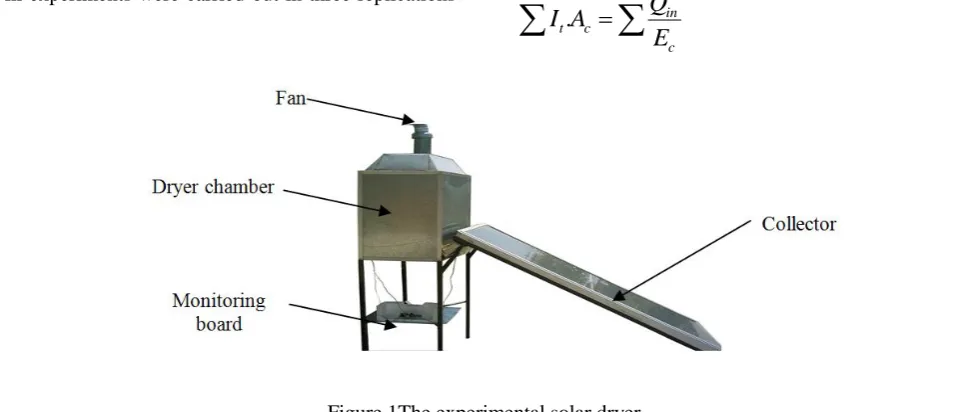
The experimental solar dryer is designed and
constructed for drying leafy vegetables (Figure1). In this
pilot dryer, hot air was provided by forced convection
through an air solar collector. Two main parts of the dryer
were fined-flat collector and dryer chamber. The area of
the collector was 1.83 m2 and the dryer chamber had an
axial tube fan and two sliding trays with total area of 1 m2.
An axial tube fan with 12 cm diameter, 210 m3/h flow,
2300 r/min, 38 W was used (Bagheri et al., 2011).To
measure temperature, temperature sensors (SMT 160-30)
were installed in the collector inlet (T1 as ambient
temperature), collector outlet (T2) and in the dry chamber
exit (T3). Because of long distances among the collector
input, the collector output and the air exit from the dryer
digital temperature sensors were used. These sensors
guarantee data transferring with high accuracy and
minimum error due to long wires connected to the sensors.
A monitoring system was constructed for recording
sensors data and calculating the current dryer efficiency.
To link the user to the monitoring system, an ActiveX
control was programmed and installed on the computer
being executable in Visual Basic 6.0. Using “Mscomm”
control, receiving and sending information from/to
RS232 port become possible.
All experiments were carried out in three replications
from 9 Am to 5 Pm in July with average ambient
temperature of 39°C during the experimental hours, total
daily solar radiation of 26.288 MJ/m2 and the monthly
average of air relative humidity of 39%. In each
replication, 5 kg of mint (with initial moisture content of
80%) was dried in the dryer.
2.2Calculation of solar dryer energy efficiency
To calculate energy efficiency of a convective solar
dryer, Equation 1 is used (Augustus Leon et al., 2002):
f c
t w
E
A
I
L
M
E
.
.
(1)
E: current dryer efficiency, decimal
Mw: evaporated moisture mass of the product, kg
L: specific latent heat of water vaporization, kJ/kg
It: solar radiation energy per collecting area, kJ/m
2
AC: collector area, m
2
Ef: fan electric energy, kJ
The quantity of solar radiation energy in collector area is
equal to the absorbed heat energy in it
(DuffieandBeckman, 1991) (Equation 2):
( 2)
It. Ac :total solar radiation energy in collector area,kJ
Qin:absorbed heat energy by collector, kJ
Ec: collector efficiency. 40% for this solar drier
Based on energy balance Equation 3
(SoheiliMehdizadeh et al., 2006):
( 3)
M: air mass (mixed of dry and wet air),kg
Cp: air specific heat, at 1 atmosphere pressure, 1.006kJ/kg.
K
T2: air temperature at the collector exit, K
T1: air temperature at the collector inlet, K
Based on energy balance equation, the necessary
energy for evaporation of product moisture is equal to
(Equation 4):
(4)
T3: air temperature at the dryer chamber exit, K
Figure 1The experimental solar dryer
c in c
t
E
Q
A
I
.
2 1
.
C
T
T
M
Q
in
p
2 3
.
.
L
M
C
T
T
So, fan electric energy is (Morey & Gustafson, 1978) as
Equation 5:
(5)
Pw: power of fan outlet air, W
t: time, s
EE: electromotor electric efficiency, %
Em: impeller mechanical efficiency, %
The power of outlet air from fan (Bleier, 1998) is as
Equation 6:
Tp
Q
.
P
w=
9
81
.
(6)
Tp: total pressure, mm WC
Q:air flow, m3/s
2.3Modelling energy efficiency by empirical models
To model energy efficiency by empirical models (E),
Design Expert Software version 7 by Response Surface
Method (RSM) is used. Four linear models with different
inputs, namely, E1 (T1 and T2 as inputs), E2 (T1 and T3 as
inputs), E3 (T2 and T3 as inputs) and E4 (Qin and Qout as
inputs) were extracted and Analysis of Variance
(ANOVA) for all empirical models was carried out. So,
correlation between predicted values by RSM and
experimental values was obtained. Finally, the result of
this model was compared with ANFIS model.
2.4Modelling energy efficiency by ANFIS models
4 ANFIS models with different variables as input
variable were used to model energy efficiency of the solar
drier. These models were A1 model (T1 and T2 were
considered as input variables); A2model (T1 and T3 were
considered as input variables); A3model (T2 and T3 were
used as input variables) and finally A4model (Qin and Qout
were considered as input variables).For all ANFIS models,
30 percent of data sets were used to test the models and
check the ability of generalization the model.
In order to create FIS using ANFIS, fuzzy logic
toolbox of MATLAB, version 7.10.0.499 was used.The
structure of generated A1 (Figure2) is composed of a
rule-based system with three components: membership
functions of input-output variables, fuzzy rules, and
output characteristics and system results (Krueger et
al.,2011).Overall, five important adjustments were made
in the structure of ANFIS network. These settings include
type of membership function input, number of
membership function input, type of membership function
output (constant or linear), type of optimization method
and number of epochs. In order to determine the optimal
number of epochs, the error for the validation data set
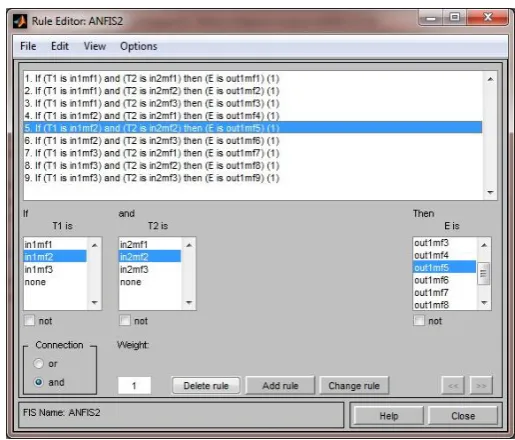
was obtained. Fuzzy rules of A1 model obtained by
artificial neural network are shown in Figure 3. These
rules consist of nine rules between T1 and T2 as input
variables and E1 as output variable in “If -Then” format.
To author: please place Figure 2 and Figure 3 at this
place.
Figure 2 Structure of generated A1 mode
Figure 3Fuzzy rules of A1 model
m E
w f
E
E
t
P
E
.
.
To obtain the best model, some statistical parameters,
namely, Sum Square Error(SSE), Mean Absolute Error
(MAE), Mean Square Error (MSE), P and R were
calculated for 4 ANFIS models.
3 Results and Discussion
3.1 The results of modelling energy efficiency by
empirical models
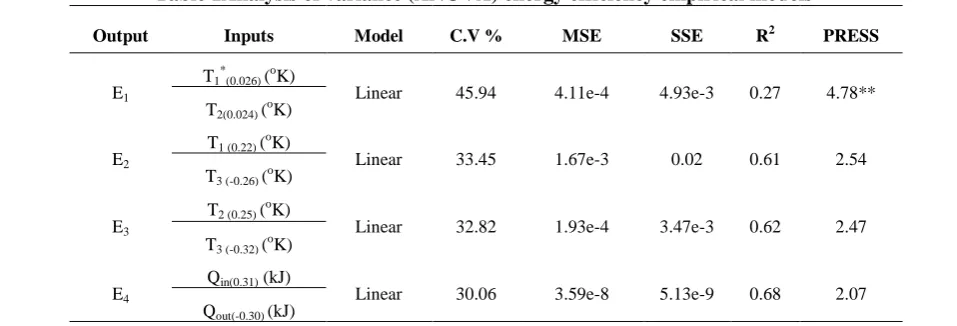
The result of Analysis of Variance (ANOVA) for
energy efficiency empirical models (E1 to E4)is shown in
Table1.
Based on ANOVA results, E4 model with using Qin
and Qout as input variables had higher coefficient of
determination (R2of 0.68) and lower amount of MSE
(3.59e-8) in comparison with other empirical models. It is
indicated that Qin and Qoutare good input variables for
prediction of energy efficiency. The second modelfor
presenting energy efficiency was E3 with usingT2 and T3
as input variables. The results indicated that using T2 and
T3 or T1 and T3 as input variables have similar results
because R2and MSEvaluesfor these two models were
very closed to each other (R2 of 0.62 and 0.61 for E3 and
E2, respectively; MSE of 1.93e-4 and 1.967e-3 for E3 and
E2,respectively).Also, results showed that coefficient of
determination for empirical models were low when the
input variables were T1 and T2. Comparison of predicted
energy efficiency by empirical models and experimental
data are indicated in Figure4. This figure shows that the
correlation of predicted values by experimental ones is
higher for E4 in comparison with other empirical models.
Table 1Analysis of variance (ANOVA) energy efficiency empirical models
PRESS R2
SSE MSE
C.V % Model
Inputs Output
4.78** 0.27
4.93e-3 4.11e-4
45.94 Linear
T1*(0.026) (oK)
E1
T2(0.024) (oK)
2.54 0.61
0.02 1.67e-3
33.45 Linear
T1 (0.22) (oK)
E2
T3 (-0.26) (oK)
2.47 0.62
3.47e-3 1.93e-4
32.82 Linear
T2 (0.25) (oK)
E3
T3 (-0.32) (oK)
2.07 0.68
5.13e-9 3.59e-8
30.06 Linear
Qin(0.31) (kJ)
E4
Qout(-0.30) (kJ)
Note : * Values in parentheses: standard errors of parameter (P<0.05)
3.2 The results of modelling energy efficiency by
ANFIS models
Figure5 shows the effect of epoch number changes on
error value for 4 ANFIS (A1 to A4) models. Results
indicated that for all models, error decreased by
increasing number of epochs. For A3 model, with
increasing number of epochs from 0 to 400, error value
didn’t have considerable changes. For A1, A2, A3 and A4,
number of necessary epochs for minimization of error
were 1500, 200, 800 and 30, respectively. For these
epochs, error was about 0.04. Figure4 Comparison of experimental and predicted values by empirical models
E4 E3
Features of ANFIS models with different input
variables for prediction of energy efficiency in the solar
dryer are presented in Table2. As it is shown in this table,
the correlation coefficient (R) for A1, A2, A3 and A4
obtained 0.936, 0.935, 0.936and 0.986, respectively
which shows that A4by having Qin and Qout as input
variables had lower amount of SSE, MSE and MAE in
comparison with other 3 ANFIS models. So, A3 and
A2had similar R value. Whereas A3 had minimum error
after 800 epochs but for A2error was minimum after 200
epochs. Close to zero values for MSE indicate that there
are no differences between the predicted and measured
data for ANFIS models.
As, it is shown in Table 1 and Table 2, R value for
empirical models (E1 to E4) were 0.51, 0.78, 0.78 and
0.82 and for the ANFIS models (A1 to A4) were 0.94,
0.93, 0.94 and 0.99, respectively. A 2
A 1
A4
A3
Table2Features of ANFIS models with different input variables for prediction of energy efficiency
R SSE
MAE MSE
Number of Epochs Type of
optimizat ion method Type of
mf output Type of
mf input Number
of mf input Inputs
No
0.94 0.79
0.031 0.002
1500 Hybrid
Linear Generalized
bell 3
T1
A1
T2
0.93 0.80
0.023 0.002
200 Hybrid
Linear Gaussian2
3 T1
A2
T3
0.94 0.78
0.023 0.002
800 Hybrid
Linear Gaussian
3 T2
A3
T3
0.99 0.17
0.007 0.0004
30 Hybrid
Linear Gaussian
3 Qin
A4
Predicted data versus the same set of measured data
for ANFIS models (A1to A4) is depicted in Figure6.
Results showed that the relationship between predicted
and experimental data was closed to linear relationship
for all models. So, the scatter plots showed that the
predictive capability was satisfactory and data points
were well concentrated around the ideal unity-slope line
selected. For all data, the linear adjustment between
measured and estimated values gives almost a slope
practically equal to 1.Therefore, there was good match
between the predicted and experimental values in all
ANFIS models, especially for A4 that had maximum
regression in comparison with other models. As, A4model
presents energy efficiency based on Qin and Qout as input
variables so, in can be concluded that Qin and Qout are
good factors for prediction of energy efficiency of ANFIS
models in comparison with Temperature based models
(T1-T2 and T3). Thus, this model could be used to
determine the energy efficiency of the forced convection
solar dryer.
Comparing the results of ANFIS models by empirical
models shows that the predicted data by ANFIS models
was more correlated by experimental data. So, the
developed ANFIS network has a good performance in
predicting energy efficiency of the solar drier.
For both ANFIS and empirical models, mathematical
equations by using Qout and Qinas input variables indicated
higher correlation and lower error whereas equations by
having T1, T2 and T3as input variables had lower
correlation by experimental data. As Qin and Qout beside
Figure6 Comparison of experimental and predicted data by ANFIS models A4
A3
depending on T are dependent to some other drying
factors, namely, air mass, air specific heat, evaporated
moisture mass of the product and specific latent heat of
water vaporization, so, they can consider more effective
variables on dryer energy efficiency and finally, they can
model and predict energy efficiency of the solar dryer
more accurately.
4 Conclusions
The present research is carried out to develop an
ANFIS model to predict and evaluate the energy
efficiency of a forced-convection solar dryer. Considering
the results obtained from this research, the following
conclusions can be drawn:
- The correlation coefficient between experimental data
and empirical models (E1 to E4) were 0.51, 0.78, 0.78 and
0.82, respectively.
- The correlation coefficient between experimental data
and ANFIS models (A1 to A4)modelswere 0.936, 0.935,
0.936 and 0.986, respectively.
- Based on the error analysis results, it was found that the
ANFIS model was more appropriate configuration for
prediction of energy efficiency in comparison with
empirical model.
- Between ANFIS and empirical models, A4 and E4
models by having Qin and Qout as input variables had
lower amount of error in comparison with other models
which indicates that Qin and Qout are good input variables
for prediction of energy efficiency in comparison with T
based models.
References
Abakarov, A., T. Jiménez-Ariza, E.C. Correa-Hernando, B. Diezma, F.J. Arranz,J. Garcia-Hierro, J.I. Robla, and P. Barreiro.2012. Control of a solar dryer through using a fuzzy logic and low-cost model-based sensor.International Conference of Agricultural Engineering, CIGR-Ageng 2012, Valencia-España.
Arjona, R., P. Ollero, and F.B. Vidal.2005.Automation of an Olive Waste Industrial Rotary Dryer.Journal of Food Engineering.68: 239-242.
Arkhipov, M. E.Krueger, andD.Kurtener.2008. Evaluation of ecological conditions using bioindicators: Application of fuzzy modeling..International Conference on Computational Science and its applications - ICCSA 2008, Part I, LNCS 5072, pp. 491-500, 200
Augustus Leon, M., S. Kumar, and S.C. Bhattacharya.2002.A comprehensive procedure for performance evaluation of solar food dryers.Journal of Renewable Sustainable Energy, 6 (4): 367-393.
Bagheri, N., A. Keyhani, S.S. Mohtasebi, R. Alimardani, S. Rafiee, and G.H. Mansoori.2011. Design, construction and evaluation of fan speed controller to optimize the overall energy efficiency in a forced convection solar dryer. Journal of Agricultural Science and Technology (JAST),13 (4):503-515.
Bleier, F.P.1998. Fan Handbook: Selection, Application and Design. McGraw-Hill, NY.
Buragohain, M.andC.Mahanta.2008. A novel approach for ANFIS modelling based on full factorial design.Applied Soft Computing, 8(1): 609-625.
Chegini, G.R., J. Khazaei, B. Ghobadian, and A.M. Goudarzi.2008. Prediction of process and product parameters in an orange juice spray dryer using artificial neural networks. Journal of Food Engineering. 84(4):534-543.
Cheng, C. B.,C. J.Cheng, and E. S.Lee.2002. Neuro-fuzzy and genetic algorithm in multiple response optimization.Computers and Mathematics with Applications, 44(12): 1503–1514.
Duffie,J.A.and W.A. Beckman.1991. Solar engineering of thermal processes. John Wiley andSons, NY.
Erenturk, S.andK.Erenturk.2007. Comparison of genetic algorithm and neural network approaches for the drying process of carrot. Journal of Food Engineering, 78(3):905-912.
Erenturk, K., S. Erenturk, and L.G. Tabil.2004. A comparative study for the estimation of dynamical drying behavior of Echinacea angustifolia: regression analysis and neural network.Computer and Electronic in Agriculture, 45 (1–3): 71-90.
Farkas, I., P. Remenyi, and A. Biro.2004. A Neural network topology for modeling grain drying.Computer and Electronics in Agriculture, 26(2): 147-158.
Goyal,R.K.and G.N. Tiweri.1999. Performance of a reverse flat plate absorber cabinet dryer: a new concept. Energy Conversion and Management.Portuguese (Brazil),40 (4): 385-392.
Inci,T.T.and D. Pehlivan.2004. Modeling the thin layer drying kinetics of some fruits under open air sun drying process.Journal of Food Engineering, 65(3):413-25.
Kerdpiboon, S. Kerr, W.L., , and S. Devahastin.2006. Neural network prediction of physical property changes of dried carrot as a function of fractal dimension and moisture content.FoodResearch .International. 39(10):1110-1118. Kiralakis, L.andN.C.Tsourveloudis.2005. Modeling and
optimization of olive stone drying process, in: WSEAS International Conference on Dynamical Systems and Control, 2-4 November, Venice, Italy, 2005.
Krueger, E., S.A. Prior, D. Kurtener, H.H. Rogers, and G. Runion.2011.Characterizing root distribution with adaptive neuro-fuzzy analysis. International Agrophysics, 25(1):93-96. Mansor, H., S.B. Mohd Noor, R.K. Raja Ahmad, F.S. Taip, and O.F. Lutfy.2010.Intelligent control of grain drying process using fuzzy logic controller. Journal of Food, Agriculture andEnvironment,8 (2):145 - 149.
Martynenko,A.I.and S.X. Yang.2006. Biologically inspired neural computation for ginseng drying rate.Biosystems Engineering, 95(3): 385-396.
Menlik, T., M. BahadirOzdemir and V. Kirmaci.2010.Determination of freeze-drying behaviors of apple by artificial neural network.Expert System With, Applications, 37(12):7669-7677
Metin, E.H.andH.Murat.2008. Comparative analysis of an evaporative condenser using artificial neural network and adaptive neuro-fuzzy inference system.International Journal of Refrigeration, 31(8): 1426-1436.
Morey, R.V.and R.J. Gustafson.1978. Fan Management for Ambient Drying Systems. Journal. ASAE (American Society of Agricultural Enginnering,No:78-3003
Mousavi, M.and S Javan.2009. Modeling and simulation of apple drying, using artificial neural network and neuro Taguchi's
method.Journal of.Agricultural.Science and. Technology, 11559-571.
Movagharnejad, K.andM. Nikzad.2007. Modeling of tomato drying using artificial neural network.Computers and Electronics in Agriculture, 59(1-2):78-85.
Othman, M.Y.H., K. Sopian, B. Yatim, and W.R.W. Daud.2006. Development of advanced solar assisted drying systems.Renewable Energy, 31(5):703-709.
Satish, S. and Y Pydisettee.2005.Modeling of a continuous fluidized bed dryer using artificial neural networks. International Communication in Heat and Mass transfer, 32(7):539- 547.
Serge, G.2001. Designing fuzzy inference systems from data: Interpretability oriented review. IEEE Transaction on Fuzzy Systems, 9 (3):426–442.
Sharma, N.andV. Siddhartha.2012. Stochastic techniques used for optimization in solar systems: A review.Renewable and Sustainable Energy Reviews, 16 (3): 1399–1411.
Simal, S., A. Femenia, M.C. Garau, and C. Rossello.2005.Use of exponential, pages and diffusional models to simulate the drying kinetics of kiwi fruit.Journal of Food Engineering, 66(3):323-8.
Sogi, D.S., U.S. Shivhare, S.K. Garg, and A.S. Bawa.2003.Water sorption isotherm and drying characteristics of tomato seeds.Biosystem.Engineering. 84 (3): 297-301.
SoheiliMehdizadeh, A., A. Keyhani, K. Abbaspoursani, and A. Akram.2006. Design of a forced convection solar dryer for leafy vegetables and evaluation of the solar energy collector performance.Journal of Agricultural Enginering and Research, 7 (27):147-163.