A Case From the South of Chile
La actitud de estudiantes universitarios hacia el inglés
como lengua extranjera: un caso del sur de Chile
1
Eric Gómez Burgos*
Universidad San Sebastián, Puerto Montt, Chile
2
Soledad Sandoval Molina**
Universidad de Los Lagos, Osorno, Chile
Attitude towards English as a foreign language is a new field of study in tertiary education in Latin-American countries, especially in Chile. However, its importance in the process of learning a language has been reported upon around the world. The aim of the current study was to identify the attitudes towards English as a foreign language of 131 university students from different educational institutions in Chile; the students’ programs included English courses as part of their study plan. The three components of attitude were analyzed by means of the participants’ replies to the statements of a questionnaire. Results gave evidence that university students hold a positive attitude towards English as a foreign language; nonetheless, the behavioral aspect of attitude obtained the lowest average of agreement among the respondents.
Key words: Attitudes, Chile, English as a foreign language, undergraduate students.
La actitud hacia el inglés como lengua extranjera es un nuevo campo de estudio en la educación universitaria en los países latinoamericanos, especialmente en Chile. Sin embargo, su relevancia en el proceso de aprendizaje de una lengua se ha investigado alrededor del mundo. El presente estudio busca identificar las actitudes hacia el inglés como lengua extranjera de 131 estudiantes universitarios de diferentes instituciones educativas del sur de Chile, cuyas carreras de pregrado incluyen cursos de inglés como parte de su plan de formación. Se analizaron los tres componentes de la actitud por medio de las respuestas de los participantes. Los resultados evidenciaron que los estudiantes tienen una actitud positiva hacia el inglés como lengua extranjera, especialmente en el dominio cognitivo; no obstante, el aspecto conductual obtuvo el promedio más bajo entre los encuestados.
Palabras clave: actitud, Chile, estudiantes universitarios, inglés como lengua extranjera.
* E-mail: [email protected] ** E-mail: [email protected]
How to cite this article (apa, 6th ed.): Gómez Burgos, E., & Sandoval Molina, S. (2020). University students’ attitudes towards efl: A case from the south of Chile. Profile: Issues in Teachers’ Professional Development, 22(1), 43-56. https://doi.org/10.15446/profile.v22n1.75401.
This article was received on October 8, 2018 and accepted on August 9, 2019.
Introduction
English as a global language has spread all over the world not only in second language settings, but also in foreign language contexts. According to Matear (2008) “the number of people learning English as a foreign language is growing across [Latin America]” (p. 131); this is because this language has the status of the Lingua Franca (Gómez Burgos & Pérez Pérez, 2015; Harmer, 2003); the international language (Pennycook, 1994); and the language of business, science, and technology worldwide. The status of English promotes people’s wishes and needs for learning that language and, at the same time, gives people more opportunities to become more competent in the world of work. Similarly, it is widely recognized that being competent in English opens doors to access a number of opportunities in different areas such as cultural exchange, knowledge, business, and education.
In Latin American countries for many decades, knowing English was mainly a hallmark of the economic and political power of the upper echelons of society (Matear, 2008) because wealthy people had easier access to learn this language; then, they were better prepared to face this new requirement of the globalized world. Recently, however, governments in Latin America have proposed new educational policies which promote the insertion of English in the curricula of their countries in publicly funded schools during the last years (Lindahl & Sayer, 2018); these new proposals are intended to democratize the teaching of the language, and people from lower and middle classes may see this initiative as an opportunity for them to be better prepared and to obtain better jobs in the near future.
In the case of Chile, teaching English as a foreign language (efl) has gained importance during the last decades. As a consequence, English was included as the compulsory foreign language in the Chilean curriculum during the 1990s, starting in year 5 in elementary educa-tion until year 12 in secondary educaeduca-tion. With the new educational reform in 1998, English was presented as a
primordial skill in the new curriculum in order for it to develop competencies in students to obtain access to information and facilitate international communication and business (McKay, 2003). From this period onwards, efl has been taught in the Chilean classrooms and its coverage broadened via its insertion from first cycle in primary levels in the last ten years. However, results of the last national examination applied to measure 11th graders’ English level showed that fewer than 20% of them obtained an a2 certificate of proficiency (Gómez Burgos, 2017).
A similar situation has occurred in Chilean tertiary education. Nowadays, English is part of many study plans (Matear, 2008) of diverse programs in the areas of science, engineering, health, arts, and humanities. This insertion has been done by including English courses in the curriculum of undergraduate programs to give the students access to scientific information written in English and develop professional language skills in the target language. But, in spite of having more English courses at university level, results from international tests revealed the very basic knowledge of English students hold. For example, a study conducted by Education First (2017) placed Chile in number 45 of 80 participating countries and in the category called “low proficiency” of language use; this aspect reflects that a considerable number of Chileans have a very limited management of the foreign language.
Pérez (2015) and Kormos and Kiddle (2013) suggested that there is limited research conducted in the field of affective factors in efl in Chile, which leads us to believe the present study contributes to expanding the existing literature in the area.
Considering the above-mentioned factors, we see this research reports on the attitudes of a group of 131 university students towards efl in Chile. Simultaneously, this report intends to characterize the way undergraduate students perceive efl, especially in the south of the country, by analyzing their responses given to the 78 statements of the questionnaire applied in the three different dimensions of attitudes, namely: behavioral, cognitive, and emotional.
Affective Factors in EFL Learning
In light of the new tendency that shows the incre-ment of efl learners in the region, but the low results of people’s language proficiency, an interesting topic in this area has to do with affective factors that interfere positively or negatively in the process of language learn-ing (Ahmed, Aftab, & Yaqoob, 2015; Hashwani, 2008). Studies in the area have reported the relevance of these variables when learners face the complex process of second language acquisition, and even more complex, foreign language learning, not only because it is time demanding, but also because it is a difficult process when negative variables intervene.
Studies about affective factors affecting efl learning are limited in South America. Puerto Zabala and Reyes Vargas (2014) reported on a group of Colombian students’ perception of efl towards English for specific purposes; results evidenced that students are conscious of the importance of English in the globalized world. Similarly, Peña Dix (2013) completed a study in Colombia and concluded that efl learning and teaching are complex processes where motivation plays a foremost role. In the same way, Chilean students, their parents and teachers are reported to hold favorable perceptions towards
the management of the English language since its use improves future job and study opportunities (cide, 2004). A similar study carried out by Gómez Burgos and Pérez Pérez (2015) concluded that 12th graders held a favorable perception towards efl because they consider the target language essential for their future; however, they do not want to devote time to it. All in all, the conclusions of the reduced studies in the field agree on the importance of affective variables in the process of learning efl.
Kormos, Kiddle, and Csizér (2011) established in their study that the most significant learning outcome of the students had to do with “the status of English as a lingua franca, and the wish to use English as a means of international communication” (p. 513); and acknowledging that an “esl/efl learner’s motivation is affected by learner’s attitude towards learning language” (Noreen, Ahmed, & Esmail, 2015, p. 96). We expect Chilean undergraduate students hold favorable attitudes towards efl. It is clear that favorable attitudes towards a language positively predispose learners to its learning process; therefore, attitude is an essential variable to consider when teaching and learning efl.
Attitude in EFL Learning
Additionally, Wenden (1991) proposed a definition of attitudes that covers three dimensions, namely, cognitive, affective, and behavioral. First, the cogni-tive dimension has to do with the individual’s beliefs or opinions about the object; second, the affective component alludes to the individual’s feeling and emotions towards the object; and third, the behav-ioral constituent refers to the individual’s behavior or actions towards the object. Therefore, attitudes are made up of all three components and, in the case of foreign language learning, they suggest “linguistic behaviour in particular” (Al-Mamun, Rahman, Rah-man, & Hossain, 2012, p. 200) because they have a clear influence over our behavior resulting from the social activities performed by using the target language (Gómez Burgos & Pérez Pérez, 2015).
In the last decade, many studies have revolved around the issue of attitudes learners at different levels have towards efl. Concerning university students’ attitudes towards efl, Soleimani and Hanafi (2013) recently conducted a survey of 40 Iranian medical students; their findings indicated that the participants held highly favorable attitudes towards the language. In the same year, Tahaineh and Daana (2013) informed of 184 Jordanian undergraduates’ motivations and attitudes towards learning efl; their findings showed the positive support English enjoys for participants’ instrumental use. Likewise, Al-Tamimi and Shuib (2009) described a research study about petroleum engineering students’ motivation and attitudes towards learning English; their findings revealed that learners held positive attitudes towards the use of English in social and educational contexts. All the studies informed above reported on favorable attitudes towards English as a universal language and highlighted the importance of English in the globalized world.
In regard to Chile, McBride (2009) investigated the students’ perceptions about the techniques used when teaching efl in Chile. Results showed that students had positive perceptions towards English, especially
concerning its use in order to facilitate communication with other language speakers. In this line, it seems the evidence shows that Chilean learners hold positive attitudes towards the target language; however, the inexistence of studies reported in tertiary education in this area makes it difficult to definitely conclude in this regard. As stated previously, this study aims to investigate and report on a group of 131 university students’ attitudes towards efl in Chile in order to characterize their attitudes towards the target language at university level.
Method
This research project is a descriptive survey study that uses quantitative methodology. It aims to charac-terize a group of university students’ attitudes towards efl by means of their responses given to the statements on a questionnaire.
Participants
Data Collection Instruments
A questionnaire was designed to gauge or probe a group of university students’ attitudes towards efl in the south of Chile. It was developed based on the analysis of previous related instruments (see Gómez Burgos & Pérez Pérez, 2015; Soleimani & Hanafi, 2013; Tahaineh & Daana, 2013). The instrument was also previously piloted and refined in order to measure the reliability level of the different items; similarly, it was proofread by three professors to corroborate the validity of the items of the questionnaire. All comments received were considered at the moment of modifying the instrument before applying it.
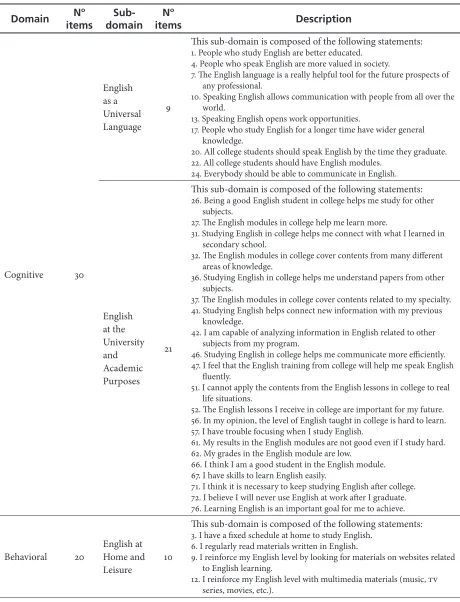
The questionnaire has two main parts: the demo-graphic information and the statements related to the three domains of the instrument. The former has questions that require information about the respon-dents’ gender, age, fields of study, number of years studying, number of subjects related to English, and number of hours dedicated to learning English. The latter is composed of 78 statements that pertain to the three domains of attitude: cognitive, behavioral, and emotional. Each domain is further divided into two categories as shown in Table 1.
The value of Cronbach’s Alpha was 0.886 which shows an acceptable consistency of reliability of the instrument.
Procedure
The development of the research consisted of three stages: the development of the instrument, the application of the instrument, and the analysis of the data. First, several questionnaires were studied and
analyzed in order to choose the most appropriate ones for the purposes of the current research; the criteria to select the instruments were (a) acceptable value of Cronbach’s Alpha, (b) similarity with the Chilean reality, and (c) Chilean context. After the analysis of the collected instruments, three previous investigations were considered (see Gómez Burgos & Pérez Pérez, 2015; Soleimani & Hanafi, 2013; Tahaineh & Daana, 2013). Later, the instrument was designed and sent to three professors to corroborate its validity; it was also piloted with ten students randomly selected from the target population. Then, all comments were considered and the final version of the instrument was presented. As a second stage, the questionnaire was sent to students of five different universities in the south of Chile by email with an invitation to participate. The first answer was received on 10/23/2016 and the last answer was recorded on 12/22/2016; the questionnaire was available from October until the end of December 2016. Finally, the responses to the questionnaire were analyzed using the statistical program spss.
Results
The most important results will be discussed in terms of the distribution of frequencies and percentages, the total means value, the standard deviation for each domain, and the results of the non-parametric test Mann-Whitney-u Test.
Cognitive Domain
Table 1. Questionnaire to Characterize University Students’ Attitudes Towards EFL
Domain itemsNº domainSub- itemsNº Description
Cognitive 30
English as a Universal Language
9
This sub-domain is composed of the following statements:
1. People who study English are better educated. 4. People who speak English are more valued in society.
7. The English language is a really helpful tool for the future prospects of any professional.
10. Speaking English allows communication with people from all over the world.
13. Speaking English opens work opportunities.
17. People who study English for a longer time have wider general knowledge.
20. All college students should speak English by the time they graduate. 22. All college students should have English modules.
24. Everybody should be able to communicate in English.
English at the University and Academic Purposes
21
This sub-domain is composed of the following statements:
26. Being a good English student in college helps me study for other subjects.
27. The English modules in college help me learn more.
31. Studying English in college helps me connect with what I learned in secondary school.
32. The English modules in college cover contents from many different areas of knowledge.
36. Studying English in college helps me understand papers from other subjects.
37. The English modules in college cover contents related to my specialty. 41. Studying English helps connect new information with my previous
knowledge.
42. I am capable of analyzing information in English related to other subjects from my program.
46. Studying English in college helps me communicate more efficiently. 47. I feel that the English training from college will help me speak English
fluently.
51. I cannot apply the contents from the English lessons in college to real life situations.
52. The English lessons I receive in college are important for my future. 56. In my opinion, the level of English taught in college is hard to learn. 57. I have trouble focusing when I study English.
61. My results in the English modules are not good even if I study hard. 62. My grades in the English module are low.
66. I think I am a good student in the English module. 67. I have skills to learn English easily.
71. I think it is necessary to keep studying English after college. 72. I believe I will never use English at work after I graduate. 76. Learning English is an important goal for me to achieve.
Behavioral 20 English at Home and
Leisure 10
This sub-domain is composed of the following statements:
3. I have a fixed schedule at home to study English. 6. I regularly read materials written in English.
9. I reinforce my English level by looking for materials on websites related to English learning.
15. I postpone my English homework as much as possible.
16. I watch movies in English without Spanish captions in my free time. 19. I listen to music in English during my free time.
21. I study English regularly even if I do not have any tests at the university.
23. I look for additional information apart from the content studied in class.
25. I do not study English at home.
English at the University and Academic Purposes
10
This sub-domain is composed of the following statements:
30. I regularly participate during the English lesson.
35. When I hear a classmate speaking English, I try to practice with him/ her.
40. Whenever I miss an English lesson, I never ask my classmates or teacher about homework.
45. I do not pay attention when my English teacher explains contents. 50. I attend English lessons eager to learn.
55. I am forced to attend English lessons. 60. I study English only to pass the module.
65. I feel relaxed whenever I need to speak English in college. 70. I feel embarrassed to speak English.
75. I am not eager to attend the English module in college.
Emotional 28
English as a Universal Language
6
This sub-domain is composed of the following statements:
2. People who study English should be proud of themselves. 5. English is socially the most highly regarded language. 8. I do not like being taught English at the university. 11. I like that English is spoken in most of the countries.
14. I would like for the teaching of English to become a priority in Chile. 18. I do not feel that English is necessary for professionals.
English at Home and Academic Purposes
22
This sub-domain is composed of the following statements:
28. I like being taught English in college. 29. Studying English in college is nice.
33. I like feeling that I am making progress in English. 34. I am interested in studying English in college. 38. Studying English in college makes me feel anxious.
39. The English lessons in college make me have more confidence to talk. 43. Studying English in college makes me feel confident about my future. 44. I like spending time on my English lessons.
48. The English modules are unnecessary for my professional training. 49. Honestly, I am not very interested in English lessons.
53. I am not anxious when I answer questions orally in English. 54. I feel scared when I practice English with my classmates. 58. I like communicating in English with other people. 59. Not being able to speak English worries me.
63. Not being able to communicate in English frustrates me. 64. I feel indifferent towards English.
68. I like perceiving that I am learning English.
69. I would like to express myself in English more fluently. 73. Not learning English fast enough discourages me.
74. My experience in secondary school makes me dislike learning English. 77. I prefer to learn English the way I was taught in secondary school. 78. The English lessons in college have been more useful than the lessons
Table 2. Results of Cognitive Domain
Item #
Frequency
(percentage) Means Std Dev Agree Disagree
Sub-category:
English as a Universal Language
1 40 (43%) 53 (57%) 2.779 1.2967
4 100 (90%) 11 (10%) 3.985 .9686
7 124 (99%) 1 (1%) 4.649 .6067
10 117 (96%) 5 (4%) 4.389 .8093
13 121 (98%) 2 (2%) 4.588 .7111
17 43 (51%) 41 (49%) 3.031 1.1763
20 84 (86%) 14 (14%) 3.779 1.0546
22 106 (92%) 9 (8%) 4.229 1.0120
24 87 (86%) 14 (14%) 3.824 1.0847
Sub-category: English at the University and Academic Purposes
26 55 (56%) 43 (44%) 3.115 1.2443
27 63 (71%) 26 (29%) 3.389 1.0639
31 67 (66%) 34 (34%) 3.351 1.2085
32 74 (82%) 16 (18%) 3.588 1.0067
36 83 (76%) 26 (24%) 3.740 1.3450
37 109 (92%) 10 (8%) 4.160 1.0511
41 76 (82%) 17 (18%) 3.603 .9975
42 79 (64%) 24 (36%) 3.481 1.0767
46 75 (82%) 17 (18%) 3.611 1.0566
47 62 (70%) 27 (30%) 3.397 1.1548
51 29 (29%) 72 (71%) 2.557 1.2351
52 99 (92%) 9 (8%) 4.000 .9282
56 13 (14%) 80 (86%) 2.267 1.0139
57 38 (37%) 66 (63%) 2.618 1.3270
61 35 (34%) 69 (66%) 2.534 1.3773
62 31 (34%) 61 (66%) 2.405 1.3114
66 64 (65%) 34 (35%) 3.221 1.1916
67 66 (63%) 38 (37%) 3.252 1.2238
71 86 (84%) 16 (16%) 3.939 1.2010
72 19 (17%) 95 (83%) 1.924 1.2380
76 96 (88%) 13 (12%) 3.985 .9844
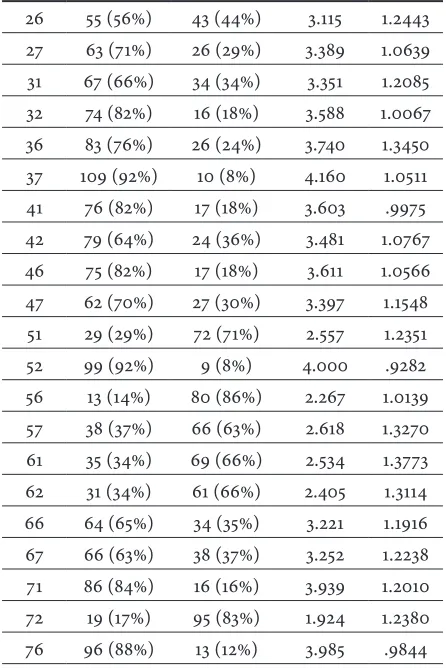
Figures in Table 2 show that the average of the participants in agreement regarding the 30 statements of the cognitive domain of attitude was 68% against 32% of the respondents who disagreed. However, when the analysis is conducted by sub-categories in the same domain, the classification English as a Universal Language
evidenced an average of 82% in agreement with the nine statements of that group in comparison to the category
English at the University and Academic Purposes that showed only 62% in agreement.
Item 7 of the survey (“The English language is a really helpful tool for the future prospects of any pro-fessional”)obtained the highest level of agreement among the participants with 99% of positive preferences, while Item 17 (“People who study English for a longer time have wider general knowledge”) was the lowest score with 51% in agreement on the positive side. Other remarkable items of the domain are Item 13 (“Speaking English opens work opportunities”)that garnered 98% of positive preferences and Item 10 (“Speaking English allows communication with people from all over the world”) where the percentage of positive attitude was 96%, among others.
Behavioral Domain
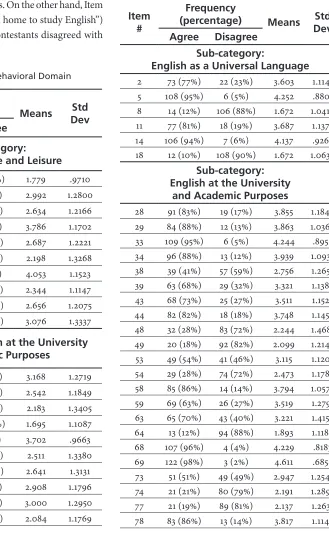
The behavioral domain of attitude is represented by 20 statements. The most significant results are shown in Table 3.
Table 3 reveals that an average of 40.5% of the par-ticipants agreed on the statements of the behavioral domain in contrast to 59.6% of participants who marked disagreement on the 20 statements as an average. Regard-ing Sub-category 1 (English at Home and Leisure) the average percentage of agreement was 42%, while in Sub-category 2 (English at the University and Academic Purposes) the average was 39%.
45 (“I do not pay attention when my English teacher explains contents”)showed that 87% disagreed with the statement, that is, participants demonstrated a positive attitude towards the assertion. Item 50 (“I attend English lessons eager to learn”) ranked an average of 87% as well regarding positive preferences. On the other hand, Item 3 (“I have a fixed schedule at home to study English”) indicated that 94% of the contestants disagreed with the statement.
Table 3. Results of Behavioral Domain
Item #
Frequency
(percentage) Means Std Dev Agree Disagree
Sub-category: English at Home and Leisure
3 7 (6%) 101 (94%) 1.779 .9710
6 47 (47%) 52 (53%) 2.992 1.2800
9 35 (36%) 61 (64%) 2.634 1.2166
12 87 (82%) 19 (18%) 3.786 1.1702
15 33 (34%) 63 (66%) 2.687 1.2221
16 25 (23%) 84 (77%) 2.198 1.3268
19 93 (86%) 15 (14%) 4.053 1.1523
21 18 (20%) 74 (80%) 2.344 1.1147
23 36 (36%) 64 (64%) 2.656 1.2075
25 54 (52%) 49 (48%) 3.076 1.3337
Sub-category: English at the University and Academic Purposes
30 59 (59%) 41 (41%) 3.168 1.2719
35 31 (30%) 71 (70%) 2.542 1.1849
40 26 (23%) 88 (77%) 2.183 1.3405
45 16 (13%) 109 (87%) 1.695 1.1087
50 76 (87%) 11 (13%) 3.702 .9663
55 33 (31%) 72 (69%) 2.511 1.3380
60 37 (36%) 66 (64%) 2.641 1.3131
65 43 (45%) 52 (55%) 2.908 1.1796
70 45 (46%) 53 (54%) 3.000 1.2950
75 18 (17%) 86 (83%) 2.084 1.1769
Emotional Domain
The emotional domain of attitude was represented by 28 assertions. Table 4 shows the main results.
Table 4. Results of Emotional Domain
Item #
Frequency
(percentage) Means Std Dev Agree Disagree
Sub-category:
English as a Universal Language
2 73 (77%) 22 (23%) 3.603 1.1141
5 108 (95%) 6 (5%) 4.252 .8801
8 14 (12%) 106 (88%) 1.672 1.0410
11 77 (81%) 18 (19%) 3.687 1.1374
14 106 (94%) 7 (6%) 4.137 .9262
18 12 (10%) 108 (90%) 1.672 1.0630
Sub-category: English at the University
and Academic Purposes
28 91 (83%) 19 (17%) 3.855 1.1840
29 84 (88%) 12 (13%) 3.863 1.0360
33 109 (95%) 6 (5%) 4.244 .8952
34 96 (88%) 13 (12%) 3.939 1.0937
38 39 (41%) 57 (59%) 2.756 1.2655
39 63 (68%) 29 (32%) 3.321 1.1386
43 68 (73%) 25 (27%) 3.511 1.1527
44 82 (82%) 18 (18%) 3.748 1.1459
48 32 (28%) 83 (72%) 2.244 1.4681
49 20 (18%) 92 (82%) 2.099 1.2144
53 49 (54%) 41 (46%) 3.115 1.1207
54 29 (28%) 74 (72%) 2.473 1.1788
58 85 (86%) 14 (14%) 3.794 1.0577
59 69 (63%) 26 (27%) 3.519 1.2791
63 65 (70%) 43 (40%) 3.221 1.4158
64 13 (12%) 94 (88%) 1.893 1.1180
68 107 (96%) 4 (4%) 4.229 .8187
69 122 (98%) 3 (2%) 4.611 .6858
73 51 (51%) 49 (49%) 2.947 1.2546
74 21 (21%) 80 (79%) 2.191 1.2897
77 21 (19%) 89 (81%) 2.137 1.2635
In the emotional component of attitudes, the general average percentage of agreement was 61.2%. The highest average of agreement for this group was obtained on Item 69 (“I would like to express myself in English more fluently”) with 98% of preferences whereas the lowest score was from Item 49 (“Honestly, I am not very interested in English lessons”) which showed a positive attitude with 82% disagreement with the statement, followed closely by Item 77 (“I prefer to learn English the way I was taught in secondary school”)which ranked 19% in agreement.
If the analysis is conducted per sub-category, the first one, English as a Universal Language obtained a 62% average of agreement and the second category, English at the University and Academic Purposes, achieved 61% of preferences. However, the analysis per specific items shows that six assertions obtained more than 90% average of preferences; for example, Item 68 (“I like perceiving that I am learning English”) wasmarked 96% as the average of agreement; similar to Items 5 (“English is the most highly regarded language socially”) and 33 (“I like feeling that I am making progress in English”) that obtained a 95% average of preferences.
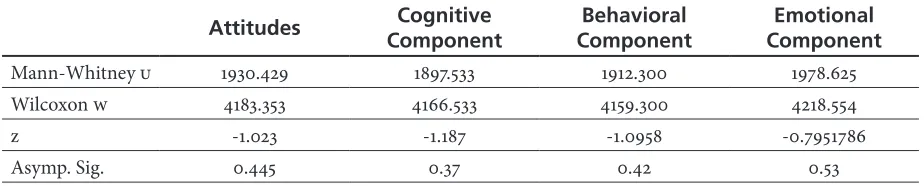
Finally, the Mann-Whitney u test was run in order to compare male and female participants’ attitudes. Based on the results obtained, it was evidenced that there was no significant difference between the two groups, that is, subjects reported similar answers to the statements of the questionnaire. The results of the three components of attitudes, according to the Mann-Whitney u test are shown in Table 5.
From this data, we can conclude that the attitude among male and female participants is the same as the
p-value, which was higher than the level of significance (0.445 > 0.05), meaning that there was no significant dif-ference between male and female students. Meanwhile, the results show that the three specific components of attitude had slight differences as the cognitive compo-nent obtained less value than the behavioral and the emotional ones.
Conclusions and Implications
The current study aimed at investigating under-graduate students’ attitudes towards efl in university contexts in Chile. The findings evidenced that 131 stu-dents hold highly positive attitudes regarding efl at the tertiary level in Chile. The cognitive aspect of attitude towards English showed evidence of the highest mean score while the behavioral domain of attitude in our study represented the lowest mean score; similar to what was reported by Soleimani and Hanafi (2013). This study showed that attitudes have a very precise influence on learners’ behavior, similar to what Gómez Burgos and Pérez Pérez (2015) reported in their work. A positive attitude towards a foreign language is fun-damental to learning it (Fakeye, 2010; Hashwani, 2008; Lai & Aksornjarung, 2018; Zainol et al., 2012) because it allows learners to have a favorable predisposition towards its learning (Karahan, 2007). However, there was statistically no significant difference between male and female students after applying the non-parametric Mann-Whitney u test.
Table 5. Results of Mann-Whitney U Test
Attitudes ComponentCognitive ComponentBehavioral ComponentEmotional
Mann-Whitney u 1930.429 1897.533 1912.300 1978.625
Wilcoxon w 4183.353 4166.533 4159.300 4218.554
z -1.023 -1.187 -1.0958 -0.7951786
With respect to the cognitive aspect of attitude, this study showed that this domain was extremely well accepted by the participants; both sub-categories obtained the highest percentage of agreement, especially the sub-domain English as a Universal Language, which ranked as having the greatest value of the study. This is aligned to the idea of English as an international language (Pennycook, 1994) and the participants’ awareness of the importance of English as a global language as reported by Puerto Zabala and Reyes Vargas (2014) and Asghar, Jamil, Iqbal, and Yasmin (2018). Similarly, respondents ascertained that learning English is a specific resource that gives power, as previously alleged by Matear (2008).
In regard to the behavioral and emotional aspect of attitude, the findings in this category are aligned with the reports given by Asghar et al. (2018) and Puerto Zabala and Reyes Vargas (2014), among others, due to the learners’ positive attitude towards these components in spite of the lower results obtained in the behavioral aspect. In this domain, the sub-group English at the University and Academic Purposes obtained negative approval by the respondents because the group was related to the participants’ own responses and behavior towards the English lessons and their study habits. Based on the responses, the learners are keen about learning English and they attend the lesson enthusiastically, but they do not pay enough attention to their instructors and they are embarrassed about speaking in class. Even though the students wish to be part of the international English-speaking community, they might find them-selves trapped by their own time-consuming university obligations, which interfere with more constant practice and study of the language prior to the lessons (Kormos et al., 2011). Evidently, there are a number of factors, other than lack of time, that make an impact on the level of students’ participation and involvement in the English lessons: attitudes towards the language, anxiety, or fear of ridicule. As an additional component, even if English is generally perceived as a very important skill to be acquired at some point in their professional
training, the perception of English as a subject is usually regarded as less important than the core modules for each program. This might help explain this apparent nonchalant attitude towards the lessons.
With reference to the emotional aspect, learners showed their interest in learning English as presented by Asghar et al. (2018); data also revealed that learners like English and those who speak it, similar to the report of Al-Mamun et al. (2012).
This study might contribute to complement research in the field of efl in Chile as “there is a lack of research in the area of affective factors that influence the learning of the target language, especially the role of positive or favorable attitudes that students hold in different classrooms” (Gómez Burgos & Pérez Pérez, 2015, p. 323). In this line, the current study contributes to comple-ment the information available of the Chilean learner specially in the area of the learners’ opinions towards the foreign language in tertiary programs. Participants of this investigation alleged that they would like for the teaching of English to become a priority in Chile (94% agreement with the assertion) and suggest this be considered by the national authorities when decid-ing on the new policies related to the inclusion of the foreign language in the country. These findings can be used to complement pertinent public policies in Chile in order to promote the inclusion of English in the country.
towards efl, is an underdeveloped topic that might lead to interesting findings to widen the field of efl research in Chile.
The institutions included private and public spheres, and the wide age range of the participating students shedding light on the importance of investigating how a relevant affective factor—attitude—might impact the acquisition of a foreign language in university students from all sorts of origins, making this issue a transversal one. Placing more emphasis on areas like English for specific purposes (esp) in university programs offers more opportunities for undergraduate students to merge their fields of expertise with a second language, which has proven to trigger positive attitudes towards its acquisition.
In order to achieve this goal, it would be necessary to introduce some changes in the way English is taught in tertiary education. These changes should cover aspects such as syllabi design, the training of teachers to provide challenging yet attainable esp lessons at university level, and the consideration for students’ needs when designing courses via survey application, to name a few. This way, teachers will ensure that tasks and practical activities promote the use of the target language for professional and academic purposes in a sheltered environment, where students feel comfortable while producing English. The combination of these factors would undoubtedly heighten affective factors such as motivation and positive attitudes towards the language, since the students will relate to the contents studied, while knowing they will be able to use English in practical ways for their future careers.
As for the limitations of the study, the number of participants (131 undergraduate students), and the number of participating institutions (4) might be seen as a drawback as they are from only one region in the south of the country. Accordingly, the study could be expanded to other regions of Chile so as to have a wider variety of participants and, therefore, an assortment of institutions. A wider sample of students and institutions
might in turn provide additional variables to consider, such as socio-economic backgrounds, types of programs, and geographic location, all of which can enlarge the scope of the present study.
With that in mind, there would be an in-depth study and analysis of the Chilean reality in this matter. A final aspect to consider has to do with the limited evidence reported from studies conducted in this particular field of language teaching, specifically in tertiary education. As this work is a pioneer in the area, there are no standards or literature with which to compare these outcomes. Nonetheless, it opens a new avenue for expanding research in efl in Chilean contexts.
References
Ahmed, M., Aftab, M., & Yaqoob, H. (2015). Students’ motivation toward English language learning at
under-graduate level. Advances in Language and Literary
Studies, 6(3), 230-238. https://doi.org/10.7575/aiac. alls.v.6n.3p.230.
Al-Mamun, A., Rahman, M., Rahman, A. R., & Hossain, A. A. (2012). Students’ attitudes towards English: The case
of life science school of Khulna University. International
Review of Social Sciences and Humanities, 3(1), 200-209. Al-Tamimi, A., & Shuib, M. (2009). Motivation and atti-tudes towards learning English: A study of petroleum engineering undergraduates at Hadhramout University
of Sciences and Technology. gema Online: Journal of
Language Studies, 9(2), 29-55.
Asghar, A., Jamil, I., Iqbal, A., & Yasmin, M. (2018). Learner attitude towards efl learning: A response from art and design. Open Journal of Social Sciences, 6(5), 81-88. https:// doi.org/10.4236/jss.2018.65007.
Barahona, M. (2015). English language teacher
educa-tion in Chile: A cultural historical activity theory
perspective. London, uk: Routledge. https://doi.
org/10.4324/9781315689937.
survey of actors in the education system]. Santiago, cl: Universidad Alberto Hurtado.
Education First. (2017). English proficiency index (7th ed.).
México, mx: Author.
Fakeye, D. O. (2010). Students’ personal variables as correlates of academic achievement in English as a second language in Nigeria. Journal of Social Sciences, 22(3), 205-211. https:// doi.org/10.1080/09718923.2010.11892803.
Gómez Burgos, E. (2017). Use of the genre-based approach to teach expository essays to English pedagogy students. how, 24(2), 141-159. https://doi.org/10.19183/how.24.2.330.
Gómez Burgos, E., & Pérez Pérez, S. (2015). Chilean 12th
graders’ attitudes towards English as a foreign language. Colombian Applied Linguistics Journal, 17(2), 313-324. https://doi.org/10.14483/udistrital.jour.calj.2015.2.a10.
Harmer, J. (2003). The practice of English language teaching.
London, uk: Longman.
Hashwani, M. S. (2008). Students’ attitudes, motivation and
anxiety towards English language learning. Journal of
Research and Reflections in Education, 2(2), 121-144. Karahan, F. (2007). Language attitudes of Turkish students
towards the English language and its use in Turkish context. Journal of Arts and Sciences, 7, 73-87.
Kormos, J., & Kiddle, T. (2013). The role of socio-economic factors in motivation to learn English as a foreign
language: The case of Chile. System, 41(2), 399-412.
https://doi.org/10.1016/j.system.2013.03.006.
Kormos, J., Kiddle, T., & Csizér, K. (2011). Systems of goals, attitudes, and self-related beliefs in
second-language-learning motivation. Applied Linguistics, 32(5), 495-516.
https://doi.org/10.1093/applin/amr019.
Lai, Y., & Aksornjarung, P. (2018). Thai efl learners’ attitudes and motivation towards learning English through
content-based instruction. mojes: Malaysian Online
Journal of Educational Sciences, 6(1), 43-65.
Lindahl, K. M., & Sayer, P. (2018). Early efl instruction and l1 literacy. Colombian Applied Linguistics Journal, 20(2), 170-184. https://doi.org/10.14483/22487085.12900. Matear, A. (2008). English language learning and education
policy in Chile: Can English really open doors for all?
Asia Pacific Journal of Education, 28(2), 131-147. https:// doi.org/10.1080/02188790802036679.
McBride, K. (2009). Percepciones estudiantiles sobre las técnicas utilizadas en la enseñanza del inglés como lengua extranjera [Students’ perceptions on the techniques used
when teaching efl]. Revista Universum, 24(2), 94-112.
https://doi.org/10.4067/S0718-23762009000200006. McKay, S. (2003). Teaching English as an international
language: The Chilean context. elt Journal, 57(2),
139-148. https://doi.org/10.1093/elt/57.2.139.
Noreen, S., Ahmed, M., & Esmail, A. (2015). Role of students’ motivation, attitude and anxiety in learning English at intermediate level in Pakistan: A gender-based study. Educational Research International, 4(2), 96-108.
Pennycook, A. (1994). The cultural politics of English as an
international language. London, uk: Longman. Peña Dix, B. (2013). Motivation and the concept of
self-regulation: Theory and implications for English language
teaching and learning in Colombia. Voces y Silencios:
Revista Latinoamericana de Educación, 4(1), 71-85. https:// doi.org/10.18175/vys4.1.2013.04.
Puerto Zabala, P., & Reyes Vargas, R. (2014). efl students’ perceptions about their English language learning and its uses for specific purposes at International Languages
Institute at uptc Duitama Branch. Enletawa Journal, (6).
Soleimani, H., & Hanafi, S. (2013). Iranian medical students’
attitudes towards English language learning. International
Research Journal of Applied and Basic Sciences, 4(12), 3816-3823.
Tahaineh, Y., & Daana, H. (2013). Jordanian undergraduates’ motivations and attitudes towards learning English in
efl context. International Review of Social Sciences and
Humanities, 4(2), 159-180.
Wenden, A. (1991). Learner strategies for learner autonomy.
London, uk: Prentice Hall.
Zainol, M. J., Pour-Mohammadi, M., & Alzwari, H. (2012). efl students’ attitudes towards learning English language:
The case of Libyan secondary school students. Asian
About the Authors
Eric Gómez Burgos is a generalist teacher with a minor in English from Universidad de Los Lagos (Chile);
also, he holds a master’s degree in applied linguistics to English as a foreign language from Pontificia Universidad Católica, Chile. His areas of research interest are related to teaching methods and teacher training.
Soledad Sandoval Molina holds a Bachelor of Arts degree in English language teaching from Universidad de