PhD Dissertation
International Doctorate School in Information and Communication Technologies
DIT - University of Trento
Knowledge Dissemination in the Web Era
Marcos Baez
Advisor:
Prof. Fabio Casati
Universit`a degli Studi di Trento
Abstract
In this research work we address the limitations of the current scientific
knowledge dissemination model to face the new scenario posed by the Web.
We explore the historical reasons behind the current model, and we show
that it is essentially the same today, even if the Web has made
dissemi-nation nearly real time and free. We show how this misalignment between
the current model and Web capabilities brings not only missed
opportuni-ties but also a serious overload problem, creating difficulopportuni-ties for authors to
gain visibility, and for readers to find interesting content. Our approach
has been to build from the ground up, by i) understanding how the very
core concepts of the scientific publishing such as “scientific contribution”,
“scientific journal” and even “reputation” should adapt to the new
sce-nario; ii) studying the dissemination and sharing practices that are
inher-ently present in the scientific community, to understand how technology can
empower those practices to reduce information overload. The outcome is
novel models, tools and a platform for knowledge dissemination that takes
full advantage of the Web while addressing the overload problem.
Keywords
Contents
1 Executive Summary 1
1.1 The Problem . . . 3
1.2 Our Approach to Knowledge Dissemination . . . 5
1.3 Structure of the Thesis . . . 9
2 Addressing Information Overload in the Scientific Commu-nity 13 2.1 Introduction . . . 13
2.2 The Liquid journal model . . . 16
2.3 Usage model and metrics . . . 22
2.4 Architecture . . . 24
2.4.1 Related work . . . 26
2.4.2 Conclusion . . . 28
3 Understanding and supporting search for scholarly knowl-edge 33 3.1 Introduction . . . 34
3.2 Understanding search . . . 36
3.2.1 Qualitative Analysis Results . . . 37
3.2.2 Quantitative Analysis Results . . . 41
3.3 Defining Network-aware recommendations . . . 43
3.3.1 Formal problem definition . . . 43
3.3.3 Defining popularity functions . . . 46
3.4 Evaluation . . . 48
3.4.1 Experiment definition . . . 48
3.4.2 Dataset Description . . . 49
3.4.3 Running and analyzing the experiments . . . 49
3.4.4 Discussion . . . 52
3.5 Related Work . . . 53
3.6 Concluding remarks . . . 55
4 Sharing Scientific Knowledge with Knowledge Spaces 57 4.1 Introduction . . . 58
4.2 Knowledge Spaces . . . 62
4.2.1 Instant Communities scenario . . . 62
4.2.2 Scientific Resource Spaces . . . 64
4.2.3 Kspaces Conceptual Model . . . 65
4.3 Knowledge space platform and services . . . 67
4.3.1 Architecture . . . 67
4.3.2 Collecting and posting knowledge . . . 69
4.3.3 KS Intentional Language . . . 70
4.4 Knowledge space Applications . . . 73
4.5 Related Work . . . 76
4.6 Findings, Status and Next Steps . . . 80
5 Resource Space Management Systems 83 5.1 Introduction . . . 84
5.2 Implications for Research Spaces Management Systems . . 86
5.3 Scientific Resource Space Management . . . 88
5.4 Generic Resource Space Management . . . 89
5.4.1 Resource Space Model . . . 90
5.4.2 Architecture and services . . . 92
5.4.3 The role of adapters . . . 94
5.5 Use Case: Liquid Journals . . . 97
5.6 Conclusion . . . 102
6 Universal Resource Lifecycle Management 105 6.1 Introduction . . . 106
6.2 Motivating Scenario . . . 109
6.2.1 EU Projects . . . 109
6.2.2 Problem and Requirements Abstraction . . . 111
6.3 Related Work . . . 113
6.3.1 Workflow Management Systems . . . 113
6.3.2 Document Management . . . 114
6.3.3 Lifecycle Modeling Notations . . . 115
6.4 Concepts, Models and Languages . . . 116
6.4.1 Lifecycle model: basics . . . 117
6.4.2 Lifecycle Execution . . . 119
6.4.3 Actions . . . 121
6.4.4 Roles and Access Rights . . . 122
6.5 Gelee at Work . . . 123
6.5.1 Overall Architecture . . . 123
6.5.2 Resources and Actions . . . 124
6.6 Conclusion and Future Work . . . 126
7 Lessons Learned 129 7.1 Impact on knowledge dissemination . . . 129
7.1.1 Liquid journals . . . 130
7.1.2 Instant Communities . . . 130
7.1.3 Knowledge Spaces Platform . . . 134
7.2 Final Remarks . . . 135
List of Figures
2.1 Example of scientific resources connected by next-version-of
relation . . . 16
2.2 Example of different representation for the same resource . 17 2.3 Example of other general relations . . . 17
2.4 LJ backend architecture . . . 30
2.5 LJ frontend collage . . . 31
3.1 Sources of references in a research paper, classified by se-niority of the researcher . . . 38
3.2 Social networks of origin for references . . . 40
3.3 Results of our online survey, classified by seniority of the researcher . . . 42
3.4 Social references by social network . . . 43
3.5 Precision of the different popularity functions by year . . . 50
3.6 Recall of the different popularity functions by year . . . 51
4.1 Kspaces and KS designs are ways to create, share and con-sume resources. . . 65
4.2 Architecture of the KS platform. . . 68
4.3 Example of Interface using KS intensional language. . . 72
4.4 Instant Community Application UI. . . 77
5.1 Architecture of the Karaku sRSMS . . . 89
5.2 Resource Space model . . . 91
5.4 Adapter registration and operation execution . . . 94
5.5 Adapter registration and operation execution . . . 100
6.1 EU Project deliverable lifecycle. . . 118
6.2 Gelee high-level architecture. . . 124
7.1 Liquid Journals sreenshots . . . 131
7.2 Liquid Journals on MIT Techonology Review and BMJ (British Medical Journal) Blog, and other publishing and library blogs132 7.3 Instant Community at various events . . . 133
Chapter 1
Executive Summary
The scenario in which current scientific research is undertaken has greatly changed since the days printed journals, letters, and conference talks were the only form of scientific knowledge dissemination. In those days, the scarce and expensive resource was the printing and distribution of papers. Publishing was expensive. As a result, there was a need to screen contribu-tions before they got published, and there were no other means to do this than peer review. Besides the unavoidable time delays, the process was the only reasonable one, and it was feasible as the research community was relatively small and the reviewing effort was low. Printing and distribution also means, for example, that journals had to be organized in volumes and
issues, available periodically.
The Web has changed the way we create, consume, share and dissemi-nate scientific knowledge. Publishing is now almost real time and free and papers are not longer the only form of scientific dissemination. We can now publish early ideas in blogs (e.g., science blogs, blogger), put pre-prints in online repositories (e.g. arXiv, eprints), experiments, datasets and slides on our homepage. A brand new world of possibilities is opened for how sci-entific knowledge dissemination, creation and evaluation could be done and for how the notion of scientific contribution could evolve to serve the need
What the above implies is that the original reasons for having the cur-rent dissemination model (content given by papers, journals divided in issues, submission and peer review process) are gone. It does not mean, however, that the dissemination model should not be based on properly written papers and peer-review as prime process. The point we make is that before the web these were the only options, now that we are freed of the constraints of printed materials, a world of new possibilities arises.
But we are facing not only opportunities in this new scenario. These changes, along with a developing educational and economic environment that has allowed an increase in the number of people doing research, have caused a tremendous increase of knowledge artifacts that are disseminated every day. This means that the scarce resource is now attention [26] and the obstacle to dissemination and the challenge for scientists - is not publishing but rather making a contribution visible (on the authors side) and quickly identifying interesting contributions (from the reader s side).
In this research project we endeavored to study whether this model is efficient and effective, which alternative models can support scientific dissemination, and how IT can support them.
Indeed, studies shed many doubts on the validity of this approach and certainly question whether this can be the only or even the preferred model for scientific dissemination. There is no scientific evidence that peer review is effective in selecting high impact papers, while there is scientific evidence that citations are not correlated with impact (e.g., [22] [31]). But one of the most important finding is that people do not find scientific knowledge or ideas by searching on search engines. At most they can retrieve the PDF from there.
On the contrary, scientists tend to stumble upon knowledge [9]. It can happen when a colleague points us to a paper, when we listen to a
CHAPTER 1. EXECUTIVE SUMMARY
presentation at a workshop, or when somebody makes a connection we did not think of, or mentions an idea at the water-cooler. These are the main ways in which we interact. What this tells us is that the most useful forms of interaction are not based on the paper as found by searching the web or reading a journal. Instead, they can happen in any form (a paper, but also a presentation, a video, a comment, or a “link” among them that makes us see a connection). It also tells us that exchanges happen socially.
Given this, what we endeavored to do is to enable these kinds of ex-changes, or, to put it differently, to help people stumble on knowledge in all its forms, and to help create conversations on this knowledge. And the Web is the key ingredient for this. The results of the research we have done clearly hints at the fact that a key role for future web applications is indeed that of helping us capture, share, and find scientific knowledge, and as such enables scientific conversations that help us create knowledge efficiently and sparkle new ideas.
1.1
The Problem
Thus, we live in an era in which we are exposed to an almost infinite am-mount of scientific knowledge of various kind, and yet we use essentially the same organisation, models and processes as in the pre-web era. This dis-crepancy brings some noticeable consequences and limitations to scientific knowledge dissemination:
• Information overload. It refers to the problem of scarce attention that makes it difficult i) for readers to find interesting and relevant scientific contributions and ii) for authors to make their contributions visible. This is perhaps the most noticeable problem to which the others below are closely related.
• Outdated notion of scientific contributions. The current model of “scientific contribution” is basically a digital representation of the printed paper. There are many other types of contributions being produced during research such as datasets, experiments, simulations, slides, or even ideas that deserve as much attention as (if not more than) the traditional paper. Currently these interesting types of con-tributions are either not accessible, hard to find or relate. Indeed, citations remain as the only way of relating scientific contributions even when the semantics of the relations might different and could serve different purposes. As a consequence the current model is not only missing opportunities but also contributing to the information overload problem.
• Uneffective organisation. Scientific contributions have tradition-ally been organised in proceedings, issues, volumes, using some topical categories. However, with the explosion in the number of scientific contribution these are not longer able to meet the more specific infor-mation needs and seeking behavior of the community [4].
• Slower processes. The processes involved in the current dissemi-nation model (e.g., peer review, publishing) are comparatively slower than the real-time nature of communications and publishing on the Web. This is a problem particularly for authors who need to wait for months to get their work published or even just feedback from their peers. Given the pace at which research is pushed nowadays, there is a need to understand how the Web, and specially the social Web, could help in bringing the scientific dissemination much closer to the speed of current communications.
• Outdated research activity rewarding. Evaluation is a neces-sary aspect of research, and as such it should encourage not only one
CHAPTER 1. EXECUTIVE SUMMARY
particular type of research activity (e.g., writing papers) but also be-haviours that are good for science. Current metrics reward only paper writing (using mostly citations), not contributing much to reducing the problem of information overload.
In the recent years, some progress has been done in the dissemination model to address some of the issues above. An indication of this is the publication of papers (or preprints) in open/free repositories and archives; new journal models experimenting different review and publishing models (e.g., [49] [42]), and new metrics aiming at evaluating more fairly the work of researchers(e.g., [25]). Even though these initiatives did alleviate some of those problems, they are still based on the traditional notion of scientific contribution and were not designed to take full advantage of the Web and more importantly to deal with the information overload problem.
We have also seen an increasing number of tools and services allow-ing publishallow-ing, searchallow-ing, sharallow-ing and bookmarkallow-ing of scientific papers. Prominent examples are Google Scholar, Mendeley, ResearchGate and CiteSeer, which facilitate the process of finding and discovering scientific papers. However, these services do not consider the practices and strate-gies of the community when it comes to finding and sharing scientific in-formation and rather provide separate solutions that, while technologically strong, do not fully exploit the specifics of the domain. This is particularly true in our community, where most of the sharing is done in different con-texts (e.g., talks, conferences, after reviews), with different networks (e.g., colleagues, people at conferences ) usually in very informal settings.
1.2
Our Approach to Knowledge Dissemination
In the light of these new opportunities and challenges, the goal of this thesis has been to identify models, develop tools and services for knowledge
semination that, by design, would embrace the benefits of the Web while addressing the problems caused by the information overload. Thus, our approach has been to build from the ground up, by i) understanding how the very core concepts of the scientific publishing such as “scientific con-tribution”, “scientific journal” and even “reputation” should adapt to the new scenario; ii) studying the dissemination and sharing practices that are inherently present in the scientific community, to understand how technol-ogy can empower those practices to reduce information overload; iii) facing the techonological challenges in designing models, services, tools and ar-chitectural support for the solution.
Analyzing the current dissemination model helped us to understand the weaknesses of the traditional models that needed to be addressed. Besides a fundamental discussion of what is a scientific contribution, we propose a model that is able to better capture the “multi-faceted”, “evolving” and “connected” nature of scientific knowledge. We also proposed novel ways of organising and disseminating scientific knowledge, building on the tra-ditional model of scientific journal. Our proposals are meant to address some core problems of the dissemination model that were contributing to the information overload problem.
Studying the information seeking and sharing practices led us to inter-esting findings. According to our results [9], scientists tend to stumble upon knowledge as opposed to searching. It can happen when a colleague points us to a paper, when we listen to a presentation at a workshop, or when somebody makes a connection we did not think of, or mentions an idea at the water-cooler. These results, along with our analysis of the lim-itations of the current model, shaped our research towards helping people stumble on knowledge in all its forms, and helping create conversations on this knowledge.
What we understood during these years of research is that doing this has
CHAPTER 1. EXECUTIVE SUMMARY
two sides. First, we need to elicit this knowledge, or, to put it differently, to lower the barriers to sharing. People often like to express opinions, but often this requires too much effort. For example, sometimes when we hear a talk we think of some related work, or we think of something we’d like to point out to the speaker, but we just dont do it. Its too much trouble to interrupt, and then there is the coffee break coming up. The opportunity is lost and you and the speaker might never catch up again. Or, think when you’re back from a conference and want to point out interesting presentations or papers to your colleagues. There is a lot of interesting knowledge such as discussions, questions or related work, that is lost on the way or simply not shared. The other aspect we understood is that capturing knowledge is context-specific. There is no single metaphor or tool that can work in all circumstances. In some cases these ways to capture knowledge are done through novel organizational models, in other cases through software platforms, most often it is a bit of both. These observation share analogies with Information Foraging Theory [43] and were exploited in our approach.
In summary, the innovative aspects and outcome of this thesis are:
• A model of scientific contributiondesigned for the Web. This new model separates the nature of the contribution (e.g., paper, dataset, experiment) from the level of certification (e.g., peer reviewed or not) and degree of maturity (e.g., workshop or journal paper, expeirment v1 or v2), thus broadening the range of scientific contributions to the opportunities of the Web. Moreover, it enables new associative or-ganization metaphors (e.g., line of research), to face the information ovearload problem, by providing semantic relations. Other benefits of the model can be also described from the perspective of new oppor-tunities in terms of knowledge creation and evaluation.
• A model and prototype of scientific journal for the Web era, namely “liquid journals”, designed to address the information over-load problem. The underlying principles consist i) in leveraging the very same (large) community of scientist that creates the overload problem/opportunity to collaborate in filtering and prioritizing the information, ii) in enabling a dissemination and consumption model that naturally reduces the noise portion of the information overload right at the source, iii) in having a set of metrics that mitigate the overload and encourage “good behaviors” for science, such as early sharing and providing feedback, and iv) by computing scientific diver-sity and enforcing it when providing information.
• A metaphor, a set of models and processes, and a social web platform, namely “knowledge spaces” (kspaces for short), that help you capture, share and find scientific knowledge, in all of its forms. The principle behind kspaces is to allow knowledge dissemination in the scientific community to occur in a way similar to the way we share knowledge with our colleagues in informal settings. It is based on the dissemination and sharing practices of the scientific community.
• Tools for supporting knowledge sharing in seminars, confer-ences and courses. Besides the conceptual contributions, a tangible outcome can be seen in the set of tools built on the foundations of this thesis. “Instant Communities”1 and “StreamScience”2, have been continously evolving over the years, supporting several conferences, workshops, seminars and courses. Thus, from mockups to prototypes they have evolved into solid tools open to the public and used by real users.
1
http://ic.kspaces.net
2
http://www.streamscience.org
CHAPTER 1. EXECUTIVE SUMMARY
• Resource Space Management Systems as an abstraction layer for integrating scientific services. It is based on a common view of the space of scientific contributions, and allows operating, searching and managing scientific resources disseminated across multiple services on the Web.
• Lifecycle management model and system for scientific arti-facts. The model called “Universal resource lifecycle management” was designed to support agile environements where flexibility at de-sign time (to allow lifecycle models evolve) and execution time (to allow users to deviate from predefied actions) are required. In this re-search project, we have developed a prototype, namely “Gelee”, that had supported (at a conceptual level) flexible scientific processes in liquid journals and kspaces.
1.3
Structure of the Thesis
This thesis is structured as a compilation of the various research publica-tions on the topics of this thesis. Thus, each chapter has been previously reviewed by peers and represents per se a contribution to a target research community.
Chapter 2. Addressing Information Overload in the Scientific Community.
Baez, M. and Birukou, A. and Casati, F. and Marchese, M. [4].
In this chapter we present a dissemination model that extends the notion of scientific journal to address the problem of information overload in the scientific community. We focus on the issues related to having access to interesting scientific content, and to narrowing down the discovery process
only to known sources (venues, authors) when dealing with vasts amounts of information. The contributions introduced in this chapter are a set of models, concepts, methods, and a supporting platform to address the over-load problem.
Chapter 3. Understanding and supporting search for scholarly knowledge
Baez, M. and Mirylenka, D. and Parra, C. [9]
In this chapter we moved to understanding the information seeking prac-tices that are inherently present in the scientific community. We took as a particular case the problem of finding relevant references and run inter-views with groups of researchers asking them how they address the prob-lem. The results of this study suggest that finding scientific knowledge has a strong social component, with the different researchers’ social networks (e.g., coauthors, people met at conferences) accounting for an important percentage of the source of the references. In this chapter we report on this study and compare our results with the evidence found in analyzing the citation network of a dataset of 5×10⁶ authors with their publications and references. We take these results and analyze different approaches for incorporating the social component into search and recommendation of scientific publications.
Chapter 4. Sharing Scientific Knowledge with Knowledge Spaces Baez, M. and Casati, F. and Marchese, M. [7]
This chapter presents a set of models and an extensible social web platform (namely, Knowledge spaces) that supports novel and agile social scientific dissemination processes. Knowledge spaces is based on a model for
CHAPTER 1. EXECUTIVE SUMMARY
entific resources that allows the representation of scientific knowledge and meta-knowledge, of effective viral algorithms for helping scientists find the knowledge they need, and of interaction metaphors that facilitate its usage. The concept and a implementation of Knowledge spaces, in their various forms and designs, are being exploited in several different pilots in cooper-ation with IEEE, the EU Commission, Springer, the archeology museum in Cambridge and major international conferences to support the collection and sharing of knowledge in scientific communities.
Chapter 5. Resource Space Management Systems Baez, M. and Casati, F. [5]
Parra, C. and Baez, M. and Daniel, F. and Casati, F. and Marchese, M. and Cernuzzi, L. [39]
As the web continues to change the way we produce and disseminate sci-entific knowledge, traditional digital libraries are confronted with the chal-lenge of transcending their boundaries to remain compatible with a world where the whole Web in itself is the source of scientific knowledge. This chapter discusses a resource-oriented approach for the management and interaction of scientific services as a way to face this challenge. Our ap-proach consists in building a general-purpose, extensible layer for accessing any resource that has an URI and is accessible on the Web, along with ap-propriate extensions specific to the scientific domain. We name the class of systems that have this functionality Scientific Resource Space Management Systems, since they are the resource analogous of data space management systems known in literature.
Chapter 6. Universal Resource Lifecycle Management Baez, M. and Casati, F. and Marchese, M. [6]
This chapter presents a model and a tool that allows Web users to define, execute, and manage lifecycles for any artifact available on the Web. In the chapter, we motivate the need for lifecycle management of Web artifacts, and we show in particular why it is important that non-programmers are also able to do this. We then discuss why current models do not allow this, and we present a model and a system implementation that achieves lifecycle management for any URI-identifiable and accessible object. The most challenging parts of the work lie in the definition of a simple but universal model and system (and in particular in allowing universality and simplicity to coexist) and in the ability to hide from the lifecycle modeler the complexity intrinsic in having to access and manage a variety of re-sources, which differ in nature, in the operations that are allowed on them, and in the protocols and data formats required to access them.
In the following, we expand on the contributions of this thesis to knowl-edge dissemination in the Web era.
Chapter 2
Addressing Information Overload in
the Scientific Community
Baez, M. and Birukou, A. and Casati, F. and Marchese, M.
In this paper we present a dissemination model that extends from the
no-tion of scientific journal to overcome the problem of informano-tion overload
in the scientific community. We focus on the issues related to having
ac-cess to interesting scientific content, and to narrowing down the discovery
process only to known sources (venues, authors) when dealing with vasts
amounts of information. In this paper we present the liquid journal model,
concepts, methods, and the supporting platform.
2.1
Introduction
The Web has opened a whole world of possibilities for how scientific knowl-edge can be created, evaluated and disseminated. We can now publish preprints in online archives (e.g., arXiv) or simply post our papers on Web
pages. Furthermore, “papers” are not the only unit of scientific dissemi-nation. Data, comments, scientific experiments, and even blogs can now be shared and they can be considered a form of scientific contribution that can help other scientists in their work. This means that today we have a large scientific community who can make available a large, and rapidly evolving, set of scientific contributions of different kinds. An implication of this is that while in the past the scarce resource in scientific dissemination was printing, now it is attention. The obstacle to dissemination is now to be able to find interesting and relevant information (for readers) and to get the work visible in the sea of virtually infinite information (for authors).
An additional and somewhat puzzling problem of information overload is that with so much information available we would at least hope to be able to broaden our horizons. For example, we would hope to be able to search for contributions on “the effectiveness of peer review” in many different domains (as this problem is indeed studied in different areas). However, having this much information results in narrowing down what we read as opposed to broadening it. We experience this in everyday life: having a TiVo1 or analogous digital video recorder makes a wide set of TV programs available to us but at the end we tend to watch/record what we know we like, and are less encouraged to look for new programs. The same effect has also been observed in science [47], as we tend to keep looking into the sources we are familiar with, thereby missing a plethora of potentially interesting and relevant contributions.
Today we have very few tools at our disposal to leverage the richness of information while handling the overload. When we search for contributions, we still tend to look for papers, and one option is to do so by looking at collection of papers indexed by services such as DBLP (essentially for titles) or Citeseer. This is useful but it does not come near to solving the
1
www.tivo.com
CHAPTER 2. ADDRESSING INFORMATION OVERLOAD IN THE SCIENTIFIC COMMUNITY
problem: we are limited to what is indexed, we are limited to papers (and to published papers), we are narrow in the selection (e.g., these services are in computer science for the most part), and despite this narrowness we are still likely to be overloaded with the result. An alternative approach is to use a google search, but that is not tailored to finding scientific contributions. Or we can use Google Scholar, the specific search for scientific contributions offered by Google, but the result is not often as helpful as when we search the Web for other purposes. Furthermore, even when we find something we like, we can only ”navigate” to related content via citations, inserted by the authors at the time of writing.
In this paper we propose the notion of Liquid Journals (LJ) as a way to overcome the information overload issue in scientific publications. Their underlying principles consist i) in leveraging the very same (large) commu-nity of scientist that creates the overload problem/opportucommu-nity to collabo-rate in filtering and prioritizing the information, ii) in enabling a dissem-ination and consumption model that naturally reduces the noise portion of the information overload right at the source, iii) in having a set of met-rics that mitigate the overload and encourage “good behaviors” for science, such as early sharing and providing feedback, and iv) in facilitating readers in linking knowledge in order to support other users subsequent search and navigation through related content.
LJs put this principles at work through concepts, methods, and ulti-mately tools. In the following, we present the usage models and derived metrics. Finally we describe the architecture and the prototypal imple-mentation of the model.
2.2
The Liquid journal model
The liquid journals model builds on a model for scientific contributions, which is designed to facilitate the search for - and navigation of - scientific information of interest. We see scientific contributions as a structured, evolving, and multi-facet objects. Specifically, we see the space of scientific content we want to search and help to assess and disseminate as consisting of scientific resources, organized as set of nodes in a graph, that can be connected and annotated by authors, editors or even readers. The reasons for connections, and hence for modeling resources as a graph, is to capture several kinds of dependencies or relationships among them (or between resources and people or other entities, as discussed next).
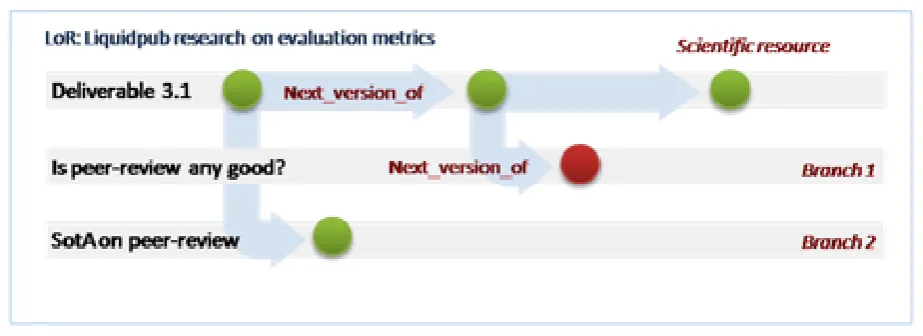
Figure 2.1: Example of scientific resources connected by next-version-of relation
To illustrate these concepts, in Figure 2.1 we show the work of our re-search group on evaluation metrics and peer review. We started this line of research within the context of a project deliverable (D3.1). This deliver-able is composed of a review of the state of the art, experiments, analysis and presentation of the results. The results were delivered in two releases, D3.1v12 and D3.1v23 , and we plan to produce in the near future a third
2
https://dev.liquidpub.org/svn/liquidpub/final/Year1/LP_D3.1.pdf
3
CHAPTER 2. ADDRESSING INFORMATION OVERLOAD IN THE SCIENTIFIC COMMUNITY
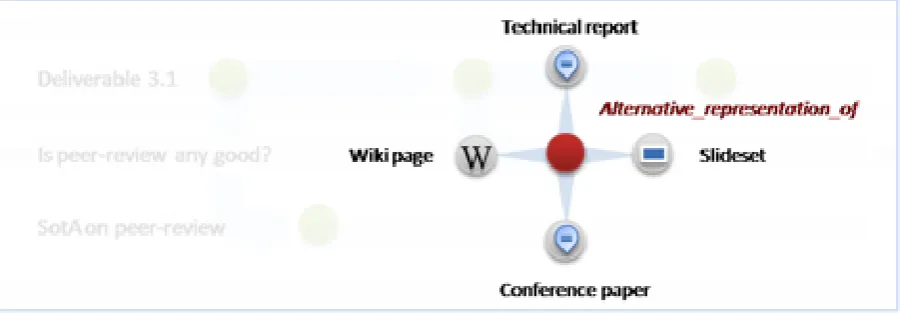
Figure 2.2: Example of different representation for the same resource
Figure 2.3: Example of other general relations
slidesets, a technical report and a conference paper. We can also see how this scientific resource is semantically related to other entities. In Figure 2.3 we illustrate the use of particular dataset and experiments (conference review data and code that processes them). These links allow us (or the editor) to connect and describe relationships among resources.
The reason for allowing anybody to define relationships is because in this way we can leverage the power of the community to build scientific dissemination knowledge, that is, knowledge that can help annotate and relate resources above and beyond what authors would do. In other words, people generate knowledge that helps in organizing and finding scientific resources. This is sometimes called “second-order knowledge”, which we believe is as important in supporting scientists’ work (“standing on the shoulders of giants”) as first order one.
Formally, we define the space of scientific resources as Σ =< SR, E, L, A > where
• SR is a set of resources r =< id, uri, ct, cf > are the individual sci-entific resources. id denotes the universal identifier for the resource. uri points to the resource as available on the Web. ct is the content type of the resource and can take values such as paper, video, slideset, dataset, experiment, and others. cf is the content format which can for example be pdf, pptx, and so on. Because we consider journals as a way to create or at least to disseminate knowledge, they are also resources.
• E is the set of entities that create, access, relate, annotate, or certify
resources. These can be people or institutions (including certification agencies).
CHAPTER 2. ADDRESSING INFORMATION OVERLOAD IN THE SCIENTIFIC COMMUNITY
to target et). Besides the objects they relate, they are essentially characterized by a type lt (e.g., “next version of”), by the users u ∈ E that created it, and by the set un∈ E of users or agencies that endorse it, if any.
• A denotes a set of annotations a =< e, at, v > that can be attached
to a resources or entity e. Annotations can be of a certain type at (e.g., tags, flags, comment), and carry a value v (e.g., “good example of state of the art” ).
This model for resources reduces overload because it clusters contribu-tions and then allow users to navigate through contribucontribu-tions in the line and evolutions, presentations, and other related resources.
While the model allows anybody to create any kind of relation, the liquid journal model assumes and leverages specific relation types, to which it assigns an agreed semantic (and also graphical interaction patterns in the LiquidJournal interface).
• Structural relations represent arbitrary relationships between contri-butions, where the relationship is described by annotations. For ex-ample, a paper can be reporting on a dataset in that it describes results of experiments on that dataset. Examples of such relations are depicted in Figure 2.3.
• Representation relations allow us to model the multi-faceted aspect.
For example, a paper can have associated slides and datasets, and so be deemed as a complex multi-faceted artifact, including artifacts that encode (part of) the same knowledge but have different representation. An example of this type of relation is illustrated in Figure 2.2.
• Authorship relations denote who contributed to the creation of the resource. An annotation of this relation would qualify the contribution (e.g., ”design of the experiment).
• Dissemination relations denote usage by mean of the LJ model. For
example they include appearance of a resource in a journal, subscrip-tion to a journal, and sharing of a resource.
This model for resources reduces overload because it clusters contribu-tions into research lines (which are themselves resources) and then allow users to navigate through contributions in the line and evolutions, presen-tations, and other related resources. Although outside the scope of this paper, it allows to more fairly attribute credit to contributions or authors by making explicit the incremental nature of a contribution and to as-sign indirect reputation to resources because they are linked by another (reputed) resource, much like what pagerank does for webpages.
A liquid journal is an evolving collection of interesting and relevant links to scientific contributions (whether freely or not) available on the web. Considering journals as collections of links means that journals do not own the contributions. We assume contributions are posted elsewhere4 (web pages, traditional journals, etc) and so they are independent of their ap-pearance in journal. Thus, many journals can then refer to the very same
4This means that availability of the actual data as well as access control and other aspects, cannot be
CHAPTER 2. ADDRESSING INFORMATION OVERLOAD IN THE SCIENTIFIC COMMUNITY
contribution. This ”appearance” of contributions in journals is an im-portant information we exploit for measuring interestingness, as discussed below.
The links in a journal (which define its content) can be decided by the editor who picks them one by one, or can be defined by a web search through the liquid journal engine, where the results are dependent of the interestingness of the resources. The result of the search can be refined and then “snapshotted” by the editor (resulting in an issue of a liquid journal), or the journal can adopt a continuous model where the journal is essen-tially the web search, and the result evolves naturally and continuously as new content becomes available or as the values of metrics for existing contributions makes them qualified for the journal we have defined.
The rationale behind this model is that we see journals as a mechanism for people to find and share interesting and diverse content, for themselves or for their research group5. While doing this, while running LJ-enabled search for web content, and while refining the results and sharing the most interesting contributions with our colleagues, we do a service to our team but, as we will see, we are also acting as “filters” in that we implicitly rate contributions. Hence, we are also doing a service to the community. LJs essentially put the community itself to work as content selectors, while hav-ing people performhav-ing activities they need to do anyways, such as lookhav-ing for content and sharing interesting findings with their team. It is like cap-turing the interestingness people perceive from the result of a web search, and using this as a way to rate content and therefore separate interesting contributions from the rest [30].
5This was also the original motivation at the birth of the scientific Journal paper model around the
2.3
Usage model and metrics
Liquid journals aim at providing tailored scientific content by bringing in-teresting scientific contributions. People fill their liquid journals in various ways: they can add content they stumble on (analogously to digging an item), by emailing a pdf file to the LJ engine, or even by taking a picture of a paper with their phone. They can also add a work-in-progress such as a google doc (see the demo videos for details6). This is intended to mimic what we do today to keep track of interesting contributions. The actual content, however, is not in the journal. A liquid journal is a collection of links, and as such, it relies on the actual sources and on the editor’s ability to access sources. Thus, access permission are always based on the reader’s permissions and on what the source of the link allows.
A value proposition of LJ is that editors and readers provide knowledge that can help connect and assess scientific contributions. This happens in 3 ways, all supported by the LJ interface:
1. Editors implicitly evaluate resources by publishing them in their jour-nal.
2. Readers implicitly evaluate resources by sharing them with their team. For example a professor or a phd student may share paper they think interesting within their team.
3. Readers provide knowledge by linking and annotating resources. For example, a reader can state that paper P1 reports results of experi-ment E over dataset D, and extends the inital results of P2. They can also state that paper P3 performs a nice literature review.
The latter action provides information that is useful for navigating from
6
CHAPTER 2. ADDRESSING INFORMATION OVERLOAD IN THE SCIENTIFIC COMMUNITY
a resource to related resources and therefore to find related information, as shown in figure 2.3.
With the first two actions, the scientific community collectively estab-lish what is worth reading. Feedback in this form is not intrusive but gets beneficiated by actions that are anyways useful for editors or readers. This work of selecting and sharing knowledge is what we do every day. What LJ tries to add is to capture this information by making it easy and convenient for each of us to select and share resources and by then implicitly using the collective (implicit) opinions expressed by people by selection and sharing content. In other words, by giving scientists a tool to collect, organize, and share interesting scientific resources we aim at having a way to assess the interestingness of such resources, and consequently a way to filter interest-ing knowledge and help manage the information overload. Furthermore, expanding the reach of metrics to other types of content and other activ-ities will allow us to look into other aspects of researcher’s productivity. For example, we explore how to reward people sharing good ideas (e.g., by posting them in a blog), selecting and creating good collections of contri-butions and also giving constructive feedback. Traditional metrics not only are unable to provide such insights but they are still based on citations, which have shown to have flaws [22].
The conceptual model of LJ also provides the information to capture these aspects in the dimensions of the scientific contributions, in the sub-scription links, in the structural links that make contributions appear in journals, in the usage information (tags, forwarding, sharing). All these rich information gathering aspects are not covered by the traditional model.
up once it has been possible to compute citations automatically. A trivial approach consists in counting the number of journals in which a resource appears, or the number of people that shares it, or tag it, etc. A more sophisticated example is provided in [38], where opinions, tags, selection in journals, and other actions that can be expressed via (and recorded by) a liquid journal contribute to the reputation of a resource. This is the algorithm currenlty integrated with the LJ platform.
However, as it is unfeasible to provide a unique (and accepted) magic formula that captures all these aspects, we focus on providing the guidelines that will govern the instantiation of particular derived metrics. Indeed, we believe it is the community to decide what counts within the community. We are developing this concept with the metric uCount7 that, as the name suggests, captures both the fact that everyone in the community counts and that everyone is involved in the process of defining what counts in the specific community. The idea is that anybody can then decide which metric formula to use to filter out the resources of interest when searching for content on the Web.
2.4
Architecture
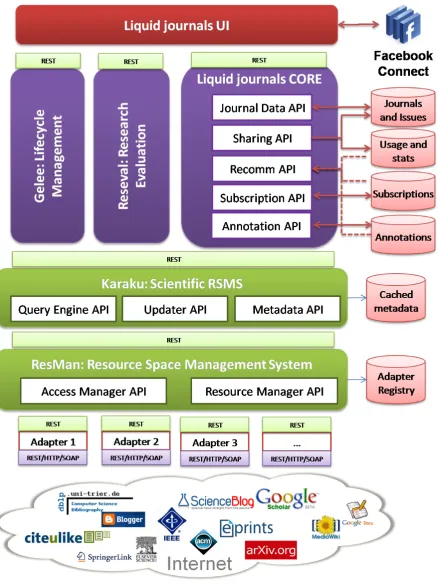
Designing and implementing an infrastructure for supporting the LJ model requires solutions and strategies for: i) managing the journals process, ii) journal creation, evolution, consumption and sharing; iii) access to scien-tific content in the Web, iv) computing the reputation of contribution (for ranking), and the v) projection of these features to a user interface. The LJ architecture relies on specialized components designed for each of the aspects mentioned. In Figure 2.4 we illustrate these components.
Liquid journals8 provides a view of the scientific content available of the
7In joint collaboration with ICST, icst.org 8
CHAPTER 2. ADDRESSING INFORMATION OVERLOAD IN THE SCIENTIFIC COMMUNITY
Web. Since scientific contributions fall outside traditional sources (e.g., digital libraries) where standards can be applied, the infrastructure requires an access layer that provides the necessary abstractions for accessing and searching content on the Web. In order to address this requirement, we rely on the abstraction of a Resource Space Management Systems (RSMS) [5] applied to the scientific domain.
The ResMan9 system, a prototype implementation of a RSMS, provides a uniform access layer to resources available on the Web. It abstracts applications on top of the heterogeneity of the underlying services on the Web. The approach followed by the system is to rely on adapters, i.e. components that map the specifics of different and non compatible services to a common and uniform protocol [10].
On top of ResMan, the abstraction of a Scientific RSMS10 (named Karaku system) provides a common and extensible conceptual model spe-cific for scientific resources, and a set of basic services for searching and operating on these resources. A core module is the Updater, which func-tions as a crawler over scientific sources and extracts resource metadata. This allows us to push resources into the system in the same way users can do it with their iPhone or using the web interface. On these archi-tectural foundation, the liquid journal core component builds the services that support the model introduced in this paper.
LJs allow users to define their own process and to this end, the archi-tecture includes also a lifecycle management component, the Gelee system [6]. The backend is completed by the Research Evaluation tool (Reseval)11, an extensible tool for computing metrics for contributions and papers (and any other user-defined entity). In this context, the tool takes information about scientific entities from Karaku and applies the algorithms for
puting metrics. Thus, LJs can be seen as domain-specific mashups that allow users to define the content, process and metrics.
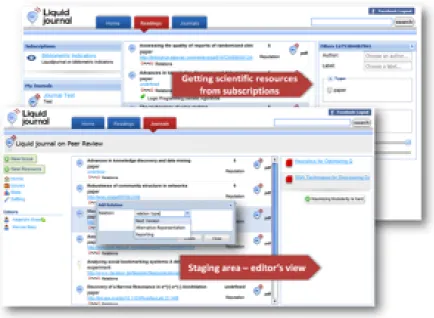
Services are very important in our architecture but to fully exploiting them it is necessary to provide an effective Web interface that facilitates journal definition, search, content consumption and sharing. In our ap-proach, we pay special attention to this issue and we are developing a rich Web application on top of the core components (see Figure 2.5). We also integrated the application with the Facebook social network with the goal of facilitating the sharing, and making it easier for people to use and connect with the system. This is possible due to the Facebook Connect service12.
2.4.1 Related work
In spite of the progress in dissemination models, the current model of pub-lishing and evaluating scientific contributions remains almost the same. Novel models such as the deconstructed model [49] and the overlay jour-nal [42] introduce interesting ideas yet to be explored and taken beyond structural changes to meet the Web. These models are still constrained to the traditional notion of paper, and so other types of contribution remain hidden. The social part, the study of behaviors that are good for science, such as early feedback, sharing and collaboration remain also unexplored. More importantly, none of the models tackles, and offers mechanism to face, the problem of attention. All these issues affect also the evaluation, which continues to be based on papers (citation-based, e.g., [25][31] ) and so leaving out other aspects of research productivity.
The Social Web has made possible new forms of collaboration. Promi-nent examples are the social bookmarking services that allow users to share
12
CHAPTER 2. ADDRESSING INFORMATION OVERLOAD IN THE SCIENTIFIC COMMUNITY
interest within communities. CiteULike13, Mendeley14, Zotero15 and Con-notea 16 are examples of social bookmarking services with the focus on sharing and organizing academic references. These tools come with social tagging features that allow people to collaboratively tag content. Thus, these tools provides storing, sharing and tagging of references to publica-tions via shared collecpublica-tions and groups.
Tools for sharing and collaboration stand as a promising direction. These systems provide some foundations and results for further studies in the scientific domain regarding collaboration. However, they are only the ”mean” for collaboration without a formal and complete knowledge dis-semination model established. Moreover, taking technical aspects apart, one disadvantage of these services is that they rely on active users, that is, users who inject content into the system. Thus, the discovery is limited to what is already there. Our model builds on some social features of these systems but provide a complete model of dissemination designed specially to overcome the dissemination overload in the scientific domain.
Search is a common service on the Web and so search engine technol-ogy has been explored and applied to scientific content [34]. Specialized search engines, such as Google Scholar17 and CiteSeer18, have been devel-oped for searching papers/books across multiple repositories using crawling techniques and protocols. Using another approach, the academic search en-gine, BASE19, indexes the metadata from repositories that implement the OAI-PMH protocol. In addition to what the user can provide as input to the search (e.g. keywords), implicit preferences and collaborative filtering
has also been used for bringing users content they might like [48]. This has led to general relevance and diversity algorithms proposals trying to balance user preferences and diversity (e.g. [21]). In the academic domain, recommendation of papers have also been explored in many studies (e.g., an evaluation in [41]).
Thus, academic search engines provide only a partial view of the scien-tific contributions dispersed over several sources on the web. They do not capture the user preferences and lack of proactive behavior. Users need to know what to search and how to search in order to get content, and when they do find an interesting resource, the navigation/exploration is limited. General approaches provide the foundation but their use in the scientific domain need to be modeled for the broader notion of scientific contribu-tion, and other special issues of the scientific domain (e.g., ranking). In our approach we rely on a model that provides semantic relations that can be exploited to explore and discover new similar and related scientific resources.
2.4.2 Conclusion
leverag-CHAPTER 2. ADDRESSING INFORMATION OVERLOAD IN THE SCIENTIFIC COMMUNITY
CHAPTER 2. ADDRESSING INFORMATION OVERLOAD IN THE SCIENTIFIC COMMUNITY
Chapter 3
Understanding and supporting
search for scholarly knowledge
Baez, M. and Mirylenka, D. and Parra, C.
In the last decade, scholarly communication have been greatly transformed
by the web, moving research dissemination away from printed papers in
journals to digital content that can be easily posted on the Internet. This
technical factor along with a larger scientific community makes it really
hard to find relevant content for research in the ever growing sea of
pub-lications. With the goal of gaining insights on how researchers find
rele-vant knowledge, we have interviewed a small group of researchers and then
opened an online survey to a larger group, asking them to explain how they
had found references for one of their papers. The results of this study
sug-gest that finding scientific knowledge has a strong social component, with
the different researchers’ social networks (e.g., coauthors, people met at
conferences) accounting for a important percentage of the source of the
ref-erences. In this paper we report on this study and compare our results with
the evidence found in a dataset of 5×10⁶ authors with their publications and references. We take these results and analyze different approaches
scientific publications.
3.1
Introduction
The notion of scientific paper as the main means of scientific knowledge dissemination and peer review as the main mechanism to guarantee quality have been, for a long time, the cornerstones of scientific knowledge advance. In the last decades the scientific world has met great changes, the Web being the changing factor pushing us to gradually move away from printed papers in journals to digital content that can be easily posted online. In this context it becomes really hard to find relevant content for research in the ever growing sea of publications. This phenomenon, referred to as “information overload”, is a reality and a challenge for the scientific community. It requires an understanding of the problem in this domain and the development of models and tools to overcome its effect.
CHAPTER 3. UNDERSTANDING AND SUPPORTING SEARCH FOR SCHOLARLY KNOWLEDGE
problem.
Current approaches, such as social bookmarking sites and other so-cial networking systems provide tools and services to share the knowledge within a single context of their systems. However, they do not consider that different incentives and tools are required to effectively capture this knowledge in different contexts. People share, discover and discuss papers, usually informally, at conferences, lectures, in the mailing lists of their re-search groups and projects. We argue that capturing this knowledge will allow us to understand what people consider important and relevant. The fact, for example, that somebody (and especially somebody we “trust”) shares a paper tells us a lot on the value of this paper, more than a ci-tation can do. This fact supports our intuition that, having this kind of information available, we will be able to use it to improve search [24].
In this paper we introduce Knowledge Spaces, an approach to capturing and supporting search for scholarly knowledge. Knowledge spaces (kspaces for short) are a metaphor, a set of models and processes, and a social web platform that help you capture, share and find scientific knowledge in all of its forms. The principle behind kspaces is to allow knowledge dissemination in the scientific community to occur in a way similar to the way we share knowledge with our colleagues in informal settings. The rationale behind this is that when we interact informally with a small team of colleagues dissemination is very effective. We are free to choose the best format for communicating our thoughts and results, we share both established results as well as latest ideas, we interact and carry on a conversation (synchronously or via email), we comment on other people’s contributions and papers and observe relations among various contributions.
Then we give some insights on using researcher’s social network for search and recommendation of scholarly publications.
The contributions of this work are the following:
• A study on the impact of researchers’ social networks in finding
ref-erences for publications, and on the importance of different kinds of networks,
• A model and a social platform for capturing knowledge and enabling
search,
• A scientific metasearch engine leveraging social metrics, and
• Initial ideas on using researchers’ social networks, and in particular co-authorship network, for personalized search for scholarly publications.
In what follows we present our study on understanding scholarly knowl-edge search, describe Knowlknowl-edge Spaces as its enabling factor, and describe our proposals of scientific metasearch and network-aware search.
3.2
Understanding search
If we are to improve the way we find scientific knowledge, the very first step to do so is to understand how this process naturally works in the mind of those who search. With the goal of reaching this understanding we have conducted a sociological study consisting of two phases:
CHAPTER 3. UNDERSTANDING AND SUPPORTING SEARCH FOR SCHOLARLY KNOWLEDGE
particular publication of their authorship. The answers to the question ranged from “my advisor suggested it” to “I searched for papers in topic X using google scholar” and ”I found it while following citation links”.
2. Quantitative Analysis of an online survey on the same subject, us-ing the categories we have found on the first phase of the study. The online survey1 would ask researchers to provide their names, which we would later use to search for their publications on a dataset extracted from Microsoft Academic Search2 of 5×10⁶ authors with their pub-lications and references. After selecting one publication, the survey ask the same question as the interview, but this time providing as optional answers the categories we have found on the previous phase.
The results we discuss on the following sub-sections, led us to the con-clusion that finding scientific knowledge has a strong social component, which is a clear motivation to incorporate this component in the way we search for scientific knowledge.
3.2.1 Qualitative Analysis Results
Based on the interviews, we have run a qualitative analysis by classifying textual transcripts for each analysed reference. From this analysis, we have classified the sources of references into three main categories:
• social: includes all the references that authors came to know thanks to the interaction with their social network including co-authors, project colleagues, people met at conferences or other events;
• keyword search: includes all the references found while searching
for some topics or keywords using tools for that purpose (e.g. google scholar, dblp, specific digital libraries);
• navigation: includes all the references found by following citations or other type of references in papers and other resources.
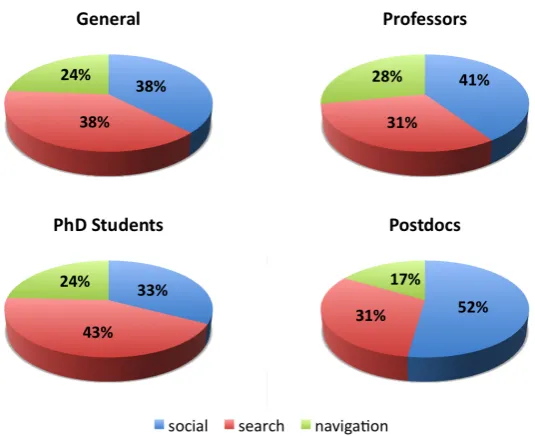
Figure 3.1 shows the average percentage of references in a paper that fol-lows each of the patterns explained before. In general, the same proportion of references comes from a social network of the authors and from specific searches they run on their own, reaching a 38%. References they got from navigating through knowledge represent the remaining 24%. When divided by seniority, results hold the same trend, with the social scoring higher than search both for professors and postdocs, and lower only for Ph.D. students. The later can be seen as a very intuitive result taking into account that the academic social network of a Ph.D. student is typically smaller than that of a senior researcher.
CHAPTER 3. UNDERSTANDING AND SUPPORTING SEARCH FOR SCHOLARLY KNOWLEDGE
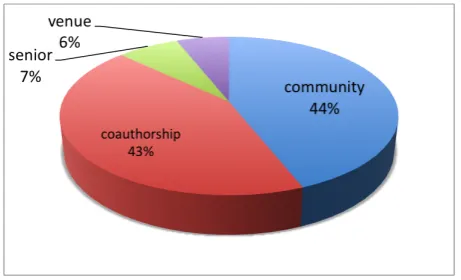
Furthermore, and given the high percentage of social related references, we have also classified the networks most commonly mentioned as sources of references. Figure 3.2 shows how many of the social references correspond to each of the following networks:
• community/field includes references that come from people or projects that can be considered as part of the same field or community around a certain topic, but whom the author has not necessarily met;
• colleagues, including peers whom the author has appointed as such. This is a very general term used by most of the interviewees and that might have a high intersection with other networks;
• venues includes references the author came to know through confer-ences or journals.
• collaboration, including people, groups or projects with whom the author has directly collaborated;
• senior colleagues includes mainly advisers or experts in a specific field;
• coauthors, including people who coauthored at least one article with the interviewee;
• research group includes people working in the author’s department or research group;
• acquaintances, including people the author has personally met, which is also a general term used by interviewees that could also be included in other networks;
• educational includes references the author got from courses, class-mates or education related networks;
Figure 3.2: Social networks of origin for references
In the same way, most citations found by navigation, were found while reading a paper or book, and then going deeper in the citation graph. Other subcategories of the navigation pattern include the follow up of one particular author, journal, conference or project. As for references found by keyword search, google and google scholar are the most used engines, while also dblp was mentioned (probably, due to the high number of computer scientist in the group of interviewees).
At the end of the study, we decided also to ask which of the analyzed references in the interview they liked the most. Even though this question was not in the original interview script, the trend we have found and that would later be confirmed by the online survey is that most liked references come mainly from authors’ social networks, accounting up to a 41%.
Data: The analysis of this phase of the study is based on 351 references
CHAPTER 3. UNDERSTANDING AND SUPPORTING SEARCH FOR SCHOLARLY KNOWLEDGE
students, 64 are from professors and 71 from postdocs. We have removed self-citations from the analysis as the authors already knew them and had no need to find them. The interviews were conducted during May of 2011 resulting in 789 different notes that were later manually categorized to get the before mentioned results.
3.2.2 Quantitative Analysis Results
The second phase of our preliminary study consisted on conducting an online automated version of our interview, using the categories we have found on the first analysis.
Figure 3.3 shows the average percentage of references in a paper in each category. The numbers are similar to those of the first phase, with the ex-ception of a significant drop in the percentage corresponding to navigation while the number of references for which authors selected the option Do not remember increased dramatically (especially for professors).
The reason behind the decrease in the navigation references percentage could be that the explanation in the online survey was not clear enough. Other reason might be that we are missing an important category, which we expect to discover as more people participate of the survey and provide feedback on possible missing categories.
For each of category, the online survey also included the option to further detail the answer by indicating
1. the social network from where the reference came from (for the social category),
2. the search engine or repository (for keyword search), and
3. while navigating what (for navigation)
Figure 3.3: Results of our online survey, classified by seniority of the researcher
significant increase in the percentage corresponding to coauthorship, which is not in line with the first phase analysis, implying that more research needs to be done in order to improve our understanding about the relevance of each of the many different social networks of a researcher. This however, we have gained interesting insights about which networks are the ones we have to investigate further.
More details and results of this analysis are available online and will be constantly updated in the site of the survey3.
Data: The online survey, currently ongoing, has gotten to this date, the
reply of 28 different researchers, that responded about the source for a 226 references distributed over 23 different publications. Aggregating these responses confirm what we have already found in the interviews: the social
CHAPTER 3. UNDERSTANDING AND SUPPORTING SEARCH FOR SCHOLARLY KNOWLEDGE
Figure 3.4: Social references by social network
component is stronger than any other.
3.3
Defining Network-aware recommendations
The goal of this work is to incorporate the social component of knowledge discovery into recommendation of scientific publications. More specifically, we aim to build a recommender system that suggests publications that researchers are likely to find through their social networks and that are related to their work.
Our model represents the graph of researchers and scientific publications connected with the relations of authorship and citation. We formalize the problem definition in the rest of the section.
3.3.1 Formal problem definition
LetR be the set of all researchers in the system, andP - the set of all
publi-cations. RelationAuthoredis defined by the set of pairs (researcher, publication) ∈ R×P such thatresearcher authoredpublication. Similarly, Cited includes
all pairs of publications (citing, cited) ∈ P2 such that citing references cited. Publication p is cited by researcher r if it is cited by any paper of r:
For each researcher r we define a set of known and a set of unknown publications:
Known(r) ={p ∈ P | Authored(r, p)∨Cited(r, p)}, Unknown(r) = P \Known(r).
With each researcher r we also associate a network, which is set of re-searchers similar to r according to some similarity function:
Network(r) ={r0 ∈ R |sim(r, r0) > δ}.
Examples of such a network may include coauthors of r, or researchers publishing in the same conferences, or researchers citing the same papers. The popularity of a publication pwithin a set of researchers s is defined as popularity(p, s) and its definition depends on the particular recommen-dation strategy. We introduce some strategies in the next subsection.
Given the definitions above, we formulate the problem of social recom-mendation of scientific publications: For a given researcher, find k publi-cations unknown to him/her that have the highest popularity in his/her network:
1. Rec(r, k) ⊆ Unknown(r), 2. |Rec(r, k)| = k,
3. ∀p ∈ Rec(r, k) ∀p0 ∈ (Unknown(r)\Rec(r, k))
(popularity(p,Network(r)) ≥popularity(p0,Network(r))).
In what follows we explore different definitions of network and popular-ity to later evaluate and analyze their performance.
3.3.2 Defining the notion of network
CHAPTER 3. UNDERSTANDING AND SUPPORTING SEARCH FOR SCHOLARLY KNOWLEDGE
type of network and the algorithms used to compute them. In this section we focus on defining different network configurations around researchers.
Coauthorship network
We first introduce the co-authorship network based on our definition of network :
Coauthors(r) = {r0 ∈ R |sim(r, r0) > δ}
expressing in the similarity function the number of papers two researchers have written together normalized by the number of publications, and then applyingδ >0 to create the network of all the coauthors a given researcher:
sim(r, r0) = kPublications(r)∩Publications(r
0)k
kPublications(r)k where
Publications(r) =[{p∈ P | Auhtored(r, p)}.
Venue network
Our definition of venue network tries to capture the likelihood of two re-searchers meeting at a venue, resulting in a future citation. We define the relation VenueOf as a set of pairs (publication, venue) ∈ P × V:
Copublished(r) ={r0 ∈ R | sim(r, r0) > δ}
where the similarity function expresses the normalized number of venues two researchers have published together:
sim(r, r0) = kVenues(r)∩Venues(r
0)k
kVenues(r)k given that
Topic network
Topic-based network capture the notion of researchers working in the same field. We assume each publication p belongs to a set of topics Topics(p) thus:
Co−topic(r) ={r0 ∈ R | sim(r, r0) > δ}
where the similarity function expresses the normalized number of topics on which two researchers have both published:
sim(r, r0) = kAfinity(r)∩Afinity(r
0)k
kAfinity(r)k
given that
Afinity(r) = [{Topics(p∈ P) | Auhtored(r, p)}.
3.3.3 Defining popularity functions
On the above we define different popularity functions that explore different views on the importance of a publication in the researcher’s network:
• network popularity: The popularity of a publication p within the net-work of a researcher r is defined as the number of researchers in pwho either authored or cited p:
popn(p, r) =
k{r0 ∈ Network(r) | p ∈ Known(r0)}k
kNetwork(r)k .
• work-weighted network popularity: Expresses the popularity of a
pub-lication p in the network of a researcher r, weighted by her similarity with all researchers in the network:
popwk(p, r) = P
{sim(r, r0 ∈ Network(r)) | p∈ Known(r0)}
CHAPTER 3. UNDERSTANDING AND SUPPORTING SEARCH FOR SCHOLARLY KNOWLEDGE
• time-weighted network popularity: Expresses the popularity of a
pub-lication p in the network of a researcher r, weighted by temporal sim-ilarity with other researchers in the network, considering the range [ymin, ymax]:
popwt(p, r) = P
{simt(r, r0 ∈ Network(r)) | p∈ Known(r0)}
kNetwork(r)k
• overall popularity: The overall popularity of a publicationp is defined
as the number of all researchers who either authored or cited p:
popularityo(p) =
k{r ∈ R |p ∈ Known(r)}k
kRk .
Recommending for a topic
The problem definition formulated above can be extended to the case where the recommendations are restricted to specific topics of interest. We assume each publication p belongs to a set of topics Topics(p). Let FilteredBy(ts) be a set of publications belonging to at least one topic from ts:
FilteredBy(ts) = {p ∈ P | Topics(p)∩ts 6= ∅}.
For a given researcher r and a set of topics ts, we need to find a set of publications Rec(r, ts, k) such that
1. Rec(r, ts, k) ⊆ FilteredBy(ts)∩Unknown(r),
2. |Rec(r, ts, k)| = k,
3. ∀p ∈ Rec(r, ts, k)
This extended problem definition will make possible the recommenda-tions on a topic and the implementation of a network-aware search for sci-entific publications. This should be accomplished by mapping the search query specified by the user to the set of topics, and recommending the pub-lications for this set of topics based on the user’s network. In this work, however, we don’t address the problem of topic-based recommendation.
3.4
Evaluation
In this section we present the evaluation of the social recommendations we introduced in the previous section.
3.4.1 Experiment definition
We obtained a crawled copy of the academic search database4 containing data about publications, their authors and citation