An Optimal Method to Design
Wireless Sensor Network Structures
https://doi.org/10.3991/ijoe.v14i01.8062
Ling Yang!!", Xucan Cai, Chunlin Wu
Zhongkai University of Agriculture and Engineering, Guangzhou, China
Abstract—In order to optimize the structure of wireless sensor network, an improved wireless sensor network sleep mechanism is proposed. First, some nodes in the area with too high redundancy are dormant by density control, so that the active nodes are even more distributed. Then, the active node is sub-jected to circular coverage redundancy decision. Different circumferential cov-erage decision methods are used for network boundary nodes and non-boundary nodes. As a result, the boundary nodes and non-boundary nodes are well dormant, and the network redundancy is reduced. The simulation results show that the improved dormancy mechanism makes the number of active nodes in the network smaller and more evenly, and the network lifetime is extended on the basis of maintaining the original coverage of the network. Therefore, the proposed method can achieve optimal coverage in wireless sensor networks. The network prolongs network lifetime while ensuring reliable monitoring per-formance.
Keywords—wireless sensor networks, dormancy mechanism, reconstruction, wake up, node mobility
1
Introduction
method of solving this problem at present mainly focuses on designing an effective MAC protocol, identifying the redundant nodes and making it dormant, so as to en-sure prolonging the life cycle of important nodes and design a rational network topol-ogy and node rotation dormancy [4].
The sensor node uses a limited battery capacity. Taking a typical hardware plat-form as an example, two AAA batteries of one node can only work for 100~120 hours. Sensor networks have huge number of nodes, and are generally deployed in unattended harsh environment, so it is very difficult to supply power to nodes. There-fore, to meet the coverage and connectivity requirements, node energy consumption should be reduced to the maximum extent, thereby extending network life. At present, the mainstream solution to the coverage problem is to save energy consumption by scheduling node on-time. Part of the redundant nodes are temporarily closed, so that all nodes take turns dormancy, thereby enhancing energy efficiency. At present, the typical dormancy mechanisms of wireless sensor networks mainly include dormancy mechanism based on node density control, dormancy mechanism based on random sleep and dormancy mechanism based on redundant node determination. Among them, the sleep mechanism based on node density control and the sleep mechanism based on random sleep are suitable for occasions where the coverage requirement is not very high. The sleeping mechanism based on redundant node decision can provide full coverage of the target area.
In this paper, a new redundancy node decision algorithm is proposed to solve the above problems. Combined with the idea of circumferential coverage, an improved sleep mechanism of wireless sensor network is designed. The algorithm first performs a density control on the network to make some nodes in the over-redundant area sleep. Then, based on the circumferential coverage, other nodes are subjected to re-dundancy determination. The judgment of the boundary node is different from that of the non-boundary node. The improved sleeping mechanism is proposed on the basis of the improved redundancy node decision algorithm. The remaining energy of the node is taken as a priority. It prevents redundant nodes and shuts down the coverage dead zone in the network at the same time.
2
State of the art
nodes, so as to prolong the life of the sensor network. The purpose is to improve the sensor network perception, monitoring, communications and other service quality. The sleep mechanism can be applied to nodes with the same function in the network. In addition, it can also be used in conjunction with hierarchical clustering topology control algorithms. Ye et al proposed a distributed node density control algorithm PEAS. The node is dormant in the initial state and is awakened after a random delay [9]. The PEAS algorithm is simple and does not depend on the location information of the nodes. The calculation overhead is small, but the coverage quality of the network cannot be guaranteed. Cerpa proposes ASCENT agreement. The ASCENT algorithm has good robustness and scalability. However, it cannot make the boundary nodes sleep on the target area, and cannot guarantee the uniform energy consumption.
For wireless sensor networks, it is two important goals to balance the energy con-sumption of the sensor nodes and improve the life cycle of the network. The distribu-tion of sensor nodes in a topology affects the energy consumpdistribu-tion of each node [10]. In the process of transmitting information, due to the different location of the node, the energy loss is also different. In 2009, Xu Gang et al. proposed application-level node dormancy / synchronization mechanism, and provided a method to calculate the empty proportion based on the expected lifetime and data acquisition requirements of nodes. The results show that the lifetime of the nodes is prolonged. With sleep tech-nology, 150h of no sleep node life can reach more than 1 year. In 2013, Hong Lu et al. proposed a dormancy algorithm for underwater sensor network nodes based on tree topologies. The algorithm can effectively shorten the number of wake-up times, pro-long the sleep time, and ensure that the end-to-end propagation delay is not affected by the sleep time. In 2015, Chen Long and other proposed a comprehensive sensor network clustering and node sleep mechanism of the agreement. It divides the life of the sensor network into several time periods. In each time period, it determines the set of similar nodes for each node, and selects the representative node (Rnode) to send the perceived data. In addition, it also hides some redundant nodes. The results show that the protocol can extend the life of the sensor network. In 2016, Feng Lin pro-posed a border area deployment adjustment of hybrid sensor network node optimiza-tion algorithm. By adding a small number of mobile nodes to the divided boundary area, it achieves the energy balance in the process of node scheduling, and realizes the purpose of extending the network lifetime.
3
Methodology
3.1 Assumptions of the algorithm
In this paper, assuming that all nodes are randomly distributed uniformly in a square area, the node density is large enough. All nodes are able to cover the entire area while they are working. It is assumed that the network has the following proper-ties:
Second, the communication radius of the node is rc=2rs, so that the full coverage is
guaranteed only when the full coverage is guaranteed.
Third, all nodes are isomorphic, that is, the detection radius rs is the same as the
communication radius rc.
Fourth, node uses Boolean perception model. All nodes within the perception range of each node can receive messages sent by them. However, the nodes outside the perceptual range cannot receive messages sent by them.
Fifth, nodes can be measured or positioned to obtain their specific location. Sixth, all the sensor nodes in the target area are in the same two-dimensional plane, and the whole target area is regarded as a convex region.
3.2 Network evaluation index
This paper evaluates the advantages and disadvantages of wireless sensor network coverage optimization algorithm from the following aspects:
Coverage rate: the coverage capability of network is an important index to measure the performance of sleep mechanism. Network coverage is usually used to reflect the coverage capacity of the network. In general, it is defined as the ratio of the effective coverage area Aa of the network to the area A of the target area, that is:
!
nai a
i a
a
A
A
S
A
i
N
C
1,
/
/
=!
=
=
(1)Among them, Aa is the union of all active nodes coverage. Sk is the coverage of
node K. Na is a set of active nodes in the region.
Coverage efficiency: the coverage efficiency in dormancy mechanism is defined as the ratio of union of all activities coverage area and the sum of all active nodes cover-age. That is:
!
na ai n i a i i s a
e
A
A
S
S
i
N
C
1 1,
/
/
=!
="
=
=
(2)It is used to measure the utilization of nodes' perception range. On the one hand, it can reflect the situation of network coverage; on the other hand, it can reflect the energy consumption of the whole network. At the same time, the redundancy of active nodes is reflected, and the redundancy of active nodes is small when the coverage efficiency is high, otherwise the redundancy is large.
Number of active nodes: in the case of meeting the requirement of network cover-age, the number of active nodes is less, the effective coverage area of nodes is larger, and the utilization ratio of nodes is higher, which can effectively reduce the energy consumption of the network.
life-time of sensor networks is an important performance index for coverage optimization algorithms.
3.3 Redundant coverage and related algorithms
Because of the wireless sensor network node hardware platform with limited re-sources, huge amount of network nodes amount and complex practical application environmental conditions and not allowing to replace the battery of "failure" nodes, it is an effective measurement for saving the nodes with limited battery energy and trying to prolong the whole network by reducing the energy consumption of the nodes. It is implemented by reducing the redundant broadcasting amount and making more nodes in the dormant state in the case of ensuring complete coverage. The rea-son is that the energy consumption of wireless communication module nodes ac-counted for more than 90% of the total energy consumption, the wireless communica-tion module has the maximum energy consumpcommunica-tion in the sending state, followed by the receiving state and the idle state, and the energy consumption of dormant state is the lowest. At present, when the communication module of the commonly used Berkeley Motes sensor is in the transmitting state, the power consumption is 60mW, when in receiving state and idle state, the power consumption is 12mW, and in the dormant state, the power consumption is only 0.03mW. Therefore, it will make parts of the nodes in the dormant state and greatly reduce the energy consumption of the nodes and prolong the working time of the nodes under the premise of satisfying the coverage requirements.
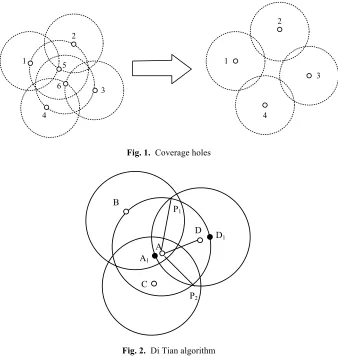
The premise of the redundant node dormancy algorithm is the determination of re-dundant nodes, that is to say, the nodes judge whether the covered area can be com-pletely detected by the neighbor nodes according to the information of neighbor nodes. After the judgment of redundant nodes, because it is a distributed algorithm, each node, only based on the neighbor information, judges whether it belongs to the node. However, since that the correlation of the node coverage is not that each node can be dormant, for example in Figure 1, node 5 and node 6 can determine itself as redundant nodes but not dormant at the same time of node 5 and node 6, otherwise, between node 1, 2, 3 and 4, it will produce the coverage holes. Therefore, how to design the redundant node algorithm is an important part of the research on the cover-age problem of wireless sensor networks. The covercover-age holes are as shown in Figure 1.
At present, the main algorithms for judging redundant nodes are Di Tian algorithm [5] and CCP algorithm [6]. The study found that these algorithms have a certain de-gree of problems. In the following, we will analyze and elaborate in detail.
The idea of Di Tian algorithm is that if a node is covered by all the neighbor nodes [0,2!], then the node is a redundant node. Specific as follows: for any node v, define its neighbor node set N(v)=
{
ud( )
u,v !rs}
, d( )
u,v indicating the distance from u to v.Define the open angle of the neighbor node u to v as "ui!v, as shown in Figure 2
2
1AP
P
1 1
2 2
3 3
4 4
5
6
Fig. 1. Coverage holes
B
A
C
D
A1
D1 P1
P2
Fig. 2. Di Tian algorithm
If all the neighbor nodes of the node v to the set of the open angle of v covers [0,2!], that is !
[
]
) ( i
u!N vui"v= 0,2 #
$ , then the node v is a redundant node.
In Figure 2, Node A is covered by B, C, and D because
[
0,2!]
=
" # " # "
#B A! C A! D A . In the Di Tian algorithm, because of using the
opening angle to judge the coverage, it makes each node, in considering whether or not covered, only considers the nodes with the distance not greater than the radius of the probe, which makes the set of the redundant nodes calculated tends to be small.
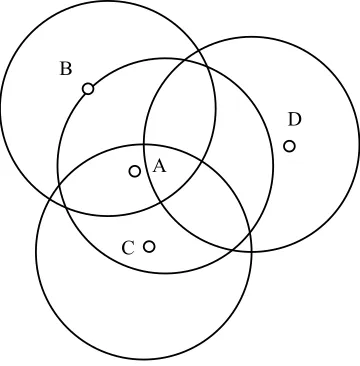
In Figure 3, the area of node A is completely covered by B, C, and D. But
) (A N
D! , according to Di Tian algorithm, A cannot be covered by B and C, so we
B
A
C
D
Fig. 3. Wrong judgment in Di Tian algorithm
The detection range of two nodes u and v is overlapped, and the condition needs to meet is that its distance is less than two times of the detection distance, namely
( )
u v rsd , !2 . In order to solve the problem of Di Tian algorithm, CCP algorithm de-fines the neighbor nodes set of any node v as N
( )
v ={
ud( )
u,v !rs}
, which enlarges the search range and improves the accuracy of the judgment.4
Result analysis and discussion
4.1 Comparison of active nodes
In the simulation, each experimental result is the average of 100 random topologi-cal experiments. Suppose that rs=6m, the total number of nodes n respectively take
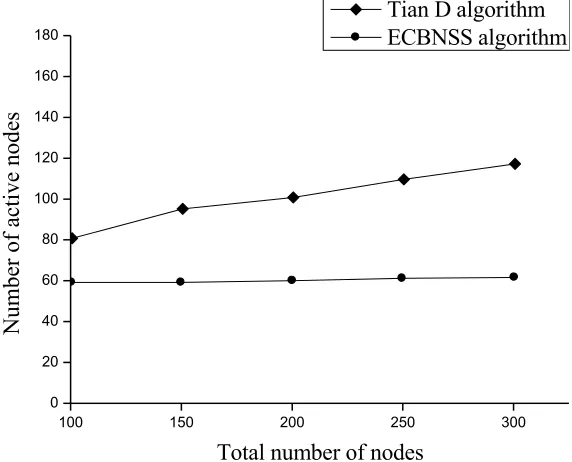
{100,150,200,250,300} five values. The number of active nodes under the two algo-rithms is observed with the total number of nodes. When rs = 6m, the number of ac-tive nodes with the total number of nodes is as shown in Figure 4.
As can be seen from Figure 4, under the same conditions, the ECBNSS algorithm can put more redundant nodes into the sleep state, so that the nodes in active state are less. The number of active nodes calculated by Tian D algorithm increases linearly with the increase of n. However, the number of active nodes calculated by ECBNSS algorithm does not increase with the increase of N, and always stays at about 60. Table 1 is the statistical data of the number of active nodes varying with the total number of nodes under the two algorithms.
100 150 200 250 300
0 20 40 60 80 100 120 140 160 180
Numb
er of
activ
e nod
es
Total number of nodes
Tian D algorithm
ECBNSS algorithm
Fig. 4. Comparison of the number of active nodes
Table 1. Comparison of the number of active nodes
Total number of nodes n 100 150 200 250 300
Number of
active nodes Tian D algorithm ECBNSS algorithm 81 59 96 60 102 61 111 62 118 62
According to the simulation results, the 100 rs=6m nodes is deployed in the
net-work. After running the Tian D algorithm, 81 nodes are in the working state. Howev-er, the ECBNSS algorithm only requires 59 nodes to work, and reduces the active nodes by 27.2%. When 300 nodes with rs = 6m are scattered in the network, the
num-ber of active nodes in Tian D algorithm is increased by 37 compared with that in 100 nodes. The ECBNSS algorithm only adds 3, and it doesn't change much. With the increase of the number of nodes, the superior performance of ECBNSS algorithm becomes more obvious.
n = 200, rs respectively take {6,8,10,12} four values. The number of active nodes
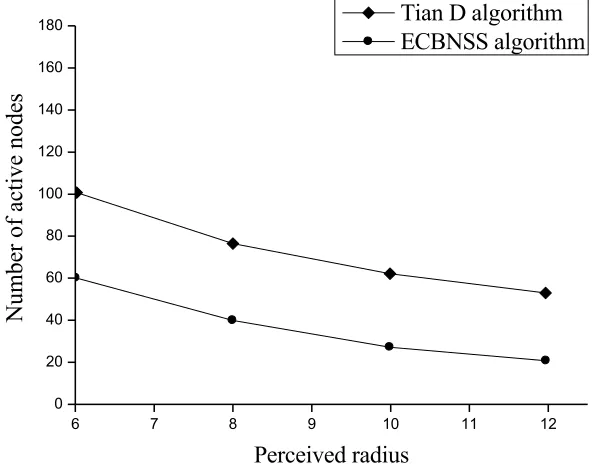
under the two algorithms is observed as the change of perceived radius. When n=200, the number of active nodes varies with the node perception radius, as shown in Figure 5.
As can be seen from Figure 5, the number of active nodes in both algorithms de-creases with the increase of rs, and the trend of change is not much different. The
difference between the two rs is little. Table 2 shows the statistics of the change of
perceived radius with the number of active nodes under the two algorithms.
6 7 8 9 10 11 12
0 20 40 60 80 100 120 140 160 180
Numbe
r of act
ive node
s
Perceived radius
Tian D algorithm
ECBNSS algorithm
Fig. 5. Comparison of the number of active nodes
Table 2. Comparison of the number of active nodes
Perceived radius rs / m 6 8 10 12 Number of
active nodes
Tian D algorithm 102 77 62 53
ECBNSS algorithm 61 41 27 20
According to the simulation results, when rs = 6m, 102 nodes are in working state
after running Tian D algorithm. The ECBNSS algorithm only needs 61 nodes to work, and reduces the active nodes by 41%. When rs=12m, the number of active nodes in
Tian D algorithm is 53. There are only 20 active nodes in the ECBNSS algorithm, which reduces the active nodes by 33%. It can be seen that the ECBNSS algorithm shows superior performance under various perceived radius.
From the above simulation results, it can be seen that the number of active nodes in ECBNSS algorithm does not increase with the increase of the sum of points, but basi-cally maintains stability. The number of active nodes is much less than that of Tian D algorithm in the total number of nodes and detection radius. Therefore, the ECBNSS algorithm can control the number of nodes and prolong the lifetime of the network.
4.2 Comparison of coverage efficiency
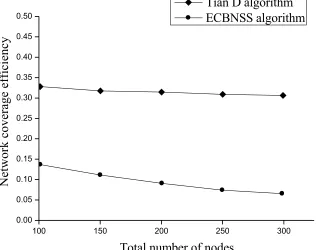
Both the ECBNSS algorithm and the Tian D algorithm can guarantee full cover-age, and the coverage rate of the simulation is approximately 1. Therefore, coverage efficiency is compared. Coverage efficiency is the ratio of the union of coverage of all active nodes in a zone to the sum of coverage of all active nodes. This indicator re-flects the redundancy of active nodes. Figure 6 shows the comparison of network coverage efficiency of the two algorithms when rs = 10m.
100 150 200 250 300 0.00
0.05 0.10 0.15 0.20 0.25 0.30 0.35 0.40 0.45 0.50
Ne
tw
or
k
co
ve
rag
e e
ff
ici
en
cy
Total number of nodes
Tian D algorithm
ECBNSS algorithm
As can be seen from Figure 6, although both algorithms can guarantee full cover-age, the node utilization rate of Tian D algorithm is apparently lower than that of ECBNSS algorithm. Especially when the node density increases, the coverage effi-ciency of Tian D algorithm decreases greatly, while the coverage effieffi-ciency of ECBNSS algorithm does not change much. This is because the number of active nodes under the Tian D algorithm increases linearly with the total number of nodes, resulting in a certain amount of energy waste. The network survival time is reduced. Table 3 gives the statistical data of network coverage efficiency under two algorithms. As can be seen from Table 3, with the increase of the total number of nodes, the network coverage efficiency of ECBNSS algorithm is significantly increased than that of Tian D algorithm. It can be seen that, when the total number of nodes increases, the ECBNSS algorithm can show its superior performance.
Table 3. Comparison of network coverage efficiency
Total number of nodes n 100 150 200 250 300
Number of
active nodes Tian D algorithm ECBNSS algorithm 0.1372 0.3265 0.1115 0.3183 0.0892 0.3156 0.0718 0.3091 0.0638 0.3067 Multiples of increase 1.38 1.85 2.53 3.31 3.81
5
Conclusions
The research status of wireless sensor networks is introduced. The research on coverage control in wireless sensor networks is summarized. Through the brief intro-duction of the sleep mechanism, the existing problems are analyzed. On this basis, in order to optimize the network structure, a sleeping mechanism for wireless sensor networks is designed. It can better control the number of active nodes and prolong the network lifetime. The density control of the network before redundant node judgment is proposed, which avoids the uneven distribution of active nodes and the complexity of algorithm communication. A method for judging the boundary nodes and non-boundary nodes is proposed, which solves the problem that the non-boundary nodes can-not sleep. The simulation results show that this method makes the boundary node sleep well. The network has fewer active nodes. The nodes are more evenly distribut-ed. The survival time of the network is extenddistribut-ed. At the same time, it can maintain the original coverage of the network. Due to the limited research time and ability, the research work of this paper still exists many immature places. In the future work, it needs further improvement.
6
References
[2]Chanak, P., Banerjee, I., & Sherratt, R. S. (2017). Energy-aware distributed routing algo-rithm to tolerate network failure in wireless sensor networks. Ad Hoc Networks, 56, 158-172. https://doi.org/10.1016/j.adhoc.2016.12.006
[3]Feng, B., Tang, W., & Guo, G. (2017). Searching Algorithm of Dormant Node in Wireless Sensor Networks. International Journal of Online Engineering, 13(5).
https://doi.org/10.3991/ijoe.v13i05.7054
[4]Han, K., Luo, J., Liu, Y., & Vasilakos, A. V. (2013). Algorithm design for data communi-cations in duty-cycled wireless sensor networks: A survey. IEEE Communicommuni-cations Maga-zine, 51(7), 107-113. https://doi.org/10.1109/MCOM.2013.6553686
[5]Haque, M. E., Hannan, M. A., Islam, M. R., & Rahman, M. H. H. (2016). Investigations optimum scheduling and TCP mechanism of hybrid topology sensor network in building SHM. Optik-International Journal for Light and Electron Optics, 127(6), 3218-3224.
https://doi.org/10.1016/j.ijleo.2015.11.118
[6]Pazzi, R. W., Boukerche, A., De Grande, R. E., & Mokdad, L. (2017). A clustered trail-based data dissemination protocol for improving the lifetime of duty cycle enabled wire-less sensor networks. Wirewire-less Networks, 23(1), 177-192. https://doi.org/10.1007/s11276-015-1089-7
[7]Song, Y., Chen, T., Feng, Y., & Dong, Z. (2014). Reliability Research and Analysis of Sink Node in Wireless Sensor Networks. Sensors & Transducers, 162(1), 94.
[8]Wu, S., Niu, J., Chou, W., & Guizani, M. (2016). Delay-Aware Energy Optimization for Flooding in Duty-Cycled Wireless Sensor Networks. IEEE Transactions on Wireless Communications, 15(12), 8449-8462. https://doi.org/10.1109/TWC.2016.2615296
[9]Yu, Y., Han, F., Bao, Y., & Ou, J. (2015). A study on data loss compensation of WiFi-based wireless sensor networks for structural health monitoring. Sensors, 13597(R2), 1. [10]Zhang, Z., Wang, Y., Song, F., & Zhang, W. (2015). An energy-balanced mechanism for
hierarchical routing in wireless sensor networks. International Journal of Distributed Sen-sor Networks, 11(10), 123521. https://doi.org/10.1155/2015/123521
7
Authors
Ling Yang, Xucan Cai and Chunlin Wu are with School of Information Science and Technology, Zhongkai University of Agriculture and Engineering, Guangzhou, China.