Distributed Optimal Maximum Rate Allocation
based on Data Aggregation in Rechargeable
Wireless Sensor Networks
https://doi.org/10.3991/ijoe.v14i03.8339Demin Gao, Jinchi Zhang!!", Fuquan Zhang, Haifeng Lin
Nanjing Forestry University, Nanjing, China
Abstract—In Rechargeable Wireless Sensor Networks(R-WSNs), it is criti-cal for data collection because a sensor has to operate in a very low and dynam-ic duty cycle owing to sporaddynam-ic availability of energy. In this work, we propose a distribute maximum rate allocation based on data aggregation to compute an upper data generation rate by maximizing it as a linear programming problem. Subsequently, a dual problem by introducing Lagrange multipliers is construct-ed, and subgradient algorithms are used to solve it in a distributed manner. The resulting algorithms are guaranteed to converge to an optimal value with low computational complexity. Through extensive simulation and experiments, we demonstrate our algorithm is efficient to maximize data collection rate in re-chargeable wireless sensor networks.
Keywords—Wireless sensor networks, Maximum Rate Allocation, Data Ag-gregation, Rechargeable-WSNs
1
Introduction
Consider the characteristics of R-WSNs, several protocols discuss several aspects of power management or MAC schemes to improve energy efficiency and maximize data collection rate [7]. A centralized algorithm with the line programming is pro-posed to compute the lexicographically maximum data collection rate and routing paths for each node [8]. Sadlapur et al. [9] provide a distribute algorithm for jointly determining the routing structure and amount of flows on each link with flow adjust-ment to achieve an optimal data collection rate. Peng S et al. [10] propose real time adaptive energy management policies based on observed information for throughput optimal. Prabhakar et al. [11] propose four throughput enhancement schemes from a simple naive scheme with low complexity to probabilistic probing scheme incorporat-ing advanced methods to appropriately use the harvestincorporat-ing energy. However, ideal energy replenished precondition is used and data aggregation has't been considered in these protocols.
In a nutshell, we propose a distribute optimal maximum rate allocation based on data aggregation for packets communications in r-WSNs. In summary, on observing the lack of data aggregation techniques consideration for improving data flow in ex-isting routing protocols, we introduce the first generic routing protocol algorithm with the data aggregation scheme in R-WSNs.
2
Design and Method
2.1 Network Model
Consider a static rechargeable wireless sensor network modeled as an undirected graph ! ! !!! !!, where ! is the set of ! rechargeable sensor nodes and sink nodes within the network. ! is the set of links, !! !!!!!! !! ! !! !! ! !!!. ! consists of a finite nonempty vertex set ! and edge set ! of ordered pairs of distinct vertices of ! Each sensor ! !! is powered by a rechargeable battery with capacity ! and its energy is harvested from its surrounding environment (e.g. solar energy). Each sensor ! sens-es its vicinity with sampling data generation rate !!. The set of nodes are connected to node ! by links is denoted as !!. We assume that the network graph is connected, i.e. It always exists a path between any pair of nodes ! and ! in !. The current remained energy of node ! is !! and the maximum bandwidth is set to be !
2.2 Energy Model
We assume the power consumption for sending and receiving one bit of data are !!, !!, respectively. When the data traffic from node ! to!! is !!!! per unit time. Hence, the energy consumption for node ! in receiving and transmitting are !! !! ! and !! !! ! , which are:
!! !! ! ! !!! !!!!!!!!!!!!!! (1) Therefore, if we let !! denote the fraction of power consumption for node ! per
unit time, which can be formulated as:
!!! !! !! ! ! !! !! ! (2)
2.3 Description of the data aggregation problem
To incorporate data aggregation into the geometric routing model, we adopt the foreign-coding model [12] scheme. Specifically, we assume a node ! is able to com-press the data originating at its adjacent neighbor!! using its local data. The compres-sion ratio depends on the data correlation between node ! and !. In our work, assumes the data correlation is inversely proportional to the Euclidean distance between nodes, or!! !! ! ! !"#!!!! ! !!!!! !, where, ! is data correlation parameters. Where, the !
!!! ! can be formulated as:
!!!!! ! !!! !! !! !!! !! ! !! (3)
The data from a source node will be transmitted to anyone sink finally by one or multiple-hops. For each node, the outflow equals or lesser than the inflow and genera-tion data from it due to some redundant informagenera-tion removed from data traffics. In the process of packet's transmission, data leak is not considered. Hence, the data flow for node ! is expressed as:
!!!!!!!! ! !!!! !!!
!!!!! ! !!! !!!!!!!!! !!!! (4)
Where, ! !! ! ! !!!!!, higher ! means smaller data correlation, and vice versa. When a sensor only forward packets for its neighbor and does not generate any pack-ets, data fusion does not occur and ! !!! ! !. Let !! denotes the fraction of power
consumption for node ! in each time unit. We have
!!! !!!!!!!! !!!!!!! !!!!!!!! !!!! !! (5)
2.4 Distribute algorithm for maximizing data collection rate
The goal of the maximum rate allocation is to deliver all packets generated by sen-sors to base stations as soon as possible subject to node available energy, node and link capacity constraints such that the data flow until the first (set of) sensor node with minimum data generation rate is maximized followed by data flow until the second (set of) sensor node with minimum value is maximized and so on. Now, we formulate this problem as a line programming, which is given by:
!!!! !!!! ! !!!! !!!
!!!!! ! !!! !!!!!!!!! !!
!!! ! !! !
!!!!! ! !!!!!!!! ! !! ! ! !! !
! !! ! ! !"# !! ! !!!!!
! !! ! ! ! !! ! ! !! !!! ! ! !! !! !!
! ! !!! !!
!!!!!!!! ! ! !!! (6)
The first set of constraints ensures that the inflow after aggregating with raw gen-eration data equals the outflow. The second constraint ensures that nodes do not con-sume more energy than they collect, which includes the energy consumption packet transmissions and packet receptions. The third constraint formulate the!!! !! ! of node i. Constraint state that the data flow and available energy do not go below zero and do not go beyond the link capacity or battery capacity.
According to the Eq.6, the constraints' model of data flow conservation at each node. We change variable to !!!!!! which indicates the time for generating per unit of packet. We define decay !! as the inverse of data collection rate !!!!!
! w,!!! > 0. Therefore, maximum data collection rate can be converted to a minimum the time for per unit of packet generation. We obtain an equivalent linear programming formula-tion.
!"#"$"%&!!!!! !"#$%&'!!"!
! !! ! ! ! ! !!!
!!!!! !!!!! !!!!!! !! ! !!
!!!! !! !
!!!!! ! !!!!!!!! ! !!! ! !! !
! !! ! ! !"# !! ! !!!!!
! !! ! ! ! !!! ! !! !!! ! !!! ! ! !!
! !!!! !!
!!! ! ! !!!! (7)
Here again, the constraints are flow conservation and power conservation con-straints. Again, we consider a quadratic objective function that is strictly convex in the !!. Also, to ensure that the dual function is differentiable, we restrict the domain
problem to minimize data generation time for per unit of byte information, which will be solved in a distributed manner. We can interpret the above problem as minimizing the maximum ratio of time elapsed to collect a packet at a node. The linear program-ming problem for Eq.5 is NP-hard and considerable difficult solved directly. Hence, a dual model will be utilized for replacing the original problem.
3
Simulations
Simulation of our algorithm for r-WSNs was done by Matlab software, with up to 100-200 nodes and 3-8 sinks are randomly deployed in a 1000m*1000m square field. The maximum communication range of each node is set to be 100m. All nodes' ener-gy devices are rechargeable with 20!"! square size solar panel, and transmission
powers are adjustable. Energy leakage and the case of signal loss of sensor are not considered in our work. Where, ! ![0.001,0.01]. Every data point in simulation fig-ures is obtained by averaging 50 runs with different random seeds, node deployment and node working schedules.
In order to further understand of the performance of our algorithm for Maximizing Rate Allocation (MRA) under network settings, in this section, we provide a scheme for performance comparison, an optimal Distributed Lexicographic rate assignment (DLEX) designed for R-WSNs [9]. In [9], the authors propose distributed algorithms for joint determining the routing structure and amount of flows on each link without considering data fusion. It involves update rate computation using optimal lexico-graphic rate assignment. In this method, nodes first compute their maximum rate using initial rate procedure. Subsequently, they send a control packet containing the flow id and the maximum achievable rate to their next hop nodes.
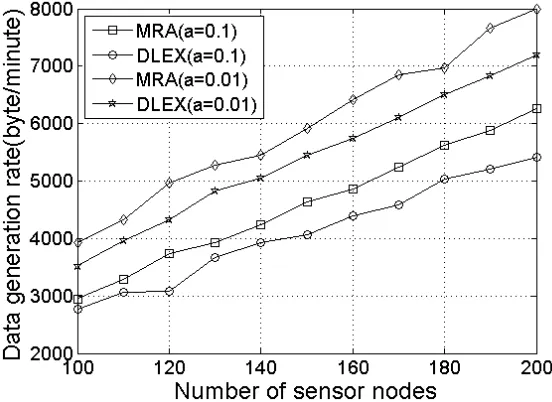
We first compare the rate allocation between our algorithm and DLEX under the distinct number of sensors with three sinks, where the average node's duty-cycles are 10%, 30%, respectively, as shown in the Fig.1. From the Fig.1, we can observe the data collection rates increase for both algorithms and that of our algorithm is slightly higher than that of another algorithm with the sensor density improved for both dif-ferent node's duty-cycle. Our algorithm is utilized for calculating the upper bound of data flow under ideal conditions and rather than establishing a detailed routing path. In actual application, the network throughput will be lower than the result value of our method. From the Fig.1, we can see the data generation rates of our algorithm are average about 6% and 9% higher than that of the Dlex scheme when duty cycles are 10%, 30%, respectively.
dense and the data correlation between neighboring nodes becomes higher, so more redundant information can be removed through data aggregation.
Fig. 1. Data generation rate with number of nodes increasing when duty cycle is 10% and 30%
4
Conclusion
In this work, we first define the network system and energy model. In order to im-prove data generation rate, we propose an algorithm to compute an upper data genera-tion rate based on data fusion that maximizes it as an optimizagenera-tion problem for a net-work. First and for most, we formulate it as a linear programming problem subject to the flow and energy conservation constraints. On top of that, a dual problem by intro-ducing Lagrange multipliers is constructed. Last but not least, a subgradient algorithm is used to solve it in a distributed manner. Through extensive simulation and experi-ments, we demonstrate our algorithm is efficient to maximize data collection rate in rechargeable wireless sensor networks.
5
Acknowledgment
This work was supported by The National Natural Science Fund of China (Grant No.31670554) and The Natural Science Foundation of Jiangsu Province of Chi-na(Grant No.BK20161527) and The Forestry SanXin Project of Jiangsu Province of China (Grant No. LYSX[2014]07). We also received three Projects Funded by The Project funded by China Postdoctoral Science Foundation (Grant No. 2017M611828), The Priority Academic Program Development(PAPD) of Jiangsu Higher Education Institutions and The Jiangsu Overseas Research & Training Program for University Prominent Young & Middle-aged Teachers and Presidents.
6
References
[1]Gao D, Wu G, Liu Y, et al. Bounded end-to-end delay with Transmission Power Control techniques for rechargeable wireless sensor networks[J]. AEU-International Journal of Electronics and Communications, 2014, 68(5): 395-405. https://doi.org/10.1016/j.aeue. 2013.11.001
[2]Yan J, Pei L, Chen Z, et al. Local adaptive sampling for wireless sensor network powered by energy harvesting[J]. Optik-International Journal for Light and Electron Optics, 2012, 123(23): 2195-2197. https://doi.org/10.1016/j.ijleo.2011.11.011
[3]Eu Z A, Tan H P, Seah W K G. Opportunistic routing in wireless sensor networks powered by ambient energy harvesting[J]. Computer Networks, 2010, 54(17): 2943-2966.
https://doi.org/10.1016/j.comnet.2010.05.012
[4]A. Kansal, J. Hsu, S. Zahedi, and M. B. Srivastava. Power Management in Energy Har-vesting Sensor Networks. ACM Transactions on Embedded Computing Systems, Vol. 6, No. 4, 2007.
[5]Seah W K G, Tan Y K, Chan A T S. Research in energy harvesting wireless sensor net-works and the challenges ahead[M]. Springer Berlin Heidelberg, 2013.
[6]Olds J P, Seah W K G. Power considerations for very low duty cycle wireless sensor net-works powered by energy harvesting[M]. School of Engineering and Computer Science, Victoria University of Wellington, 2011.
[8]Liu R S, Fan K W, Zheng Z, et al. Perpetual and fair data collection for environmental en-ergy harvesting sensor networks[J]. Networking, IEEE/ACM Transactions on, 2011, 19(4): 947-960. https://doi.org/10.1109/TNET.2010.2091280
[9]Sadlapur A, Pushpa P V. Computing optimal data collection rate for energy harvesting sensor networks[C]//Advances in Computing, Communications and Informatics (ICACCI), 2013 International Conference on. IEEE, 2013: 1468-1472.
[10]Peng S, Low C P. Throughput optimal energy neutral management for energy harvesting wireless sensor networks[C]//Wireless Communications and Networking Conference (WCNC), 2012 IEEE. IEEE, 2012: 2347-2351.
[11]Prabhakar T V, Iyer M, Prakruthi K, et al. Throughput schemes for energy harvesting sen-sor networks[C]//Communication Systems and Networks (COMSNETS), 2012 Fourth In-ternational Conference on. IEEE, 2012: 1-7.
[12]P. von Rickenbach, R. Wattenhofer, Gathering correlated data in sensor networks, in: DIALM-POMC’04: Proceedings of the 2004 Joint Workshop on Foundations of Mobile Computing, ACM Press, New York, NY, USA, 2004, pp.60-66. https://doi.org/10.1145/1 022630.1022640
[13]L. Xiao, M. Johansson, and S. Boyd, “Simultaneous routing and resource allocation via dual decomposition,” IEEE Trans. Commun., vol. 52, no. 7, pp. 1136-1144, 2004.
https://doi.org/10.1109/TCOMM.2004.831346
7
Authors
Demin Gao. In 2012, He joined in the College of Information Science and
Tech-nology, Nanjing Forestry University as a lecturer. From 2013, He pursues advanced postdoctoral engineering training at the School of Computer Science and Engineering, Southeast University, Nanjing City, China. His current research fields contain routing protocols for delay tolerant, data aggregation and multi-constrained routing algo-rithms in wireless sensor networks and rechargeable wireless sensor networks.
Jinchi Zhang is a professor at Nanjing Forestry University
Fuquan Zhang is an associate professor at Nanjing Forestry University
Jinchi Zhang is an associate professor at Nanjing Forestry University