S H O R T G E N O M E R E P O R T
Open Access
Draft genome sequences of
Pantoea
agglomerans
and
Pantoea vagans
isolates
associated with termites
Marike Palmer
1,2, Pieter de Maayer
1,3, Michael Poulsen
4, Emma T. Steenkamp
1,2, Elritha van Zyl
1,2,
Teresa A. Coutinho
1,2and Stephanus N. Venter
1,2*Abstract
The genus
Pantoea
incorporates many economically and clinically important species. The plant-associated species,
Pantoea agglomerans
and
Pantoea vagans,
are closely related and are often isolated from similar environments.
Plasmids conferring certain metabolic capabilities are also shared amongst these two species. The genomes of two
isolates obtained from fungus-growing termites in South Africa were sequenced, assembled and annotated. A high
number of orthologous genes are conserved within and between these species. The difference in genome size
between
P. agglomerans
MP2 (4,733,829 bp) and
P. vagans
MP7 (4,598,703 bp) can largely be attributed to the
differences in plasmid content. The genome sequences of these isolates may shed light on the common traits that
enable
P. agglomerans
and
P. vagans
to co-occur in plant- and insect-associated niches.
Keywords:
Pantoea, Bacteria, Insect, Symbiosis
Introduction
The bacterial genus
Pantoea
contains several
economic-ally important plant pathogens, as well as strains of
clin-ical importance [10]. Amongst the plant pathogens,
Pantoea ananatis
, with its broad host range (e.g. onion,
eucalyptus and pineapple) and
P. stewartii
subsp.
stewar-tii
, the causal agent of Stewart’s wilt on maize, are the
best known. The human pathogens include species such
as
P. septica
and
P. brenneri
[9], although some
plant-as-sociated species have also been isolated from
immuno-compromised patients [12, 17].
P. agglomerans
and
P.
vagans
are most commonly isolated from similar
eco-logical niches, including both plant and insect hosts [41].
Three plasmids (pPag1, pPag2 and pPag3) were
identi-fied in the genome of the biocontrol strain
P. vagans
C9-1 [45] and it is thought that the presence of these
plasmids may play a role in the physiological and
eco-logical functioning of this strain. The plasmid, pPag1,
codes for sucrose metabolism, while the plasmid, pPag2,
harbours genes for an antimicrobial peptide and sorbitol
utilization [33, 46]. The megaplasmid pPag3 belongs to
the LPP-1 plasmids conserved among all sequenced
Pantoea
sppecies to date and carries genes involved in
pigment production, thiamine biosynthesis and maltose
metabolism [19, 46]. In contrast to
P. vagans
, some strains
of
P. agglomerans
are also known to induce galls on
Gyp-sophila
spp., beet (
Beta vulgaris
), Douglas fir (
Pseudotsuga
menziesii
) and
Wisteria
spp. [6, 37]. This ability has been
linked to a genomic island that encodes a Type III secretion
system and pPath plasmid genes involved in the
biosyn-thesis of the plant hormones, indole-3-acetic acid and
cyto-kinins [6].
P. agglomerans
strains have also been shown to
cause opportunistic infections in humans [15, 18].
In this study we summarize the features of a
P.
agglomerans
(Mn107) and a
P. vagans
(Mn109) that
were isolated from two different colonies of the
fungus-growing termite
Macrotermes natalensis
in South Africa,
and provide an overview of the draft genome sequences
and annotations for these two strains. The genome
se-quences provide some understanding of the shared
gen-omic features that could be linked to their survival in
* Correspondence:[email protected]1Department of Microbiology and Plant Pathology and the Genome Research Institute, University of Pretoria, Pretoria 0002, South Africa 2DST-NRF Centre of Excellence in Tree Health Biotechnology, Forestry and Agricultural Biotechnology Institute, University of Pretoria, Pretoria 0002, South Africa
Full list of author information is available at the end of the article
similar environments and the unique features that
char-acterise the species.
Organism information
Classification and features
Both
P. agglomerans
MP2 (LMG 29065) and
P. vagans
MP7 (LMG 29064) are members of the
Enterobacteria-ceae
in the class
Gammaproteobacteria
, and are thus
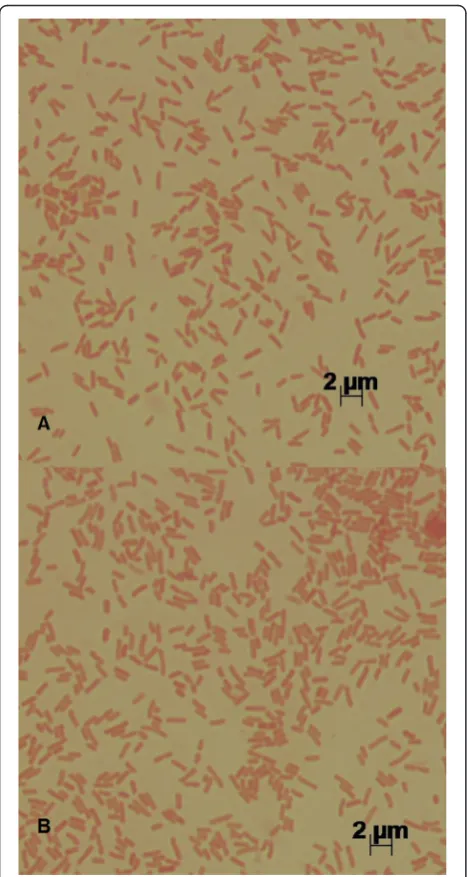
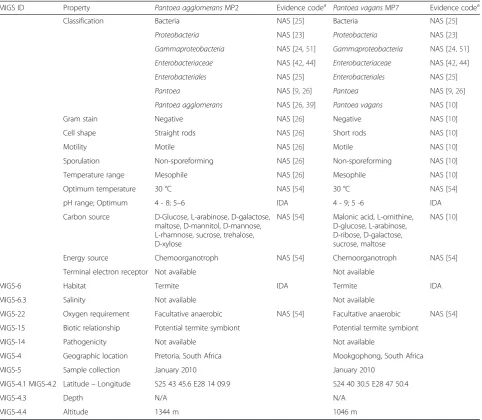
Gram-negative, motile, non-spore-forming, rods (Fig. 1,
Table 1). After incubation on Luria-Bertani agar (10 g
tryptone, 5 g yeast extract, 5 g NaCl, and X g agar per
litre) at 28 °C for 24 h, colonies of
P. agglomerans
MP2
and
P. vagans
MP7 are yellow, convex and round with
entire margins.
The 16S rRNA gene sequences of the enteric bacteria
tend to provide insufficient resolution and the
phylogen-etic relationships of
P. agglomerans
MP2 and
P. vagans
MP7 were therefore inferred with multi-locus sequence
analysis. This analysis included closely related members
in the genus
Pantoea
with available genome sequences,
and was based on partial nucleotide sequences of four
protein coding genes (i.e.,
atpD
,
carA, gyrB
,
infB, recA
and
rpoB
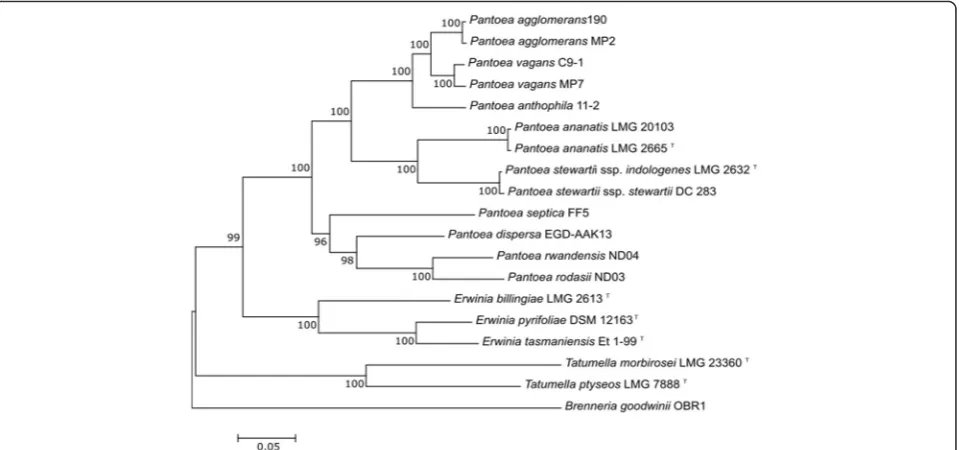
) [57]. Our results showed that
P. agglomerans
and
P. vagans
group as sister-species (Fig. 2).
The two isolates (strain codes: MP2 = Mn109-1w1C
and MP7 = Mn107-old1M) were isolated from
Macro-termes natalensis
termite mounds in 2010. The surface
of worker termite was rinsed using phospate buffer
sa-line and MP2 was isolated from the rinsate, which was
inoculated directly onto chitin medium (4 g chitin, 0.7 g
K
2HPO
4, 0.3 g KH
2PO
4, 0.5 g MgSO
4.5H
2O, 0.01 g
FeSO
4.7H
20, 0.001 g ZnSO
4, 0.001 g MnCl
2, and 20 g of
agar per litre), while MP7 was isolated from fungus
comb ground in PBS and inoculated onto
Carboxy-methyl cellulose medium (10 g carboxyCarboxy-methyl cellulose
and 20 g agar per litre). Isolates were streaked onto
Yeast Malt Extract Agar medium (4 g yeast extract, 10 g
malt extract, 4 g D-glucose and 20 g bacteriological agar
per litre), and once in pure culture, they were stored in
10 % glycerol at
−20 °C. The specificity and possible role
of associations between fungus-growing termites and
the two
Pantoea
isolates have not been determined,
but the abundance of members of the
Enterobacteria-ceae
in both fungus-growing termite guts [40] and
fungus combs [4] suggests the possibility of a specific
association.
Genome sequencing information
Genome project history
The genomes of both isolates were sequenced using the
Illumina platform. Velvet [56] and Mauve [16] were
employed for the assembly of the genomes and
annota-tions were done using the Rapid Annotation using
Sub-system Technology [5] and WebMGA. The genomes
will remain as high quality drafts and are available from
the National Center for Biotechnology Information
(Tables 2 and 3). The Whole Genome Shotgun projects
have been deposited at DDBJ/EMBL/GenBank under the
accessions JPKQ00000000 and JPKP00000000,
respect-ively. The versions described in this paper are version
JPKQ00000000.1 and JPKP00000000.1.
Growth conditions and genomic DNA preparation
Pure cultures of the MP2 and MP7 isolates that were
initially grown at 28 °C on YMEA plates was then
cul-tured in Luria-Bertani broth (10 g tryptone, 5 g yeast
extract, and 5 g NaCl per litre). DNA was subsequently
extracted from the cultures using the Qiagen DNeasy
blood and tissue kit (Qiagen, CA). DNA quality was
assessed using a NanoDrop
™
spectrophotometer.
Genome sequencing and assembly
The genomes of the two isolates were sequenced using
mate-paired Illumina sequencing using the HiSeq
Plat-form at the Beijing Genomics Institute. Libraries with an
insert size of 500 bp were generated and sequence
lengths of 90 bp in both directions were obtained. After
filtering out reads with >10 % Ns and/or 25–35 bases
of low quality (≤Q20), and removing adapter and
duplication contamination as well as trimming read
ends,
approximately
850
Mb
of
sequence
data
remained per isolate. The sequence reads were
bled using Velvet [56] and the sequencing and
assem-bly metrics are given in Table 2. Contigs generated in
this way were further assembled into contiguous
scaf-folds by alignment against the closest complete
ge-nomes, based on BLAST, of
P. vagans
C9-1 [45] and
the draft genome of
Pantoea
sp. SL1-M5 [1] using
the progressive Mauve algorithm in Mauve 2.3.1 [16].
The final genomes had coverage of
ca.
180 ×, where
that of MP2 consisted of 16 contigs and that of MP7
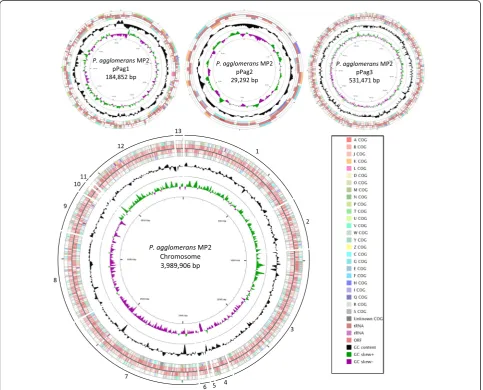
consisted of 8 contigs (Figs. 3 and 4).
Table 1
Classification and general features of
P. agglomerans
MP2 and
P. vagans
MP7
MIGS ID Property Pantoea agglomeransMP2 Evidence codea Pantoea vagansMP7 Evidence codea
Classification Bacteria NAS [25] Bacteria NAS [25]
Proteobacteria NAS [23] Proteobacteria NAS [23]
Gammaproteobacteria NAS [24,51] Gammaproteobacteria NAS [24,51] Enterobacteriaceae NAS [42,44] Enterobacteriaceae NAS [42,44] Enterobacteriales NAS [25] Enterobacteriales NAS [25]
Pantoea NAS [9,26] Pantoea NAS [9,26]
Pantoea agglomerans NAS [26,39] Pantoea vagans NAS [10]
Gram stain Negative NAS [26] Negative NAS [10]
Cell shape Straight rods NAS [26] Short rods NAS [10]
Motility Motile NAS [26] Motile NAS [10]
Sporulation Non-sporeforming NAS [26] Non-sporeforming NAS [10]
Temperature range Mesophile NAS [26] Mesophile NAS [10]
Optimum temperature 30 °C NAS [54] 30 °C NAS [54]
pH range; Optimum 4 - 8; 5–6 IDA 4 - 9; 5 -6 IDA
Carbon source D-Glucose, L-arabinose, D-galactose, maltose, D-mannitol, D-mannose, L-rhamnose, sucrose, trehalose, D-xylose
NAS [54] Malonic acid, L-ornithine, D-glucose, L-arabinose, D-ribose, D-galactose, sucrose, maltose
NAS [10]
Energy source Chemoorganotroph NAS [54] Chemoorganotroph NAS [54]
Terminal electron receptor Not available Not available
MIGS-6 Habitat Termite IDA Termite IDA
MIGS-6.3 Salinity Not available Not available
MIGS-22 Oxygen requirement Facultative anaerobic NAS [54] Facultative anaerobic NAS [54]
MIGS-15 Biotic relationship Potential termite symbiont Potential termite symbiont
MIGS-14 Pathogenicity Not available Not available
MIGS-4 Geographic location Pretoria, South Africa Mookgophong, South Africa
MIGS-5 Sample collection January 2010 January 2010
MIGS-4.1 MIGS-4.2 Latitude–Longitude S25 43 45.6 E28 14 09.9 S24 40 30.5 E28 47 50.4
MIGS-4.3 Depth N/A N/A
MIGS-4.4 Altitude 1344 m 1046 m
IDAInferred from Direct Assay,TASTraceable Author Statement (i.e., a direct report exists in the literature),NASNon-traceable Author Statement (i.e., not directly observed for the living, isolated sample, but based on a generally accepted property for the species, or anecdotal evidence). These evidence codes are derived from the Gene Ontology project
a
Genome annotation
The genomes were annotated using the RAST pipeline
[5]. RAST initiated the annotation by predicting RNA
molecules, followed by an initial gene prediction and
placing of the genome into phylogenetic context. The
most closely related genomes were used to assess
pro-tein families using FIGfams (i.e., sets of propro-tein
se-quences that are similar along their full length and that
likely represent isofunctional homologs). The remaining
genes were then assessed against the FIGfam database
Fig. 2Maximum likelihood phylogenetic tree indicating the phylogenetic relationship of sequenced isolates. The maximum likelihood (ML) tree was constructed from an alignment of concatenatedatpD, carA, gyrB, infB, recAandrpoBgene sequences [57]. The tree was constructed with Mega 6 [49] using the general time reversible (GTR) model [36] with the estimation of the proportion of invariable sites and gamma distribution. Bootstrap support values were calculated from 1000 bootstrap replicates. Several strains (including type strains; indicated with“T
”) ofPantoea sppecies for which genome sequences are publicly available were included in the analysis [Genbank Accessions:P. agglomerans190 [26]: GCA_000731125.1,P. vagansC9-1 [10]: GCA_000148935.1,P. anthophila11–2 [10]: GCA_000969395.1,P. stewartiisubsp.indologenesLMG 2632T [38]: GCA_000757405.1,P. stewartiisubsp.stewartiiDC283 [38]: GCA_000248395.2,P. ananatisLMG 2665T[38]: GCA_000710035.1,P. ananatisLMG
20103 [38]: GCA_000025405.2,P. septicaFF5 [9]: GCA_000612605.1,P. dispersaEGD-AAK13 [26]: GCA_000465555.2,P. rodasiiND03 [11]: GCA_000801085.1,P. rwandensisND04 [11]:GCA_000759475.1]. Type strains of species of the sister generaTatumella[Tatumella ptyseosLMG 7888 T [31, 52]: GCA_000439895.1 andTatumella morbiroseiLMG 23360 T [31]: GCA_000757425.2 (Genbank Accessions)] andErwinia[44, 55], [Erwinia billingiaeLMG 2613 T [39]: GCA_000196615.1,Erwinia pyrifoliaeDSM 12163 [34]: GCA_000026985.1,Erwinia tasmaniensisEt-99: GCA_000026185.1 (Genbank Accessions)], for which genome sequences are available, were also included.Brenneria goodwiniiOBR-1 [GCA_001049335.1 (Genbank Accession)] was used as outgroup
Table 2
Project information
MIGS ID Property P. agglomeransMP2 P. vagansMP7
MIGS-31 Finishing quality High-quality draft High-quality draft
MIGS-28 Libraries used 500 bp 500 bp
MIGS-29 Sequencing platforms Illumina HiSeq mate-pair Illumina HiSeq mate-pair
MIGS-31.2 Fold coverage 179 × 184 ×
MIGS-30 Assemblers Velvet Velvet
MIGS-32 Gene calling method RAST RAST
Genbank ID JPKQ00000000.1 JPKP00000000.1
Genbank Date of Release 23/9/2014 23/9/2014
GOLD ID Gp0099200 Gp0099199
BIOPROJECT PRJNA254768 PRJNA254769
MIGS-13 Source material identifier SAMN02905153 SAMN02905155
Table 3
Summary of the genomes
Label Size (Mb) Topology INSDC identifier RefSeq ID
Pantoea agglomeransMP2 Chromosome 1 3988.2 circular JPKQ0100001-13 NZ_JPKQ01000001.1-13.1
Plasmid 1 184.9 circular JPKQ01000014 NZ_JPKQ01000014.1
Plasmid 2 292.9 circular JPKQ01000015 NZ_JPKQ01000015.1
Plasmid 3 531.5 circular JPKQ01000016 NZ_JPKQ01000016.1
Pantoea vagansMP7 Chromosome 1 3913.1 circular JPKP01000001-6 NZ_JPKP01000001.1-6.1
Plasmid 1 176.9 circular JPKP01000007 NZ_JPKP01000007.1
Plasmid 2 508.6 circular JPKP01000008 NZ_JPKP01000008.1
[5], followed by metabolic reconstruction. The number
of protein-coding genes with functional predictions was
thus based on the subsystem technology of RAST.
Both genomes were also subjected to analysis on
WebMGA, where comparisons to the Clusters of
Ortho-logous Genes [50] and Protein family (pfam) databases
[7] were performed with rpsblast [2]. Signal peptide
pre-diction and transmembrane helix prepre-diction for the
protein-coding genes in the genomes were performed
using Phobius [32]. CRISPR repeats were detected using
the CRISPRs database [29] (Table 4).
Genome properties
The total genomes of
P. agglomerans
MP2 and
P. vagans
MP7 were 4,733,829 bp and 4,598,703 bp in size,
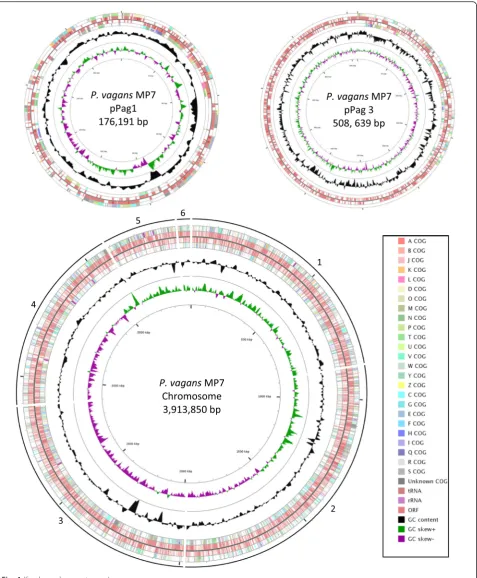
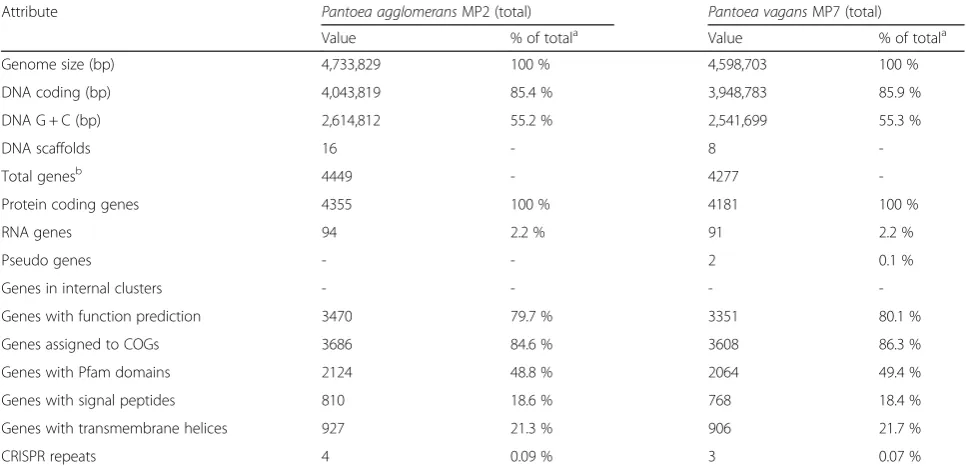
re-spectively (Table 4; Figs. 3 and 4). The
P. agglomerans
MP2 genome includes three closed plasmids which show
high sequence similarity and synteny to pPag1, pPag2
and pPag3 of
P. vagans
C9-1. The genome of
P. vagans
MP7 on the other hand incorporates only copies of
pPag1 and pPag3. The pPag2-harbored herbicolin
bio-synthetic locus of
P. vagans
C9-1 is absent from the
genomes of both MP2 and MP7 [33], while the pPATH
pathogenicity island [37] is likewise absent from both
strains. For
P. agglomerans
MP2, 85.4 % (4,043,819 bp)
of the genome coded for 4,449 genes. Of these, 4,355
genes were protein-coding. For
P. vagans
MP7, 85.9 %
(3,948,783 bp) of the genome coded for 4181
protein-coding genes. The majority of protein-protein-coding genes had
functional predictions using both RAST annotations and
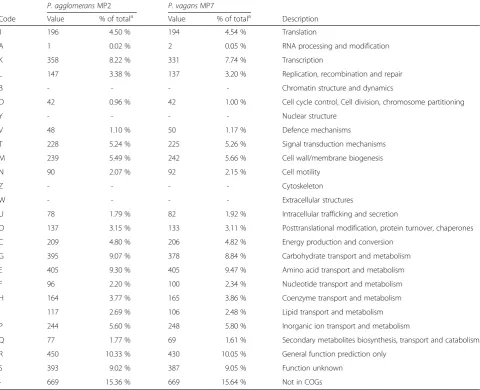
the COG database (Table 4). A high number of genes
code for proteins that are involved in metabolism (COG
codes C, G, E, F, H, I, P and Q) with fewer genes
in-volved in all other classes (Table 5).
Insights from the genome sequences
The genomes of the sequenced isolates were compared
to the publicly available genomes of
P. agglomerans
190
and
P. vagans
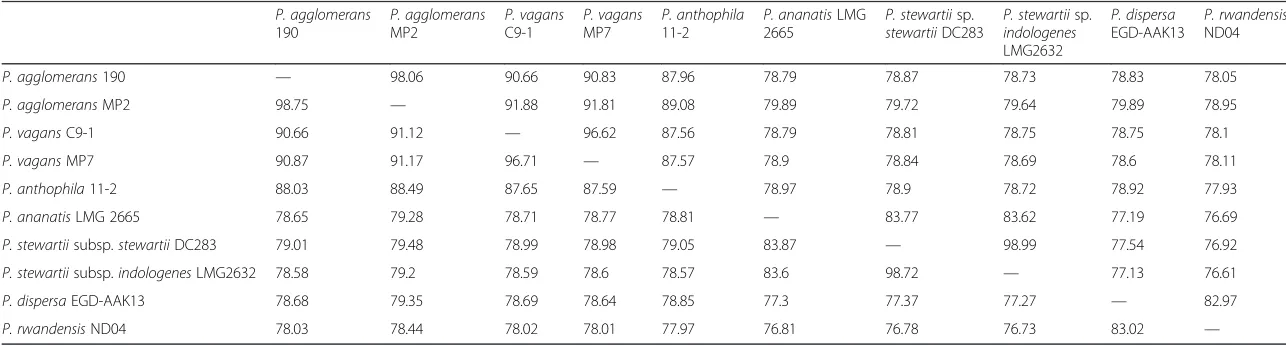
C9-1 [45] to determine the average
nu-cleotide identity [28, 43] values between the isolates
(Table 6). The ANI calculations were done with JSpecies
[43] using the BLAST function, which is based on
frag-menting the genomic sequence into pieces of 1,020
(See figure on previous page.)Fig. 4The genome structure ofP. vagansMP7. The genome consists of 1 chromosome and 2 plasmids. The order of the contigs was based on the complete genome sequence ofP. vagansC9-1 which is publicly available [45]. The contigs varied in size with the largest (contig 2) being approximately 1,010 kbp and the smallest (contig 6) being just below 50 kbp. The predicted ORFs are indicated in the inner tracks and are flanked with the COG classes associated with each of the ORFs. The GC content of the various regions within the genome is indicated in black, with the GC skew indicated in green and purple [48]
Table 4
Nucleotide content and gene count levels of the genomes
Attribute Pantoea agglomeransMP2 (total) Pantoea vagansMP7 (total)
Value % of totala Value % of totala
Genome size (bp) 4,733,829 100 % 4,598,703 100 %
DNA coding (bp) 4,043,819 85.4 % 3,948,783 85.9 %
DNA G + C (bp) 2,614,812 55.2 % 2,541,699 55.3 %
DNA scaffolds 16 - 8
-Total genesb 4449 - 4277
-Protein coding genes 4355 100 % 4181 100 %
RNA genes 94 2.2 % 91 2.2 %
Pseudo genes - - 2 0.1 %
Genes in internal clusters - - -
-Genes with function prediction 3470 79.7 % 3351 80.1 %
Genes assigned to COGs 3686 84.6 % 3608 86.3 %
Genes with Pfam domains 2124 48.8 % 2064 49.4 %
Genes with signal peptides 810 18.6 % 768 18.4 %
Genes with transmembrane helices 927 21.3 % 906 21.7 %
CRISPR repeats 4 0.09 % 3 0.07 %
a
The percentage of total is based on either the size of the genome in base pairs or the total number of protein coding genes in the annotated genome b
nucleotides long and performing similarity searches to
determine homology between the genomic fragments.
The number of shared genes within and between
spe-cies ranged from 3,400 to 3,500. Based on the ANI
values, the isolates grouped with representatives of the
designated species, as species cut-off values are
sug-gested at 95 % for ANI [28].
Conclusion
The two bacteria described in this report were
phylogen-etically and genomically very closely related, but clearly
belonged to different species. The ANI values supported
the identification of isolates MP2 and MP7 as
P.
agglom-erans
and
P. vagans
, respectively.
Their similarity in genomic content may allow
P.
agglomerans
and
P. vagans
to occupy the same or
over-lapping niches and perform the same or similar
functional roles. This is consistent with what has been
observed before where isolates of
P. agglomerans
and
P.
vagans
occur in similar environmental niches and may
even co-occur in the same environment [40]. Although
recombination among micro-organisms occupying the
same niche is common [3, 27], our data indicated that
P.
agglomerans
and
P. vagans
have remained sufficiently
distinct to identify them as separate species. This
sug-gests that their ability to occupy the same niche is likely
a function of their shared genes [13, 30, 35], but that the
integrity of their individual genomic complements is
protected by barriers that limit genetic exchange or gene
flow between these species [14, 47].
Members of the genus
Pantoea
are often considered
generalists that are isolated from a wide variety of
envi-ronments [10, 19, 26]. Large metabolic repertoires
(un-published data, Marike Palmer) may allow species of this
Table 5
Number and proportion of genes associated with 25 COG functional categories
P. agglomeransMP2 P. vagansMP7
Code Value % of totala Value % of totala Description
J 196 4.50 % 194 4.54 % Translation
A 1 0.02 % 2 0.05 % RNA processing and modification
K 358 8.22 % 331 7.74 % Transcription
L 147 3.38 % 137 3.20 % Replication, recombination and repair
B - - - - Chromatin structure and dynamics
D 42 0.96 % 42 1.00 % Cell cycle control, Cell division, chromosome partitioning
Y - - - - Nuclear structure
V 48 1.10 % 50 1.17 % Defence mechanisms
T 228 5.24 % 225 5.26 % Signal transduction mechanisms
M 239 5.49 % 242 5.66 % Cell wall/membrane biogenesis
N 90 2.07 % 92 2.15 % Cell motility
Z - - - - Cytoskeleton
W - - - - Extracellular structures
U 78 1.79 % 82 1.92 % Intracellular trafficking and secretion
O 137 3.15 % 133 3.11 % Posttranslational modification, protein turnover, chaperones
C 209 4.80 % 206 4.82 % Energy production and conversion
G 395 9.07 % 378 8.84 % Carbohydrate transport and metabolism
E 405 9.30 % 405 9.47 % Amino acid transport and metabolism
F 96 2.20 % 100 2.34 % Nucleotide transport and metabolism
H 164 3.77 % 165 3.86 % Coenzyme transport and metabolism
I 117 2.69 % 106 2.48 % Lipid transport and metabolism
P 244 5.60 % 248 5.80 % Inorganic ion transport and metabolism
Q 77 1.77 % 69 1.61 % Secondary metabolites biosynthesis, transport and catabolism
R 450 10.33 % 430 10.05 % General function prediction only
S 393 9.02 % 387 9.05 % Function unknown
- 669 15.36 % 669 15.64 % Not in COGs
a
Table 6
Average nucleotide identity (ANI) values for the sequenced isolates and additional strains representative of the lineages of
Pantoea
P. agglomerans
190
P. agglomerans
MP2
P. vagans
C9-1
P. vagans
MP7
P. anthophila
11-2
P. ananatisLMG 2665
P. stewartiisp.
stewartiiDC283
P. stewartiisp.
indologenes
LMG2632
P. dispersa
EGD-AAK13
P. rwandensis
ND04
P. agglomerans190 — 98.06 90.66 90.83 87.96 78.79 78.87 78.73 78.83 78.05
P. agglomeransMP2 98.75 — 91.88 91.81 89.08 79.89 79.72 79.64 79.89 78.95
P. vagansC9-1 90.66 91.12 — 96.62 87.56 78.79 78.81 78.75 78.75 78.1
P. vagansMP7 90.87 91.17 96.71 — 87.57 78.9 78.84 78.69 78.6 78.11
P. anthophila11-2 88.03 88.49 87.65 87.59 — 78.97 78.9 78.72 78.92 77.93
P. ananatisLMG 2665 78.65 79.28 78.71 78.77 78.81 — 83.77 83.62 77.19 76.69
P. stewartiisubsp.stewartiiDC283 79.01 79.48 78.99 78.98 79.05 83.87 — 98.99 77.54 76.92
P. stewartiisubsp.indologenesLMG2632 78.58 79.2 78.59 78.6 78.57 83.6 98.72 — 77.13 76.61
P. dispersaEGD-AAK13 78.68 79.35 78.69 78.64 78.85 77.3 77.37 77.27 — 82.97
P. rwandensisND04 78.03 78.44 78.02 78.01 77.97 76.81 76.78 76.73 83.02 —
Standards
in
Genomic
Sciences
(2016) 11:23
Page
9
of
genus to form opportunistic associations with many
po-tential hosts including insects [8, 53]. These associations,
as with the biocontrol isolates [41], may be based on the
Pantoea
isolates outcompeting potentially harmful
bac-teria in the respective environments as microbial
antago-nists. This is likely also true for
P. agglomerans
and
P.
vagans
and their association with termites, however
re-cent evidence (unpublished data, Michael Poulsen)
sug-gest that the bacterial species may provide nitrogen
fixation capabilities to the termites. It is possible that the
antimicrobial [21, 22, 41] and metabolic capabilities
(especially pectinolytic and other carbohydrate
degrad-ing enzymes) [8] of these bacteria allow them to
out-compete other, potentially harmful micro-organisms,
while also providing carbohydrates and other
com-pounds for the termites to utilize [20].
Competing interests
The authors declare that they have no competing interests.
Authors’contributions
MPa performed annotations, constructed genome maps, calculated the genome metrics and drafted the manuscript. PDM constructed the genome assemblies, assisted with the submission of sequences, provided guidance for the annotations and revised the manuscript. MPo performed collections and isolations of the isolates and provided support with drafting and revising the manuscript. EVZ provided organism information, performed culturing of the organisms and assisted with submission of isolates and revision of the manuscript. ETS, TAC and SNV participated in the coordination of the study, provided support with interpretation of the data and helped draft the manuscript. All authors read and approved the final manuscript.
Acknowledgements
The authors would like to acknowledge funding from the Danish Council for Independent Research, Natural Sciences (STENO grant: Michael Poulsen), the National Research Foundation (NRF) (RCA Fellowship: Pieter De Maayer) and the NRF/Dept. of Science and Technology Centre of Excellence in Tree Health Biotechnology (CTHB), South Africa. We would like to thank Wai-Yin Chan for assistance with the annotation of the genomes.
Author details
1
Department of Microbiology and Plant Pathology and the Genome Research Institute, University of Pretoria, Pretoria 0002, South Africa. 2
DST-NRF Centre of Excellence in Tree Health Biotechnology, Forestry and Agricultural Biotechnology Institute, University of Pretoria, Pretoria 0002, South Africa.3Centre for Microbial Ecology and Genomics, University of Pretoria, Pretoria 0002, South Africa.4Department of Biology, Centre for Social Evolution, Section for Ecology and Evolution, University of Copenhagen, Univeritetsparken 15, 2100 Copenhagen East, Denmark.
Received: 19 October 2015 Accepted: 20 January 2016
References
1. Adams AS, Jordan MS, Adams SM, Suen G, Goodwin LA, Davenport KW, Currie CR and Raffa KF. Cellulose-degrading bacteria associated with the invasive woodwaspSirex noctilio. ISME J. 2011;5:1323–31.
2. Altschul SF, Madden TL, Schäffer AA, Zhang J, Zhang Z, Miller W, and Lipman DJ. Gapped BLAST and PSI-BLAST: a new generation of protein database search programs. Nucleic Acids Res. 1997;25:3389–402. 3. Andam CP, Gogarten JP. Biased gene transfer in microbial evolution. Nat
Rev Microbiol. 2011;9:543–55.
4. Aylward FO, Suen G, Biedermann PHW, Adams AS, Scott JJ, Malfatti SA, Glavina del Rio T, Tringe SG, Poulsen M, Raffa KF, Klepzig KD, Currie CR. Convergent bacterial microbiotas in the fungal agricultural systems of insects. mBio. 2014;5. doi:10.1128/mBio.02077-14.
5. Aziz R, Bartels D, Best A, DeJongh M, Disz T, Edwards R, Formsma K, Gerdes S, Glass E, Kubal M, Meyer F, Olsen G, Olson R, Osterman A, Overbeek R, McNeil L, Paarmann D, Paczian T, Parrello B, Pusch G, Reich C, Stevens R, Vassieva O, Vonstein V, Wilke A and Zagnitko O. The RAST Server: Rapid Annotations using Subsystems Technology. BMC Genomics. 2008;9:75. 6. Barash I, Manulis-Sasson S. Recent evolution of bacterial pathogens: the
gall-formingPantoea agglomeranscase. Annual Review of Phytopathology. 2009;47:133–52.
7. Bateman A, Birney E, Durbin R, Eddy SR, Howe KL, Sonnhammer ELL. The Pfam protein families database. Nucleic Acids Res. 2000;28:263–6. 8. Behar A, Jurkevitch E, Yuval B. Bringing back the fruit into fruit fly–bacteria
interactions. Mol Ecol. 2008;17:1375–86.
9. Brady CL, Cleenwerck I, Venter SN, Engelbeen K, De Vos P and Coutinho TA: Emended description of the genus Pantoea, description of four species from human clinical samples, Pantoea septica sp. nov., Pantoea eucrina sp. nov., Pantoea brenneri sp. nov. and Pantoea conspicua sp. nov., and transfer of Pectobacterium cypripedii (Hori. Brenner et al. 1973 emend. Hauben et al. 1998 to the genus asPantoea cypripediicomb. nov. Int J Syst Evol Microbiol. 1911;2010(60):2430–40.
10. Brady CL, Venter SN, Cleenwerck I, Engelbeen K, Vancanneyt M, Swings J, and Coutinho TA.Pantoea vaganssp. nov.,Pantoea eucalyptisp. nov., Pantoea deleyisp. nov. andPantoea anthophilasp. nov. Int J Syst Evol Microbiol. 2009;59:2339–45.
11. Brady CL, Cleenwerck I, Van der Westhuizen L, Venter SN, Coutinho TA, De Vos P.Pantoea rodasiisp. nov.,Pantoea rwandensissp. nov. andPantoea wallisiisp. nov., isolated from Eucalyptus. International journal of systematic and evolutionary microbiology. 2012;62:1457–64.
12. Cataño JC, Echeverri LM, Szela C. Bacterial contamination of clothes and environmental items in a third-level hospital in Colombia. Interdiscip Perspect Infect Dis. 2012. doi:10.1155/2012/507640.
13. Coenye T, Gevers D, Van de Peer Y, Vandamme P, Swings J. Towards a prokaryotic genomic taxonomy. FEMS Microbiol Rev. 2005;29:147–67. 14. Cohan FM. What are bacterial species? Annu Rev Microbiol. 2002;56:457–87. 15. Cruz AT, Cazacu AC, Allen CH.Pantoea agglomerans–a plant pathogen
causing human disease. J Clin Microbiol. 2007;45(6):1989–1992. 16. Darling AE, Mau B, Perna NT. progressiveMauve: multiple genome
alignment with gene gain, loss and rearrangement. PLoS ONE. 2010;5: e11147.
17. De Baere T, Verhelst R, Labit C, Verschraegen G, Wauters G, Claeys G, and Vaneechoutte M. Bacteremic infection withPantoea ananatis. J Clin Microbiol. 2004;42:4393–5.
18. De Champs C, Le Seaux S, Dubost JJ, Boisgard S, Sauvezie B, Sirot J. Isolation ofPantoea agglomeransin two cases of septic monoarthritis after plant thorn and wood sliver injuries. J Clin Microbiol. 2000;38:460–1. 19. De Maayer P, Chan W-Y, Blom J, Venter S, Duffy B, Smits T, and Coutinho
TA. The large universalPantoeaplasmid LPP-1 plays a major role in biological and ecological diversification. BMC Genomics. 2012;13:625. 20. De Vries EJ, Jacobs G, Sabelis MW, Menken SB, Breeuwer JA. Diet–dependent
effects of gut bacteria on their insect host: the symbiosis ofErwiniasp. and western flower thrips. Proc R Soc Lond Ser B-Biol Sci. 2004;271:2171–8. 21. Dillon RJ, Charnley AK. Chemical barriers to gut infection in the desert
locust: in vivo production of antimicrobial phenols associated with the bacteriumPantoea agglomerans. J Invertebr Pathol. 1995;66:72–5. 22. Dillon RJ, Dillon VM. The gut bacteria of insects: nonpathogenic interactions.
Annu Rev Entomol. 2004;49:71–92.
23. Garrity GM, Bell JA, Lilburn T. Phylum XIV.Proteobacteriaphyl. nov. In: Garrity GM, Brenner DJ, Krieg NR, Staley JT, editors. Bergey’s manual of systematic bacteriology, second edition, volume 2, part B. New York: Springer; 2005. p. 1. 24. Garrity GM, Bell JA, Lilburn T. Class III.Gammaproteobacteriaclass. nov. In:
Garrity GM, Brenner DJ, Krieg NR, Staley JT, editors. Bergey’s manual of systematic bacteriology, second edition, volume 2, part B. New York: Springer; 2005. p. 1.
25. Garrity GM, Holt JG. Taxonomic outline of theArchaeaandBacteria. In: Garrity GM, Boone DR, Castenholz RW, editors.Bergey’s manual of systematic bacteriology, second edition, volume 2, part B. 2nd edition. New York: Springer; 2001. 26. Gavini F, Mergaert J, Beji A, Mielcarek C, Izard D, Kersters K, and De Ley J.
Transfer ofEnterobacter agglomerans(Beijerinck 1888) Ewing and Fife 1972 toPantoeagen. nov. asPantoea agglomeranscomb. nov. and description of Pantoea dispersasp. nov. Int J Syst Bacteriol. 1989;39:337–45.
28. Goris J, Konstantinidis KT, Klappenbach JA, Coenye T, Vandamme P, Tiedje JM. DNA-DNA hybridization values and their relationship to whole-genome sequence similarities. Int J Syst Evol Microbiol. 2007;57:81–91.
29. Grissa I, Vergnaud G, Pourcel C. CRISPRFinder: a web tool to identify clustered regularly interspaced short palindromic repeats. Nucleic Acids Res. 2007;35:W52–7. 30. Hacker J, Carniel E. Ecological fitness, genomic islands and bacterial
pathogenicity. EMBO reports. 2001;2:376–81.
31. Hollis DG, Hickman FW, Fanning GR, Farmer JJ, Weaver RE, Brenner DJ.Tatumella ptyseosgen. nov., sp. nov., a member of the family Enterobacteriaceae found in clinical specimens. J Clin Microbiol. 1981;14:79–88.
32. Käll L, Krogh A, Sonnhammer ELL. Advantages of combined transmembrane topology and signal peptide prediction: the Phobius web server. Nucleic Acids Res. 2007;35:W429–32.
33. Kamber T, Smits TM, Rezzonico F, Duffy B. Genomics and current genetic understanding ofErwinia amylovoraand the fire blight antagonistPantoea vagans. Trees. 2012;26:227–38.
34. Kim WS, Gardan L, Rhim SL, Geider K.Erwinia pyrifoliaesp. nov., a novel pathogen that affects Asian pear trees (Pyrus pyrifoliaNakai). International Journal of Systematic Bacteriology. 1999;49(2):899–906.
35. Lan R, Reeves PR. Intraspecies variation in bacterial genomes: the need for a species genome concept. Trends Microbiol. 2000;8:396–401.
36. Lanave C, Preparata G, Sacone C, Serio G. A new method for calculating evolutionary substitution rates. J Mol Evol. 1984;20:86–93.
37. Manulis S, Barash I.Pantoea agglomeranspvs.gypsophilaeandbetae, recently evolved pathogens? Mol Plant Pathol. 2003;4:307–14. 38. Mergaert J, Verdonck L, Kersters K. Transfer ofErwinia ananas, synonym,
Erwinia uredovoraandErwinia stewartiito the genusPantoeaemend. as Pantoea ananas, Serrano 1928 comb. nov. andPantoea stewartii, Smith 1898 comb. nov., respectively, and description ofPantoea stewartiisubsp. indologenessubsp. nov. Int J Syst Bacteriol. 1993;43:162–73.
39. Mergaert J, Hauben L, Cnockaert MC, Swings J. Reclassification of non-pigmentedErwinia herbicolastrains from trees as Erwinia billingiae sp. nov. Int J Syst Bacteriol. 1999;49:377–83.
40. Otani S, Mikaelyan A, Nobre T, Hansen LH, Koné NA, Sørensen SJ, Aanen DK, Boomsma JJ, Brune A and Poulsen M. Identifying the core microbial community in the gut of fungus-growing termites. Mol Ecol. 2014;23:4631–44. 41. Pusey PL. Biological control agents for fire blight of apple compared under
conditions limiting natural dispersal. Plant Dis. 2002;86:639–44. 42. Rahn O. New principles for the classification of bacteria. Zentralblatt für
Bakteriologie, Parasitenkunde, Infektionskrankheiten und Hygiene Abteilung II. 1937;96:273–86.
43. Richter M, Rosselló-Móra R. Shifting the genomic gold standard for the prokaryotic species definition. Proc Natl Acad Sci. 2009;106:19126–31. 44. Skerman VBD, McGowan V, Sneath PHA. Approved lists of bacterial names.
Int J Syst Bacteriol. 1980;30:225–420.
45. Smits THM, Rezzonico F, Kamber T, Goesmann A, Ishimaru CA, Stockwell VO, Frey JE and Duffy B. Genome sequence of the biocontrol agentPantoea vagansstrain C9-1. J Bacteriol. 2010;192:6486–7.
46. Smits THM, Rezzonico F, Pelludat C, Goesmann A, Frey JE, Duffy B. Genomic and phenotypic characterization of a nonpigmented variant ofPantoea vagansbiocontrol strain C9-1 lacking the 530-kb megaplasmid pPag3. FEMS Microbiol Letters. 2010;308:48–54.
47. Sorek R, Zhu Y, Creevey CJ, Francino MP, Bork P, Rubin EM. Genome-wide experimental determination of barriers to horizontal gene transfer. Science. 2007;318:1449–52.
48. Stothard P, Wishart DS. Circular genome visualization and exploration using CGView. Bioinformatics. 2004;21:537–9.
49. Tamura K, Stecher G, Peterson D, Filipski A, Kumar S. MEGA6: Molecular Evolutionary Genetics Analysis Version 6.0. Mol Biol Evol. 2013;30:2725–9. 50. Tatusov RL, Galperin MY, Natale DA, Koonin EV. The COG database: a tool
for genome-scale analysis of protein functions and evolution. Nucleic Acids Res. 2000;28:33–6.
51. Validation of publication of new names and new combinations previously effectively published outside the IJSEM. List no. 106. Int J Syst Evol Microbiol. 2005;55:2235–38.
52. Validation of the publication of new names and new combinations previously effectively published outside the IJSB. List No. 8. Int J Syst Bacteriol. 1982;32:266–68.
53. Vorwerk S, Martinez-Torres D, Forneck A.Pantoea agglomerans-associated bacteria in grape phylloxera (Daktulosphaira vitifoliae, Fitch). Agric For Entomol. 2007;9:57–64.
54. Whitman WB, Goodfellow M, Kämpfer P, Busse HJ, Trujillo ME, Suzuki K, and Ludwig W. Bergey’s manual® of systematic bacteriology (vol 5). New York: Springer; 2012.
55. Winslow CEA, Broadhurst J, Buchanan RE, Krumwiede C, Rogers LA, Smith GH. The families and genera of the bacteria: final report of the committee of the society of American bacteriologists on characterization and classification of bacterial types. J Bacteriol. 1920;5:191–229.
56. Zerbino DR, Birney E. Velvet: algorithms for de novo short read assembly using de Bruijn graphs. Genome Res. 2008;18:821–9.
57. Zhang Y, Qiu S. Examining phylogenetic relationships ofErwiniaand Pantoeaspecies using whole genome sequence data. Antonie van Leeuwenhoek. 2015;108:1037–46.
• We accept pre-submission inquiries
• Our selector tool helps you to find the most relevant journal
• We provide round the clock customer support
• Convenient online submission
• Thorough peer review
• Inclusion in PubMed and all major indexing services
• Maximum visibility for your research
Submit your manuscript at www.biomedcentral.com/submit