SETTLING TANKS
•
THEORY
•
OPERATION
THEORY
• Also referred as ‘SEDIMENTATION TANKS’.
• Settling- process by which particulates settle to the bottom of a liquid and form a sediment.
• Particles experience a force, either due to gravity or due to centrifugal motion; tend to move in a uniform manner in the direction exerted by that force.
• Gravity settling- the particles will tend to fall to the bottom of
the vessel, forming a slurry at the vessel base.
• For dilute particle solutions, two main forces enacting upon
Settling or Sedimentation
•
Settling- a unit operation in which solids are drawn toward a
source of attraction. The particular type of settling that will be discussed in this section is gravitational settling. It should be noted that settling is different from sedimentation.Recirculating Aquaculture Systems Short Course
Removal Mechanisms
Gravity separation
Settling tanks, tube settlers and hydro cyclones
Filtration
Screen, Granular media, or porous media filter
Flotation
Recirculating Aquaculture Systems Short Course
Settling Basins
Advantages
• Simplest technologies
• Little energy input
• Relatively inexpensive to install and operate
• No specialized operational skills
• Easily incorporated into new or existing facilities
18 D ) ( g V 2 p p s
Disadvantages
• Low hydraulic loading rates
• Poor removal of small suspended solids • Large floor space requirements
Recirculating Aquaculture Systems Short Course
Solids Physical Characteristics
•
particle specific gravity
•
particle size distribution
Two most important physical
DESIGN
In specifying a water and wastewater sedimentation tank size, the major features to be considered are:
- tank cross sectional area, - tank depth,
and type of cleaning mechanism used.
In specifying a design basis for water and wastewater sedimentation tanks; three conditions are commonly considered:
- solid handling capacity (kg/day), - overflow rate (lpm/m2),
- detention time.
Recirculating Aquaculture Systems Short Course
Sedimentation
Stokes Law
•
Denser and large particles have a
higher settling velocity
18 D ) ( g V 2 p p s
18
)
(
p p2s
D
g
Recirculating Aquaculture Systems Short Course
Settling Basins
•
Design to minimize turbulence:
chamfered weir to enhance laminar flow
(85% of water depth)
full-width weir
inlet outlet
effective settling zone
1–2 m
length:width = 4:1 to 8:1
Recirculating Aquaculture Systems Short Course
Settling Basins
•
Overflow rates are used for design: V
o)
(
)
/
(
2 3m
area
surface
settling
s
m
Rate
Flow
Rate
Overflow
settling surface area = length x width
width length
Recirculating Aquaculture Systems Short Course
Settling Basin Design
"Rule of Thumb"
Settling Basin Design
basin floor area of 41 Lpm per m2 of flow.
250 to 410 Lpm per m width of weir for outflow.
submerge inlet weir 15% of basin water depth.
use 25 cm wide weirs and use rounded edges .
Settling (Sedimentation)
Settling Tanks, Basins, or Clarifiers
Generally, two types of sedimentation basins (also called tanks, or clarifiers) are used:
Rectangular and Circular.
Rectangular settling, basins or clarifiers, are basins that are rectangular in plans and cross sections. In plan, the length may vary from two to four times the width.
Circular Basin
Basin Model
Settling Model
Settling Model
A particle that is just removed has a settling velocity v
0.
This trajectory represents a particle which has a settling velocity v0
v
0= h / t = Q / A
Where: t = V/Q
Critical Settling Velocity and Overflow Rate
Critical Settling Velocity and Overflow Rate
v0 expressed in units of velocity (ft/s) is the critical settling velocity
Critical settling velocity is the settling velocity of particles which are 100% removed in the basin
v
v00 expressed in units of flow per unit area is called the expressed in units of flow per unit area is called the
As you can see the only difference between the critical settling velocity and the overflow rate is the type of unit used to express the number
The critical settling velocity and the overflow rate are the same number, but proper units should be used to express each
Since smaller particles have lower settling velocities, if you want to remove smaller particles in the settling basin you have to have a
lower overflow rate.
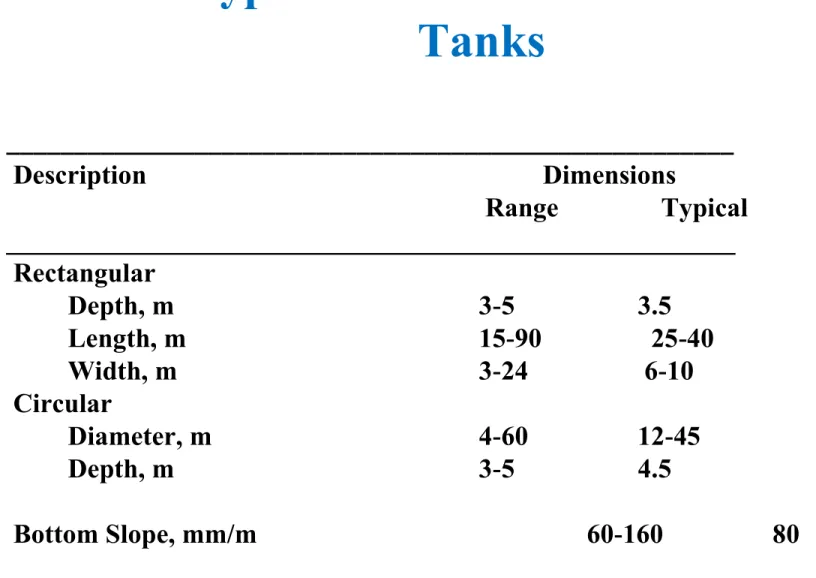
Table 1 Typical Dimensions of Sedimentation
Tanks
______________________________________________________
Description Dimensions
Range Typical ______________________________________________________ Rectangular
Depth, m 3 5 3.5 ‑
Length, m 15 90 25 40 ‑ ‑
Width, m 3 24 6 10‑ ‑
Circular
Diameter, m 4 60 12 45‑ ‑
Depth, m 3 5 4.5‑
Bottom Slope, mm/m 60 160 80‑
Example 1
Example 1
A water treatment plant has a flow rate of 0.6 m
A water treatment plant has a flow rate of 0.6 m33/sec. The settling basin at the /sec. The settling basin at the
plant has an effective settling volume that is 20 m long, 3 m tall and 6 m wide.
plant has an effective settling volume that is 20 m long, 3 m tall and 6 m wide.
Will particles that have a settling velocity of 0.004 m/sec be completely
Will particles that have a settling velocity of 0.004 m/sec be completely
removed? If not, what percent of the particles will be removed?
removed? If not, what percent of the particles will be removed?
v
v00 = Q/A = 0.6 m/sec / (20 m x 6 m) = 0.005 m/sec = Q/A = 0.6 m/sec / (20 m x 6 m) = 0.005 m/sec
Since v
Since v00 is greater than the settling velocity of the particle of interest, is greater than the settling velocity of the particle of interest, they will
they will notnot be completely removed. be completely removed.
The percent of particles which will be removed may be found using the
The percent of particles which will be removed may be found using the
following formula:
following formula:
Percent removed = (v
Percent removed = (vpp / v / v00) 100) 100
= (0.004/0.005) 100 = 80 %
Example 2
Example 2
How big would the basin need to be to remove 100% of the particles that
How big would the basin need to be to remove 100% of the particles that
have a settling velocity of 0.004 m/sec?
have a settling velocity of 0.004 m/sec?
v
v00 = Q / A = Q / A
0.004 = 0.6 / A
0.004 = 0.6 / A
A = 150 m
A = 150 m33
If the basin keeps the same width (6 m):
If the basin keeps the same width (6 m):
A = 150 m
A = 150 m33 = 6m x L = 6m x L
L = 25 m
Sludge zone W id th , W Length, L Water Level Particle trajectory Settling zone Sl u d ge z o n e d ep th Fr ee B o ar d Si d e W at er D ep th H0
D
H
H0 0.5 m Port 1 to 7
D= 15-20 cm H= 2-4 m
Example
• Example Batch Settling test results reduction analysis for sample port no. 1 • Plot a grid showing percent TSS removal at each port at different time intervals
• Draw lines of equal % removal (isoremoval). These lines are drawn similarly to contour lines.
• Draw vertical line at each point an iso removal line intersects the x-axis (3.5 m depth). List the observations
Time, min TSS removed, mg/l Removal efficiency, %
0 200 0 ?
10 134 66 ?
20 75 125 ?
30 51 149 ?
•
Observations
•
For example, the R=60% isoremoval curve
intercept the x-axis at 38 minutes. The 60%
settling time t is therefore 38 min.
•
90% of the particles have settled 0.51 m or
more.
•
80% of the particles have settled 0.72 m or
more
•
Likewise, 70 % and 60% of the particles have
Port No.
Dept h, m
Sampling time, min
10 20 30 40 50 60 70 80 90
1 0.5 33 62 74 90
2 1.0 21 41 65 71 80 89 90
3 1.5 16 36 59 67 74 81 86 91
4 2.0 17 33 56 64 71 78 82 88 91
5 2.5 14 32 54 64 70 78 82 85 88
6 3.0 14 30 52 63 69 75 81 83 85