Product Development
PR_H8309.indd i
Product Development
A Structured Approach to Consumer
Product Development, Design,
and Manufacture
Anil Mital
Anoop Desai
Anand Subramanian
Aashi Mital
AMSTERDAM • BOSTON • HEIDELBERG • LONDON NEW YORK • OXFORD • PARIS • SAN DIEGO SAN FRANCISCO • SINGAPORE • SYDNEY • TOKYO
Butterworth-Heinemann is an imprint of Elsevier
PR_H8309.indd iii
Linacre House, Jordan Hill, Oxford OX2 8DP, UK Copyright © 2008 by Elsevier Inc. All rights reserved.
No part of this publication may be reproduced, stored in a retrieval system, or transmitted in any form or by any means, electronic, mechanical, photocopying, recording, or otherwise, without the prior written permission of the publisher.
Permissions may be sought directly from Elsevier’s Science & Technology Rights Department in Oxford, UK: phone: (+44) 1865 843830, fax: (+44) 1865 853333, E-mail: [email protected]. You may also complete your request on-line via the Elsevier homepage (http://elsevier.com), by selecting “Support & Contact” then “Copyright and Permission” and then “Obtaining Permissions.”
Recognizing the importance of preserving what has been written, Elsevier prints its books on acid-free paper whenever possible.
Library of Congress Cataloging-in-Publication Data
Product development : a structured approach to consumer product development, design, and manufacture / Anil Mital . . . [et al.].
p. cm.
Includes bibliographical references and index.
ISBN 978-0-7506-8309-8 (hardcover : alk. paper) 1. New products — Management. 2. New products — Marketing. 3. Strategic planning. I. Mital, Anil.
HF5415.153. p7484 2007 658.5′75 — dc22
2007029384 British Library Cataloguing-in-Publication Data
A catalogue record for this book is available from the British Library. ISBN: 978-0-7506-8309-8
For information on all Butterworth–Heinemann publications visit our Web site at www.books.elsevier.com
Printed in the United States of America
07 08 09 10 11 12 10 9 8 7 6 5 4 3 2 1
Working together to grow
libraries in developing countries
www.elsevier.com | www.bookaid.org | www.sabre.org
PR_H8309.indd iv
To our families, friends, and colleagues
PR_H8309.indd v
Table of Contents
Preface xv
Biographical Sketches xvii
Chapter 1
The Signifi cance of Manufacturing
1.1 Globalization and the World Economy 1
1.2 Importance of Manufacturing 4
1.3 What Is Manufacturing? 6
1.4 Some Basic Concepts 7
1.4.1 Capital Circulation or the Production Turn 8 1.4.2 Manufacturing Capability 9
1.4.3 Mass Production 9 1.4.4 Interchangeability 10 1.4.5 Product Life Cycle 10
1.4.6 The S Curve of the Technology Growth Cycle 11
1.4.7 Simultaneous or Concurrent Engineering 11
1.4.8 Design for ‘X’ 12
1.4.9 The Engineering Problem-Solving Process 13
1.5 Summary 15 References 15
Chapter 2
Developing Successful Products
2.1 Introduction 17
2.2 Attributes of Successful Product Development 18
2.3 Key Factors to Developing Successful New Products 19
2.3.1 Uniqueness 19
2.3.2 Customer Focus and Market Orientation 20 2.3.3 Doing the Homework 20
vii
PR_H8309.indd vii
2.3.4 Sharp and Early Product Defi nition 20 2.3.5 Execution of Activities 21
2.3.6 Organizational Structure and Climate 21 2.3.7 Project Selection Decisions 21
2.3.8 Telling the World You Have a Good Product 22 2.3.9 Role of the Top Management 22
2.3.10 Speed without Compromising Quality 22
2.3.11 Availability of a Systematic New Product Process 23 2.3.12 Market Attractiveness 23
2.3.13 Experience and Core Competencies 23 2.3.14 Miscellaneous Factors 24
2.4 Strategy for New Product Development 25
2.4.1 Determining the Company’s Growth Expectation from New Products 25
2.4.2 Gathering Strategic Information 25 2.4.3 Determining Existing Opportunities 26 2.4.4 Developing a List of New Product Options 28
2.4.5 Setting Criteria for Product Inclusion in the Portfolio 28 2.4.6 Creating the Product Portfolio 28
2.4.7 Managing the Portfolio 28 2.4.8 Developing New Product Plans 29
2.4 Summary 36 References 36
Chapter 3
The Structure of the Product Design Process
3.1 What Is Design? 37
3.2 The Changing Design Process 38
3.3 Design Paradigms 40
3.3.1 The Need for a Model 41 3.3.2 The Need for Redundancy 42 3.3.3 The Scale Effect 42
3.3.4 Avoiding Starting Problem Analysis in the Middle 46 3.3.5 Avoiding Confi rming a False Hypothesis 46
3.3.6 Avoiding Tunnel Vision 49
3.4 The Requirements for Design 49
3.5 The Design Process 50
3.5.1 Problem Confronting the Designers 50 3.5.2 Steps of the Engineering Design Process 52 3.5.3 Defi ning the Problem and Setting Objectives 52
3.5.4 Establishing Functions, Setting Requirements, and Developing Specifi cations 60
3.5.5 Developing Provisional Designs 63 3.5.6 Evaluation and Decision-Making 66
3.6 Summary 67 References 70
PR_H8309.indd viii
Chapter 4
Design Review: Designing to Ensure Quality
4.1 Introduction 71
4.1.1 Why Quality Control? 72
4.1.2 Reactive versus Proactive Quality Control 73
4.2 Procedures for Incorporating High Quality in Design Stages 74
4.2.1 Six Sigma 74
4.2.2 Mistake Proofi ng (Poka-Yoke) 75
4.2.3 Quality Function Deployment 76 4.2.4 Design Review 79
4.3 Case Studies 84
4.3.1 A Design Review Case Study 84 4.3.2 A Six Sigma Case Study 84
References 90
Chapter 5
Consideration and Selection of Materials
5.1 Importance of Material Selection in Product Manufacture 93
5.2 Economics of Material Selection 96
5.3 Material Selection Procedures 96
5.3.1 Grouping Materials in Families 96
5.3.2 Grouping Materials Based on Process Compatibility 97 5.3.3 Super Materials and Material Substitution 99
5.3.4 Computer-Aided Material Selection 99
5.4 Design Recommendations 102
5.4.1 Minimize Material Costs 102 5.4.2 Ferrous Metals, Hot-Rolled Steel 103 5.4.3 Ferrous Metals, Cold-Finished Steel 103 5.4.4 Ferrous Metals, Stainless Steel 106 5.4.5 Nonferrous Metals 106
5.4.6 Nonmetals 107
References 111
Chapter 6
Selection of Manufacturing Processes and Design Considerations
6.1 Introduction 113
6.1.1 Primary Processes 113 6.1.2 Secondary Processes 114 6.1.3 Tertiary Processes 116
6.2 Design Guidelines 116
6.2.1 Design Guidelines for Casting 116 6.2.2 Design Guidelines for Forging 121 6.2.3 Design Guidelines for Extrusion 122 6.2.4 Design Guidelines for Metal Stamping 123
6.2.5 Design Guidelines for Powdered Metal Processing 124
PR_H8309.indd ix
6.2.6 Design Guidelines for Fine-Blanked Parts 125 6.2.7 Design Guidelines for Machined Parts 127 6.2.8 Design Guidelines for Screw-Machine Parts 130 6.2.9 Design Guidelines for Milling 131
6.2.10 Design Guidelines for Planing and Shaping 132 6.2.11 Design Guidelines for Screw Threads 132 6.2.12 A Typical Part Drawing and Routing Sheet 133
References 134
Chapter 7
Designing for Assembly and Disassembly
7.1 Introduction 135
7.1.1 Defi nition and the Importance of the Assembly Process 135 7.1.2 Defi nition and the Importance of the Disassembly Process 135
7.2 Design for Assembly 136
7.2.1 Defi nition 136
7.2.2 Different Methods of Assembly 136
7.3 Design Guidelines for Different Modes of Assembly 137
7.3.1 Manual Assembly 137 7.3.2 Automatic Assembly 139 7.3.3 Robotic Assembly 140
7.4 Methods for Evaluating Design for Assembly 140
7.4.1 The Hitachi Assemblability Evaluation Method 141 7.4.2 Lucas DFA Evaluation Method 142
7.4.3 The Boothroyd-Dewhurst DFA Evaluation Method 144
7.5 A Design for Assembly Method Based on MTM Standards 149
7.6 A Design for Assembly Case Study 151
7.7 Design for Disassembly 153
7.7.1 Defi nition 153
7.7.2 Disassembly Process Planning 156
7.8 Design for Disassembly Guidelines 157
7.9 Disassembly Algorithms 159
7.9.1 Product Recovery Approach 159
7.9.2 Optimal Disassembly Sequence Planning for Product Recovery 160
7.9.3 Disassembly Sequence Planning for a Product with Defective Parts 162
7.9.4 Evaluation of Disassembly Planning Based on Economic Criteria 162
7.9.5 Geometric Models and CAD Algorithms to Analyze Disassembly Planning 164
7.9.6 Automation of Disassembly Technology and Predicting Future Trends 164
7.10 A Proactive Design for Disassembly Method Based on MTM Standards 165
7.11 A Design for Disassembly Case Study 166
7.12 Concluding Remarks 176
References 177
PR_H8309.indd x
Chapter 8
Designing for Maintenance
8.1 Introduction 179
8.1.1 Importance of Designing for Maintenance 179 8.1.2 Factors Affecting Ease of Maintenance 180
8.2 Maintenance Elements and Concepts 182
8.2.1 Maintenance Elements 182 8.2.2 Maintenance Concepts 182
8.2.3 Design Review for Maintainability: Planning for Maintenance and Its Management 186
8.3 Mathematical Models for Maintainability 190
8.3.1 Simple Models 191
8.3.2 An Integrated Approach to Maintenance 192 8.3.3 Capital Replacement Modeling 193
8.3.4 Inspection Maintenance 193 8.3.5 Condition-Based Maintenance 193
8.3.6 Maintenance Management Information Systems 194
8.4 Prediction Models for Maintenance 195
8.4.1 The RCA Method 195
8.4.2 The Federal Electric Method 198 8.4.3 The Martin Method: TEAM 199
8.4.4 The RCM Method: Maintenance Management 201 8.4.5 Design Attributes for Enhancing Maintainability 203 8.4.6 The SAE Maintainability Standard 204
8.4.7 The Bretby Maintainability Index 209
8.5 A Comprehensive Design for a Maintenance Methodology Based on Methods
Time Measurement 214
8.5.1 A Numeric Index to Gauge the Ease of Maintenance 215 8.5.2 Role of Work Standards and Standard Times 218
8.5.3 Common Maintenance Procedures and the Parameters Affecting Them 218
8.5.4 Provision for Additional Allowances for Posture, Motion, Energy, and Personnel Requirements 218
8.5.5 Design Parameters Affecting Premaintenance Operations 220 8.5.6 Structure of the Index 222
8.5.7 Using the Index 227
8.5.8 Priority Criteria for Design Evaluation 227
8.6 Developing and Evaluating an Index 228
8.6.1 Numeric Index and Design Method for Disassembly and Reassembly 228
8.6.2 Numeric Index and Design Method for Maintenance 229 8.6.3 Priority Criteria for Maintenance 229
8.6.4 A Holistic Method for Maintainability 231 8.6.5 Design Modifi cations and Measures to Enhance Ease of
Maintenance 232
8.7 Design for Maintenance Case Study 232
8.8 Concluding Remarks 236
References 237
PR_H8309.indd xi
Chapter 9
Designing Products for Functionality
9.1 Introduction 241
9.1.1 Defi nition and Importance of Functionality 241 9.1.2 Factors Affecting Functionality 241
9.2 Concurrent Engineering in Product Design 242
9.2.1 Functionality in Design 244
9.2.2 Function and Functional Representations: Defi nitions 244
9.3 A Generic, Guideline-Based Method for Functionality 247
9.3.1 Phase 1. Development of Generic Criteria for Functionality 248 9.3.2 Phase 2. Validation and Testing of Developed Criteria and
Processes 249
9.4 The Procedure for Guideline Development 251
9.5 Functionality Case Study: Can Opener 254
9.5.1 Can Opener Architecture 254
9.5.2 Can Opener Manufacturing Processes 254
9.5.3 Guideline Development Process for the Can Opener 255 9.5.4 Identifi cation of Important Manufacturing Variables Affecting
Functionality 255
9.5.5 Functionality-Manufacturing Links 256 9.5.6 Survey Development 258
9.5.7 Statistical Analysis and Testing 261 9.5.8 Hypothesis Test Results 268 9.5.9 Discussion of the Results 269
9.6 Functionality Case Study: Automotive Braking System 270
9.6.1 The Function of an Automotive Braking System 270 9.6.2 The Components of an Automotive Braking System 271 9.6.3 Wheel Cylinder Architecture 271
9.6.4 Wheel Cylinder Manufacturing Processes 271
9.6.5 Guideline Development Procedure for the Automotive Brake System 272
9.6.6 Functionality-Manufacturing Links 274 9.6.7 Survey Development 280
9.6.8 Testing and Statistical Analysis 280 9.6.9 Discussion of the Results 292
References 293
Chapter 10
Design for Usability
10.1 Introduction 295
10.2 Criteria for Designing and Manufacturing Usable Consumer
Products 296
10.2.1 Functionality 296 10.2.2 Ease of Operation 297 10.2.3 Aesthetics 298 10.2.4 Reliability 298
PR_H8309.indd xii
10.2.5 Serviceability and Maintainability 299 10.2.6 Environmental Friendliness 300 10.2.7 Recyclability and Disposability 301 10.2.8 Safety 301
10.2.9 Customizability 302
10.3 Design Support Tools and Methodologies 303
10.3.1 Design for Producibility 303 10.3.2 Design for Assembly 303 10.3.3 Robust Design 304 10.3.4 Group Technology 304
10.3.5 Quality Function Deployment 305
10.4 Design Methodology for Usability 305
10.4.1 Development of Generic Usability Evaluation Checklists 305 10.4.2 Development of Generic Design and Manufacturing
Checklists 306
10.4.3 Reliability and Validity Testing 307
10.4.4 Testing the Effectiveness of the Design/Manufacturing Guidelines 307
10.5 Generic Checklist Design: Methods and Case Studies 307
10.5.1 Product Development for the Usability of a Can Opener 308 10.5.2 Product Development for the Usability of a Toaster 318 10.5.3 Checklists for Evaluating the Usability of a
Consumer Product 327
10.6 Case Study for the Development of Customized Checklists 345
10.6.1 Gauging User Requirements 345 10.6.2 Technical Requirements 348
10.6.3 Product and Process Characteristics 350 10.6.4 Manufacturing Process Attributes 353
10.6.5 Development of Usability and Design Checklists 356
10.7 Concluding Remarks 365
References 365
Chapter 11
Establishing the Product Selling Price
11.1 Why Estimate Costs? 369
11.2 Cost and Price Structure 370
11.3 Information Needs and Sources 373
11.4 Estimating Direct and Indirect Costs 374
11.4.1 Direct Labor Costs 374 11.4.2 Direct Material Costs 376 11.4.3 Indirect or Overhead Costs 380
11.4.4 An Example 381
11.5 Product Pricing Methods 382
11.5.1 Conference and Comparison Method 383 11.5.2 Investment Method 383
11.5.3 Full Cost Method 383
11.5.4 Direct Costing or Contribution Method 383
PR_H8309.indd xiii
11.6 Summary 383 References 384
Chapter 12
Assessing the Market Demand for the Product
12.1 Why Assess the Market Demand? 385
12.2 Methods for Assessing the Initial Demand 387
12.2.1 Expert Evaluation Technique 387 12.2.2 Jury of Executive Opinion 387 12.2.3 Delphi Method 388
12.2.4 Sales Force Composite 388
12.2.5 Supply Chain Partner Forecasting 388 12.2.6 Market Research 388
12.2.7 Decision Tree Diagram 390
12.2.8 Market Potential–Sales Requirement Method 391
12.3 Methods for Determining the Annual Growth 391
12.3.1 Graphical Displays of Data 391 12.3.2 Constant Mean Model 394 12.3.3 Linear Model 395
12.3.4 Quadratic Model 395 12.3.5 Exponential Model 397
12.4 Adjusting for Seasonal Fluctuations 398
12.4.1 Naive Model 398
12.4.2 Moving Average Model 398 12.4.3 Exponential Smoothing 400
12.5 Summary 401
Chapter 13
Planning the Product Manufacturing Facility Design
13.1 Introduction 403
13.2 Determining the Location of the Manufacturing Facility 404
13.3 Developing the Preliminary Design for the Manufacturing Facility 407
13.3.1 Determining Space Requirements 407 13.3.2 Assembly Line Balancing 409 13.3.3 Systematic Layout Planning 412
13.4 Summary 415 References 416
Postscript 417 Index 419
PR_H8309.indd xiv
Preface
Manufacturing is essential for generating wealth and improving the standard of living. Histori-cally, developed countries have devoted at least 20% of their gross domestic product (GDP) to manufacturing. It is unlikely that any nation would achieve the “developed” status without a signifi cant proportion of its GDP-related activities devoted to manufacturing. Furthermore, the manufacturing activities must culminate in production of high-quality products that people need and want, globally. The emphasis on a global market is critical in today’s economy, characterized by shrinking national boundaries and globalization of the marketplace. Not only should the prod-ucts manufactured be wanted, these should be high-quality prodprod-ucts that are reliable, economical, and easy to use and produce, and are brought to the market in a timely manner.
Efforts to develop, design, and manufacture a consumer product knowledge base, by and large, have been fragmented and can be categorized into two main domains. The fi rst domain primarily comprises product developers who emphasize issues such as identifying the market, defi ning product features, and developing promotional strategies for the market. The second domain com-prises mainly manufacturing and design engineers involved in the technical details of product design and manufacture. In this context, the emphasis to date has been on only manufacturing processes; to a very limited extent engineers have focused on issues of product assembly and maintenance.
As is evident, the development, design, and manufacture of consumer products entails not only the interests of people in both domains but also those of the consumer and the user (the two are not necessarily the same). Among their interests are attributes such as a product’s usability, its functionality, and how its function can be maintained and repaired. From the design and manu-facturing perspective, there are many other important considerations, such as how the product components are assembled, how the product will be disassembled during the course of routine maintenance or troubleshooting and at the end of its life, and how the material-manufacturing-cost confi guration will be optimized. Such a comprehensive approach to product development, design, and manufacture is lacking at present. Also, no books are available that propagate teaching such a comprehensive product development and design approach.
This book provides a comprehensive approach to product development, design, and manufac-ture and attempts to fi ll the existing void. While this comprehensive approach has been outlined in archival research publications and taught at the University of Cincinnati at the graduate level in its College of Engineering, it is yet to become widely available to students at large. This book
xv
PR_H8309.indd xv
is intended to share our perspective on the entire product “development to manufacture” spectrum and emphasizes the “how-to” process.
Chapters 1 through 3 outline the importance of manufacturing in the global economy, what kinds of products to develop, and what is the general product design process. In other words, they discuss why manufacture, what to manufacture, and how to design what to manufacture. Then Chapters 4 through 10 discuss and describe specifi c methodologies dealing with the selection of material and processes, and designing products for quality, assembly and disassembly, mainte-nance, functionality, and usability. In Chapters 11 through 13, we cover some basics of manu-facturing cost estimation, assessing (forecasting) market demand, and developing preliminary design of the facility to manufacture the developed product. While not directly related to product development and design, we consider this information critical in the overall product manufacture cycle.
While this book is intended for senior and starting level graduate students, it should prove useful to any product designer interested in cradle-to-grave design. It should be particularly useful to all design and manufacturing engineers, production engineers, and product design researchers and practitioners.
We wish to thank our numerous colleagues and many former students who have encouraged us to undertake the writing of this book, telling us time and again how much such an effort was needed. We hope we have not failed them and have met their expectations, partially if not fully.
PR_H8309.indd xvi
Biographical Sketches
Anil Mital is Professor of Manufacturing Design and Engineering at the University of Cincinnati.
He is also the former Professor and Director of Industrial Engineering and a Professor of Physical Medicine and Rehabilitation at the University of Cincinnati. Dr. Mital is the founding Editor-in-Chief Emeritus of Elsevier’s International Journal of Industrial Ergonomics and is the founding Editor-in-Chief of the International Journal of Industrial Engineering — Theory, Applications,
and Practice. Dr. Mital has authored and coauthored nearly 500 publications, including 200
journal articles and 23 books. He has made over 200 technical presentations in various parts of the world. He frequently conducts seminars in different countries on a wide range of topics, such as work design, engineering economy, facilities planning, human-centered manufacturing, ergo-nomics, and product design. Dr. Mital is a Fellow of the Institute of Industrial Engineers (IIE) and the Human Factors and Ergonomics Society (HFES). He also is a recipient of IIE’s David F. Baker Distinguished Research Award, HFES’s Paul M. Fitts Educational Award, and the Society of Automotive Engineers’ Ralph Teetor Educational Award. Dr. Mital has been recog-nized by the Engineering Economy Division of IIE through its Eugene Grant Award and by the Society of Work Sciences through its M. M. Ayoub Award.
Anoop Desai is an Assistant Professor in the College of Science and Technology at Georgia
Southern University, Statesboro. He received his Ph.D. in industrial and manufacturing engineer-ing from the University of Cincinnati in 2006. Dr. Desai’s main research interests are product life-cycle management and design. His research deals extensively with Design for “X” principles, focusing primarily on green design, environment conscious manufacturing, and design and main-tainability. He also is actively involved in research and teaching related to different aspects of engineering economy and new product development. Dr. Desai has written over 25 articles, including 13 journal papers, and his research work has been widely cited.
Anand Subramanian is a Senior Engineer at JFAssociates, Inc., based in the Washington,
D.C., area. He received his doctoral and masters degrees in Industrial Engineering from the Uni-versity of Cincinnati, Ohio, and a bachelors degree in Production Engineering from the UniUni-versity of Bombay, India. Dr. Subramanian has been associated with JFAssociates, Inc., since 2003, where his responsibilities include experimental design, data collection, statistical data analysis, and data interpretation and documentation. His areas of expertise include ergonomic evaluations, economic analyses, facilities planning, warehouse design, and time and motion studies. He
xvii
PR_H8309.indd xvii
co authored a number of journal publications and made presentations at a number of industrial engineering conferences.
Aashi Mital currently is pursuing degrees in Finance and Political Science at the University
of Cincinnati. Her areas of interest include fi nance and accounting as well as journalism. She also enjoys history and the performing arts, including the theater, the opera, and dance.
PR_H8309.indd xviii
Product Development
A Structured Approach to
Consumer Product Development,
Design, and Manufacture
Second Edition
Anil Mital
Mechanical Engineering and Manufacturing
Engineering and Design, University of Cincinnati,
Cincinnati, Ohio, USA
Anoop Desai
Mechanical Engineering, Georgia Southern University,
Statesboro, Georgia, USA
Anand Subramanian
JF Associates, Vienna, Virginia, USA
Aashi Mital
History Department, University of Cincinnati,
Cincinnati, Ohio, USA
Radarweg 29, PO Box 211, 1000 AE Amsterdam, Netherlands The Boulevard, Langford Lane, Kidlington, Oxford OX5 1GB, UK 225 Wyman Street, Waltham, MA 02451, USA
First edition 2008 Second edition 2014
Copyright © 2014, 2008 Elsevier Inc. All rights reserved.
No part of this publication may be reproduced or transmitted in any form or by any means, electronic or mechanical, including photocopying, recording, or any information storage and retrieval system, without permission in writing from the publisher. Details on how to seek permission, further information about the Publisher’s permissions policies and our arrangement with organizations such as the Copyright Clearance Center and the Copyright
Licensing Agency, can be found at our website: www.elsevier.com/permissions.
This book and the individual contributions contained in it are protected under copyright by the Publisher (other than as may be noted herein).
Notices
Knowledge and best practice in this field are constantly changing. As new research and experience broaden our understanding, changes in research methods, professional practices, or medical treatment may become necessary.
Practitioners and researchers must always rely on their own experience and knowledge in evaluating and using any information, methods, compounds, or experiments described herein. In using such information or methods they should be mindful of their own safety and the safety of others, including parties for whom they have a professional responsibility.
To the fullest extent of the law, neither the Publisher nor the authors, contributors, or editors, assume any liability for any injury and/or damage to persons or property as a matter of products liability, negligence or otherwise, or from any use or operation of any methods, products, instructions, or ideas contained in the material herein.
British Library Cataloguing-in-Publication Data
A catalogue record for this book is available from the British Library
Library of Congress Cataloging-in-Publication Data
A catalog record for this book is available from the Library of Congress
ISBN: 978-0-12-799945-6
Dedication
Preface to the second edition
Our intention in preparing the first edition was to provide a comprehensive coverage of the product development process—from conceiving a product to designing it and, finally, manufacturing it. The coverage also included a critical aspect of the product development process, that is, design of the facility to manufacture the final product. We felt that such coverage was lacking; most product design books on the market tend to be single dimensional, covering only one aspect of the product development pro-cess. The coverage tends to focus on manufacturing, marketing, materials, quality, or some similar aspect. The excellent reviews the first edition received from professional journals and peers, and its adoption by many universities in their curricula motivated us to undertake the preparation of the second edition.
As we noted in the first edition, much of the information focuses on the funda-mentals of the product development process; it is time-tested and covers the basics of issues such as the product design process, selection of materials, and choice of the manufacturing method, and is, therefore, not subject to drastic changes from edi-tion to ediedi-tion. The reader will find that much of the basic informaedi-tion has remained unchanged, or has undergone only minor changes in the second edition as well. We have added and corrected material throughout the text. As new research has come to light, we have made additions accordingly. For instance, a new chapter has been added integrating design guidelines pertaining to concurrent consideration of product usability and its functionality. Basic information in Chapter 1 has also been updated. The changes in the second edition, thus, are incremental in nature.
As before, the chapters are divided into three parts. One can focus as much attention on each part as one desires. We would like to emphasize that the product development process involves a wide variety of expertise that simply cannot be provided by a single individual. It is a team process rather than a singular effort. And yet there are aspects that rely more on the creativity of an individual than the whole team—for instance, con-ceiving the physical form or the preliminary design. In a classroom setting, therefore, one can emphasize both individual creativity as well as team effort.
It is our hope that this revised edition will be as useful as the first edition and will continue to provide an overview of the entire product development process to indi-vidual practitioners, students, and researchers.
Preface
Manufacturing is essential for generating wealth and improving the standard of living. Historically, developed countries have devoted at least 20% of their gross domestic product (GDP) to manufacturing. It is unlikely that any nation would achieve the “developed” status without a significant proportion of its GDP-related activities devoted to manufacturing. Furthermore, the manufacturing activities must culminate in production of high-quality products that people need and want, globally. The emphasis on a global market is critical in today’s economy, characterized by shrinking national boundaries and globalization of the marketplace. Not only should the products manufactured be wanted, these should be high-quality products that are reliable, economical, and easy to use and produce, and are brought to the market in a timely manner.
Efforts to develop, design, and manufacture a consumer product knowledge base, by and large, have been fragmented and can be categorized into two main domains. The first domain primarily comprises product developers who emphasize issues such as identifying the market, defining product features, and developing promotional strategies for the market. The second domain comprises mainly manufacturing and design engineers involved in the technical details of product design and manufacture. In this context, the emphasis to date has been on only manufacturing processes; to a very limited extent engineers have focused on issues of product assembly and maintenance.
As is evident, the development, design, and manufacture of consumer products entails not only the interests of people in both domains but also those of the consumer and the user (the two are not necessarily the same). Among their interests are attrib-utes such as a product’s usability, its functionality, and how its function can be main-tained and repaired. From the design and manufacturing perspective, there are many other important considerations, such as how the product components are assembled, how the product will be disassembled during the course of routine maintenance or troubleshooting and at the end of its life, and how the material–manufacturing–cost configuration will be optimized. Such a comprehensive approach to product develop-ment, design, and manufacture is lacking at present. Also, no books are available that propagate teaching such a comprehensive product development and design approach.
perspective on the entire product “development to manufacture” spectrum and empha-sizes the “how-to” process.
Chapters 1 through 3 outline the importance of manufacturing in the global economy, what kinds of products to develop, and what is the general product design process. In other words, they discuss why manufacture, what to manufacture, and how to design what to manufacture. Then Chapters 4 through 10 discuss and describe specific methodologies dealing with the selection of material and processes, and designing products for quality, assembly and disassembly, maintenance, functional-ity, and usability. In Chapters 11 through 13, we cover some basics of manufacturing cost estimation, assessing (forecasting) market demand, and developing preliminary design of the facility to manufacture the developed product. While not directly related to product development and design, we consider this information critical in the overall product manufacture cycle.
While this book is intended for senior and starting level graduate students, it should prove useful to any product designer interested in cradle-to-grave design. It should be particularly useful to all design and manufacturing engineers, production engineers, and product design researchers and practitioners.
Biographies
Anil Mital is Professor of Mechanical Engineering and Manufacturing Engineering and
Design at the University of Cincinnati. He is also a Professor of Physical Medicine and Rehabilitation at the University of Cincinnati. Formerly, he was a Professor and Director of Industrial Engineering at the same institution. He holds a B.E. degree in Mechanical Engineering from Allahabad University, India, and an M.S. and Ph.D. in Industrial Engineering from Kansas State University and Texas Tech University, respectively. He is the Founding Editor-in-Chief Emeritus of the International Journal of Industrial Ergonomics, and the Founding Editor-in-Chief Emeritus of the International Journal of Industrial Engineering. He is also the former Executive Editor of the International
Journal of Human Resource Management and Development and author/coauthor/
editor of over 500 technical publications, including 24 books and over 200 journal articles. His current research interests include Design and Analysis of Human-Centered Manufacturing Systems, Application of DFX Principles to Product Design, Economic Justification, Manufacturing Planning, and Facilities Design. He is the founder of the International Society (formerly Foundation) of Occupational Ergonomics and Safety and winner of its first Distinguished Accomplishment Award (1993). He is a Fellow of the Human Factors and Ergonomics Society and recipient of its Paul M. Fitts Education Award (1996) and Jack A. Kraft Innovator Award (2012). He is also a recipient of the Liberty Mutual Insurance Company Best Paper Award (1994) and a Fellow of the Institute of Industrial Engineers and Past Director of its Ergonomics Division. In 2007, he received the Dr. David F. Baker Award from the Institute of Industrial Engineers for lifetime research activities. He has also received the Eugene L. Grant Award from the American Society of Engineering Education and the Ralph R. Teetor Award from the Society of Automotive Engineers.
Anoop Desai is an Associate Professor of Mechanical Engineering in the College
Anand Subramanian is a Senior Managing Engineer at JFAssociates, Inc. based in the Washington, DC, area. He received his doctoral and master’s degrees in Industrial Engineering from the University of Cincinnati, OH, and bachelor’s degree in Production Engineering from the University of Bombay, India. He is a Certified Six-Sigma Black Belt and also a registered Certified Professional Ergonomist with the Board of Certified Professionals on Ergonomics. Since 2003, he has been associated with JFAssociates, Inc., where his responsibilities include leading and conducting time and motion studies, experimental design, data collection, statistical data analysis, data modeling and report-ing, identifying and evaluating specific needs and requirements of users, performing ergonomic evaluations of office workstations and manufacturing workstations, devel-oping and implementing ergonomic programs, and preparing reports and presentations. His areas of specialty include time and motion studies, process improvement, ergo-nomic evaluations, ecoergo-nomic analyses, facilities planning, and warehouse design. He is coauthor of a number of national and international journal publications and has made presentations at a number of prestigious Industrial Engineering and Ergonomics confer-ences. Currently, he is the coeditor of the Industrial and Systems Engineering Review
(ISER), an open access journal aimed at the advancement of industrial and systems engineering theory and practice as applied to any enterprise system. He also serves as a member of the Board of Directors of the Institute of Industrial Engineers (IIE) National Capital Chapter since 2011. From 2007 to 2011, he served as the managing editor of the International Journal of Industrial Engineering: Theory, Applications, and Practice.
Aashi Mital currently attends the University of Cincinnati, where she continues her
Product Development. DOI:
© 20152014 Elsevier Inc. All rights reserved.
http://dx.doi.org/10.1016/B978-0-12-799945-6.00001-6
The Significance of
Manufacturing
1.1 Globalization and the world economy
Globalization of the marketplace is synonymous with, or akin to, the free flow of goods and services, labor, and capital around the world. Aided by huge improvements in global communication and the transport industry, the barriers to free trade are being eroded, and most countries are advancing on the path to embracing market capital-ism. This includes not only traditional capitalist nations such as the United States and United Kingdom, but communist giants such as China and social republics such as India. In countries such as India and Brazil, large pools of inexpensive and relatively skilled workers are putting pressure on jobs and wages in the rich countries in Europe and North America and, lately, China (a machine operator in China earns about $6405 compared to $4817 in India; Time, 2013). For consumers, the benefits of free trade are reflected in cheaper and better quality imports, giving them more for their money. This, in turn, forces the domestic producers to become increasingly competitive by raising their productivity and producing goods that can be marketed overseas.
For a long time, the West (North America and Western Europe) dominated the world economy by accounting for most of the global output of products and services. This picture has undergone a major change in the last few years; currently over half the global economic output, measured in purchasing power parity (to allow for lower prices in economically poorer countries), is accounted for by the emerging world. Even in terms of GDP (gross domestic product), the emerging world countries (also referred to as the Third World or poor countries) account for nearly one-third the total global output and more than half the growth in global output. The trend clearly indi-cates that economic power is shifting from the countries of the West to emerging ones in Asia (King and Henry, 2006; Oppenheimer, 2006). At the present time, developing countries consume more than half the world’s energy and hold nearly 80% of the foreign exchange reserves; China leads the pack, with nearly $3.66 trillion in foreign exchange reserves (The Wall Street Journal, 2013). The exports of emerging econo-mies in 2012 were approximately 50% of total global exports. Clearly, this growth in the emerging world countries, in turn, accelerated demand for products and services from traditionally “developed” countries. Globalization, therefore, is not a zero-sum game: China, India, Brazil, Mexico, Russia, and South Korea are not growing at the expense of Western Europe and North America. As individuals in emerging econo-mies get richer, their need and demand for products and services continue to grow.
As the emerging economies have become integrated in the global economy, the Western countries’ dominance over the global economy has weakened. Increasingly, the current boost to global economy is coming from emerging economies, and rich countries no longer dominate it. With time, industrial growth in the developing countries, as indicated by the growth in energy demand (oil), is getting stronger.
Figure 1.1 shows emerging economies in comparison to the whole world using a
number of measures. For instance, growth in emerging economies has accounted for nearly four-fifths of the growth in demand for oil in the past 5 years. Further, the gap between the emerging economies and developed economies (defined by mem-bership in the Organization for Economic Cooperation and Development prior to 1994), when expressed in terms of percentage GDP increase over the prior year (growth rate), has widened (Figure 1.2). Between 2003 and 2013, the emerging economies have averaged nearly 8.5% annual growth in GDP (International Monetary
Fund, 2013) compared to just over 2.5% for the developed economies. Figure 1.3,
for instance, shows the trend in the US GDP growth. If such trends continue, the bulk of future global output, as much as nearly two-thirds, will come from emerging economies.
When the current and anticipated future GDP growth are put in historical perspec-tive, the post-World War II economic growth and the growth during the Industrial Revolution appear to be extremely slow. It would be fair to say that the world has never witnessed the pace of economic growth, it has undergone in the last two dec-ades. Owing to lower wages and reduced capital per worker, the developing econo-mies have the potential to raise productivity and wealth much faster than the historic precedent. This is particularly true in situations where the know-how and equipment are readily available, for instance, in Brazil, Russia, and India; China has been losing the wage advantage as labor costs there are getting increasingly higher.
Associated with fast economic growth are higher living standards for the masses and greater buying power. While, on one hand, this has increased the global demand for products and services, on the other hand, it has created a fear of job and industrial
0 10 20 30 40 50 60 70 80 90
Population Foreign exchange
reserves
Energy consumption
GDP Exports GDP at market exchange
rates
Stock market capitalization
Figure 1.1 Emerging economies as a percent of the world total.
output migration to less capital-intensive emerging economies. Such fears are base-less, as the increased demand in emerging economies is creating greater demand for products and services from both internal and external sources in the newly developing markets. The huge and expanding middle-class markets in China and India just prove
Developed countries 10
8
6
4
2
0
–2
–4
’86’87 ’88’89’90’91’92’93’94 ’95’96’97’98’99’00’01’02’03’04’05’06’07 ’08’09’10’11’12’13’14 ’15’16 Emerging countries
Emerging country and developed country GDP growth (with IMF forecasts)
Trend Trend
Figure 1.2 Emerging versus developed countries’ GDP growth rates 1986–2015.
Source: Adapted from International Monetary Fund, World Economic Outlook Database, Hopes, Realities, Risk, 2011.
United States GDP growth rate Percent change in gross domestic product
10
5
0
–5
–10
10
5
0
–5
–10
2000 2002 2004 2006 2008 2010 2012
Figure 1.3 United States GDP growth in recent years.
the point. It is anticipated that the global marketplace will add more than a billion new consumers within the next decade. And, as these consumers mature and become richer, they will spend increasingly more on nonessentials, becoming an increasingly more important market to developed economies (Ahya et al., 2006).
While the integration of emerging economies is resulting in redistribution of income worldwide and a lowering of the bargaining power (lowering of wages and shifting of jobs to low wage countries) of workers in the West, it should be realized that emerging economies do not substitute for output in the developed economies. Instead, developing economies boost incomes in the developed world by supply-ing cheaper consumer goods, such as microwave ovens, televisions, and computers, through large multinationals and by motivating productivity growth in the West through competition. On the whole, growth in emerging economies will make the developed countries better off in the long run. Combined with innovation, manage-ment, productivity improvements, and development of new technologies, the devel-oped economies can continue to create new jobs and maintain their wage structures. If wages remain stagnant or rise more slowly, this would have more to do with increas-ing corporate profit than competition from emergincreas-ing economies. Figure 1.4 makes the point that corporate profits in the G7 countries have been increasing in the last four decades (U.S. Department of Commerce, 2012). Increased competition, however, should reduce profits and distribute benefits to consumers and workers over a period of time. An estimate by the Petersen Institute for International Economics states that globalization benefits every American family to the tune of $10,000 per year or nearly 10% of the family annual income (Bergsten, 2010). This translates into almost $1 tril-lion in benefits to the American economy and a tremendous boost in output.
Corporate profits after tax (without IVA and CCAdj) (CP) 120
100
80
60
40
(P
ercent change from y
ear ago)
20
0
–20
–40
–60
1980 1985 1990 1995
Shaded areas indicate US recessions
2000 2005 2010 2015
Figure 1.4 G7 corporate profits as a percent of GDP.
1.2 Importance of manufacturing
The synopsis of globalization and the state of the world economy presented in the previous section leads to a simple conclusion: global output will continue to rise, and at a faster pace as the consumer markets around the world get bigger and bigger. This presents both emerging and established economies with an unprecedented opportu-nity to boost national prosperity by efficiently producing high quality products that are needed and wanted. Any shortcoming in achieving this outcome most certainly is going to result in a loss of competitiveness in the global market. For emerging economies, the stakes are much higher, as this will jeopardize the very prospect of these economies ever achieving a “developed” status. In fact, manufacturing activi-ties are essential for any nation for the creation of wealth, raising the standard of living of its population and, ultimately, achieving a high economic status. In fact, no nation in the world has ever achieved developed status without a manufacturing base that comprises at least 20% of GDP and provides at least 30% of the goods traded between nations (Mital et al., 1994). The importance of manufacturing in the context of globalization is evident.
For many countries, such as Japan, Switzerland, and Taiwan, that have no natural resources of consequence, manufacturing is the only means of survival. These coun-tries must generate wealth by trading high value-added products with the rest of the world and use that wealth to meet their need for energy and staples.
The manufacturing, however, must be competitive. That is, the unit labor cost must be held down and the output must be of the high quality that consumers want. Further, the output must make it to the global market in a timely manner. It is imperative to realize that poor quality products can result in the loss of national prestige, and the stigma associated with producing low quality products is neither easy nor inexpensive to overcome. Producing innovative products of high quality also requires avoiding intellectual stagnation and loss of creativity. These are the essential ingredients of remaining competitive. Making lots of stuff that relies on core technologies from else-where will not lead either to continued economic prosperity or the ability to compete with the best in the world. Countries such as China, India, Brazil, and South Africa must be creative, developing and mastering new technologies, training workers and management in necessary skills, and developing product brands for global consumers. On the other hand, to benefit fully from globalization, countries such as the United States and United Kingdom must produce higher value-added goods and services while keeping their markets open and flexible.
while the US GDP is on the decline, the GDP of emerging economies is on the rise
(Figure 1.2). What these trends indicate is that the emerging economies, primarily in
Asia, currently drive the world economy. The Asian countries are not only producing more, they are consuming more. The world economy increasingly is dependent on the growth in domestic demand in Asian markets. In terms of purchasing power par-ity, Asia’s consumer market now is larger than America’s (The Economist, August 4, 2011). Keep in mind that the Asian markets are yet to develop fully; masses of new consumers are yet to appear on the scene. The growth in the Asian economies also means that the world is less vulnerable to a single economy, America’s, and is likely to be more stable. All this makes for a very strong case for manufacturing, particularly for manufacturing high value-added products.
While one can see that manufacturing is important, owing to the need to increase output, it is critical to realize that manufacturing must be efficient. Approximately five-sixths of this planet’s nearly 6 billion people live in areas considered emerging economies. As they get richer, they want more goods that improve their standard of living—houses, cars, home appliances, and the like. This, in turn, means a huge increase in consumption and demand for energy and raw materials. China alone has accounted for third of the increase in world oil consumption and nearly one-fourth of the increase in world metal consumption in the last 5–10 years. While some of this consumption is the result of shifting production operations from Japan, Europe, and North America to China, India, Latin America, and Africa, most of it is the result of growth in world output. As the domestic demand in China and other Asian coun-tries, such as India, increases, the demand for oil, metals, and water increases further. Moreover, as the standard of living in developing countries improves, demand for energy and consumables per capita rise (currently, it is far below the per capita con-sumption levels in the United States). Given the tight supply of oil, water, and other
16
P
ercent
14
12
10
8
6
4
2
0
1948 1958
Brazil, India, and other emerging
economies
Mexico
China
(and Hong Kong) China joins WTO
Mexico signs onto
GATT
1968 1978 1988 1998 2008
Figure 1.5 US Exports to emerging economies as a percentage of GDP.
raw materials and increasing levels of demand, it is logical to expect higher prices for energy, water, and metals. The rising prices may curb demand and slow economic growth, with adverse consequences. This is expected to stir demand for more efficient products, such as more fuel-efficient cars and products that can be recycled. Already, the movement to curb carbon emissions has gained momentum. China is a case in point: China is considering closing inefficient coal-burning power plants as opposed to building new ones at the rate of one per week (Komnenic, 2013). The concern for reducing greenhouse gases and conservation of resources mandates more efficient manufacturing. For instance, the rate of water consumption in China cannot be sus-tained at current levels. Nearly 60% of the water consumed in Chinese industry is not recycled. According to the Chinese Academy of Social Sciences, the number of rivers in China with a significant catchment area has been reduced from nearly 50,000 to just about 23,000. The increase in output, therefore, must be accompanied by meth-ods that consume less energy during production and operation and designs that allow recycling of materials while minimizing or eliminating waste. In short, manufacturing must accomplish at least the following objectives:
1. Increase the output of high value-added products
2. Produce high quality goods and services, economically and quickly
3. Produce goods that are needed and wanted
4. Minimize the production of greenhouse gases
5. Maximize recycling, eliminate waste, and conserve raw materials
6. Minimize consumption of energy during production
7. Minimize consumption of energy during product operation
8. Reducing industrial water consumption and increase water recycling.
The world does not have resources that will last forever. The needs of industriali-zation must be met, however, and it is the manufacturing know-how that will help us accomplish the objectives of industrialization by meeting these goals.
1.3 What is manufacturing?
Historically, manufacturing has been defined narrowly as the conversion of raw materials into desirable products. The conversion process requires the application of physical and chemical processes to change the appearance and properties of the raw materials. A combination of machine tools, energy, cutting tools, and manual labor is applied to produce various components that, when put together (assembled) with the aid of manual effort, robots, or automated equipment, result in the final product. Manufacturing used to be considered an evil that must be carried out to undertake more meaningful business activities. Therefore, manufacturing was considered sim-ply as a means to add value to the raw material by changing its geometry and proper-ties (physical and chemical).
product must not only be of acceptable quality but must be desired by the end user, the customer. Efficiency and economies of scale are critical for competitiveness in the global market. Further, it is important that a product make it to the market quickly, so as to capture as large a market share as possible. From this standpoint, a product should be innovative and have value and utility for the customer; a “me-too” product has a low probability of survival in today’s global market. Figure 1.6 shows the essen-tial requirements of modern manufacturing.
The terms manufacturing and production, though often used interchangeably, are not the same. While manufacturing generally refers to activities that convert raw materials into finished products by using various shaping techniques, production is a general term associated with output and can apply to the output of coal mines and oil fields as easily as to power plants and farms.
The type of products that are manufactured generally are classified into two broad categories: consumer products, such as automobiles, coffeemakers, lamps, and televi-sions, and producer capital goods such as drilling machines, lathes, railroad cars, and overhead cranes. Whereas consumer products are directly consumed by the public at large, producer goods are used by enterprises to produce consumer goods. Enterprises and organizations that employ capital goods to produce consumer goods are known as manufacturing industries. Specific activities used to convert raw materials into finished products, such as milling, grinding, turning, and welding, are known as
manufacturing processes.
Manufacturing engineering, by definition, involves the design, planning, operation, and control of manufacturing processes and manufacturing production. A manufactur-ing system is an organization that comprises not only the manufacturmanufactur-ing processes and production but also activities such as marketing, finance, human resources, and accounting for the purpose of generating output. The entire manufacturing infrastruc-ture involves all activities associated with generating output. Figure 1.7 shows the entire manufacturing enterprise wheel.
As shown in Figure 1.7, the customer is the center of the manufacturing infra-structure. Whatever technologies and resources are utilized and whatever activities are undertaken, it is with the understanding that the customer is the center of atten-tion. One can, therefore, restate that manufacturing is the use of the appropriate and optimal combination of design, machinery, materials, methods, labor, and energy to produce desirable products quickly, easily, economically, and efficiently. And this knowledge is essential for wealth generation, global competitiveness, and economic
Transform raw materials
Quickly, easily, economically,
efficiently
Desired product (quality, value, utility) Manufacturing Process raw materialsinto desired products
survival. Just having resources is not sufficient, as is the case with many countries. Japan and Taiwan have shown the importance of manufacturing and its impact on economic growth.
1.4 Some basic concepts
In this section, we discuss some basic concepts that are important in the overall understanding of the process of product development, design, and manufacture. Specifically, we define the following terms: capital circulation or the production turn,
manufacturing capability, mass production, interchangeability, product life cycle,
Customer Peop
le—Ma terials —T
ools—Resources—Information —Tec hnology— Su ppliers Em plo yee— Inve stor— Comm
unity—Responsibilities—Regulatory—Ethic
al—En viron ment al Life cycle transitions Customer services
Sales andpromotion
Distribution Global organizatio n Materia l management Assembly and rest Component fabrication Operations planning Resource planning
Documentation and release
Continuous improvement Component desig n Syste m desig n Busines s definitio n Organization People Team work Manufacturing Systems Cus tom ersu ppor t Pro du ct/pro ce ss (1) (2) (3) (4) (5) (6)
Manufacuring infrastructure
Shared knowledge
Figure 1.7 The manufacturing enterprise wheel (as outlined by the Society of Manufacturing
the S curve or the technology growth cycle, simultaneous or concurrent engineering,
design for “X,” and the engineering problem-solving process.
1.4.1 Capital circulation or the production turn
Businesses exist to make money. Manufacturing and production activities are no dif-ferent. The exceptions are nonprofit activities and government activities, such as those undertaken in the defense of the country or for the welfare of the citizenship, such as bridge or highway building. Even these activities must provide benefits that are at least equal to the costs incurred.
As explained by Karl Marx, capital is utilized to acquire the means of production, which, with the assistance of labor, produce goods that are sold. The proceeds from the sale (revenue) are used to accumulate capital (profit). In the context of modern manufacturing activities, a manufacturing enterprise invests capital, by borrowing from either a bank or other source (stockholders or profits from other projects), in a manufacturing plant, produces goods by employing manufacturing activities, sells the manufactured goods with the help of a sales and marketing force, and generates revenue. Part of this revenue is returned to the lending institution (or stockholders in the form of dividends) and part is retained as profit for other ventures. Figure 1.8
shows the circulation of capital or the production turn. The cycle works most effi-ciently when the cost of production is minimized (profits are maximized) and goods are produced and sold quickly. The cycle obviously is less efficient when the produc-tion costs are high, or producproduc-tion takes longer, or products cannot be sold easily or quickly and inventory builds up.
1.4.2 Manufacturing capability
The combined limitations on the size and weight of products that can be processed, the manufacturing processes available, and the volume (quantity) that can be pro-duced in a specified period of time are collectively referred to as the manufacturing capability of a manufacturing plant. Not all manufacturing plants are equipped with machine tools that can undertake processing of all kinds of materials. In other words, plants generally have only a limited number of manufacturing processes available and, therefore, can process only a limited number of materials. A plant equipped to manufacture airplanes cannot produce pharmaceutical products. Similarly, machine
Investment
(financial institutions, stockholders, etc.)
Manufacturing plant
(resources, labor, etc.)
Marketing
(sales activities)
Capital
Payoff and profit
Revenue
Manufactured products Money to purchase
raw materials and for running costs
tools have limitations and can accommodate only products of certain shapes and sizes. The number and variety of machine tools and the size of the labor force also limit the number of units that can be produced in a specified time: per hour, per day, per month, and per year.
1.4.3 Mass production
Mass production refers to the production of large quantities of the same kind of
product for a sustained or prolonged period of time. Generally speaking, the produc-tion quantity has to be in at least thousands (preferably millions) and is unaffected by daily fluctuations in sales. Television sets, computers, and automobiles are typical examples of products of mass production. Mass production is associated with a high demand rate for a product, and the manufacturing plant typically is dedicated to the production of a single type of product and its variations (e.g., production of two-door and four-door automobiles in the same plant). The machine tools involved are special purpose tools that produce only one type of part quickly and in large numbers and generally are arranged sequentially in a line and in the order in which manufacturing operations must take place (some variations, such as cellular layouts, also exist). The product flows through these machine tools until completed. The layout of machine tools is called a product layout.
1.4.4 Interchangeability
When the tires of a car wear out, we simply go to a tire shop and replace the old worn-out tires with new ones. We assume that, if we provide the size of the tire, not only can the replacement tire be easily obtained, it would fit the car wheel prop-erly. This is possible as a result of the concept of interchangeability, which requires that parts must be able to replace each other and, as much as possible, be identical. Interchangeability is achieved by ensuring that each part is produced within a speci-fied tolerance so that replacement can be undertaken without the need of perform-ing any fittperform-ing adjustments. In other words, the production of a part is standardized by minimizing variation in size between parts; the variation must be acceptable, as defined by an acceptable level of tolerance. Since interchangeability has dire eco-nomic consequences, many countries have established national standards to promote interchangeability. In many instances, the standards are international in nature and adopted by most countries.
1.4.5 Product life cycle
longer is fresh, sales and profits decline further and it no longer is profitable to pro-duce the product. During this period, profits should be maintained by making minor modifications to the product and relaunching it as new and improved. Businesses (designers and manufacturers) must understand this cycle to maximize profits. Efforts should focus on extending the maturity period as much as possible. Also, for busi-nesses to grow, they must launch new products in such a way that a new product approaches sales maturity just when the ones launched earlier are in decline.
1.4.6 The S curve of the technology growth cycle
The growth of technology is an evolutionary process, following an S curve. It has three phases: a slow growth phase, followed by a rapid growth phase, and finally a leveling off phase. The progression of these three stages looks like letter S stretched to the right (Figure 1.10). Once the third stage is reached and growth is exhausted, a par-adigm shift occurs and new technology evolves. Initially, it takes a lot of effort (time) to understand and master the technology, but as knowledge and experience accrue, progress becomes rapid. Eventually, however, technology is fully exploited and a state of exhaustion is reached; little is gained in performance (new product development), even with considerable effort. It is critical for any research and development (R&D) program to recognize this moment of paradigm shift and come up with new technol-ogy on which newer products can be based. A successful R&D program is able to negotiate this technological paradigm shift successfully by introducing new technolo-gies just when the older ones are becoming exhausted. This is a dire necessity for the continual growth of the enterprise. Companies that are unable to provide continuity
Product A
Product B
Introduction (A)
Growth (A)
Maturity (A)
Growth (B)
Introduction (B)
Maturity (B)
Decline (A)
Decline (B)
Time
Sales volume
Figure 1.9 The product life cycle.
from one S curve to another lose market to their competitors. Cincinnati Milacron is a good example. At one time, the company owned nearly three-fourths of the world robot market; it has been out of the robot manufacturing market now for many years as it failed to realize that market needs shifted from general-purpose robots to special purpose robots. Companies that provide continuity are able to make the transition from one S curve to another successfully and thrive (e.g., Boeing, IBM, Motorola, and Microsoft).
1.4.7 Simultaneous or concurrent engineering
A product that functions in a limited, unexpected, or unsatisfactory manner does not enjoy consumer confidence. With this in mind, over the years, the following two primary criteria have dominated the thinking of product designers: functionality and performance. However, in today’s competitive marketplace, consideration of func-tionality and performance alone in product design and manufacture is insufficient. A designer must deal with realistic market constraints, such as costs, timing, and the current state of technology; the availability of technology (material, process, etc.) frequently is dictated by factors such as production volume and production rate. For instance, production processes such as die casting, which are suitable for large volumes, are totally unsuitable for small volumes; methods such as those involving metal removal (machining from a solid) may have to be used for smaller production volumes.
While many of the factors mentioned previously have conflicting requirements (e.g., cost containment needs may dictate the selection of a cheaper material), it has been contended that manufacturing is the most significant factor in product design and must dominate trade-offs when conflicting requirements of various other factors are consid-ered. It is also contended that a product designed for manufacturability is most likely to
Time (effort)
Performance
be dependable, perform satisfactorily, and succeed commercially (Corbett et al., 1991). This is so because the design for manufacturability (DFM) philosophy requires design-ers to aim at designing products usdesign-ers want and that can be produced economically, easily, and quickly, and can function reliably. Further strengthening this statement are the needs to optimize production, buyers’ expectations of product variety, concerns for the environment (green design), and compliance with product liability laws.
It is now widely recognized that the design and manufacturing functions must be closely associated if these goals are to be met. This close, and now inseparable, association is referred to by many names in the published literature: design for manufacturability (manufacture), design for excellence, concurrent engineering, or simultaneous engineering. The term integration engineering is popular in some circles. Under the simultaneous or concurrent engineering, the design of a product is based on concurrent integration of the following major activities (Chang et al., 1991):
1. Design conceptualization and design axioms
2. Identification of product functions
3. Product modeling and CAD (graphical and analytical representation of the product)
4. Material selection (material properties and associated manufacturing processes)
5. Design for efficient manufacturing (minimizing positional requirements and considering
assembly)
6. Specification of dimensions and tolerances (selection of machinery).
1.4.8 Design for “X”
It is our belief that terms such as DFM, concurrent engineering, and simultaneous
engineering, as defined in the published literature, even though considerably more
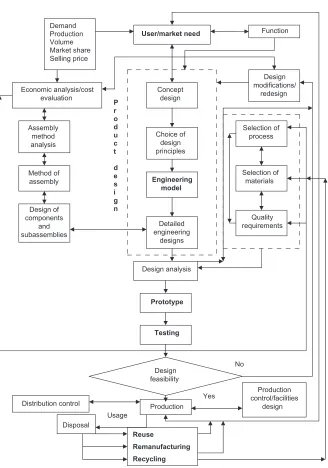
User/market need Function Demand Production Volume Market share Selling price Economic analysis/cost evaluation Assembly method analysis Method of assembly Design of components and subassemblies Concept design Choice of design principles Engineering model Detailed engineering designs Design analysis Prototype Testing Design modifications/ redesign Selection of process Selection of materials Quality requirements Design feasibility Production Distribution control Production control/facilities design P r o d u c t d e s i g n No Yes Disposal Usage Reuse Remanufacturing Recycling
Figure 1.11 An integrated approach to product design.
Figure 1.11 shows a considerably more detailed and integrated approach to product