GEOGRAPH AND EVOLUTION
Invasive Species and Evolution
Alycia L. Stigall
Published online: 22 April 2012
#Springer Science+Business Media, LLC 2012
Abstract Invasive species are a major threat to modern eco-systems and cause billions of dollars in economic damage annually. The long-term impacts of species invasions are dif-ficult to assess on ecological timescales available to biologists, but the fossil record provides analogues that allow investiga-tion of the long-term impacts of species invasions. Two case studies of ancient invasions, the Late Devonian Biodiversity Crisis (~375million years ago) and the Late Ordovician Rich-mondian Invasion (~446 million years ago), provide insight into the effect of invasive species on extinction, speciation, and ecosystem structuring. During both intervals, invasive species are characterized by broad ecological tolerances, broad geo-graphic ranges, and higher-than-average survival potential through the crisis interval. Among the native species, narrowly adapted ecological specialists are more likely to become ex-tinct, while broadly-adapted generalist species persisted through the invasion interval by modifying aspects of their ecological niche through niche evolution. In addition, forma-tion of new species practically stopped during the invasion intervals due to reduced opportunities for geographic isolation and speciation. The results of these impacts produced post-invasion biotas with less diversity, greater biotic homogeniza-tion between regions, and a lack of new species forming. Conservation efforts to eradicate invasive species may help mitigate these outcomes in the current biodiversity crisis.
Keywords Paleontology . Biogeography . Speciation . Extinction . Introduced species . Marine . Biodiversity . Competition
Introduction
The introduction of non-native species into modern ecosys-tems is one the primary contributors to modern biodiversity loss (Enserink1999). These non-native taxa have been intro-duced both intentionally (such as songbirds by European immigrants in the 1800s) and accidentally (such as zebra mussel larvae hitching rides in ballast water of ocean liners). Typically, introduced species are referred to asinvasive species once they have established populations within the ecosystem that are both self-sustaining and increasing in size (Lockwood et al. 2007; Davis2009). According to the official U.S. De-partment of Agriculture definition, introduced species are re-ferred to as invasive species when they are introduced to an ecosystem to which they are not native and their introduction causes environmental harm or harm to human health (http://
www.invasivespeciesinfo.gov/). In the United States alone,
invasive species cause environmental losses and damages of over $120 billion dollars annually (Pimentel et al.2005).
Due to their significant impact on modern ecosystems and government budgets, a substantial number of studies have examined the effects of invasive species in modern ecosystems, and aspects of their immediate and short-term ecological impacts are well understood (reviewed in Lockwood et al.
2007). Modern invasive species have been documented to cause ecosystem restructuring, both in terms of simplifying food webs and altering resource utilization patterns. A classic example is the spread of kudzu (Pueraria montanavar.lobata), a vine introduced in the late 1800s for erosion control that now crowds out native species in the United States (Blaustein2001). This single species overgrows and chokes out the native veg-etation, resulting in ecosystem degradation by overgrowth of entire landscapes in the southeastern United States.
The effect of modern invasive species on evolutionary processes of extinction and speciation, however, is less clear A. L. Stigall (*)
Department of Geological Sciences and OHIO Center for Ecology and Evolutionary Studies, Ohio University, 316 Clippinger Laboratories,
(Davis 2003). In modern ecosystems, the only documented cases of invaders directly causing extinction involve predator species overutilizing prey items. A prime example is the brown Treesnake (Boiga irregularis) which was inadvertently intro-duced to Guam probably as a stowaway in ship cargo during the early 1950s (Fritts and Rodda1998). Due to abnormally abundant prey resources on Guam and the absence of natural predators and other population controls, brown tree snake populations reached unprecedented population numbers (up to 13,000 per square mile) and caused extinction of endemic ground-nesting bird species and extirpation of most of the other vertebrate forest species from the island. A more subtle form of extinction, genetic extinction—in which the unique genome of a native taxon is lost through hybridization with closely related invaders—has also been demonstrated, partic-ularly in fish (Lockwood et al.2007). Competition between native and invading species may result in local extirpations of native species, but no compelling cases of global extinction resulting from competition with introduced species exist (Lockwood et al.2007). Impacts of modern invasive species on speciation are difficult to access because the speciation process takes many generations to complete.
The timescale in which biological or ecological experi-ments can be run precludes classic“invasion biology”from assessing the long-term effects—thousands of years or more —of modern human-mediated introductions. However, spe-cies invasions are documented throughout the fossil record, and studying these ancient invasions can help to establish an understanding of the long-term impacts of invasive species on modern biodiversity (Stigall2010a). Fossil invasions can be identified by mapping species ranges geographically and tem-porally within an evolutionary context; species that expand their geographic range during their lifetime or in relation to their ancestral species may be considered invasive (Rode and Lieberman 2004). Since not controlled by humans, ancient invasions are facilitated the by the collapse of barriers that normally constrain species ranges. These barriers are varied and include climatic barriers, such as temperature and season-ality, geographic barriers, such as tectonic arches or ecological barriers. Species invasions are common during times of bio-logical turnover and times when endemic biotas transform into cosmopolitan faunas.
This paper examines two waves of species invasions that occurred in the shallow marine realm during the Late Ordovi-cian and Late Devonian periods as case studies in the long-term dynamics of species invasions.
Case Study 1: Late Devonian Biodiversity Crisis
The first case study of fossil-invasive species focuses on Late Devonian brachiopod and bivalve species of North America. The Late Devonian interval (approximately 385–370 million
Since the Late Devonian crisis was due largely to speciation decline, understanding the extinction and persistence patterns of invasive vs. native species cannot explain the crisis fully; causes of speciation decline must be addressed explicitly. In order for speciation to occur, a group of individuals must become reproductively isolated from the remainder of their species (the ancestral species). The isolating factor is most often the separation of populations in geographic space (Mayr
1942). Geographic separation can occur either due to vicari-ance, where the ancestral species is passively divided into two or more isolated populations by the erection of a barrier, such as rising of a mountain range; ordispersal,where a subpopu-lation actively migrates away from the ancestral range, such as an interbasinal species invasion (Wiley and Mayden 1985). Under either scenario, the isolated population (incipient daugh-ter species) subsequently develops morphological or behav-ioral differences via natural selection that prevent continued breeding with members of the ancestral species. Because the speciation process is explicitly tied to evolutionary events in geographic space, examining speciation patterns requires both species-level phylogenetic hypotheses and information about the geographic distribution of species.
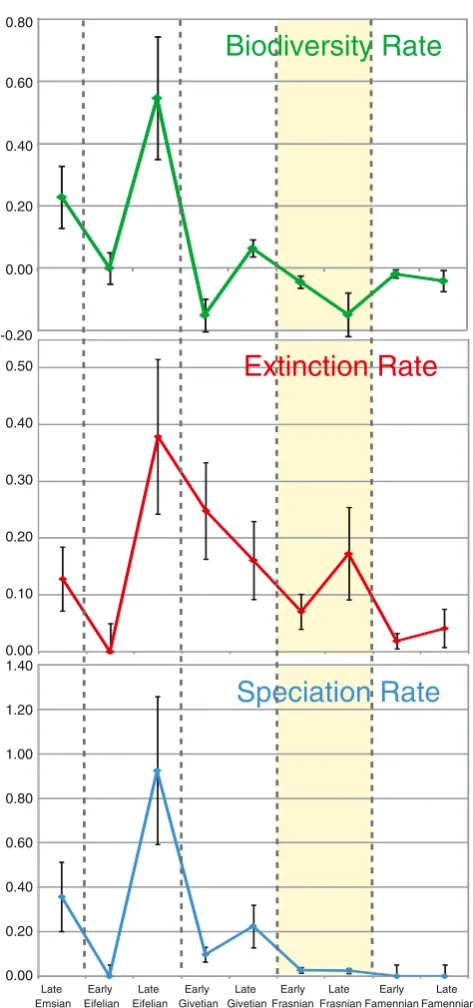
Stigall (2010b) used species-level phylogenetic hypotheses of two brachiopod genera, a bivalve genus, and an order of crustaceans to examine Late Devonian speciation patterns. From this analysis, two clear patterns emerged. Firstly, both speciation and extinction rates were lower during the Late Devonian (Frasnian and Famennian Stages) Crisis than during the preceding Middle Devonian (Eifelian and Givetian Stages) in these taxa (Fig.3). In fact, the rate at which new species formed declined to approximately zero during the Frasnian crisis interval. This result support those of genus-level analy-ses by McGhee (1996) and Bambach et al. (2004) and further reinforces the interpretation of the Late Devonian interval as a biodiversity crisis rather than a mass extinction event. Sec-ondly, the primary mechanism for speciation reduction was the loss of speciation via vicariance (Stigall2010b). During the Late Devonian, only 28% of speciation events were due to vicariance compared to 54–74% during other intervals of geologic time (Stigall2010b). Effectively, the primary mech-anism of speciation in Earth history was shut down during the Late Devonian crisis interval. The speciation loss can be attributed to the high levels of species invasions present at this time (Stigall2012a,b). Successful modern invasive spe-cies commonly exhibit broad levels of ecological tolerance, which allows them to exploit many types of environments (Davis2009). This attribute also indicates that where invasive species are present, opportunities for new species to form would be reduced due to competition for resources. Incipient species, as discussed above, have relatively small population sizes, which means that these populations are more likely to become extinct than thrive and expand their population sizes when faced with fierce competition for resources.
B
C
D
N
A
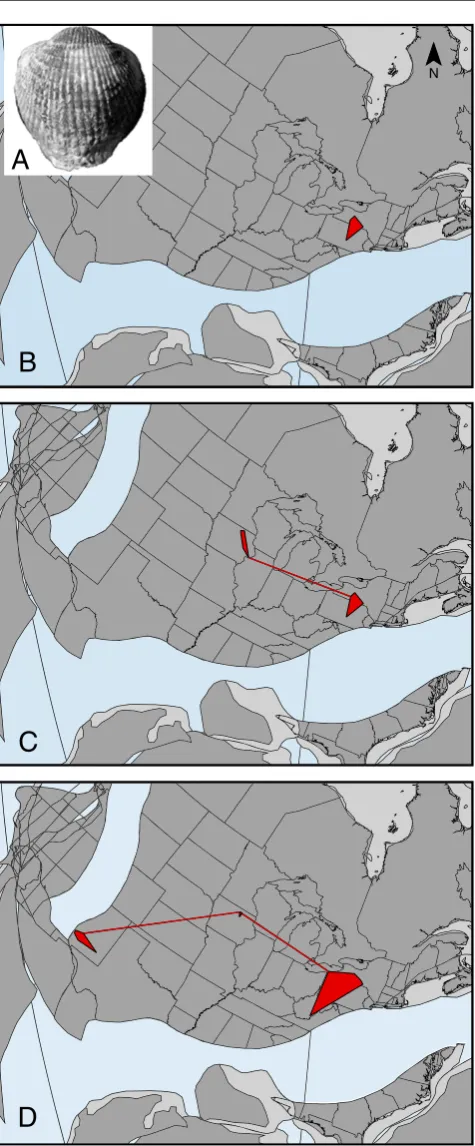
Fig. 1 Geographic range changes in a Late Devonian invasive
When the results of these Late Devonian analyses are com-bined, a clear picture begins to emerge of the impact of invasive species during this interval. The invaders themselves were highly successful at establishing themselves in new geographic areas following immigration events facilitated by rises in rela-tive sea level. As a result of their widespread presence, speci-ation rates declined due to the lack of opportunities for speciation, particularly allopatric speciation. The few specia-tion events that occurred were due to dispersal, which is essen-tially an invasion event where the population that migrated later established a new species rather than maintained genetic flow with the ancestral species. Furthermore, the established species that were geographically restricted to a single depositional basin were more likely to become extinct during the crisis interval than species with an invasive history. This combination of features resulted in a post-crisis fauna characterized by geographic areas dominated by broadly adapted species, many with a history of invasion. Therefore, the potential long-term effects of modern invasive species include lack of new species forming, increased resistance of invaders to extinction, and ultimately faunal homogenization.
Case Study 2: Late Ordovician Richmondian Invasion
The second case study examines a basinal-scale invasion event during the Late Ordovician, the Richmondian Invasion. The Richmondian Invasion was an invasion of over 50 taxa into a shallow marine basin that was centered on present-day Cincinnati, Ohio and began at the boundary of the Maysvillian and Richmondian Stages (~446 million years ago; Meyer and Davis2009). Invader species included taxa from shallow to
deep marine environments and all trophic levels. Notably, invader taxa included members of common Ordovician orders, such as rugose corals and rhynchonellid brachiopods, that were absent from the Cincinnati region prior to onset of the invasion. The invasion itself took place during several waves of introductions spread out over 500,000 years, likely
0 3 6 9 12 15
Number of invasion events
Early Givetian
Early Frasnian
Early Famennian 18
Late Givetian
Late Frasnian
Fig. 2 Interbasinal invasion intensity during the Middle and Late
Devo-nian. The spread of invasive species was facilitated by sea level rises, indicated byblue arrows. The Late Devonian Biodiversity Crisis interval is indicated inyellow. Modified from Stigall (2012a)
Biodiversity Rate
-0.20 0.00 0.20 0.40 0.60 0.80
Speciation Rate
0.00 0.20 0.40 0.60 0.80 1.00 1.20 1.40
Late Emsian
Late Eifelian Early Eifelian
Late Famennian Early
Famennian Late Frasnian Early Frasnian Late Givetian Early Givetian
0.00 0.10 0.20 0.30 0.40
0.50
Extinction Rate
Fig. 3 Rate trends in biodiversity (change in total species extant
due to shifts in oceanographic conditions (Patzkowsky and Holland1996). The introduction of the Richmondian invaders resulted in the breakdown of the community structure that had persisted for the preceding five million years (Holland and Patzkowsky2007). Following this invasion interval, a new stable ecosystem structure emerged in which invader species dominated the native species both in terms of biomass and species diversity.
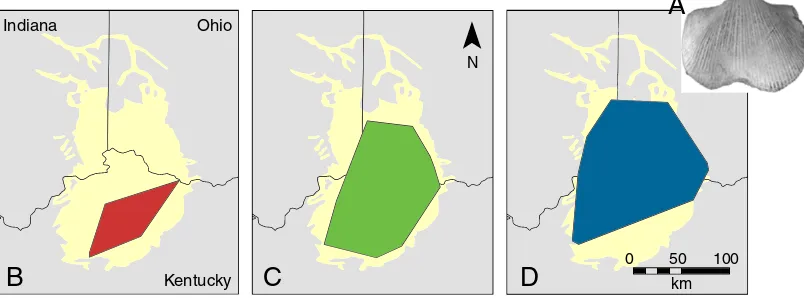
To examine the biogeographic impact of the invasion, geo-graphic ranges of articulate brachiopod species were recon-structed using GIS, as in the Devonian study by Stigall (2010a; Fig.4). Species distribution data were collected for 45 species across six depositional sequences (C1 through C6) to incorpo-rate the interval prior to and following the Richmondian Inva-sion, which occurred in the C4 sequence. Each depositional sequence comprises strata deposited during a single cycle of rise and fall in relative sea level (Patzkowsky and Holland
1996). Individual depositional sequences, therefore, can be used as proxies for temporal intervals. Brachiopod species preserved in Cincinnatian strata during this interval were cat-egorized into four groups: (1) species native to the Cincinnati region that became extinct by the end of the Maysvillian, (2) natives species that persisted into the Richmondian, (3) extra-basinal invaders that arrived during the Richmondian invasion, and (4) species that evolved in the Richmondian from Cincin-natian natives.
When geographic range sizes were compared by group, several patterns emerged (Stigall2010a). Native species that persisted into the post-invasion interval had larger geographic ranges than species that did not (Stigall2010a). This is consis-tent with the Devonian pattern in which generalist species preferentially survive intervals of biotic turnover compared to ecological specialists. In addition, the invasive species exhibited relatively large geographic ranges, indicative of eco-logical generalists (Stigall 2010a). Interestingly, the average range size of native species that survived into the Richmondian
was larger than the average range size of the extrabasinal invaders throughout the invasion and the next million years. This suggests that although both survivors and invaders had relatively broad ecological tolerances, the only native species able to persist during the initial waves of biotic invasion were those with the broadest ecological niches. Conversely, new species that evolved in the Richmondian occupied small geo-graphic ranges, suggesting radiation into empty ecological niches, including the specialist niches vacated by the extinction of the Maysvillian taxa (Stigall 2010a). Notably, only three speciation events were recorded during the early stages of the invasion in the C4 sequence; all other speciation events fol-lowed the stabilization of the post-invasion community struc-ture. This is consistent with the Devonian analyses (e.g., Stigall
2012a, b) indicating decline in speciation rate and lack of vicariance during invasive regimes.
Clearly, a suite of native species persisted in the Cincin-nati region following the Richmondian Invasion; however, analyzing the size of species’geographic ranges alone does not provide a complete analysis of how some native species were able to persist through the invasion interval. Geograph-ic range sizes reconstructed solely from fossil occurrence data may underestimate the true geographic range of a species due to undersampling or lack of preservation of outcrop. One way to reduce this bias is to employ an analytical technique that incorporates both environmental and species occurrence data. Therefore, another way to examine invasion dynamics is to investigate whether or not species altered their ecological niches in response to invasion pressure. Range size and ecological niches are linked because the geographic range that any species occu-pies is a function of its ecological niche, the set of environ-mental tolerances and limits in multidimensional space that determine where a species in potentially able to maintain populations (Hutchinson1957; Lomolino et al.2006). Species that persisted through the invasion interval may have exhibited
Ohio
Kentucky Indiana
N
0 50 100 km
B
C
D
A
Fig. 4 Changes in the geographic range size ofHebertella occidentalis(a,
0.6x) during the Late Ordovician from thebpre-invasion (C1 sequence),c invasion (C4 sequence), anddpost-invasion (C5 sequence) intervals. This
one of two end-member responses to invasion pressure: niche conservatism or niche evolution (Stigall2012b). Under niche conservatism, species maintain the parameters of their original ecological niche through time. These species cope with envi-ronmental change by tracking their preferred habitat laterally. In niche evolution, the parameters of a species’ ecological niche are adapted via natural selection to better exploit the new environmental conditions.
The ecological niches of Cincinnatian brachiopods were modeled in a series of analyses (Dudei and Stigall 2010; Malizia and Stigall 2011; Stigall 2011; Walls and Stigall
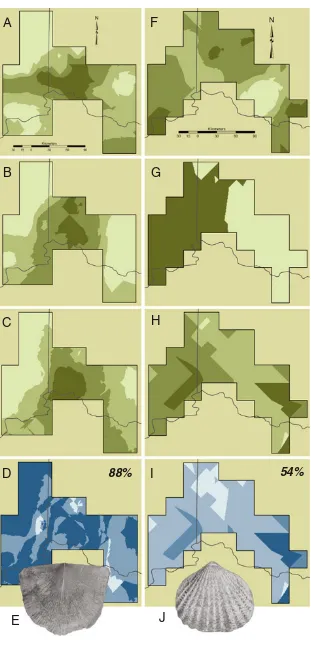
2011) that examined the relative amount of niche stability in species before, during, and after the Richmondian Invasion. Species niches were modeled using a technique called eco-logical niche modeling for three time slices in each interval, generating a total of nine time slices for comparison (Fig.5). Analyses indicated that species conserved the parameters of their ecological niche to a high degree during the pre-invasion interval (Malizia and Stigall 2011; Walls and Stigall 2011). Although no biotic invasion occurred during this interval, the Cincinnatian region and its biota did experience gradual envi-ronmental change due to gradual shallowing of the basin during the three time slices before the invasion (Walls and Stigall2011). The overall biotic response to gradual change was niche conservation. Intervals of more rapid sea level rise exhibited slightly higher levels of niche evolution than during slower sea level change, but the overall pattern was still dom-inantly one of niche conservatism in the pre-invasion interval. However, the degree of niche conservatism declined signifi-cantly during the invasion interval (Dudei and Stigall2010; Malizia and Stigall2011). This indicates that the response of the biota to invasion pressure was to undergo adaptation and niche evolution. The interval of niche evolution continued throughout the invasion and at least the first million years of the post-invasion interval, as niche stability increased very slightly post-invasion but remained substantially below pre-invasion stability levels (Malizia and Stigall2011).
Thus, the amount of niche stability exhibited by Cincin-natian brachiopods is correlated with the speed of environ-mental change. During the gradual abiotic changes of the pre-invasion interval, species exhibited high levels of niche conservatism. Conversely, the rapid introduction of the Richmondian invaders resulted in niche evolution. As dis-cussed above, the native species that persisted through the invasion interval were characterized by large geographic ranges, an indicator that these species could occupy a broad suite of environmental conditions (Stigall 2010a). Since these species entered the invasive regime with broad niches, they could undergo niche evolution in a way that focused their revised niche on a subset of their original niche rather than evolve new ecological tolerances (Stigall2012b). This
style of niche evolution would have provided a competitive advantage to the native species and allowed them to survive the ecosystem reorganization following the Richmondian Invasion. Interestingly, the invasive species exhibited similar levels of niche evolution to the native species in the post-invasion interval, which suggest a similar dynamic operated with these generalist species as well.
Summary and Conclusions
The results of the Late Devonian and Ordovician invasion analyses provide complementary insights into the long-term impacts of invasive species on native ecosystems. During both intervals, invasive species were characterized by broad eco-logical tolerances, broad geographic ranges, and higher-than-average survival potential through the crisis interval. Among the native species, narrowly adapted ecological specialists were more likely to become extinct, while broadly adapted generalist species persisted through the invasion interval by modifying aspects of their ecological niche through niche evolution. This suggests that in order to avoid extinction, native species must retain broad ecological tolerances and, most importantly, the ability to evolve and adapt in the face of increased competition due to species invasions. Furthermore, the presence of invasive species reduced speciation rate during the invasion interval of both time periods. This occurred primarily by reducing geographic isolation. High levels of dispersal, associated with interbasinal invasions, reduced op-portunities for allopatric speciation. The culmination of these long-term impacts resulted in post-invasion ecosystems that fundamentally differ from the pre-invasion biota. The result-ing faunas were dominated by relatively few broadly adapted generalist species, most of which were invasive taxa. This promoted biotic homogenization between regions, extinction of local endemic species, and blocked new species from forming.
We might expect the same long-term effects of invasive species to manifest themselves in the current biodiversity crisis. Clearly, the loss of endemic species and biotic homog-enization between regions is already occurring (Williamson
88%
54%
A
B
C
D
F
J
G
I
E
H
Fig. 5 Ecological niche model
projection maps. Predicted range ofRafinesquina alternata
(e, 0.5×) illustrating high niche stability during the pre-invasion interval,apredicted range for the C3-2 time slice based on C3-2 niche model,bpredicted range for the C3-3 time slice based on the C3-2 niche model, cpredicted range during the C3-3 time slice based on the C3-3 niche model,dcalculated overlap betweenbandc, a measure of niche stability. If a species occupied exactly the same niche in two time slices, these range maps would com-pletely overlap. The 88% overlap indicates strong niche conservatism. Predicted range ofLepidocyclas perlamellosus
(j, 0.75×) illustrating low niche stability during the post-invasion interval,gpredicted range for the C5-2 time slice based on C5-2 niche model,g predicted range for the C5-3 time slice based on the C5-2 niche model,hpredicted range during the C5-3 time slice based on the C5-3 niche model, icalculated overlap betweeng
andh. The 54% overlap
indicates substantial niche evolution. Fora–candf–h,
light colorsindicate low predicted probability of occurrence whiledark colors
could produce a very low diversity biota on our planet. Con-servation efforts, including habitat protection, federal regula-tion of species importaregula-tion, and removal of already established invasive species, are critical to the protection of the biodiversity on our planet today. Many efforts of this type are already underway, but expansion of the programs and involvement of volunteers (like you) are critical to their success.
Acknowledgments Thanks to Jonathan Hendricks and an
anony-mous reviewers for constructive reviews and to Bruce Lieberman for the invitation to submit this research to this edited volume. This research was supported by NSF EAR-0922067 and a grant from the donors of the American Chemical Society’s Petroleum Research Fund.
References
Bambach RK, Knoll AJ, Wang SC. Origination, extinction, and mass depletions of marine diversity. Paleobiology. 2004;30:522–42. Blaustein RJ. Kudzu’s invasion into Southern United states life and
culture. The great reshuffling: human dimensions of invasive species. Cambridge, UK: The World Conservation Union; 2001. p. 55–62. Davis MA. Biotic globalization: does competition from introduced
species threaten biodiversity? Bioscience. 2003;53:481–9. Davis MA. Invasion biology. Oxford: Oxford University Press; 2009.
p. 288.
Droser ML, Bottjer DJ, Sheehan PM, McGhee Jr GR. Decoupling the taxonomic and ecologic severity of Phanerozoic marine mass extinctions. Geology. 2000;28:675–8.
Dudei NL, Stigall AL. Using ecological niche modeling to assess biogeo-graphic and niche response of brachiopod species to the Richmondian Invasion (Late Ordovician) in the Cincinnati Arch. Palaeogeogr Palaeoclimatol Palaeoecol. 2010;296:28–47.
Enserink M. Biological invaders sweep in. Science. 1999;285:1834–6. Fritts TH, Rodda GH. The role of introduced species in the degradation of an island ecosystem: a case history of Guam. Annu Rev Ecol Syst. 1998;29:113–40.
Holland SM, Patzkowsky ME. Gradient ecology of a biotic invasion: biofacies of the type Cincinnatian Series (Upper Ordovician), Cincinnati, Ohio Region, USA. Palaios. 2007;22:392–407. Hutchinson GE. Concluding remarks. Cold Spring Harbor Symposium
on Quaternary Biology. 1957;22:415–27.
Johnson JG, Klaper G, Sandberg CA. Devonian eustastic fluctuations in Euramerica. Geol Soc Am Bull. 1985;96:567–87.
Lawton JH, May RM. Extinction rates. Oxford, UK: Oxford University Press; 1995. 248 p.
Lockwood J, Hoopes M, Marchetti M. Invasion ecology. Singapore: Blackwell; 2007. p. 312.
Lomolino MV, Riddle BR, Brown JH. Biogeography. 3rd ed. Sunderland, Massachusetts: Sinauer; 2006.
Malizia RW, Stigall AL. Analyzing niche stability in Late Ordovician articulated brachiopods during the Richmondian Invasion. Geolog-ical Society of America Abstracts with Programs. 2010;42(5):258. Malizia RW, Stigall AL. Niche stability in Late Ordovician
artic-ulated brachiopod species before, during, and after the Rich-mondian Invasion. Palaeogeogr Palaeoclimatol Palaeoecol. 2011; 311:154–70.
Mayr E. Systematics and the origin of species. New York: Columbia Univ. Press; 1942. p. 367.
McGhee Jr GR. The Late Devonian mass extinction; the Frasnian/ Famennian crisis. New York: Columbia Univ. Press; 1996. p. 303. Meyer DL, Davis RA. A sea without fish: life in the Ordovician sea of the Cincinnati region. Bloomington: Indiana University Press; 2009. p. 346.
Patzkowsky ME, Holland SM. Extinction, invasion, and sequence stratig-raphy; patterns of faunal change in the Middle and Upper Ordovician of the Eastern United States. Paleozoic Sequence Stratigraphy: views from the North American Craton. Boulder, Colorado: Geological Society of America; 1996. p. 131–42.
Pimentel D, Zuniga R, Morrison D. Update on the envrionmental and economic costs associated with alien-invasive species in the United States. Ecol Econ. 2005;52:273–88.
Rode AL, Lieberman BS. Using GIS to unlock the interactions between biogeography, environment, and evolution in Middle and Late Devo-nian brachiopods and bivalves. Palaeogeography, Palaeoclimatology, Palaeogeography. 2004;211:345–59.
Stigall AL (2010a) Using GIS to assess the biogeographic impact of species invasions on native brachiopods during the Richmondian Invasion in the Type Cincinnatian (Late Ordovician, Cincinnati re-gion). Palaeontologia Electronica 13: 5Ahttp://palaeo-electronica. org/2010_1/207/index.html
Stigall AL. Invasive species and biodiversity crises: testing the link in the Late Devonian. PLoS One. 2010b;5(12):e15584. doi:10.1371/ journal.pone.0015584.
Stigall AL. Application of niche modeling to analyze biogeographic patterns in Palaeozoic brachiopods: evaluating niche stability in deep time. Memoirs of the Association of Australasian Palaeontol-ogists. 2011;41:229–55.
Stigall AL. Speciation collapse and invasive species dynamics during the Late Devonian“Mass Extinction”. GSA Today. 2012a;22(1):4–9. Stigall AL. Using ecological niche modeling to evaluate niche
stability in deep time. J Biogeogr. 2012b. doi:10.1111/j.1365-2699.2011.02651.x.
Walls BJ, Stigall AL. Analyzing niche stability and biogeography of Late Ordovician brachiopod species using ecological niche modeling. Palaeogeogr Palaeoclimatol Palaeoecol. 2011;299:15–29. Wiley EO, Mayden RL. Species and speciation in phylogenetic
system-atics, with examples from North American fish fauna. Ann MO Bot Gard. 1985;72:596–635.