How does Task Sharing Influence Individual’s Performance? An
Investigation with Interference Paradigms
By
Roberta Sellaro
Advisor: Prof. Roberto Cubelli
Doctoral School in Brain and Cognitive Sciences
XXV cycle
A dissertation presented in partial fulfillment of the requirements for the degree of Doctor of Philosophy
iii
v
Abstract
In this thesis I investigated whether and to what extent performing a task with another
person may change individual cognitive performance. Interference paradigms are
particularly suitable for addressing this issue. The rationale behind the use of these
paradigms is that most of them can be split in two complementary or independent tasks
assigned to two different individuals. By comparing task performance when participants
act in the joint context and when they perform the task individually, important
information may be derived about whether the co-actor’s task is represented and how
this representation influences one’s own performance.
Following this approach, I adopted the joint version of two different and well-known
paradigms: the picture-word interference paradigm (Study 1: Experiments 1, 2, 3) and
the Simon task (Study 2: Experiments 4, 5, 6). Both paradigms allow understanding
how people can deal with the task irrelevant information when the accomplishment of
the task is achieved in a joint (and cooperative) context.
The results of both studies provided converging evidence showing that, regardless of the
paradigm used, task sharing determines the disappearance of the interference effect
produced by the task irrelevant information (Study 1) or by the (incidental) spatial
representation of an alternative response (Study 2). The disappearance of the
vi
different or complementary stimuli but not when s/he was in charge of the same stimuli
as the participant.
These findings will be accounted for by taking into consideration both the specific
peculiarities of each paradigm exploited and the strategic processes of division of labor
vii
Table of contents
Theoretical background ... 1
1.1 SOCIAL FACILITATION ... 2
1.2 JOINT ACTION ... 10
Aims of the study ... 35
Study 1: Task sharing can change the fate of task irrelevant information ... 49
3.1 INTRODUCTION ... 49
3.2 EXPERIMENT 1 ... 52
3.3 EXPERIMENT 2 ... 60
3.4 EXPERIMENT 3 ... 65
3.5 GENERAL DISCUSSION ... 73
Study 2: When task sharing eliminates the Simon effect ... 77
4.1 INTRODUCTION ... 77
4.2 EXPERIMENT 4 ... 82
4.3 EXPERIMENT 5 ... 94
4.4 EXPERIMENT 6 ... 99
4.5 GENERAL DISCUSSION ... 103
General discussion ... 107
1
1
Theoretical background
Studies in cognitive psychology have long been directed to investigate human cognitive
functions in environments in which participants act in isolation. Studies conducted in
experimental psychology labs, indeed, do not usually admit the involvement of people
other than the individual under investigation. The presence of other people is commonly
considered as a source artifacts, which has to be absolutely avoided. It is worth noting,
however, that in everyday life we rarely engage in activities that do not imply the
presence or the involvement of other people. We are social beings and we perform
actions in environments penetrated with social interactions. As a consequence, our
actions are necessary influenced by the presence of other people, the kind of
relationships we have with them and their specific actions. In the light of this fact, in the
last decades cognitive psychology has started to take into consideration the influence of
these variables on human cognition and actions. What has been traditionally considered
as an artifact, in this new perspective is seen as a fundamental variable that deserves to
be investigated.
In this respect, two different research areas can be distinguished: social facilitation and
joint action. The main difference between these two lines of research is that social
2
presence of another person performing simultaneously and independently the same task
as the participant (i.e., two participants performing the same task in the same room
without co-acting, that is, independently of one another); in contrast, joint action1 area
refers to actual interactive conditions in which two participants take care of two
different (and/or complementary) aspects of the same task. In the following sections I
summarize the main studies and the relevant results characterizing these two different
areas of research.
1.1 SOCIAL FACILITATION
Social facilitation is one the oldest concept in social psychology (Allport, 1920; Bond &
Titus, 1983)2. Social facilitation theory focuses on the changes that occur when
individuals perform tasks alone or in presence of real, imagined or implied others: an
audience (i.e., people in the same room where the participant is performing his/her task)
or co-actors (i.e., persons performing independently the same task as the participant).
Several social facilitation studies have unequivocally demonstrated that task
performance is affected differentially by social presence. Typically, performance is
1 Joint action research embraces several aspects of human interactions (see Knoblich, Butterfill, &
Sebanz, 2011, for a review). An extensive review of all the studies and paradigms related to the joint action area is beyond the purposes of this thesis. As a consequence, in this chapter I focus only on the literature related to the joint Simon effect.
2
3
facilitated in simple tasks, whereas it is impaired in difficult tasks (Aiello & Douthitt,
2001; Guerin, 1993).
Over the years, different interpretations have been proposed to account for these effects.
According to the traditional interpretation, the presence of others increases the general
drive and the activation level of the actor (generalized drive hypothesis; Zajonc, 1965).
In Zajonc’s view, increasing in activation is an innate reaction that would allow people
to promptly respond to any potential unexpected actions by others. The increase in
activation level enhances the dominant-response tendency: It facilitates dominant responses
(i.e., those responses that have priority in one’s own behavioral repertoire) and it inhibits
subordinate responses. In simple (or well-learned) tasks, the dominant response is the
correct one, which leads to performance improvement. In contrast, in difficult (or not
well-learned) tasks, the dominant response is the wrong one and, as a consequence, performance
is impaired.
Few years later, Zajonc’s theory was brought into question by Henchy and Glass
(1968), who argued that the presence of others is not sufficient to induce social
facilitation. In contrast to Zajonc’s hypothesis, these authors claimed that the increase in
individual arousal induced by social presence is not an innate response but it occurs
only when the individuals are afraid that their performance will be evaluated (evaluation
apprehension hypothesis; see also Cottrell, Wack, Sekerak, & Rittle, 1968 for an
extension of this theory, the learned drive hypothesis).
In the 80s, the role of attention was emphasized. According to the distraction-conflict
hypothesis (Baron, Moore & Sanders, 1978) the presence of others has a distracting
4
turns into an increase in activation, arising from a conflict between the others and the
task, which always impairs performance on difficult tasks. Whereas performance on
simple tasks can either improve or decrease depending on the number of distractors in
the environment and, thus, the size of activation: the more distractors are, the worst
performance is.
The overload hypothesis (Baron, 1986) can be considered as a modified version of the
distraction-conflict hypothesis, as it states that the distraction induced by the presence of
others does not lead to an increased arousal but rather it gives rise to a cognitive
overload. Cognitive overload, in turn, causes a restriction of the focus of the attention,
resulting in performance facilitation when the task is simple or requires attention to a
small numbers of elements, and in performance impairment when the task is complex or
requires paying attention to many elements. Performance increases on simple tasks
because cognitive overload allows participants to focus their attention on the relevant
stimuli and to filter out irrelevant information.
In contrast, on difficult tasks, which usually consist of several stimuli that tie up
attention, performance decreases because participants might neglect stimuli that are
crucial to perform the task.
Empirical evidences in support of the attentional theories of social facilitation have been
obtained by employing one of the best-known interference tasks in cognitive
psychology: the Stroop task (Stroop, 1935). In the next paragraph I review relatively
5
1.1.1 Social presence influence on the Stroop effect
The standard Stroop task requires participants to name the color of the ink with which a
letters string is printed. Typically, RTs are slower when the string is a color name
incongruent with its ink color (e.g., when the word green is shown in red) as compared
to neutral trials (e.g., when a string of Xs is displayed in red), a phenomenon known as
Stroop interference (MacLeod, 1991). The occurrence of this interference has been
traditionally attributed to the fact that reading is automatic and that skilled readers
cannot refrain from accessing word meaning (Besner, Stolz, & Boutilier, 1997).
Importantly, the presence of such an effect is a clear example of interference arising
from a conflict between an automatic (uncontrolled) cognitive process (word reading)
and a relatively controlled cognitive process (color naming).
The Stroop task is particularly appropriate to disentangle between the two main
hypotheses advanced to explain social facilitation effects, that is, the generalized drive
hypothesis (Zajonc, 1965) and the distraction-conflict hypothesis (Baron et al., 1978).
Indeed, on the basis of these two hypotheses, opposite effects are expected when
participants perform the Stroop task in presence of others. Specifically, following the
generalized drive hypothesis the presence of an audience (or co-actors) should facilitate
dominant responses – here, word reading – thus increasing the Stroop interference.
Consistent with this prediction, past research have shown that increased arousal
enhances the Stroop interference (Conty, Gimmig, Belletier, George, & Huguet, 2010;
6
In contrast, according to the distraction-conflict hypothesis, since the presence of others
is a source of distraction, participants should narrow their attention on the relevant
information – here, color naming – thus reducing the Stroop interference. Consistently
with this alternative prediction, previous studies have demonstrated that distraction
reduces the Stroop interference (Lavie, 2005; Hartley & Adams, 1974; Houston &
Jones, 1967).
The results of several studies using the social Stroop task have provided converging
evidence in favor of the distraction-conflict hypothesis (Muller & Butera, 2007; Dumas,
Huguet & Ayme, 2005; Huguet, Dumas, & Monteil, 2004; Muller, Atzeni, & Butera,
2004; Huguet, Galvaing, Monteil, & Dumas, 1999; MacKinnon, Geiselman, and
Woodward, 1985). For example, in the study of Huguet et al. (1999), participants were
required to execute a manual version of the Stroop task first alone and then in presence
of a confederate. The presence of the confederate was motivated as due to technical
problems in another room wherein a different experiment was taking place. In line with
the distraction-conflict hypothesis, results showed that the Stroop interference was
significantly reduced when participants performed the task in presence of an audience,
compared to when they executed the task in isolation. The same pattern of results was
observed in a second experiment aimed at investigating social facilitation effects in a
co-action context implying social comparison. After completing the Stroop task alone,
participants performed the task in the presence of a same-sex confederate who worked
simultaneously on the identical task. Participants were forced to compare their
performance with that of the confederate who, depending on the experimental condition,
7
faster (upward social comparison) than the participant. The authors observed a
significant reduction of the Stroop interference in the conditions in which participants
faced with a similar or a faster responding co-actor, compared to the conditions in
which participants performed the task either alone or in presence of a slower co-actor.
On the basis of these results, Huguet et al. concluded that the attentional focus on the
relevant information (i.e., the ink color) is not simply due to the fact that social presence
induces distraction, but it also results from the participants' willingness to actively
inhibit word reading when the co-actor is a relevant target of comparison, that is, when
they faced with an actual (in the case of upwards social comparison) or potentially (in
the case of lateral social comparison; i.e., mere co-action) self-threatening co-actor (see
Muller & Bureta, 2007, and Muller, Atzeni, and Butera, 2004 for similar results and
conclusions using a different paradigm). In contrast, when participants’ performance is
better than that of the co-actor (in the case of downward social comparison), comparison
is not relevant and, thus, it is not distracting3 just because participants are not threatened
in their self-evaluation. This interpretation would also explain why co-action effects are
not observed when the co-actor works on a different task (Sanders, Baron, & Moore,
1978). In this case, indeed, the co-actor’s performance does not represent a
self-evaluation threat given that the risk of being inferior to him/her can be easily justified
by the fact that s/he is performing a different task.
3
8
In a follow-up study, Huguet et al. (2004) provided further evidence that social
comparison plays a crucial role in reducing the size of the Stroop interference.
Moreover, they demonstrated that attentional control under social comparison is
effective when it is unconscious (i.e., when participants competed against the co-actor),
whereas this control is ineffective when it is conscious (i.e., when participants
performed the task in the perspective of a desired reward). Furthermore, a later study
showed that self-evaluation threat is sufficient to reduce the Stroop interference even
when the co-actor is not physically present or when participants are required to compare
their performance with that of a mentally represented peer group (Dumas et al., 2005;
see also Muller & Butera, 2007 for similar results using a different paradigm)4.
Recently, Sharma, Booth, Brown and Huguet (2010) provided strong evidence that
social facilitation is caused by distractor inhibition (i.e., word reading inhibition). In
contrast with the traditional distraction-conflict hypothesis (Baron et al., 1978), which
assumes that social presence reduces the likelihood of processing distractors (“early
selection” account), these authors demonstrated that distractors are normally processed,
and then strongly inhibited before selecting the correct response (“late selection”
account). Sharma et al. implemented an experimental design similar to that employed
by Huguet et al. (1999, Experiment 1): Participants performed the manual version of the
Stroop task either alone or in (supposedly incidental) presence of a same-sex
4
9
confederate. In contrast with the previous studies, however, they manipulated the
interval between successive stimuli (short vs. long) before they examined the RTs
distribution (see delta-plot method developed by Ridderinkhof, van den Wildenberg,
Wijnen, & Burle, 2004). Consistently with previous findings showing that inhibition
requires time to build up (Eimer, 1999; Eimer & Schlaghecken, 1998; Ridderinkhof et
al., 2004), Sharma et al. observed that the reduction of the Stroop interference under
social presence occurred only when the interval between successive stimuli was long
enough to allow participants to inhibit word reading. Conversely, no social facilitation
was observed when the interval between successive stimuli was so short to reduce
cognitive control processes.
On the basis of these results they proposed that social facilitation effects strongly
depend on inhibition processes that can be affected online by the presence of other
people.
1.1.2 Conclusive remarks
The practical implications of all these findings are quite obvious. As a whole, social
facilitation research, besides providing strong demonstration that the presence of others
can have an impact on individual performance, can explain why social presence
sometimes facilitates performance and sometimes impairs it.
Despite of the large number of theories on this topic, nowadays most social
psychologists agree that, considering the variety of activities that we perform in public,
10
mechanism. On the contrary, it is very likely that social facilitation is the result of the
converging effects of different factors such as increased arousal, distraction and
awareness of evaluation. Furthermore, it makes sense to assume that social facilitation
effects can be modulated also by the kind of audience that people are faced with.
Recently, Flynn and Amanatullah (2012) examined whether specific characteristics of
co-actors can affect participants’ performance as well. Their findings demonstrated that
performance gains when participants work nearby high-status co-actors but only if the
co-action is independent. According to the authors, high-status individuals have strong
influence over peers and can provide a source of inspiration, thus allowing people to
elevate their performance. This source of inspiration, however, turns into intimidation
when the co-action context is competitive.
1.2 JOINT ACTION
Only recently researchers have started to investigate the cognitive and neural
mechanisms underlying joint actions. Joint action can be defined as “…any form of
social interaction whereby two or more individuals coordinate their actions in space and
time to bring about a change in the environment” (Sebanz, Bekkering, & Knoblich,
2006, p.70). It is not necessary to emphasize how important this question is given that,
in everyday life, we are constantly required to engage in some sort of interactions with
other people to achieve common goals.
For this reason, a growing number of studies are trying to establish what determines
11
actions performed by other individuals. A way to assess this issue is to compare a
situation in which two complementary actions are performed by an actor (individual
condition) with a situation in which one of the two actions is performed by another
person (joint condition). The comparison between the individual and the joint
conditions may reveal important information about whether the co-actor’s task and
his/her response are represented and how these representations influence one’s own
performance. This is exactly what Sebanz, Knoblich, and Prinz (2003) did when they
distributed a Simon compatibility task (Simon & Small, 1969) between two participants
(i.e., the joint Simon task). By using this paradigm, Sebanz et al. demonstrated that two
participants, each performing half of the task, show the same compatibility effects of
single participants performing the whole task (i.e., the joint Simon effect). In the light of
this finding Sebanz and colleagues (2006) proposed that successful joint actions
critically (but not only) depend on the ability to form shared task representations, which
would allow people to integrate their own actions with others actions in a whole action
planning.
The seminal study of Sebanz et al. (2003) has given rise to an interesting and substantial
line of research aimed at investigating the cognitive processes underlying
co-representation and how social relationships between co-actors as well as co-action
contexts affect co-representations.
In the next sections I briefly describe the main characteristics of the Simon task, and
then I provide a brief overview on the joint Simon effect literature. Before that,
however, I present the ideomotor theory, that is, the theoretical framework of human
12
1.2.1 The ideomotor theory
The ideomotor theory is a well-known theoretical framework for action control that
originated in the 19th century (James, 1890; Lotze, 1852), but started to attract interest
only at the end of the ‘900 (Prinz, 1987; Greenwald, 1970). The basic idea behind the
different versions proposed during the years is that perception and action are tightly
linked together so that imaging an action or perceiving someone else’s action creates a
tendency to perform that action (Prinz, 1997). Broadly speaking, ideomotor theories
assume that actions are represented in terms of their perceptual consequences. By
experiencing different types of actions, a learning mechanism allows humans to
integrate the motor pattern of these actions with the cognitive representations of their
respective perceptual consequences. Thereby, humans can activate motor patterns
associated to specific actions by simply accessing to (or thinking of) the representations
of their consequences (for a review see Shin, Proctor, & Capaldi, 2010, and Stock &
Stock, 2004).
The most influential ideomotor theory is the so-called theory of event coding (TEC;
Hommel, Müsseler, Aschersleben, and Prinz, 2001; for a review see Hommel, 2011,
2009). According to this theory, perceived events (stimuli) and produced events
(actions) are represented in the same system and by means of the same codes, so that the
cognitive system cannot really distinguish between stimuli and responses. Thus, seeing
an event activates the action associated with that event, and performing an action
13
One of the core concepts of TEC framework is that of event file. TEC posits that
cognitive representations of stimuli and actions are composed of several feature codes,
which are bound together into a whole event file. According to Hommel et al., every
external event, including one’s own actions, is stored in an event file. Event files are
sensorimotor networks of codes representing the features of all perceivable action
effects. The activation of one code in a given network automatically spreads activation
to all the other codes in the same network. Thus, “…thinking of an action always
involves the tendency to generate that action motorically by spreading activation from
the effect codes to the associated motor codes” (Hommel 2009, p.520; see also Keysers
& Perrett, 2004; Jeannerod & Decety, 1995).
A logical implication of the event file concept is that the more features are shared by
different events (i.e., the more they are similar or the more they overlap), the more they
can be related to, compared with, or confused with each other.
Another important aspect of TEC framework is the assumption that cognitive control is
achieved by an “intentional weighting” mechanism, which is supposed to operate
offline before actions take place (Hommel et al., 2001; for a review see Memelink &
Hommel, in press). In a nutshell, the basic idea is that preparing for an action requires a
top-down priming of those feature dimensions that are relevant to accomplish the task
(e.g., color, shape, position, or other perceptual or semantic stimulus features). As a
consequence, all stimulus features that are defined on the selected dimension receive
more weight and become more salient, thus having a stronger impact on performance.
Since perceived events (stimuli) and action events (responses) are represented using the
14
discriminations should automatically induce task relevance of the same dimension in
action discriminations” (Memelink & Hommel, in press, p 5). It is important to know,
however, that although the intentional weighting mechanism fosters the processing of
task relevant information it does not prevent the irrelevant information to be processed
and to impact performance.
Based on the ideomotor framework, which postulates a close link between perception
and action, it is reasonable to assume that specific other-generated actions can
selectively affect one’s own actions. This rationale is what has inspired research on
shared task representations.
1.2.2 The Simon paradigm
1.2.2.1 The basic phenomenon
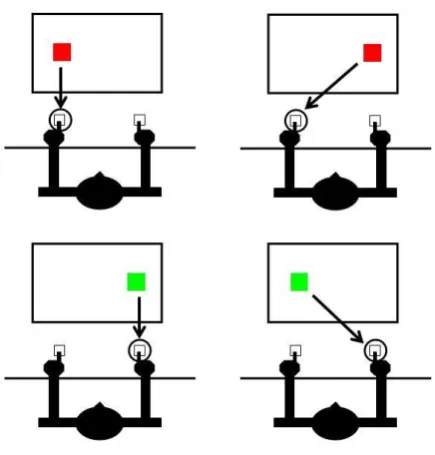
In a typical Simon task, an imperative stimulus (e.g., a red or green square) is randomly
presented on the left or on the right of the screen, and participants are required to press a
left or right button depending on a non-spatial attribute of this stimulus (e.g., the color,
as in the example of Figure 1.1). The Simon effect (e.g., Simon & Small, 1969) refers to
the finding that, even if stimulus location is task irrelevant, participants are usually
faster and often more accurate when the position of the stimulus corresponds to the
position of the required response (i.e., corresponding trials; e.g., left stimulus — left
response; see Figure 1.1, left panels) than when it does not correspond (i.e.,
15
Nowadays, all accounts of the Simon effect share the assumption that this effect is due
to a competition that occurs, at the response selection stage, between the response
spatially corresponding to the stimulus, which is automatically activated when the
imperative stimulus is presented (Eimer, 1995; De Jong, Liang, & Lauber, 1994), and
the response selected on the basis of the relevant attribute (i.e., dual-route models;
Zhang, Zhang, & Kornblum, 1999; Kornblum & Lee, 1995; Zorzi & Umiltà, 1995; De
Jong, Liang, & Lauber, 1994; Kornblum, Hasbroucq, & Osman, 1990). According to
the dual route models, when the imperative stimulus is presented, it activates the correct
response via a controlled (indirect) route, which processes the task-relevant stimulus
16
dimension (e.g., the color) on the basis of the instructions. Simultaneously, the
imperative stimulus activates the spatially corresponding response via an uncontrolled
(direct) route, which processes the task-irrelevant stimulus dimension (the stimulus
location) independently of the instructions. As a result, response selection process is
facilitated in corresponding trials in which the irrelevant and the relevant stimulus
dimensions activate the same response code, leading to faster reaction times (RTs).
Conversely, a conflict takes place in non-corresponding trials in which the irrelevant
and the relevant stimulus dimensions activate different response codes, thus slowing
down RTs (see Lu & Proctor, 1995, and Umiltà & Nicoletti, 1992, for a review).
1.2.2.1 The Go/NoGo variant of the Simon task
The Simon effect is thought to be an index of the representation of two possible
competitive responses. The activation of the representation of two spatially distinct
responses, indeed, is the necessary prerequisite for the Simon effect to occur. This
assumption is further supported by the fact that the Simon effect does not usually occur
in a Go/NoGo version of the task (Ansorge & Wühr, 2004; Callan, Klisz, & Parsons,
1974), in which participants are required to respond to only one stimulus value (e.g., the
red color) and to refrain from responding to the other stimulus value (e.g., the green
color). Very likely, the absence of the Simon effect in Go/NoGo tasks is due to the fact
that when only one response key has to be pressed, this response cannot have any
spatial connotation. Indeed, a response can be coded as left (or right) when it is encoded
in a context in which there are right (or left) responses. Thus, when only one response is
17
their response (e.g., the fact that participants use either the left or right hand, or the fact
that they have to use a response device that is either on the left or on the right with
respect to another response device), the necessary prerequisite to produce the Simon
effect (i.e., the presence of an alternative response) is missing.
Nevertheless, there are several exceptions to this rule (Ansorge & Wühr, 2009, 2004;
Hommel, 1996). As an example, the Simon effect arises in Go/NoGo tasks if
participants place a passive finger on the alternative response button (Ivanoff & Klein,
2001; Hommel, 1996) or when the Go/NoGo task is preceded by a two-choice task in
which participants press both the alternative buttons (Ansorge & Wühr, 2009, 2004).
The response-discrimination hypothesis proposed by Ansorge and Wühr (2004; see also
Ansorge & Wühr, 2009) can account for these exceptions. According to Ansorge and
Wühr, the Simon effect occurs because participants use the stimulus position to
discriminate between different responses that are stored in working memory. In
Go/NoGo tasks the stimulus position is not useful to discriminate between responses,
given that the two response options are not spatially defined: Participants have to decide
whether to respond or to withhold the response. However, if the Go/NoGo task is
executed after a two two-choice task, working memory representations of two distinct
and spatially-defined responses can be transferred from the first task to the Go/NoGo
task. In other words, the to-be discriminated responses activated in the two-choice task
and stored in working memory are then transferred and kept active in the subsequent
Go/NoGo task, even if only a single response is required. As a consequence, the Simon
18
1.2.3 The joint Simon paradigm
1.2.3.1 The basic phenomenon
Sebanz et al. (2003) first discovered the phenomenon nowadays known as “joint Simon
effect”. In their seminal work, Sebanz et al. distributed the Simon task between two
individuals, sitting next to each other, in such a way that each person responded to only
one of the two possible values of the stimulus by pressing the button in front of him/her,
that is, they performed two complementary Go/NoGo task (e.g., one participant
responded to the red color only and the other participant responded to the green color
19
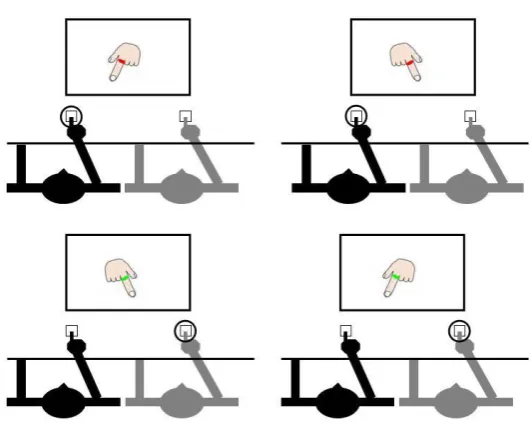
only). Targets were presented as colored (i.e., red or green) rings on the picture of an
index finger pointing to the left, to the right, or centrally (as in the example of Figure
1.2). In this version of the paradigm, the relevant stimulus attribute was represented by
the ring color, whereas the irrelevant stimulus attribute was conveyed by the direction of
the pointing finger.
Interestingly, although instructions required each participant to perform a Go/NoGo
task, the Simon effect was nevertheless observed: RTs of each participant were faster
when the direction of the pointing finger coincided with the position of the participant
who was in charge of responding (e.g., leftward pointing finger — left-side participant;
see Figure 1.2, left panel) than when the direction of the pointing finger coincided with
the position of the co-actor (e.g., rightward pointing finger — left-side participant; see
Figure 1.2, right panel). Importantly, the Simon effect was observed neither when
participants carried out the Go/NoGo task individually (i.e., without a co-actor) nor
when they performed the Go/NoGo task next to a non-actively involved co-actor (i.e.,
when the co-actor merely sat beside the participant without responding to the
complementary color; see also Tsai, Kuo, Hung, & Tzeng, 2006). Based on these
findings, Sebanz et al. concluded that responding to the Go stimuli in a joint setting in
which another person is responding to the NoGo stimuli is functionally similar to the
condition in which a single person takes care of both stimuli/responses (i.e., in
two-choice Simon tasks). In analogy with what happens in regular two-two-choice Simon
paradigms, in joint Simon tasks the response spatially corresponding to the
task-irrelevant spatial code (i.e., left- vs. right-pointing finger) is automatically activated,
20
selection conflict takes place when the irrelevant and the relevant stimulus attributes
activate two different responses. Conversely, when participants carry out the Go/NoGo
task individually (i.e., without a co-actor performing the complementary task), only the
actor‘s response is represented so that no response conflict occurs and, thus, the Simon
effect does not show up. Indeed, as previously claimed, the representation of two
spatially distinct responses is necessary for the Simon effect to occur.
To account for the joint Simon effect, Sebanz and colleagues proposed that when two
individuals perform together two complementary parts of the same task, each actor
represents not only his/her own task but also the task of the co-actor and integrates these
representations in his/her action planning, the so-called action co-representation
account (Sebanz, Bekkering, & Knoblich, 2006). The occurrence of the Simon
interference effect in the joint but not in the individual Go/NoGo version of the task has
been considered a convincing evidence that joint action contexts lead participants to
form shared representations of tasks, even if it would be more effective to ignore the
co-actor’s task.
The joint Simon effect has been replicated many times (Sebanz, Knoblich, Prinz, &
Wascher, 2006; Sebanz, Knoblich, & Prinz, 2005) and it has been obtained also with
abstract stimuli, like lateralized colored squares (Hommel, Colzato, & van den
Wildenberg, 2009; Welsh, Higgins, Ray, & Weeks, 2007; Tsai et al., 2006), and
auditory stimuli (Ruys & Aarts, 2010; Vlainic, Liepelt, Colzato, Prinz, & Hommel,
2010; for an extension of the classical paradigm see Ferraro, Iani, Mariani, Nicoletti,
Gallese, & Rubichi, 2012; Milanese, Iani, Sebanz, & Rubichi, 2011, and Milanese, Iani,
21
The action co-representation account of the joint Simon effect (Sebanz et al., 2006)
relies on the ideomotor theories (Greenwald, 1970; James, 1890; see Section 1.2.1) that,
as previously mentioned, postulate a close link (i.e., a common code) between
perception and action. According to these theories, imaging to perform an action as well
as observing (or knowing about) someone else’s action activates the same motor
representations that are involved in the execution of that action. These representations
lead to a tendency to perform that action, which needs to be suppressed (Prinz, 1997).
Consistently with this assumption, event-related potentials (ERPs) recorded during
Go/NoGo joint and individual Simon tasks showed that participants exhibit a stronger
response inhibition in NoGo trials of the joint task than in those of the individual task
(Tsai, Kuo, Hung, & Tzeng, 2008; Sebanz, Knoblich, Prinz, & Wascher, 2006; Tsai et
al., 2006; for errors monitoring in joint Go/NoGo tasks see De Bruijn, Miedl, &
Bekkering, 2011, and De Bruijn, Miedl, & Bekkering, 2008). In a similar vein, the
results observed by Holländer, Hung, and Prinz (2011) suggest that task sharing leads to
the activation of the motor system of the non-acting participant when the required
response is up to the co-actor. Importantly, they observed that this motor activation was
independent on the specific hand used by the co-actor to perform the task, indicating
that participants adopted an egocentric perspective in simulating the co-actor’s action.
1.2.3.2 Impact of contextual and social factors on the joint Simon effect
Since Sebanz’s et al. seminal work (2003), several other studies have been conducted to
22
the identification of the conditions that allow others’ actions to be represented and
included in one’s own action plan.
Some of these studies suggest that participants can co-represent the co-actor’s action
also when the visual and auditory feedback from these actions is hampered (Vlainic et
al, 2010; Sebanz et al., 2003) and even if the co-actor performs the task in a different
room (Ruys & Aarts, 2010; Tsai et al., 2008).
For instance Vlainic at al. (2010), by employing an auditory version of the joint Simon
task, observed the joint Simon effect with participants wearing opaque goggles, which
prevented them from observing the co-actor’s action, and responding by using a
noise-free keyboard, which did not provide any auditory feedback about the co-actor’s action.
Consistently, Tsai et al. (2008) and Ruys and Aarts (2010) observed that the mere belief
of co-acting with another person, who was thought to perform the complementary
Go/NoGo task in a different room, was sufficient to induce the joint Simon effect (but
see Welsh et al., 2007, for contrasting results).
Even participants’ mood was found to modulate the joint Simon effect (Kuhbandner,
Pekrun, & Maier, 2010). In the study of Kuhbandner et al., participants performed the
joint Simon task after seeing a neutral or an emotionally-charged movie presented for
inducing a neutral, positive or negative mood. The results showed that, compared to the
neutral mood condition, negative mood significantly reduced the Simon effect, whereas
positive mood significantly enhanced the joint Simon effect. To account for their
results, Kuhbandner et al. proposed that mood can modulate the tendency to take each
other’s tasks into account, either by enhancing this tendency (positive mood) or by
23
Finally, other studies have provided converging evidence showing that the others’
actions can be incorporated into one’s own task representation only when the co-actor is
perceived as an intentional agent. Indeed, joint action effects were not observed when
participants were required to share the task with a puppet (Tsai & Brass, 2007; but see
Stenzel et al., 2012 and Muller et al., 2011a), a computer (Tsai et al., 2008), or a human
co-actor whose responses were controlled mechanically (Atmaca et al., 2011).
A related line of research has examined whether the joint Simon effect can be
modulated by social factors, such as the kind of relationship between the actor and the
co-actor (Hommel et al., 2009), the cooperative or competitive nature of the interaction
(Iani et al., 2011; Ruys & Aarts, 2010), and the group membership (Müller, Kühn, et al.,
2011b; Iani, Anelli, Nicoletti, Arcuri, & Rubichi, 2011). For example, Hommel et al.
(2009) showed that the occurrence of the joint Simon effect depends on the valence of
the relationship that is established between the two interacting participants. Specifically,
they observed a joint Simon effect when the co-actor behaved friendly (positive
relationship) but not when the co-actor acted unfriendly (negative relationship).
In the same vein, Iani et al. (2011) demonstrated that competition may prevent
participants from taking into account the co-actor’s task. They observed no joint Simon
effect when the two interacting participants were required to compete to receive an
economic reward on the basis of their speed and accuracy (but see Ruys & Aarts, 2010).
Finally, a recent study of Müller, et al. (2011b) provided evidence supporting the idea
that even mere group membership can modulate the degree to which others’ actions are
24
share the task with an in-group member (i.e, an image of a white hand), but not when
they share the task with an out-group member (i.e., an image of a black hand).
1.2.3.3 What is really co-represented in joint Simon task?
Another important question pertains to what is really co-represented in joint Simon
tasks. In a follow-up study, Sebanz and colleagues (2005) provided evidence suggesting
that co-representations are not restricted to the partner’s actions but comprise also the
conditions under which these actions have to be performed (see Kiernan, Ray, & Welsh,
2012 for consistent results demonstrating that even the effects of the co-actor’s actions
and his/her intentions can be represented). In this study, participants in a pair were
asked to take care each of one of two different attributes of the same target stimulus:
One participant had to respond only to one of two possible stimulus colors and the other
participant had to respond only to one of two possible pointing directions. In half of the
trials responses of the actor and the co-actor overlapped in time (double response),
whereas in the other half the actor and the co-actor took turns in responding (single
response). Results showed a significant slowing down in RTs in double response trials
as compared to single response trials, thus demonstrating that the performance of each
participant was influenced by the partner’s task. To account for this finding, Sebanz et
al. proposed that the impairment of performance in double response trials is the result of
an increased response conflict produced by the simultaneous activation of two different
task rules.
Recently, Wenke, Atmaca, Holländer, Liepelt, Baess, and Prinz (2011), after reviewing
25
be induced by others source of interference, such as the conflict that might arise when
self-other discrimination is required. According to the authors, the joint Simon effect
observed in most of the previous studies can be accounted for by assuming that
participants co-represent that another person is responsible for the complementary part
of the task and when it is his/her turn of responding. This can lead to an agent
identification conflict when some aspects of the task (e.g., stimulus position) prime the
co-actor’s turn (the actor co-representation account; for consistent results see Liepelt,
Wenke, & Fischer, 2012; Ferraro, Iani, Mariani, Milanese, & Rubichi, 2011; Liepelt,
Wenke, Fischer, & Prinz, 2011; Philipp & Prinz, 2010; but see Welsh, 2009).
The assumption that the joint Simon effect reflects action/task co-representations has
been recently called into question by other authors according to whom performing a
Go/NoGo Simon task in close proximity to another person simply re-introduce the
possibility to code spatially two alternative responses (Dolk, Hommel, Prinz, & Liepelt,
2013; Dittrich, Rothe, & Klauer, 2012; Dolk, Hommel, Colzato, Schütz-Bosbach, Prinz
& Liepelt, 2011; Guagnano, Rusconi, & Umiltà, 2010). Hence, given that spatial
response coding is sufficient for the Simon effect to occur in individual Go/NoGo tasks
(cf. Ansorge & Wühr, 2009, 2004), it makes sense to assume that the spatial coding of
actor and co-actor positions is sufficient to induce the joint Simon effect as well.
1.2.3.4 The referential coding account of the joint Simon effect
The results of recent studies have raised some doubts about the social nature of the joint
Simon effect. Indeed, some authors have advanced the hypothesis that this effect may
26
position with reference to the sitting position of the co-actor. This would reintroduce a
dimensional overlap between the task-irrelevant stimulus dimension and the response
dimension, which is usually missing in individual Go/NoGo Simon tasks.
The first evidence in favor of this non-social explanation of the joint Simon effect
comes from a study of Guagnano, Rusconi, and Umiltà (2010). In this study,
participants in a pair were required to execute two independent detection tasks: One
participant had to respond only to red stimuli and the other participant had to respond
only to blue stimuli. The majority of the trials involved the simultaneous presentation of
the red and blue targets, one on the left and one on the right of the screen, thus
eliminating the turn-taking aspect that characterized typical joint Simon tasks. Co-acting
participants performed this task sitting either close to or further apart from each other. A
Simon effect was observed although the tasks of the actor and the co-actor were
independent from one another (i.e., the actor and the co-actor did not share any goal).
More importantly, the Simon effect was present only in the condition in which the actor
acted in close proximity as compared to the condition in which the co-actor sat far from
the actor5. Based on these results, Guagnano et al. proposed that the presence of another
person performing a task in the peripersonal space of the participant provides him/her
with a reference to spatially code his/her own response. The spatial coding of the
response position of the participant is sufficient to give rise to the Simon effect by
facilitating participant’s responses in corresponding trials (but see Ferraro et al., 2011
5
27
for results showing that the joint Simon effect is mainly due to interference in
non-corresponding trials rather than to facilitation in non-corresponding trials).
In the same vein, a recent study of Dolk et al. (2011) questioned the action
co-representation account. In this study, participants performed the auditory version of the
joint Simon task while their sense of ownership over the co-actor’s hand was
experimentally induced through the so-called rubber hand illusion (RHI, Botvinck &
Cohen, 1998). The RHI is the phenomenon for which seeing a rubber (or another
person) hand synchronously stroked with one’s own hidden hand produces the illusion
that the seen rubber hand is part of one’s own body. The RHI illusion does not occur
when the rubber and the participant hands are stroked asynchronously.
28
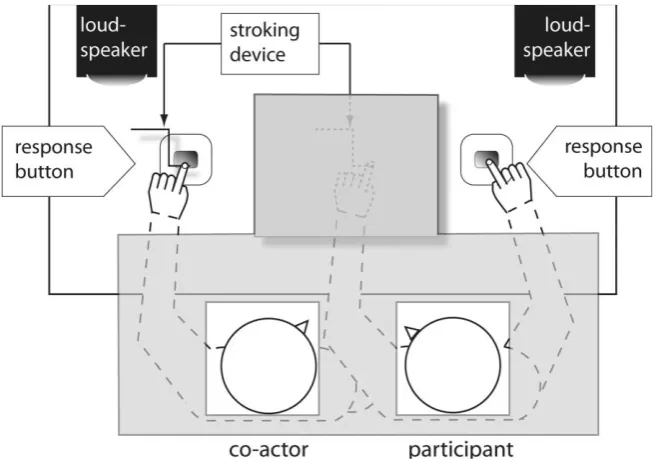
Dolk et al. used this manipulation to test the assumption that the joint Simon effect
reflects the integration of the co-actor’s action into the actor’s task representation. The
participant sat on the right and was required to respond to one of two sounds by
pressing the button in front of him/her with the right hand (see Figure 1.3). The co-actor
sat on the left and responded to the complementary sounds by pressing with the left
hand the button in front of him/her.
During the task, the left hand of the participant was hidden and stroked either
synchronously or asynchronously with the left hand of the co-actor, thus to induce or
not in the actor the illusion of ownership over the co-actor’s hand. According to the
authors, inasmuch as the joint Simon effect is due to the integration of the co-actor’s
action in one’s own action planning, this should result into a larger effect in the
synchronous stroking condition than in the asynchronous stroking condition. Yet, the
opposite pattern occurred: The asynchronous stroking condition gave rise to a larger
joint Simon effect as compared to the synchronous stroking condition. Hence, Dolk et
al. proposed that the joint Simon effect is not due to the integration of the co-actor’s
action but rather to the separate perception of one’s own action from the co-actor’s
action. Based on this finding and inspired by TEC framework (Hommel et al., 2001;
Hommel, 2013; Prinz, 1997; see also Section 1.2.1), Dolk et al. advanced the so-called
referential coding account of the joint Simon effect (see also Dolk et al., 2013; Dittrich
et al., 2012; Hommel, 1993). According to the referential coding account, given that
self-generated and (perceived) other-generated actions are represented by their sensory
consequences, the presence of another individual sitting next to the participant and
29
similar to the actor’s action event, provides him/her with an alternative action. The
presence of an alternative action requires the participant to discriminate between
representations referring to his/her action and others concurrently activated
representations (cf. Ansorge & Wühr, 2004; see also response-discrimination account
in Section 1.2.2.1). Proper discriminations can be achieved by spatial coding one’s own
response position with reference to such alternative events. This, in turn, leads to a
match or a mismatch between stimulus and response sets, which gives rise to the Simon
effect (Kornblum et al., 1999).
In a follow-up study, Dolk et al. (2013) demonstrated that any sufficiently salient event,
not necessary another person, can represent an action alternative to that of the
participant, thus enabling the spatial coding of the participant’s response position.
Indeed, they observed a Simon effect in different experiments requiring participants to
execute individually an auditory Go/NoGo Simon task while different salient events
(i.e., a Japanese waving cat, a clock, or a ticking metronome) occurred on the side
opposite to the participant’s response position.
In line with the referential coding account and with the results reported by Dolk et al.
(2011, 2013), Dittrich et al. (2012) proposed that the joint Simon effect occurs because
the spatial arrangement of the two co-acting participants (left vs. right) emphasizes the
horizontal dimension of the response, which can match or not with the spatial horizontal
dimension of the stimulus. Consistently, Dittrich et al. did not observe a joint Simon
effect in the condition in which two co-acting participants, sitting side-by-side, were
required to perform a Go/NoGo task in which both target stimuli and responses were
30
effect could be accounted for by assuming that the sitting position of the participants
made participants to code their responses as “left” and “right” instead of coding them as
“up” and “down”. As a consequence, the spatial dimension of the responses did not
match anymore with the spatial dimension of the stimuli and the Simon effect did not
show up.
1.2.3 Other joint Simon-like paradigms
The occurrence of an interference effect in joint tasks was recently replicated by
splitting other Simon-like paradigms in two complementary Go/NoGo tasks, performed
by two participants sitting side-by-side. For instance, Atmaca, Sebanz, Prinz, &
Knoblich (2008) distributed between two participants a parity judgment task. This task
usually requires classifying a centrally presented number (ranging from 1 to 9) as either
odd or even, by pressing a left or right button. Typically, even though number
magnitude is irrelevant to perform the task, left responses are faster for numerically
small numbers, whereas right responses are faster for numerically large numbers, a
well-known phenomenon called SNARC effect (i.e., Spatial Numerical Association of
Response Codes; Dehaene, 1997; Dehaene, Bossini, Giraux, 1993). This effect is
thought to be due to the fact that numbers are spatially represented on a mental number
line, which is oriented from left to right. The SNARC effect is usually attributed to the
automatic activation of spatial representations of number magnitudes, which interact
with response position codes. In the joint version employed by Atmaca et al., one
31
only to even numbers. Results showed that participants sitting on the left reacted faster
to small than large numbers, whereas participants sitting on the right were faster in
responding to large than small numbers. In contrast, in the individual Go/NoGo task no
SNARC effect occurred. Consistently with the interpretation advanced to explained the
joint Simon effect, the occurrence of the SNARC effect in the joint but not in the
individual Go/NoGo task seems to suggest that participants activated the representation
of the co-actor’s action alongside to the representation of their own action, thus giving
rise to the same conflict between responses that occurs when left and right responses are
emitted by a single individual. According to Atmaca et al. the occurrence of the joint
SNARC effect demonstrates that the close link between perception and action can have
an impact on the processing of symbolic information as well.
In a further study, Atmaca, Sebanz, and Knoblich (2011) demonstrated that action
co-representations can also occur when the task involves arbitrary stimulus-response
associations. In this study, a flanker task (Eriksen & Eriksen, 1974) was distributed
between two participants sat alongside each other. Participants in a pair were presented
with a string of letters and were instructed to press the button in front of their body
depending on the identity of the central (target) letter. One participant had to respond
only when the target was H or K, and the other participant had to respond only when the
target was C or S. Target letters were flanked on both the left and right sides by
distracter letters that could be the same as the target (identical trials; e.g., KKKKK),
assigned to the same participant (congruent trials; e.g., HHKHH), assigned to the
co-actor (incongruent trials; e.g., SSKSS), or associated to none response (neutral trials;
32
flankers are the same as the target (identical trials) or when they are associated to the
same response (congruent trials), as compared to the condition in which they require a
different response (incongruent trials). This effect is thought to reflect the fact that both
the target and the flankers activate the responses associated with them on the basis of
the task instructions. As a consequence, performance is facilitated when the target and
the flankers activate the same response, whereas a conflict takes place when they
activate different responses (see Cohen & Shoup, 1997; Sanders & Lamers, 2002, for
reviews). Consistently, Atmaca et al. observed that RTs of each participant were slower
when the target was flanked by letters that would have required a response from the
co-actor (incongruent trials). The flanker effect occurred also when participants performed
the same Go/NoGo flanker task individually. However, the effect was significantly
larger in the joint than in the individual Go/NoGo task.
Interestingly, the joint flanker effect was not observed when participants performed the
joint task with co-actor whose responses were controlled by an electromagnet, which
pulled down the co-actor’s finger when it was his/her turn of responding. This finding
would demonstrate that for action co-representation to be formed the co-actor has to be
perceived as an agent acting intentionally.
Finally, other studies demonstrated that participants performance in joint tasks can also
be influenced by the co-actor’s focus of attention (the social Navon effect; Bockler,
Knoblich, & Sebanz, 2012), and by inhibition processes related to the co-actor’s action
(the social inhibition of return; Cole, Skarratt, & Billing, 2012; Welsh et al., 2005, and
33
1.2.4 Conclusive remarks
After Sebanz’s et al. (2003) seminal study, the literature on the joint Simon effect has
grown very quickly. Despite of the different interpretations that have been advanced to
account for this effect, most of the authors agree that the joint Simon task is a useful
tool to investigate the degree of interpersonal integration. Indeed, the size of the joint
Simon effect has been found to change as a function of the religious practice (Colzato,
Zech, Hommel, Verdonschot, van den Wildenberg & Hsieh, 2012), the social
self-construal (Colzato, De Bruijn, & Hommel, 2012) and the cognitive style of thinking
(Colzato, van den Wildenberg, & Hommel, in press). Furthermore, the joint Simon
paradigm seems to be useful to evaluate whether and to what extent self-other
integration can be achieved by clinical samples, such as, individuals with autism
(Sebanz, Knoblich, & Stumpf, 2005), brain damaged patients (Humphreys & Bedford,
2011), schizophrenic patients (Liepelt, Schneider, et al., 2012) and congenitally-blind
35
2
Aims of the study
Recent years have witnessed an increasing overlap between cognitive psychology and
social psychology. Given that humans are social beings and that the study of human
behavior cannot prescind from the social context in which it occurs (see Cacioppo,
Berntson, Lorig, Norris, Rickett, & Nusbaum, 2003), recent studies have started to
investigate whether, and to what extent, performing a task with (or in presence of)
another person may change individual performance.
Interference paradigms are particularly suitable for addressing this issue. The rationale
is that most of them can be split in two (complementary or different) parts which, in
turn, can be distributed between two different individuals. By comparing task
performance when participants act in the joint context and when they perform the task
individually, important information may be obtained about whether the co-actor’s task
is represented and how this representation influences one’s own performance.
The joint Simon task, developed by Sebanz et al (2003), is nowadays one of the most
widely-used paradigms to address this issue (see Section 1.2.3).
In the standard version of the Simon task, a single person is required to emit left or right
responses depending on the color (e.g., red and green) of a target stimulus that randomly
36
RTs are usually faster and more accurate when the target position corresponds to the
position of the required response than when it does not correspond (Simon & Small,
1969). The presence of such an effect demonstrates that, although the target position is
irrelevant to perform the task, it is automatically processed and it interferes with
responses, giving rise to a conflict between responses when the target appears on the
opposite side of the required response (Kornblum & Lee, 1995; De Jong, Liang, &
Lauber, 1994; Kornblum, Hasbroucq, & Osman, 1990; for a review see Lu & Proctor,
1995).
Sebanz et al. (2003) showed that the Simon effect occurs also in the joint version of the
task – namely the joint Simon effect – in which the two action alternatives (the left and
right responses associated respectively to the two stimulus colors) are distributed
between two participants, sitting next to each other, so that each participant performs a
Go/NoGo Simon task (e.g., the left-side participant responds to the green stimuli only
and the right-side participant responds to the red stimuli only). Apparently it would be
nothing surprising about this effect, were it not for the fact that no Simon effect usually
occurs when participants perform the Go/NoGo Simon task individually, without a
co-actor (Ansorge & Wühr, 2009, 2004; Sebanz et al, 2003).
As Sebanz et al. (2003) stated, the presence of the Simon interference effect in joint but
not in individual Go/NoGo tasks is hard to explain in terms of social facilitation
(Zajonc, 1965; Baron et al., 1978, see Section 1.1), given that studies belonging to this
area have observed the same pattern of results regardless of whether participants
performed the task simply in presence of others or with another person engaged in the
37
difficult tasks (Aiello & Douthitt, 2001; Guerin, 1993).Thus, social facilitation effects
do not seem to depend on the specific actions carry out by other people. Rather, the
joint Simon effect can be better accounted for within the framework of ideomotor
theories which, assuming a close link between perception and action, postulate that
perceiving (or imaging) actions made by others is functionally similar to perform the
same actions (Prinz, 1997; Hommel et al., 2001; see Section 1.2.1). Consistently with
ideomotor theories, Sebanz et al. proposed the so-called action co-representation
account (Sebanz, Bekkering, & Knoblich, 2006; Knoblich & Sebanz, 2006). Following
this account, the joint Simon effect occurs because participants represent (and
incorporate in their task representation) the action to be executed by the co-actor, thus
giving rise to the same conflict between actions that arises when they take care of both
left and right responses (for a different interpretation see Dolk et al., 2013; Dittrich et
al., 2012; Dolk et al., 2011; Guagnano et al., 2010; see also Section 1.2.3.4 and later in
this chapter).
The interference effect was replicated by splitting other Simon-like paradigms in two
complementary Go/NoGo tasks, performed by two participants sitting side-by-side: the
joint SNARC effect (Atmaca et al., 2008) and the joint flanker effect (Atmaca et al.,
2011; see Section 1.2.3). For instance, in the study of Atmaca et al. (2008) participants
were required to respond to either odd or even centrally-presented numbers, ranging
from 1 to 9, by pressing the button in front of their body. Participants performed this
task both individually and with a co-actor who was in charge of the complementary task
(e.g., if the participant responded to odd numbers then the co-actor reacted to even
38
individually, by pressing the left and right button, a stable finding is that left responses
are faster for small than large numbers, whereas right responses are faster for large then
small numbers. This effect, known as SNARC effect, has been accounted for by
assuming that numbers are represented in succession along a left-to-right spatially
oriented line. The spatial information, conveyed by number magnitude, automatically
interacts with response selection processes, thus slowing down RTs in spatially
non-corresponding trials (e.g., small number – right response; Dehaene, 1997; Dehaene et
al., 1993). Consistently, Atmaca et al. observed that in the joint SNARC task,
participants sitting on the left reacted faster to small than large numbers, whereas
participants sitting on the right were faster in responding to large than small numbers,
thus resembling the same pattern of results that occurs when a single participant
performs the whole task individually. In contrast, in the individual Go/NoGo task,
participants’ RTs were similar for both small and large numbers. According to the
authors, the occurrence of the SNARC effect in the joint but not in the individual
Go/NoGo task suggests that, similarly to what happens in joint Simon tasks, participants
represented the co-actor’s response alongside to their own response.
In a follow-up study, Atmaca et al. (2011) extended these findings suggesting that
action co-representation can also occur when the task involves arbitrary
stimulus-response associations. In this study, the authors employed the joint version on another
well-known interference task, that is, the flanker task (Eriksen & Eriksen, 1974).
Typically, this task requires participants to judge, by pressing one of two response
buttons, the identity of a central target letter, flanked on both sides by distracter letters.