Fuzzy Speed Sensorless Vector Control of Dual
Star Induction Motor Drive Using MRAS
Approach
K. Kouzi
Semi Conductors and Functional Materials Laboratory, Electrical Engineering Depart, Laghouat University Algeria Email: [email protected]
T. Seghier and A. Natouri
Laboratoire d'étude et de Développement des Matériaux, Semi Conducteur et Diélectrique, Laghouat University Algeria Email: [email protected], [email protected]
Abstract—This paper investigates a fuzzy speed sensorless vector control of Dual Star Induction Motor (DSIM) using MRAS approach. The rotor flux and speed estimator based on a PI model reference adaptive system (MRAS) is developed. The error in the instantaneous phase position of the two rotor flux estimates is utilized for rotor speed estimation. In order to achieve high performances in term of fast dynamic speed response and best disturbance rejection, fuzzy logic controller (FLC) is used for speed regulation. The proposed scheme is recommended for applications requiring robust speed control even in presence of some key parameters deviation. The performance of the suggested scheme has been tested through some simulation results.
Index Terms—dual star induction motor, speed sensorless vector control, MRAS estimator, fuzzy logic controller
I. INTRODUCTION
Due to its robustness, the simplicity of its structure, its low cost and which does not need a regular maintenance, the induction motor offers technological prospects in many industrial fields. Recently , there is an increasing interest towards multiphase motor drives, especially for medium and high power applications such as naval and railway propulsion systems. The use of multi-phase drives has been recognized as a viable approach to obtain high power ratings without increasing the stator current per phase, making it possible to use standard power switches based on a single device. Besides, multiphase motor drives possess several advantages over conventional three-phase motor drives, such as reducing the amplitude and increasing the frequency of torque pulsations, reducing the rotor harmonic currents, and improving the reliability and faulttolerance [1]-[3].
With the rapid development of microelectronics and power electronics, most adjustable-speed drives are now realized with ac machines. Vector control allows high-performance control of speed and torque to be achieved
Manuscript received October 9, 2014; revised February 10, 2015.
from an induction motor. A “speed sensor” is usually requisite for vector control.
All high-performance vector-controlled DSIM drives require accurate rotational speed or rotational position information for feedback control. This information is provided by an incremental encoder, which is the most common positioning transducer used today in industrial applications. The use of this sensor implies more electronics, higher cost, lower reliability, difficulty in mounting in some cases such as motor drives in harsh environment and high speed drives, increase in weight, increase in size, and increase electrical susceptibility [4]. Therefore, their elimination is an attractive prospect, which can be achieved by estimating speed from the stator terminal current measurements. This is what is commonly called the sensorless control of electrical machines.
In the existing literature, many approaches have been suggested for speed sensorless vector control induction motor drives. These methods are based on the following schemes [4]:
Model Reference Adaptive System (MRAS) [5], [6];
Extended Luenberger observers [7]; Extended Kalman filter (EKF) [8]; Instantaneous reactive power [4]; Artificial neural network (ANN) [9]; Harmonic caused by machine saliency [10]; Carrier frequency signal injection in the stator
windings [10].
This paper introduces a vector control based on a PI model reference adaptive system for dual star motor sensorless drives. The main advantages of MRAS scheme are less complex and more effective than any other estimation strategies [4], [5].
The outline of this paper is as follows: in Section II, the modelling of DSIM is presented. Section III deals with the rotor field oriented control of a DSIM. The design of MRAS speed estimator is presented in Section IV. In Section V the conception of FLC for speed regulation is proposed. In Section VI, the performances of the proposed sensorless control are illustrated by some simulation results. Finally some concluding remarks are given in Section VII.
II. DUAL STAR INDUCTION MOTOR MODEL Under the assumptions of magnetic circuits linearity, and assuming sinusoidal distributed air-gap flux density, the equivalent two-phase model of DFIG motor, represented in a synchronous frame (d, q) and expressed in state-space form, is a fourth-order model [1]-[3]:
𝑥.= 𝐴𝑥 + 𝐵𝑣
𝑠 (1) where:
{𝑋 = [𝜓𝑑𝑠1 𝜓𝑑𝑠2 𝜓𝑞𝑠1 𝜓𝑞𝑠2 𝜓𝑑𝑟 𝜓𝑞𝑟] 𝑇
; 𝑈 = [𝑣𝑑𝑠1 𝑣𝑑𝑠2 𝑣𝑞𝑠1 𝑣𝑞𝑠2 0 0]𝑇
The system matrices are given by:
A =
[ −(RLs1s1−
Rs1La
Ls12 )
Rs1La
Ls1Ls2 ws 0
Rs1La
Ls1Lr 0
Rs2La
Ls1Ls2 −(
Rs2
Ls2−
Rs2La
Ls22 ) 0 ws
Rs2La
Ls2Lr 0
−ws 0 −(RLs1
s1−
Rs1La
Ls12 )
Rs1La
Ls1Ls2 0
Rs1La
Ls1Lr 0 −ws LRs1s2LLs2a −(RLs2s2−Rs2LLa
s2
2 ) 0
Rs2La
Ls2Lr
RrLa
Ls1Lr
RrLa
LrLs2 0 0 −(
Rr
Lr−
RrLa
Lr2) (ws− w)
0 0 RrLa
LS1Lr
RrLa
LrLs2 −(ws− w) −(
Rr
Lr−
RrLa
Lr2)]
and:
𝐵 =
[
1 0 0 0 0 0 0 1 0 0 0 0 0 0 1 0 0 0 0 0 0 1 0 0 0 0 0 0 0 0 0 0 0 0 0 0]
The mechanical modeling part of the system is given by: r f l em r k T T dt d
J (2)
Moreover, the electromagnetic torque is given by:
𝑇𝑒𝑚= 𝑃𝐿𝐿𝑚
𝑚+𝐿𝑟[(𝑖𝑞𝑠1+ 𝑖𝑞𝑠2)𝜓𝑑𝑟− (𝑖𝑑𝑠1+ 𝑖𝑑𝑠2)𝜓𝑞𝑟 ] (3)
III. ROTOR FIELD ORIENTED CONTROL According to the field orientation theory [3], [11], [12], the machine currents are decomposed into isd and isq
components, which are respectively, flux and torque components. The key feature of this technique is to keep namely
rq0 and
rd
r. Hence, the flux and theelectromagnetic torque are decoupled from each other, and can be separately controlled as desired. Then the drive behavior can be adequately described by a
simplified model expressed by the following equations [3], [11], [12]:
𝑇𝑒𝑚= 𝑝(𝐿𝐿𝑚
𝑚+𝐿𝑟)𝜓𝑟 (𝑖𝑞𝑠1+ 𝑖𝑞𝑠2) (4)
The expressions of the rotor currents may be given as:
𝑖𝑑𝑟=𝐿 1
𝑟+𝐿𝑚[𝜓𝑟− 𝐿𝑚(𝑖𝑑𝑠1+ 𝑖𝑑𝑠2)] (5) 𝑖𝑞𝑟= −𝐿𝐿𝑚
𝑟+𝐿𝑚(𝑖𝑞𝑠1+ 𝑖𝑞𝑠2) (6)
Finally the sliding pulsation can be represented by:
𝑤𝑠𝑙=(𝐿𝑅𝑟𝐿𝑚
𝑚+𝐿𝑟)
(𝑖𝑞𝑠1+𝑖𝑞𝑠2)
𝜓𝑟 (7)
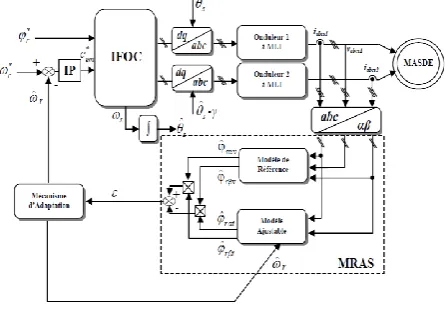
IV. DESIGN OF MRASSPEED ESTIMATOR The speed estimator, analyzed in this paper, is the one originally proposed in [5] and shown in Fig. 1, where the two left-hand side blocks perform integration of (1) and (2). It relies on measured stator currents and voltage. In the MRAS estimation method, there needs two models which outputs are to be compared. One is voltage model (or stator equation) and the other is current model (or rotor equation). Because the voltage model doesn’t include rotor speed, it may be regarded as a reference and the other may be considered as an adjustable model, which includes rotor speed. [5], [6]. The error between two models can be used to derive a suitable adaptation law which generates the estimated rotor speed for the adjustable model rotor speed for the adjustable model.
Figure 1. The block diagram of a fuzzy speed sensorless control of a field-oriented DSIM equipped with MRAS observer.
If we consider all of the parameters in the motor and the estimator are the same value, the estimator operates in the stationary reference frame (,) and it is described with the following equations [4]-[6]:
d𝜓̂rαv
dt =
Lm+Lr
Lm [ 𝑣sα1− rs1isα1− δ(Ls+ Lm) disα1
dt −
Lm Lr Lm+Lr
disα2 dt ] d𝜓̂rβv
dt =
Lm+Lr
Lm [ 𝑣sβ1− rs1isβ1− δ(Ls+ Lm) disβ1
dt −
Lm Lr Lm+Lr
disβ2
with:
δ = 1 −(𝑙 𝑙𝑚2
𝑚+ 𝑙𝑟)(𝑙𝑚+ 𝑙𝑠)
d𝜓̂rαi
dt =
Lm
Tr(isα1+ i𝐬β𝟏) −
1
Tr𝜓̂rαi− wr𝜓̂rβi d𝜓̂rβi
dt =
Lm
Tr(isα1+ isβ1) − 1
Tr𝜓̂rβi+ wr𝜓̂rαi (9)
In the above equations, (8) is the stator equation (or reference model) and (9) is the rotor equation (or adjustable model).
The error designed for regulator is expressed as follow:
ε = 𝜓̂rαi𝜓̂rβv− 𝜓̂rαv𝜓̂rβi (10)
The global stability of this algorithm is shown by Popv hyperstability criterion. By respecting Popov’s criterion, Schauder proposes the following adaptation law [4]-[6]:
𝑤̂𝑟= 𝜀 (𝑘𝑝+𝑘𝑆𝑖) (11)
As is evident from (8)-(11), the adaptive mechanism (PI controller in this case) relies on the error quantity that represents the difference between the instantaneous positions of the two rotor flux estimates.
The MRAS estimator gives the rotor flux amplitude
r
ˆ and its position needed for the field orientation, which is calculated as follow:
ˆ ˆ arctan ( )
ˆ
ψrβ ρ
ψrα
(12)
V. DESIGN OF FLC FOR DSIMSPEED CONTROL The structure of a standard FLC can be seen as a traditional PI controller, where the speed error e and its variation Δe are considered as input linguistic variables and the electromagnetic reference torque change ΔTem is considered as the output linguistic variable [13], [14].
For convenience, the inputs and the output of the FLC were scaled with three different coefficients ke, ke, and
k∆Ten. These scaling factors can be constant or variable, and play an important role for the FLC design in order to achieve a good behaviour in both transient and steady state.
Seven membership functions with overlap, of triangular shape and equal width, are used for each input and output variable, so that a 49 rule base is created (see Fig. 2). The sum-product inference algorithm is selected to complete the fuzzy procedure, and the FLC output is obtained by the gravity center defuzzification method [15].
Figure 2. Membership functions of inputs and output of FLC.
The suggested built inference rules table used for FLC is depicted in Table I
TABLEI. INFERENCE RULES TABLE
.∆e/e NB NM NS Z PS PM PB
NB NB NB NB NB NM NS Z
NM NB NB NB NM NS Z PS
NS NB NB NM NS Z PS PM
Z NB NM NS Z PS PM PB
PS NM NS Z PS PM PB PB
PM NS Z PS PM PB PB PB
PB Z PS PM PB PB PB PB
where:
NB Negative Big; NM Negative Medium; NS Negative Small; Z (Approximately) Zero; PS Positive Small; PM Positive Medium; PB Positive Big.
VI. SIMULATION RESULTS AND DISCUSSION To investigate the effectiveness of the proposed system, and to check the closed-loop stability of the complete system, several tests were performed at different dynamic operating conditions such as sudden change in command speed, and step change in load. The parameters of the test motor are given in Table II.
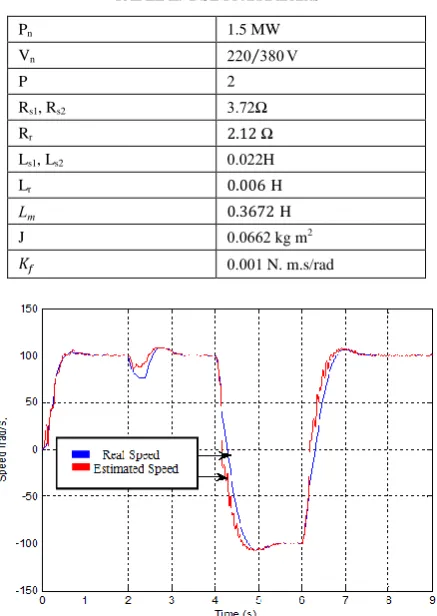
TABLEII. DSIMPARAMETERS
Pn 1.5 MW
Vn 220 380⁄ V
P 2
Rs1, Rs2 3.72Ω
Rr 2.12 Ω
Ls1, Ls2 0.022H
Lr 0.006H
Lm 0.3672H
J 0.0662 kg m2
𝐾𝑓 0.001 N. m.s/rad
Inverter 1
1 Inverter
2
1
FLC
1
Reference Model
1
Adjustable Model
1 Adaptive
Mechanism
1
ˆ ˆ
Figure 3. Transient response to speed step command ±100 (rad/s) at rated load.
Fig. 3 shows transient behavior of some characteristics of the drive with the following PI gains kp = 20, ki = 1455, Besides, the parameters of the FLC controller are: ke = 280, k∆e = 0.5, k∆Tem = 0.95. One can notice the fast convergence of the estimated speed during the transients and the capability to maintain the estimation at standstill. Besides, it can be seen that the dynamic and static performances are also satisfactory at the speed reversion.
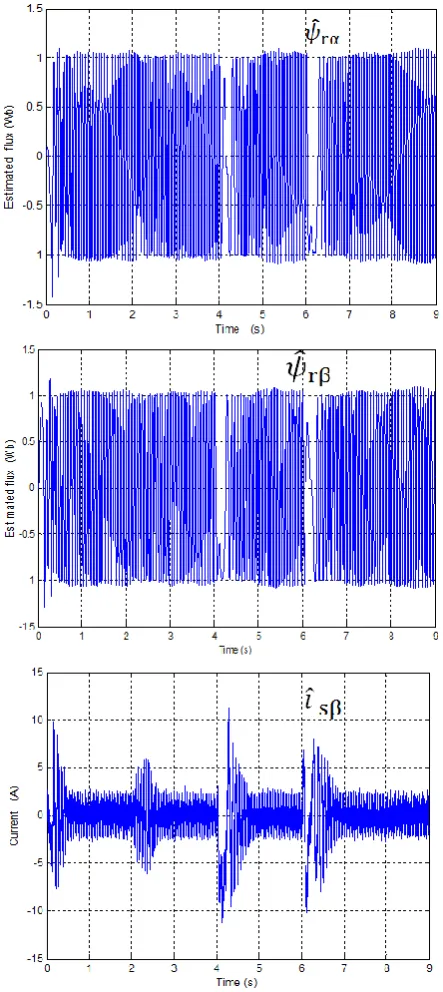
The numerical tests at low speed have been also investigated at rated load (See Fig. 4), one can notice that the proposed estimator is still able to maintain estimates in those operating conditions and the dynamic behaviour is acceptable.
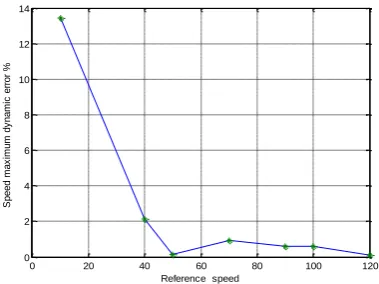
Figure 5. Speed maximum dynamic error at rated load operation versus reference speed.
The effectiveness of the sensorless scheme in terms of the speed estimation accuracy is also tested. Fig. 5 shows the maximum of the speed dynamic error versus the speed reference. It can be noted that the speed estimation is sufficiently accurate, in fact the dynamic error is 13% at a very low speed of (10 rad/s) and doesn’t exceed 0.61% at the rated speed (100 rad/s).
VII. CONCLUSION
In this paper fuzzy speed sensorless vector control of dual star induction motor using a parallel MRAS estimator is presented. The error in the instantaneous phase position of the two rotor flux estimates is utilized for rotor speed estimation.
The effectiveness of the developed parallel MRAS structure is verified by simulation testing in the low speed region. From these simulation results, one can conclude that the proposed scheme shows good convergence and closed-loop stability over a wide speed range at rated load operation.
APPENDIX NOMENCLATURE
ˆ Estimated values
αβ Stationary reference frame
1 2 2
1
qs ds qs ds
I I I I dq stator current components
s
, r αβ rotor flux components
qr dr
I I “d-q” rotor currents Tem Electromagnetic torque
gl
Sliding pulsation
δ
Stator leakage coefficient r
, Rotor angular speed/ rotor flux angle
Pn Nominal power
Ωr Mechanical speed of DSIM
Rs1, Rs2 Per phase stators resistances Ls1, Ls2 Per phase stators leakages inductances
m
L Magnetizing inductance
r
R Per phase rotor resistance
r
L Per phase rotor leakage inductances
𝐾𝑓 Viscous coefficient
𝜔𝑠 Stator pulsation
REFERENCES
[1] M. Mengoni, L. Zarri, A. Tani, G. Serra, and D. Casadei, “Sensorless multiphase induction motor drive based on a speed observer operating with third-order field harmonics,” in Proc. IEEEEnergy Conversion Congress and Exposition (ECCE), 2011, pp. 68-74.
[2] A. Nanoty and A. R. Chudasama, “Control of designed developed six phase induction motor,” International Journal of Electromagnetics and Applications, vol. 2, no. 5,pp. 77-84, 2012. [3] F. Ameur and K. Kouzi, “Genetic algorithm optimized PI and
fuzzy logic speed vector control of dual stator induction generator in wind energy conversion system,” in Proc 3rd International Conference on Systems and Control, Algiers, Algeria, Oct. 29-31, 2013, pp. 174-180.
[4] M. Boussak and K.
indirect stator flux orientation control of induction motor drive,” IEEE Trans. Industry Elect.,vol. 53, no. 1, pp. 41-49, Feb. 2006. [5] C. Schauder, “Adaptive speed identification for vector control of
induction motors without rotational transducers,” IEEE Trans. Ind. Appl., vol. 28, no. 5, pp. 1054-1061, 1992.
[6] L. Zhen and L. Xu, “Sensorless field orientation control of induction machines based on mutual MRAS scheme,” IEEE Trans. Ind. Electron., vol. 45, no. 5, pp. 824-831, Oct. 1998.
[7] L. B. Brahim, S. Tadakuma, and A. Akdag, “Speed control of induction motor without rotational transducers,” IEEE Trans. Ind. Appl., vol. 35, no. 4, pp. 844-850, 1999.
[8] Y. R. Kim, S. K. Sul, and M. H. Park, “Speed sensorless vector control of induction motor using an extended Kalman filter,” IEEE Trans. Ind. Appl., vol. 30, no. 5, pp. 1225-1233, 1994.
[9] S. H. Kim, T. S. Park, and G. T. Park, “Speed sensorless vector control of an induction motor using neural network estimation,” IEEE Trans. PowerElectron., vol. 48, no. 3, pp. 609-614, Jun. 2001.
[10] D. Drevensek, D. Zarko, and T. A. Lipo, “A study of sensorless control induction motor at zero speed utilizing high frequency voltage injection,” EPE J., vol. 12, no. 3, pp. 7-11, Aug. 2003. [11] R. Sadouni and A. Meroufel, “Performances comparative study of
field oriented control (FOC) and direct torque control (DTC) of dual three phase induction motor (DTPIM),” International Journal of Circuits, Systems and Signal Processing, vol. 6, no. 2, 2012. [12] H. Amimeur, D. Aouzellag, R. Abdessemed, and K. Ghedamsi,
“Sliding mode control of a dual-stator induction generator for wind energy conversion systems,” ELSEVIER Trans, Electrical Power and Energy Systems, vol. 42, no. 1, pp. 60-70, Nov. 2012. [13] K. Kouzi, L. Mokrani, and M. S. Naït-Saïd, “A new design of
fuzzy logic controller with fuzzy adapted gains based on indirect vector control for induction motor drive,” in Proc.
Southeastern Symposium on System Theory, Mar. 2003, pp. 362-366.
[14] K. Kouzi, L. Mokrani, and M. S. Naït-Saïd, “A fuzzy logic controller with fuzzy adapted gains based on indirect vector control for induction motor drive,” Journal of Electrical Engineering,vol. 3, no. 2, pp. 49-54, 2003.
[15] Y. Shi. and P. C.Sen, “A new defuzzification method for fuzzy control of power converters,” in Proc. Conference Record of the 2000 IEEE Industry Applications Conference, Rome, Italy, Oct. 2000, pp. 1202-1209.
Katia Kouzi was born in Algeria. She obtained her Engineer and her Master degrees in Electrical Engineering in 1998 and 2002, respectively. She received the PhD degree in Electrical and Computer Engineering from University of Batna, in 2008. Her research interests are focused on Advanced Control of ac Drives, including Vector, Sensorless, Intelligent Artificial Control, and Renewable Energy Systems Control and Managements. She is a researcher in Semi Conductors and Functional Materials Laboratory, as well as a full doctor at the Electrical Engineering Institute at the Laghouat University, Algeria, and she is currently working toward the professor degree. Katia Kouzi is the corresponding author and can be contacted at: katia_kouzi @yahoo.fr. 0 20 40 60 80 100 120
0 2 4 6 8 10 12 14
Reference speed
S p e e d m a x im u m d y n a m ic e rr o r %
Jarray, “A high-performance sensor less
Tahar Seghier was born in 25th of January 1971 in Laghouat, Algeria. He received the Electrical Engineer degree in electrical machines form Amar Telidji University of Laghouat (UATL), Algeria, in 1996 and the magister degree in Electrical Engineering materials from UATL in 2001. He joined the research Laboratory “Laboratoire d’études et Développement des Matériaux Semi-conducteurs et Diélectriques” at UATL in 2001, where he is now the head of Materials for Energy conversion Research
Team. His research interests include materials characterization aging, discharge phenomena modeling in dielectrics, high voltage and Electromagnetic Compatibility. He is working as an associate professor at the electrical engineering department of UATL since 2011.