Conjecturing, generalizing and justifying: Building theory around teacher knowledge of proving
Kristin Lesseig, Washington State University Vancouver,
[email protected] Abstract
The purpose of this study was to detail teachers’ proving activity and contribute to a framework of Mathematical Knowledge for Teaching Proof (MKT for Proof). While working to justify claims about sums of consecutive numbers, teachers searched for key ideas and productively used examples to make, test and refine conjectures. Analysis of teachers’ mathematical activity revealed knowledge of the proving process that would be useful for and useable in the teaching of proof. This includes knowledge of the interconnections among empirical exploration,
conjecturing, generalizing, and justifying as well as an understanding of the characteristics of examples and conjectures that could support the proving process. The central premise of this paper is that delineating aspects of teacher knowledge is a first step to supporting teachers’ efforts to engage all students in fundamental mathematical practices of conjecturing, generalizing and justifying.
Keywords: proof; mathematical knowledge for teaching; conjecturing, generalizing and justifying
Introduction
Proving is a fundamental practice in mathematics that plays a vital role in the
learning of mathematics (Ball & Bass, 2003; Yackel & Hanna, 2003). The processes of
conjecturing, generalizing and justifying require students to think broadly and flexibly
about mathematical ideas and relationships and support students as they solve problems
and seek to understand the mathematics they are learning and using (Carpenter, Franke,
Levi, 2003; Lannin, Ellis & Elliott, 2011). The importance of promoting these practices
in school mathematics is universally echoed in national standards. For example, in the
US students at all levels are expected to make conjectures, explore the truth of these
conjectures by analyzing cases and counterexamples, and justify their conclusions to
others (CCSSI, 2010; NCTM 2000). Similarly, a major aim of the national curriculum in
following a line of enquiry, conjecturing relationships and generalizations, and
developing an argument, justification or proof using mathematical language” (U.K.
Department of Education, 2014).
However, few studies have considered the knowledge required of teachers to
adequately support students’ understanding of and engagement in these practices. We
lack images of teachers engaged in conjecturing and generalizing activity, and thus know
little about teachers’ understanding of these practices. The purpose of this study was to
investigate teachers’ conjecturing, generalizing and justifying behavior in order to make a
theoretical contribution regarding teacher knowledge of proving.
To this end, this paper examines how teachers formulated, justified and refuted
mathematical claims as they worked on a proof-related task in professional development.
Analysis was guided by the following questions:
1. What is the nature of teachers’ proving activity when engaged in a
proof-related task in professional development?
2. How is teachers’ proving activity related to conjecturing, generalizing and
justifying as depicted in the mathematics literature?
Theoretical Foundations
The Mathematical Knowledge for Teaching Proof framework (MKT for Proof)
elaborated in this paper is grounded in literature on proving and contributes to recent
efforts to detail mathematical knowledge for teaching within particular domains. This
section begins with working definitions of principle activities associated with the proving
process and a brief literature review describing how the process might progress. This is
Throughout this paper, proving is broadly interpreted to include the range of
activities used to make sense of and establish mathematical knowledge; practices
generally referred to as mathematical reasoning (Russell, 1999; G. Stylianides & A.
Stylianides, 2009; U.K. Department of Education, 2014). These activities include
identifying patterns, making conjectures, testing examples, providing non-proof
arguments and constructing proofs (A. Stylianides, 2007; G. Stylianides, 2009).
Non-proof arguments include empirical arguments or other rationale that while convincing, are
not valid mathematical proofs because they do not guarantee the truth of the assertion for
all cases in the domain (G. Stylianides, 2009). Given that a primary instructional goal is
to support students’ progression toward deductive proof, conceptualizing proving activity
in this way has great educative value. First, it highlights how exploration and inductive
reasoning support sense making around core math ideas and can lead to more formal
justifications. Second, this definition focuses on the explanatory and discovery roles of
proof that many argue demand more attention in mathematics education (Hanna, 2000;
Stylianou, Blanton & Knuth, 2009).
This paper focuses on three interrelated actions: conjecturing, generalizing and
justifying, associated with proving. Conjecturing involves reasoning about mathematical
relationships to develop statements that are tentatively thought to be true but are not
known to be true (Lannin et al., 2011 p. 13). This element of doubt distinguishes
conjectures from proofs and provides an access point for further mathematical reasoning
(Lannin et al., 2011; Mazur, 1997; Reid, 2002). Generalizing denotes the act of
identifying commonalities across cases or extending mathematical reasoning to consider
demonstrate the truth (or falsehood) of a claim using mathematical forms of reasoning
(Staples, Bartlo, & Thanheiser, 2012). While this definition is restricted to ways of
reasoning accepted in the discipline of mathematics (e.g., reasoning through examples,
analogy, or previously accepted results) it does not necessitate the same level of rigor
demanded by mathematical proof (Balacheff, 2008). Instead, justifying includes any
attempts to use mathematics to convince oneself or others, regardless of whether the
argument is complete or would be accepted by the broader mathematics community as
indisputable proof. Finally, it is worth noting that these three definitions intentionally
focus on actions, rather than a final product. For example, the use of the word justify
rather than justification or proof, captures the exploratory nature entailed in investigating
why a particular relationship exists or a pattern might hold in general.
A progression of inductive reasoning. In describing the interaction between
generalization, specialization, and induction, Polya (1954) provided insight into ways one
might naturally progress toward generalization or specialization by either removing or
introducing a restriction, respectively. For example, one might generalize properties of
triangles to properties of other polygons by removing the restriction placed on the
number of sides. Introducing a restriction that all side lengths be equal entails
specialization as it narrows down the exploration to only those properties specific to
regular polygons.
Burton (1984) offered a similar description of spiraling mathematical activity
comprised of specializing, conjecturing, generalizing and convincing. These processes
occur naturally as one first explores the meaning of a question or problem by examining
connect these examples. Generalizations arenatural building blocks learners then use to
create order out of this empirical data. These generalizations become public during the
final step of convincing.
Building on the above work, Cañadas and colleagues (2007) further theorized
about types, stages and contexts of conjecturing. The mathematics problem discussed in
this paper typically elicits what is referred to as Type 1 conjecturing, or empirical
induction from a finite number of discrete cases. According to Cañadas and colleagues
(2007, p. 63), empirical induction involves the following seven stages: (1) observing
cases; (2) organizing cases, most commonly through lists or tables; (3) searching for and
predicting patterns by imagining that such patterns might apply to the next unknown
case; (4) formulating a conjecture about all possible cases based on empirical facts; (5)
validating the conjecture for a specific case through some independent method; (6)
generalizing the conjecture by removing doubt of its truth in the general case; and (7)
justifying the generalization by convincing another person or creating a mathematical
proof that guarantees truth of the conjecture.
Across these descriptions, two interrelated points are important to note. First,
while there is a natural progression from empirical exploration to conjecturing and
justifying, these activities are not necessarily linear. Second, the acts of ascertaining
(convincing oneself) and persuading (convincing others) (Harel & Sowder, 1998) play a
key role throughout this process. For example, the process of verifying, step five above,
involves additional empirical work to test one or more specific examples. This validation
further conjectures. However, convincing a broader community of a statement’s truth, as
in the final stages of generalizing and justifying, requires further justification.
Recognizing the importance of promoting these disciplinary practices in
classroom communities, researchers have articulated what mathematical conjecturing,
generalizing and justifying might look like in elementary and, to a lesser extent,
secondary classrooms (e.g., Ellis, 2011; Lampert, 2001; Martino & Maher, 1999; Reid,
2002; Staples, 2007; Zack, 1999). Classroom images garnered from this work provide
evidence that students at all levels are capable of engaging in these practices given
opportunities and a supportive environment. However, the majority of these studies
involve design experiments or teacher-researchers investigating their own practices. A
next logical step is to consider the implications such studies have for preparing typical
classroom teachers to do this work. Specifically, what do teachers need to know and be
able to do in order to advance students’ ability to conjecture, generalize and justify?
Mathematical Knowledge for Teaching
This paper is situated within a current research trend to identify mathematical
knowledge needed for teaching (MKT) and adds to recent attempts to outline MKT for
proof specifically (Lesseig, 2011, 2016; A. Stylianides & Ball, 2008; Steele & Rogers,
2012). Mathematical knowledge for teaching is conceptualized as a form of knowledge
that takes into account what, when, and how mathematical knowledge is required and
used to meet the demands of classroom teaching (Ball, Hill & Bass, 2005; Ball, Thames
& Phelps, 2008; G. Stylianides & A. Stylianides, 2010).
In previous work (Lesseig, 2011), I developed a framework of MKT for Proof
CCSSI, 2010; NCTM 2000), research on teacher knowledge and perceptions of proof
(e.g., Harel & Sowder, 2007; Knuth 2002; Martin & Harel, 1989) and studies
documenting difficulties teachers have evaluating proofs or advancing students’ ability to
create valid proofs (e.g., Bieda, 2010; Tabach et al., 2010). This literature review was
coordinated with Ball and colleagues’ (2008) domains of MKT to identify mathematics
content knowledge and pedagogical content knowledge central to the work of teaching
proof. Because teachers in this study were engaged as mathematical learners and not
exploring pedagogy for teaching proof, this paper concerns only the two categories of
subject matter knowledge, Common Content Knowledge (CCK) and Specialized Content
Knowledge (SCK).
Obviously, teachers need to have a firm grasp of the mathematical ideas they are
expected to teach. In the domain of proof, this includes the ability to construct a valid
proof and understand the basic components of a proof, similar to what Steele and Rogers
(2012) categorized as creating and defining proof. These elements comprise Common
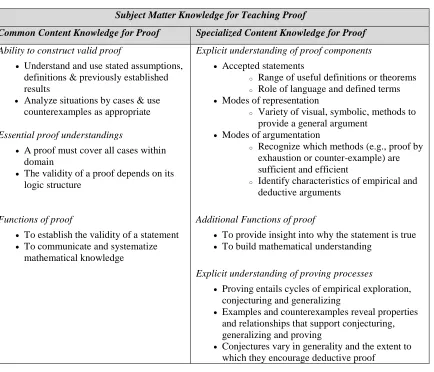
Content Knowledge (CCK) for teaching proof (see Table 1). In general, CCK refers to
mathematical knowledge that while connected to the work of teaching, might also be held
in common with others who use mathematics.
To support students in learning mathematical content, teachers need Specialized
Content Knowledge (SCK, Ball, Thames & Phelps, 2008). SCK is pure mathematical
knowledge (i.e. it is devoid of consideration of students or teaching) that is integrally
connected to the work of teaching. For example, in addition to understanding basic
components of a valid proof, teachers also need to know how an argument might be
modes of argumentation that are accepted by and accessible to the classroom community
(A. Stylianides, 2007). Supporting students’ ability to construct a valid proof demands
that teachers be fluent with a variety of visual, symbolic or verbal methods that can be
used to express a general argument. To evaluate student-generated proofs, teachers must
also be knowledgeable of different forms of argumentation. This includes knowing how
a claim about a finite number of cases can be verified through a systematic list, or how a
generic example (Mason & Pimm, 1984) can be used to prove a more general claim.
This type of specialized knowledge, categorized as explicit understanding of
proof components (see Table 1), pertains mainly to teachers’ understanding of the final
product—a valid mathematical proof—and deals less with the reasoning processes
leading up to proof. One might imagine that teachers need to draw upon additional
knowledge in order to encourage generalizations and engage students in formulating,
verifying or refuting their own mathematical conjectures. For example, it is important for
mathematicians and others to understand that testing examples is not sufficient for
proving a general statement. However, teachers also need to understand specific
characteristics of examples and conjectures that support or hinder the development of a
proof. These elements of SCK, referred to as explicit understanding of proving
processes, are the focus of this paper:
1. Proving entails cycles of empirical exploration, conjecturing and generalizing.
2. Examples and counterexamples reveal properties and relationships to support conjecturing, generalizing and proving.
Table 1
Mathematical Knowledge for Teaching Proof
Subject Matter Knowledge for Teaching Proof
Common Content Knowledge for Proof Specialized Content Knowledge for Proof
Ability to construct valid proof
Understand and use stated assumptions, definitions & previously established results
Analyze situations by cases & use counterexamples as appropriate Essential proof understandings
A proof must cover all cases within domain
The validity of a proof depends on its logic structure
Functions of proof
To establish the validity of a statement To communicate and systematize
mathematical knowledge
Explicit understanding of proof components Accepted statements
o Range of useful definitions or theorems o Role of language and defined terms
Modes of representation
o Variety of visual, symbolic, methods to provide a general argument
Modes of argumentation
o Recognize which methods (e.g., proof by
exhaustion or counter-example) are sufficient and efficient
o Identify characteristics of empirical and
deductive arguments Additional Functions of proof
To provide insight into why the statement is true To build mathematical understanding
Explicit understanding of proving processes
Proving entails cycles of empirical exploration, conjecturing and generalizing
Examples and counterexamples reveal properties and relationships that support conjecturing, generalizing and proving
Conjectures vary in generality and the extent to which they encourage deductive proof
It is worth noting that distinguishing between CCK and SCK requires some
speculation about what knowledge teachers draw on to effectively complete certain tasks
of teaching (Herbst & Kosko, 2014; Steele, Hillen, & Smith, 2013). Moreover, it is quite
reasonable to expect that non-teachers might also possess the knowledge labeled as SCK.
However, defining CCK as the ability to solve mathematical problems (i.e. construct
proofs) for oneself and SCK as knowledge necessary to support teaching this
mathematics to new learners, is a useful way to conceptualize the range of job-specific
Methods
This study draws on data from a research and development project investigating
what leaders need to know and be able to do to facilitate productive mathematical
discussions in professional development (PD). As part of this project, teacher-leaders
participated in a series of three 2-day seminars in which they engaged in mathematics
tasks, video case discussions, and other activities to support their work as mathematics
teacher-leaders (see Elliott, Kazemi, Lesseig, Mumme, Carroll, & Kelley-Petersen, 2009
for additional project details). Although all project participants were designated
teacher-leaders, they are referred to as “teachers” rather than “leaders” throughout this paper to
emphasize that it was their role as classroom teachers that was most salient in this study.
Participants and Seminar Context
Participants (n=24) came from several school districts located in the Northwest
region of the US and represented a range of classroom teaching and leadership
experience. Half of the participants identified themselves primarily as classroom
teachers; others were currently employed as school level mathematics coaches, or district
level math specialists. Nine were elementary grades K-6 teachers, (students aged 5-12)
and the remaining fifteen had experience teaching secondary grades 7-12 (students aged
12-18).
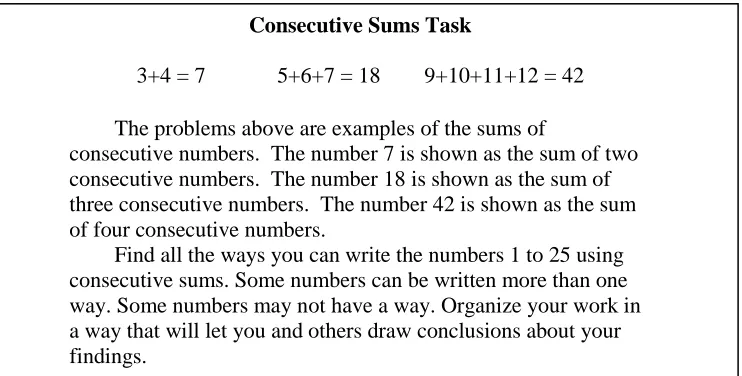
This paper focuses on teachers’ work on the Consecutive Sums task (Figure 1)
during the first leader seminar. Consecutive Sums is an elementary number theory task
that involves investigating number patterns and making generalizations about particular
of empirical induction described earlier and thus was an information rich site in which to
investigate teachers’ proving activity.
While working first individually and then in small groups, teachers were
prompted to make conjectures about sums that could and could not be made using
consecutive addends and consider ways to justify any patterns they noticed. Each small
group prepared a poster of their conjectures and initial reasoning to support their
conjectures or generalizations. Teachers then engaged in a whole group discussion of
these posters before viewing video cases depicting two different professional
development sessions in which this same task was used (Carroll & Mumme, 2007). In a
series of small and whole group discussions that followed, seminar participants were
prompted to compare the explanations, conjectures, and generalizations offered in these
two video cases.
Figure 1. Consecutive Sums Task (Driscoll, 1999) as presented in project seminar.
Data Analysis
Consecutive Sums Task
3+4 = 7 5+6+7 = 18 9+10+11+12 = 42
The problems above are examples of the sums of
consecutive numbers. The number 7 is shown as the sum of two consecutive numbers. The number 18 is shown as the sum of three consecutive numbers. The number 42 is shown as the sum of four consecutive numbers.
Because the intent was to analyze the nature of teachers’ proving activity, video
from leader seminars was the primary data source. Two cameras were used to capture
teachers’ mathematical work and interaction within two small groups and all
whole-group discussions. In addition to video data, researcher field notes, seminar materials
(e.g., facilitation notes, video case transcripts and other handouts), and artifacts (e.g.,
group posters and individual journal writings) were collected and analyzed.
Video analysis occurred in several steps and was supported by the use of
Studiocode© (Studiocode Business Group, 2012), a qualitative video analysis software.
First, initial codes (Saldana, 2015) were used to describe teachers’ general activity (e.g.,
recording conjectures or offering numeric examples) and mark teachers’ use of specific
terms such as “proof,” or “conjecture.” As patterns and themes were identified through
subsequent viewings, codes were added to denote more specific activities such as
teachers evoking number properties, using examples and counterexamples, or refining
conjectures. These codes and corresponding examples from the data were constantly
vetted with other project researchers familiar with my research questions.
After coding the video data, matrix and Boolean search features within
Studiocode were used to support further qualitative analysis. For example, all instances
coded as number properties, conjecture, or generalization could be collected and viewed
in succession to explore how teachers were searching for mathematical structure (e.g., did
they consider properties of particular sets of numbers?), and articulating their conjectures
and generalizations (e.g., did they qualify statements or make the domain explicit?).
Since teachers clearly understood that providing examples was not enough to
examples played in the development and communication of teachers’ conjectures,
generalizations and justifications. Teacher discussion coded as using examples or
counterexamples was analyzed further to determine when, why, and how examples and
counterexamples supported the proving process. This analysis led to the second theme
described in the findings.
Throughout this analysis process, links among teachers’ proof-related work,
mathematicians’ views on the role of conjectures and examples, and the literature on
proving activity in K-12 classrooms were continually sought. This literature provided a
lens through which to consider knowledge of proving that would support teachers’ work
with students.
Findings
To address the two research questions: what is the nature of teachers’ proving
activity and how is that activity related to conjecturing, generalizing and justifying as
depicted in the mathematics literature, I first summarize themes that emerged from
teachers’ work on the Consecutive Sums task. An extended excerpt from one small
group discussion is then used to highlight these themes. To be clear, the purpose of my
analysis was not to infer what individual teachers did or did not understand about proof
or proving, but to explore the nature of teachers’ mathematical activity. Such empirically
based descriptions of teachers engaging in conjecturing, generalizing, and justifying are
currently lacking and can advance our understanding of teachers’ proof-related work in
PD. Connections to teaching are taken up in the discussion.
The Nature of Teachers’ Proof-related Work
of proofs, teachers naturally sought to justify why their conjectures were true. In the
process, teachers drew on their knowledge of proof and the functions of proof to (1)
analyze the situation by cases and search for key ideas; (2) generate examples and
counterexamples; and (3) establish intermediate conjectures that could contribute to a
final deductive proof.
Organizing by cases advanced the proving process. The Consecutive Sums
task naturally elicits conjectures or generalizations based on observed number patterns.
Thus, it is not surprising that while working on the task teachers discussed patterns and
made conjectures related to particular classes of numbers such as multiples of three,
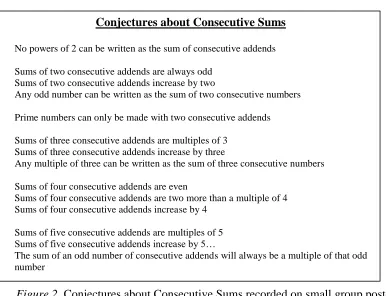
two-addend sums, prime numbers or powers of two. Figure 2 contains a list of conjectures
that were recorded on small group posters. More striking than the breadth of conjectures
generated, was teachers’ persistence in explaining why these generalizations made sense
mathematically.
To support their generalizations and explain why these patterns occurred or might
continue, teachers identified relevant characteristics of numbers (i.e., factors, divisibility,
even and odd properties) that applied to particular sets of numbers. For example,
teachers continually asked what was special about powers of 2 or prime numbers and
considered how properties such as “they have no odd factors,” (for the case of powers of
2) and “they have no proper factors other than one,” (for the case of prime numbers)
Figure 2. Conjectures about Consecutive Sums recorded on small group posters.
Testing examples supported but did not constitute proof. Teachers’ judicious
use of examples emerged as a consistent theme in the Consecutive Sums task. Initially,
teachers searched for patterns in their empirical work and used examples to formulate
conjectures, aligning with the first four stages of empirical induction (Cañadas, 2007).
Teachers continued to use examples even after sharing initial patterns and conjectures.
Analysis of teachers’ small group discussions revealed three distinct contexts in which
examples were invoked: to clarify an idea, to test a new conjecture, and to convince
oneself or others in the group that a particular assertion was true.
The first usage arose out of the need for teachers to communicate their thinking
and to support their own and their colleagues’ sense-making as new ideas emerged. For
example, when a teacher conjectured that the consecutive sum would always contain at Conjectures about Consecutive Sums
No powers of 2 can be written as the sum of consecutive addends Sums of two consecutive addends are always odd
Sums of two consecutive addends increase by two
Any odd number can be written as the sum of two consecutive numbers Prime numbers can only be made with two consecutive addends Sums of three consecutive addends are multiples of 3
Sums of three consecutive addends increase by three
Any multiple of three can be written as the sum of three consecutive numbers Sums of four consecutive addends are even
Sums of four consecutive addends are two more than a multiple of 4 Sums of four consecutive addends increase by 4
Sums of five consecutive addends are multiples of 5 Sums of five consecutive addends increase by 5…
least one of the factors of the number, unless the number is prime, she was pressed by a
colleague to give a clarifying example. The teacher went on to explain, “So like 15.
Three times five is fifteen; both of my consecutive sums have three or five.”
The latter two contexts of example use were related to justification and illustrated
the back and forth movement between exploration and verification. For example, after
clarifying the conjecture above, the pair went on to scan their table of consecutive sums
to verify this tentative statement. They noted that 33 had a consecutive sum that
contained 3 and one that contained 11, whereas the consecutive sum for 10 had a 2 but
not a 5, etc. The group did not have time to explore this particular conjecture further and
admittedly didn’t have an explanation or justification.1
Despite using examples to test or extend their conjectures, teachers made explicit
comments that empirical justification did not constitute a valid proof. For example, in the
whole group discussion of the task, one teacher noted that their group had not yet proven
that consecutive sums could not result in powers of 2, stating “All we’ve done is noticed
the pattern and used examples, so right now this is still just our conjecture.” Given
students’ reliance on empirical justification as proof, this is an important distinction for
teachers to embrace (Harel & Rabin, 2010; Harel & Sowder, 2007). This knowledge of
productive examples in the service of proof versus examples as proof was demonstrated
throughout teachers work on the Consecutive Sums task and is highlighted further in the
small group excerpt below.
Establishing and evaluating intermediate conjectures contributed to
deductive proof. Not all of the conjectures teachers generated or noted in the video
1
cases were of equal value. For example, the conjecture that 32 will be the next number
that can’t be made with consecutive addends is less general than the conjecture that you
can never come up with sums for powers of 2. The first conjecture, based on an
observation that the missing numbers double each time, is an example of results-based
reasoning that may or may not support further generalizations or reveal why this pattern
exists (Lannin, 2005; Pedemonte & Buchbinder, 2011). This second conjecture, about an
entire class of numbers, all powers of two, is not only more general, but provides a
starting point to begin the proving process. By naming the particular set of numbers, one
can begin exploring properties unique to powers of two that might reveal underlying
reasons why this pattern not only continues to the next number but also should hold in
general.
In the process of explaining why the powers of 2 cannot be made, teachers
established a number of additional conjectures such as, “every number that is not a power
of 2 contains an odd factor,” or “any odd number can always be written as the sum of two
consecutive numbers,” that were productive in moving toward proof. Teachers also
generated a number of tangential conjectures and questions that were less helpful in
building understanding or furthering an argument. Teachers evaluated their conjectures
both explicitly and implicitly as they chose which to record on the group poster and
which to pursue in more depth.
Teachers also evaluated the conjectures presented in the middle grades video case.
Teachers noted how the conjectures had moved from specific cases of three or five
addend sums toward a generalization for all odd numbers that enabled further reasoning
this generalization useful in a broader context, it revealed underlying ideas as to why the
statement is true (i.e., there is a property common to all odd numbers that is relevant to
sums of consecutive numbers).
A Cycle of Empirical Exploration, Conjecturing, Generalizing and Justifying
The following small group excerpt demonstrates key aspects of the proving
process evident in teachers’ work on the Consecutive Sums task and offers more detail to
the findings reported above. More importantly, this episode provides much needed
images of teachers’ engaging in proving activity and developing personal knowledge of
processes leading to proof, rather than exploring pedagogy for teaching proof. Here
teachers were reasoning through examples to generate additional conjectures and
generalizations as they attempted to justify a claim about prime numbers.
Can prime numbers only be made one way? The small group discussion
began after teachers shared a variety of patterns and one teacher, Wayne, verbalized his
curiosity about why there were two or three ways to create some numbers but other
numbers could only be created in one way. For example, the number 5 can only be
written one way (2+3) whereas the number 15 can be written two ways (7 + 8 or 3 + 4 +
5). In the process of explaining why this is the case, teachers explored specific numbers
to make and then refine a conjecture about prime numbers.
Rose: Does prime numbers come into that at all? Because anywhere that you have a prime number...
Wayne: You're back to only one way. Fran: Is that true?
Hannah: Except two. Two doesn't have one way…[begins checking her list and whispering, thirteen, seventeen, nineteen…]
Fran: So all prime numbers only have one way?
Hannah: Except for two. Two would be the exception. But two is the only even prime.
Fran: I think there has to be one way with two consecutive numbers. Because you look at like six has one way… and twelve, the difference is that the primes have two consecutive addends.
Hannah: And that goes back to the only way to get the odd numbers is with some sort of even, odd combination because you can’t get an even number doing that.
Wayne’s wondering focused the group on looking more specifically at the number
of ways to make each sum, and in particular why some numbers could be made in more
than one way. The systematic tables of sums teachers had constructed aided in the
formulation of a new conjecture about prime numbers. When first stating the conjecture
that prime numbers have “only one way,” there was a need to be convinced as indicated
by Fran’s comment “is that true?” and Hannah’s return back to her list to check 13, 17,
etc.; using specific examples to verify the conjecture and convince herself. Although
certainly not proof, the fact that all the prime numbers in the table could only be made
one way makes Wayne’s prime conjecture more plausible.2
Hannah also saw that two, a prime number that cannot be made with consecutive
addends, was a counter-example to the claim. In this case Hannah quickly decided two,
as the only even prime number, was a special case that the group then left out of the
conjecture, a technique often referred to as exception-barring (Lakatos, 1976).3 The issue
raised by Fran, that even though six and twelve are not prime numbers they can only be
made one way as well, served a different purpose. Although six and twelve are not
technically counterexamples to the original conjecture, this observation caused the group
to refine the conjecture to add that prime numbers can only be made with two-addend
2 According to Pólya (1954) such reasoning might be stated as: p implies q; q more likely
(because it is true in cases thus far), implies p more plausible.
3
sums. This refinement narrowed down the conjecture and brought out key connections
between odd numbers and two-addend sums used later in the teachers’ argument.
In summary, teachers’ empirical exploration has done three important things.
First, testing a number of examples led to conviction that the prime conjecture is true and
hence a proof is worth pursuing; progressing through steps five and six in Cañadas and
colleagues (2007) seven stages of empirical induction. Secondly, the identification of
two as a counterexample led to explicit domain defining that narrows the focus of a
subsequent proof to what is known about prime numbers and establishes when this
generalization can be applied for later use. Finally, the examples of other numbers with
only one way led to further refinement of the conjecture to include only two-addend
sums. This tightening of the conjecture highlights key ideas about prime numbers, the
structure of odd sums and relationships between factors and consecutive addends that
may aid the formulation of a proof.
Why can prime numbers only be made one way? After the conjecture, “Any
prime number except 2 will only be the sum of two consecutive counting numbers,” was
eventually refined and recorded on the group poster, Rose began another cycle of
exploration by asking:
Rose: So what do we know about prime numbers? Hannah: They only have 2 factors.
Fran: And they are odd.
Wayne: So what is it about a prime number that makes us think that... (pause). We know it's going to be odd. Could we make the conjecture that any odd number will always be the sum of two consecutive?
Rose’s question focused the group on key properties of prime numbers that might support
numbers was not followed up in the moment, it resurfaced later in the discussion when
Wayne explained how there are actually two parts to proving the group’s original prime
number conjecture. First, one must prove that prime numbers can be made with two
consecutive integers. Second, one must prove that this is the only way to write prime
numbers as sums of consecutive numbers.
Instead, the group followed additional patterns Fran observed and began
reasoning by cases to generate more conjectures. Based on these patterns, the group
began building an argument by systematically eliminating other possible ways (with
three, four, five addends, etc.) to make prime numbers. This form of argumentation by
cases to generate a series of contradictions is one well suited to the Consecutive Sums
task.
Fran: If we look at our addends so far... multiples of three have three addends.
Rose: It’s going to go even, odd, even odd.
Fran: So if it's a multiple of three it cannot be prime. Right? Ones with four addends are all even, which are not prime. If they have five addends it's a multiple of five, right? If it has six addends it looks like it's a multiple of three from what I figured out here, because it's six apart…
Following this logic, the group continued generalizing and tested seven-addend
sums, verifying that they are all multiples of seven. Hannah then described how they
might create an argument based on exhaustion by showing that sums of any other number
of addends (other than just two) will create a number that is not prime.
In this example, teachers did not stop at the conjecture stage. Instead, teachers
focused on definitions or theorems related to factors and multiples or odd and prime
numbers to explain why prime numbers can only be written with two consecutive
result of both a knowledge issue, lacking understanding of a key idea, and an
epistemological issue, lacking understanding that a proof must be based on key ideas. As
evidenced in teachers’ questioning, “what do we know about prime numbers?” it was
clear that teachers both recognized that proofs must be based on key ideas and were able
to focus in on key statements that would support a valid proof.
This small group excerpt illustrates how teachers’ mathematical work on the
Consecutive Sums task progressed from exploring specific numbers, to formulating
conjectures and generalizations, back to using specific cases to clarify or verify these
conjectures. This cycle of investigating particular types of numbers and revising
intermediate conjectures was supported by and in support of the quest to explain why a
generalization might be true.
Discussion
Teachers’ own proving activity on the Consecutive Sums task mirrored many of
the mathematical practices in which we want students to engage. Teachers productively
used examples to make, test, and refine conjectures and began to develop mathematical
arguments to justify their conclusions. It is important to note that teachers were acting as
mathematical learners during this work. However, in the MKT for Proof framework
(Table 1), I advance that explicit knowledge of this back and forth movement between
empirical exploration, conjecturing, generalizing and justifying evident in teachers’ work
can help teachers both recognize and support students’ engagement in proving practices.
To support this theoretical claim that specialized knowledge of proving activity
would be useful for and useable in teaching, I return to the research on proof. I focus on
understanding of proving processes related to the use of examples and counterexamples,
and the ability to identify and distinguish characteristics of conjectures.
Using examples in service of proof, not as proof
When working on the Consecutive Sums task, teachers chose specific examples to
refine or verify conjectures as well as to explain or clarify general procedures. Although
convincing, teachers were clear that these examples did not constitute a proof. Findings
demonstrating teachers’ productive use of examples is especially important given the
complex relationship between proof and examples documented in the literature.
Research has shown that teachers’ use of examples to verify statements contributes to
students’ belief that testing a number of examples is sufficient proof (Harel & Sowder,
1998; G. Stylianides & A. Stylianides, 2009). At the same time, inductive reasoning can
aid students in recognizing key general properties of examples that support further
generalizations and eventual deductive proof (Lannin, 2005; Lannin, Barker &
Townsend, 2006; Pedemonte & Buchbinder, 2011).
From a mathematical perspective, the production and analysis of examples and
counterexamples is central to the back and forth interaction between proof and refutation
that leads to the development of new mathematical theories (Lakatos, 1976). It is through
the careful selection of examples and counterexamples that key ideas underlying a proof
are revealed and the boundaries of generalizations are explored (Lannin et al., 2011;
Watson & Chick, 2011; Zazkis, Liljedahl & Chernoff, 2008). Studies on example use
have demonstrated how numerical variation, large number examples, and pivotal
counterexamples promote generalization by highlighting relevant features and underlying
However, these studies also reveal that generating productive examples and
counterexamples to exemplify a theorem or disprove an impromptu conjecture in the
moment is not an easy task for teachers.
Distinguishing characteristics of conjectures
The Consecutive Sums task encourages conjectures and generalizations based on
patterns discovered for different numbers of addends or classes of numbers (see Figure
2). As discussed earlier, these conjectures vary in terms of generality and proof
affordances. Understanding different levels or characteristics of conjectures can help
teachers assess whether students have noted a general property about a class of numbers,
or have reasoned only from a subset of results without regard to underlying structure or
key ideas (Pedemonte & Buchbinder, 2011; Raman, 2003).
Teachers also need to critically evaluate and determine what is entailed in proving
student-generated conjectures. Armed with this knowledge, teachers are better prepared
to decide what conjectures are worth pursuing or whether students have the requisite
background (e.g., a grasp of key definitions or theorems) to produce a valid proof (A.
Stylianides, 2007). A major aim in mathematics instruction is to move students from
inductive justifications toward deductive proof (Harel & Sowder, 2007). Given the
difficulties teachers have supporting students in developing arguments based on key ideas
(Bieda, 2010), this knowledge of proof entailments seems particularly critical.
Limitations and Implications
The purpose of this paper was to detail teachers’ engagement in conjecturing,
generalizing and justifying practices. Thus I focused on one task that explicitly invoked
further refinements or additions to the MKT for Proof framework. For example, a
geometry task, or a task steeped in algebraic symbolization, might reveal critical
additions or differences across elementary and secondary grade levels.
Moreover, the task did not call for the construction of a formal proof, nor was
sufficient time provided during the PD seminar for that to occur. Teachers were asked
only to generate and record initial conjectures along with supporting evidence or
preliminary justifications. No claims can be made about whether teachers’ verbal
arguments to verify or convince others of the truth of their conjectures would constitute
mathematical proof, or what other forms of argumentation might be employed to prove
the various conjectures. However, the unpacking of proving activities afforded by this
task is a nice complement to studies that have focused more intently on knowledge of
proof as a final product (e.g., Lesseig, 2016).
Another limitation of this study is that the categorization of knowledge evident in
teachers’ activity as MKT for proof represents an interpretation of its usefulness in
teaching. However, this classification is grounded in mathematics and mathematics
education research literature and the goals of mathematics instruction outlined in current
policy documents. As such it represents a promising starting point to investigate what
and how mathematical knowledge might be drawn upon during proof instruction.
Indeed, while working on the Consecutive Sums task teachers did not make
explicit references to classroom instruction, leaving it to chance that teachers’ could
successfully use this knowledge to support students in similar proving activity. In order
supports the work of teaching should be made clear. This has implications for
professional development related to proof and proving.
Implications for Professional Development
As a research tool, the MKT for Proof framework can be used to analyze
teachers’ proof-related work in the classroom or to evaluate PD experiences. As a
practical tool, the framework can help PD facilitators define teacher learning goals,
design tasks, and guide teacher discussion to intentionally target aspects of MKT for
proof. For example, to build teachers’ knowledge of the role of examples or
characteristics of conjectures, facilitators could call out productive proving practices in
the moment and ask teachers to:
1) Identify characteristics of examples and non-examples that they generated.
2) Categorize their conjectures in terms of generality and proof affordances.
3) Articulate the assumptions underlying their conjectures and generalizations.
4) Openly reflect on how examples or intermediate conjectures supported their
justifications.
These ideas can then be directly linked to how such knowledge would be useful in
classroom situations. Such explicit conversations not only build new knowledge, but also
increase the likelihood that teachers are able to draw upon this knowledge to support
students’ proving activity.
Conclusion
To date, there is little research on what effective professional development for
reasoning and proof might entail (Ball, 2003; G. Stylianides & Silver, 2009). To promote
learners, to engage in conjecturing, generalizing, justifying and refuting. However, as a
field we lack images of this type of work in PD and thus know little about what teachers
are learning. This paper not only illustrates teachers’ engagement in cycles of proving
activity, but also provides a tool to characterize productive mathematical work in relation
to proof-related learning goals. Moreover, the MKT for Proof framework can support
intentional planning and implementation of PD designed to build teachers’ knowledge of
proving. The central premise of this paper is that delineating aspects of teacher
knowledge is a first step to supporting teachers’ efforts to engage all students in
fundamental mathematical practices of conjecturing, generalizing and justifying.
References
Balacheff, N. (2008). The role of the researcher’s epistemology in mathematics education: An essay on the case of proof. ZDM: The International Journal on Mathematics Education, 40, 501-512.
Ball, D. L. (2003). Mathematical proficiency for all students: Toward a strategic
research and developmental program in mathematics education.Santa Monica, CA: RAND Mathematics Study Panel.
Ball, D. L., & Bass, H. (2003). Making mathematics reasonable in school. In J.
Kilpatrick, W.G. Martin & D. Schifter (Eds.), A research companion to principles and standards for school mathematics (pp. 27-44). Reston, VA: National Council of Teachers of Mathematics.
Ball, D. L., Hill, H. C., & Bass, H. (2005). Knowing mathematics for teaching. American Educator, 29 (3), 14.
Ball, D. L., Thames, M. H., & Phelps, G. (2008). Content knowledge for teaching: What makes it special? Journal of Teacher Education, 59, 389–407.
Bieda, K.N., (2010). Enacting proof-related tasks in middle school mathematics: Challenges and opportunities. Journal for Research in Mathematics Education, 41, 351-382.
Burton, L. (1984). Mathematical thinking: The struggle for meaning. Journal for Research in Mathematics Education, 35–49.
Cañadas, M. C., Deulofeu, J., Figueiras, L., Reid, D., & Yevdokimov, O. (2007). The conjecturing process: perspectives in theory and implications in practice. Journal of Teaching and Learning, 5(1), 55-72.
Carpenter, T. P., M. L Franke, & Levi, L. (2003). Thinking Mathematically: Integrating Arithmetic and Algebra in Elementary School. Portsmouth, NH: Heinemann. Carroll, C., & Mumme, J. (2007). Learning to lead mathematics professional
development. Thousand Oaks, CA: Corwin Press.
Common Core State Standards Initiative. (2010). Common Core State Standards for Mathematics. Washington, DC: National Governors Association Center for Best Practices and the Council of Chief State School Officers. Retrieved from
http://www.corestandards.org/assets/CCSSI_Math%20Standards.pdf.
Driscoll, M. (1999). Fostering algebraic thinking: A guide for teachers, grades 6-10. Portsmouth, NH: Heinemann.
Ellis, A. B. (2011). Generalizing-promoting actions: How classroom collaborations can support students’ mathematical generalizations. Journal for Research in
Mathematics Education, 42, 308-345.
Elliott, R., Kazemi, E., Lesseig, K., Mumme, J., Carroll, C. & Kelley-Petersen, M. (2009). Conceptualizing the work of leading mathematical tasks in professional development. Journal of Teacher Education, 60(4), 364-379.
Hanna, G. (2000). Proof, explanation and exploration: An overview. Educational Studies in Mathematics, 44(1), 5-23.
Harel, G., & Rabin, J. M. (2010). Teaching practices associated with the authoritative proof scheme. Journal for Research in Mathematics Education, 41, 14. Harel, G., & Sowder, L. (1998). Students’ proof schemes: Results from exploratory
mathematics education, III (pp. 234-283). Washington, DC: Mathematical Association of America.
Harel, G., & Sowder, L. (2007). Toward comprehensive perspectives on the learning and teaching of proof. In F. K. Lester, Jr. (Ed.), Second handbook of research on mathematics teaching and learning: A project of the National Council of Teachers of Mathematics (pp. 805–842). Charlotte, NC: Information Age Publishing.
Herbst, P., & Kosko, K. (2014). Mathematical knowledge for teaching and its specificity to high school geometry instruction. In Research trends in mathematics teacher education (pp. 23-45). Switzerland: Springer International Publishing.
Knuth, E.J. (2002). Teachers’ conceptions of proof in the context of secondary school mathematics. Journal of Mathematics Teacher Education, 5, 61-88.
Lakatos, I. (1976). Proofs and refutations: The logic of mathematical discovery. Cambridge, NY: Cambridge University Press.
Lampert, M. (2001). Teaching problems and the problems of teaching. New Haven: Yale University Press.
Lannin, J.K. (2005). Generalization and justification: The challenge of introducing algebraic reasoning through patterning activities. Mathematical Thinking and Learning, 7, 231-258.
Lannin, J. K., Barker, D. D., & Townsend, B. E. (2006). Recursive and explicit rules: How can we build student algebraic understanding? Journal of Mathematical Behavior, 25, 299-317.
Lannin, J.K., Ellis, A.B., Elliott, R. (2011). Developing Essential Understanding of Mathematical Reasoning for Teaching Mathematics in Prekindergarten-Grade 8. R.M. Zbiek, (Ed.). Reston, VA: National Council of Teachers of Mathematics. Lesseig, K. (2016). Investigating Mathematical Knowledge for Teaching Proof in
professional development. International Journal of Research in Education and Science, 2(2), 253-270.
Lesseig, K. (2011). Mathematical knowledge for teaching proof. Unpublished Doctoral Dissertation, Oregon State University.
Martin, T. S., & McCrone, S. S. (2003). Classroom factors related to geometric proof construction ability. The Mathematics Educator, 7(1), 18–31.
Martin, W.G., & Harel, G. (1989). Proof frames of preservice elementary teachers. Journal for Research in Mathematics Education, 20, 41-51.
Martino, A.M., & Maher, C.A. (1999). Teacher questioning to promote justification and generalization in mathematics: what research practice has taught us. Journal of Mathematical Behavior, 18, 53-78.
Mason, J., & Pimm, D. (1984). Generic examples: Seeing the general in the particular. Educational Studies in Mathematics, 15(3), 277-289.
Mazur, B. (1997). Conjecture. Synthese, 111, 197–210.
National Council of Teachers of Mathematics (2000). Principles and Standards for School Mathematics. Reston, VA: NCTM.
Pólya, G. (1954). Mathematics and Plausible Reasoning (Vols. 1, 2). Princeton, NJ: Princeton University.
Raman, M. (2003). Key ideas: what are they and how can they help us understand how people view proof? Educational Studies in Mathematics, 52, 319–325.
Reid, D. A. (2002). Conjectures and refutations in grade 5 mathematics. Journal for Research in Mathematics Education, 33, 5–29.
Russell, S. J. (1999). Mathematical reasoning in the elementary grades. In L.V. Stiff (Ed.), Developing mathematical reasoning in grades K-12 (pp. 1–12). Reston, VA: National Council of Teachers of Mathematics.
Saldaña, J. (2015). The coding manual for qualitative researchers. Thousand Oaks, CA: Sage.
Staples, M. (2007). Supporting whole-class collaborative inquiry in a secondary mathematics classroom. Cognition and Instruction, 25(2-3), 161–217. Staples, M. E., Bartlo, J., & Thanheiser, E. (2012). Justification as a teaching and
learning practice: Its (potential) multifacted role in middle grades mathematics classrooms. The Journal of Mathematical Behavior, 31(4), 447-462.
Steele, M. D., & Rogers, K. C. (2012). Relationships between mathematical knowledge for teaching and teaching practice: the case of proof. Journal of Mathematics Teacher Education, 1–22.
Steele, M. D., Hillen, A. F., & Smith, M. S. (2013). Developing mathematical knowledge for teaching in a methods course: the case of function. Journal of Mathematics Teacher Education, 16(6), 451-482.
Studio Code Business Group (2012). Studiocode. Warriewood, NSW: Sportstec.
Stylianides, A.J. (2007). Proof and proving in school mathematics. Journal for Research in Mathematics Education, 38, 289-321.
Stylianides, A.J., & Ball, D.L. (2008). Understanding and describing mathematical knowledge for teaching: knowledge about proof for engaging students in the activity of proving. Journal of Mathematics Teacher Education 11, 307-332. Stylianides, G. J. (2009). Reasoning-and-proving in school mathematics textbooks.
Mathematical Thinking and Learning, 11, 258–288.
Stylianides, G. J., & Silver, E. (2009). Reasoning-and-proving in school mathematics: The case of pattern identification. In D. A. Stylianou, M. L. Blanton, & E. J. Knuth (Eds.), Teaching and learning proof across the grades: A K−16 perspective (pp. 235-249). New York, NY: Routledge.
Stylianides, G.J, & Stylianides, A.J. (2009). Facilitating the transition from empirical arguments to proof. Journal for Research in Mathematics Education, 40, 314-352.
Stylianides, G. J., & Stylianides, A. J. (2010). Mathematics for teaching: A form of applied mathematics. Teaching and Teacher Education, 26, 161–172.
Stylianou, D.A., Blanton, M.L., & Knuth, E.J. (Eds.). (2009). Teaching and learning proof across the grades: A K−16 perspective. New York, NY: Routledge. Tabach, M., Levenson, E., Barkai, R., Tirosh, D., Tsamir, P. & Dreyfus, T. (2010).
Secondary school teachers’ awareness of numerical examples as proof. Research in Mathematics Education, 12, 117-131.
https://www.gov.uk/government/publications/national-curriculum-in-england-mathematics-programmes-of-study
Yackel, E., & Hanna, G. (2003). Reasoning and proof. In J. Kilpatrick, W.G. Martin, & D. Schifter (Eds.), A research companion to principles and standards for school mathematics (pp. 227-235). Reston, VA: National Council of Teachers of Mathematics.
Watson, A., & Chick, H. (2011). Qualities of examples in learning and teaching. ZDM: The International Journal on Mathematics Education, 43, 283-294.
Zack, V. (1999). Everyday and mathematical language in children’s argumentation about proof. Educational Review, 51, 129–146.
Zazkis, R., & Chernoff, E. J. (2008). What makes a counterexample exemplary? Educational Studies in Mathematics, 68, 195–208.
Zazkis, R., Liljedahl, P., & Chernoff, E. J. (2008). The role of examples in forming and refuting generalizations. ZDM: The International Journal on Mathematics Education, 40, 131–141.