
INFLUENCE OF INTERCRITICAL ANNEALING TEMPERATURE ON
MECHANICAL PROPERTIES AND MICROSTRUCTURE OF
0.23%C LOW ALLOY STEEL
S. C. Ikpeseni
1, *, B. O. Onyekpe
2and H. Ovri
31 DEPARTMENT OF MECHANICAL ENGINEERING,DELTA STATE UNIVERSITY,OLEH CAMPUS,DELTA STATE.NIGERIA. 2DEPARTMENT OF MECHANICAL ENGINEERING,UNIVERSITY OF BENIN,BENIN-CITY,EDO STATE.NIGERIA. 3 INSTITUTE OF MATERIALS RESEARCH,MATERIALS MECHANICS,HELMHOLTZ-ZENTRUM GEESTHACHT ZENTRUM FÜR
MATERIAL- UND KÜSTENFORSCHUNG, MAX-PLANCK-STRAßE 1,21502GEESTHACHT,GERMANY.
Email addresses: 1[email protected], 2 [email protected], 3 [email protected]
ABSTRACT
The influence of intercritical annealing temperature on the microstructure and mechanical properties of an 0.23%C low alloy steel was undertaken in this work. The as-received steel was normalised and afterwards annealed in the (α+ϒ) region at 730OC, 750OC, 770OC and 790OC followed by quenching in hot water at about 50OC.Mechanical testing (tensile, impact and hardness) of the annealed samples were conducted at room temperature. The fracture surfaces of the impact test samples were examined using the scanning electron microscope (SEM). Micros structural evolution of the samples was also examined with an optical microscope. The results showed that all the evaluated mechanical properties were improved by intercritical annealing, with the samples treated at 790OC possessing the optimum combination of properties. The ultimate tensile strength (UTS), yield strength (YS), impact strength (IS), total elongation (TEL) and hardness of these samples improved by 2.7%, 13.7%, 19.7% and 31.05% respectively over the normalised sample. The microstructure photographs of the intercritically annealed samples revealed duplex structures of predominantly martensite in a ferrite matrix with little dispersions of either carbide or retained austenite, which is a typical characteristic of conventional dual phase steel.
Keywords: intercritical annealing, dual phase steel, mechanical properties, microstructure.
1. INTRODUCTION
Steel, is world’s most “advanced” material. It is the most widely used engineering material, essentially due to the fact that it can be manufactured at very competitive cost in large quantities to very precise specifications. Again, it is a very versatile material with an extensive range of mechanical properties from moderate strength levels (200-300 MNm-2) with excellent ductility and toughness, to very high strengths (5500 MNm-2) with adequate ductility [1, 2]. Hence, the mechanical behaviour of steels, accounts for their selection in engineering applications, especially where relatively high strength and reasonable toughness are required. Higher strengths imply the use of thinner sections and lighter components, while higher toughness means less likelihood of sudden failure [3]. For many engineering alloys however, an
increase in strength is accompanied by a reduction in toughness, hence the optimum combination of these properties is usually selected to meet the service requirement.
Dual phase steels are fast becoming one of the most popular and versatile materials in today’s automotive industry. These steels are presently used in most structural applications where they have replaced the more conventional high strength low alloy (HSLA) steels. According to United States Steel, they offer a great opportunity for part weight reduction. The improved formability, capacity to absorb crash energy and ability to resist fatigue failure has driven this substitution [4].
element content, particularly the low carbon level, is of great advantage. Furthermore, as the need for larger diameter pipes has grown, steels of higher yield stress have been used to avoid excessive wall thickness. In general, dual phase steels also referred to as dual phase low alloy steels, DPLA, are a mixture of ferrite matrix and marten site is lands decorating grain boundaries, with possible addition of bainite and retained austenite [4].
They exhibit no yield discontinuity but work harden rapidly so as to be just as strong as the conventional HSLA steels when both have been deformed by about 5%. In contrast to ferrite pearlite steels, the work hardening rate of dual-phase steels increases as the strength increases. The absence of discontinuous yielding in dual-phase steels is an advantage during cold pressing operations and this feature combined with the way in which they sustain work hardening to high strains makes them very attractive materials for sheet-forming operations.
According to Honeycombed and Bhadeshia [1], the simplest way of achieving a duplex structure is to use intercritical annealing in which the steel is heated to the (α+γ) region, between AC1, and AC3 and held, typical at 7900C for several minutes to allow small regions of austenite to form in the ferrite, followed by cooling at a rate which ensures that the γ-phase transforms to marten site.
The present investigation is aimed at examining the influence of intercritical annealing temperature on the mechanical properties and microstructure of the invstigated steel which was locally produced in Nigeria.
2. MATERIALS AND METHOD
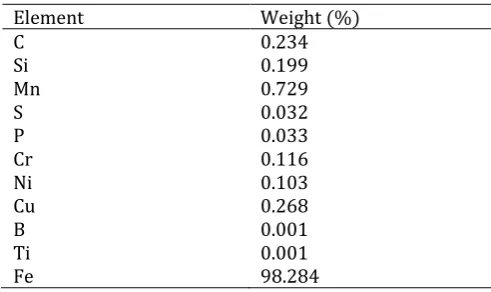
The material for the investigation is a carbon steel as-supplied in cylindrical (rod) form of 16mm diameter. Chemical analysis of the steel was performed with a spark spectrometer metal analyser (NCS Labspark 750B). The result is shown in Table 1.
Table 1: Chemical Composition Analysis Result
Element Weight (%)
C 0.234
Si 0.199
Mn 0.729
S 0.032
P 0.033
Cr 0.116
Ni 0.103
Cu 0.268
B 0.001
Ti 0.001
Fe 98.284
2.1 Heat Treatment
2.1.1 Normalizing: this was done to annul the thermal and mechanical history of the steel. This involved heating to 850oC (30oC above AC3), soaking for one hour (1hr.) in amuffle furnace and then cooled in air. A group of these normalized samples were labelled as A and used as the control sample.
The normalizing temperature, 850oC, was arrived at by evaluating the AC3 of the steel using equation (1) after Andrews[5]. AC1, AC3 and Ms were evalutaed to be 710oC, 819oC and 404oC respectively.
𝐴𝐶1(℃) = 723 − 20.7(%𝑀𝑛) − 16.9 (%𝑁𝑖)
+ 29.1 (%𝑆𝑖) − 16.9 (%𝐶𝑟) (1𝑎) 𝐴𝐶3(℃) = 910 − 203√%𝐶 − 15.2(%𝑁𝑖) +
44.7(%𝑆𝑖) + 104(%𝑉) + 31.5(%𝑀𝑜) (1𝑏) 𝑀𝑠(℃) = 512 − 453(%𝐶) − 16.9(%𝑁𝑖) + 15(%𝐶𝑟)
− 9.5(%𝑀𝑜) + 217(%𝐶2) − 71.5(%𝐶)(%𝑀𝑛)
− 67.6(%𝐶)(%𝐶𝑟) (1𝑐) In the above equations, AC1 and AC3 are lower and upper critical transformation temperatures respectively and Ms is martensite start temperature.
2.1.2 Intercritical Annealing: involved annealing of the normalized samples for thirty minutes in the (α + ϒ) region at 730oC, 750oC, 770oC and 790oC respectively followed by quenching in warm water at about 50oC. Warming of the water became imperative to avoid the tendency of quenching crack development. The intercritically annealed samples were assigned letter B for the purpose of identification. The identification code for each specimen is shown in Table 2.
2.2 Sample Preparation and Testing
After the heat treatments, test samples for impact test, hardness test, tensile test and microstructural studies were prepared. The impact test was conductedby means of a pendulum Charpy Impact Tester .The fractured surfaces of some of the impact test samples were examined using the naked eye and with the aid scanning electron microscope (SEM).Hardness of the samples was determined using a LECOVicker’s hardness direct-reading indentation machine (LM-700AT Model). The tensile strength of the samples was determined using an electrically operated digital tensometer (PC 2000 model) fitted with computer interface at a speed of 20mm/min. The specimens were prepared to ASTM E8M - 91 standtards[6]. All the tests were conducted at room temperature.
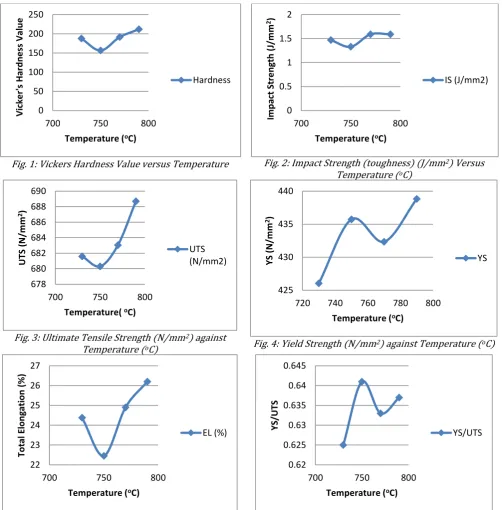
Fig. 1: Vickers Hardness Value versus Temperature Fig. 2: Impact Strength (toughness) (J/mm2) Versus Temperature (oC)
Fig. 3: Ultimate Tensile Strength (N/mm2) against
Temperature (oC) Fig. 4: Yield Strength (N/mm2) against Temperature (oC)
Fig. 5: Total Elongation (%) against Temperature (oC) Fig. 6: YS/UTS against Temperature (oC)
Table 2: Sample Identification
Type of Heat Treatment
Temperature (oC)
Identification Code
Normalizing 850 A
Intercritical Annealing
730 B730
750 B750
770 B770
790 B790
3. RESULTS
Table 3 shows the results obtained after mechanical testing of the normalised material. Figs 1 - 6 show the
results of mechanical testing of intercritically annealed samples. The results showed improvement of the properties. For all the tests two samples each were tested and average taken.
Table 3: Results of Mechanical Properties of the Normalised Sample SAMPL E UTS (N/mm 2) YS (N/mm 2) YS/UT S TEL (%) IS (J/mm 2) HARDNE SS
A 670.55 385.96 0.575 21.9 7
1.30 161.7
0 50 100 150 200 250
700 750 800
Vi cke r' s H ar d n e ss Val u e
Temperature (oC)
Hardness 0 0.5 1 1.5 2
700 750 800
Im p ac t Str e n gth ( J/ m m 2)
Temperature (oC)
IS (J/mm2) 678 680 682 684 686 688 690
700 750 800
UT S (N /m m 2)
Temperature( oC)
UTS (N/mm2) 425 430 435 440
720 740 760 780 800
YS ( N /m m 2)
Temperature (oC)
YS 22 23 24 25 26 27
700 750 800
To tal E lo n gation (% )
Temperature (oC)
EL (%) 0.62 0.625 0.63 0.635 0.64 0.645
700 750 800
YS
/UT
S
Temperature (oC)
Plate 1: Photomicrograph of A X400 i.e. phase structure produced by normalizing at 850oC for one hour. The
structure reveals ferrite (light phase) and pearlite (alternate layers of ferrite - light and cementite – dark).
Plate 2: Photomicrograph of B730 X400 i.e. Sample intercritically annealed at 730oC for 30 minutes. The
structure reveals large proportion of ferrite (light) matrix and martensite (gray) with little retained
austenite (dark).
Plate 3: Photomicrograph of B750 X400 i.e. Sample intercritically annealed at 750oC for 30 minutes. The structure reveals large proportion of ferrite (light) matrix and increased number of martensite (gray) with little retained austenite (dark).
Plate 4: Photomicrograph of B770 X400 i.e. Sample intercritically annealed at 770oC for 30 minutes. The structure reveals fine and medium size distribution of ferrite (light) matrix and martensite (gray) with little
retained austenite (dark).
3.1 Vicker’s Hardness
Fig. 1 shows the result of the variation of hardness obtained with annealing temperature.
3.2 Charpy Impact Strength
Results obtained from the charpy impact test were used to plot the graph shown in Fig. 2. Plates 6 to 9 show the SEM fracto graphs of the fractured surfaces of samples.
3.3 Tensile Tests Result
Table 3 also shows the results of the tensile properties – ultimate tensile strength,yield strength,ductility
(total elongation) and YS to UTS ratio. These were equally used to plot the charts shown in Fig. 3 to Fig.6.
3.4 Microscopic Examination Results
Plate 5: Photomicrograph of B790 X400 i.e. Sample intercritically annealed at 790oC for 30 minutes. The
structure reveals fine distribution of ferrite (light) matrix and martensite (gray) with little retained
austenite (dark).
Plate6: Fractograph of sample A showing a mixture of fibrous and cleavage surfaces.
Plate 7: Fractograph of sample B750 showing ridge – like features with more of cleavage surfaces.
Plate 8: Fractograph of B790: Structure reveals dimple fibrous fractured surface.
Plate 9: Fractograph of B770 Structure reveals dimple fibrous fractured surface.
4. DISCUSSION OF RESULTS
4.1 Effect of Intercritical Annealing Temperature on Tensile Properties:
Table 3 shows the result of the tensile test of normalized sample, while fig 3 – 6 show the tensile test results of intercritically annealed samples. The ultimate tensile strength and yield strength of all the intercritically annealed samples are superior to that of the normallized sample. This is consistent with the observations of Alameneet al [7], Nobuyuki[8], Kumar
temperature limit. This could be attributted to the increasing volume fraction of martensite. The ductility of the samples followed the same trend with the UTS as depicted in Fig. 5. Resultsof UTS and ductility observed in this present work shows similarity with some already published work by Bag etal[11], Alaneme[7,12].
However, continuous yielding was not observed in the present work as reported by other researchers. This could be attributed to the low amount of some alloying elements such as Ti, V and Nb. Secondly the cooling rate could have been reduced by warming the quenching water, which could have interfered with transformation to dual phase (ferrite/martensite), leading to the presence of retained austenite as can be observed in the microstructures (dark spots) – plates 2 to 5.
The yield strength, however did not follow the trend of UTS as samples annealed at 750oC and 790oC have higer values of 435.74N/mm2 and 438.83N/mm2 respectively against 424N/mm2 and 432.35N/mm2 for samples annealed at 730oC and 770oC respectively – Fig.4. The YS/UTS ratio is highest for samples annealed at 750oC. This coupled with the poor ductility observed for samples annealed at this temperature will make it more difficult to work on the steel treated at this temperature compared to other temperatures.
The increased tensile properties at higher temperatures could be attributed to the increased volume fraction of martensite.As intercritical annealing temperature increases the amount of austenite in the dual phase (α + ϒ)region also increases which transforms to martensite upon quenching, thereby increasing the amount of martensite in the duplex structure produced at higher intercritical annealing temperatures.
4.2 Impact Toughness and Intercritical Annealing Temperatures
Fig. 2 Shows the plot of impact strength (impact toughness) against temperature. It can be observed from Table 3 that the intercritically annealed samples showed improved impact strength over the normallized samples. Again samples annealed at 750oC showed lowest value of impact toughness, while samples annealed at 770oC and 790oC possessed higher impact strength of 1.59J/mm2 each. The generally improved toughness observed in the duplex phase structures is attributed to the composite structure of ferrite and martensite which creates a synergy of the soft ferritic phase and the hard martensitic phase,
which helps in increasing the materials resistance to crack propagation and fracture [13].
Observation of the fractured surfaces with the naked eyes revealed more shiny and clevage surfaces for the sample intercritically annealed at 750oC. While the conventionally normallized sample and that annealed at 730oC showed mixture of reflecting and dull surfaces with greater proportion of it being reflecting. The surfaces of the fractured samples annealed at 770oC and 790oC revealed more of dull surface with less reflections. Both showed fibrous nature on their fractured surfaces. Plates 6 to 9 show the fractured surfaces of samples A, B750, B770 and B790 respectively as examined under the SEM. This collaborates with the observations of the naked eyes described. However, SEM of the fractured surfaces revealed the presence of some obstacles such as cavities or carbides.
The general low mechanical properties of the samples annealed at 750oC could be attributed to intense spherodization of cementite in pearlite followed by recrystallization of α – ϒ grains [12, 14].
4.3 Microstructure and Intercritical Annealing Temperatures:
Plate 1 shows the microstructure developed after normalizing the steel at 850oC for one hour. It reveals the structure of ferrite (light) and pearlite (alternate layers of ferrite – light and cementite – dark). Plates 2 – 5 show the microstructures developed after intercritical annealing at 730oC, 750oC, 770oC and 790oC respectively for thirty minutes. They reveal the structure of ferrite (light) and martensite (gray) with some little amount of retained austenite (dark spots). It can be observed that the amount of martensite increases with increased temperature. They consist essentially of martensite laths in a ferrite matrix. The ferrites are of irregular shapes mixed with martensite which lie mostly along prior austenite boundaries.
4.4 InterciticalAnnealing Temperature with Optimum Properties
and13.34% respectively for samples annealed at 770oC.
5. CONCLUSION
Research on 0.23%C low alloy steel manufactured in Nigeria to determine the effect of intercritical annealing temperature on its microstructures and mechanical properties has been conducted. The research findings showed that mechanical properties improved with increasing intercritical annealing temperature. However, optimum combination of properties was observed at 790OC. Though there was low improvement on the UTS (2.7%), high improvement is recorded on YS (13.7%), ductility (19.7%), impact strength (IS) (22.31%), and hardness (31.05%). Hence, the intercritically annealed material (dual phase steel) has greater capability to: carry load, absorb sudden load (impact), worked upon and withstand abrasion. Finally, the dual phase (ferrite/martensite) structures were revealed in the microstructures developed after annealing at the (α+ϒ) region.
6. REFERENCES
[1] Honeycombe, R.W.K and Bhadeshia,H.K.D.H, (1995): Steels, Microstructure and properties,2nd ed., Edward Arnold, London.
[2] Bello, K.A.; Hassan, S.B. and Abdulwahab, M. (2007): Effects of Tempering on the Microstructures and Mechanical Properties of Low Carbon, Low Alloy Martensitic Steel. Journal of Applied Sciences Research, 3(12), pp 1719 – 1723.
[3] Budinski, K.G. (1993): Engineering Materials: Properties and Selection, 2nd ed., Reston Publishing Co., Virginia.
[4] Ovri H and kamma C. M. (2008): Evaluation of the Transformation Mechanisms and Mechanical Properties of Ferrite-Martensite Microalloyed Steels. Materials Research, vol. 11, No.1, pp 97 – 101.
[5] Andrews K.W. (1965): Empirical Formulas for the Calculation of some Transformation Temperatures. J. Iron Steel Inst. 203, pp 721 - 727.
[6] ASTM E8M – 91 (1992): Standard Test Method for Tension Testing of Metallic Materials [Metric], In: Annual Book of ASTM Standards: ASTM International, pp160.
[7]Alaneme K.K., Ranganathan S. and Mojisola T. (2010): Mechanical Behaviour of Duplex Phase Structures in a Medium Carbon Low Alloy Steel, Journal of Minerals and Materials Characterization and Engineering, vol. 9, No. 7, pp 621 – 633.
[8] Nobuyuki I., Nobuo S and Joe K. (2008): Development of Ultra – High Strength Linepipes with Dual – Phase Microstructure for High Strain Application, JFE Technical Report, No. 12, pp 15 – 19.
[9] Kumar A., Singh S.B. and Ray K.K. (2005): Influence of Bainite/Martensite Content on the Tensile Properties of Low Carbon Dual Phase Steels,Materials Science and Engineering A, 474, 270 – 282.
[10] Sun S. and Pugh M (2002): Properties of Thermomechanically Processed Dual – Phase Steels Containing Fibrous Martensite, Materials Science and Engineering A, Vol. 335, Issues 1 – 2, pp 298 – 308.
[11] Bag A., Ray K. and DwarakadasaE.S. (1999): Metall. Mater. Trans., 30A, 1193.
[12] Alaneme K.K. and KammaC.M. (2009): Evaluation of the Influence of Intercritical Treatment Variables on the Transformation Behaviour of a Carbon Steel, NSE Technical Transaction, Vol.44, No.3, pp 1- 12.
[13] SalehiA.R., Serajzadeh S. and TaheriA.K. (2006): A Study on the Micro structural Changes in Hot Rolling of Dual – Phase Steels, Journal of Materials Science, Vol. 41, No. 7, pp 1917 – 1925.

![Table 3 shows the result of the tensile test of normalized sample, while fig 3 – 6 show the tensile test etal [9] and Sum and Pugh[10]](https://thumb-us.123doks.com/thumbv2/123dok_us/10034100.1990112/5.595.49.284.548.746/table-shows-result-tensile-normalized-sample-tensile-pugh.webp)
