Research Article
Comparative efficiency of pedigree, modified bulk and single seed descent
breeding methods of selection for developing high-yielding lines in rice (
Oryza
sativa
L.) under aerobic condition
Adnan Kanbar1, Katsuhiko Kondo2 and H.E. Shashidhar3
1Department of Field Crops, Faculty of Agriculture, University of Damascus, Damascus, Syria. 2
Department of Agriculture, Faculty of Agriculture, Tokyo University of Agriculture, Tokyo, Japan.
3Department of Genetics and Plant Breeding, University of Agricultural Sciences, Bangalore, India.
*Email: [email protected]
(Received:31Dec 2010; Accepted:12Jun2011)
Abstract:
The knowledge about the relative efficiency of the different breeding methods may greatly help the plant breeder in selecting a better method to be adopted in a particular crop. In the present experiment, the comparative efficiency of three selection methods, viz., pedigree, modified bulk and single seed descent (SSD) were assessed in F3, F4, F5 and F6 generations of a cross
combination Moroberekan/IR20 of rice. Bulk population showed superiority over pedigree for grain yield, panicle length, number of panicles, number of tillers and harvest index in F3 generation. Pedigree method was found to be superior over bulk and SSD
for grain yield per plant in F4 and F5 generations. In the three breeding methods, mean values of grain yield showed directional
shift across the generations. In F6 generation, the pedigree-derived lines showed higher superiority over mean value than lines
derived from SSD and modified bulk for grain yield, number of panicles and harvest index. No significant differences existed between pedigree and modified bulk-derived F6 lines for grain yield and harvest index. Inter-generation correlation coefficients
were significant and positive between all the generations for grain yield, number of tillers and number of panicles. Significant and positive correlations were observed between these three characters across generations supporting the intergeneration correlation results. Visual selection based on the number of tillers and number of panicles per plant was very effective for increasing yield in bulk and pedigree methods.
Keywords: Rice,modified bulk, pedigree, single seed descent.
Introduction
Rice is central to the lives of billions of people around the world and one of the oldest domesticated grain (~10,000 years). It is staple food for 2.5 billion people and growing the largest single use of land for producing food, covering 9% of the earth's arable land. It provides 21% of global human per capita energy and 15% of per capital protein. Asia accounts for over 90% of the world's production of rice. India and Indonesia are the major countries in Asia producing the 85% of the rice produced in the world which is used for direct human consumption ((Anon., 2004).
The rice crop is sensitive to drought at different developmental stages, particularly during the tillering and reproductive stage when varied degrees of sterility can arise under drought stress (Widawsky and O’Toole, 1990). In the rainfed lowland and
upland ecosystems, there are frequent periods of drought. Tolerance of rice plants to drought is influenced by both genetically and physiologically complex traits. Rice genotypes vary significantly in their tolerance to drought. It is also known that drought tolerance (DT) mechanisms in rice cultivars in upland and lowland conditions are different, as a result of their adaptations to different environmental and soil factors present in the two ecosystems (O’Toole, 1982; Fukai and Cooper, 1995). Thus, development of DT rice cultivars has not been very successful despite the tremendous efforts made by breeders.
1990) as well as significant genotype x environment interaction (Falconer and Mackay, 1996). Several selection procedures (pedigree selection, bulk population breeding, single-seed descent, etc.) have been proposed for improving grain yield of self-pollinated crops. However, only a few of these procedures have been used extensively in rice. The knowledge about the relative efficiency of the different methods may immensely help the plant breeder in choosing a better method to be adopted in a particular crop. The information available on this aspect is little and controversial (Fahim et al., 1998).
Since, selection based on single plant basis in F2 was not effective, Shebeski (1967) suggested that a large number of F2 plants may be selected and their F3 progenies will be based on their actual yields or their yields expressed as percentage of adjacent control. The rationale behind the early generation testing has a positive correlation that exists between the yields of early generations and their progenies in later generations (Sneep, 1977). A number of breeders have conducted early generation tests of individual families or lines with diverse results. Mahmud and Kramer (1951) observed that F3 lines provide estimates of the average yield potentialities of the F4 segregates. Lupton and Whitehouse (1957) obtained a correlation of 0.55** between grain yield of F4 and F5 lines grown in successive years.
Various methods of selection may be applied to advance segregating material in self-pollinated crops and the choice depends on a set of conditions. Generally, a selection system of advancing generations should be such that additive genetic variance is generated (Murthy, 1979). At the same time the mean performance needs to be maintained or increased in the selected progenies.
Material and methods
Plant material:The F3, F4, F5, and F6 material derived from crossing divergent parents viz, Moroberekan and IR20 were used in this experiment. While, the female parent Moroberekan was an African japonica pocessing a deep and thick root and is tolerant to drought but relatively low yielding, the male parent is IR20, an indica type, having short stature, a shallow root system and high yielding but susceptible to drought.
Breeding methods: The breeding procedures pedigree, single-seed descent (SSD) and modified bulk methods were used to advance the material for the study in the farmer’s field at Shettigere village during 2003-2005 under aerobic condition. The village of Shettigere is located in the heart of the
South - the Deccan Plateau, with an average elevation of 900 m above sea level, it has pleasant weather, with temperature ranging from around 24°C in winter to 35°C during summer, despite being between the very tropical latitudes of 12° 39' N and 13° N, longitude being 77° 37' East. The F2 seeds were divided into two sub-populations for evaluating root and yield morphological traits simultaneously. In aerobic condition method, rice is grown like an upland crop, such as wheat, on nonflooded aerobic soils. The significant advantages of aerobic rice are less water requirement, no flood irrigation.
Pedigree selection: Ninety-two phenotypically superior plants (5% selection intensity) were selected from F2 population based on visual and weight selection. Selected lines were space planted (direct sowing) in Kharif 2003 in host farmer field at Shettigere village. Each family was planted in three replications with two rows in each replication of 3-meter length at 25 cm distance between rows and 15 cm between plants. The crop was irrigated once every five days up to maturity. Each family was identified by numbered plastic labels held by wooden peg. The following types of selection were performed:.
a) Individual selection by the host farmer alone when the crop was matured.
b) Group selection by rice farmers from the same village and other two neighboring villages. The farmers have been invited for a field day when more than 90% of the lines were mature.
c) Visual selection by the breeders.
d) Post harvested selection was done by the researcher based on the grain yield, harvest index and grain type.
Ninety F3:4 families were planted in summer 2004 in two replications under well-watered condition. Other crop production specifications of the experiment were same as those of F3 generation. The plants were irrigated once every five days up to maturity. 24 plants were selected by each host farmer and breeders at maturity stage (visual selection) and 78 plants were selected after harvesting based on grain yield, harvest index and grain type. The total number of selected plants was 126. There was overlapping between farmer’s and breeder’s selections for some plants and these selected plants have been classified into any of the groups according to the largest number of selected participants.
maturity. Other crop production specifications of the experiment were same as those of F3 generation. Twenty superior plants were selected by each the host farmer and breeders and the best five plants in each family were bulked. Ten families were chosen randomly from each farmer and breeders selection and raised to F6 generation for comparison study.
Single-seed descent method (SSD: A single seed was taken from each 1240 F2 plants to forward to F3 generation. These seeds were sown in plots of 3 x 3 meter size at low density (25 cm between rows and 15 cm between plants in each row). At harvesting, one seed was taken from each plant, the seeds bulked and then used to raise the next generation of plants. The same procedure was repeated in F4 generation and F5 generations.
In F5 generation, 480 plant-to-row progenies of the SSD F4 plants were grown with low-density (25 cm between rows and 15 cm between plants in each row). The number of SSD plants have been reduced from 1224 to 480 plants due to environmental stresses caused by high temperature in summer season which led to the death of many plants. At maturity, 112 families were chosen at random to represent the whole population and the seed from each of these families harvested separately from that of every other to produce a mapping population comprising 112 RI lines.
Modified bulk method (Bulk) : From each F2 vigorous and good yielding plants, which accounted to some 10% of the total number, twenty seeds were taken and thereafter bulked. A sample of seeds was taken from this bulk to raise a population of 2000 F3 plants. Only visual selection was applied by breeder at maturity to select the desirable plants. 100 superior plants (5% intensity of selection) were selected and seeds of these lines were bulked in order to raise F4 population containing 2000 plants. In F4 generation, the selection carried out was similar to that practiced in the F3 population. The seed from selected plants were harvested separately. This seed was used to sow 100 two-row F5 progenies. The selection carried out in this generation was the same as that in the F4 generation but family wise. A sample of 20 F5 families was chosen at random and the seeds from the best 5 plants of each family were harvested separately.
Experimental design and statistical analysis: For comparison between pedigree, modified bulk and SSD populations at F3, F4 and F5 generations, selecting 80 random plants from each bulk and SSD methods and 80 random families (means) from
pedigree population were taken. These plants were a part of the population, which was to be forwarded to next generation. SSD and bulk populations were grown without design while pedigree selections were laid out in randomized complete block design with three, two, and three replications at F3, F4 and F5, respectively. At F6 generation, twenty families produced by each of the three breeding methods were grown in a RCBD with four replications at farmer’s field (upland direct sowing) during the summer season 2005. The following observations were recorded on the entries in farmer’s field: days to 50 per cent flowering, plant height (cm), number of tillers, number of panicles (productive tillers) per plant, panicle length (cm), grain yield per plant (g), shoot dry weight (g) and harvest index.
Step-wise discriminant analysis: Step-wise discriminant analysis using PROC STEPDISC in SAS program was employed to determine the best combination of variables that would separate between the three breeding methods. The STEPDISC procedure selects a subset of quantitative variables to produce a good discrimination model using step-wise selection. The set of variables that make up each class is assumed to be multivariate normal with a common covariance matrix. Variables are chosen to enter or leave the model according to one of two criteria: (1) The significance level of an F test from an analysis of covariance, where the variables already chosen act as covariates and the variable under consideration is the dependent variable, or (2) The squared partial correlation for predicting the variable under consideration from the CLASS variable, controlling for the effects of the variables already selected for the model.
Intergeneration correlation and regression coefficients: Intergeneration correlation (r) and regression coefficients (b) were calculated for each character between F3-F4, F4-F5, and F5-F6 generations. In each case the progeny means ( ) of a particular generation were regressed on the individual plants (y) of the previous generation following the pedigree of plant progeny rows.
Where,
= Standard deviation of y (parent)
The heritability values in narrow sense were calculated according to Smith and Kinman (1965).
h2 (F3-F4) = 4
/8 b(F4, F3)
h2 (F4-F5) = 15/16 b(F5, F4)
h2 (F5-F6) = 31/32 b(F6, F5)
Where, h2 = heritability in narrow sense.
b(F4, F3) = regression coefficient of F4 progeny means on F3 parental value for respective characters
b(F5, F4) = regression coefficient of F5 progeny means on F4 parental value for respective characters
b(F6, F5)= regression coefficient of F6 progeny means on F5 parental value for respective characters
Results and discussion
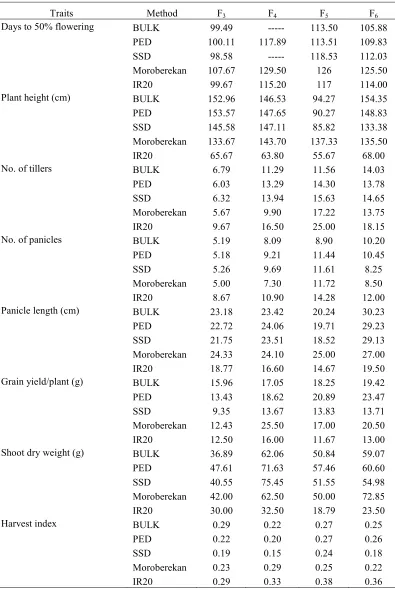
In breeding crop plants, selection methods used to handle segregating population is determined by the reproductive mechanism of concerned crop and partly by the objective of the breeding program. Efficient methods are required to advance the segregating populations and to succeed in selection to identify and advance lines with desirable combination of characters. Pedigree, bulk and SSD methods are commonly used directly or with modifications to advance segregating populations of self-pollinated crops. The method-means across generations for yield contributing characters are given in Table 1. In pedigree method, the mean values of grain yield were higher in F4 (18.62 g), F5 (20.89 g) and F6 (23.47 g) generations. In F5 generation, there was reduction in plant height and panicle length comparing with other generations mean. Number of tillers and number of panicles were increased from F3 generation to F5 generation in three breeding methods. Among these available methods, pedigree is widely used and it enjoys prime place in improvement of self-pollinated crop plants because of advantages associated with it. There is little evidence for efficiency of single plant selection in early generation.
Means of the methods over generations differed significantly for grain yield per plant. Pedigree method was found to be superior over bulk and SSD for grain yield per plant in F4 (18.62) and F5 (20.89 g) generations. It showed superiority over SSD across generations by recording higher significant mean value of shoot dry weight (47.61) and panicle length
(22.72) in F3. While bulk population showed superiority over pedigree for grain yield (15.96 g), panicle length (23.18), number of panicles (5.19) and number of tillers (6.79) in F3 generation. Pedigree population recorded superiority over bulk population for shoot dry weight, grain yield, panicle length, number of panicles, number of tillers, and plant height in F4 generation.
The visual and weight selections were performed in pedigree method while visual selection was only performed in bulk method. The results indicated that combining both the visual and weight selections in early generations could be more successful in raising the mean yields. Royce et al. (1947) obtained that visual selection was as successful as selection by weight in raising the mean yields. In wheat, Pawar et al. (1986) advanced the F3 and F4 respectively by adopting three selection methods. They found the mean values of pedigree selection proved to be superior for all the traits except for days to 50% flowering and plant height than SSD and bulk populations.
In the three breeding methods, mean values of grain yield showed directional shift across the generations (Fig 1). Increasing number of panicle across generations reflected in significant changes in the grain yield per plant. Tee and Qualset (1975) reported difference in generation mean between SSD and bulk only for competitive effect of plant height.
The fluctuation in the means and variances across generations could be attributed due to genotype x environment interactions, such as those reviewed by Luedders et al. (1973), Raeber and Weber (1953) and Boerma and Copper (1975) in soybean. The climate conditions in the four seasons (kharif 2003, summer 2004, kharif 2004 and summer 2005) of this study were a diverse, with kharif 2003 being a season of wet and cold at filling stage, summer 2003 and 2004 being a season of near drought and high temperature conditions.
-0.36*). Where as in SSD method, grain yield recorded negative correlation with days to 50 % flowering in F6 (r= -0.21) generations under irrigated condition. Visual selection based on the number of tillers, number of panicles, panicle density and biomass was very effective in increasing yield in bulk and pedigree methods across generations due to the strong association of yield contributing characters with grain yield. Amirthadevarathinam (1983), Ekanayake et al. (1985) and Gomathinayagam et al. (1990) also found significant contribution of number of tillers towards grain yield. Therefore, this trait could be used as thumb character for selecting genotypes for grain yield. As number of tillers or number of productive tillers is easily observable characters in field level, it could be advantageously utilized as indirect selection criteria for selecting the genotypes for higher yield.
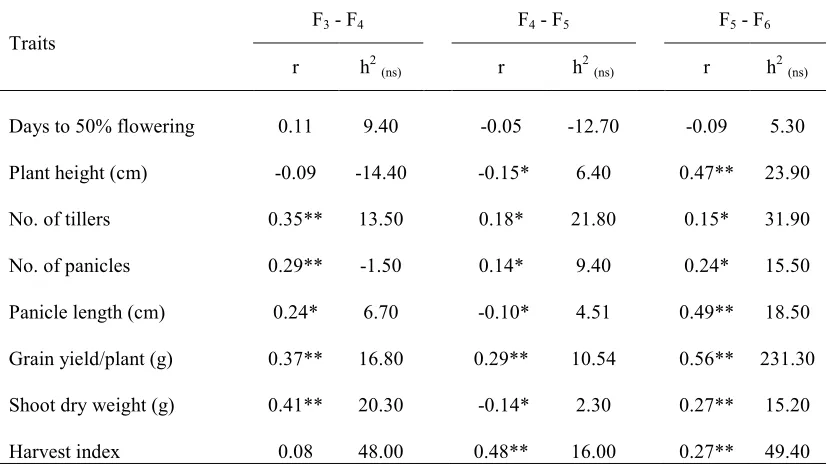
Intergeneration correlation coefficients were estimated to study the relationship between F3-F4, F4 -F5 and F5-F6 generations for yield morphological traits (Table 3). Intergeneration correlations were positive and significant for grain yield per plant (r F3-F4= 0.37**, rF4-F5 = 0.29**, rF5-F6 = 0.56**), number of tillers (rF3-F4= 0.35**, rF4-F5 = 0.18*, rF5-F6 = 0.15*) and number of panicles (rF3-F4= 0.29**, rF4-F5 = 0.14*, rF5-F6 = 0.24*). In F5-F6 correlations, significant and positive correlations were recorded for plant height (rF5-F6= 0.47**) and harvest index (rF5-F6= 0.27**). Therefore, the performance of the plants in F3 generation is a reliable indicator of the performance of their progeny in subsequent generations. Similar conclusions were drawn by Pawar et al. (1986) indicating the effectiveness of early generation selection in wheat for a complex character like seed yield per plant. But the conclusion was not blanket for other traits like days to 50 % flowering and plant height because of both characters showed low narrow-sense heritability values and it was attributed to G x E interaction as days to 50 % flowering and plant height are very sensitive to the climate condition like temperature, light and water deficit. In F3-F4 generations, the narrow-sense heritability was highest for harvest index (h2ns = 48.00) followed by shoot dry weight (h2ns = 20.30) and grain yield (h2ns = 16.80). In F4-F5 generations, narrow-sense heritability was highest for number of tillers (h2ns = 21.80) followed by harvest index (h2ns = 16.00). In F5-F6 generations, narrow-sense heritability was highest for grain yield (h2ns = 231.30) followed by harvest index (h2ns = 49.40).
The significant and positive intergeneration correlation of grain yield in this study was similar to the results reported by Mishra et al. (1994) in rice,
Lupton and Whitehouse (1957), Busch et al. (1974), Cregan and Busch (1977) in wheat.
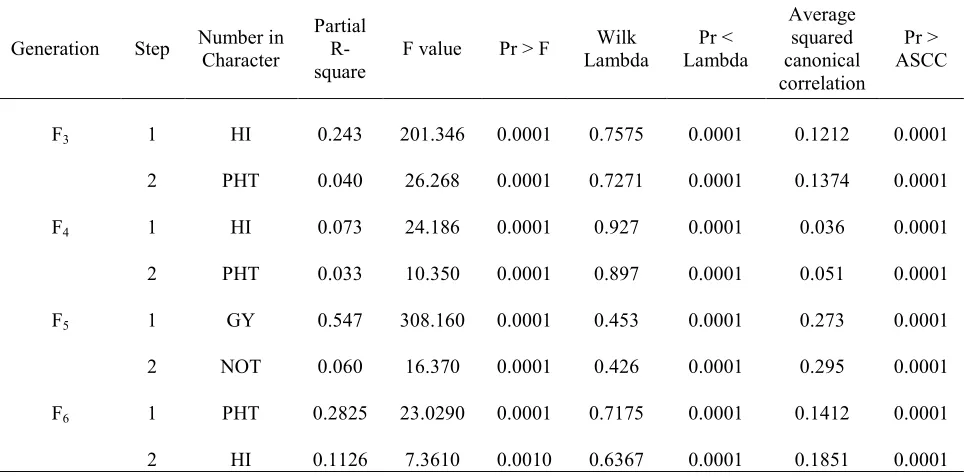
Step-wise discriminant analysis was used to determinate the best combination of variable that would separate the three breeding methods in each generation (Table 4). Step-wise discriminant analysis found two variables only to be significant at 0.0001 in each generation with respect to their partial R2. In F3 and F4 generations, the most important variable for discriminating the three populations was harvest index with the partial R2 of 24.31 % in F3 and 7.30 % in F4 generations followed by plant height with partial R2 of 6 % in F3 and 3.3 % in F4 generations. These two characters together were explained about 28.30 % and 10.60 % of the variability between three populations in F3 and F4, respectively. That is due to the significant differences observed between the three breeding methods for these two traits. A large variation was recorded for plant height and shoot dry weight in SSD population comparing with pedigree and bulk populations.
Whereas, in F5 generation, the most important variable for discriminating the three populations was grain yield with the partial R2 of 54.70% followed by number of tillers with partial R2 of 6.00%. These two characters together were explained about 60.70 % of the variability between three breeding populations in F5. In F6 generation, plant height was the most important variable to discriminate between the three breeding populations with the partial R2 of 28.25% followed by harvest index (R2= 11.26%). These two traits together explained about 39.51% of the variability between three breeding populations. Differential pattern of variation of the grain yield and shoot dry weight variations across these generations was reflected on the stability of the harvest index variation between breeding method populations.
References
Amirthadevarathinam, A. 1983. Genetic variability, correlation and path analysis of yield components in upland rice. Madras Agric. J., 70: 781-785. Anonymous. 2004. Annual report for 2003, IRRI, Los
Banos, Philippines, pp. 81-87.
Atlin, G.N. and Frey, K.J. 1990. Selecting oat lines for yield in low-productivity environments. Crop Sci.
30: 556-561.
Boerma, H.R. and Cooper, P.L. 1975. Comparison of three selection procedures for yield in soybean. Crop
Sci.,15: 225-229.
Busch, R. H., Janke, J. C. and Frohberg. R. C. 1974. Evaluation of crosses among high and low yielding parents of spring wheat (Triticum
aestivum L.) and bulk prediction of line
performance. Crop Sci.,14: 47–50.
Cregan, P.B. and Busch, R.H. 1977. Early generation bulk hybrid yield testing of adapted hard red spring wheat crosses. Crop Sci.,17: 887-891.
Ekanayake, I.J., O’Toole, J.C., Garrity, D.P. and Masajo, T.N. 1985. Inheritance of root characters and their relations to drought resistance in rice. Crop
Sci., 25 : 927-933.
Fahim, M., Dhanapala, M.P., Senadhira, D. and Lawrence, M. J. 1998. Quantitative genetics of rice II. A comparison of the efficiency of four breeding methods. Field Crop Res., 55: 257-266.
Falconer, D.S. and Mackay, T.F.C. 1996. Introduction to quantitative genetics. 4th Edition. Pearson Education Ltd., Essex, England.
Fukai, S. and Cooper, M. 1995. Development of drought resistant cultivars using Physio-morphological traits in rice. FieldCropsRes., 40: 67-87. Gomathinayagam, P., Natarajan, S. and Subramanian, M.
1990. Genetic variability in drought tolerant genotypes of rice. Oryza, 27 (3): 328-330. Luedders, V.D., Duclos, L.A. and Matson, A.L. 1973.
Bulk, pedigree, early generation testing breeding methods compared in soybeans. Crop Sci., 13: 519-526.
Lupton, F.G.H. and Whitehouse, R.N.H. 1957. Studies on the breeding of self-pollinated cereals, I. Selection methods in breeding for yield.
Euphytica, 6: 169-184.
Mahmud, I. and Kramer, H.H. 1951. Segregation for yield, height and maturity following a soybean cross.
Agron. J.,44: 136-141.
Mishra, D.D., Singh, C.B. and Rao, S.K. 1994. Effectiveness of different selection methods in segregating populations of rice (Oryza sativa L.) in ARC 10372 x IR36 in different environments.
Indian J. Genet., 54: 402-408.
Murty, B.R. 1979. Selection of parental material, breeding methods and evaluation procedures in developing improved crop varieties. Indian J. Genet., 39: 305-314.
O’Toole, J.C. 1982. Adaptation of rice to drought prone environments In: Drought resistance in crops
with emphasis on rice. IRRI, Los Bonos,
Philippines. pp. 195-213.
Pawar, I.S., Paroda, R.S. and Singh, S. 1986. A comparison of pedigree, SSD and bulk methods in two wheat crosses. Crop improve., 13: 34-37.
Pawar, I.S., Paroda, R.S. and Singh, S. 1986. A comparison of pedigree, SSD and bulk methods in two wheat crosses. Crop improve., 13: 34-37.
Raeber, J.C. and Weber, C.R. 1953. Effectiveness of selection for yield in soybean crosses by bulk and pedigree system of breeding. Agron. J., 45: 362-366.
Royce, S.W., Copp, L.G.L. and Frenkel, O. H. 1947. The effectiveness of selection for yield in wheat.
Heredity, 1: 232-233.
Shebeski, L.H. 1967. Wheat and breeding. In: Proc. Canadian Centennial Wheat Symp. (Eds.) Nelson, K. F., Modern Press, Saskatoon. pp. 255-272.
Smith, J.D. and Kinman m.L. 1965. The use of parent-offspring regression as an estimate of heritability.
Crop Sci.,5: 595–596.
Sneep, J. 1977. Selection for yield in early generations of self-fertilizing crops. Euphytica. 26: 27-30. Tee, T.S. and Qualset, C.O. 1975. Bulk population in wheat
breeding: comparison of single seed descent and random bulk methods. Euphytica, 24: 393-405. Widawsky, D.A. and O’Toole, J.C. 1990. Prioritizing the
Table 1. Method-means across generations for yield contributing characters of Moroberekan/IR20 population
Traits Method F3 F4 F5 F6
Days to 50% flowering BULK 99.49 --- 113.50 105.88
PED 100.11 117.89 113.51 109.83
SSD 98.58 --- 118.53 112.03
Moroberekan 107.67 129.50 126 125.50
IR20 99.67 115.20 117 114.00
Plant height (cm) BULK 152.96 146.53 94.27 154.35
PED 153.57 147.65 90.27 148.83
SSD 145.58 147.11 85.82 133.38
Moroberekan 133.67 143.70 137.33 135.50
IR20 65.67 63.80 55.67 68.00
No. of tillers BULK 6.79 11.29 11.56 14.03
PED 6.03 13.29 14.30 13.78
SSD 6.32 13.94 15.63 14.65
Moroberekan 5.67 9.90 17.22 13.75
IR20 9.67 16.50 25.00 18.15
No. of panicles BULK 5.19 8.09 8.90 10.20
PED 5.18 9.21 11.44 10.45
SSD 5.26 9.69 11.61 8.25
Moroberekan 5.00 7.30 11.72 8.50
IR20 8.67 10.90 14.28 12.00
Panicle length (cm) BULK 23.18 23.42 20.24 30.23
PED 22.72 24.06 19.71 29.23
SSD 21.75 23.51 18.52 29.13
Moroberekan 24.33 24.10 25.00 27.00
IR20 18.77 16.60 14.67 19.50
Grain yield/plant (g) BULK 15.96 17.05 18.25 19.42
PED 13.43 18.62 20.89 23.47
SSD 9.35 13.67 13.83 13.71
Moroberekan 12.43 25.50 17.00 20.50
IR20 12.50 16.00 11.67 13.00
Shoot dry weight (g) BULK 36.89 62.06 50.84 59.07
PED 47.61 71.63 57.46 60.60
SSD 40.55 75.45 51.55 54.98
Moroberekan 42.00 62.50 50.00 72.85
IR20 30.00 32.50 18.79 23.50
Harvest index BULK 0.29 0.22 0.27 0.25
PED 0.22 0.20 0.27 0.26
SSD 0.19 0.15 0.24 0.18
Moroberekan 0.23 0.29 0.25 0.22
Table 2. Method-phenotypic correlation coefficients across generations for grain yield with yield-related characters in field condition
Generation Method
Days 50% to flowering
Plant height
(cm)
No. of tillers
No. of panicles
Panicle length
(cm)
Shoot dry weight
(g)
Harvest index
F3 BULK -0.03 0.303** 0.76** 0.69** 0.49** 0.79** 0.53**
PED 0.10 0.10 0.59** 0.61** 0.17 0.81** 0.61**
SSD 0.06 0.28** 0.65** 0.62** 0.42** 0.78** 0.36**
F4 BULK --- -0.11 0.43** 0.65** 0.00 0.28** 0.75**
PED -0.19** 0.19** 0.14 0.24** -0.03 0.32** 0.85**
SSD --- 0.06 0.41** 0.51** 0.14** 0.37** 0.69**
F5 BULK 0.10 0.19 0.02 0.08 0.18 0.28** 0.35**
PED -0.19* 0.24** 0.28** 0.32** 0.15 0.17 0.49**
SSD 0.06 0.21** 0.10 0.10 0.10 0.21** 0.04
F6 BULK 0.40** 0.09 0.02 0.31* 0.39* 0.31* 0.73**
PED -0.36* 0.28 0.88** 0.87** 0.11 0.77** 0.70**
SSD -0.21 0.13 0.77** 0.88** 0.10 0.85** 0.69**
Table 3. Intergeneration correlation coefficients (r) and narrow-sense heritability (h2) for yield contribution characters in pedigree selection method
Traits
F3 - F4 F4 - F5 F5 - F6
r h2(ns)
r h
2 (ns)
r h
2 (ns)
Days to 50% flowering 0.11 9.40 -0.05 -12.70 -0.09 5.30
Plant height (cm) -0.09 -14.40 -0.15* 6.40 0.47** 23.90
No. of tillers 0.35** 13.50 0.18* 21.80 0.15* 31.90
No. of panicles 0.29** -1.50 0.14* 9.40 0.24* 15.50
Panicle length (cm) 0.24* 6.70 -0.10* 4.51 0.49** 18.50
Grain yield/plant (g) 0.37** 16.80 0.29** 10.54 0.56** 231.30
Shoot dry weight (g) 0.41** 20.30 -0.14* 2.30 0.27** 15.20
Table 4. Method-stepwise discriminant analysis across generations for yield contributing characters of Moroberekan/IR20 population
Generation Step Number in Character
Partial R-square
F value Pr > F Wilk Lambda
Pr < Lambda
Average squared canonical correlation
Pr > ASCC
F3 1 HI 0.243 201.346 0.0001 0.7575 0.0001 0.1212 0.0001
2 PHT 0.040 26.268 0.0001 0.7271 0.0001 0.1374 0.0001
F4 1 HI 0.073 24.186 0.0001 0.927 0.0001 0.036 0.0001
2 PHT 0.033 10.350 0.0001 0.897 0.0001 0.051 0.0001
F5 1 GY 0.547 308.160 0.0001 0.453 0.0001 0.273 0.0001
2 NOT 0.060 16.370 0.0001 0.426 0.0001 0.295 0.0001
F6 1 PHT 0.2825 23.0290 0.0001 0.7175 0.0001 0.1412 0.0001