www.ann-geophys.net/26/2543/2008/ © European Geosciences Union 2008
Annales
Geophysicae
Ring current decay time model during geomagnetic storms: a
simple analytical approach
R. Monreal MacMahon and C. Llop-Romero
University of Magallanes, CEQUA, Space Physics Lab, Casilla 113-D, Punta Arenas, Chile
Received: 24 September 2007 – Revised: 12 June 2008 – Accepted: 17 July 2008 – Published: 3 September 2008
Abstract. The ring current growth and decay, characterized by theDst index, has been studied for thirty years using the
Burton et al. (1975) equation. The original formula is based on the restriction of the DPS (Dessler, Parker, and Schoppke) theorem and assuming a constant decay time of particles. The decay time scale is important because the energy injec-tion rate cannot be determined it without the knowledge of this parameter. In a previous work, instead of using a con-stant value, we introduced the decay time of particles in the energy rate balance equation as a continuous function of the absolute value of the pressure correctedDst index to avoid
the reported discontinuities determining it. Here, based on the DPS restriction, we extend our previous empirical work to obtain analytically the proposed continuous function con-sidering losses due to a global resistive force as a product of viscous-like, and other related dissipation processes. We test our model predictingDst for a couple of specific storm
events and also comparing our results with forecasts of a good reference model appeared in the literature.
Keywords. Magnetospheric physics (Current systems; So-lar wind-magnetosphere interactions; Storms and sub-storms)
1 Introduction
As a result of the solar wind-magnetosphere coupling there is a dynamo transferring energy into the inner magnetosphere which is partially injected and dissipated in the ring current belt. This ring is a toroidal current that flows in the mag-netosphere of the Earth between 2 and 10 Earth radii (RE)
(e.g. Gonzalez et al., 1994) and is characterized by theDst
index in such a way that an enhancement in the ring current is followed by a depression of theDst index.
Correspondence to: R. Monreal MacMahon ([email protected])
The energy balance of the current is carried by geomag-netically trapped energetic ions and electrons with energies between 10 and 200 keV (e.g. Frank, 1967; Williams, 1981). The actual mechanism that adds particles to the ring cur-rent is not completely understood (Daglis et al., 1999). It has been widely accepted that the access and energization of charged particles occurs during the main phase of a magnetic storm which lasts between approximately 3 and 12 h and is determined by the polar cap potential and the plasma sheet number density, that is, the inward transport of plasma sheet particles is driven by the enhanced convection electric field (e.g. Williams, 1981). However, Sun and Akasofu (2000) have shown that the formation of the ring current belt during geomagnetic storms is not just a result of an enhanced con-vection which is directly driven by the solar wind and that substorm processes are crucial in populating the ring current by O+ions.
The loss mechanisms that cause the recovery phase of the storm are fairly well documented. The recovery phase is due to largely collisional processes that causes the ring current to subsequently decay to its original quiet level on a typical time scale of approximately 2 and 3 days. Ebihara and Ejiri (2000) have reported that ions are lost by charge-exchange with neutral hydrogen and convection outflow to the day-side magnetopause (azimuthally located atL=10), neglect-ing the Coulomb collision loss with thermal plasma, the wave-particle interaction, and the loss cone loss processes. They show that the charge-exchange contributes significantly andD∗st hardly recovers without this process during the late recovery phases.
It is well known that the temporal evolution of the ring current energy can be determined by the energy rate balance equation
dKR
whereURis the injection rate of energy andUL=(KR/τ )is
due to the rate of energy loss.KRandτare the kinetic energy
of particles in the ring current and the associated decay time, respectively.
On the other hand, Dessler and Parker (1959) and Sckopke (1966) have shown that the ground magnetic field perturba-tion1Bis related with the total energyEof particles by the DPS expression
1B(0) B0
= −2 3
E Em
, (2)
where Em=43πRE3B02/µ0(=8×1024ergs) is the total
en-ergy of the outer magnetic field (µ0 is the vacuum
mag-netic susceptibility),B0is the horizontal geomagnetic field
(0.3 gauss), and 1Bz(0) is the ring current magnetic field
in the Earth’s centre and can be approximated by the ab-solute value of theDst index. This approximation is valid
when (Akasofu and Chapman, 1972), i) the ring current is symmetric in relation with the dipole axis, ii) the non-linear distortion of the geomagnetic field due to the ring current is not important. So, even thoughDst also includes the
non-symmetric partial ring current, we assume that when theDst
index has a negative value it gives the field of the symmet-ric ring current. However, the magnetic field produced by the ring current is given by the pressure correctedDst index, that
is (e.g. Gonzalez et al., 1989)
D∗st =Dst−b
√
p+c, (3)
where p=ρv2 is the disturbed ram pressure of the solar wind, (ρ andv are the solar wind density and velocity, re-spectively),b=15.8 nT/
√
nPa is a constant value which rep-resent a typical factor of proportionality for intense storms (Gonzalez et al., 1989) andc=20 nT gives the quiet-day con-tribution to Dst∗. More recently, O’Brien and McPherron (2000a) obtained correction values ofb=7.26 nT/
√ nPa and c=11 nT. As noted above, the expression for D∗st involves only ram pressure correction. An additional correction to D∗st due to induced current in the solid Earth (e.g. Dessler and Parker, 1959; Langel and Estes, 1983; Stern, 1984) has been usually neglected in the literature and it was not taken into account here. Such a correction typically reduces the value ofDst∗ by a factor of 1/3 (e.g. Akasofu and Chapman, 1972; Langel and Estes, 1985; Gonzalez et al., 1994), so the values obtained from Eq. (3) tend to overestimateUR if we
consider the DPS restriction.
Usually, the study of the ring current dynamics has been focused on an analysis of theDst index. Additionally to be
a measure of the magnetic field of the ring current flowing in the magnetosphere, the absolute valueDofDst∗ is also a measure of the kinetic energyKRof the particles that make
up the toroidal current. Then, from the DPS equation (Eq. 2) followsD/B0=23KR/Emand the usual energy balance
equa-tion (Eq. 1) can be written as an evoluequa-tion equaequa-tion for D (Burton et al., 1975)
dD dt +
D
τ = −Q, (4)
whereQis the energy related input function, which is usu-ally considered as directly proportional to the interplanetary electric fieldvBS(e.g. O’Brien and McPhherron, 2000), that
is
Q= −4.4(vBS−EC), (5)
whenvBS>EC=0.49 mV/m, otherwiseQ=0.
The parameterτ in Eq. (4) corresponds to the decay time of particles which has been observed to be much shorter ing the early recovery phase of very intense storms than dur-ing the posterior recovery.
The behavior of tau with the recovery phase proceeding has been explained in connection with the tail current con-tribution toDst (e.g. Maltsev, 2004, and references therein)
considering that the cross-tail current decays more rapidly than the ring current because it is more directly related to the changing convection electric fields imposed by solar wind in-teractions. Another previous explanation is connected to the contribution of O+ ions of ionospheric origin to the storm time particle content (e.g. Daglis et al., 2003). That is, the ring current decay time should depends not only to changing convection electric fields imposed by solar wind interactions but to internal dynamics of the inner magnetosphere system. We use the simple formula of Burton et al., which have been successfully used for more than thirty years, but con-sidering the decay time parameter as a continuous function of the absolute value of theDst∗ index (Monreal MacMahon and Gonzalez, 1997). Here, based on the DPS restriction, which relates Dst to the internal dynamics, we extend our
previous empirical work to obtain analytically the proposed continuous function making some assumptions in the system condition. As explained by Zhang et al. (2007), “under the enhanced convection electric fields and geomagnetic fields, a mixture of the fresh ionospheric and solar wind plasmas, to-gether with the magnetospheric plasmas, is energized and un-dergoes large-scale drift in the global magnetosphere. Some of the particles can be transported inward enough to form the storm-time ring current”. Our simple model is based on a global large-scale current flux which is associated to differ-ent flux sources whether of ionospheric origin or magnetotail origin driven by the solar wind, involving both previous ex-planations.
It is interesting to note that for a very complex system we can use a simple model which can be obtained through reliable physical assumptions reduced to a global resistive force which explains partially the decay time of particles and makes possible to do a good 1 h-Dst prediction. In Sect. 2
2 The decay time parameter
Previous works (e.g. Prigancov´a and Feldstein, 1992) have shown that a reconstitution of the ring current energization process require an adequate estimate of the decay time of par-ticles in the ring current. As was stated by Akasofu (1986), a better knowledge and estimate ofτ will give us a greater insight of the energy input - output in the magnetosphere. As the energy injection rateUR and consequently the total
en-ergy rateUT can not be determined without using the decay
time scale, a detailed knowledge of this property is of great interest.
Diverse works have been done onτ estimate. Some of them have proposed constant values of the decay time for all possibleDst values (e.g. Burton et al., 1975; Perrault and
Akasofu, 1978; Murayama, 1982). Several others have em-phasized the necessity to introduce a variable τ (e.g. Aka-sofu, 1981; Vasyliunas, 1987; Gonzalez et al., 1989; Feld-stein et al., 1990; Prigancov´a and FeldFeld-stein, 1992).
On the observation basis that the decay time is much shorter during the early recovery of very intense storms, as identified by large negative Dst, it has been proposed
thatτ depends onDst. In this way, Feldstein et al. (1990)
have introduced two values of 10 and 11.5 h for the de-cay time parameter according to intervals of Dst during
the recovery phase. Gonzalez et al. (1989) have used three τ values of 4, 0.5, and 0.25 h for Dst≥−50 nT,
−50>Dst≥−120 nT, andDst<−120 nT, respectively. After
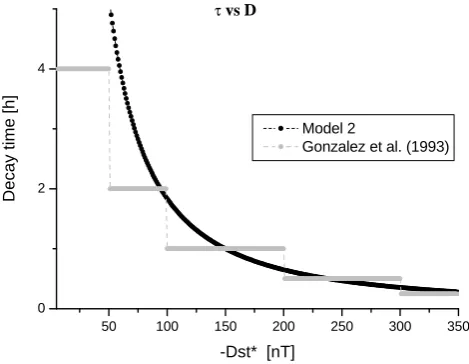
that, Gonzalez et al. (1993) modified and improved the pre-vious model to introduce very intense storms extending the values ofτ to five, that is, 4.0, 2.0, 1.0, 0.5, and 0.25 h for Dst≥−50 nT, −50>Dst≥−100 nT, −100>Dst≥−200 nT,
−200>Dst≥−300 nT, and Dst<−300 nT, respectively. So,
typical values of several hours, during the beginning of the main phase of the storm, can arrive to values lower than 1 h during the main phase peak of very intense storms.
However, it has been reported (e.g. Mendes Jr., 1992) that the decay timeτ, consideringDst intervals, results on
dis-continuities in the relation between the ring current dissipa-tion and the coupling funcdissipa-tion.
In order to avoid the reported discontinuities in the bal-ance equation, some attempts fitting data parameterized in terms ofDst have been done to provide a continuous
func-tional form (e.g. Valdivia et al., 1996; Monreal MacMahon and Gonzalez, 1997).
Other authors have suggested a control decay by a function determined by the solar wind-magnetosphere coupling. Aka-sofu (1981) have observed a decay timeτ of about 20 h for the parameter<5×10¹⁸ergs andτ∼1 h for>5×10¹⁸ergs. Pudovkin et al. (1988) found a functional dependence be-tweenτ and a relation proportional to vBS. O’Brien and
McPherron (2000a) have also proposed that the ring current decay time varies with the injection function proportional to vBS but not with Dst, emphasizing that the generally
ob-served dependence of the decay parameter onDstis actually
an alias of the coincidence of intenseDst and intensevBS.
They obtained functional dependencies, of the decay timeτ and the injection termQon the convection electric fieldvBS,
which are consistent with a positive correlation betweenτ andDstpeak. In a later work O’Brien and McPherron (2000b)
show that their approach (Model 1) performs better than oth-ers two models which also provide the time evolution ofDst
in terms of solar wind parameters.
A new model for the prediction ofDst on the basis of the
solar wind was introduced by Temerin and Li (2002, 2006). In that case the calculatedDst is a sum of several terms
in-cluding many parameters which results in a more compli-cated model than some previous ones. Even though they ar-gue that they have far more data than parameters, a common associated criticism is the idea that with enough free param-eters one can fit anything.
Other models use arbitrary mathematical expressions to analyze the dynamics ofDst and suggest that the usual
first-order differential equation introduced by Burton et al. (1975) could be replaced by one of second-order (Klimas et al., 1998; Vassiliadis et al., 1999). They concluded that the de-cay time depends on the presence of the solar wind input and that presumablyvBScan change the magnetospheric electric
field and modify the ring current decay.
Here, instead of merely fit some data on previous models ofτ or use arbitrary mathematical expressions to analyze the dynamics, we extend our previous work to derive the analyt-ical function for the decay time from characteristic physanalyt-ical properties of a simplified system which considers that the ring current particles are losing energy mainly through a re-sistive force associated to collisional, viscous-like and other processes.
Physically, the association between the decay time of the ring current particles and theDst index is given by the DPS
theorem, which states that the magnetic field perturbation caused by the ring current particles is directly proportional to their total kinetic energy.
2.1 The continuous function for the decay time
During magnetic storm events, a mixture of the fresh iono-spheric and solar wind plasmas besides charged particles in the near-earth nightside plasma sheet are injected into the in-ner magnetosphere taking part of the westward ring current due to their energization and drift in the geomagnetic field.
As stated by the DPS theorem, the perturbation of the mag-netic field is directly proportional to the kimag-netic energy of the ring current particles.
If we consider that the energization of the ring current satisfies the first order differential equation which involves energy storage only in the magnetic field configuration pro-duced by the ring current and energy dissipation in the ring current itself, we can represent this assumption with a sim-pleLRcircuit where the emfV0, the inductanceLand the
50 100 150 200 250 300 350 0
2 4
Fig. 1 τ vs D
Decay time [h]
-Dst* [nT] Model 2
Gonzalez et al. (1993)
Fig. 1. Two models of the decay time of particles in terms ofDst. Comparison between our approach (Model 2) and the refined model of Gonzalez et al. (1993).
There is no ambiguity in considering currents instead of particle flux since the current density is j=nqv, wheren, q, and v are the numeric density, charge, and velocity of parti-cles, respectively.
So, the energy balance
energy input = magnetic storage + ring current dissipation satisfies the differential equation
V0i=
d dt(
1 2Li
2)+i2R. (6)
Considering small fluctuations on the magnetic configuration we can assume the autoinductanceLof the system as a con-stant (dL/dt=0). Using the DPS theorem and identifying the kinetic energy of particles (KR) with the release of particles
stored in the magnetic field (12Li2) we arrive to the Burton et al. (1975) model, expressed in Eq. (4).
In this way, the usual balance equation of Burton et al. (1975), when derived from the simple LR-circuit, did not consider temporal variability in the autoinductance. Conse-quently, we can assume that the variability of the decay time τ=L/2R only depends on the resistance R of the system, that is, on viscous-like, collisional or any other-related resis-tive process.
Then, for a resistive force depending on the velocity of particles in the ring current,v(note that, as stated before, the electrical drift currentiis proportional to the velocity v of charged particles), we can develop the resistive forceFr in
Taylor’s series as follows:
Fr =F0+
∂F
∂v
0v
+ 1 2!
∂2F ∂v2
0v
2+... (7)
The speed of particlesvR in the preexisting ring current is
enhanced by the injection of particles with speedvi, so, the
net current speed in the ring current isv=vR+vi. When the
injection of particles stops, the velocity of particles in the ring current attains an extreme value and then begins to de-crease returning back to previous values. This means that the resistive force in the ring current never reaches a zero value.
The extreme value is satisfied when ∂F∂v
0
=0 and
∂2F ∂v2
0
=κ<0. In a first approach, neglecting the higher or-der terms, the resistive force results proportional tov2, that is
Fr =κv2. (8)
This is the case when the velocity of particles is greater than the thermal speed (e.g. Molina, 2000; Murray et al., 2004).
As the associated work in the ring current is given by dWr=Fr·dl, wheredl=vdt, then, the average work done by the resistive forces during a characteristic decay timeτ is
< Wr >≈κv3τ (9)
So, the decay time is inversely proportional to the cubic power of the speed of particles,
τ =γ v−3 (10)
But, from the DPS relation the absolute value of theDst
in-dex is proportional to the kinetic energy of particles, that isD∝KR, and as the kinetic energy is proportional to the
square of the speed of particles, KR∝v2, we can write for
the ring current decay time
τ =(α/D)3/2 (11)
whereα(which is proportional toγ2/3) is an adjustable pa-rameter.
Note, from Eqs. (9) and (10), thatγ is a parameter pro-portional to<Wr>. The average work in the ring current
is driven by the storm intensity which is characterized by the−Dst peakD0, so, theα parameter should depends on
D0. An early analysis of this parameter during the recovery
phase of storms gives a linear relationship betweenαandD0
(Monreal MacMahon et al., 2002). However, the study of this relationship is out of the scope of the present work.
A fit of Eq. (11) with the refined work of Gonzalez et al. (1993) is shown in Fig. 1, where the value of the ad-justable parameterαwas chosen in order to get a decay time of 1 h whenDst∗=−150 nT.
The model is tested in the next section predictingDst for
a couple of magnetic storms using the chosen constant value forα.
2.1.1 Prediction ofDst
In the previous section we have developed our simple model from an analytical point of view. At this time, it is important to test the behavior of our model predictingDst for specific
[image:4.595.49.284.62.244.2]2400 2424 2448 2472 2496 2520 0
6 12 18 24 30 36
Decay time [h]
2400 2424 2448 2472 2496 2520 -320
-240 -160 -80 0
Dst* Model 1 Model 2
13 April 1981
Dst [nT]
2400 2424 2448 2472 2496 2520 0
2 4 6 8 10 12 14 16
vBs [mV/m]
[image:5.595.311.545.61.381.2]Julian hour
Fig. 2. Event: 11–15 April 1981. The top panel shows time
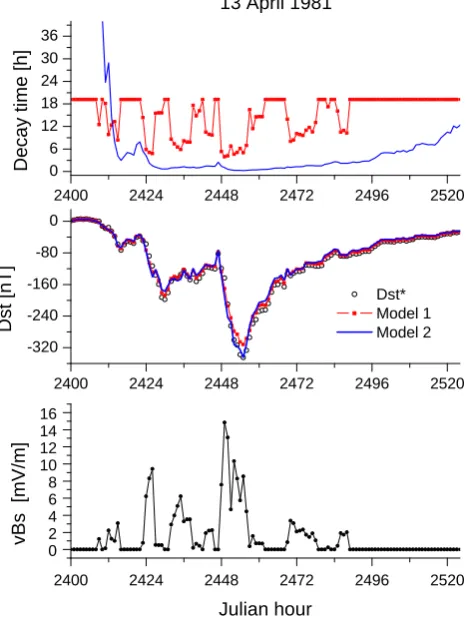
varia-tions of the decay time of ring current particles for models 1 (solid squares) and 2 (continuous line), between 2400 and 2524 Julian Hours, on April of 1981. The middle panel shows a comparison be-tween theDst-forecast of both models and the calculated pressure correctedDst values (open circles). The bottom panel shows the electric field characterizing the injection.
A 1 h-forecast for different models of the decay timeτcan be done using the discrete version of the Burton et al. equa-tion, that is
D∗st(t+1t )=Dst∗(t )+
Q(t )−D ∗
st(t ) τ
1t (12)
We use the model of O’Brien and McPherron (2000a) as a good reference (Model 1) to compare with our model (Model 2) because between the models providing the time evolution ofDstin terms ofvBStheir approach perform best
(O’Brien and McPherron, 2002b). For a comparison with models of the decay time based on interplanetary parame-ters, it is necessary to choose specific sample storms between those we found a good solar wind coverage.
For brevity we have chosen two storms, a complex storm event that occurred on 11–15 April, between 2400 and 2524 Julian hours, of 1981 and the very intense storm that occurred on 1–6 March, between 1416 and 1560 Julian hours, of 1982.
2400 2424 2448 2472 2496 2520
-25 -20 -15 -10-5 0 5 10
Julian hour
Bz [nT]
300 400 500 600 700 800
v [km/s]
0 10 20 30 40 50
p [nPa]
-320 -240 -160 -80
0 April 1981
Dst* [nT]
Fig. 3. The top panel shows time variability of the pressure
cor-rectedDstbehavior during the event of 11–15 April 1981. The sec-ond panel shows time variations of the calculated dynamic pressure for the same event. The third panel shows the time variations of the solar wind velocity. The bottom panel shows the time variability of the IMF-Bzcomponent.
Figures 2 and 4 show at the top panel, the behavior of the ring current decay time for model 1 (solid squares) and model 2 (continuous line), at the middle panel a 1-h Dst
forecast comparison between both models and the calculated pressure correctedDst values (open circles), and at the
bot-tom panel the electric field characterizing the energy injec-tion.
Figures 3 and 5 show at the top panel, the time variability of the computed pressure correctedDst index. The second,
third and bottom panels show the time variations of the cal-culated dynamic pressure, the solar wind velocity and the IMF-Bzcomponent, respectively.
It is clear from the top panels of Figs. 2 and 4 that low (high) values of−Dst are related to long (short) decay time
of particles. Long decay time values are characteristics of a quietDst behavior previous to the storm commencement
[image:5.595.51.287.67.380.2]1416 1440 1464 1488 1512 1536 1560 0
6 12 18 24 30 36
2 March 1982
Decay time [h]
1416 1440 1464 1488 1512 1536 1560 -240
-160 -80 0
Dst** Model 1 Model 2
Dst [nT]
1416 1440 1464 1488 1512 1536 1560 0
4 8 12 16
vBs [mV/m]
[image:6.595.308.544.62.386.2]Julian hour
Fig. 4. Event: 1–6 March 1982. Same as that in Fig. 2 except for
the period, between 1416 and 1560 Julian Hours on March of 1982.
During stormtime, where the lifetime of particles decreases, our decay time model (continuous line) get shorter values than model 1 (solid squares) and looks like a well behaved smooth function of time.
Figures 2 and 3 show the complex event occurred on April 1981, 2400–2524 Julian hours, which includes a sequence of three types of storms, from moderate to super intense. Prior to the beginning of the whole three-step event,Dst presents
a quiet behavior oscillating around zero values for a couple of days. During the occurrence of the first two, a moderate and an intense storm, both models follow quite well (with subtle difference between them) the standardDst variability
(open circles). More significant differences appear between both models during the development of the main and early recovery phase of the last event, a super intense storm (Dst
peak<−240 nT) initiated by a huge amount of energy in-jection (vBs peak∼15 mV/m) which coincides with an
in-terplanetary shock (dotted line in Fig. 3) characterized by sudden changes in solar wind speed (1v∼200 km/s in 1 h), high dynamic pressure, and IMF-Bz changing in ∼40 nT,
from∼12 nT to∼−26 nT, in less than 2 h (Fig. 3). Injection persists (remains overEc=4.9 mV/m) for about eight hours,
during the main phase, while solar wind speed and pressure
1416 1440 1464 1488 1512 1536 1560
-25 -20 -15 -10-5 0 5 10 15
2 March 1982
Julian hour
Bz [nT]
400 600 800
v [km/s]
0 10 20 30
p [nPa]
-240 -160 -80 0
Dst** [nT]
Fig. 5. Same as that in Fig. 3 except for the event of 1–6 March
1982. From top to bottom, the behavior of the pressure corrected Dst index and the interplanetary parameters as dynamic pressure, solar wind speed and the electric fieldvBS.
oscillates. The main phase of this super storm begins with high values of−Dst (around 90 nT), that is, before the
previ-ous intense storm had sufficiently recovered. This probably prevented model 1 from reaching theDstpeak. However, the
next recovery of the whole event is clear and both models fit quite well the standardDst.
Figures 4 and 5 show the storm occurred on 1–6 March 1982, 1416–1560 Julian hours (chosen previously by O’Brien and McPherron (2000a) to test their model). The beginning of this large event coincides also with the inci-dence of an interplanetary shock (dashed line in Fig. 5) as-sociated to abrupt enhancements in dynamic pressure, so-lar wind speed and interplanetary magnetic field disturbing the quietDst behavior. After the storm sudden
commence-ment the main phase develops in two steps. The rapid and large changes of the IMF-Bz component, from northward
(∼10 nT) to southward (∼−20 nT), initiates the storm main phase injecting energy for a short period through the pene-tration of a sudden electric field (vBs peak∼15 mV/m). A
[image:6.595.51.289.63.381.2](dotted line in Fig. 5). While the injection persists is accom-panied by similar but less abrupt enhancements in pressure and solar wind speed. TheDst recovery develops after the
injection recedes and all the parameters return back to quiter values. The 1-h forecast of both models (middle panel of Fig. 4) fit quite well the standard Dst behavior during the
whole event. Some differences appear again around theDst
peak values.
Even though the models sometimes fail to reach some peak values, especially when an intense storm event devel-ops after a not fully recovered previous storm, the perfor-mance of both models is quite good (correlation coefficients ∼0.99 and standard deviations of ∼8 nT). However, by all measures done apparently our simple approach perform best during large storms around peakDstvalues.
We assume that the decay time of particles in the ring cur-rent depends onDst. Physically, this association is given by
the DPS theorem, which states that the magnetic field pertur-bation caused by the ring current particles is directly propor-tional to their total kinetic energy. TheDst index is obtained
from the horizontal component of the geomagnetic field re-sponding more directly to the internal dynamic of the inner magnetosphere and the ring current decay time should de-pends not only to changing convection electric fields imposed by solar wind interactions but to internal dynamics of the in-ner magnetosphere system. The ein-nergy injection is primar-ily driven by the solar wind which enhances the electric field convection related to the generation of cross-tail currents and consequently the flux currents originating in the magnetotail. Part of the energy is redistributed in the inner magnetosphere through different particle fluxes associated to diverse drifts feeding the ring current. The global current flux, involving also plasmas of ionospheric origin, is associated to drift cur-rents and magnetization curcur-rents which attains a maximum value during the storm peak identified with the largest abso-lute value ofDst. At this time the resistive forces depending
on the velocity of particles intruding the ring current also at-tains a maximun and consequently the decay time of particles get its lower value. After that, the recovery phase proceeds and the decay time increases as a function ofD, the absolute value of theDstindex.
3 Conclusions
The decay time of particles in the ring current was developed as a continuous function of the absolute value of the pressure correctedDst index proposed previously. This function was
analytically obtained just considering losses by viscous-like and other related processes represented by a resistive force depending on the speed of the particles conforming the ring current. Physically, the association between the decay time of the ring current particles and theDst index is given by the
DPS theorem, which states that the magnetic field
perturba-tion caused by the ring current particles is directly propor-tional to their total kinetic energy.
A comparison with observations of our model and a pre-vious empirical model was done during intense magnetic storms through a forecast analysis using a discrete version of the Burton et al equation. The analysis shows that each of the studied data events is better described introducing our proposed functional form for the decay time parameter in the balance equation. However, our functional form depends also on an adjustable parameterαwhich was obtained fitting our decay time model to the previous approach of Gonzalez et al. (1993). As it is apparent in Fig. 1, the chosen fit is better correlated for more intense storms. Probably an even better correlation with observation, during storm events, should be obtained considering the dependence of theαparameter on the storm intensity as discussed in Sect. 3. A further analysis on this relationship is out of the scope of the present paper and will be matter of a future work.
Acknowledgements. We would like to thank the NSSDC for making the OMNI dataset available. This work was partially supported by FONDECYT grant 1991020.
Topical Editor I. A. Daglis thanks two anonymous referees for their help in evaluating this paper.
References
Akasofu, S.-I.: Energy coupling between the solar wind and the magnetosphere, Space Sci. Res., 28, 121–190, 1981.
Akasofu, S.-I.: Some critical issues on magnetospheric substorms, Planet. Space Sci., 34, 563–560, 1986.
Akasofu, S.-I. and Chapman, S.: Solar Terrestrial Physics, Claren-don, Oxford, England, 1972.
Burton, R. K., McPherron, R. L., and Russell, C. T.: An empirical relationship between interplanetary conditions andDst, J. Geo-phys. Res., 80, 4204–4214, 1975.
Daglis, I. A., Thorne, R. M., Baumjohann, W., and Orsini, S.: The terrestrial ring current: Origin, formation, evolution and decay, Rev. Geophys., 37, 407–438, 1999.
Daglis, I. A., Kozyra, J. U., Kamide, Y., Vassiliadis, D., Sharma, A. S., Liemohn, M. W., Gonzalez, W. D., and Tsurutani, B. T.: Intense space storms: Critical issues and open disputes, J. Geo-phys. Res., 108(A5), 1208, doi:10.1029/2002JA009722, 2003. Dessler, A. J. and Parker, E. N.: Hydromagnetic theory of
geomag-netic storms, J. Geophys. Res., 64, 2239–2252, 1959.
Ebihara, Y. and Ejiri, M.: Simulation study on fundamental prop-erties of the storm-time ring current, J. Geophys. Res., 105, 15 843–15 859, 2000.
Feldstein, Y. I., Grafe, A., Pisarskij, V., Yu, V., Prigancov´a, A., and Surnaruk, P. V.: Magnetic field of the magnetospheric ring current and its dynamics during magnetic storms, J. Atmos. Terr. Phys., 52, 1185–1191, 1990.
Frank, L. A.: On the extraterrestrial ring current during geomag-netic storm, J. Geophys. Res., 72, 3753–3767, 1967.
Gonzalez, W. D.: Ring current evolution during intense mag-netic storm/substorm relationship, Storm/Substorm relationship Workshop, Breckenridge, Colorado, 1993.
Gonzalez, W. D., Joselyn, J. A., Kamide, Y., Kroehl, H. W., Ros-toker, G., Tsurutani, B. T., and Vasyliunas, V. W.: What is a geomagnetic storm?, J. Geophys. Res., 99, 5771–5792, 1994. Klimas, A. J., Vassiliadis, D., and Baker, D. N.:Dst index
predic-tion using data-derived analogues of the magnetospheric dynam-ics, J. Geophys. Res., 103, 20 435–20 447, 1998.
Langel, R. A. and Estes, R. H.: Large-scale, near-field magnetic fields from external sources and the corresponding induced in-ternal field, J. Geophys. Res., 90, 2487–2494, 1985.
Maltsev, Y. P.: Points of controversy in the study of magnetic storms, Space Sci. Rev., 110, 227–267, 2004.
Mendes Jr., O.: A origem interplanetaria e o desenvolvimento da fase principal das tempestades geomagneticas moderadas (1978– 1979), PhD thesis, INPE-5445-TDI/491, Sao Jose dos Campos, Sao Paulo, Brazil, 1992.
Molina, M. I.: Body motion in a resistive medium at temperature T, Rev. Mex. Fis., 48(2), 132–134, 2000.
Monreal MacMahon, R. and Gonzalez, W. D.: Energetics during the main phase of geomagnetic storms, J. Geophys. Res., 102, 14 199–14 207, 1997.
Monreal MacMahon, R., Llop, C., and Miranda, R.: Ring current decay during northward turnings of the interplanetary magnetic field, Geophys. Res. Abstr., 4, EGS02-A-00577, EGS XXVII General Assembly, Nice, France, 2002.
Murayama, T.: Coupling function between solar wind parameter and geomagnetic indices, Rev. Geophys. Space Phys., 20, 623– 629, 1982.
Murray, N., Weingartner, J. C., and Capobianco, C.: On the flux of extrasolar dust in Earth-s atmosphere, Astrophys. J, 600, 804– 827, 2004.
O’Brien, T. P. and McPherron, R. L.: An empirical phase space analysis of ring current dynamics: Solar wind control of injection and decay, J. Geophys. Res., 105, 7707–7719, 2000.
O’Brien, T. P. and McPherron, R. L.: Forecasting the ring current indexDst in real time, J. Atmos. Solar Terr. Phys., 62, 1295– 1299, 2000.
Perrault, P. and Akasofu, S.-I.: A study of geomagnetic storm, Geo-phys. J. Roy. Astrom. Soc., 54, 547–573, 1978.
Prigancov´a, A. and Feldstein, Ya. I.: Magnetospheric storm dynam-ics in terms of energy output rate, Planet. Space Sci., 40, 581– 588, 1992.
Pudovkin, M. I., Grafe, A., Zaitseva, S. A., Sisova, L. Z., and Us-manov, A. V.: Calculating the Dst-variation field on the basis of solar wind parameters, Gerland Beitr. Geophysik, Leipzig, 97, 525–533, 1998.
Sckopke, N.: A general relation between the energy of trapped par-ticles and the disturbance field near the Earth, J. Geophys. Res., 71, 3125–3130, 1966.
Stern, V. M.: Energetics of the magnetosphere, Space Sci. Rev., 39, 193–213, 1984.
Sun, W. and Akasofu, S.-I.: On the formation of the storm-time ring current belt, J. Geophys. Res., 105, 5411–5418, 2000.
Temerin, M. and Li, X.: A new model for the prediction ofDst on the basis of the solar wind, J. Geophys. Res., 107(A12), 1472, doi:10.1029/ 2001JA007532, 2002.
Temerin, M. and Li, X.: Dst model for 1995–2002, J. Geophys. Res., 111(A04), 221, doi:10.1029/ 2005JA011257, 2006. Valdivia, J. A., Sharma, A. S., and Papadopoulos, K.: Prediction of
magnetic storms by nonlinear models, Geophys. Res. Lett., 23, 2899–2902, 1996.
Vassiliadis D., Klimas, A. J., Valdivia, J. A., and Baker, D. N.: The Dstgeomagnetic response as a function of storm main phase and amplitude and the solar wind electric field, J. Geophys. Res., 104, 24 957–24 976, 1999.
Vasyliunas, V. M.: A method for evaluating the total magneto-spheric energy output independently of the epsilon parameter, Geophys. Res. Lett., 14, 1183–1186, 1987.
Williams, D. J.: Ring current composition and sources: An update, Planet. Space Sci., 37, 1195–1203, 1981.