Ann. Geophys., 27, 297–301, 2009 www.ann-geophys.net/27/297/2009/
© Author(s) 2009. This work is distributed under the Creative Commons Attribution 3.0 License.
Annales
Geophysicae
A study of evolution/suppression parameters of equatorial
postsunset plasma instability
O. S. Oyekola
Department of Physics, Covenant University, Canaanland, Ota, Ogun State, Nigeria
Received: 27 June 2008 – Revised: 5 September 2008 – Accepted: 21 October 2008 – Published: 16 January 2009
Abstract. Evening equatorial pre-reversal vertical ionE×B drift (VZP) and the peak of the ionospheric F2 maximum
alti-tude (hmF2P) of the postsunset equatorial F-layer, which are
the essential parameters requisite for the generation or inhi-bition of postsunset bottomside equatorial irregularities were deduced from ionosonde observations made in the Africa region (Ouagadougou: ∼3◦N dip latitude) between Jan-uary 1987 and December 1990 for solar activity minimum, medium, and maxima (F10.7=85, 141, 214, and 190, re-spectively) for quiet geomagnetic conditions. We investi-gate variations of evening equatorial pre-reversal drift and the corresponding altitude at four levels of solar activity. Our observations show strong variations with solar variabil-ity. Correlation analysis between these parameters indicates that the correlation coefficient value between hmF2P versus
VZPdecreases considerably with increasing solar flux value.
There seems to be no significant link between these param-eters under high solar activity, especially for solar intensity F10.7>200 units. We conclude that meridional neutral wind in the F-region contributes substantially to the variations of the pre-reversal vertical plasma drifts enhancement and the peak hmF2, particularly the electrodynamics during twilight high solar flux conditions.
Keywords. Ionosphere (Electric fields and currents; Equa-torial ionosphere)
1 Introduction and data base description
The F-region vertical iron drift at the magnetic equator is a parameter of primary importance for all studies of equatorial ionosphere. In the early evening hours, a unique feature of the equatorial and low-latitude ionosphere is the pre-reversal
Correspondence to: O. S. Oyekola (ja [email protected])
enhancement (PRE) in the vertical ion velocities that occurs shortly after local sunset, superimposed in the typical diur-nal variation of daytime upward and nighttime downward drifts (Fesen et al., 2000). The phenomenon is mainly driven by eastward electric fields and can significantly change the height of ionosphere. The equatorial electric field and plasma drift vary with longitude at a given local time and affect the growth rate of the Raleigh-Taylor (RT) instability through the gravitational and electrodynamics drift terms and by control-ling the electron gradient in the bottomside of the F-region after dusk (Farley et al., 1970; Ossakow, 1981; Abdu et al., 1982; Aarons, 1993; Fejer et al., 1999).
The height of the postsunset equatorial F-layer is another important parameter that controls the generation or inhibi-tion of equatorial bottomside plasma instability (Jayachan-dran et al., 1993; Abdu, 2001). So far, the postsunset height studies have been limited to the height of the base of the F-layer,h0F resulting in a lack of data of the peak hmF2. Al-ready, it has become an established fact that the evening rapid rise of the F-layer, produced by a pre-reversal enhancement in the F-region ionization drift velocity, is closely linked in some way with the development of the equatorial spreadF
(ESF) (Faley et al., 1970; Woodman, 1970). Furthermore, numerous studies regarding the effects of evening equatorial pre-reversal drifts in F-region instability have been presented (e.g. Fejer et al., 1999; Lee et al., 2005; Li et al., 2007; Whalen, 2001). Unfortunately, electrodynamic effects on the early evening ionosphere are infrequently studied in the African longitude sector. The understanding of ionosphere variability in regard to these key factors (evening prereversal enhancement and the corresponding peak height) have prac-tical and scientific impacts.
298 O. S. Oyekola: Evolution/suppression parameters of equatorial postsunset plasma instability
15
J F M A M J J A S O N D
350 400 450 500 550 600
(b)
h
m
F
2P
(
k
m
)
Month
J F M A M J J A S O N D
0 5 10 15 20 25
Figure 1. (a)
1987 (Low Flux) 1988 (Moderate Flux)
1989 (High Flux) 1990 (High Flux)
VZ
P
(m
/s
)
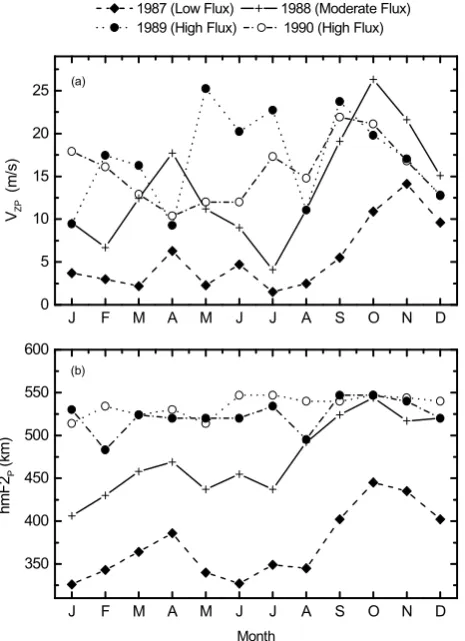
Fig. 1. Variation of (a) pre-reversal vertical ion drift (VZP)and (b) the corresponding maximum hmF2P for four levels of solar
ac-tivity.
1.5◦W, dip latitude,∼3◦N), we show the variation and the relationship between evening peak velocityVZP and the
cor-responding evening peak altitude hmF2 at various levels of solar activity. In addition, we show that at high solar activ-ity period, meridional wind play a pivotal role in the vari-ability of postsunset ionosphere. Details of the procedure for measuring F-region vertical drifts and the peak altitudes using ionosonde were fully described in earlier publications (Oyekola et al., 2007, 2008). Uncertainties inVZP are in the
range of∼(±1–2 m/s), while that of hmF2P varies between ∼(±4–13 km).
2 Results and discussion
[image:2.595.53.286.64.385.2]We present in Fig. 1a (top panel) the variation of evening equatorial pre-reversal vertical drift velocity for four differ-ent values of solar flux intensity F10.7and in Fig. 1b (bottom panel) the corresponding monthly averages of evening maxi-mum hmF2. The averaged monthly solar flux intensity F10.7 values were 85, 141, 214, and 190, respectively. The pre-reversal peak in vertical drifts is smaller at all months for the
Table 1. Regression parameters for Fig. 2.
Year F10.7 (in Slope Regression flux units) coefficients
1987 85 8.84 0.86
1988 141 5.69 0.83
1989 214 0.47 0.21
1990 190 2.59 0.50
lowest flux value. The moderate and high solar maxima show considerable fluctuations. Of particular important, the values ofVZPduring moderate solar activity year 1988 (F10.7=141) are either roughly comparable or even higher thanVZP
dur-ing the maximum solar activity year 1989 (F10.7=214) and 1990 (F10.7=190) in equinoxes (April and October) and De-cember solstice (November and DeDe-cember) months. On av-erage, the magnitude of the evening pre-reversal enhance-ment in vertical iron drift during 1987 (low), 1988 (medium), 1989 (high), and 1990 (high) is 5.5 m/s, 13.7 m/s, 17.1 m/s, and 15.5 m/s, in that order. Clearly, the values indicate so-lar activity dependence. A close look at Fig. 1b, one notes that the variability patterns show apparent solar activity de-pendence, but not as strong as in the PRE in the vertical ion drift. Again, peak hmF2 are smaller in values during all the months for the lowest flux value. In addition, the trends dur-ing 1989 (high) and 1990 (high) are not significant compared toVZP trends during the same periods. It is also noticeable
that values of peak hmF2 during the moderate solar activ-ity year 1988 are approximately similar to maximum hmF2 during 1989 and 1990 solar maxima periods. The overall average value of hmF2p is∼370 km, 470 km,∼535 km, and 523 km for 1987, 1988, 1989, and 1990 periods, respectively. The average value of peak hmF2 also indicates solar activity dependence.
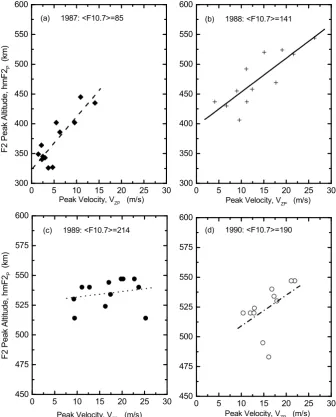
Figure 2 presents the dependence of evening pre-reversal maximum in F2 peak height hmF2p on the postsunset verti-cal ion drifts for 1987, 1988, 1989, and 1990, respectively. Notice that the occurrence time of evening peak in the ver-tical drift is in the range 17:00–22:00 LT. Figure 2 shows four panels of plots along with the best-fit representing so-lar cycle minimum (left top), moderate (right top), maximum (bottom left), and maximum (bottom right) conditions. The best-fit parameters are put together as Table 1. It is inter-esting to see from the table that the slope connecting hmF2p andVZP decrease considerably with the increasing phase of
[image:2.595.342.510.88.167.2]O. S. Oyekola: Evolution/suppression parameters of equatorial postsunset plasma instability 299
16
0 5 10 15 20 25 30
300 350 400 450 500 550 600
F
2
P
e
a
k
A
lti
tu
d
e
,
h
m
F
2P
(k
m
)
(a) 1987: <F10.7>=85
F
2
P
e
a
k
A
lti
tu
d
e
,
h
m
F
2P
(k
m
)
0 5 10 15 20 25 30
300 350 400 450 500 550 600
(b) 1988: <F10.7>=141
0 5 10 15 20 25 30
450 475 500 525 550 575 600
(c) 1989: <F10.7>=214
0 5 10 15 20 25 30
450 475 500 525 550 575 600
Peak Velocity, VZP (m/s) Peak Velocity, VZP (m/s)
Peak Velocity, VZP (m/s)
Figure 2.
Peak Velocity, VZP (m/s)
[image:3.595.129.466.65.483.2](d) 1990: <F10.7>=190
Fig. 2. Dependence of ionospheric peak F2 maximum height (hmF2P)on the evening pre-reversal enhancement in vertical ion drift. The
average decimetric solar flux for each year is indicated on each panel.
irregularities exhibiting strong anti-correlation with the so-lar effect. It is important to stress that the peak velocity and maximum altitude relationship breaks down at higher solar activity suggesting that the pre-reversal enhancement width before reversal is important too. The lower solar activity re-lationships imply that the pre-reversal enhancement shape is fairly constant and the peak velocity is the main variable. Hence, we suspect that even when meaningful onset values (E×B in vertical ion drift or peak hmF2) needed to ignite postsunset plasma instability are met, plasma irregularities can still be inhibited during high solar activity periods. This result is in agreement with the report of Su et al. (2007) that used space-based (ROCSAT-1) observations to show anti-correlation between the solar activity effect and topside
den-sity irregularity occurrence rate at longitude of bad alignment of magnetic field lines in a solstice season. It is observed that the magnitudes of the evening peak velocities are gener-ally smaller, even the yearly average value is less than 20 m/s (commonly reported threshold value of peak velocity neces-sary to trigger plasma instability) for each level of solar activ-ity. Dabas et al. (1998, 2003, 2007), reported that day-to-day occurrence of scintillation at 4 GHz up to 21◦N magnetic latitudes is strongly dependent on the evening hour virtual height orh0F and the time rate of change ofh0F values over the magnetic equator, and suggested that in the neighborhood of the magnetic equator, the threshold values ofE×B (or
300 O. S. Oyekola: Evolution/suppression parameters of equatorial postsunset plasma instability
17
0 6 12 18 24
-60 -40 -20 0 20 40 60 80 100 120 140
Figure 3.
Equinoxes June Solstice December Solstice
M
e
ri
d
io
n
a
l
W
in
d
V
e
lo
c
it
y
(m
/s
)
Local Time (hours)
Fig. 3. Meridional neutral wind over Ouagadougou F-region iono-sphere.
demonstrated the effects of the pre-reversal enhancement on the ground-based GPS TEC data at the equatorial latitudes in the Pacific longitude region.
It must be noted that Ouagadougou station is not located exactly at the magnetic equator, thus meridional neutral wind could play a vital role during high solar epoch. Therefore, an idea of how transequatorial wind intensity could affect the variation of evening prereversal enhancement and peak hmF2 can be obtained from the data presented in Fig. 3, which shows the difference in the hmF2 values over two magnetic conjugate point stations obtained from Ibadan (3◦S dip lati-tude) and Ouagadougou (3◦N dip latitude) during compara-ble solar and geophysical conditions. The hmF2 values over the northern conjugate station is subtracted from that of the southern conjugate station (hmF2IBA–hmF2OUA). The result-ing1(hmF2) represents the direct measure of the transequa-torial wind (Abdu et al., 2006). A positive (negative) value of 1 (hmF2) represents the northward (southward) transe-quatorial wind. The data for the three different seasons are plotted in Fig. 3. We observe that northward transequatorial wind is considerably large within the December solstice, es-pecially during the evening hours over Ouagadougou, mod-erate in equinoxes, and significantly weaker within the June solstice. This result is in agreement with the work presented by Mayer et al. (1979), who found the maximum around sun-set in meridional wind during the equinoctial months of a high solar activity period. Thus, the large transequatorial winds (northward) in equinoxes and December solstice could
be responsible for anti-solar correlation between the hmF2P
andVZP while at the same time quenching the instability
growth in an otherwise unstable flux tube, thus maintains a stable ionosphere with perhaps no equatorial spread-F insta-bility during equinoxes and solstice high solar flux condi-tions.
3 Summary
There exists large variation, particularly in the evening en-hancement in the F-region peak velocity and the evening maximum hmF2 measured over Ouagadougou for the four different values of solar decimetric flux. The F-region pa-rameters (VZP and peak hmF2) required to trigger the ESF
instability exhibit strong anti-correlation with solar activity effect. We note that these parameters are poorly correlated during periods of high solar activity, particularly (F10.7>200 units). In this way, the peak velocity and the corresponding altitude are confined to a narrow altitude range (see Fig. 2c) and, as a result, the ionosphere irregularity generation and evolution may possibly be weakened or inhibited. Lastly, two effects are found to contribute to the variation of evening F-region parameters, especially the electrodynamics; solar variability and the meridional neutral wind in the F-region.
Acknowledgements. We acknowledge the useful comments and
suggestions made by the two referees on the draft of the paper and on the re-processing of Fig. 2.
Topical Editor M. Pinnock thanks V. Eccles and another anony-mous referee for their help in evaluating this paper.
References
Aarons, J.: The longitudinal morphology of equatorial F-layer ir-regularities relevant to their occurrence, Space Sci. Rev., 63, 209–243, 1993.
Abdu, M. A.: Outstanding problems in the equatorial ionosphere-thermosphere elctrodynamics relevant to spread-F, J. Atmos. Solar-Terr. Phys., 63, 869–884, 2001.
Abdu, M. A., de Medeiros, R. T., and Sobral, J. H. A.: Equato-rial spread F instability conditions as determined from ionogram, Geophys. Res. Lett., 9, 692–695, 1982.
Abdu, M. A., Batista, I. S., Reinisch, B. W., Sobral, J. H. A., and Carrasco, A. J.: Equatorial F-region evening vertical drift, and peak height, during southern winter months: A comparison of observational data with the IRI descriptions, Adv. Space Res., 37, 1007–1017, 2006.
Dabas, R. S., Lakshmi, D. R., and Reddy, B. M.: Day-to-day vari-ability in the occurrence of equatorial and low-latitude scintilla-tions in the Indian zone, Radio Sci., 33, 89–96, 1998.
[image:4.595.49.283.59.318.2]O. S. Oyekola: Evolution/suppression parameters of equatorial postsunset plasma instability 301
Dabas, R. S., Das, R. M., Sharma, K., Garg, S. C., Devasia, C. V., Subbarao, K. S. V., Niranjan, K., and Ramar Rao, P. V. S.: Equatorial and low latitude spread-F irregularity characteristics over the Indian region and their prediction possibilities, J. Atmos. Solar-Terr. Phys., 69, 685–696, 2007.
Farley, D. T., Balsley, B. B., Woodman, R. F., and McClure, J. P.: Equatorial spread F: Implication of VHF radar observations, J. Geophys. Res., 75, 7199–7216, 1970.
Fejer, B. G., Scherliess, L., and de Paula, E. R.: Effects of the verti-cal plasma drift velocity on the generation and evolution of equa-torial spreadF, J. Geophys. Res., 104, 19869–19869, 1999. Fesen, C. G., Crowley, G., Roble, R. G., Richmond, A. D., and
Fejer, B. G.: Simulation of the pre-reversal enhancement in the low-latitude vertical ion drifts, Geophys. Res. Lett., 27, 1861– 1864, 2000.
Horvath, I. and Essex, E. A.: VerticalE×B drifts velocity varia-tions and associated low- latitude ionospheric irregularities in-vestigated with the TOPEX and GPS satellite data, Ann. Geo-phys., 21, 1017–1030, 2003,
http://www.ann-geophys.net/21/1017/2003/.
Jayachandran, B., Balan, N., Rao, P. B., Sastri, J. H., and Bailey, G. J.: HF Doppler and ionosonde observations on the onset condi-tions of equatorial spread F, J. Geophys. Res., 98, 13741–13750, 1993.
Lee, C. C., Liu, J.-Y., Reinisch, B. W., Chen, W.-S., and Chu, E. D.: The effects of the pre-reversal drift, the EIA asymmetry, and magnetic activity on the equatorial spreadF during solar maxi-mum, Ann. Geophys., 23, 745–751, 2005,
http://www.ann-geophys.net/23/745/2005/.
Li, G., Ning, B., Liu, L., Ren, Z., Lei, J., and Su, S.-Y.: The correla-tion of longitudinal/seasonal variacorrela-tions of evening equatorial pre-reversal drift and of plasma bubbles, Ann. Geophys., 25, 2571– 2578, 2007, http://www.ann-geophys.net/25/2571/2007/. Mayer, H. G., Harris, I., Spencer, N. W., Hedin, A. E., Wharton, L.
E., Parter, H. S., Walker, J. C. G., and Carson Jr., H. C.: Tides and midnight temperature anomaly in the thermosphere, Geophys. Res. Lett., 6, 447–450, 1979.
Ossakow, S. L.: Spread F theories – A review, J. Atmos. Terr. Phys., 43, 437–452, 1981.
Oyekola, O. S., Akin Ojo, Akinrimisi, J., and dePaula, E. R.: Seasonal and solar cycle variability in F-region vertical plasma drifts over Ouagadougou, J. Geophys. Res., 112, A12306, doi:10.1029/2007JA012560, 2007.
Oyekola, O. S., Ojo, A., and Akinrimisi, J.: A compari-son of ground and satellite observations of F-region verti-cal velocity near the dip equator, Radio Sci., 43, RS1005, doi:10.1029/2007RS003699, 2008.
Su, S.-Y., Chao, C. K., Liu, C. H., and Ho, H. H.: Meridional wind effect on anti-solar activity correlation of equatorial density irregularity distribution, paper presented at International Sym-posium on Coupling Processes in the Equatorial Atmosphere (CPEA Symposium), held at Kyoto University Clock Tower Cen-tennial Hall, Kyoto, Japan, 20–23 March 2007, pp. 1–36, 2007. Whalen, J. A.: The equatorial anomaly: Its quantitative relation to
equatorial bubbles, bottomside spread-FandE×Bdrift velocity during a month at solar maximum, J. Geophys. Res., 106, 29125– 29132, 2001.