https://doi.org/10.5194/bg-14-4879-2017 © Author(s) 2017. This work is distributed under the Creative Commons Attribution 3.0 License.
Effects of temperature on the composition and diversity of bacterial
communities in bamboo soils at different elevations
Yu-Te Lin1, Zhongjun Jia2, Dongmei Wang2, and Chih-Yu Chiu1 1Biodiversity Research Center, Academia Sinica, Taipei 11529, Taiwan
2State Key Laboratory of Soil and Sustainable Agriculture, Institute of Soil Science, Chinese Academy of Sciences, Nanjing 210008, People’s Republic of China
Correspondence to:Zhongjun Jia ([email protected]) and Chih-Yu Chiu ([email protected]) Received: 30 March 2017 – Discussion started: 18 April 2017
Revised: 11 September 2017 – Accepted: 21 September 2017 – Published: 6 November 2017
Abstract. Bamboo is an important resource distributed in mountain areas in Asia. Little is known about the impact of temperature changes on bamboo soil bacterial communities. In this study, responses of bacterial communities collected at 600, 1200, and 1800 m to different incubation tempera-tures (15, 20, and 35◦C) were examined using barcoded py-rosequencing and soil analyses. Soil respiration was greater at higher elevation and incubation temperature. The bacterial diversity decreased after 112 days of incubation at 35◦C. Be-fore incubation,AcidobacteriaandProteobacteriawere the most abundant phyla in all communities. The relative abun-dance of Acidobacteriagenerally decreased after 112 days of incubation at the three temperatures. α-Proteobacteria showed a similar trend, while γ-Proteobacteria increased after incubation, except in samples from 1800 m incubated at 35◦C. Non-metric multi-dimensional scaling analysis re-vealed structural variability under different incubation times and temperatures. Principal component analysis indicated that the bacterial structure in samples incubated at 35◦C cor-related with temperature and soil respiration, while structures in samples incubated at 15 and 20◦C correlated with time. These results suggest that a temperature rise could result in increasing soil respiration and soluble carbon and nitrogen consumption as well as differentially influence bacterial di-versity and structure at different elevations.
1 Introduction
Temperature is one of the most important factors influenc-ing soil organic matter decomposition and microbial com-munities. For example, temperature significantly affects the soil microbial phospholipid fatty acid composition associ-ated with straw decomposition at the early stage (Zhou et al., 2016). Bacterial abundance increases in conditions of el-evated temperature and CO2 concentration (Castro et al., 2010). The complex responses of bacterial composition and diversity of bamboo soils across altitudinal gradients have been suggested to result from interactions with multiple fac-tors, including temperature (Lin et al., 2015).
In Taiwan, moso bamboo (Phyllostachys pubescens) is an important versatile forest resource that is widely used for food, construction, and as a furniture material. It is dis-tributed from low- to high-mountain regions at approxi-mately 1800 m above sea level (a.s.l.). Management practices for increasing bamboo production, including regular removal of understory vegetation, tillage, and fertilizer application, can increase the soil CO2efflux (Liu et al., 2011) and water-soluble organic N concentration (Wu et al., 2010). However, these management practices can lower the microbial func-tional diversity (Xu et al., 2008). Considering the effects of bamboo plantations on soil properties and microbial com-munities, it is worth elucidating the changes in bamboo soil bacterial communities under environmental changes.
max-imum diversity at middle elevations, and community struc-ture formed different clusters at different elevations (Lin et al., 2015). Our parallel study showed that invasion of bamboo into adjacent forest soils increased humification of soil organic matter (SOM) (Wang et al., 2016b). In addition, changes in the SOM pool and the rate of humification with el-evation were primarily affected by changes in climatic condi-tions along the elevation gradient in the bamboo plantacondi-tions (Wang et al., 2016a). However, it is not known whether bam-boo soil bacterial groups respond to temperature changes.
Soil bacterial communities include different phylotypes that likely represent different functional groups, and their relative abundances are affected by carbon (C) availability. For example, some members of Proteobacteriaare consid-ered copiotrophs, and their relative abundances appear to be higher in C-rich environments. In contrast, oligotrophs (e.g., Acidobacteria) can live in stressful environmental conditions (Fierer et al., 2007). However, little is known about how these two groups respond to the environmental temperature changes. Here, we hypothesized that the temperature changes would alter the structure and diversity of soil bacterial com-munities at different elevations, and that bacterial taxa, in-cluding copiotrophic and oligotrophic groups, would have distinct responses to altered nutrient availability caused by temperature changes. To test these hypotheses, soil commu-nities sampled at bamboo plantations at three elevations were incubated at different temperatures and investigated by us-ing the barcoded pyrosequencus-ing technique. The objectives of this study were to elucidate (1) changes in soil organic carbon, nitrogen, and respiration at elevation gradients and at different incubation temperatures, (2) differences in bac-terial structure and diversity under different incubation tem-peratures and periods, and (3) changes in the abundances of different phylogenetic groups at different incubation temper-atures.
2 Methods
2.1 Site description and soil sampling
This study was conducted in Mt. Da’an, a subtropical mountain area in Nantou County, central Taiwan (23◦420N, 120◦410E). The soil samples were collected from moso bam-boo plantations at 600, 1200, and 1800 m a.s.l.along a county road. The three sampling sites were all dominated by moso bamboo with few understory plants. Based on weather sta-tion records and the temperature–elevasta-tion correlasta-tion, the annual mean air temperature was estimated as 20.3◦C at 600 m, 17.2◦C at 1200 m, and 14.1◦C at 1800 m with a de-crease of 0.52◦C per 100 m elevation gain (Wang et al., 2016a). At each elevation, three 25 m×25 m plots were estab-lished along transect lines in March 2015. Within each plot, three subsamples were collected with a soil auger 8 cm in di-ameter and 10 cm deep and pooled. Visible detritus, such as
roots and litter, was manually removed prior to passing the soil through a 2 mm sieve. Soil samples collected at each el-evation were combined and homogenized for further incuba-tion and analysis. The sieved soils were stored at 4◦C before incubation experiments.
2.2 Incubation experiment and soil analysis
Three replicates (25 g each) from each elevation were incu-bated at 15, 20, or 35◦C for 112 days. The temperatures of 15 and 20◦C were selected based on the mean annual tem-perature, while 35◦C was selected to simulate the summer condition. During the entire incubation period, the soil mois-ture was maintained at 60 % of the water-holding capacity. At various incubation times, soil samples were taken from the same container. Soil respiration (CO2-C) was measured as described (Huang et al., 2014). Soluble organic carbon (SOC) and nitrogen (SON) were extracted from the soil sam-ples after different incubation periods with 2 M KCl and mea-sured with the Fisons NA1500 elemental analyzer (Thermo-Quest Italia, Milan, Italy) as described (Huang et al., 2014). 2.3 Barcoded pyrosequencing of the 16S rRNA genes Soil community DNA was extracted using the PowerSoil® soil DNA isolation kit (MoBio Industries, Carlsbad, CA, USA) in accordance with the manufacturer’s instructions. The V1 to V2 regions of the bacterial 16S rRNA gene were amplified using 27F and 338R primers (Lane, 1991). Poly-merase chain reactions (PCR) were performed as described previously (Lin et al., 2015). Secondary PCR (using 3 cy-cles instead of 20) was carried out to barcode the DNA in each sample. The unique and error-correcting barcodes facil-itated sorting of sequences from a single pyrosequencing run (Hamady et al., 2008). The barcoded PCR products were pu-rified on a column filter using a PCR clean-up system (Vio-gene Biotek Corp., New Taipei City, Taiwan). The quali-ties and concentrations of the purified barcoded PCR prod-ucts were determined using a NanoDrop spectrophotometer (Thermo Fisher Scientific, Waltham, MA, USA). Amplicon pyrosequencing was performed by Mission Biotech (Taipei, Taiwan) using the 454/Roche GS-FLX Titanium instrument (Roche, Branchburg, NJ, USA). All sequences have been submitted to the Short Read Archives under accession num-ber SRS1923345.
2.4 Sequence analyses
analyses. Taxonomic information was analyzed using the naïve Bayesian rRNA classifier in RDP (Wang et al., 2007). The Shannon diversity index was calculated based on com-plete linkage clustering data for operational taxonomic units (OTUs), with an evolutionary distance of 0.03. The distri-bution of shared OTUs among the communities was ob-tained using the Mothur program (Schloss et al., 2009). Non-metric multi-dimensional scaling (NMDS) based on the dis-tribution of shared OTUs was plotted by using the PRIMER V6 software (Clarke and Gorley, 2006). The Mantel tests as implemented in PRIMER V6 software was used to ana-lyze the relationships between bacterial communities, phy-logenetic groups and soil properties. Principal component analysis (PCA) to determine the relationship between bac-terial community and soil properties was carried out using R v.3.2.1.
3 Results
3.1 Soil respiration, SOC, and SON
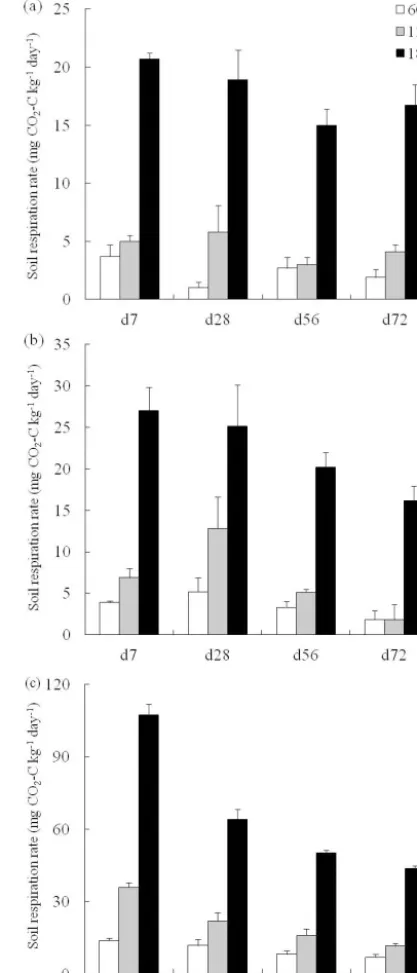
Data on soil respiration CO2-C in samples taken from three elevations and incubated at different temperatures are shown in Fig. 1. Under the same temperature, the soil samples col-lected at higher elevation, especially those from 1800 m, had a significantly higher soil respiration rate than those obtained at lower elevation. The soil respiration rate increased with temperature within each elevation. At 35◦C, the soil respira-tion rate decreased significantly with incubarespira-tion time. At 15 and 20◦C, the respiration rates of some soil samples slightly increased in the early incubation period (until day 28, d28) (Fig. 1). Because the respiration rate was stabilized after d72, respiration rate analyses were conducted only up to this time point.
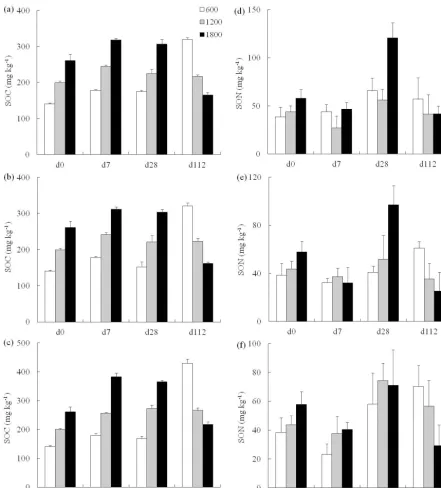
At d0, the SOC and SON contents of the soils increased significantly with elevation (Fig. 2). Compared to d0, the concentration of SOC in the high-elevation soils (1800 m) decreased, while those at 600 and 1200 m increased after 112 days (d112) of incubation at three temperatures. Incu-bation at higher temperature (35◦C) resulted in higher SOC content than that at lower temperatures (15 and 20◦C). In most samples, SON content increased until d28 of incuba-tion, but was decreased at d112.
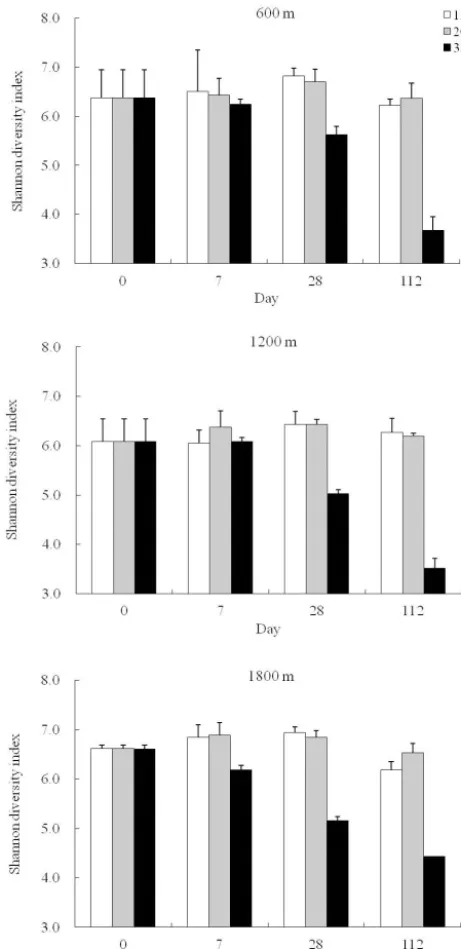
[image:3.612.323.532.70.557.2]3.2 Community diversity at different temperatures The soil bacterial diversity at three elevations at different incubation temperatures was determined based on an OTU cutoff of≤0.03. Based on the Shannon diversity index, the bacterial diversity of soils incubated at 35◦C decreased af-ter long incubation (d112). Under incubation at 15 or 20◦C, the bacterial diversity slightly increased at d7 and d28, and decreased at d112 (Fig. 3). Analysis of the β-diversity re-vealed that though incubated with different temperature, the
Figure 1.Respiration CO2-C rate in soils sampled at three
eleva-tions under incubation at(a)15◦C,(b)20◦C, and(c)35◦C. Error bars represent SD.
communities at the same elevation formed a cluster different from those at other elevations (Supplement Fig. S1).
3.3 Community composition at different incubation temperatures
eleva-Figure 2.Concentration of(a–c)soluble organic carbon (SOC) and(d–f)nitrogen (SON) in bamboo soils sampled at three elevations and incubated at(a, d)15◦C,(b, e)20◦C, and(c, f)35◦C. Error bars represent standard deviation.
tions, together representing more than 60 % of the soil bac-terial communities (Table 1). Within the Proteobacteria,α -Proteobacteriawere predominant (Table 1). At 1800 m, Bac-teroidetes accounted for 8 % of the community, while they comprised only 2–4 % of the communities at the two other elevations. The relative abundance ofActinobacteriawas 4– 6 %, and the other phylogenetic groups represented less than 3 % of the communities.
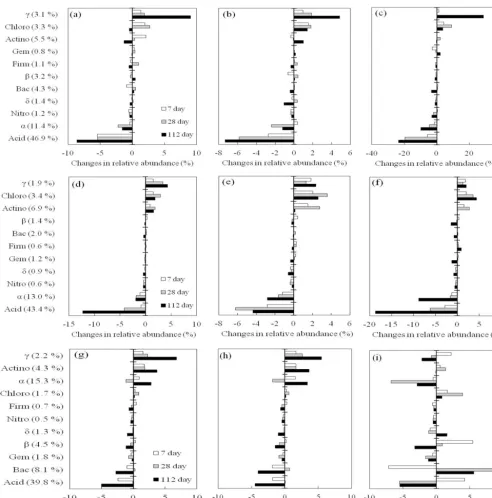
[image:4.612.79.520.65.553.2]tempera-Figure 3.Changes in bacterial diversity of soil community at 600, 1200, and 1800 m incubated at different temperatures.
tures, except at d7 at 600 m, 20◦C, and at d7 at 1200 m, 35◦C (Fig. 4a–f). At 1800 m, the changes in abundance were differ-ent.α-Proteobacteriawere elevated at d7 and d112, but were lower at d28 of incubation at 15 and 20◦C. Their abundance decreased over time under incubation at 35◦C (Fig. 4g–i). With regard to γ-Proteobacteria, their relative abundance mostly increased over incubation, except in soils sampled at 1800 m under incubation at 35◦C, in which it was increased at d7 but decreased at d28 and d112 (Fig. 4i). The relative abundance ofChloroflexialso increased over incubation,
ex-Table 1.Relative abundances (%) of different phylogenetic groups in the bamboo soil bacterial communities at different elevations.
Phylogenetic groups 600 m 1200 m 1800 m
Acidobacteria 46.9 43.6 39.8 Actinobacteria 5.5 6.9 4.3
Bacteroidetes 4.3 2.0 8.1
Chloroflexi 3.3 3.4 1.7
Firmicutes 1.1 0.6 0.7
Gemmatimonadetes 0.8 1.2 1.8
Nitrospirae 1.2 0.6 0.5
Alphaproteobacteria 11.4 13.0 15.3 Betaproteobacteria 3.2 1.4 4.4 Gammaproteobacteria 3.1 1.9 2.2 Deltaproteobacteria 1.4 0.9 1.3 Proteobacteria, others 6.2 6.3 7.1
Others 11.6 18.2 12.8
cept in samples taken at 600 m, incubated at 15◦C, on d112. Some other phyla demonstrated inconsistent changes under increased temperature. The abundances ofActinobacteriaat 1200 and 1800 m increased at higher temperature (Fig. 4d– i), while it decreased in samples taken at 600 m (Fig. 4a–c). Likewise, Bacteroidetesshowed inconsistent changes after different incubation times and temperatures (Fig. 4a–i).
The changes in relative abundance of some abundant genera are shown in Fig. 5. The relative abundance of acidobacterial-GP1 generally decreased over the en-tire incubation period at all temperatures, except at 35◦C (Fig. 5i). The α-proteobacterial Bradyrhizobium showed similar trends, while its relative abundance at 1800 m in-creased at all three incubation temperatures (Fig. 5g– i). Within β-Proteobacteria, the relative abundance of Burkholderiaat 1200 m decreased over incubation, except in samples incubated at 15◦C in the first 7 days (Fig. 5d). With regard to γ-Proteobacteria, Dyella in samples from 1200 m decreased under all three incubation temperatures (Fig. 5d–f), and its abundance increased mostly in commu-nities at 600 m and 1800 m (Fig. 5a–c and g–i). The relative abundance ofMucilaginibacterof Bacteroidetesat 1800 m increased greatly in samples incubated at 35◦C on d28 and d112 (Fig. 5i).
NMDS analysis based on the distribution of shared OTUs also revealed the variability in bacterial structure under dif-ferent incubation times and temperatures (Fig. 6). The bac-terial community at 1800 m formed a different cluster from those at 600 and 1200 m. Incubation at higher temperature (35◦C) led to a bacterial structure different from those at 15 and 20◦C. Incubation time also changed the bacterial struc-ture. The bacterial structure under long incubation (at d112) was different from those at d7 and d28.
[image:5.612.50.281.66.541.2] [image:5.612.324.532.94.260.2]Figure 4.Changes in relative abundance of phylogenetic groups of bamboo soil bacterial communities at(a)600 m, 15◦C;(b)600 m, 20◦C;
(c)600 m, 35◦C;(d)1200 m, 15◦C;(e)1200 m, 20◦C;(f)1200 m; 35◦C,(g)1800 m, 15◦C;(h)1800 m, 20◦C; and(i)1800 m, 35◦C. Abbreviation: Acid:Acidobacteria; Actino:Actinobacteria; Bac:Bacteroidetes; Chloro:Chloroflexi; Firm:Firmicutes; Gem: Gemmatimon-adetes; Nitro:Nitrospirae;α,β,γ,δ:α-,β-,γ-, andδ-Proteobacteria.
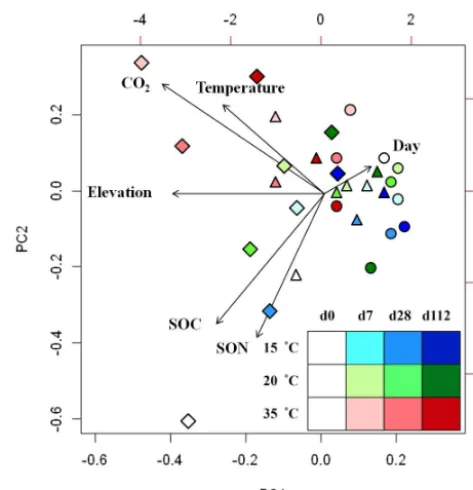
CO2-C, while at 15 and 20◦C, bacterial structure correlated with incubation time (Fig. 7).
4 Discussion
Figure 5.Changes in relative abundance of abundant genera of bamboo soil bacterial communities at(a)600 m, 15◦C;(b)600 m, 20◦C;
(c)600 m, 35◦C;(d)1200 m, 15◦C;(e)1200 m, 20◦C;(f)1200 m, 35◦C;(g)1800 m, 15◦C;(h)1800 m, 20◦C; and(i)1800 m, 35◦C.
reported higher respiration rate at high temperatures (Stark et al., 2015). Incubation at increasing temperatures enhanced the soil microbial activity and led to an increase in soil respi-ration in forest mesocosms (Lin et al., 2001). In our study, the respiration rate decreased after long incubation. This could be due to the exhaustion of labile compounds after microbial decomposition (Zhou et al., 2016). The decrease in bacterial diversity at high elevation and high incubation temperature, calculated from abundance data of the phylogenetic groups, could also be the result of nutrient exhaustion after long in-cubation. In addition, the correlation between soil respiration and bacterial structure in the soil samples under incubation at 35◦C suggests the adaption and high activity of bacterial communities at higher temperature.
In d0 samples, which represent the original composition of the bamboo soils, the bacterial diversity was higher in the 1800 m soils, followed by the 600 and 1200 m soils. Commu-nities with higher diversity are reportedly more resistant to environmental changes (Loreau and de Mazancourt, 2013).
In a study by Ren et al. (2015) in rice paddies, the diverse soil communities were more resistant to elevated CO2 and temperature than the less diverse foliar bacterial communi-ties. The increasing concentration of recalcitrant C with in-creasing elevation (Wang et al., 2016a) could be helpful in providing more carbon resources to the community at high elevation. Together, these findings indicate that bamboo soil bacterial communities with higher diversity could be more capable of maintaining soil community and function when exposed to climatic changes and subjected to management at high elevation (1800 m).
Figure 6. NMDS analysis of bamboo soil bacterial communities sampled at three elevations and incubated at different tempera-tures. Circles, triangles, and diamonds represent communities at 600, 1200, and 1800 m elevation, respectively. The analysis was based on the distribution of OTUs formed at an evolutionary dis-tance of 0.03.
time (Keiser et al., 2011). Recently, bamboo shoot harvest and timber production has moved from about 600 to 1200 m in the study area. Soils at different elevation have distinct soil SOC and SON contents, which could result in different forces to alter bacterial communities. Incubation temperature also had an effect on community structure. Warming in the experimental field in a previous study in the Arctic environ-ment caused a significant increase in the abundance of fungi and bacteria (Yergeau et al., 2012). The quantity of SOC and CO2 flux has been shown to increase under warming con-ditions (Zhang et al., 2005; Zhou et al., 2011). Increasing temperature increased relative bacterial growth in arable soils from southern Sweden (Bárcenas-Moreno et al., 2009) and, particularly, the abundance of genes involved in labile car-bon degradation in a tall-grass prairie ecosystem in central Oklahoma, USA (Zhou et al., 2011), and led to C loss. In the present study, the shifts in bacterial communities at three elevations could reflect differences in nutrient availability, in-cluding SOC and SON, and bacterial activity under different incubation temperatures and at distinct time points during in-cubation.
[image:8.612.50.286.65.224.2]Bacterial community structure under incubation at 35◦C was affected by temperature, while under incubation at 15 and 20◦C it correlated with incubation time (Fig. 7). Warm-ing has been shown to change the bacterial structure of alpine meadow soils (Xiong et al., 2014) and to cause thermal-adaption functional shift of microbial communities (Rousk et al., 2012). Recent studies have observed changes in tem-perature sensitivity of microbial communities along incuba-tion time. Shifts in microbial communities in response to warming occur after a few years (Yergeau et al., 2012) or even only a few months (Xiong et al., 2014). However, some studies revealed no significant community changes over time
Figure 7.PCA of bamboo soil bacterial communities and environ-mental properties. Symbols are the same as in Fig. 6.
owing to warming (Allison et al., 2010; Zhou et al., 2011). The present work revealed community structure differences after incubation for only about 4 months, suggesting that the bacterial communities in bamboo soils at elevation are highly sensitive to temperature changes, even though they faced a relatively short-time warming condition.
The responses of phylogenetic abundances to tempera-ture differed. As for Acidobacteria, the abundance gener-ally decreased with increasing temperature. This is in ac-cordance with previous studies showing decreases in the rel-ative abundance ofAcidobacteriain warming soils (Xiong et al., 2014; Yergeau et al., 2012).Acidobacteriaare known as slow-growing (oligotrophic) bacteria that prefer low nutri-ent availability (Fierer et al., 2007) and possess high maxi-mum growth efficiency (Roller and Schmidt, 2015). Warm-ing conditions in the soil could increase substrate availabil-ity and might favor fast-growing (copiotrophic) microorgan-isms, which are more sensitive to nutrient availability (Män-nisto et al., 2016). Thus, the decreases in the abundance of Acidobacteriacould reflect their interactions with copi-otrophic species. The abundance ofAcidobacteriacould also be limited by high temperatures (Stark et al., 2015).
α-Proteobacteriain the present study could reflect the de-crease in SOC content, which was exhausted by soil res-piration CO2-C after incubation. Bradyrhizobium of α -Proteobacteria at 1800 m increased at all three incubation temperatures. This genus includes species capable of nitro-gen fixation and may significantly contribute to soil func-tion (Yarwood et al., 2009). The increase in their abun-dance might explain the elevated SON. Moreover, these bac-teria are plant-growth-promoting bacbac-teria, stimulating plant growth by fixing N2, increasing the availability of nutrients in the rhizosphere, positively influencing root growth and mor-phology, and promoting other beneficial plant–microbe sym-bioses (Vessey, 2003). Their response to incubation temper-atures indicates their potential roles in bamboo growth and responses to application of fertilizers under climatic change. The increase in abundance ofγ-Proteobacteria after in-cubation in our study differed from that in the soil commu-nity sampled at elevated soil temperature.γ-Proteobacteria showed a lower relative abundance under elevated tem-perature than in the ambient temtem-perature control (Ren et al., 2015). Withinβ-Proteobacteria, the abundant genus Burkholderia is nutritionally versatile and is commonly found in rhizosphere soils. Their functional diversity, includ-ing nitrogen fixation and plant growth promotion (Coenye and Vandamme, 2003), could help maintain soil commu-nity stability. In addition, ActinobacteriaandBacteroidetes showed variable responses at different temperatures. These phyla also prefer nutrient-rich environments (Nemergut et al., 2010). Differences in vegetation and litter quality among the study sites might explain this variation. Acti-nobacteria are involved in the organic matter degradation. Under climatic changes, managements of bamboo forests need to consider the responses ofActinobacteriato temper-ature, especially that in N fertilizers, since the abundance of this phylum was positively affected by N fertilization treatments (Zhou et al., 2015). TheMucilaginibacterspecies of Bacteroidetesare capable of degrading polysaccharides (Pankratov et al., 2007); thus, the increase in their abundance can be explained by the increase in plant residues in the soil. A previous study suggested the relationship of elevation and temperature with the decomposition of recalcitrant C (Wang et al., 2016a). After decomposition of labile C, the availabil-ity of recalcitrant C can strongly affect the communavailabil-ity. More-over, based on a literature survey by Ho et al. (2017), there is little consistency in oligotrophic and copiotrophic phyla of bacterial communities. The microorganisms can display a variety of metabolic characteristics and adjust between high and low substrate use efficiency to adapt to environmental changes. Therefore, shifts in the relative abundances of bac-terial taxa may not necessarily indicate their life strategies as an oligotroph or copiotroph but might just reveal the response of a community to such local factors (Ho et al., 2017). Fur-ther study, including more comprehensive temperature gra-dients and more detailed time-course analysis, will be
neces-sary to elucidate the exact influences of temperature on soil communities.
Acidobacteria and α-Proteobacteria, which comprised more than 10 % of the communities before incubation, tended to decrease after incubation. Groups with lower abundance before incubation, especially,γ-Proteobacteria, showed an increasing trend after incubation. These patterns were similar to those shown in communities of a rice paddy and desert soils (Wang et al., 2012; Ren et al., 2015), in which numerically dominant bacterial phyla/classes were reduced, while originally rare groups increased in relative abundance after exposure to environmental changes. These results sug-gest that shifts in bacterial populations facing environmental changes may follow predictable patterns.
5 Conclusions
Our results revealed that an increase in temperature could result in increased soil respiration CO2-C and consump-tion of SOC and SON contents, which directly or indirectly influence the bacterial diversity and structure of bamboo soils at different elevations. In addition, the different re-sponses of bacterial groups to the temperature changes sug-gest the adaptation of soil communities to global-warming-related climatic changes. This study highlights the need for further research on the physiological and ecological roles of soil bacterial members, such as Acidobacteria, α- and
γ-Proteobacteria, in response to climatic change in forest ecosystems.
Data availability. All sequences have been submitted to the Short Read Archives under accession number SRS1923345.
The Supplement related to this article is available online at https://doi.org/10.5194/bg-14-4879-2017-supplement.
Author contributions. YTL performed statistical analyses; ZJ built statistical models; CYC interpreted ecological rationale; CYC and ZJ formulated the study hypothesis and developed the methodology; and YTL wrote and ZJ and CYC edited the manuscript. All authors read and approved the final manuscript.
Competing interests. The authors declare that they have no com-peting interests.
Academia Sinica, Taipei, Taiwan, for assisting with molecular analyses. This study is also partly supported by the Strategic Priority Research Program of the Chinese Academy of Sciences (XDB15040000).
Edited by: Denise Akob
Reviewed by: two anonymous referees
References
Allison, S. D., McGuire, K. L., and Treseder, K. K.: Resistance of microbial and soil properties to warming treatment seven years after boreal fire, Soil Biol. Biochem., 42, 1872–1878, 2010. Bárcenas-Moreno, G., Gómez-Brandón, M., Rousk, J., and
Bååth, E.: Adaptation of soil microbial communities to temper-ature: comparison of fungi and bacteria in a laboratory experi-ment, Glob. Change Biol., 15, 2950–2957, 2009.
Castro, H. F., Classen, A. T., Austin, E. E., Norby, R. J., and Schadt, C. W.: Soil microbial community responses to multiple experimental climate change drivers, Appl. Environ. Microb., 76, 999–1007, 2010.
Clarke, K. R. and Gorley, R. N.: Primer v6: user manual/tutorials, Primer-E Ltd, Plymouth, 2006.
Coenye, T. and Vandamme, P.: Diversity and significance of Burkholderiaspecies occupying diverse ecological niches, En-viron. Microbiol., 5, 719–729, 2003.
Fierer, N., Bradford, M. A., and Jackson, R. B.: Toward an ecologi-cal classification of soil bacteria, Ecology, 88, 1354–1364, 2007. Hamady, M., Walker, J. J., Harris, J. K., Gold, N. J., and Knight, R.: Error-correcting barcoded primers for pyrosequencing hundreds of samples in multiplex, Nat. Methods, 5, 235–237, 2008. Ho, A., Lonardo, D. P. D., and Bodelier, P. L. E.:
Re-visiting life strategy concepts in environmental mi-crobial ecology, FEMS Microbiol. Ecol., 93, fix006, https://doi.org/10.1093/femsec/fix006, 2017.
Huang, C. Y., Jien, S. H., Chen, T. H., Tian, G., and Chiu, C. Y.: Soluble organic C and N and their relationships with soil or-ganic C and N and microbial characteristics in moso bamboo (Phyllostachys edulis) plantations along an elevation gradient in Central Taiwan, J. Soil Sediment., 14, 1061–1070, 2014. Keiser, A. D., Strickland, M. S., Fierer, N., and Bradford, M. A.:
The effect of resource history on the functioning of soil micro-bial communities is maintained across time, Biogeosciences, 8, 1477–1486, https://doi.org/10.5194/bg-8-1477-2011, 2011. Lane, D. J.: 16S/23S rRNA sequencing, in: Nucleic Acid
Tech-niques in Bacterial Systematics, edited by: Stackbrandt, E., and Goodfellow, M., Wiley, New York, 115–175, 1991.
Lin, G., Rygiewicz, P. T., Ehleringer, J. R., Johnson, M. G., and Tingey, D. T.: Time-dependent responses of soil CO2efflux com-ponents to elevated atmospheric [CO2] and temperature in
exper-imental forest mesocosms, Plant Soil, 229, 259–270, 2001. Lin, Y. T., Tang, S. L., Pai, C. W., Whitman, W. B., Coleman, D. C.,
and Chiu, C. Y.: Changes in the soil bacterial communities in a cedar plantation invaded by moso bamboo, Microb. Ecol., 67, 421–429, 2014.
Lin, Y. T., Whitman, W. B., Coleman, D. C., Shi, S. Y., Tang, S. L., and Chiu, C. Y.: Changes of soil bacterial communities in
bam-boo plantations at different elevations, FEMS Microbiol. Ecol., 91, fiv033, https://doi.org/10.1093/femsec/fiv033, 2015. Liu, J., Jiang, P., Wang, H., Zhou, G., Wu, J., Yang, F., and Qian, X.:
Seasonal soil CO2efflux dynamics after land use change from a
natural forest to moso bamboo plantations in subtropical China, Forest Ecol. Manag., 262, 1131–1137, 2011.
Loreau, M. and de Mazancourt, C.: Biodiversity and ecosystem sta-bility: a synthesis of underlying mechanisms, Ecol. Lett., 16, 106–115, 2013.
Männisto, M., Ganzert, L., Tiirola, M., Häggblom, M. M., and Stark, S.: Do shifts in life strategies explain microbial commu-nity responses to increasing nitrogen in tundra soil?, Soil Biol. Biochem., 96, 216–228, 2016.
Nemergut, D. R., Cleveland, C. C., Wieder, W. R., Washen-berger, C. L., and Townsend, A. R.: Plot-scale manipulations of organic matter inputs to soils correlate with shifts in microbial community composition in a lowland tropical rain forest, Soil Biol. Biochem., 42, 2153–2160, 2010.
Pankratov, T. A., Tindall, B. J., Liesack, W., and Dedysh, S. N.: Mu-cilaginibacter paludisgen. nov., sp. nov., andMucilaginibacter gracilissp. nov., pectin-, xylan- and laminarin-degrading mem-bers of the familySphingobacteriaceaefrom acidic Sphagnum peat bog, Int. J. Syst. Evol. Micr., 57, 2349–2354, 2007. Ren, G., Zhu, C., Alam, M. S., Tokida, T., Sakai, H., Nakamura, H.,
Usui, Y., Zhu, J., Hasegawa, T., and Jia, Z.: Response of soil, leaf endosphere and phyllosphere bacterial communities to elevated CO2and soil temperature in a rice paddy, Plant Soil, 392, 27–44,
2015.
Roller, B. R. K. and Schmidt, T. M.: The physiology and ecological implications of efficient growth, ISME J., 9, 1481–1487, 2015. Rousk, J., Frey, S. D., and Bååth, E.: Temperature adaptation of
bac-terial communities in experimentally warmed forest soils, Glob. Change Biol., 18, 3252–3258, 2012.
Schloss, P. D., Westcott S. L., Ryabin, T., Hall, J. R., Hartmann, M., Hollister, E. B., Lesniewski, R. A., Oakley, B. B., Parks, D. H., Robinson, C. J., Sahl, J. W., Stres, B., Thallinger, G. G., Van Horn, D. J., and Weber, C. F.: Introducing mothur: open-source, platform-independent, community-supported software for de-scribing and comparing microbial communities, Appl. Environ. Microb., 75, 7537–7541, 2009.
Stark, S., Männistöb, M. K., Ganzert, L., Tiirola, M., and Hägg-blom, M. M.: Grazing intensity in subarctic tundra affects the temperature adaptation of soil microbial communities, Soil Biol. Biochem., 84, 147–157, 2015.
Vessey, J. K.: Plant growth promoting rhizobacteria as biofertilizers, Plant Soil, 255, 571–586, 2003.
Wang, B. Z., Zhang, C. X., Liu, J. L., Zeng, X. W., Li, F. R., Wu, Y. C., Lin, X. G., Xiong, Z. Q., Xu, J., and Jia, Z. J.: Mi-crobial community changes along a land-use gradient of desert soil origin, Pedosphere, 22, 593–603, 2012.
Wang, H. C., Chou, C. Y., Chiou, C. R., Tian, G., and Chiu, C. Y.: Humic acid composition and characteristics of soil organic matter in relation to the elevation gradi-ent of moso bamboo plantations, Plos One, 11, e0162193, https://doi.org/10.1371/journal.pone.0162193, 2016a.
Wang, Q., Garrity, G. M., Tiedje, J. M., and Cole, J. R.: Naïve Bayesian classifier for rapid assignment of rRNA sequences into the new bacterial taxonomy, Appl. Environ. Microb., 73, 5261– 5267, 2007.
Wu, J. S., Jiang, P. K., Chang, S. X., Xu, Q. F., and Lin, Y.: Dis-solved soil organic carbon and nitrogen were affected by conver-sion of native forests to plantations in subtropical China, Can. J. Soil Sci., 90, 27–36, 2010.
Xiong, J., Sun, H., Peng, F., Zhang, H., Xue, X., Gibbons, S. M., Gilbert, J. A., and Chu, H.: Characterizing changes in soil bac-terial community structure in response to short-term warming, FEMS Microbiol. Ecol., 89, 281–292, 2014.
Xu, Q., Jiang, P., and Xu, Z.: Soil microbial functional diversity un-der intensively managed bamboo plantations in southern China, J. Soils Sediment, 8, 177–183, 2008.
Yarwood, S. A., Myrold, D. D., and Högberg, M. N.: Termination of belowground C allocation by trees alters soil fungal and bacterial communities in a boreal forest, FEMS Microbiol. Ecol., 70, 151– 162, 2009.
Yergeau, E., Bokhorst, S., Kang, S., Zhou, J., Greer, C. W., Aerts, R., and Kowalchuk, G. A.: Shifts in soil microorganisms in response to warming are consistent across a range of Antarctic environments, ISME J., 6, 692–702, 2012.
Zhang, W., Parker, K. M., Luo, Y., Wan, S., Wallace, L. L., and Hu, S.: Soil microbial responses to experimental warming and clipping in a tallgrass prairie, Glob. Change Biol., 11, 266–277, 2005.
Zhou, G., Zhang, J., Chen, L., Zhang, C., and Yu, Z.: Temperature and straw quality regulate the microbial phospholipid fatty acid composition associated with straw decomposition, Pedosphere, 26, 386–398, 2016.
Zhou, J., Xue, K., Xie, J., Deng, Y., Wu, L., Cheng, X., Fei, S., Deng, S., He, Z., Van Nostrand, J. D., and Luo, Y.: Microbial mediation of carbon-cycle feedbacks to climate warming, Nat. Clim. Change, 2, 106–110, 2011.