Copyright © 2019 (Lei Vincent Huang and Ke Zhang). Licensed under the Creative Commons Attribution Non-commercial No Derivatives (by-nc-nd). Available at http://ijoc.org.
Engagement, Formality, and Visibility:
Managing Paradoxes of Using Mobile Instant Messaging for Work
LEI VINCENT HUANG
Hong Kong Baptist University, Hong Kong
KE ZHANG
Soochow University, China
Supporting dyadic and multisided messaging with various communication modalities as well as social networking, mobile instant messengers provide a communication tool that alters processes in not only social but also professional interactions. In this study, we employ a paradox-based perspective to examine how WeChat, the most popular mobile instant messenger in China, is a productive and problematic tool for work-related interactions. Findings from interviews with Chinese employees suggest that, although enhancing connectivity and coordination among employees, WeChat use is associated with paradoxes of engagement, formality, and visibility. Technical features, organizational norms, coworker expectations, and conflicts in individual understandings of WeChat contribute to the perceptions of these paradoxes. Participants respond to the paradoxes by developing their own rules, exerting control, or withdrawing from some features of WeChat. Implications of this study on mobile communication research and organizational communication practices are discussed.
Keywords: mobile instant messaging, work, paradox, microcoordination, smartphone, China
Mobile communication technologies are widely used for work-related purposes nowadays, enhancing connectivity among employees (Mazmanian, Orlikowski, & Yates, 2013), improving work engagement and job satisfaction (Fujimoto, Shahriar, Sekiguchi, & Sugianto, 2016; Sheer & Rice, 2017), and enabling distributed, flexible work arrangements (Fonner & Roloff, 2012; Leonardi, Treem, & Jackson, 2010). Among the mobile technologies, mobile instant messengers (MIMs), such as WeChat, Line, and WhatsApp, represent a new generation of instant messaging tool that provides wide functionality for social networking and multimodal communication. These communication tools are now frequently used not only for personal but also for professional purposes. Despite this trend, little research exists that explores how MIM use alters communication processes for work-related processes and contributes to employee and
Lei Vincent Huang: [email protected] Ke Zhang: [email protected]
organizational outcomes (Sheer & Rice, 2017). Filling this research gap, in this study, we examine how WeChat, the most popular MIM in China, is used for work.
In the present study, we explore paradoxes in the use of WeChat for work-related communication. A paradox is felt when an action that pursues one goal includes elements that may undermine the goal (Stohl & Cheney, 2001). Scholars have already shown the paradoxical nature of mobile technology use (Jarvenpaa & Lang, 2005) and its impact on employee and organizational outcomes. However, prior work focuses mostly on early generations of MIMs and pays little attention to how the wide functionality provided by the most recent generation of MIMs is associated with paradoxical user experience. Therefore, aiming at filling in this gap, using WeChat as an example, we present a holistic analysis of using the new generation of MIMs for work through the theoretical lens of paradox. Adopting a paradoxical view also means that we consider a mutually constituted technology-user relationship. That is, we assume that technology use is shaped by both features of the technology and users’ understanding and appropriation of the features. Therefore, in the present study, we pay attention to how technological features of MIMs and factors related to users interact to result in outcomes favored or not favored by the employees.
In the following sections, we review literature of MIM use for work, describe functions of WeChat and processes enabled by WeChat using concepts of microcoordination (Ling & Lai, 2016; Ling & Yttri, 2002) and connected presence (Licoppe, 2004), and introduce the paradoxical perspective of mobile technology use. We then present an interview study from which we identify three major paradoxes of using WeChat for work and factors associated with the paradoxes. Finally, we discuss theoretical and practical implications.
Literature Review
(Mobile) Instant Messaging for Work
Instant messaging affords seamless, near synchronous interactions among employees at individual and group levels. Prior research suggests that, being used in mainly collaboration tasks (Pazos, Chung, & Micari, 2012), instant messaging supports copresence of employees, facilitates informal knowledge exchange (Davison, Ou, & Martinsons, 2013), and enables employees to check availability of their coworkers with little effort (Nardi, Whittaker, & Bradner, 2000). Instant messaging thus increases connectivity among employees and is found to facilitate workplace relationship development and improve communication quality and job satisfaction (e.g., Dahlberg, 2005; Davison, Ou, Martinsons, Zhao, & Du, 2014; Ou & Davison, 2015; Quan-Haase, Cothrel, & Wellman, 2005).
when they are frequently approached for quick questions, which leads to an unbalanced distribution of cognitive labor.
Incorporating instant messaging services with mobile technologies such as smartphones, MIMs emerge as a new communication tool and are increasingly popular among employees. Surprisingly, little research has been conducted to explore MIM use for work-related purposes. In one of the few exceptions, Li and Lin (2016) found that Chinese employees used MIMs to keep updated on company events, communicate with colleagues, and perform work-related tasks. Another exception is from Sheer and Rice (2017), who found that MIM use among real estate agents in Hong Kong contributed to their online social capital, job performance, and job satisfaction. As an emerging line of investigation, research to date on MIM has only focused on patterns of MIM use (e.g., frequency of use, number of contacts per day, and types of tasks) and their impact. However, as the new generation of MIMs on smartphones provides wide functionality that supports multimedia messaging in dyadic and multisided interactions (Ling & Lai, 2016), it is necessary to consider how MIMs provide a new means of communication for work-related purposes beyond only examining the use patterns. To better understand the affordances of MIMs, we draw on mobile communication scholarship, especially recent discussion on integrative design of MIMs and instrumental and expressive processes enabled by such design (Cui, 2016; Ling & Lai, 2016; Ling & Yttri, 2002; Yu, Huang, & Liu, 2017).
Integrative Design of WeChat
What distinguishes WeChat from other similar applications such as Line and WhatsApp is that WeChat is famous for its “all in one place” design (Cheng & Nielsen, 2016). Starting as an instant messenger, WeChat provides functions of multimedia instant messaging, by which users can send text/voice messages, pictures, videos, and files to another user or a group of users. It also provides a social networking service (SNS) called Moments. Through Moments, users can post original content (e.g., texts, photos, and video clips) as well as content shared from other websites. In addition to the previously mentioned functions that support social interactions, WeChat also provides a platform for organizations and individuals to manage mini-websites called “official accounts.” Users can subscribe to these accounts and receive updates or interact with the organizations and the individuals. Finally, WeChat incorporates utility functions such as payment and booking services.
Academic research on WeChat is proliferating. To date, scholars have examined adoption of WeChat (Huang & Zhang, 2017; Lin & Li, 2014) and uses of WeChat for close relationship management (Cui, 2016), political participation (J. Chen, 2016; Y. Chen, 2017), corporate public engagement and marketing (Y.-R. R. Chen, 2016), and grassroots movements (Wang & Gu, 2016). These studies suggest that WeChat enables multimodal communication that can benefit maintenance and development of relationships with strong ties. The integrative design of WeChat that allows easy information dissemination, synchronized one-to-one and/or many-to-many communication, and interactive interface of public accounts can facilitate engagement with certain content and collaboration at interpersonal, group, and organizational levels.
of WeChat users engage in work-related activities on the platform (China Tech Insights, 2017). Although much has been done to explore WeChat use, we still know little regarding how WeChat can contribute to instrumental and social processes in organizational contexts. To better understand implications of the integrative design of WeChat, we draw on concepts in mobile and mediated communication to describe and discuss processes enabled by MIMs and implications of high integration of functions on these processes.
Microcoordination and Connected Presence
Developed by Ling and Yttri (2002), microcoordination suggests that mobile phones are used in people’s daily lives to “work out everyday logistics, to ‘soften’ schedules, and to iteratively coordinate social interaction” (Ling & Lai, 2016, p. 836). Now, as MIMs introduce more functions such as group communication and searching functions, recent work updates our understanding of microcoordination. For example, Ling and Lai (2016), based on interviews with WhatsApp users, found that new-generation smartphone apps enabled multisided group communication, through which people could plan ad hoc activities easily. They also identified that people engage in meme-based coordination, where people rely on each other and draw on the collective memory of MIM groups to continuously participate in discussion and coordination. Meme-based coordination is similar to Bertel’s (2013) concept of flexible alignment, which describes MIM users’ ability to retrieve information in a flexible manner irrespective of time and place.
In addition to describing instrumental processes using MIMs, Ling and Lai (2016) also highlight that MIMs afford continuous dyadic and multisided conversations. This aspect of microcoordination taps into the social processes enabled by MIMs, similar to what is demonstrated by the concept of connected presence (Licoppe, 2004). Licoppe (2004) argues that using mobile services, people can engage in continuous conversations with their partners who are geographically separate, which results in the connected presence of the partners in the relationships. Recent MIM research using this concept suggests that MIM users draw on the flexibility of modality switching and the richness of communication cues to achieve a higher level of connected presence so that they can better maintain close relationships with people who are not colocated (Cui, 2016; Yu et al., 2017). Supporting and extending these studies, Ling and Lai (2016) suggest that microcoordination using MIMs could enable connected presence beyond two people to a group, creating pervasive group awareness (Hampton, 2016).
Microcoordination conceptualizes how functionality afforded by MIMs can benefit coordination and relationship development. However, use of MIMs may also bring challenges. Although using MIMs can facilitate group communication, people may find it difficult to follow conversations in the groups and reach conclusions (Ling & Lai, 2016). Also, it is evident that in organizational contexts, people engage in strategic presence management (Birnholtz, Dixon, & Hancock, 2012; Gibbs, Rozaidi, & Eisenberg, 2013), which means that sometimes people do not want to show their availability to others so that they can manage their time and attention more easily with fewer interruptions. Licoppe et al. (2014) argue that instant messaging promotes asking quick questions, a communication genre that can benefit microcoordination; however, such a genre may be counterproductive because those who are sought for help may spend a lot of time answering the quick questions and have their autonomy of work sacrificed.
These findings can be applied to analysis of using WeChat for work because WeChat provides functions similar to the mobile technologies mentioned. However, WeChat can be distinct from the mentioned technologies. First, the integrative design may further facilitate connectivity among users and lead to unexpected outcomes such as surveillance. For example, Yu and colleagues (2017) found that parents constantly checked their children’s life status through sending private messages and reading their posts. To resist such surveillance, children regulated their behaviors, such as posting only positive content on Moments. Such unexpected outcomes may also be the case in work-related use of WeChat. Using WeChat for work brings challenges to working adults in China, which is evident in reports from the popular press discussing issues related to using WeChat for work (e.g., “WeChat’s World,” 2016). These articles highlight that employees worry about control from organizations when they add their managers on WeChat.
Second, WeChat users usually connect with people from various aspects of their lives, which may bring concerns about connectivity. Research suggests that diversity and specificity of user groups results in difficulty managing expectations regarding responsiveness and accessibility (Matusik & Mickel, 2011). That is to say, when an MIM user connects to diverse user groups, he or she may feel more pressure in managing communication using the application and have boundary concerns. As for specificity, it is suggested that when users connect to communities (e.g., team, department, and organization chat groups) rather than specific users (e.g., peers, managers, and clients), they feel more stress in managing expectations because it is harder to predict expectations. Similarly, on WeChat, we would expect that employees may need to manage expectations of responsiveness and accessibility, and encounter difficulties when they wish to connect to a group of users while disconnecting from another group.
The preceding review suggests that using smartphone-based MIMs can potentially facilitate work-related interactions and connectivity, but bring concerns about surveillance and the challenges of managing connectivity. To holistically examine MIM use for work, in this study, we adopt a paradox-based perspective in mobile technology research.
Paradoxes in Mobile Technology Use for Work
2001). Research on technology use in organizational contexts consistently indicates that people have paradoxical experience with technologies. For example, Birnholtz et al. (2012) found that although collaboration tools such as instant messenger increased visibility and reduced distances among employees, these tools created tensions when employees, for example, wanted to have more control over time to stay focused. Teleworking research shows that teleworkers draw on communication technologies to stay connected with their physically distant coworkers; however, they also strategically manage distance with other employees by using the same technologies because they do not want to be interrupted constantly (Leonardi et al., 2010). Research on employees who bring their own mobile devices to work shows that although there are many benefits, such as facilitating microcoordination, bringing personal devices to work may result in a lot of unintended negative consequences, such as role conflicts and work/life boundary issues (Stephens et al., 2017).
Understanding paradoxes of technology use is an important step in understanding user experience. One of the benefits of studying paradoxes is that it can help to unify contradictions in research findings and provide a more comprehensive view of technology use for work-related purposes (Ter Hoeven, van Zoonen, & Fonner, 2016). In addition to considering both advantages and disadvantages, adopting a paradoxical view also means that we assume that the experience of technology use is shaped by both features of the technology and human factors, such as norms, cultures, and users’ understanding and appropriation of the technology’s features. Another benefit of adopting a paradox-based perspective, then, is that it helps scholars to examine technology use holistically and simultaneously consider the impact of user agency and technical architecture on practices (DeSanctis & Poole, 1994; Kim & Lingel, 2015). In the present study, we uncover how technological features of MIMs and factors related to users interact to result in outcomes favored or not favored by the employees. Through this investigation, we seek to extend our understanding of how using the next generation of MIM, which features high integration of various functions, can bring positive impact and challenges to work. Specifically, we ask the following research questions:
RQ1: How is WeChat used for work-related purposes in China?
RQ2: What are the paradoxes that emerge from the work-related use of WeChat?
RQ3: How do employees respond to the paradoxes?
Method
Guanxi-Based Sampling
the Chinese context. According to Kriz et al. (2013), similar to snowball sampling, researchers who adopt a guanxi-based sampling method should find an appropriate referral in the beginning for recommendations of potential research participants. Also, guanxi sampling is purposive and follows the same standards of participant selection as those used in snowball sampling. Researchers select participants based on their relevance to the research topics and collect data until theoretical saturation is achieved. However, different from Western snowball sampling methods, researchers using a guanxi-based sampling method are leveraging goodwill of the referrers in using their names for introductions. Making recommendations is usually a favor to the researchers. Participating in the research can also be regarded as a favor to the referrers and the researchers. Therefore, researchers should be considerate of the relational dynamics and carefully cultivating relationships with the referrers and the referrals (Kriz et al., 2013).
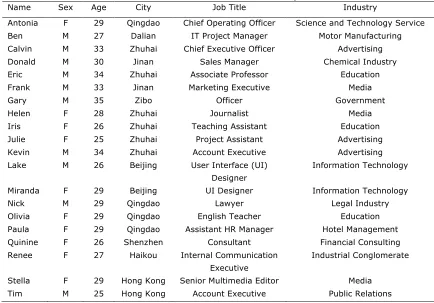
As we aim toward gathering rich data, including stories, episodes, challenges, and problems of WeChat use for work among Chinese employees, we expect that a guanxi-based sampling method can help us to achieve this goal and overcome difficulties of obtaining rich data. We started identifying potential participants from our guanxi networks (e.g., close friends and professional contacts). One of the limitations of guanxi-based sampling is that the researchers may have homogenous social networks, which limits the diversity of study samples. Taking this limitation into consideration, we purposefully selected contacts from different occupations. As long as we confirmed that our contacts used WeChat for work-related purposes, we invited them to participate in our study. We introduced our research goals and methods to the potential participants. Following their agreement to participate, we conducted semistructured interviews with the participants.
Semistructured Interviews
We conducted semistructured interviews with WeChat users. A semistructured protocol was used that ensured consistency and at the same time allowed unanticipated emergence of topics during interviews (Lindlof & Taylor, 2011). We asked participants about their jobs and work routines so that we could understand the contexts of using WeChat for work. We then asked about their experience using WeChat for work-related purposes, and their concerns, problems, and issues associated with its use. The questions were organized into sections that corresponded to interpersonal, group, and organizational levels of communication using WeChat and the use of SNS function, that is, Moments. We also asked general questions regarding benefits and drawbacks of using WeChat for work.
Participants’ Information
Table 1. Basic Information About Participants.
Name Sex Age City Job Title Industry
Antonia F 29 Qingdao Chief Operating Officer Science and Technology Service
Ben M 27 Dalian IT Project Manager Motor Manufacturing
Calvin M 33 Zhuhai Chief Executive Officer Advertising
Donald M 30 Jinan Sales Manager Chemical Industry
Eric M 34 Zhuhai Associate Professor Education
Frank M 33 Jinan Marketing Executive Media
Gary M 35 Zibo Officer Government
Helen F 28 Zhuhai Journalist Media
Iris F 26 Zhuhai Teaching Assistant Education
Julie F 25 Zhuhai Project Assistant Advertising
Kevin M 34 Zhuhai Account Executive Advertising
Lake M 26 Beijing User Interface (UI)
Designer
Information Technology
Miranda F 29 Beijing UI Designer Information Technology
Nick M 29 Qingdao Lawyer Legal Industry
Olivia F 29 Qingdao English Teacher Education
Paula F 29 Qingdao Assistant HR Manager Hotel Management
Quinine F 26 Shenzhen Consultant Financial Consulting
Renee F 27 Haikou Internal Communication Executive
Industrial Conglomerate
Stella F 29 Hong Kong Senior Multimedia Editor Media
Tim M 25 Hong Kong Account Executive Public Relations
Data Analysis
We adopted open coding and axial coding procedures (Strauss & Corbin, 1990) to analyze our data. During the open coding stage, we generated codes (i.e., emergent codes) from reading transcripts of the interviews. In this process, we also kept in mind previously identified themes in MIM use research (Jarvenpaa & Lang, 2005; Kim & Lingel, 2015; Li & Lin, 2016) and used them as code names where appropriate. Next, in axial coding, we established high-order codes to organize the codes generated in opening coding. We organized the codes around three broad themes: usage, paradoxes, and strategies. We also identified organizational, individual, and technical factors that influenced the paradoxes and coping strategies.
Findings
WeChat to achieve various instrumental and social goals. All the participants used WeChat for one-to-one and group communication with their coworkers or clients for information exchange, work requests, and coordination for tasks and social activities. Groups were also used for broadcasting information such as notifications and organizing organizational, departmental, and non-work-related coworker activities. It should be noted that some WeChat use was prescribed by organizations. For instance, almost all the participants’ organizations set up WeChat groups that corresponded to their organizational structures. Our participants also used Moments to present desirable self-images to, and gain familiarity with, their coworkers.
Although our participants regarded WeChat as an important tool for organizational communication, its use resulted in paradoxical outcomes. Answering RQ2 and RQ3, we found that the paradoxes were related to their engagement with one-to-one and group communication, the formality of messaging content, and visibility in self-presentation on WeChat. In the following sections, we report on our findings concerning the three paradoxes, the factors that contribute to them, and employees’ responses to them. As mentioned, some of our participants were client-facing employees whose WeChat use involved intraorganizational communication. In addition to the communication beyond organizational boundaries, the findings described in the next section also involve communication among coworkers outside work hours. Essentially, such communication is also work-related communication and thus should be included in the analysis.
Engagement Paradox
Our participants believed that using WeChat increased their engagement in interaction with coworkers across time and space. They could reach coworkers who were not at their desks or not colocated. Many participants mentioned that they were in WeChat groups that included employees of entire organizations, departments, teams, and specific projects. Receiving messages, most of which were notifications of events or work arrangements, made them feel that they were connected to their organizations. For project groups, WeChat helped employees to stay updated and engaged in discussions regardless of time and space. Olivia, a teaching supervisor, stated that she could easily navigate discussions on class management issues because every class had a WeChat group where she could find teachers and parents.
By interacting with coworkers in WeChat groups for team projects and organizational events, participants felt that WeChat provided a platform for effective coordination. Participants benefited from flexible access to information. Usually, a group’s chat history is saved on MIM users’ smartphones. People can choose to read or retrieve the information at any time. Those who were not engaged in a particular group discussion can review the interaction history later when they have more time.
The flexible access to information benefits individual schedule planning. Nick, as an example, shared that lawyers in his firm were asked to share daily work reports and schedules for the next day in a WeChat group:
Knowing each other’s court visit schedule is helpful because I can ask my colleague to deliver that document for me while I am in other courts for more complicated matters.
While our participants indicated an increase in work engagement as a result of using WeChat, they also stated that they occasionally wished to disengage from WeChat interaction. Some technical features of WeChat are designed to enhance engagement. For example, notifications will appear on a smartphone screen even when the screen is locked. When in too many groups, people can receive hundreds of notifications in a short period. Antonia, a chief operating officer, joined more than 10 WeChat groups for work. She eventually muted all the notifications from these groups because she was receiving so many. “Many messages are irrelevant to my work,” she said, “so I just ignore most of them and every time the number of unread reaches 100, I just click it [the group] and I won’t read them in detail, just skim and see if there is anything important.” Antonia’s case represents a cognitively taxing user experience because of the large volume of incoming messages and notifications.
Although it allows users to avoid receiving too many incoming message notifications, muting all the work groups led some of our participants to fear missing out on important information. Some participants said that they had missed meeting notifications or new assignments because they did not always engage in the ongoing discussion in WeChat groups. Lake, a UI designer, provided an example:
One day, my colleagues around me all stood up and went to the conference room. I was focusing on Photoshop for a design request and didn’t know what happened. I asked them what’s going on and they told me that earlier there was a notification for project meeting in WeChat group.
In addition to technical features, organizational norms and social expectations also shaped the paradox of engagement. Although some of our participants opted out of interactions they deemed counterproductive and irrelevant to their work, they were at times asked by their colleagues and superiors to participate in such interactions on WeChat. As Antonia illustrated, she was asked to “say something” in a company WeChat group when people were discussing recent achievements:
Some people are quite active in WeChat groups, but I am not into it. After all, my work is not assessed by how much engaged I am in this kind of interaction. However, occasionally, my superior would suggest me to also say something.
As a chief operating officer, Antonia’s presence and active participation in WeChat work groups were expected because they could encourage her subordinates and help to create a positive atmosphere for internal communication. However, she had to manage her attention so that she could focus on more important tasks at work, which created a paradox of engagement.
Faraj, Kane, & Azad, 2013) of WeChat to selectively participate in WeChat group discussions. Our participants stated that only when they were mentioned in groups would they take a look at the discussion.
Managers and executives, as mentioned, are expected to show presence in various WeChat groups. However, they have to allocate their attention to important tasks rather than attending to a host of group discussions. In this situation, our participants adopted behaviors similar to surface acting (Grandey, 2003; Hochschild, 1983). That is to say, they simply modified their behaviors to show their presence, but actually did not mentally engage in the communication. Antonia said that when she was asked to say something in the group by her superior, she quickly sent a short message or even an emoticon, such as a smiling face or a thumbs-up, to the group to show her presence. This practice allowed her to avoid allocating undue attention to group discussions while working on important tasks.
Formality Paradox
Our participants acknowledged the benefits of using WeChat to socially coordinate for tasks. However, social coordination on WeChat may compromise formality of interactions for work-related tasks. Informal communication was deemed appropriate among coworkers, especially those who know each other well. However, some of our participants encountered awkward situations when they received work request messages that were very “intimate.” Renee said, “One day, I got a message like ‘dear, can you help me, <3’. I was shocked because we would never talk like that at work.” Similarly, Ben was bothered by his clients’ inappropriate use of WeChat. He believed that WeChat should not be used for formal communication such as pricing inquiries. However, his clients kept sending such inquiries using WeChat.
In WeChat groups, our participants sometimes felt uncertain about the level of formality they should maintain during the interaction. Nick shared a failed attempt to socialize with his colleagues in the law firm’s WeChat group:
I found a very funny joke about lawyers and shared it in our law firm’s group. Some of my colleagues replied like “haha” or “this is very funny,” but our executive asked why it was funny. He didn’t get the point. I felt awkward and rarely shared interesting stuff in the group later.
Nick’s example illustrates the social consequences of being informal in work groups. In addition to this, in our data, we found that employees or companies might also have to deal with performance-related consequences. As mentioned earlier, MIM groups support meme-based coordination, a process that “socializes the task of organizing activities” (Ling & Lai, 2016, p. 846) because people are constantly reminded of events and activities when they receive notifications from messaging groups. Our participants perceived the benefits of meme-based coordination. However, they shared their concerns. Paula stated,
work, is not formal at all. It’s better to send an email to all employees and then send a reminder to employees in WeChat group asking them to check out that email.
The quote from Paula indicates that the formality paradox is associated with the meme-based nature of coordination using MIM. While organizational messages can be quickly distributed in WeChat groups and through word-of-mouth among employees, the user-constructed meaning of WeChat as an informal communication tool can bring ambiguity to the communication of important, formal information and reduce perceptions of authoritativeness of messages.
The paradox of formality was also indicated in choices of content formats for task-related communication. Our participants reported that sending voice messages was time saving and could help them to be more expressive in communication. However, Quinine believed that voice messages were only appropriate for informal communication. When her colleagues with whom she was not familiar sent some voice messages about work, she would always reply using texts because with voice messages, she had to rehearse what she was going to say. The formal use of voice messages is also undermined because she believed that what was said could not be used as an official record. Therefore, she would always repeat what was said in a summary in text format after voice message exchanges regarding some tasks with her colleagues.
Responses. Our participants managed the formality paradox using metacommunication and meaning construction through channel switching. In Paula’s case mentioned earlier, she found that metacommunication regarding how and where the messages should be delivered was helpful. She suggested designing templates for different types of messages so that employees can quickly navigate messages in work groups. Through repetitive use of the templates, employees can discern the importance and formality of the messages. Another strategy our participants adopted was to switch communication channels to maintain formality of communication actively. Some of them stated that they explicitly asked their communication partners to switch to another interaction modality, such as a phone call or in-person meeting.
Visibility Paradox
participants stated that they occasionally received connection requests from coworkers with whom they were not well acquainted or who were strangers. Donald and Gary expressed that they felt uncomfortable adding stranger coworkers on WeChat. “It would be better if we can chat for a while and then decide whether to add each other on WeChat,” said Gary. Donald stated that he would block the access to Moments for new contacts who were strangers because he did not want them to get access to much of his personal information.
In addition to dealing with unwanted disclosure of self-related information to newly connected coworkers, our participants also perceived the paradox of visibility with their already connected coworkers. The paradox was especially related to considerations of what and when to share in Moments. As for what to share, some participants worried about social surveillance from their coworkers. Although they shared their personal lives with coworkers on Moments, which they thought could improve their relationships with coworkers, the content might be subject to unwanted interpretation from coworkers. Paula’s experience is illustrative:
One day I posted a picture of me and one of my colleagues at lunch. We were in a very nice Korean restaurant, so I wanted to share it with my friends. Although my colleague’s face was not shown in the picture, other colleagues identified him from the watch he’s wearing in this picture. Then there was a rumor that I hang out very often with this colleague.
The presence of participants’ managers or superiors also limited their openness in self-disclosure. Many of the participants mentioned that they could not say whatever they wanted to say, especially negative aspects of their jobs, on Moments because they did not want to upset their managers. Even though they could control the audience of the content on Moments, they did not want to take risks of sharing too many negative comments about their work.
The last concern regarding visibility is about timing. Participants had to carefully think of when to post on Moments. Almost all of them believed that using Moments at work was inappropriate because it had nothing to do with work, unless it was used for work-related activities, such as product promotion. Even when it is used for a mental break at work, it can be misinterpreted as cyberslacking (Vitak, Crouse, & Larose, 2011). Therefore, participants often were very discreet when using Moments at work. Activities on Moments also signal availability. Our participants mentioned that their coworkers might think that they were available if they saw them posting something to Moments. Thus, when posting something on Moments, they might check for any unreplied messages from their coworkers. Therefore, the visibility signaled by Moments activities facilitates panoptic presence (Yu et al., 2017), or surveillance among employees.
social media platforms, such as Instagram and Weibo. For instance, Stella maintained that she could freely express her negative feelings about work on Weibo because her coworkers never used it.
Concluding Discussion
Focusing on WeChat, the most popular MIM in China, we explored how Chinese employees used this mobile instant messaging application for work and paradoxes that emerged from the user experience. Our study adds to the literature on paradoxical mobile communication technology use (Jarvenpaa & Lang, 2005; Mazmanian et al., 2013) by examining a new type of MIM that provides much wider functionality and enables a higher level of multimodal communication than its predecessors. Prior work suggests that these new features enhance close relationships (Cui, 2016) and facilitate social coordination (Ling & Lai, 2016). However, the paradoxes related to MIM use identified in a previously understudied organizational communication context indicate that using these features may be counterproductive.
Our findings suggest several factors that contribute to the paradoxical user experience. They are technical features of MIMs, organizational norms, coworker expectations, and conflicts in individual understandings of WeChat. As for technical features, our study suggests that multisided messaging using MIMs could enhance employees’ visibility to coworkers, which occasionally is not expected. In organizationally prescribed WeChat groups, employees are possibly connected to many latent ties, that is, connections that are technically and yet socially established (Haythornthwaite, 2005). Moreover, activating such ties through WeChat requires little effort; one simply sends a connection request. After a connection request is accepted, two people are connected not only in organizationally established communication contexts (company groups) but also on a platform that is deemed appropriate for at least acquainted coworkers. This process demonstrates the visibility paradox. That is, the pervasive awareness created in microcoordination enhances connectivity (Hampton, 2016; Ling & Lai, 2016) among employees, but it can also be leveraged to establish unwanted social connections.
In addition to facilitating connectivity among employees, WeChat can mediate relationships among users, their coworkers, and their organizations. Being in organizationally prescribed groups, employees become more visible to their managers when they talk in the groups. Organizations that engage employees in WeChat groups may put them into tricky situations when they have to perform behaviors meeting organizations’ and coworkers’ expectation of responsiveness and accessibility. Although it seems that employees feel more pressure to manage expectations when they connect to organizational groups, as suggested by Matusik and Mickel (2011), our findings indicate that communicating expectations plays a vital role in helping to relieve the pressure on employees. Therefore, our study extends Matusik and Mickel’s (2011) research to suggest that not only technical but also social factors affect the experience of using highly integrative mobile technologies for work.
as is demonstrated in Antonia’s example of being asked to show presence in work groups, some norms of interactions may be counterproductive, creating only job stress when their relation to productivity and performance is not clearly defined and explained. The paradoxes reported in this study are also due to discrepancies in individuals’ understanding of WeChat, or technological frames (Orlikowski & Gash, 1994) of this smartphone-based MIM. WeChat is mostly used to maintain relationships among strong ties (China Tech Insights, 2017; Cui, 2016). Holding this assumption may bring challenges to employees who mainly use this tool for work because they may have to establish connections with strangers or coworkers with whom they are less acquainted, and maintain a boundary between professional and private life.
Our study also contributes to the understanding of the quick and wide adoption of WeChat as a tool for work-related communication in China. The “all in one place” design makes WeChat an indispensable tool in people’s everyday lives. WeChat is the most used MIM and social media in China (CNNIC, 2018). Thus, integrating WeChat in organizational communication and using WeChat to maintain professional networks would require very little cost organizationally and individually. The integrative design of WeChat also makes it easy to maintain an open network for users. Prior research suggests that Chinese mobile phone users tend to maintain an open network that includes contacts from not only their personal life but also their professional life (Yuan, 2012). Using WeChat, people can maintain their open network easily and have more chances to interact with their business contacts (e.g., “like” a client’s post and get connected to potential business partners in WeChat groups). For these reasons, WeChat has become a favorite communication tool in organizational contexts.
Our findings have practical implications as well. Organizations can reflect on their employees’ communication on WeChat based on the three paradoxes to identify problems in communication and develop strategies to help enhance productivity and user experience. Although this study does not aim at identifying genres of MIM communication, we did identify several genres deemed useful by WeChat users. Previous research suggests that genres help to structure communicative practices for work-related purposes (Im et al., 2005; Orlikowski & Yates, 1995). With these socially accepted communicative actions, employees can work more efficiently and effectively. Our study supports this notion; our participants mention that their teams or organizations agree on certain communicative actions in groups (e.g., sending daily schedules and class updates in teacher-parent groups) that can facilitate coordination. Managers can develop rules and actively communicate with employees about how to use WeChat for work, enacting work-related genres for WeChat interactions.
References
Bertel, T. F. (2013). “It’s like I trust it so much that I don’t really check where it is I’m going before I leave”: Informational uses of smartphones among Danish youth. Mobile Media & Communication, 1(3), 299–313.
Birnholtz, J., Dixon, G., & Hancock, J. (2012). Distance, ambiguity and appropriation: Structures affording impression management in a collocated organization. Computers in Human Behavior, 28(3), 1028–1035.
Chen, J. (2016). Can online social networks foster young adults’ civic engagement? Telematics and Informatics, 34(5), 487–497.
Chen, Y. (2017). WeChat use among Chinese college students: Exploring gratifications and political engagement in China. Journal of International and Intercultural Communication, 10(1), 25–43.
Chen, Y.-R. R. (2016, June). Corporate WeChat communication in China: Examining institutional factors, media richness, content type, and public engagement. Paper presented at the International Communication Association Annual Conference, Fukuoka, Japan.
Cheng, Y., & Nielsen, J. (2016). WeChat: China’s integrated Internet user experience. Retrieved from https://www.nngroup.com/articles/wechat-integrated-ux/
China Tech Insights. (2017). From social to business: 2017 WeChat user and business ecosystem report. Retrieved from https://www.slideshare.net/ChinaTechInsights/wechat-user-business-ecosystem-report-china-tech-insights-exclusive
CNNIC. (2018). The 41st China Statistical Report on Internet Development. Retrieved from http://www.cnnic.cn/hlwfzyj/hlwxzbg/hlwtjbg/201803/P020180305409870339136.pdf
Cui, D. (2016). Beyond “connected presence”: Multimedia mobile instant messaging in close relationship management. Mobile Media & Communication, 4(1), 19–36.
Dahlberg, L. (2005). The use of instant messaging in working relationship development: A case study. Journal of Computer-Mediated Communication, 10(4).Retrieved from
https://academic.oup.com/jcmc/article/10/4/JCMC1044/4614493
Darics, E. (2014). The blurring boundaries between synchronicity and asynchronicity: New communicative situations in work-related instant messaging. International Journal of Business Communication, 51(4), 337–358.
Davison, R. M., Ou, C. X. J., Martinsons, M. G., Zhao, A. Y., & Du, R. (2014). The communicative ecology of Web 2.0 at work: Social networking in the workspace. Journal of the Association for
Information Science and Technology, 65(10), 2035–2047.
DeSanctis, G., & Poole, M. (1994). Capturing the complexity in advanced technology use: Adaptive structuration theory. Organization Science, 5(2), 121–147.
Fonner, K. L., & Roloff, M. E. (2012). Testing the connectivity paradox: Linking teleworkers’ communication media use to social presence, stress from interruptions, and organizational identification. Communication Monographs, 79(2), 205–231.
Fujimoto, Y., Shahriar, A., Sekiguchi, T., & Sugianto, L. (2016). The effect of mobile technology usage on work engagement and emotional exhaustion in Japan. Journal of Business Research, 69(9), 3315–3323.
Gibbs, J. L., Rozaidi, N. A., & Eisenberg, J. (2013). Overcoming the “ideology of openness”: Probing the affordances of social media for organizational knowledge sharing. Journal of Computer-Mediated Communication, 19(1), 102–120.
Grandey, A. A. (2003). When “the show must go on”: Surface acting and deep acting as determinants of emotional exhaustion and peer-rated service delivery. Academy of Management Journal, 46(1), 86–96.
Hampton, K. N. (2016). Persistent and pervasive community: New communication technologies and the future of community. American Behavioral Scientist, 60(1), 101–124.
Haythornthwaite, C. (2005). Social networks and Internet connectivity effects. Information, Communication & Society, 8(2), 125–147.
Hislop, D., & Axtell, C. (2011). Mobile phones during work and non-work time: A case study of mobile, non-managerial workers. Information and Organization, 21(1), 41–56.
Hochschild, A. R. (1983). The managed heart: Commercialization of human feeling. Berkeley, CA: University of California Press.
Huang, H., & Zhang, X. (2017). The adoption and use of WeChat among middle-aged residents in urban China. Chinese Journal of Communication, 10(2), 134–156.
Im, H., Yates, J., & Orlikowski, W. (2005). Temporal coordination through genres and genre systems. Information, Technology, and People, 89(2), 89–119.
Kim, H., & Lingel, J. (2015). Working through paradoxes: Transnational migrants’ urban learning tactics using locative technology. Mobile Media & Communication, 4(2), 221–236.
Kriz, A., Gummesson, E., & Quazi, A. (2013). Methodology meets culture: Relational and guanxi-oriented research in China. International Journal of Cross Cultural Management, 14(1), 27–46.
Leonardi, P. M., Treem, J. W., & Jackson, M. H. (2010). The connectivity paradox: Using technology to both decrease and increase perceptions of distance in distributed work arrangements. Journal of Applied Communication Research, 38(1), 85–105.
Li, L., & Lin, T. T. C. (2016). Exploring work-related smartphone dependency among young working adults in China: A qualitative approach. International Journal of Communication, 10, 2915–2933.
Licoppe, C. (2004). “Connected” presence: The emergence of a new repertoire for managing social relationships in a changing communication technoscape. Environment and Planning D: Society and Space, 22(1), 135–156.
Licoppe, C., Cudicio, R., & Proulx, S. (2014). Instant messaging requests in connected organizations: “Quick questions” and the moral economy of contribution. Discourse Studies, 16(4), 488–513.
Lin, T. T. C., & Li, L. (2014). Perceived characteristics, perceived popularity, and playfulness: Youth adoption of mobile instant messaging in China. China Media Research, 10(2), 60–71.
Lindlof, T. R., & Taylor, B. C. (2011). Qualitative communication research methods (3rd ed.). Thousand Oaks, CA: SAGE Publications.
Ling, R., & Lai, C.-H. (2016). Microcoordination 2.0: Social coordination in the age of smartphones and messaging apps. Journal of Communication, 66(5), 834–856.
Ling, R., & Yttri, B. (2002). Hyper-coordination via mobile phones in Noruega. In J. E. Katz & M. Aakhus (Eds.), Perpetual contact:Mobile communication, private talk, public performance (pp. 139–169). Cambridge, UK: Cambridge University Press.
Majchrzak, A., Faraj, S., Kane, G. C., & Azad, B. (2013). The contradictory influence of social media affordances on online communal knowledge sharing. Journal of Computer-Mediated Communication, 19(1), 38–55.
Matusik, S. F., & Mickel, A. E. (2011). Embracing or embattled by converged mobile devices? Users’ experiences with a contemporary connectivity technology. Human Relations, 64(8), 1001–1030.
Nardi, B., Whittaker, S., & Bradner, E. (2000). Interaction and outeraction: Instant messaging in action. In CSCW ‘00: Proceedings of the 2000 ACM Conference on Computer Supported Cooperative Work (pp. 79–88). Philadelphia, PA: ACM Press.
Orlikowski,W. J., & Gash, D. C. (1994). Technological frames: Making sense of information technology in organizations. ACM Transactions on Information Systems, 12, 174–207.
Orlikowski, W. J., & Yates, J. (1995). Genre repertoire: The structuring of communicative practices in organizations. Administrative Science Quarterly, 39(4), 541–574.
Ou, C. X. J., & Davison, R. M. (2015). Shaping guanxi networks at work through instant messaging. Journal of the Association for Information Science and Technology, 67(5), 1153–1168.
Pazos, P., Chung, J. M., & Micari, M. (2012). Instant messaging as a task-support tool in information technology organizations. Journal of Business Communication, 50(1), 68–86.
Quan-Haase, A., Cothrel, J., & Wellman, B. (2005). Instant messaging for collaboration: A case study of a high-tech firm. Journal of Computer-Mediated Communication, 10(4). Retrieved from
https://onlinelibrary.wiley.com/doi/full/10.1111/j.1083-6101.2005.tb00276.x
Sheer, V. C., & Rice, R. E. (2017). Mobile instant messaging use and social capital: Direct and indirect associations with employee outcomes. Information & Management, 54(1), 90–102.
Stephens, K. K. (2012). Multiple conversations during organizational meetings: Development of the multicommunicating scale. Management Communication Quarterly, 26(2), 195–223.
Stephens, K. K., Zhu, Y., Harrison, M., Iyer, M., Hairston, T., & Luk, J. (2017). Bring your own mobile device (BYOD) to the hospital: Layered boundary barriers and divergent boundary management strategies. In Proceedings of the Fiftieth Annual Hawaii International Conference on Social Systems (HICSS) (pp. 3517–3526). New York, NY: IEEE.
Stohl, C., & Cheney, G. (2001). Participatory processes/paradoxical practices: Communication and the dilemmas of organizational democracy. Management Communication Quarterly, 14, 349–407.
Strauss, A., & Corbin, J. (1990). Basic of qualitative research: Grounded theory procedures and techniques. Newbury, CA: SAGE Publications.
Ter Hoeven, C. L., van Zoonen, W., & Fonner, K. L. (2016). The practical paradox of technology: The influence of communication technology use on employee burnout and engagement.
Communication Monographs, 83(2), 239–263.
Vitak, J., Crouse, J., & Larose, R. (2011). Personal Internet use at work: Understanding cyberslacking. Computers in Human Behavior, 27(5), 1751–1759.
Wang, X., & Gu, B. (2016). The communication design of WeChat: Ideological as well as technical aspects of social media. Communication Design Quarterly Review, 4(1), 23–35.
WeChat’s world. (2016). The Economist. Retrieved from
http://www.economist.com/news/business/21703428-chinas-wechat-shows-way-social-medias-future-wechats-world
Yates, J., & Orlikowski, W. (2002). Genre systems: Structuring interaction through communicative norms. Journal of Business Communication, 39(1), 13–35.
Yu, Q., Huang, P., & Liu, L. (2017). From “connected presence” to “panoptic presence”: Reframing the parent-child relationship on mobile instant messaging uses in the Chinese translocal context. Mobile Media & Communication, 5(2), 123–138.