PLEASE SCROLL DOWN FOR ARTICLE
On: 18 January 2010
Access details: Access Details: [subscription number 791963552]
Publisher Routledge
Informa Ltd Registered in England and Wales Registered Number: 1072954 Registered office: Mortimer House,
37-41 Mortimer Street, London W1T 3JH, UK
Planning Theory & Practice
Publication details, including instructions for authors and subscription information:
http://www.informaworld.com/smpp/title~content=t713624517
Is Israel Ready for Participatory Planning? Expectations and Obstacles
Deborah F. Shmueli a
a Department of Geography, University of Haifa, Israel
To cite this Article Shmueli, Deborah F.(2005) 'Is Israel Ready for Participatory Planning? Expectations and Obstacles', Planning Theory & Practice, 6: 4, 485 — 514
To link to this Article: DOI: 10.1080/14649350500349656
URL: http://dx.doi.org/10.1080/14649350500349656
Full terms and conditions of use: http://www.informaworld.com/terms-and-conditions-of-access.pdf
This article may be used for research, teaching and private study purposes. Any substantial or systematic reproduction, re-distribution, re-selling, loan or sub-licensing, systematic supply or distribution in any form to anyone is expressly forbidden.
Is Israel Ready for Participatory
Planning? Expectations and Obstacles
DEBORAH F. SHMUELI
Department of Geography, University of Haifa, Israel
ABSTRACT This is a study of recent experiences in Israel to integrate public participation into the Israeli planning system. It aims to analyse and evaluate the adoption of participatory structures and processes within Israel’s strategic master planning systems. Existing planning laws and traditions, socio-political forces, attitudes of planning leadership and affected populations, geographical settings and other spatial factors are examined for their impact upon the participatory process. In three cases selected for study, a variety of techniques were used to secure the desired information and to test the effectiveness of the structures for involving the public. Two of the cases involve public participation as an input into the planning process. The third is an initial effort at a collaborative form of stakeholder involvement. The findings document the failure of the planning system and its bureaucracy to integrate these processes effectively. An overriding question throughout the analysis is what in the Israeli political and socio-cultural context enhances or inhibits effective participation?
Keywords: Participatory planning theory and practice; Israeli planning; stakeholder involvement; collaboration; Upper Galilee; Misgav; Emek Hefer
Introduction
For over three decades, citizen participation mechanisms have been mandated in planning processes in the USA, Australia and parts of Western Europe such as the UK, the Netherlands and Denmark. All have employed a wide variety of approaches. In Israel, public response to plans is solicited at the stage of deposit with the appropriate level Planning Commission for final statutory approval. However, participation is relatively new in the formative stages of a plan, and, at these stages, not embedded in Israeli planning law or practice. Therefore, the case studies treated in this paper deal with voluntary efforts by regional councils to introduce participation throughout the process. While participatory concepts have influenced current planning thinking, in practice the results have been mixed. Israeli planning policy makers are still searching, through experimentation, for appropriate participation mechanisms. When planners and governmental decision makers do not consider the results of participation as binding, and when the public is uncertain that its contribution is taken seriously, the process is undermined (Innes & Booher, 2004).
The Israeli planning system consists of three administrative levels: the national, district and local. The district administrative level often addresses issues that are common to the national and local levels. The cases chosen in this study include the first two participatory regional-level strategic planning efforts in Israel. These were conducted by two of the
Correspondence Address: Deborah F. Shmueli, Department of Geography, University of Haifa 31905, Israel. Email: [email protected]
1464-9357 Print/1470-000X On-line/05/040485-30q2005 Taylor & Francis DOI: 10.1080/14649350500349656
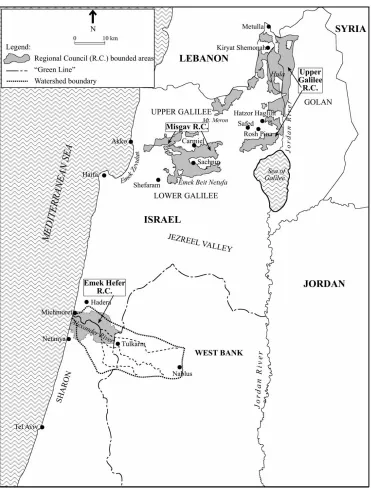
country’s northern regional councils, the Upper Galilee and Misgav. The third case is the master plan for the Emeq Hefer Regional Council that is located within the Central Coastal Plain where the stream meets the Mediterranean. It is a comprehensive plan that was developed in connection with the on-going Alexander Watershed Restoration Project, which encompasses a larger area that includes Emeq Hefer (see Figure 1). The three cases
Figure 1.Case study setting: the three Regional Councils
analyse process characteristics within different physical-geographic, socio-ethnic and political-ideological settings, and provide insights into how the process has worked within the Israeli policy-making structure.
With its highly developed, urbanized hi-tech and service-oriented economy, Israel faces many of the planning problems of similar societies with regard to rapid urban spread and pressures on agricultural lands and open spaces. Unlike many developed countries, however, planning goals must take into account security concerns of a nation within a limited geographical area, surrounded in part by hostile countries, and in continuing conflict with the Palestinian Arabs of the West Bank and Gaza, and the Palestinian Diaspora. It also has a potentially destabilizing and growing internal Arab minority. In addition, the planning goals include absorption of mass immigration of Jews with many different languages and cultures, and the spread of a growing population to establish a presence in as much of the country as possible, while at the same time conserving land, water and unique bio-cultures.
A wide variety of sources were used in the study. These included a series of open-ended interviews with policy makers/planning specialists and with individuals who were drawn into the process as citizen participants, in some instances as leaders of impacted communities and in others as concerned citizenry. Additional primary sources were the protocols of steering committee and open forum meetings, and the documented objectives of the project organizers in seeking to incorporate participation into the planning projects. Insights were also gained from a separate study in which interviews with prominent community builders and designers revealed their general views towards participation.
Historical Trends in Participation Theory and Experiences
The citizen participation processes that emerged in the US and Western Europe in the 1960s have evolved in the subsequent decades, and are still being refined. The reasons, motives and images of participation vary widely. For some the aim is minority influence over public decisions; others have reluctantly acceded to community demands or legal requirements with ‘lip-service’ acquiescence. Attitudes include views of participation as a means of sharpening the issues in public conflict, avoidance or resolution of conflict, or an ultimate expression of democracy. Some resist it because they believe that lay persons lack the knowledge and expertise to influence public policy and its implementation, or that they will use it to manipulate or undermine policy.
Many of the works have focused on the development of public participation mechanisms within the framework of planning. The studies cited in this section are presented generally by decades. While they inform practice, sometimes the theory precedes practice, and at others is derived from insights from field experience. Indeed, some are theoretical, some normative and others empirical.
Many mechanisms in the earlier decades were formal and prescriptive, with some of the most familiar venues being public hearings, citizen and ‘blue ribbon’ committees and focus groups. Early proponents of public participation assumed that such venues would provide minority groups with an opportunity to publicize their views and advocate their interests and needs. On the informal level, ‘participation by protest’ was found by various pressure groups to be an effective tool in attracting the media and attaining their goals (O’Riordan, 1977). Definitive steps in bringing participation into the mainstream were the legislation mandating participation processes that was enacted in the US on both the federal and state levels, and in Britain on the local level through the passage of various Town and County Planning Acts.
In designing the three case studies, the author was conscious of the pitfalls inherent in efforts to ‘democratize’ planning. As early as 1969 Arnstein, in her article ‘The Ladder of Citizen Participation’1warned that what was heralded as the promise of a new democratic process in the 1960s, seemed to have turned out to be exercises in manipulation. Her study became a benchmark that planners subsequently employed to assess the democratic goals of public participation (Bailey, 1975; Estrin, 1979). Many of these public involvement efforts involved large numbers of participants, were very time-and money-intensive, offered little opportunity for dialogue, and had little or no influence on decision making. Participation in the 1980s, particularly in the US, was broadened through focus on the citizen role as consumer. This created a framework for information flow from citizens to decision makers that would be used for needs assessment, and from decision makers to the public in the mode of informing.
Disappointment with both process and outcomes during the first two decades spurred a shift in focus. Those studying participation in policy contexts began to change emphasis from large-scale participation forums to more collaborative stakeholder-oriented venues based on consensus building. The goal of achieving consensus (meeting the interests of all stakeholders) differs from the advocacy role, which aims at predetermined outcomes.
Negotiation theory emerged as influential in planning because it was a good match with a central fact: parties to a planning decision are often interdependent. This implies the need for joint decision-making processes, such as negotiations, which hold the promise of joint gains (Susskind & Cruikshank, 1987) instead of resulting in winners and losers. But negotiations provide challenges of their own, such as information dilemma traps (similar in structure to a prisoners’ dilemma) meaning that while win-win outcomes are possible, lose-lose outcomes always threaten participatory planning and planning negotiations (Lax & Sebenius, 1986; Susskind & Ozawa, 1984).
Planners often play roles ‘in-between’ numerous, interdependent stakeholders (Forester, 1989, 1999). This leads them to act much like mediators as they help parties to avoid what can otherwise become mutually destructive games of defensiveness (Schon, 1983) and negotiation traps, so that they can instead reach mutual gains that take advantage of the parties’ differences in priorities (Kolbet al., 1994). However, as they help parties negotiate mutually acceptable outcomes, planners run the risk of forgetting that, as opposed to neutral mediators, they too are in a sense interested parties, with the mandate to uphold the public interest, which at times can be at odds with those of some stakeholders.
Beginning in the 1990s, Healey and Innes developed parallel and overlapping lines of work in their publications on collaboration and communicative planning (e.g. Healey, 1996, 1998, 2003; Innes, 1996; Innes & Booher, 2004).2
For some theorists and practitioners, participation is a means for expanding social capital to enable participants to develop as individuals. They hold that reasoning together can overcome a great number of conflicts, and that collaborative frameworks for representation of interests, deliberation and flexibility increase responsiveness, in contrast to the more limited responsiveness that characterizes the traditional decision-making approaches (Frank & Elliott, 2002; Healey, 2003; Shmueli & Plaut, 2004). Critics charge that it is naı¨ve to assume that this type of collaborative planning necessarily leads to good decision making since it does not necessarily address the roles of power, objective standards and accountability (Amy, 1987, 1990; Rabe, 1988). It must be recognized that participation in planning is seldom problem-free or without manipulation and controversy. Given Israel’s later start in participation efforts, the cases that will be discussed have telescoped some of the historical trends without benefiting from their lessons.
What, then, counts as participation? Public involvement or even collaboration does not, in itself, guarantee the effectiveness of the participatory process. At a minimum, frameworks that provide for representation, voice, transparency and a role in the negotiations that lead up to the final decisions, are required. A number of criteria emerge from this historical overview and are listed below. The relationship of each case to these criteria will be identified within the context of the exposition of the case. They include:
. Representation of interests.
. Ability of process to address power imbalances.
. Process flexibility and degree of prescriptiveness (to what degree of rigidity was the process decided upon at the outset and how open is it to adaptation, which may be indicated from understandings reached during the process itself).
. Level of transparency. . Deliberative interaction.
. Structured negotiation among stakeholders. . Learning process and individual growth. . Cultural translation of values.
. Level of consensus or shared decision making.
The Israeli Context
Political, Economic and Socio-cultural Influences on Participation
To understand the setting for the effort to integrate public participation within the Israeli planning process, it is useful to note the role of participation within the more general Israeli socio-political scene.
At the national political level the Israeli governance structure is highly centralized. The Knesset is organized along national party lines. Regional and local interests are secondary to party loyalties, and have no formal representation at the national decision-making level. Absence of ‘their’ specific Knesset member, on whom individual citizens and community groups can bring pressure, has inhibited the motivation for involvement and protest on issues other than those of national security and economic policies. In addition, the governance structures that represent these interests lack the tax base to enable them to take substantial independent political actions. However, cities and regional councils, while still dependent on central governmental funding, are slowly seeking to exercise greater independence in directing these funds to social and economic spheres, and indeed, it is from here that the initiatives for many of the participatory planning efforts have come.
On the socio-cultural level, some segments of the Israeli populace do not have a tradition of participation in public affairs while others do. The culture of the Arab community, which represents nearly 20 per cent3of the population, entrusts much of the decision making in public affairs to tribal and clan leaders. The ultra-orthodox Jewish community (about 10 per cent) has a similar relationship with its leading rabbis. Many of the million immigrants from the Former Soviet Union who have been absorbed within Israel since 1990 have carried over to the Israeli scene their distrust of government, and are cynical about the efficacy of participation. One might conclude that the combination of these socio-cultural forces, reinforcing the widely-held opinion that the highest priorities are set by national security and economic development needs, leaves little room for effective public questioning of policies that participation can generate.
However, there are countervailing forces that have historically embraced broad individual and community participation. The culture of participatory decision making is
most entrenched within the communal kibbutz and co-operative moshav settlement movements, which have played such a key role in shaping the destiny of the country. This has been carried over to the newer large and small community villages (yishuvim kehilatiyyim and mitzpim) located in rural and exurban areas, and whose participatory governance is akin to the New England town meeting. In the urban areas, participatory neighbourhood and community development experiments date back to the 1970s. In the past 15 years, Israel has seen a growing number of non-governmental civic and environmental organizations that operate on both the national and local levels. All of these forces have influenced the discourse about participation that has become popular in the media and among planners, and has begun to attract the attention of politicians. However, the interpretation of ’participation’ differs widely among the various groups.
In the economic arena, as well, contradictory trends discourage and favour public participation in planning. Among the economic changes that have taken place in the past decade is the unprecedented growth of high-tech industries and financial services, which, fuelled by the market economy and international trade, has shifted the national attention away from the focus on rural settlement that characterized the early Zionist enterprise, to urbanized activities in cities and their suburbs, and isolated exurbs in rural areas. This has been spurred by privatization of large-scale enterprises formerly owned by the government and the General Confederation of Labor (Histadrut), and the opening up of kibbutz and moshav farmlands for private real estate development.
Both the private corporations and the farm interests represent significant lobbying forces that try to discourage public dialogue and participation with respect to issues such as pollution control, encroachment on open space, or using part of the land for new, privatized development. This is supported by the attitude of the current leadership of the Israel Land Authority (ILA) that endorses the desirability of private ownership unhampered by governmental planning restraints, let alone by participatory processes. Thus, Vice Prime Minister and ILA Chairman Ehud Olmert espouses “the principle that entrepreneurs should be allowed to operate without interference and without anyone asking bothersome questions about the links between capital and government” (Rinat, 2005, p. 5). The ILA resolution 979, approved by the ILA Council in 2003, is an example of the implementation of this approach. That decision granted the kibbutzim and moshavim extensive residential and commercial building rights on agricultural lands (leased to the kibbutzim and moshavim but owned by the State) and made possible the lease of land to external (non-kibbutz or moshav) commercial interests. The decision would have stymied the public and professional discourse on issues of preservation of open space (50 per cent of open space in Israel is zoned agricultural). In an opinion written in January 2005, the Attorney General noted that this “far-reaching decision was made without a factual professional foundation” and stated that it should not be approved (Rinat, 2005).
Opposed to these development interests are many of the local residents and vocal environmental NGOs that mobilize in response to almost every plan. Supporting the agenda of the environmental interests is the recent passage of National Outline Scheme (NOS) No. 35 (January 2005). This focuses on the designation of areas for construction inside or near urban centres, and maximum preservation of open space, making the conversion of farmland for development more difficult. This law has been reinforced by a court decision that has frozen the process that permits kibbutzim and moshavim to use their land for development.
However, a strategic-political counter-force that challenges the policy put forward in NOS 35 is a recent governmental proposal to build up to 30 towns, villages and private farms, mostly in the Galilee and the sparsely populated Negev. Security, internal as well
as external, is the rationale for dispersing small communities along Israel’s borders and within these peripheral regions The Construction and Housing Minister has put one of the security objectives of the policy in blunt terms “The purpose—including fencing off large tracts for individual farms—is primarily to prevent Israeli Arabs, especially Bedouins, from encroaching on state lands” (Friedman, 2003, pp. 7 –8). This illustrates a situation in which security concerns go against the policies of the planning institutions and require amendments to statutory plans.
The present study examines how these antithetical pressures come into play in developing master plans to guide policy on the strategic regional planning level. The three case studies presented take place within the rural regional context and within sectors which, for the most part, have a history of participatory experience within their own localities. The study examined how countervailing tendencies come into play in incorporating a participatory ethic in the development of master plans to guide policy on the strategic regional planning level.
The Centralized Structure of Israeli Planning
The planning process in Israel is hierarchical and statutory. The country’s Planning and Building Law of 1965 controls all planning and development. It is based on the British legislation of 1922 and 1936 during its mandate in Palestine, and remained in force until 1965 when the Israeli Planning and Building Law was passed. British Mandate legislation did not have a national planning body or national statutory plans. The 1965 legislation added both (Alterman, 2001). When that law was amended to allow more local scope, localities proved ill equipped to take advantage of their additional responsibilities, both because their independent financial bases suffer from limited taxing authority, and because they lack the breadth of professional staff to exercise these powers.
In this centralized and hierarchical planning system, there is an assumed continuity from the statutory Outline Schemes at the national to the district (regional) and local levels, to actual project permitting on the local level. Master plans, which are not statutory, often precede and provide policy guidance to the Outline Schemes. This all falls within the purview of the Ministry of Interior.
Distinct from the regulatory, the other component of Israeli planning is devoted to ‘developmental planning’. This is the responsibility of a parallel set of ad hoc, development-oriented institutions and organizations. Ministries other than Interior, such as Construction and Housing, as well as the Israel Land Authority (ILA),4were granted important powers and large budgets to effect change in the Israeli landscape (Bollens, 2000). This second system is characterized by organizational complexity and is proactive, practical and strategic (Alexanderet al., 1983; Hill, 1980; Yiftachel, 1993).
Alterman (2001, p. 272) points out that Israel’s centralized land-use planning system “combines top-down planning with bottom-up initiative”. The local planning commis-sions are the first and usually crucial platforms for local and regional policies and most development initiatives. These decisions require approval of the District Planning Commissions that are composed mainly of central governmental agencies, and in turn subject to national planning oversight. It is the local and regional councils that provide the greatest opportunities for integrating public participation into the planning process.
Israeli Institutionalized Participatory Planning
While public participation in planning processes in Israel now generates widespread attention from the general public, as well as organized civic groups and the media, its
weakness is that, in most cases, the process is limited to the public right to object to plans when they are presented at the deposit stage.5Thus, the 1965 Planning and Building Law requires planning authorities to publicize projects and hear public opposition onlyafter
the authorities have made their choice from the options available to them, and the projects which have been deposited await final approval. Meyer-Brodnitz, a leading private planner with much experience as an ‘investigator’ of contested plans in Israeli Arab villages, points out: “The body which hears the objections is the same District Commission that has deposited the plan. . .First it plays an administrative role, and second, it plays a quasi-judicial role, hearing objections to a plan to which it has already formed an opinion and approved” (Foresteret al., 2001, p. 80).
An important change has recently taken place with regard to the definition of the public that is allowed to object at this stage. In the past, the ‘public’ was narrowly limited to those community groups, individuals and selected NGOs that could prove a direct connection to the land in question. Currently, the ‘11th-hour objection’ can be raised by a wide range of groups and individuals. However, the results remain that participation is seen as negative by definition, and is viewed by local administrations and developers as an obstacle to implementation and growth. While public objections at the deposit stage may therefore result in project delay, it has generally been considered that they rarely bring about significant changes to, or cancellation of, the proposed project.6
Because of lack of transparency during most of the planning process and the development of plans without early public knowledge or participation, the proposed projects often are technically and professionally impressive, but may not be implementable because they become mired in either the Planning Committees or in litigation (Shmueli & Plaut, 2004).
Non-mandatory Participation in Israeli Planning
Participatory experiences included in this category are not mandated by national law, but are formally adopted by local and regional councils. The last decade has witnessed growth in the number of NGOs in Israel, accompanied both by demands for participation and by expanded use of litigation over planning projects by individuals, groups of citizens, and by NGOs. Such opposition often leads to delays, which proponents of the plan, including developers, claim are unnecessary and intolerable. This poses a dilemma. As a positive force, greater participation may be an enlightened solution, particularly on the local level, where planners and some of the leadership of the local and regional councils have taken steps to incorporate public input and participation. On the negative side, these efforts are often diffused, and non-institutionalized, taking different forms and using different methods and instruments, and frequently by-passed by decision makers.
In recent years, in response to the conflicts engendered by development proposals, a considerable number of official participatory experiments have been initiated across the country to try to break the deadlocks between policy makers and activist citizen groups. In the early 1980s, the American-Jewish Joint Distribution Committee supported the establishment of Municipal Planning Units (MPUs) in city, local and regional councils under the auspices of the Ministry of Interior. The MPUs were set up in the early 1980s to help these bodies plan for the rapid growth of localities within the rural parts of the country, while seeking to overcome the constraints of their traditional managerial structures (Janner-Klausner, 1994). A number of the MPU’s initiated participatory planning processes. Janner-Klausner, then director of the Committee’s strategic planning units, describes the motivation for doing so:
. . .there are no channels, in Israel, for the public interest to be expressed duly and properly. The public participation skills are underdeveloped. There’s no onus on local governments, on bureaucracy, to do outreach, to explain what it’s doing and gain legitimacy for it. . .Israel’s a very paternalistic society in a lot of ways, and people tend to be happy with that. One side of paternalism is that it creates a huge gray zone, which is sort of quasi-legal, in terms of how people gain access to information and power. So a paternalistic, closed system creates a distorted power system alongside the public interest system which now includes vested interests. (Foresteret al., 2001, pp. 185 – 186)
The Case Studies
The three case studies7that were selected belong to the category of the relatively new, not legally mandated participatory efforts, which are designed to bring citizen groups into positive partnerships with official bodies. The two Galilee strategic master plan cases were the very first in which public participation was elicited. Both Regional Councils, the Upper Galilee and Misgav, share many common physical-geographic features, but differ in a variety of ways. The Alexander Watershed case is the first participatory planning case for a regional council located within a broader watershed planning effort.
The Upper Galilee Regional Council: Strategic Planning Process
The Upper Galilee Regional Council is homogenous in terms of settlement type, composed of 43 long-established kibbutzim, with deeply entrenched socialistic interests and outlooks. Historically, they had a strong sense of self-reliance and self-containment. Three-quarters of the kibbutzim were established between 1939 and 1949—the first two created in 1916 and 1918, and the most recent one in 1968 (Sternberg, 1997). The territory governed by the Council is non-contiguous; it does not include the area’s development towns and moshavim, which have their own regional or town councils.
The region is located in the northeastern corner of Israel, bordered by Lebanon on the north, the Golan Heights on the east and the Sea of Galilee and Beit Netufa Valley on the south. It embraces the Hula Valley and the highly dissected mountainous and plateau area of the eastern Upper Galilee that lies to the west of the Hula (see Figure 1).
The crisis faced by the kibbutzim at the time of the strategic planning process was more than economic; it was also ideological, focusing on the issue of privatization and lifestyle. After nearly a century of vibrant collective social and economic experimentation, the kibbutz ideal had lost much of its appeal for its younger generations. A third generation had now emerged with very different desires and goals than that of the founding pioneers. Rejecting the closed kibbutz society and in search of individual expression, many of the younger members had begun to leave. The Upper Galilee settlements, historically the stronghold of the kibbutz movement, suffered a 7 per cent negative out-migration between 1991 and 1995 (Sternberg, 1997), and that population loss continues.
Nevertheless, the individual kibbutzim in the Upper Galilee did not make an effort to build the impact of their changing ideologies into the strategic planning process. The focus was solely on a reversal of economic deterioration. The ideological transition in terms of privatized social organization and lifestyle changes, which followed the planning process (in the late 1990s), was not addressed jointly, but was understood to be an internal matter to be dealt with by each kibbutz.
In 1993, the Upper Galilee Regional Council became the first regional council to initiate a strategic regional Master Plan with the participation of its residents (Misgav followed in the same year.) The Council established a Municipal Strategic Planning Unit (MPU) to develop this Plan. The MPU provided professional planning staff to work with, and report to, the regional authority in order to augment the regional councils’ professional capacity. While agriculture had been the original economic base of the kibbutzim, in relatively short order they all expanded their economies for industrial development. Many of the industries focused on products for the agricultural market such as chemicals, fertilizers and plastics. By the time the first stage of the strategic plan had been initiated, industry had outstripped farming as the leading economic activity, but many of these plants were now old and outmoded. A deteriorating economic situation made it difficult to support the needs of an ageing population as well as provide outlets for the younger generation, and many took jobs outside the kibbutz. Moreover, over 40 per cent of the region’s entire kibbutz workforce was dedicated to community services rather than to income producing activities (Sternberg, 1997). The focus of the plan was reversal of economic deterioration. No attention was paid to the ideological crisis over the future of a communal society.
Phase I of the strategic planning process (shown schematically and indicating which stages included public participation in Table 1a) was carried out directly by the Regional Council and the MPU. The work plan and the information gathering stages were conducted by them without public participation. In February 1993, the process was opened with a large-scale public forum to which 150 participants from various kibbutzim were invited. Following the forum, thematic working groups on the non-ideological issues were established, using the Charette8method, wherein the group undertakes to deliver a draft on a particular theme as the outcome of wide-ranging discussions. They worked on such themes as education, culture and leisure, economic development, youth, welfare and higher education, but not in the context of changing the communal, socialist kibbutz model. The quality of group output varied, with some reaching agreement and recommendations, and others disintegrating. As a whole, they were unable to develop strategic recommendations.
In Phase II, without consulting the public that had already become involved, the Council and MPU hired an outside planning team to redirect the process (see Table 1b, Phase II). Here participation took the form of large-scale surveys and questionnaires with other types of group public participation intermittently woven into the process (Avraham, 1993). One of the workshops used the Delphi9method, wherein the organizers designed questionnaires for the participants, and then analysed the findings to be used as inputs for developing alternatives to the plan. This process left much of the power with the planners running the meeting. The preference voiced by the participants was for the economic privatization of the kibbutz and for choices among community settlement models. Thematic workshops dealt also with new directions in agriculture, tourism and transportation. In the wake of the Oslo Agreement of 1993, another group considered the economic opportunities that peace might present to the region as a gateway to the Arab States of the Middle Eastern interior. In neither phase of the process did they deal directly with the issue of how to keep the younger generations on the Upper Galilee kibbutzim through major changes in lifestyles and economic re-organizations.
As Tables 1a and 1b show, the public participated in 8 of the 18 stages of the planning process (Phases I and II) through membership in thematic working groups, discussions, workshops and public meetings about various planning stages, reports in local media, public opinion polls and dissemination of information to the various kibbutz management committees. In April of 1995, the planning consultants held a public workshop which
T able 1a. Strategic Planning Pr ocess: Upper Galilee. Phase I: 150 participants, appr oximately 2.6% of the adult population Stag e P ro cess Pr oduct Pr ocess Pa rticipants Met hodolog y 1 Deve lop pr ocess and work pla n M unicipa l Plann ing Unit 2 R egional dat a report Ana lysis of curr ent conditions M unicipa l Plann ing Unit 3 Explo ration of Plan topic them es Lar ge-scal e pub lic forum (‘Ma alot’) Steer ing commi ttee, Cou ncil execu tives and resid ents Brai nstormi ng 4 Explo ration of futur e devel opment stra tegies Them atic working gr oups Cou ncil em ploy ees, Jew ish resid ents, pr ofessionals Ch arr et te 5 Feed back Rep orts by thematic wo rking gr oups Cou ncil em ploy ees, Jew ish resid ents, pr ofessionals Comm unity meetin gs and heari ngs 6 Rec ommen dations for developm ent (not achie ved) Them atic working gr oups Cou ncil em ploy ees, Jew ish resid ents, pr ofessionals Ch arr et te N ormal font ¼ pla nnin g stage; italics ¼ pla nnin g stage with at-lar ge pub lic partic ipation Sou rce: (Stern ber g, 1997 , pp. 87 – 88).
T able 1b. Phase II: 450 participants, 7.8% of the adult population Stag e P ro cess Pr oduct Pr oc ess Partic ipants Metho dology 7 Hir e outside plann ing co nsultants to develop the Strate gic Plan Mun icipal Plan ning Unit 8 Deve lop pr oc ess and w ork plan Mun icipal Plan ning Unit, consu ltant s 9 Consolid ation of pr ofessi onal w orking gr oups for: agri cultur e, tou rism, trans portation, potent ial for international co-o peration Mun icipal Plan ning Unit, consu ltant s 10 Ana lysis of curr ent co nditions Pr ofess ional plann ing firm s 11 Popu lation survey Public, pr ofess iona l plann ing firms Questio nnair es and surv eys 12 Cry stallization of popu lation developmen t stra tegies W orkshop: ways to expan d and cult ivate exi sting commu nities Public, pr ofess iona l plann ing firms, C ouncil ex ecutiv es, Muni cipal Plann ing Unit; 94 participa nts Delphi 13 Ana lysis of existing con ditions and potent ial deve lopment strate gies Pr of essional workin g g roups Mun icipal Plan ning Unit, pr ofess ional plann ing firm s Charr ette 14 Feedback, selection of central d evelopment altern ative Meeti ng to choose housin g and developm ent st rategy Public, pr ofess iona l plann ing firms, C ouncil ex ecutiv es, Muni cipal Plann ing Unit Commu nity meetings 15 Feed back, selection of them atic developm ent altern atives Themat ic meetin gs for strat egy developm ent: agric ultur e, tourism , transp ortatio n, potenti al for internati onal co-op eration ,and spatial settlem ent mod els, about 100 in each them atic gr oup (wi th overlap, 400 total) Public, pr ofess iona l plann ing firms, C ouncil ex ecutiv es, Muni cipal Plann ing Unit Commu nity meetings, Delphi 16 Deve lopment of the them atic strategies: agricu ltur e, tour ism, transp ortation, potent ial for international co-o peration Mun icipal Plan ning Unit, pr ofess ional plann ing firm s 17 Deve lopment of compr ehens ive develop ment str ategy Mun icipal Plan ning Unit, pr ofess ional plann ing firm s 18 Feedb ack Discu ssion and pr esent ation of cho sen strategic deve lopment strate gy Steering comm ittee, Council execut ives, Muni cipal Plann ing Unit Note: norm al font ¼ plan ning stage; italics ¼ pla nning stage with at-lar ge publi c participation
responded to the public request to discuss four options or models for settlement re-organization and expansion, which for the first time touched on the major changes facing the region: the kibbutz model as is, the ex-urban community model for kibbutz members, the kibbutz with an adjacent rental neighbourhood for non-kibbutz members, and the kibbutz with an adjacent ownership neighbourhood for non-kibbutz members. The focus was on spatial, not ideological, ramifications of the alternatives.
Analysis of this participatory process included a series of open-ended interviews (Sternberg, 1997) with seven project initiators/organizers and 11 public participants to solicit information on the following:
. the rationale andexpectationsfor the public participation process; . opinions on thestructureof the process;
. levels of satisfaction with theresults(deliverables); and . reactions to the strategic participatory planning experience.
Of the public participants, seven had taken part in the working groups and four in the open forum. Separate open-ended interview protocols were developed for the project leadership (elected head of the Regional Council and the director of the Municipal Planning Unit) together with the Regional Council Department heads (who led the working groups), and for the public participants in both the working groups and public forum. The responses can be summarized as follows.
The four groups were in agreement that expectations were not met. Only the participants who had taken part from the onset of the project expressed opinions on the structure of the process, and they voiced a number of criticisms. The Leadership was satisfied with the results since the plan reflected their own strategies and objectives. It sought validation, and neither wanted nor expected participation to challenge or change the plan. Indeed, when reviewing the process, leaders saw the need for strategic planning, but were sceptical about the need for it being participatory. The Regional Council Department heads who organized the working groups were divided as to results. Half reflected the positive sentiments of leadership, and half were disappointed that new ideas were not generated. In terms of process, all viewed participatory strategic planning as part of their jobs and perceived the need for better communication between Council and residents.
The seven public participants in the working groups deemed the results minimal and of little utility to the community. Despite this, their reactions to the process were positive. They appreciated inclusion and felt that it enhanced interaction between Council and residents, and among the residents themselves.
After enjoying the open meeting experience, the four public forum participants interviewed were disappointed on all levels—they could not get answers on the results and had no sense of the effectiveness of the process. Table 2 details these responses.
Efficacy of the Process
. Representation of interests: geographically targeted proportional representation. . No flexibility: the agenda set by planning consultants and local officials.
. Limited transparency only in those stages in which public was included:10results not available to public forum participants.
. Deliberation limited to stages programmed by decision makers.
. Learning and individual growth modest for professionals and public; minimal for leadership.
. Cultural translation of values: side-stepped as being within the purview of each kibbutz.
T able 2. Upper Galilee responses to interviews Leadersh ip : E lec ted hea d o f Regiona l Council (RC ) & Dir ec-tor of M P U W orkin g G roup Or ganiz ers : R C Depar t-ment Head s W orkin g G ro u ps: Public Pa rticipants Pub lic Forum Pa rticipants Exp ectations Pr ocess not as gr eat as exp ected. Public inter est waned after first open forum. W orking groups pr oduced less than expect ed High public inter est, but it w aned after first forum . P articipants dif fer ed in their expect ations Big expect ations, big dis appoin tments. Open forum mee ting unfocuse d Lik ed what happe ned at first mee ting. Di sappoin ted
at no
significant fo llow-up Str uctur e W ro n g p a rt ic ip a n ts fo r th e working g roup s, too m uch foc us on deta ils. Poor gr oup facilitators, had to be chan ged mid-st ream Missed pr esenc e o f 18 to 23 year olds; T o o many diver se inter ests in work ing gr oup s. T o o man y ex per ts amo ng par tic ipan ts. Participants select ed at rand om fr om lists pr ovided by strate gic pla nners H alf descr ibed it as demo cratic; half as ‘lip -service ’. Lack of mor e gene ral publi c mem bers noted . P rocess co mplicated, sometime s uncle ar
No continuity with
rest of pr ocess Re sults (D eliverab les) Plan results met the expect ations of the initiators, but n o t those of the pub lic partic ipants. No major dif fer ence in outcome o f the Pla n b ro u ght abo ut by participatory pr ocess Public pa rticipants focuse d o n small, n arr ow local points (size of kib butz industr ial zone or expansion ar ea) Half satisfie d with resu lts, half responde d that n o new idea s wer e generated into the plan pr odu ct Re sults of Pha se I unclear . Cont ribu tion to co mmunit y dis appoin ting and minima l T
ried toascer
tain resu lts but co uld not get an swers Re ac ti ons to Str ategic Participatory Pla nning Pr ocess See need for strategic pla nning, uncert ain as to the utility of participatory pr ocess V iew pr ocess a s p art o f their jobs; Per ceived n eed for bet ter comm unica tion betwee n Cou ncil and reside nts, especially as re giona l p o pulation is gr owing Cou ncil br ought closer to re si dents, wh o learned w hat is going on ; Help ed Counc il depar tmen t h eads to imp rove relation s w ith comm unit y; Enh anced inter action amon g reside nts; W oul d part icipate in similar pr ocess in futur e comm unit y n ow h as tools for fut ur e involvem ent N o idea w hether pr ocess was ef fective
. No consensus or shared decision-making: structured negotiations among stakeholders in Phase I that did not lead to consensus and was abandoned in Phase II.
Despite the familiarity of the kibbutzniks with participatory democracy within their own villages and the strength of their social networks, the process faltered. The representation of interests was deficient in the absence of 18 to 23-year olds. The openness and unpredictability of the output of Phase I caused the leadership to fear loss of control over joint industrial and other regional activities. This led to the overly prescriptive design structure of Phase II, and the reluctance of the leaders and consultants to cede any of their authority or expertise to the lay public. Both phases can be categorized as ‘degrees of tokenism’ on Arnstein’s ‘ladder of participation’, with Phase I perhaps on a higher rung within that category than Phase 2.
In the decade that followed the strategic master planning process, individual kibbutzim have addressed the ideological changes that were only marginally dealt with regionally in the plan. On the whole, the collective way of life has been dramatically weakened. Various models of privatization and communal organization can be found among the kibbutzim. Large numbers of the members who work outside the kibbutz retain their own salaries. Many services have been privatized and members must pay for them. Welfare systems are tailored to the needs of each kibbutz, and individual kibbutzim have allocated parts of their lands for private, residential neighbourhoods.
Misgav Regional Council: Strategic Planning Process
The Misgav Regional Council, which is located within the hills and valleys of the Lower Galilee, consists of newer, smaller communities, primarily yishuvim kehilatiyyim (community settlements), with a smattering of kibbutzim (see Figure 1). The yishuvim kehilatiyyim were established between 1978 and 1982 as part of a plan by the national authorities to increase the Jewish population of the Galilee. These residents are largely educated, middle-class commuters, who seek a rural setting and a measure of self-government. They strongly identified with the regional council that they organized in 1982, inasmuch as they, unlike the kibbutzim of the Upper Galilee, had no national organization or movement to fall back upon. After the formation of the Council, it was expanded from 20 community settlements to include seven more: five kibbutzim, one moshav,11and one Bedouin village (Salamah, which had been recognized and planned in 1976). There were also 15 or so Bedouin encampments scattered along the north-eastern and south-western margins of the area which, at the time, lacked official status (Misgav Regional Council, 1995). In 1992 the Jewish settlements represented about 60 per cent of the region’s population of approximately 9000, and the Bedouin about 40 per cent (see Figure 2).
The following year, the Misgav Regional Council became the second regional council to initiate a strategic regional Master Plan with the participation of its residents. It established a Municipal Strategic Planning Unit (MPU) that mirrored the structure of the MPU of the Upper Galilee. The major challenge for the Misgav region was Jewish – Bedouin co-existence, inasmuch as the Jewish settlements had been placed within a heavily populated Arab area. Ironically, as in the Upper Galilee case where kibbutz ideological change was not on the agenda, the major regional challenge was side-stepped. A conscious decision was made by the Council leadership and planners to omit the Bedouins from the Council’s participatory planning process. The rationale offered was to facilitate discussion by avoiding controversy, and to develop a separate, non-participatory plan for the Bedouins.
Participation of the Jewish residents was closely managed by government officials. Nearly 4 per cent of the region’s Jewish population of 7000 in 199512 participated in various phases of the process: the initial brainstorming forum, working groups and general informational meetings. However, participation was minimized or excluded from such critical stages as problem definition and alternative choices for development. (Table 3 is a schematic presentation of the process, indicating which project stages involved public participation and which did not.) Instead, the Regional Council leadership and the MPU planners decided on the goals of the Plan, selected the members of the public who would participate, and the stages at which participation would occur. The public was able to critique plan components and programmes, but the officials and technocrats retained veto power. Interviews with public participants indicated that some were considerably disappointed with a process that they viewed as providing a ‘rubber stamp’ for the Plan, as well as with the results. Others felt that they did influence the process through their ability to make the final choice from the planning alternatives presented (Sternberg, 1997). Planning for the Bedouin population, then approximately 3500, was treated separately, on the grounds that, with the exception of the village of Salamah, the rest lived in ‘encampments’ that were not ‘legally authorized’ settlements. The encampments are distributed along the bottomlands and the lower slopes of two valleys that rim part of the periphery of the Misgav Regional Council’s area. These areas provide grazing land for herds, and support tree crops such as olives, almonds and grapes. Poor road connections to the Jewish communities of the region serve to widen the socio-political gap between the two peoples. Those Bedouin who work outside their traditional grazing-farming habitats find
Figure 2.Misgav Regional Council and surrounds
T able 3. Strategic Plan ning Pr ocess: Misgav . 122 participants, 3.6% of adult Jewish population Stag e P ro cess Pr oduct Pr ocess Participants Met hodolog y 1 Deve lop pr ocess and work plan Munic ipal Plann ing Unit 2 PRE SENT PROC ESS AND WOR K PLA N S T E E R IN G C O M M IT T E E , M IS G A V COUNCIL SESSION 3 Cry stalli zation of P lan topi c them es Brai nstormi ng Manag ement forum and Jewish resid ents: 12 Brai nstormi ng 4 Ne eds assessm ent and futur e develo pment strategies Thema tic w orking gr oups Counc il employ ees, Je wish residents , pr ofess ionals: 29 Ch arr et te 5 Ch oice of demographic develo pment strategy Pu blic dis cuss ion ‘Misgav 2000’ Jewish residents : 51 Comm unity me eting 6 Inpu t with regard to Plan goals and objectives Thema tic w orking gr oups Counc il employ ees, Je wish residents , pr ofess ionals Ch arr et te 7 Deve lopment , cry stallization and pr esent ation of goa ls and tar get s Steering co mmittee 8 Pri oritizin g goa ls and obje ctives Thema tic w orking gr oups Counc il employ ees, Je wish residents , pr ofess ionals Ch arr et te 9 Deve lopment of compr ehens ive pla n alternatives Munic ipal Plann ing Unit 10 EV ALU A T IO N O F A L TERNA TIVES COUNCIL MA NAGE MENT FO RUM 11 Pu blic hea ring: feed back fr om pub lic Jewish residents : 30 Exhib ition, public heari ng 12 STR A TEGI C PLA N APPR OV AL S T E E R IN G C O M M IT T E E , M IS G A V COUNCIL SESSION 13 Deve lopment of policy docume nts base d o n the cho sen alternative Munic ipal Plann ing Unit N ormal fo nt ¼ planni ng stage; CAP IT AL LET TERS ¼ pla nning stag e includ ing participation of public repr esent ative; ita lics ¼ plann ing stage with at-lar ge publ ic pa rticipation Sou rce: (Stern ber g, 1997 , p . 65).
seasonal or full-time employment in nearby kibbutzim or in such urban centres as Carmiel and metropolitan Haifa, but this does little to close the gap.
Since 1995, five13of the Bedouin encampments have been grouped into villages at the north-eastern edge of the region, together with the pre-existing and largest one, Salamah, which has a population of 2200. The fifth new village is on the south-western edge (Arner, 1996).
In the Plan for the Bedouins at that time, the little participation that took place was primarily lip-service, with outside planners preparing the outline scheme, and at most explaining to Bedouin representatives why the plan was in their best interest. The result of planning separately for the two sectors was to avoid the region’s major challenges, crafting measures that would enhance coexistence between Jews and Bedouins. This failure was keenly felt when the Israeli Arab unrest that attended the outbreak of the Second Intifada in October 2000 hit the Misgav region particularly hard.
Analysis of the participatory process was undertaken in 1995, concurrently with that of the Upper Galilee case, using the same interview protocols. In Misgav, ten project initiators/organizers and 15 public participants were interviewed. Of the public participants, 11 had participated in the working groups and four in the open forum. As with the Upper Galilee, the Misgav respondents were drawn from the four groups Their responses can be summarized as follows.
Expectations of the leadership (head of the Regional Council and director of the MPU) were met in that the process brought the public into the workings of the Regional Council. Their critique of the structure that they had designed had to do with mechanisms for participation. They were disappointed with the limited numbers of Jewish participants, but defended their decision to exclude the Bedouins, asserting that the latter were not ready for a formal role in participation. Leadership was split on plan results, half feeling that the participatory process influenced the plan and the others that it had no substantial impact. Their reaction to the benefits of the process was uniformly enthusiastic.
Department Heads, who were the Working Group Organizers, reported that they had no expectations as to what the process could offer—this was part of their jobs. Their critique of the structure had to do with the composition of the working groups, as over-loaded with experts and insufficient numbers of the public. They too did not object to exclusion of the Bedouins. All were pleased with the process, although none felt that the participation had changed the plan results. Some considered this an affirmation of their planning approach, and others were disappointed that new ideas had not emerged.
Public participants in the Working Groups had a wide range of reactions, from satisfaction to disappointment. Public Forum participants, who lacked continuity in the process, liked what happened at the open meeting, but were disappointed with the lack of opportunity for their further input and had no information on the results. Responses are detailed in Table 4.
Efficacy of the Process
. Incomplete representation of interests: Bedouins excluded and failed to object; geographically targeted proportional representation among Jewish adults.
. Flexibility: agenda set by local officials, with flexibility only within discussions. . Transparency only in those stages in which the public was included and with no
feedback on results.14
. Deliberation limited to stages programmed by decision makers.
. Little evidence of structured negotiations: project not designed for this purpose. . Learning process and personal growth: a wide spectrum among all participants.
T able 4. Misgav responses to interviews Leaders hip (Electe d Head of Regiona l Counci l (RC ) & Dir ector of MPU W ork ing Gr oup Or ganizer s (RC Department Heads) W orking Gr oup s: Pub lic Part icipants Public Foru m Partic ipants Exp ectations T o instil idea among st public that they , rat her than the lead ers and pr o fessiona ls, a re the Regio n al Council, and that w hat public participants want acc omplish ed is for the benefi t o f the entir e comm unity Perso nal satisfact ion fr om part icipation Liked what happened at first meeting . Disapp ointed with lack of opp ortun ity for furthe r input Str uctur e Bedou in comm uniti es not included in pr ocess – ‘not read y fo r it’. Po or publicity in attracting Jew ish participants. W orkin g g roups shoul d have been mor e inter discipli nary Need for pub lic at-lar ge, too many experts. Pa rticipants wer e peopl e known to working gr ou p head s Discu ssion agen da flexib le. Fr om full participation to ‘lip -service ’ No co ntinuity with rest of pr oc ess Re sults (D eliverab les) For some ,Plan results influe nced by public pa rticipants, culm inating in choice o f devel opment alte rnative, for others, n o subst antial impact on outcome o f Plan H a lf sa ti sfi ed w ith re su lt s, fe lt pr o cess a ffirmed th e ir p la n n in g appr oac h. Half fel t that no new idea s eme rged, too much fo cus on narr o w ‘practical’ issues ‘Our ’ comm unit y did not benefit, but entir e regio n may No idea whethe r their input into the pr ocess was ef fective. T rie d to ascertai n results b ut coul d not get answer s Re ac ti ons to Str ategic Participatory Pla nning Pr ocess Initiators gaine d g reat er unders tandin g o f publ ic desir es fo r impr oved worki ng pr ocedur es and better under stand ing o f costs and benefits of long-term plan ning and de ve lo p m en t. Fe lt th at res id en ts g a ined be tte r u nd er st anding of Regiona l Counci l’s pr o blems Led them to a mor e compr ehensiv e perspe ctive, forwa rd-think ing an d g rea te r w or k ing effect ivene ss thr o ugh increas ed departmental interactions. Got to better know the pub lic Ranged fr o m a feeling o f full part icipation to ‘lip-service’. Fr om sa tis fa ctio n to dis a ppo intm e n t. Str engthene d statu s and po sition of Council. Pa rticipants used as a rubbe r stam p
. No cultural translation of values: no effort to respect Bedouin values. . No consensus or shared decision making.
. Future conflict not averted, as demonstrated later in the Intifada period.
On the Arnstein ladder, the Misgav experience for the Jewish population falls within the category of ‘tokenism’—information widely shared, citizen opinion solicited at discrete points, and citizens did serve in working groups that had limited influence on the outcome. There was no sharing or delegation of power in terms of decision making. Of the three planning alternatives developed by the planners and presented to the public for evaluation, the final plan was chosen by majority vote of the invited participants. Disappointment was particularly acute among those who felt limited by the parameters of their input.
A decade has passed since the strategic planning project was conducted. Now that most of the Bedouins live in legally authorized villages within the Misgav Council, Outline Schemes are being developed for the individual communities, and some participatory ideas picked up in the strategic planning process are being applied.
Exclusion of the Bedouin from the process reflected the concerns of the Jewish leadership and most participants over security, and their agreement with governmental policies aimed at geographical containment of the Bedouin population. Council leadership, having absorbed the lesson of this earlier Bedouin exclusion, are making a special effort to introduce the collaborative approach to planning, with a desire to go beyond the participatory experience of 1995 to 1997. They have discovered major obstacles to introducing Western planning concepts to the Bedouin culture. Two cases illustrate these difficulties. When Arab-al-Naim, the poorest of the villages, received official recognition, it was allotted additional land by the Israel Land Authority. Mindful of the Bedouin culture in which the key decision maker is the Sheikh, Regional Council planners met with the Sheikh of Arab-al-Naim, and suggested siting the village centre on the new lands to avoid private land taking. The Sheikh and his advisors decided that the centre should remain on the original private lands, even though it would necessitate land taking. He and the planners were able to convince all but two of the families to contribute land. Their refusal has deadlocked all improvements and developments in the village for the past three years. Losing patience, the Sheikh has recently requested that the Regional Council resort to governmental re-parcelization (mandated exchange of lands) of those two plots.
The second example takes place in Kamaneh, the most prosperous of the villages, which is divided into three inter-connected neighbourhoods of rival sub-clans. The Regional Council planners proposed that the villagers decide on the site of a much-needed school. Each sub-clan insisted that school be located within its neighbourhood, and the impasse lasted for a number of years. At this point, the Regional Council abandoned the concept of participation, and built the school in one of the neighbourhoods. Despite stormy protests on the first day and threats that no child from the other two neighbourhoods would be enrolled, all the children of Kamaneh are now in attendance and the school has flourished to the extent that even outsiders have sought to attend.
While still not an integrated planning approach for the Jewish and Arab communities, the current process does attempt to compensate for the previous exclusion of the Bedouins from the strategic Master Plan framework. However, the lack of simultaneous comprehensive collaborative planning for all Misgav residents, Jewish and Arab, limits the impact of Bedouins on planning for the region as a whole. Moreover, as a consequence of their disappointment with their prior experience, a number of Bedouin communities are
requesting to separate from the Misgav Regional Council and form a separate Bedouin Regional Council.
An interview with Misgav’s current strategic planning head highlighted an additional barrier to successful participatory planning over and above the socio-cultural divide. This is the limited training and planning skills of most Israeli planners to facilitate and guide the participation process effectively.
The Alexander Watershed: Strategic Master Plan and Outline Schemes for Emek Hefer Regional Council
The third case, the Alexander River Watershed and the Emek Hefer Regional Council located within it, was selected because it was the first watershed to attempt to address its environmental problems collaboratively, and seemed most open to the participatory process. The watershed of the 20-mile long Alexander River covers 550 km2. Its headwaters rise as an intermittent stream west of the West Bank City of Nablus and flow through the Samarian Upland past Tulkarm before dropping onto the northern part of the Sharon, Israel’s Central Coastal Plain. There it becomes a perennial stream entering the Mediterranean at Michmoret. Emek Hefer (the Alexander Valley) forms the lower portion of the river along this part of the coastal plain, covering an area of 130 km2, or one-quarter of the total watershed (see Figure 1). Much of the valley’s western half had been a malaria-ridden swamp, formed by the stream. There it had been backed up as it cut through the hard kurkar ridge parallel to the coast. Sparsely populated by Arabs until the 1920s, these swampy lands were purchased and reclaimed by Jewish pioneers in the 1930s. The Emek has since developed into a flourishing, densely settled agricultural region, and the Council presently consists of 27 moshavim, nine kibbutzim and eight yeshuvim kehilatiyyim, with a combined population of approximately 30 000.The Alexander became highly polluted from canals that carry urban, agricultural and industrial wastes to the point where it was no longer free-flowing.
The case is important not only as an illustration of master planning for a regional council within a metropolitan area, but also for its international significance. Because the stream rises in the Palestinian Territory, pollution abatement requires the co-operation of two peoples locked in political and military conflict and subject to different sets of legal systems. On the Israeli side, while watershed improvement is dependent economically on the decisions of regional authorities, the environmental issues have a growing impact on the day-to-day lives of its inhabitants, who feel entitled to a direct voice in decisions about these issues. Moreover, national environmental NGOs could be expected to encourage participation. Until very recently, the current chaotic economic and political conditions stemming from the Intifada, the Palestinian Arab sector had neither the capacity nor the will to participate in integrated planning efforts on the national level, although local interaction (Tulkarm-Emek Hefer) continued intermittently.
Part of the debate amongst the Council’s various settlements over Emek Hefer’s development plans is fanned by the desires of some of the veterans to cling to their rural, ideological roots that are so much a part of Zionist settlement traditions and mythology. What fuels the conflict is the heavy demand for residential, commercial and industrial real estate created by the northward spread of the Tel Aviv conurbation. This provides a strong temptation for many of the settlements’ members to maximize the value of their lands through real estate development. The traditionalists among the residents seek to preserve the status quo. External support for their opposition to the Emek Hefer Restoration
development plans comes from the country’s main environmental lobbying group, the Society for the Preservation of Nature in Israel (SPNI).
Two central problems have plagued the river for years: (1) development pressures in the open space surrounding the stream which threaten its potential for leisure, recreation and agriculture; and (2) pollution from a variety of domestic, agricultural and industrial sources, including the West Bank Arab cities of Tulkarm and Nablus, and the Israeli Arab towns at the eastern edge of Emek Hefer. Indeed, Tulkarm is the single largest polluter, mostly from household sewage and olive oil processing waste. Another important polluter is the Emek Hefer Industrial Zone located near the river’s outlet east of Michmoret that has a mix of enterprises including agricultural processing plants, high-tech and biohigh-tech firms, and garage maintenance facilities.
Established in 1995 with a mandate to remove pollutants and restore landscapes and ecosystems, the Alexander River Restoration Authority was charged with developing a comprehensive Master Plan that would define restoration policy for the river as it flows through Emek Hefer. The Authority, which served as an expanded Steering Committee, consisted of 41 members, including 20 active representatives from national governmental agencies, local communities, NGOs and residents. This does not include the West Bank Palestinian representatives who were involved in the pollution mitigation planning. The initiating agencies, the Ministry of Environment (MOE), the Jewish National Fund (JNF) and the Emek Hefer Regional Council, as well as the National Tourism Corporation and the Sharon Drainage Authority, led the process and provided the financial support. Among the other members were representatives of such national stakeholders as the Israel Land Authority, the National Park Service, the Water Authority, and SPNI. The Steering Committee held 12 meetings with representatives of the 20 settlements that adjoin the waterway and would be most affected by the plan. During the process, the Steering Committee solicited input from an additional 125 stakeholders, and in November 1997, convened a forum of 230 people from 31 settlements to which it presented the plan.
The restoration was to be carried out through 135 projects located mainly along the river, each of which was to be guided by a planning Outline Scheme. The projects were to be confined to Emek Hefer. Point source pollutions within the watershed but outside the region, and particularly from Tulkarm were to be addressed in a separate planning mechanism, although in parallel and coordinated fashion.
Initial capital funding for the Emek Hefer projects was to be provided by the MOE and the JNF. Future investments, as well as continuing maintenance costs were to be supported by taxes levied upon the real estate developments. The German Government committed funding for a large sewerage treatment plant for Tulkarm, a collaborative project between Tulkarm and Emek Hefer, which is to be sited on the Green Line.
With the outbreak of the Intifida in September 2000, plans for the West Bank project were shelved until very recently,15although Israel did proceed to build a first stage, low-level waste purification system at Yad Hannah within the Green Line to contain some of the sewerage from Tulkarm and other West Bank pollution sources. Elsewhere, wastes from dairy farms within Emek Hefer have been diverted from the stream into three large reservoirs, with the treated water then re-used for irrigating citrus and avocado groves (Rosenberg, 2004).
From the outset of the preparation of the Master Plan, the process was open to all the interested stakeholders and the general public. The inevitable conflicts among seemingly opposing interests such as ecology, flood control, economic development, tourism and landscape preservation were to be reconciled within the framework of working groups,
meetings and interviews with residents. The aim of this approach was consensus building (Israel Ministry of Environment Bulletin, 2002).
The Alexander case differed from the previous two cases in that its structure was collaborative and open ended, rather than prescriptive and sequential. Thus Emek Hefer’s participatory planning was marked by vigorous, interactive dialogue. However, the reality was that power relations were strongly hierarchical and enabled the chief initiators (the MOE, JNF and the Emek Hefer Regional Council) to set most of the project agenda. When the dialogue centred on general principles of the non-statutory Master Plan, consensus was easily reached. The Master Plan for Emek Hefer’s restoration was approved by all 17 of the Authority’s member agencies and the planning committees. However, intense opposition from within the Authority’s membership and from some communities built up against the detailed Outline Schemes (statutory) that had been subsequently prepared between 1997 and 1999, and were prerequisites for the Plan to be accorded legal status. Because of the serious dissension, the Outline Schemes, which included zoning maps and guidelines, became mired in controversy and have yet to be passed.
The major conflict involved the development of open spaces. Proponents (particularly the Emek Hefer Regional Council and other project initiators) claimed that restoration of the river and its maintenance would be funded by future revenues from the proposed real estate projects. Opponents (including the environmental groups) rejected the scale of the developments advanced in the Outline Schemes, arguing that their negative environmental and ecological impacts will be irreversible.
The ultimate decisions were made by the initiators who were strong advocates of development. Most of the participating stakeholders did not feel that they had gained a greater understanding of one another’s positions and interests, nor did the process foster better working relations. The mistrust grew as the conflicts became clearer and better defined (Yona, 2003). The general public played an informational role, participating through open meetings and sessions with planners, but having no direct impact upon the decision-making process.
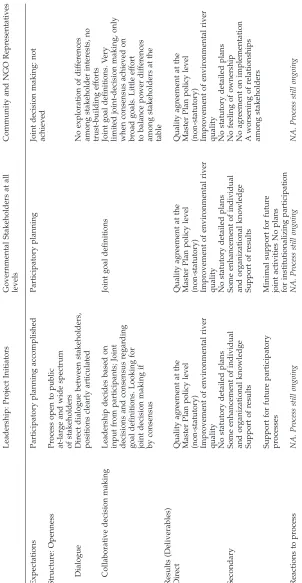
An evaluation of this case was initiated in 2003 when 11 interviews were undertaken. Of these, three were drawn from Leadership—the project initiators, five from various Governmental Stakeholders, and three from Community and NGO representatives. Table 5 summarizes the responses of the three groups. The interview format was structured, open-ended, uniform for all interviewees and designed to focus on the collaborative elements (Yona, 2003).
The Leadership group was the most enthusiastic about the process and the results. Its expectations for wide participation were met, and it supports similar approaches for the future. Consensual decisions regarding Master Plan goals were achieved, and when this proved unfeasible for the statutory, detailed Outline Schemes, Leadership reserved to itself the decision-making power.
Governmental stakeholders had similar expectations, but were less supportive of future joint participatory efforts. They considered the inability to get the statutory Outline Plans passed an indication that the process was an impediment to implementation.
The Community and NGO constituencies expected that what had been labelled a ‘consensus building process’ would lead to joint decision making with respect to the Outline plans. They are bitter about their lack of influence and power, and have no feeling of ownership on the agreements that have been reached. They consider that relationships among stakeholders have worsened and are blocking implementation.