Q U E S T I O N A N D A N S W E R
Open Access
Q&A: What are pathogens, and what have
they done to and for us?
Francois Balloux
*and Lucy van Dorp
Abstract
Microbes are found on us, within us and around us. They inhabit virtually every environment on the planet and the bacteria carried by an average human, mostly in their gut, outnumber human cells. The vast majority of microbes are harmless to us, and many play essential roles in plant, animal and human health. Others, however, are either obligate or facultative pathogens exerting a spectrum of deleterious effects on their hosts. Infectious diseases have historically represented the most common cause of death in humans until recently, exceeding by far the toll taken by wars or famines. From the dawn of humanity and throughout history, infectious diseases have shaped human evolution, demography, migrations and history.
What is a pathogen?
A pathogen is defined as an organism causing disease to its host, with the severity of the disease symptoms referred to as virulence. Pathogens are taxonomically widely diverse and comprise viruses and bacteria as well as unicellular and multicellular eukaryotes. Every living organism is affected by pathogens, including bacteria, which are targeted by specialized viruses called phages.
The number of viruses and bacteria on earth is stag-gering and they occupy essentially every environment. A liter of surface seawater typically contains in excess of ten billion bacteria and 100 billion viruses. The number of viruses on Earth is estimated to be around 1031, which corresponds to roughly ten billion times the number of stars in the universe [1]. An average human is made up of about 30 trillion cells but carries a similar number of bacteria, mostly in the gut [2].
The vast majority of viruses and bacteria we are exposed to have no negative effect and some can even
* Correspondence:[email protected]
UCL Genetics Institute (UGI), Darwin Building, Gower Street, London WC1E 6BT, UK
be beneficial, though a tiny fraction of these can severely affect our health. Specifically, about one in a billion microbial species is a human pathogen. Indeed, approxi-mately 1400 human pathogens have been described, whereas it has been estimated that there are one trillion microbial species on Earth, the vast majority of which remain uncharacterized [1].
What is the relationship between pathogens and hosts?
Pathogens can be divided into two main categories, namely facultative and obligate pathogens, reflecting how intimately their life cycle is tied to their host.
Facultative pathogens are organisms for which the host is only one of the niches they can exploit to reproduce. Facultative pathogens are primarily environmental bac-teria and fungi that can occasionally cause infection. They include many of the most problematic hospital-acquired bacteria involved in the antimicrobial resistance pandemic. A distinction is sometimes made between facultative and accidental pathogens, with the latter representing those which only occasionally infect weakened or immunocom-promised hosts. Typical examples of ‘accidental’ patho-gens includeNeisseria meningitidisorEscherichia coli.
Obligate pathogens require a host to fulfil their life cycle. All viruses are obligate pathogens as they are dependent on the cellular machinery of their host for their reproduction. Obligate pathogens are found among bacteria, including the agents of tuberculosis and syph-ilis, as well as protozoans (such as those causing malaria) and macroparasites.
Some obligate pathogens require multiple different hosts to fulfil their life cycle. The definite host, which supports the adult form of the pathogen, is often a verte-brate and the intermediate host (referred to as a vector) is generally an arthropod or a mollusc. This alternation of vertebrate and invertebrate hosts is found in viruses (for example the Zika virus), bacteria (for example Lyme disease) and protozoa (malaria). Trematodes (parasitic flatworms) go even further and some exhibit among the
most baroque life cycles. Digenetic trematodes have a basic three-host life cycle, and for some species a four-host life cycle. For instance, Halipegus occidualis sequentially has to infect a freshwater snail, an ostracod, a dragonfly nymph and ends its cycle after the dragonfly is eaten by the green frog Rana clamitans, where it re-sides under its tongue [3].
What is the host range of pathogens?
Some pathogens are limited to infecting a single host species, whereas others can infect a multitude of host species. Host ranges can feel highly idiosyncratic if not outright puzzling. For example, leprosy in humans is caused by two related intracellular bacteria Mycobacterium leprae and Mycobacterium lepromato-sis, which are essentially restricted in the wild to humans, as well as armadillos in the Americas and red squirrels in Scotland [4].
Conversely, Yersinia pestis, another intracellular obli-gate bacterium and the agent of plague, has a natural life cycle involving alternating infections of rodents and fleas, but can infect essentially any mammalian host. An interesting twist in the case of plague is thatY. pestisis not well adapted to the human host. With the exception
of uncommon occurrences of human-to-human
transmissions, referred to as pneumonic plague, plague epidemics (bubonic plague) are caused by plague-infected fleas biting humans. Somewhat ironically for a pathogen that is possibly the biggest killer in human his-tory, bubonic plague is a complete evolutionary disaster. The human host is at a very high risk of dying, the flea cannot reproduce on a meal of human blood and the bacterium is stuck in an evolutionary dead-end as it cannot transmit to another host.
There is no obvious predictor for the host range of different pathogens. Intuitively, it may be tempting to predict that pathogens with a more intimate relationship with their host are more closely adapted to their host, and thus have a more restricted host range. However, there is no obvious pattern suggesting that viruses (that rely on the host cells’machinery for reproduction) have a narrower host range than bacteria. Also, intracellular bacteria do not seem to have a markedly narrower host range than extracellular ones, despite being more intim-ately tied to their host.
We know relatively little about the underlying genetic changes required for a pathogen to infect a new host, though, interestingly, only a few mutations can be required for a host jump. For example, avian influenza is only around five mutations away from being able to transmit in mammals [5], and a single amino acid change was sufficient for the human-adapted bacterium Staphylococcus aureus to become a pathogen of rabbits [6].
What is special about pathogen genomes?
Obligate pathogens tend to be highly adapted to their hosts, with sophisticated mechanisms to synchronise their life cycles with that of the host, and the ability to manipu-late the host’s immune system, metabolism and sometimes even behaviour. Genes encoding proteins specific to pathogenicity are referred to as virulence factors, which include a variety of molecules required for colonization of the host, immunoevasion and immunosuppression, scav-enging nutrients within the host, and entry into and exit out of cells for intracellular pathogens.
In bacteria, virulence factors are often found in groups of genes on pathogenicity islands, which can be trans-ferred horizontally by plasmids or other transposable elements. For example, one of the defining features of the plague bacterium Y. pestis from its less virulent closest relative Yersinia pseudotuberculosis, is the inclu-sion, early in its evolution, of two plasmids carrying genes involved in pathogenicity [7].
While acquisition of novel genes and repurposing of existing ones is essential in the evolution towards patho-genicity, a general feature during the evolution towards pathogenicity is genome reduction through the inactiva-tion and loss of genes. This can be primarily explained by the fact that a host represents a fairly stable and resource-rich environment where some metabolic pathways required in the environment are not necessary. Genome reduction is a general trend accompanying the evolution towards pathogenicity and is observed in Mycobacterium tuberculosis, pathogenic E. coli strains and in the ongoing adaptation of Klebsiella pneumoniae lineages to cystic fibrosis patients. The most extreme ex-ample is leprosy (M. lepraeandM. lepromatosis), which has shed nearly half the genes found in their environ-mental relatives [8]. Another interesting tendency of many bacterial pathogens is the secondary loss of the ability to undergo genetic recombination [9].
How do pathogens cause disease?
Pathogens cause illness to their hosts through a variety of ways. The most obvious means is through direct damage of tissues or cells during replication, generally through the production of toxins, which allows the pathogen to reach new tissues or exit the cells inside which it replicated. Bacterial toxins are among the dead-liest poisons known and include famous examples such as tetanus, anthrax or botulinum toxin, known as Botox in its commercial application.
1918–1919 influenza epidemic, where the toll was highest amongst the young and healthy possibly be-cause they mounted the strongest immune response and as such died from a ‘cytokine storm’ in the lungs leaving patients literally drowning in their own body fluids [11].
Some pathogens benefit from the hosts’ immune reaction to spread within an infected host or increase their transmission to uninfected hosts. Influenza transmits mainly through aerosols created through the sneezing and coughing it causes. Vibrio cholerae triggers a strong inflammatory response in the gut mucosa, leading to watery diarrhoea and ensuring its release in the environment and thus infection of fur-ther hosts.
Are co-evolved pathogens less virulent?
Pathogens greatly vary in the severity of their symptoms from a mild inconvenience to assured death. It is some-times assumed that the deadliest pathogens represent recent host jumps where the pathogens’virulence is mal-adapted to the new host, and that co-evolution between host and pathogen will lead to more benign symptoms over time. However, this is only true in the case of strict vertical transmission (such as from mother to child), where survival and transmission of host and pathogen are intimately linked.
In the case of horizontal transmission, the situation is more complex and there is no straightforward way to predict the evolution of future virulence, as it will de-pend on a variety of factors, including the population structure of the host and the correlation between virulence and transmission [12]. A textbook example for reduction in virulence is the introduction of myxoma-tosis into the European rabbit population in Australia and France in 1950 and 1952, respectively. Upon intro-duction, the virus initially killed about 99% of infected rabbits but over a few years mortality went down to 90%, following the emergence of attenuated virus strains and genetic resistance in the rabbit population. While the virulence went down, which translated into higher transmission rates, the current 90% mortality rate re-mains exceedingly high and there is no evidence for fur-ther reduction in the short term [13].
BdGPL, the global lineage of the amphibian fungal pathogen Batrachochytrium dendrobatidis (Bd), is the only known pathogen to have extirpated entire host spe-cies. Yet, over the three decades since its discovery, it shows no sign of evolving lower virulence. The primary reason there is little selective pressure on Bd for virulence attenuation is that it can infect a very vast host range so that the extinction of any particular host spe-cies has limited impact on its fitness. Even worse, some host species, such as the widely introduced African
clawed frog, Xenopus laevis, and the American bullfrog, Rana catesbeiana, carry the disease asymptomatically, fuelling the globalBdpandemics and limiting any short-term prospect for significant decrease in virulence [14]. These are just examples of the evolution of virulence but both illustrate that there is no simple pattern of decrease in pathogenicity with time.
How old are the major human pathogens?
Apart from a few putative ancestral pathogens, including Helicobacter pylori [15], that might have co-speciated with their human host, the infectious diseases afflicting us were acquired through host jumps from other wild or domesticated animal hosts or sometimes from the wider environment. The timing of these events and the original source remains unclear in many cases.
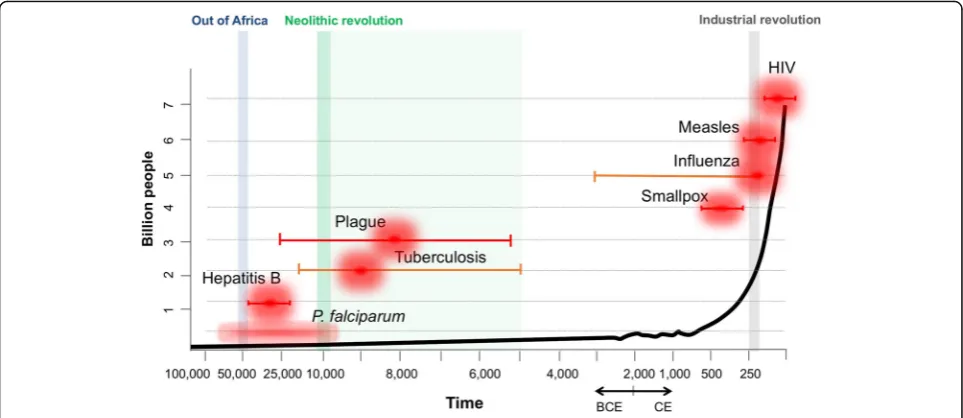
The traditional view has been that many human path-ogens emerged during the Neolithic revolution. The main arguments for an origin of human pathogens linked to agriculture are based on the proximity between traditional farmers with their livestock and the emer-gence of higher human population densities in stable settlements enabled by agricultural subsistence. High population density is indeed required by some epidemic diseases which could not have maintained themselves on scattered groups of hunter-gatherers [12]. This argu-ment, however, neglects the fact that pathogens can evolve fast. Also, while the proximity of humans and livestock is conducive to host jumps, humans transmit-ted more diseases to domestic animals than they acquired, with tuberculosis in particular having probably jumped from humans to cattle rather than the other way around [16]. Finally, this argument also neglects the high burden of pathogens in wild populations, including in the great apes.
Where are the resistance-conferring genes in the human genome?
Infectious diseases have killed well over half of all humans who have ever lived on earth. Pathogens, such as childhood diseases, that affect their host prior to reproduction, through death or reduced fertility, have exerted enormous selective pressures. Yet, scans of the genome for signatures of pathogen-driven selection have identified only a few variants with clear effects. Similarly, genome-wide association studies (GWAS) for infectious disease resistance/susceptibility have identified only few loci impacting on infectious disease susceptibility [17], despite their success in identifying thousands of variants involved in chronic diseases and phenotypic traits such as height. Even for diseases that have affected us for a long time, for example tuberculosis, we know of no obvious protective genetic variant.
Given the high selective pressure pathogens must have exerted, it is reasonable to ask where all the resistance genes are. Strongly protective variants may have reached fixation, rendering them undetectable unless the patho-gen has a highly heteropatho-geneous distribution range. An interesting case for regional selective pressure is the Duffy negative antigen mutation protective against Plas-modium vivax that is found at close to 100% in Sub-Saharan Africa but virtually absent anywhere else. Another situation where a resistance gene does not reach fixation arises when the protective variant is dele-terious when homozygous, as in sickle cell anaemia. We might also speculate that the evolutionary potential and
high genetic diversity of most pathogens limits our abil-ity to detect protective variants in the human genome, particularly so if these were only effective against a subset of lineages within a pathogenic species.
In addition to the few variants protective against specific pathogens, we also know of genomic regions involved in immunity against a wide spectrum of patho-gens, such as interleukin genes or the major histocom-patibility complex (MHC) system. The very high genetic diversity of the MHC is believed to have been shaped by exposure to different pathogen species [18]. Also, follow-ing the recent development of techniques to sequence ancient DNA, it has been suggested that immunity genes such as those encoding toll-like receptors have been acquired following hybridization with archaic humans and are over-represented in the current gene pool of anatomically modern humans relative to genes not in-volved in immunity [19, 20].
How did pathogens shape human history?
Infectious diseases had a massive impact on our history, leading to the rise and fall of civilizations, both through the toll they took on human life but also through eco-nomic and societal collapse following epidemics. More military campaigns have probably been lost or won due to infectious diseases than due to the tactical acumen of the armies’ commanders. Thucydides reports in his History of the Peloponnesian War, written in the 5th cen-tury BC, how the plague of Athens devastated the city-state of Athens in ancient Greece during the second year
Fig. 1.Age of emergence of significant infectious diseases impacting on human populations. The time of emergence for the various major diseases is based on a synthesis of published research. When known with some confidence, point estimates are provided for each disease together with error bars depicting uncertainty in the inferred estimates.Orange error barsdepict higher uncertainty compared tored. Theblack trend lineplots an increase in human population size through time (x axis) in the order of billions of people (y axis). Key events in human history are highlighted and annotated at the top. Main references used were: smallpox [27]; influenza [28]; HIV [29]; tuberculosis [30–33];P. falciparum
of the Peloponnesian War (430 BC) when it was on the cusp of victory against Sparta, ending the golden age of Pericles and Athenian predominance in the ancient world. The eventual fall of the Roman Empire was also largely down to another epidemic, the Justinian plague in 541–542 CE, which precluded the Emperor Justinian recovering lost territories in the western part of the em-pire [21].
Infectious disease played an equally important role in past human migrations. The conquistadores’ sweeping conquests of large swaths of the Americas in the 16th century was greatly aided by the diseases they brought with them, such as measles and smallpox, to which the in-digenous populations had limited immunity [22]. Con-versely, one of the possible reasons Europeans managed to colonize Africa was that they used quinine, an antimalarial drug derived from the bark of the cinchona tree [23].
History has been shaped not only by pathogens infect-ing humans, but also those affectinfect-ing domestic animals and crops. For example, it has been suggested that the Islamic conquest of the 7th and 8th centuries did not extend to Sub-Saharan Africa because the horses and camels of the Islamic armies were dying from trypa-nosma spread by tsetse flies [24]. Conversely, pathogens were at other times the drivers of large migration. Around one million Irish people died and another million migrated to the US to escape the famine caused byPhytophthora infestansdestroying potato harvests be-tween 1845 and 1852 [25].
But what about now?
At least in the developed world, the leading causes of hu-man mortality are no longer infectious diseases but in-stead age-associated disorders such as cancer, heart disease and diabetes. Numerous countries have undergone an epidemiological transition, starting some 300 years ago in some developed countries and less than 80 years ago for developing countries. Diseases that once devastated human populations, such as smallpox, are now eradicated. Others, such as the plague or leprosy, are largely under control with the exception of a few hotspots.
The current situation is, however, one of new chal-lenges. Globalization and increased mobility, particularly air travel, have facilitated the transmission of diseases not just locally but between continents. The recent out-break of Zika in the Americas, for example, has been at-tributed in part to an increase in air travel from infected areas into Brazilian airports, extending both the inci-dence and geographic range of the virus [26]. The 2003 outbreak of severe acute respiratory syndrome (SARS) and recurrent Ebola crises in Central Africa highlight the ability of new and existing diseases rapidly to become significant international health threats. In addition, our ability to combat infectious diseases is also
challenged by the widespread emergence of pathogen drug resistance. The global antimicrobial resistance (AMR) crisis is increasingly limiting our resources to combat disease through antimicrobial therapy.
Thus, in spite of the global health narrative supporting a decline in the number of deaths caused by infectious disease, the complexity of our interactions with disease-causing agents are as significant now as through history. Infectious diseases continue to be a major cause of mortality globally, responsible for between a quarter to a third of all deaths and nearly half of all deaths in people under the age of 45, with most of these in principle avoidable.
Acknowledgements
The authors are grateful to Liam Shaw for discussions on the manuscript and for financial support from the MRC, BBSRC, NERC and ESRC (grants NE/M000591/1 and MR/P007597/1).
Authors’contributions
LvD and FB wrote the manuscript. Both authors read and approve the final version.
Competing interests
The authors declare that they have no competing interests.
Publisher’s Note
Springer Nature remains neutral with regard to jurisdictional claims in published maps and institutional affiliations.
References
1. Microbiology by numbers. Nat Rev Microbiol. 2011;9(9):628.
2. Sender R, Fuchs S, Milo R. Revised estimates for the number of human and bacteria cells in the body. PLoS Biol. 2016;1:14.
3. Bolek MG, Tracy HR, Janovy J. The role of damselflies (Odonata: Ztgoptera) as paratenic hosts in the transmission of Halipegus eccentricus (Digenea: Hemioridae) to Anurans. J Parasitol. 2010;96(4):724–35.
4. Avanzi C, del-Pozo J, Benjak A, Stevenson K, Simpson VR, Busso P, et al. Red squirrels in the British Isles are infected with leprosy bacilli. Science. 2016;354:744–7. 5. Herfst S, Schrauwen EJA, Linster M, Chutinimitkul S, de Wit E, Munster VJ,
et al. Airborne transmission of influenza A/H5N1 virus between ferrets. Science. 2012;336:1534–41.
6. Viana D, Comos M, McAdam PR, Ward MJ, Selva L, Guinane CM, et al. A single natural nucleotide mutation alters bacterial pathogen host tropism. Nat Genet. 2015;47:361–U195.
7. Achtman M, Zurth K, Morelli C, Torrea G, Guiyoule A, Carniel E. Yersinia pestis, the cause of plague, is a recently emerged clone of Yersinia pseudotuberculosis. Proc Natl Acad Sci U S A. 1999;96:14043–8. 8. Singh P, Benjak A, Schuenemann VJ, Herbig A, Avanzi C, Busso P, et al. Insight
into the evolution and origin of leprosy bacilli from the genome sequence of Mycobacterium lepromatosis. Proc Natl Acad Sci U S A. 2015;112:4459–64. 9. Achtman M, Wagner M. Microbial diversity and the genetic nature of
microbial species. Nat Rev Microbiol. 2008;6:431–40.
10. Guidotti LG, Chisari FV. Immunobiology and pathogenesis of viral hepatitis. Annu Rev Pathol. 2006;1:23–61.
11. Morens DM, Fauci AS. The 1918 influenza pandemic: insights for the 21st century. J Infect Dis. 2007;195:1018–28.
12. Anderson RM, May RM. Infectious diseases of humans. Dynamics and control. Oxford: Oxford University Press; 1991.
13. Kerr PJ, Liu J, Cattadori I, Ghedin E, Read AF, Holmes EC. Myxoma virus and the leporipox viruses: an evolutionary paradigm. Viruses. 2015;7:1020–61. 14. Fisher MC, Henk DA, Briggs CJ, Brownstein JS, Madoff LC, McCraw SL, et al.
Emerging fungal threats to animal, plant and ecosystem health. Nature. 2012;484:186–94.
16. Smith NH, Hewinson RG, Kremer K, Brosch R, Gordon SV. Myths and misconceptions: the origin and evolution of Mycobacterium tuberculosis. Nat Rev Microbiol. 2009;7:537–44.
17. Hill AVS. Evolution, revolution and heresy in the genetics of infectious disease susceptibility. Philos Trans R Soc B Biol Sci. 2012;367:840–9. 18. Prugnolle F, Manica A, Charpentier M, Guegan JF, Guernier V, Balloux F.
Pathogen-driven selection and worldwide HLA class I diversity. Curr Biol. 2005;15:1022–7. 19. Deschamps M, Laval G, Fagny M, Itan Y, Abel L, Casanova JL, et al. Genomic
signatures of selective pressures and introgression from archaic hominins at human innate immunity genes. Am J Hum Genet. 2016;98:5–21.
20. Dannemann M, Andres AM, Kelso J. Introgression of Neandertal- and Denisovan-like haplotypes contributes to adaptive variation in human Toll-like receptors. Am J Hum Genet. 2016;98:22–33.
21. Buntgen U, Myglan VS, Ljungqvist FC, McCormick M, Di Cosmo N, Sigl M, et al. Cooling and societal change during the Late Antique Little Ice Age from 536 to around 660 AD. Nat Geosci. 2016;9:231–U163.
22. Darling MI, Donoghue HD. Insights from paleomicrobiology into the indigenous peoples of pre-colonial America - a review. Mem Inst Oswaldo Cruz. 2014;109:131–9.
23. Webb Jr JLA. Malaria in Africa. History Compass. 2011;9:162–70.
24. William CS. The historical spread of Trypanosoma evansi (surra) in camels: a factor in the weakening of Islam?’. In: Emery E, editor. Selected papers from the first international conference‘Camel cultures: historical traditions, present threats and future prospects’. London: RN Books; 2013. p. 87–94. 25. Turner RS. After the famine: plant pathology, Phytophthora infestans, and
the late blight of potatoes, 1845–1960. Historical Studies Phys Biol Sci. 2005;35:341–70.
26. Faria NR, Azevedo RDD, Kraemer MUG, Souza R, Cunha MS, Hill SC, et al. Zika virus in the Americas: early epidemiological and genetic findings. Science. 2016;352:345–9.
27. Duggan AT, Perdomo MF, Piombino-Mascali D, Marciniak S, Poinar D, Emery MV, et al. 17th century variola virus reveals the recent history of smallpox. Curr Biol. 2016;26:3407–12.
28. Taubenberger JK, Morens DM. Pandemic influenza - including a risk assessment of H5N1. Rev Sci Tech Off Int Epizoot. 2009;28:187–202. 29. Faria NR, Rambaut A, Suchard MA, Baele G, Bedford T, Ward MJ, et al. The
early spread and epidemic ignition of HIV-1 in human populations. Science. 2014;346:56–61.
30. Hershkovitz I, Donoghue HD, Minnikin DE, Besra GS, Lee OYC, Gernaey AM, et al. Detection and molecular characterization of 9000-year-old Mycobacterium tuberculosis from a Neolithic settlement in the Eastern Mediterranean. PLoS One. 2008;3(10):e3426.
31. Eldholm V, Pettersson JHO, Brynildsrud OB, Kitchen A, Rasmussen EM, Lillebaek T, et al. Armed conflict and population displacement as drivers of the evolution and dispersal of Mycobacterium tuberculosis. Proc Natl Acad Sci U S A. 2016;113:13881–6.
32. Bos KI, Harkins KM, Herbig A, Coscolla M, Weber N, Comas I, et al. Pre-Columbian mycobacterial genomes reveal seals as a source of New World human tuberculosis. Nature. 2014;514:494–7.
33. Kay GL, Sergeant MJ, Zhou ZM, Chan JZM, Millard A, Quick J, et al. Eighteenth-century genomes show that mixed infections were common at time of peak tuberculosis in Europe. Nat Commun. 2015;6:6717.
34. Tanabe K, Mita T, Jombart T, Eriksson A, Horibe S, Palacpac N, et al. Plasmodium falciparum accompanied the human expansion out of Africa. Curr Biol. 2010;20:1283–9.
35. Sundararaman SA, Plenderleith LJ, Liu WM, Loy DE, Learn GH, Li YY, et al. Genomes of cryptic chimpanzee Plasmodium species reveal key evolutionary events leading to human malaria. Nat Commun. 2016;7:14. 36. Paraskevis D, Magiorkinis G, Magiorkinis E, Ho SYW, Belshaw R, Allain JP,
et al. Dating the origin and dispersal of hepatitis B virus infection in humans and primates. Hepatology. 2013;57:908–16.
37. Furuse Y, Suzuki A, Oshitani H. Origin of measles virus: divergence from rinderpest virus between the 11(th) and 12(th) centuries. Virol J. 2010;7:4. 38. Rasmussen S, Allentoft ME, Nielsen K, Orlando L, Sikora M, Sjogren KG, et al.
Early divergent strains of Yersinia pestis in Eurasia 5,000 years ago. Cell. 2015;163:571–82.