Harpenden, Herts, AL5 2JQ
Telephone: +44 (0)1582 763133
Web: http://www.rothamsted.ac.uk/
Rothamsted Research is a Company Limited by Guarantee Registered Office: as above. Registered in England No. 2393175. Registered Charity No. 802038. VAT No. 197 4201 51. Founded in 1843 by John Bennet Lawes.
Rothamsted Repository Download
A - Papers appearing in refereed journals
Hassani-Pak, K., Castellote, M., Esch, M., Hindle, M. M., Lysenko, A.,
Taubert, J. and Rawlings, C. J. 2016. Developing integrated crop
knowledge networks to advance candidate gene discovery. Applied &
Translational Genomics. 11 (December), pp. 18-26.
The publisher's version can be accessed at:
•
https://dx.doi.org/10.1016/j.atg.2016.10.003
The output can be accessed at:
https://repository.rothamsted.ac.uk/item/8v300/developing-integrated-crop-knowledge-networks-to-advance-candidate-gene-discovery
.
© 2016. CC-BY terms apply
Developing integrated crop knowledge networks to advance candidate
gene discovery
Keywan Hassani-Pak
a,⁎
, Martin Castellote
a,b, Maria Esch
a, Matthew Hindle
a, Artem Lysenko
a,
Jan Taubert
a, Christopher Rawlings
aa
Rothamsted Research, Department of Computational and Systems Biology, UK b
INTA EEA-Balcarce, Laboratory of Agrobiotechnology, Argentina
a b s t r a c t
a r t i c l e i n f o
Article history:
Received 3 June 2016 Accepted 24 October 2016
The chances of raising crop productivity to enhance global food security would be greatly improved if we had a com-plete understanding of all the biological mechanisms that underpinned traits such as crop yield, disease resistance or nutrient and water use efficiency. With more crop genomes emerging all the time, we are nearer having the basic information, at the gene-level, to begin assembling crop gene catalogues and using data from other plant species to understand how the genes function and how their interactions govern crop development and physiology. Unfor-tunately, the task of creating such a complete knowledge base of gene functions, interaction networks and trait bi-ology is technically challenging because the relevant data are dispersed in myriad databases in a variety of data formats with variable quality and coverage. In this paper we present a general approach for building genome-scale knowledge networks that provide a unified representation of heterogeneous but interconnected datasets to enable effective knowledge mining and gene discovery. We describe the datasets and outline the methods, workflows and tools that we have developed for creating and visualising these networks for the major crop species, wheat and barley. We present the global characteristics of such knowledge networks and with an example linking a seed size phenotype to a barley WRKY transcription factor orthologous to TTG2 from Arabidopsis, we illustrate the value of integrated data in biological knowledge discovery. The software we have developed (www.ondex.org) and the knowledge resources (http://knetminer.rothamsted.ac.uk)we have created are all open-source and provide a first step towards systematic and evidence-based gene discovery in order to facilitate crop improvement.
© 2016 The Authors. Published by Elsevier B.V. This is an open access article under the CC BY license (http://creativecommons.org/licenses/by/4.0/). Keywords:
Bioinformatics Knowledge network Data integration Gene discovery
Knowledge discovery, crop genomics
1. Introduction
The development of improved agricultural crops is a critical societal challenge, given current global developments such as population growth, climate and environmental change, and the increasing scarcity of inputs (fuel, fertiliser, etc.) needed for agricultural productivity. To meet this challenge, we will need to breed or engineer improved crop varieties, with higher yields, robustness to biotic (e.g. pathogens, pests) and abiotic stress, and better adapted to their intended environments; and to acceler-ate the breeding programmes needed to implement these designs. Many biomedical and agronomic traits are complex and their variation is deter-mined by manifold interactions among genetic, epigenetic and environ-mental factors (Polderman et al., 2015). The use of forward genetics, reverse genetics and“omics”technologies combined with bioinformatics approaches to discover causal genetic loci and variants that determine a
particular biological phenotype in crops, animals or humans is referred to as the genotype to phenotype challenge.
The generation of the hypotheses that link genotype to phenotype and the identification of the candidate biological pathways, processes and functional genes that could be involved requires the integration of multiple heterogeneous types of information. This information is spread across many different databases (Rigden et al., 2016) that can include known records of gene-phenotype links, gene-disease associations, gene expression and co-expression, allelic information and effects of ge-netic variation, links to scientific literature, homology relations, protein-protein interactions, gene regulation, protein-protein pathway memberships, gene-ontology annotations, protein-domain information and other do-main specific information. Such data is typically highly connected, e.g. through common references to named biological entities, and semi-structured, e.g. because some data can be found in databases and other in free text. Furthermore, these data types are not static because new types of data are constantly emerging from advances in high-throughput experimental platforms. These characteristics of life science data make networks, consisting of nodes and links between them, rep-resent aflexible data model that can capture some of the complexity and interconnectedness in the data (Huber et al., 2007).
Abbreviations:GSKN, Genome-scale Knowledge Network; CropNet, Crop knowledge network; RefNet, Reference knowledge network of model species.
⁎ Corresponding author.
E-mail address:[email protected](K. Hassani-Pak).
http://dx.doi.org/10.1016/j.atg.2016.10.003
2212-0661/© 2016 The Authors. Published by Elsevier B.V. This is an open access article under the CC BY license (http://creativecommons.org/licenses/by/4.0/). Contents lists available atScienceDirect
Applied & Translational Genomics
In mathematics and computer science a distinction is made between homogeneous networks, where all nodes have the same data type (e.g. protein-protein interaction networks) and heterogeneous networks, sometimes referred to as information or knowledge networks, where nodes and links can have various types (Sun and Han, 2012). Biological knowledge networks are composed of nodes which represent biological entities such as genes, transcripts, proteins and compounds, as well as, other entities such as protein domains, ontology terms, pathways, liter-ature and phenotypes (Liekens et al., 2011). The links in the network correspond to relations between entities and are described using terms which reflect the semantics of the biological or functional rela-tionship such asencodes,interacts,controls,expressed,part_of, is_a,
published_in, etc. A knowledge network is referred to as genome-scale knowledge network (GSKN) when it contains the entire known genome (all genes) of an organism as nodes in the network. An integrated GSKN built from a semantically rich variety of dispersed, heterogeneous data can add value to the native data and significantly facilitate both comput-er-aided data mining and manual data exploration.
There are a variety of ways to represent information in knowledge networks. Simple information such as a gene location can be added as start and end attributes (key-value-pairs) on the nodes representing genes (Gene nodes). However, when the nature of the information is more complex, it can be better represented in an expanded form with additional linked nodes of clearly defined types. For example, SNP infor-mation could either be represented in a simplistic manner, i.e. as multi-ple attributes on a Gene node or in a linked way using individual Gene-SNP relations. The linked approach enables nodes representing Gene-SNPs (SNP nodes) to have properties attached to them and allows further linking of SNP-Phenotype information, for example, based on the results of a genome wide association study (GWAS). Therefore, representing this information in an expanded form with clearly defined types can en-able better data visualisation and more effective data mining.
Ondex provides a framework for building integrated knowledge net-works from heterogeneous datasets (Köhler et al., 2006). In Ondex ter-minology, the nodes of a network are called concepts and the links between them are called relations. To address a certain integration or analysis task in Ondex, public and private data sources containing the desired type of information need to be selected. The Ondex framework uses a network data model and provides an Application Program Inter-face (API) to insert data into the data model. The Ondex in-memory net-work data structure is based on a labelled and directed multi-graph that isflexible and allows information and metadata from most biological databases to be captured. Ondex uses a set of parsers implemented as plugin software modules that transform data from their native format and exploit the Ondex API to populate the network. Other plugin mod-ules perform data integration tasks that identify semantically similar nodes (mapping methods), remove unwanted information (filters) and simplify the network structure (transformers). These plugins can be combined together using an XML-based description of a workflow of reproducible steps that convert heterogeneous data into integrated networks. Such Ondex workflows can be generated and executed either via a graphical user interface (Ondex Integrator) or via the command line interface (Ondex-CLI). The Ondex Scripting Console provides a means to parse configurable tabular data formats (including simple CSV formatfiles) for integration into Ondex where no format-specific Ondex parsers are yet available. The scripting syntax is based on a be-spoke language developed in Lysenko 2012. Ondex networks can be exported in several formats such as the Ondex exchange format OXL (Taubert et al., 2007), RDF (Splendiani et al., 2012) or Cytoscape-com-patible JSON. Networks can be visualised and inspected using tools like Cytoscape (Shannon et al., 2003) or in the Ondex User Interface (Ondex UI) (Fig. 1).
Since its release, Ondex has undergone various phases of develop-ment. Recent work has extended the Ondex UI with an on-demand in-formation retrieval capability using web-service based scripts that add the retrieved information to a visualised network (Horn et al., 2014).
This enables an exploratory analysis: starting with a small network and then gradually, on-demand, extending to a larger network. A web-enabled version of the Ondex UI, called Ondex Web, has been de-veloped to allow Ondex network visualisations to be embedded in web-pages (Taubert et al., 2014). Furthermore, a Cytoscape plugin, called OndexView allows for concise graphical representations of inte-grated knowledge networks (Weile et al., 2011). Some studies were un-dertaken to evaluate the utility of semantic web technologies (RDF, SPARQL) within the umbrella of Ondex (Splendiani et al., 2012; Canevet et al., 2010). Two studies showed the contributions of Ondex towards Bayesian data integration (Weile et al., 2012) and towards logic-based modelling (Lesk et al., 2011). Finally, Ondex was used as the main platform for biological network analysis (Lysenko et al., 2011; Defoin-Platel et al., 2011) and in a biological study to identify can-didate virulence genes in the fungusFusarium graminearum(Lysenko et al., 2013).
2. Methods and principles
The creation of GSKNs for crop species is described in the following four sections: i) the general principles of data integration in Ondex, ii) building a reference knowledge network from model species datasets (RefNet), iii) integrating crop-specific information (CropNet) and iv) the steps needed to update the knowledge networks.
2.1. Ondex approach to data integration
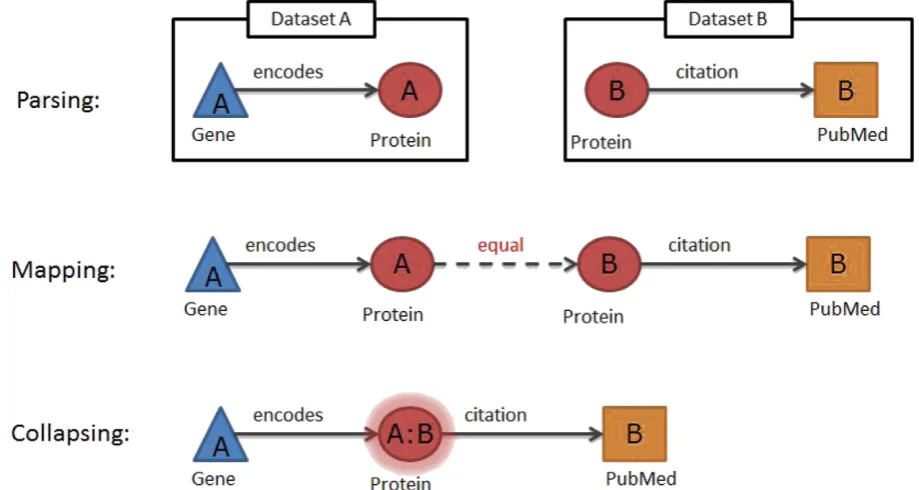
We illustrate the Ondex approach to knowledge network creation by integrating a small knowledge network from three different data sources UniProt (UniProt Consortium, 2015), Gene Ontology (GO) (Gene Ontology Consortium, 2015) and PubMed (http://www.ncbi. nlm.nih.gov/pubmed). The goal is to merge these different data sources in order to gain insights from studying their intersection. The main steps towards achieving this goal include parsing data, mapping equivalent concepts and collapsing redundant concepts (Fig. 2).
2.1.1. Parsing
Ondex uses an ontology model that describes what and how data are captured in an Ondex network. This ontology is the core semantic framework for the data model and describes OndexConcept Classes, Re-lation Types,Data Sources,Attribute NamesandEvidence Types. Every ex-ternal data source is parsed so that it becomes a network populated with instances from the ontology model. Parsers are plugins in Ondex that read each dataset and produce independent networks within Ondex. Concepts and relations of an Ondex network will capture the parsed content within their attributes. An alternative way of importing data into Ondex is through the Ondex Scripting Console. Ondex scripts can for example parse a tabularfile that contains gene IDs in one column and gene-related SNP data in the other columns. The code can create
GeneandSNPconcepts for every line in the tabularfile and a relation of typehas_variancethat connects the two concepts. Concepts sharing the same accessions within the parsed dataset are automatically merged into one representative concept.
2.1.2. Mapping
concepts between databases. For instance, the Ondex“accession based mapping”can be used to create a relation of typeequalbetween two concepts of the same type when they share a common unique identifier such as GO or PubMed IDs. Alternative mapping approaches can be used for mapping concepts with no common identifiers. These include“name based mapping”that maps based on shared names / synonyms or
“sequence based mapping”that maps based on the similarity of sequence attributes.
2.1.3. Collapsing
After mapping related concepts using exactly matching common da-tabase accessions, all equivalent concepts can be collapsed into a single
Fig. 1.Examples of public data sources that can be integrated into Ondex (A) using the Ondex Integrator and the Ondex Console (B). Following the data integration workflow, the knowledge network (C) is loaded into the Ondex UI for visualisation and exploration (D).
concept. The mapping and collapsing steps ensure that no concept oc-curs more than once in the network. Avoiding redundancy in the con-struction of the knowledge network makes successive data mining of the integrated resources significantly easier. In Ondex, this can be done with a network transformer such as the“Relation collapser”. The provenance of the data is stored within theData Sourceattribute of each Ondex concept. Once two or more concepts have been collapsed, this attribute will be assigned a summary of all the data provenances. This is how Ondex keeps track of the source of the data. These men-tioned steps interconnect several data sources into one integrated knowledge network.
2.2. Integration of model species data
The majority of genes in crop species such as wheat or barley are not well studied and have vague or unknown functions. Therefore, to be able to link the genetic and genomic crop information to biological pro-cesses and pathways we need to infer functional gene information from model species based on sequence conservation and comparative geno-mics. For most plant and crop species, the most suitable model species, with a range of high quality annotation and interaction data is
Arabidopsis(Defoin-Platel et al., 2011). We also like to include other well-studied plant species that provide high quality functional gene in-formation. From these model species datasets, we follow an integration approach to build a reference knowledge network (a RefNet) that can be added to crop-specific networks.
Curated Arabidopsis and plant datasets can be retrieved from public databases such as TAIR (Lamesch et al., 2012), Araport (Krishnakumar et al., 2015), Gramene (Jaiswal, 2011) and UniProt. Using the Ondex In-tegrator and similar integration principles (parsing, mapping and col-lapsing) as before, a core Arabidopsis network wasfirst developed consisting ofGene-Proteinrelations. This core network can be iteratively extended with functional and interaction data including GO annota-tions, Gramene Trait Ontology (TO), pathway data, phenotypes, GWAS data, protein-protein interactions (PPI) and links to relevant publica-tions. The RefNet was created by interconnecting these individual datasets based on mapping and collapsing equivalentGeneorProtein
concepts. The PPI dataset provided by TAIR is based on Arabidopsis gene identifiers and not protein ids, therefore, it was translated into a
Gene-Geneinteraction network. Next, all reviewed plant proteins (ex-cluding Arabidopsis) with their GO annotations and literature citations were retrieved from UniProt and added to the RefNet.
Gene-phenotype information based on experimental evidence are the most valuable pieces of evidence in trait-based gene discovery. Such connected phenotype information is available in dispersed loca-tions including UniProt, TAIR and NCBI GeneRIF databases. The majority of plant phenotype descriptions, however, is still only available as un-structured text without a mapping to a un-structured phenotype ontology. In the Arabidopsis knowledge network, gene-phenotype informa-tion curated by domain specialists is represented asPhenotype con-cepts linked to genes or as attributes of protein concon-cepts from UniProt. A certain amount of redundancy can occur when the data providers have not used ontologies to describe same/similar pheno-types. In addition to curated gene-phenotype relations, automated text-mining methods can be exploited to extract and integrate phe-notypic information from PubMed abstracts and link them to the cor-responding Arabidopsis genes. The Trait Ontology (TO) and Arabidopsis gene names were used as inputs to the Ondex text-min-ing plugin (Hassani-Pak et al., 2010) which established new relations betweenGeneandTOconcepts related to plant developmental and functional traits. Additionalfiltering steps in the RefNet workflow helped to retain only those relations where gene names and ontolo-gy terms co-occurred in the same sentence. Tn total, over 27,000 new text-mining basedGene-TOrelations were added to the knowledge network.
2.3. Integration of crop specific data
The methods and workflows to build crop-specific knowledge net-works (CropNet) are presented with data from barley and wheat but are similarly applicable to other crop species.
2.3.1. Genes and proteins
The starting point of building a genome-scale knowledge network is a public genome sequence dataset. Our interest is not in the genome se-quence itself but more in the annotations including genes and the tran-scripts/proteins they encode. These annotations are available from GFF3 files (The Sequence Ontology - Resources - GFF3 [Internet]) and se-quence information can be obtained in FASTA format. The Ondex
“FASTA-GFF3”parser takes standard GFF3 and protein FASTAfiles as in-puts and produces a network ofGeneandProteinconcepts connected via relations of typeencodes. Information such as chromosome, start and end are added as attributes of the Gene concepts. A taxonomy iden-tification argument (TAXID) is used to distinguish which species (e.g. wheat) the data comes from. Wheat and barley gene models and pro-tein sequences were obtained from Ensembl and parsed using the FASTA-GFF3 Ondex parser. This creates theGene-Proteinnetwork in which concepts are connected via relations of typeencodes.
The“TSVfile parser”can be used to add simple information such as gene location or synonymous names to the Gene concepts. The parser creates a concept for every line in a tabularfile and adds information from the columns as attributes of the concept. This information can be mapped and collapsed and provides a useful way for adding missing at-tributes to concepts in the knowledge network. The wheat POPSEQ dataset provides estimated gene locations in centiMorgans (cM) based on a whole genome sequencing approach (Chapman et al., 2015). The
“TSVfile parser”was used to add the POPSEQ-based cM coordinates to the wheatGeneconcepts.
2.3.2. Genetics and genome variation
The next integration goal is to incorporate genome variation (i.e. SNPs) and genetics data (i.e. GWAS and QTL) into the knowledge net-works. In order to ensure that GWAS and QTL data can be co-located with genes it is important that the datasets are based on the same phys-ical or genetic maps. In the ideal case, every gene in the network will have a chromosome, start and stop position based on physical genome coordinates (bp), and similarly SNP and QTL intervals would be defined using genome location. For many crop species, QTLs are defined by their genetic map locations. In such cases, QTL intervals need to be trans-formed from genetic to physical map coordinates before being incorpo-rated into the knowledge network. An ideal resource for standardised QTL and GWAS data of livestock species in GFF3 format is the AnimalQTLdb (Hu et al., 2016). In crop species, however, such struc-tured genetics resources are only slowly beginning to emerge (Blake et al., 2016). Once such data is in the public domain, the Ensembl Vari-ation database provides access to the variVari-ation data, along with genes in close proximity, functional consequence of the variation and associa-tions with phenotypes (Chen et al., 2010). The Ondex Scripting Console can be used to translate such tabular data intoGene-SNP-Traitand QTL-Traitnetworks. TheGene-SNP-Traitnetwork was mapped to the Gene-Protein network based on common ENSEMBL gene ids (e.g. TRAES_2AL_65B19CC73). TheQTL-Traitnetwork was integrated with theGene-Proteinnetwork by using a mapping method that creates links betweenGeneandQTLconcepts when they are co-located.
2.3.3. Orthology and protein domains
The next step in building CropNet is to enrich and extend the wheat
(Goodstein et al., 2011) or OMA Browser (Altenhoff et al., 2014). It can also be locally computed using tools like OMA Standalone, InterProScan (Mitchell et al., 2015), Smith-Waterman (SW) (Smith and Waterman, 1981) or Blast (Altschul et al., 1990). It is important that theProtein con-cepts in the RefNet have the same accessions as provided in the orthology and sequence similarity based datasets of CropNet, since these will be used to interconnect the two networks. Pre-computed data from wheat included protein domains and inferred orthology to
Arabidopsisand barley were obtained from Ensembl BioMart. Sequence alignments between all wheat proteins and reviewed UniProt plant pro-teins (excludingArabidopsis) were created using SW while taking the top 10 hits per query sequence (E-valueb0.001). The Ondex Scripting Console was used to parse these additional wheat related datasets, transform them into Ondex networks and export them in OXL format. These steps created new concepts of typeProteinandProtein Do-main and new relations of type ortholog, has_domain and
has_similar_sequencethat were integrated with theProteinconcepts of wheat Gene-Protein network based on ENSEMBL protein ids (e.g. TRAES_2AL_65B19CC73.1).
2.3.4. Integrating CropNet with RefNet
The above steps were followed to create a knowledge network for the crop of interest (a CropNet), which contains genes, proteins, genetic, orthology and protein domain information. In afinal integration step, the CropNet and the RefNet were brought together and linked using
the orthology and protein domain information. Their integration was based on common concept accessions so that duplicated concepts were mapped and collapsed. For example, CropNet contains both wheatProteinconcepts andProteinconcepts from the reference species. These functioned as anchors for linking the two networks through ac-cession-based mapping steps by mapping and collapsingProtein con-cepts using shared TAIR and UniProt accessions. Additionally,Protein Domainconcepts from the CropNet were connected to corresponding GO terms in the RefNet. This step exploited public GO mappingfiles (Index of /external2go [Internet]) as the input to the Ondex mapping pluginExternal2GO. This mapping method created relations of type
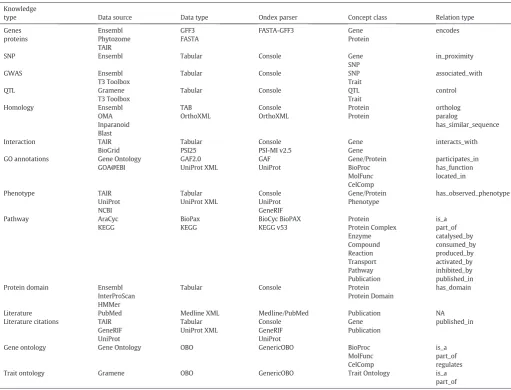
“cross_reference”between semantically similar concepts of different type. A full overview of selected data sources and Ondex parsers used for building a crop GSKN are given inTable 1.
2.4. Updating knowledge networks
Public life science databases are not static and are updated regularly. For example, the number of publications in PubMed that contain the word Arabidopsis has risen by nearly 20,000 new articles in the last 5 years. In recent times, GO annotations, nucleotide and protein se-quence repositories have all had a similar sharp rise in their content. Therefore, it is increasingly important to keep such fast growing infor-mation up-to-date on a regular basis. On the other hand, crop-specific
Table 1
Summary of the data sources and Ondex parsers that were used to create the crop and reference knowledge networks. Knowledge
type Data source Data type Ondex parser Concept class Relation type Genes proteins Ensembl Phytozome TAIR GFF3 FASTA FASTA-GFF3 Gene Protein encodes
SNP Ensembl Tabular Console Gene
SNP
in_proximity
GWAS Ensembl
T3 Toolbox
Tabular Console SNP Trait
associated_with
QTL Gramene
T3 Toolbox
Tabular Console QTL Trait control Homology Ensembl OMA Inparanoid Blast TAB OrthoXML Console OrthoXML Protein Protein ortholog paralog has_similar_sequence Interaction TAIR BioGrid Tabular PSI25 Console PSI-MI v2.5 Gene Gene interacts_with
GO annotations Gene Ontology GOA@EBI GAF2.0 UniProt XML GAF UniProt Gene/Protein BioProc MolFunc CelComp participates_in has_function located_in Phenotype TAIR UniProt NCBI Tabular UniProt XML Console UniProt GeneRIF Gene/Protein Phenotype has_observed_phenotype Pathway AraCyc KEGG BioPax KEGG BioCyc BioPAX KEGG v53 Protein Protein Complex Enzyme Compound Reaction Transport Pathway Publication is_a part_of catalysed_by consumed_by produced_by activated_by inhibited_by published_in Protein domain Ensembl
InterProScan HMMer
Tabular Console Protein Protein Domain
has_domain
Literature PubMed Medline XML Medline/PubMed Publication NA Literature citations TAIR
GeneRIF UniProt Tabular UniProt XML Console GeneRIF UniProt Gene Publication published_in
Gene ontology Gene Ontology OBO GenericOBO BioProc MolFunc CelComp
is_a part_of regulates Trait ontology Gramene OBO GenericOBO Trait Ontology is_a
datasets such as genome assemblies, gene models and QTL data change less frequently and can therefore be updated on demand.
In order to facilitate the continuous reintegration of updated data we created a central knowledge store of data snapshots that correspond to the database versions available at the time of integration. We have de-veloped scripts for rebuilding this knowledge store in a semi-automated manner. The focus has been on automating the update of datasets that frequently change and are publicly accessible in standardised formats for which Ondex Parsers are available, i.e. ontologies, publications and GO annotations. We have therefore automated most of the RefNet data download and integration steps that include:
● Backup of old RefNet datasets
● Download and integrate new RefNet datasets including
○UniProt plants (XML format)
○Gene ontology (OBO format)
○Trait ontology (OBO format)
○Arabidopsis Gene Annotations (GAF)
○PubMed abstracts (XML format)
○BioGRID interactions (TAB)
● Re-run workflows that integrate new RefNet with existing CropNet
● Export new GSKN in OXL or other formats
The update and integration scripts make use of Ondex-CLI which is a lightweight version of Ondex that runs on the command line and not via a graphical user interface. The results are manually inspected in the Ondex UI and by studying the integration logs.
3. Results
3.1. Comparison of crop knowledge networks
We have developed reproducible workflows to integrate multiple public data sources from crop and model species into genome-scale knowledge networks (GSKN). The Ondex integration process lasts ~ 5 h on a Linux server with Intel E7 2.2 GHz and requires 20 Gb RAM to build a GSKN for species like wheat and barley. All workflows and datasets for building crop GSKNs are available online, e.g. see the release notes of the wheat GSKN (KnetMiner Wheat Release Notes [Internet], 2016).
Each crop GSKN includes an identical reference network consisting ofArabidopsisand other plant species from UniProt-SwissProt Plants but differs in their crop-specific information (genes, SNP, QTL, traits, publications). The size of a crop GSKN can vary depending on the ge-nome size and data integrated for that particular organism. The wheat and barley genome releases that were integrated contained 99,386 and 79,379 genes respectively. The resulting version of the wheat GSKN (WheatNet) contains about 450 k concepts and 1.7 million rela-tions, while the barley GSKN (BarleyNet) is slightly smaller with 420 k concepts and 1.3 million relations. The type and amount of information held in a knowledge network also varies from species to species.
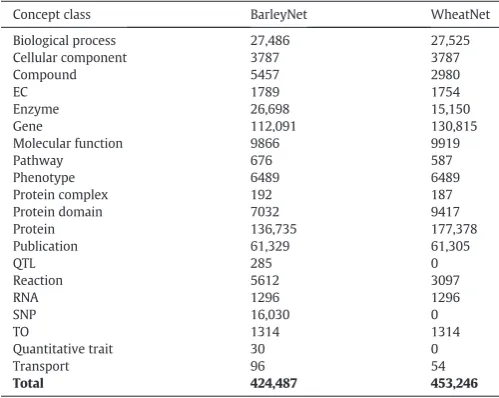
Tables 2provides a comparison of the abundance ofConcept Classesin BarleyNet and WheatNet. In barley, we integrated trait, QTL and SNP in-formation from Gramene and Ensembl resulting in 30 quantitative traits, 285 QTL and 16,030 SNP concepts in BarleyNet. At the time of this analysis, such data was not readily available for wheat in standardised formats but can be added to WheatNet once it becomes available. In both wheat and barley GSKNs, nearly 10% of genes consist of only a simpleGene-Proteinnetwork; these are genes for which the only available information are the proteins they encode (without genet-ic, homology or protein domain data). The text-mining analysis con-nected 5553Arabidopsisgenes to 409 TO terms based on 18,341 co-citations.
3.2. Search and visualisation of GSKN in Ondex
Due to the scale of GSKNs, visualisation and interaction with such large and complex networks is not straightforward. Opening a GSKN in the Ondex visualisation application takes about 5 min (Windows PC with Intel Core i5 CPU) and requires at least 6 Gb of RAM for storing the network in-memory.
Although the main network is too large to be displayed, the ontology types, represented in the Ondex Metagraph visualisation, summarise the variousConcept ClassesandRelation Typespresent in the knowledge network and their relationships.Fig. 3shows the ontology types present in the metagraph of the barley GSKN. The metagraph consists of 21 dif-ferentConcept Classesrepresentative of both biological entities (Gene, Protein, Protein Complex, Compound, SNP) and general entities (Biolog-ical Process, Pathway, Phenotype, Publication). The metagraph visual-ises relationships betweenConcept Classes, for example,‘Biological Process (GO)’has incoming relations from multipleConcept Classes, such as Gene, Protein, RNA, Protein Domain and Enzyme Classification. The Metagraph functions enable users to make subsets of the main net-work visible/invisible.
In addition, Ondex provides graphical user interfaces for searching, filtering and annotating networks that can be used to gradually build small to medium size networks for visualisation. For example, it is pos-sible to search for genes or phenotypes of interest and apply a neighbourhood search or a shortest path search to identify a potential link between selected concepts. Such smaller subnetworks can be grad-ually extended using the context-sensitive right-click menus in Ondex that allow additional links of certain types to be added to the knowledge network (Horn et al., 2014).
3.3. Application of GSKN to gene discovery and crop improvement
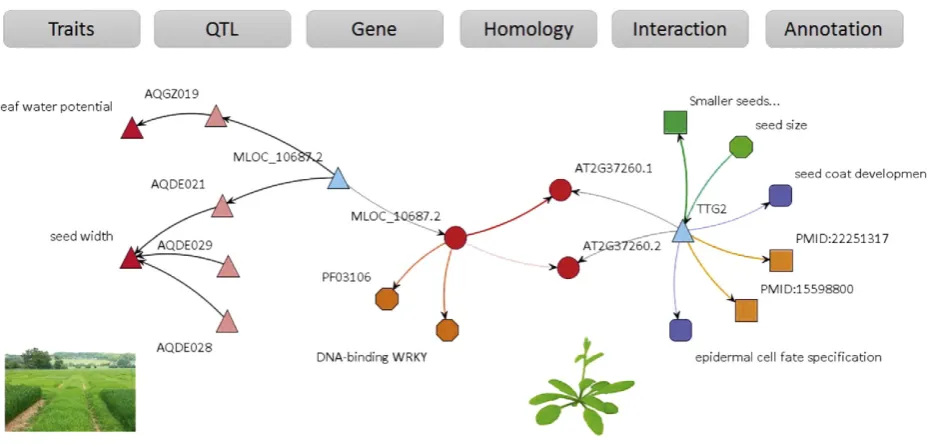
The main driver for building crop GSKNs was that selected data sources contain fundamental relationships that upon integration and consecutive analysis, can yield chains of functional associations among more distant concepts. In this case, the motivation was to identify chains of functional associations between traits (phenotypes) and causal genes. Here, we present an example network, extracted from the BarleyNet, to provide a proof-of-concept and demonstrate the potential application of integrated data to biological knowledge discovery. The BarleyNet was searched andfiltered to identify a potential relationship between barley gene MLOC_10687.2 and a seed size phenotype (Fig. 4). The analysis extracted a gene-evidence network that shows
Table 2
Total number of concepts perConcept Classincluded in BarleyNet and WheatNet (Release June 2016). Note that these networks include the same RefNet.
Concept class BarleyNet WheatNet Biological process 27,486 27,525 Cellular component 3787 3787
Compound 5457 2980
EC 1789 1754
Enzyme 26,698 15,150
Gene 112,091 130,815
Molecular function 9866 9919
Pathway 676 587
Phenotype 6489 6489
Protein complex 192 187 Protein domain 7032 9417
Protein 136,735 177,378
Publication 61,329 61,305
QTL 285 0
Reaction 5612 3097
RNA 1296 1296
SNP 16,030 0
TO 1314 1314
Quantitative trait 30 0
Transport 96 54
Fig. 3.The ontology types present in the metagraph of the barley GSKN (BarleyNet). Different node shapes and colors represent different Concept Classes. Relation Types are omitted here for clarity reasons.
MLOC_10687.2 to be co-located with QTLs on chromosome 5 for seed width (AQDE021,http://archive.gramene.org/db/qtl/qtl_display?qtl_ accession_id=AQDE021) and leaf water potential (AQGZ019). It en-codes a protein that contains a DNA-binding WRKY domain and is orthologous to TTG2 in Arabidopsis. Evidence information in Arabidopsis indicates thatTTG2mutants have smaller seeds and that
TTG2is involved in seed coat development and epidermal cell fate spec-ification. PubMed references (PMID:22251317and PMID:15598800) are provided within the knowledge network as an additional source of evidence (Fang et al., 2012; Garcia et al., 2005).
This example highlights the potential benefits of data integration and linked data to establish associations between distant concepts such as traits/QTL on the one side and genes/biological processes on the other side. The original information was dispersed across several heterogeneous databases (Gramene, Ensembl, TAIR, GO and PubMed) and only by interconnecting them in a semantically consistent manner it is possible to search the information effectively and reveal indirect transitive associations between distant concepts of the network. This and other similar examples provide a proof-of-concept for data integra-tion needs in life sciences.
4. Discussion
To demonstrate a general approach for building genome-scale knowledge networks (GSKNs) we have presented, as examples, those we have developed for the cereal crops wheat and barley. These GSKNs can be used for the identification of candidate genes and the gen-eration of research hypotheses. Theflexibility of the network construc-tion approach is readily transferable to other plant and animal species. We have, in fact, developed knowledge networks for several other species such asArabidopsis, poplar, potato, tomato,Brassica, maize, pig, cattle and chicken. Resulting networks are provided in different formats that can be explored in tools like Ondex frontend or Cytoscape. Due to the large size of GSKNs, the exploration and visu-alisation of such networks is resource intensive, slow and requires powerful computers with sufficient RAM. Tools for knowledge min-ing and discovery need to be further developed to exploit integrated knowledge networks more effectively in order to predict candidate genes for key agronomic traits in a systematic manner. We are cur-rently in the process of developing such a tool, named KnetMiner, for mining genome-scale knowledge networks. Publicly accessible prototypes can be used to search the existing crop knowledge net-works (KnetMiner[Internet]).
Heterogenous data sources can contain explicit references to each other, thereby making it possible to interconnect the data. In situations, where direct references do not exist between the data sources, other ap-proaches need to be exploited for connecting the different datasets. The Ondex data integration framework provides basic text-mining capabili-ties to facilitate the linking of datasets lacking direct references. It anal-yses the unstructured PubMed abstracts ofPublicationconcepts in a GSKN to establish connections between different biological entities. The text-mining based relations can create novel relationships between concepts that are not yet present in structured databases (Hassani-Pak et al., 2010).
The data integration approach is pragmatic and does not attempt to integrate every dataset that is in the public domain or exhaustively model the complex semantics of every database. Instead, our methodol-ogy focuses on integrating datasets that add value to a particular appli-cation case (e.g. candidate gene discovery) at an appropriate level of semantic complexity. Selected data sources usually contain fundamen-tal relationships that upon integration and consecutive analysis, can yield chains of functional associations among more distant concepts. Our integration approach does not attempt to utilise raw data, but in-stead, it integrates processed data. For example, data from large scale genetic and transcriptomic experiments are integrated as processed and interpreted data in the form of SNP location or gene expression
information; not as raw NGS data. Other tools such as Galaxy and R li-braries provide the specialist tools for this stage of data analysis. We seek to complement and build on primary data analysis by supporting interpretation and knowledge discovery tools.
When developing an Ondex data integration workflow we encour-age an exploratory and incremental approach, whereby each step is evaluated by opening and investigating the Ondex network in the Ondex Visualisation Toolkit. In addition, the Ondex Integrator is missing a fully-configurable Ondex parser for custom tabular data types. Before tabular files can be included in an automated Ondex integration workflow, they mustfirst be parsed into Ondex using the Ondex Scripting Console. The process of building knowledge networks has been partially automated to include data download and data integration of RefNet using the Ondex-CLI. Using these automated steps, new ver-sions of the knowledge networks are created on a regular basis. This ap-proach of rebuilding knowledge networks from scratch, instead of updating the parts that have changed, has the advantage of avoiding the accumulation of legacy and obsolete data. In the future, we intend to develop methodologies to determine which parts of the knowledge network have changed after an update and which genes have new links or updated annotations of interest. This would allow for the devel-opment of automated services to inform users when new information about their genes of interest becomes available. In addition, we are con-sidering how to exploit Linked Open Data initiatives and Semantic Web technologies which might be able to facilitate the generation of GSKNs. The exemplars we have used demonstrate the process of building a knowledge network for a species with a sequenced genome. In many cases, especially for non-model organisms, whole genome sequences or gene models are not available. For these species, a transcriptome as-sembly (for example from RNA-seq data) can be used to build the knowledge network. However, a knowledge network based on a tran-scriptome assembly lacks genomic coordinates, and entity identifiers that are standardised across public databases. Data integration workflows and methods are therefore far more challenging for transcriptomes and the approach needs to be customised further to ac-commodate these specific situations.
5. Conclusions
Navigating the heterogeneous data landscape is a technically challenging task for many biologists and bioinformaticians that can consume an excessive amount of time pre-processing data for inte-grative analysis. Therefore, knowledge discovery is often hampered by the challenges of data integration and new approaches are needed to improve the efficiency, reproducibility and objectivity of these processes. We have developed transferable and readily reproducible Ondex data integration workflows to build crop knowledge net-works. The process is pragmatic in that it allows a network of appro-priate complexity to be developed and updated without an excessive technical and semantic burden to the user. Feasibility studies have shown that biological knowledge networks provide a suitable data structure for the effective gene and biological knowledge discovery. We have demonstrated that useful biological insights can be gained from the crop GSKNs, such as discovery of an inferred relationship between barley gene MLOC_10687.2 and a seed size phenotype. Fu-ture work will need to focus on the development of user-friendly tools, e.g. KnetMiner, that exploit such networks systematically in order to help scientists and breeders improve gene discovery for key agronomic traits such as yield, drought tolerance and disease resistance.
Competing interests
Authors' contributions
KHP and CR conceived the project. KHP designed the GSKN workflows. MC, ME helped to refine and test the workflows. JT, MH, AL, KHP developed the Ondex components used in this work. KHP wrote the manuscript. All authors have read, reviewed and approved the manuscript for publication.
Acknowledgements
We acknowledge all the past members of the Ondex team and col-laborators who contributed to the development of the Ondex software (seehttp://www.ondex.org/people.shtml). The Ondex project was funded by the UK Biotechnology and Biological Sciences Research Coun-cil (BBSRC) award BB/F006039/1 and with strategic funding of Rothamsted Research. KHP received additional support from the BBSRC 20:20 Wheat® Institute Strategic Program (BBS/E/C/00005202 and BBS/E/C/00005203). AL was supported by BBSRC studentship BBS/ S/E/2006/13205.
References
Altenhoff, A.M., Kunca, N., Glover, N., C.-M., T., Sueki, A., Pili ota, I., et al., 2014.The OMA orthology database in 2015: function predictions, better plant support, synteny view and other improvements. Nucleic Acids Res. 43, D240–D249.
Altschul, S.F., Gish, W., Miller, W., Myers, E.W., Lipman, D.J., 1990.Basic local alignment search tool. J. Mol. Biol. 215, 403–410.
Blake, V.C., Clay, B., Matthews, D.E., Hane, D.L., Peter, B., Jean-Luc, J., 2016.The Triticeae toolbox: combining phenotype and genotype data to advance small-grains breeding. Plant Genome 9.
Canevet, C., Artem, L., Andrea, S., Matthew, P., et al., 2010. Analysis and visualisation of RDF resources in Ondex. Nat. Precedingshttp://dx.doi.org/10.1038/npre.2010.5430. Chapman, J.A., Mascher, M., Buluç, A., Barry, K., Georganas, E., Session, A., et al., 2015.A
whole-genome shotgun approach for assembling and anchoring the hexaploid bread wheat genome. Genome Biol. 16, 26.
Chen, Y., Cunningham, F., Rios, D., McLaren, W.M., Smith, J., Pritchard, B., et al., 2010.
Ensembl variation resources. BMC Genomics 11, 293.
Defoin-Platel, M., Hassani-Pak, K., Rawlings, C., 2011.Gaining confidence in cross-species annotation transfer: from simple molecular function to complex phenotypic traits. Asp. Appl. Biol. 107, 79–87.
Fang, W., Wang, Z., Cui, R., Li, J., Li, Y., 2012.Maternal control of seed size by EOD3/ CYP78A6 inArabidopsis thaliana. Plant J. 70, 929–939.
Garcia, D., Fitz Gerald, J.N., Berger, F., 2005.Maternal control of integument cell elongation and zygotic control of endosperm growth are coordinated to determine seed size in Arabidopsis. Plant Cell 17, 52–60.
Gene Ontology Consortium, 2015.Gene ontology consortium: going forward. Nucleic Acids Res. 43, D1049–D1056.
Goodstein, D.M., Shu, S., Howson, R., Neupane, R., Hayes, R.D., Fazo, J., et al., 2011.
Phytozome: a comparative platform for green plant genomics. Nucleic Acids Res. 40, D1178–D1186.
Hassani-Pak, K., Legaie, R., Canevet, C., van den Berg, H.A., Moore, J.D., Rawlings, C.J., 2010. Enhancing data integration with text analysis tofind proteins implicated in plant stress response. J. Integr. Bioinform. 7. http://dx.doi.org/10.2390/biecoll-jib-2010-121.
Herrero, J., Muffato, M., Beal, K., Fitzgerald, S., Gordon, L., Pignatelli, M., et al., 2016. Ensembl comparative genomics resources. Database 2016.http://dx.doi.org/10. 1093/database/bav096.
Horn, F., Fabian, H., Martin, R., Jan, T., Artem, L., Christopher, R., et al., 2014. Interactive ex-ploration of integrated biological datasets using context-sensitive workflows. Front. Genet. 5.http://dx.doi.org/10.3389/fgene.2014.00021.
Hu, Z.-L., Park, C.A., Reecy, J.M., 2016.Developmental progress and current status of the Animal QTLdb. Nucleic Acids Res. 44, D827–D833.
Huber, W., Carey, V.J., Long, L., Falcon, S., Gentleman, R., 2007.Graphs in molecular biolo-gy. BMC Bioinforma. 8 (Suppl. 6), S8.
Index of /external2go [Internet], . [cited 5 Sep 2015]. Available:http://geneontology.org/ external2go/.
Jaiswal, P., 2011.Gramene database: a hub for comparative plant genomics. Methods Mol. Biol. 678, 247–275.
KnetMiner Wheat Release Notes [Internet], 2016. [cited 3 Jun 2016]. Available:https:// ondex.rothamsted.ac.uk/QTLNetMinerWheat/html/release.html(12 Jan). KnetMiner[Internet], d. [cited 3 Jun 2016]. Available:http://knetminer.rothamsted.ac.uk. Köhler, J., Baumbach, J., Taubert, J., Specht, M., Skusa, A., Rüegg, A., et al., 2006. Graph-based analysis and visualization of experimental results with ONDEX. Bioinformatics 22, 1383–1390.
Krishnakumar, V., Hanlon, M.R., Contrino, S., Ferlanti, E.S., Karamycheva, S., Kim, M., et al., 2015. Araport: the Arabidopsis information portal. Nucleic Acids Res. 43, D1003–D1009.
Lamesch, P., Berardini, T.Z., Li, D., Swarbreck, D., Wilks, C., Sasidharan, R., et al., 2012.The Arabidopsis Information Resource (TAIR): improved gene annotation and new tools. Nucleic Acids Res. 40, D1202–D1210.
Lesk, V., Taubert, J., Rawlings, C., Dunbar, S., Muggleton, S., 2011.WIBL: Workbench for In-tegrative Biological Learning. J. Integr. Bioinform. 8, 156.
Liekens, A.M.L., De Knijf, J., Walter, D., Bart, G., De Rijk, P., Jurgen, D.-F., 2011.BioGraph: unsupervised biomedical knowledge discovery via automated hypothesis generation. Genome Biol. 12, R57.
Lysenko, A., Defoin-Platel, M., Hassani-Pak, K., Taubert, J., Hodgman, C., Rawlings, C.J., et al., 2011.Assessing the functional coherence of modules found in multiple-evidence networks from Arabidopsis. BMC Bioinforma. 12, 203.
Lysenko, A., Urban, M., Bennett, L., Tsoka, S., Janowska-Sejda, E., Rawlings, C.J., et al., 2013.
Network-based data integration for selecting candidate virulence associated proteins in the cereal infecting fungusFusarium graminearum. PLoS One 8, e67926.
Mitchell, A., Chang, H.-Y., Daugherty, L., Fraser, M., Hunter, S., Lopez, R., et al., 2015.The InterPro protein families database: the classification resource after 15 years. Nucleic Acids Res. 43, D213–D221.
Polderman, T.J.C., Beben, B., de Leeuw, C.A., Sullivan, P.F., van Bochoven, A., Visscher, P.M., et al., 2015.Meta-analysis of the heritability of human traits based onfifty years of twin studies. Nat. Genet. 47, 702–709.
Rigden, D.J., Fernández-Suárez, X.M., Galperin, M.Y., 2016.The 2016 database issue of Nucleic Acids Research and an updated molecular biology database collection. Nucleic Acids Res. 44, D1–D6.
Shannon, P., Markiel, A., Ozier, O., Baliga, N.S., Wang, J.T., Ramage, D., et al., 2003.
Cytoscape: a software environment for integrated models of biomolecular interaction networks. Genome Res. 13, 2498–2504.
Smith, T.F., Waterman, M.S., 1981.Identification of common molecular subsequences. J. Mol. Biol. 147, 195–197.
Splendiani, A., Andrea, S., Rawlings, C.J., Shao-Chih, K., Robert, S., Phillip, L., 2012.Lost in Translation: Data Integration Tools Meet the Semantic Web (Experiences from the Ondex Project). Lecture Notes in Electrical Engineering, pp. 87–97.
Sun, Y., Han, J., 2012.Mining Heterogeneous Information Networks: Principles and Meth-odologies. Morgan & Claypool Publishers.
Taubert, J., Sieren, K.P., Hindle, M.M., Hoekman, B., Winnenburg, R., Philippi, S., et al., 2007. The OXL format for the exchange of integrated datasets. J. Integr. Bioinform. 4 (3):62.
http://dx.doi.org/10.2390/biecoll-jib-2007-62.
Taubert, J., Hassani-Pak, K., Castells-Brooke, N., Rawlings, C.J., 2014.Ondex Web: web-based visualization and exploration of heterogeneous biological networks. Bioinfor-matics 30, 1034–1035.
The Sequence Ontology - Resources - GFF3 [Internet], d. [cited 5 Sep 2015]. Available:
http://www.sequenceontology.org/gff3.shtml.
UniProt Consortium, 2015.UniProt: a hub for protein information. Nucleic Acids Res. 43, D204–D212.
Weile, J., Pocock, M., Cockell, S.J., Lord, P., Dewar, J.M., E.-M., H., et al., 2011.Customizable views on semantically integrated networks for systems biology. Bioinformatics 27, 1299–1306.