Available online at www.ijrp.org
International Journal of Research Publications
Optimal management of waste collection in Bamako by the genetic algorithm
Souleymane Ouattara Centre de Recherche et de Formation pour l’Industrie Textile, CERFITEX-Ségou, 223 Mali Abstract
The problem of waste collection is part of the problem of optimizing the routes taken by vehicles to meet the need for transport of waste between collection points and final storage. It is a question of determining a circuit of several vehicles, so as to serve at a lower cost a set of collection points distributed in a network. That is, designing a set of visits, from the same repository, through a set of predefined collection points (nodes). We propose a resolution of the genetic algorithm to minimize the total cost of transportation which is proportional to the total distance. We tested the efficiency of our algorithm under Matlab R2014a.
© 2019 Published by IJRP.ORG. Selection and/or peer-review under responsibility of International Journal of Research Publications (IJRP.ORG)
Keywords: waste collection problem, genetic algorithm, vehicle routing problem with time windows
1.Introduction
The problem of waste collection is a vehicle tour problem that involves collecting waste from all homes in a city via a generally heterogeneous fleet of vehicles while minimizing transport costs. Vehicle Routing Problems (VRP) have been an intensive research topic in recent decades, given its presence and importance in
Available online at www.ijrp.org
International Journal of Research Publications
Volume-42, Issue-1,December 2019
Accepted and Published Manuscript
Optimal management of waste collection in Bamako by the genetic algorithm
Souleymane Ouattara
PII : Souleymane Ouattara.100421122019832 DOI: 100421122019832
Web: http://ijrp.org/paper-detail/833
To appear in: International Journal of Research Publication (IJRP.ORG)
Received date: 01 Dec 2019 Accepted date: 17 Dec 2019 Published date: 18 Dec 2019
Please cite this article as: Souleymane Ouattara , Optimal management of waste collection in Bamako by the genetic algorithm , International Journal of Research Publication (Volume: 42, Issue: 1),
http://ijrp.org/paper-detail/833
International Journal of Research Publications
Optimal management of waste collection in Bamako by the
genetic algorithm
Souleymane Ouattara
Centre de Recherche et de Formation pour l’Industrie Textile, CERFITEX-Ségou, 223 Mali
Abstract
The problem of waste collection is part of the problem of optimizing the routes taken by vehicles to meet the need for transport of waste between collection points and final storage. It is a question of determining a circuit of several vehicles, so as to serve at a lower cost a set of collection points distributed in a network. That is, designing a set of visits, from the same repository, through a set of predefined collection points (nodes). We propose a resolution of the genetic algorithm to minimize the total cost of transportation which is proportional to the total distance. We tested the efficiency of our algorithm under Matlab R2014a.
© 2019 Published by IJRP.ORG. Selection and/or peer-review under responsibility of International Journal of Research Publications (IJRP.ORG)
Keywords: waste collection problem, genetic algorithm, vehicle routing problem with time windows
1.Introduction
2
all areas. The VRP consists in serving a set of requests dispersed geographically, respecting the constraints of capacity of the vehicles and the delays of service. The problem of waste collection, represents a complex problem, which is in addition to the constraints of turns and capacity of the vehicles, characterized by the density of the requests to serve (the residences), from where the necessity of a regrouping strategy demands. In addition, the collection of waste is characterized by the high cost of transport, so the objective of the problem is to minimize these costs Clark 1993, R M.Gilleau and Or.I, Curi.K,1999. The problem of waste collection has been well studied in the literature, so several works have dealt with the different classes of this problem: a first publication dealing with the problem of waste collection was by Beltrami et al. in 1974 and Kim et al. in 2006, they studied the problem of collection of waste with window of time, and lately (2019), Ouattara et al 2019 proposed three heuristics for the resolution of the same problem, namely tabu research (TS), closest neighbor heuristics and 2-optimality heuristics. In this article we adapt a genetic algorithm for solving the problem M. Dorigo and G.Dri Caro, 1999. This considering the following economic objective:
minimize the costs (mileage of the course) of collection and transportation
Under the following strong constraints
Each tour starts and ends at the deposit
The capacity of each vehicle must not be exceeded at the visit of each request
An application can not be broken down (each request is served by a single vehicle)
2.Presentation of the problem
Our problem emerges from waste collection problems in the district of Bamako. As the number of
household’s increases, the waste generated also increases, in order to maintain the quality of the environment, the waste generated must be properly collected. As a reminder, in the city of Bamako, each inhabitant produces about 1kg of waste per day. The management of these wastes is done at two levels, the primary collection or pre-collection provided by the Economic Interest Group which using trucks, tow carts and tricycles, pick up waste at the gates of the concessions for them deposit at the level of transits deposits. At this first level, it is the GIEs that provide this primary management and in the context of decentralization the first responsible is the Mayor of the municipality. The secondary collection is provided by the Highways and its partner Ozone Mali. Thus, it is Ozone Mali which transports the waste of the points of transit, towards the final discharge of Noumoubougou or final deposit.
Despite the fact that several players have been on the ground, namely the informal, the Economic Interest Group, Ozone Mali, the result remains insufficient. This poor waste management has consequences for wastewater when it is known that rainwater managed by collectors is only used for drainage. It should be noted that Bamako produces more than 1600 tons of household waste per day and only 40% of this waste is evacuated by Ozone-Mali. This proves that the city is far from clean. The difficulties in collecting waste in Bamako are due to the allocation of limited financial resources and also the problem of transport route. There is less of an optimal route for trucks to make their tours of the city to the final depot, which is 60 km from the city. This study will therefore make it possible to manage the waste issue more optimally.
The strong constraints of the system are:
pass all collection points,
maximum number of vehicles per collection day,
maximum tonnage of the truck not to be exceeded
3.Mathematical model
Our objective is to serve all garbage collection requests, minimizing the total cost of transportation. This cost
is relative to the
.
The problem is characterizedThe precise problem that we seek to solve is that presented by (Fisher et al) [11; 12] the formulation of the mathematical model is based on a directed graph: G = (V, A) where:
is the set of n vertices (nodes) of the graph representing the set of clients,
with, representing the repository;
is the set of oriented arcs representing the path between the two
vertices.
The parameters of the problem:
all available vehicles;
the ability to collect on a node v_i;
the ability to collect on a node nœud ;
the travel distance of the arc .
[ ] : the time window associates with the node with the arrival date at the earliest in the
node et representing the end date of service at the latest for the node
: the service time of the node
to the node
in the node;
:
a great value.
The decision variables used are
if the node is visited by the vehicle et 0 otherwise..
if the arc is in the vehicle tour and 0 otherwise
4
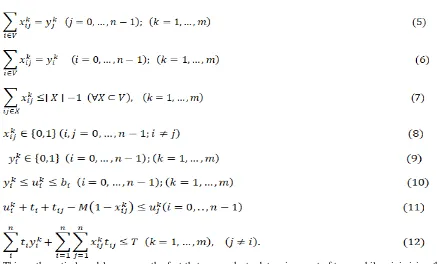
This mathematical model expresses the fact that one seeks to determine a set of tours while minimizing the total distance traveled (1). The constraint (2) expresses that the capacity of the vehicle must be respected. Constraints (3) and (4) express the fact that a node is visited by a single vehicle, the depot is visited by all vehicles. Constraints (5) and (6) establish that a vehicle visiting a collection node leaves it to visit another node. Constraint (7) states that all tours must be related and from the depot. The binary of the decision variables is given by the constraints (8) and (9). The constrain (10) makes it possible to verify that the nodes are collected in their respective time window for a given vehicle. The constraint (11) expresses the succession
between the collection of two vertices : if is collected after by the same vehicle then the start
of the collection can not be done until the collection of is complete and until the path between these two
nodes has been completed. Taking into account a limit on the duration of each tour (that is to say a working time), noted T can be done by introducing the constraint (12).
4.Genetic algorithm for minimizing the total cost of transport
In this part, we will present our approach based on genetic algorithms to minimize the total cost of transport.
4.1.Coding of the chromosome
The coding makes it possible to represent the solutions in the form of chromosomes. A chromosome is a sequence (permutation) of nodes, which indicates the order in which a vehicle must visit all the nodes. This type of coding (Figure 1) is called permutation-list coding.
Nod i 0 5 2 6 4 3 10 8 7 9 1 0
Node 0 represents the depot.
4.2.Decoding the passage of vehicle
Decoding allows, from each chromosome of the population, to obtain an initial solution indicating the passage of each vehicle on the corresponding nodes. (Figure 2)
0 2 4 1 5 0
0 3 6 7 10 0
0 8 9 0
Fig. 2.Order of passage of vehicles
4.3.Crossing
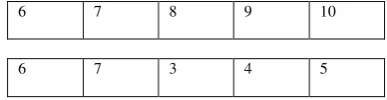
Following the generation of the initial population randomly, we proceed the crossing phase which ensures the recombination of parental genes to form new descendants. To do this, we consider p the crossing position, and we treat this phase as shown in Figure 3.
1 2 3 4 5 6 7 8 9 10
P=2
1 2 8 9 10 6 7 3 4 5
Fig. 3.Crossing
4.4.Mutation
The mutation (Figure 5) consists in choosing two alleles, at random, in a chromosome and exchanging their respective values.
1 2 3 4 5
Before the transfer
4 2 3 1 5
Fig. 4.Mutation of any two alleles
Note here that we must respect the constraints of precedence, to ensure that a customer is not visited before its supplier, and capacity, to ensure the non-overload of each vehicle.
4.5.Procedure of the proposed approach for minimizing the total cost of the transport
4.5.1 Generation of the initial population
6
In our case, we will generate two types of populations. A first population denoted P_ (node), which represents all the nodes to be visited by all the vehicles, according to the permutation list coding. (Figure 2) The second population rated P_vehicle indicates the number of nodes visited by each vehicle. Knowing that k varies between 1 and 5 vehicles.
4.5.2 Generation of the population nodes / Vehicles
Before starting construction of the population P_ (node) / P_vehicle, we proceed to the phase of correction of precedence and capacity between the nodes. The following pairs of nodes are: (1.5), (2.8), (9.7), (10.3) and (4.6), noting that Q_kmax = 12000 kg, we present, respectively, in Figures 7 and 8 the principle of correction of precedence and capacity.
0 3 2 6 8 1 4 5 9 10 7 0
Before correction
0 3 8 2 6 5 1 4 7 9 10 0
After correction
Fig. 4.Precedence correction principal
0 5 8 7 3 1 2 4 9 6 10 0
Before correction
0 5 8 7 9 3 1 2 4 6 10 0
After correction
Fig. 5.Capacity correction
Principle considering the population P_node, given in Figure 2, the correction procedures and the population P_vehicle, given in Figure 6, we illustrate in Figure 9 the corresponding individuals of the population
V1 C1 0 5 8 2 6 4 3 0
V2 C2 0 10 7 9 1 0
Fig. 6.Example of individuals from
4.5.3 Calculation procedure
Each vehicle goes to serve the nodes in his tour according to the assignment order. Once back at the depot, we calculate the transportation cost for the distance traveled, and repeat this until all nodes are served.
We reproduce this work for each individual of the population taking into account the different
possible combinations between and , in order to obtain thereafter the corresponding individual of
the population P_ (node / vehicle) which minimizes our objective function.
5.Numerical results
Table 1. Result obtained by the tabu search
vehicle Tour
1
[0-22-21-4-5-10-15-19-23-13-0]
2
[0-20-8-11-9-3-7-4-16-24-0]
3
[0-18-1-10-2-6-12-0]
Cost 601km
Table 2. Actual result for Ozone Mali
vehicle Tour
1
[0-13-8-4-15-19-23-22-5-10-0]
2
[0-9-21-16-24-11-9-20-7-0]
3
[0-3-12-18-2-1-6-13-0]
Cost 803 km
As can be seen in both tables, the total distance travelled by ozone is 803 km. This solution is improved by the genetic algorithm with a percentage of (803-601) * 100/803 = 25%
This reduction in the distance travelled reduces the amount of fuel used by the vehicle andtherefore benefits
Ozone Mali. The more you travel less, the less you use the vehicle used, which remains profitable for the
company. We assumed that time windows were flexible. It should be noted that 75% of the nodes were
collected in the time allowed and the remaining 15% represents the duration of thedeposit.
6.Conclusion
A search algorithm to solve the problem of collecting waste with time windows has been developed. For this, we presented the mathematical modeling of the problem studied, and we detailed the procedure to follow as well as, the calculation process to determine the optimal solution. This algorithmic process has refined all the acquired tricks to obtain an optimal distance. The algorithm was applied to a sample of the 25-node Solomon reference problem. The results obtained show that the optimal solution is lower than the current Ozone Mali solution. With good tour planning, collecting ozone waste can save a lot of money.
References:
Clark, R. M.; Gillean, J. I. 1975. Analysis of solid waste management operations in Cleveland, Ohio: A case study. Interfaces. Vol. 6, Issue 1, Part 2, pp. 32-42.
Or, I.; Curi, K. 1993. Improving the efficiency of the solid waste collection system in Izmir, Turkey through mathematical programming. Waste Management & Research. Vol. 11, pp. 297311.
M. Dorigo and G. Di Caro, 1999. The Ant Colony Optimization Meta -Heuristic. In D. Corne, M. Dorigo and F. Glover, editors, New Ideas in Optimization, McGraw-Hill, 11-32.
8
Research, 33: 3624-3642.
S Ouattara, D Kamissoko, D Diarra. 2019. Optimization of waste collection in Bamako by Tabou search algorithm International Journal of Science and Research (IJSR). Vol. 8 Issue 11, pp: 1436-1440.
Beltrami, E. J.; Bodin, L. Networks and vehicle routing for municipal solid waste collection. Networks. 1974, Vol. 4, pp. 659 4.
Dorigo M. « Optimization, learning and natural algorithms ». Doctoral dissertation, politecnico di Milano, Italy, 1992.